

Soul: Immortality; Rebirth and Liberation.
Official Syllabus: Paper II, Section B, Unit 4
The metaphysical proofs (Article 2) tried to show from the nature of the soul that it cannot die, and Kant showed that theoretical reason cannot do this. A second family of arguments starts from somewhere else — from the demands of morality, the goodness and purpose of God, the unfinished potential of human beings, the conservation of energy and of value, the law of karma, and the evidence claimed by psychical research. This article explains each argument with its criticisms, especially Kant’s moral argument — immortality as a postulate of practical reason — and then sets out immortality in the Hindu tradition, from the Kaṭha Upaniṣad’s story of Naciketas to the Bhagavad Gītā’s arguments for the deathless self.
In simple words
Suppose a teacher gives you a task that cannot be finished in one school year — and says it is compulsory. Either the teacher is unfair, or the school must go on after this year. Kant’s moral argument is like this: the moral law commands us to become perfectly good, which no one can finish in one lifetime; since the command is real, life must continue beyond death. The theist adds: a loving Creator would not build such a school and then close it the moment the pupils start learning.
Context & Problem
From Proof to Postulate
- Kant’s verdict on the metaphysical proofs: speculative (theoretical) reason can neither prove nor disprove the immortality of the soul (Article 2).
- But Kant did not stop there. He asked what we must assume if our moral experience is to make sense. A postulate is “a theoretical proposition, not demonstrable as such, but which is an inseparable result of an unconditional a priori practical law”.
- So the question changes from “Can we prove the soul is immortal?” to “Must a moral agent believe it?“
The Wider Family
- Besides Kant, philosophers and religions have argued from: God’s justice (good must be rewarded and evil punished); God’s love and purpose (a Creator would not let persons perish); teleology (human powers exceed the needs of one life); the conservation of energy and the conservation of values; the law of karma; the universal desire and belief in survival; psychical research; and the practical benefits of belief.
- These are not strict proofs; most are arguments to the best explanation or arguments from what a moral and religious life requires.
Core Doctrine
1. Kant’s Moral Argument — Immortality as a Postulate of Practical Reason
The steps
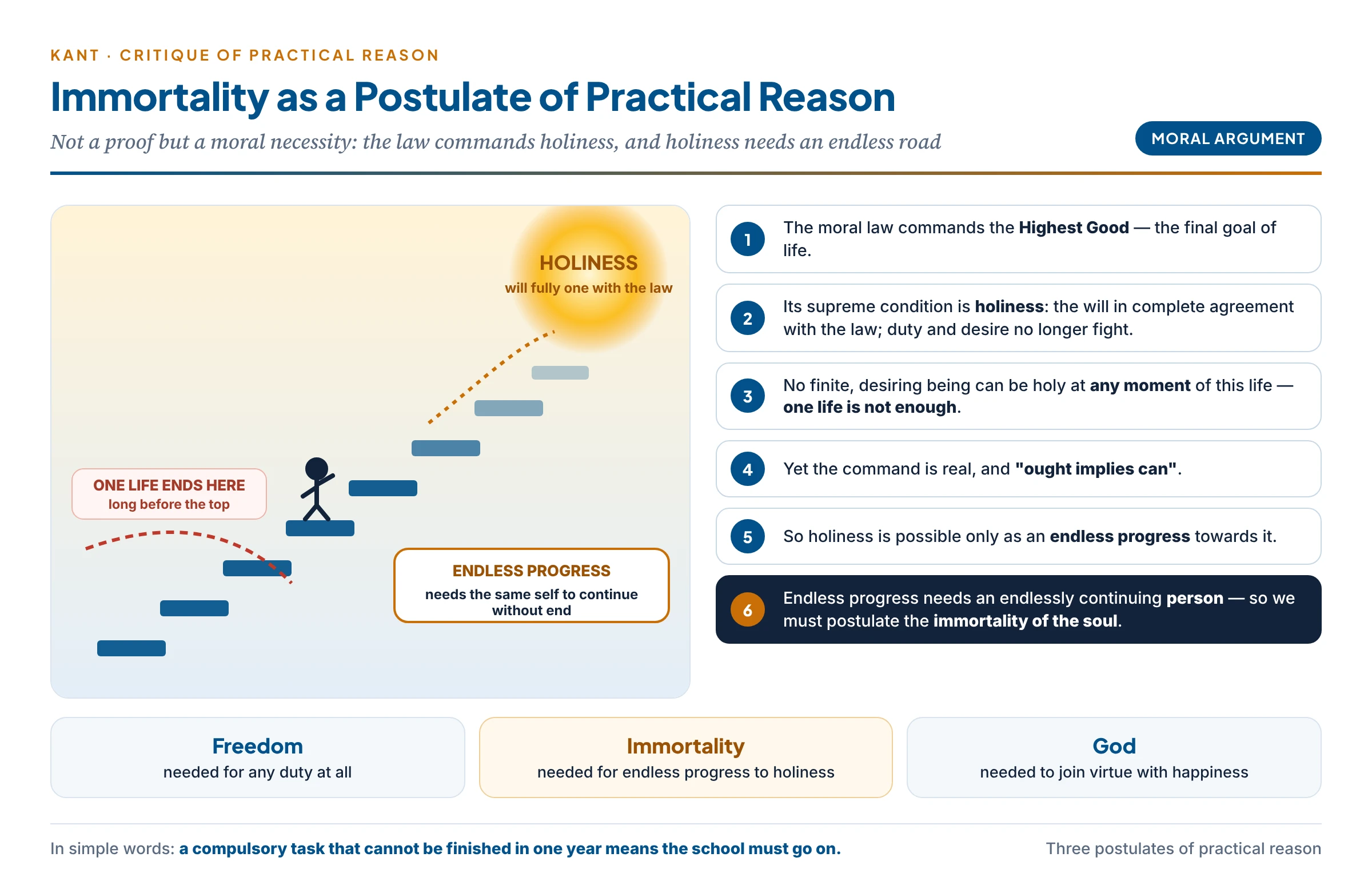
- The moral law commands us to promote the Highest Good (summum bonum) — the ultimate goal of life.
- The supreme condition of the Highest Good is the complete conformity of the will with the moral law — holiness, or moral perfection. At this stage the conflict between duty and desire disappears.
- But no finite, sensuous being — pulled by desires and bodily needs — can reach holiness at any moment of its existence. One life is not enough; a finite life cannot achieve such moral height.
- Yet the moral law commands it, and “ought implies can” — what we are obliged to do must be possible.
- Holiness can therefore be reached only in an endless progress towards it (progressus in infinitum).
- An endless progress is possible only if the same rational being continues to exist, with its personality, for an endless time.
- Therefore the immortality of the soul must be postulated: it is “inseparably connected with the moral law“.
The second element — happiness and justice
- The Highest Good also includes happiness in exact proportion to virtue. In this world the virtuous often suffer and the wicked prosper.
- All human beings have a conviction that virtue will be rewarded and vice punished. This conviction points to an after-life where perfect justice is done — and to a God who can bring virtue and happiness together (Kant’s second postulate).
- Kant’s three postulates: freedom, immortality, God.
What kind of claim this is
- Not knowledge but rational faith: Kant had to “deny knowledge in order to make room for faith“.
- Not a bribe: the believer is not good in order to be rewarded; rather, a person who takes the moral law seriously must hope that its goal is achievable.
- Practical effect: an endless moral future gives ordinary people an incentive to lead a moral life and to act without fear or favour.
“The Highest Good, then, practically is only possible on the supposition of the immortality of the soul.” — Kant
Criticisms of Kant’s argument
- Why must the Highest Good be necessary for all? Kant gives no clear ground for making perfect holiness a duty of every person.
- One life may be enough: many people achieve their moral goals in this life itself — Buddhist arhats, Jaina kevalins, jīvanmuktas, saints. Why say one life cannot suffice?
- “Ought implies can” cuts the other way: if I really cannot become perfect in this life, it follows that I am not obliged to — not that another life must exist. Moral obligations may simply end with death.
- Demands do not create reality: the requirements of the moral law do not guarantee a metaphysical fact. A wish, even a rational one, is not evidence.
- Endless progress never arrives: if holiness is reached only at infinity, it is never reached — the soul is condemned to endless imperfection. An infinite approach is a “bad infinite” — always more of the same, never the goal.
- Morality has a point without immortality: if being moral has any point in this life, it has it without reference to an afterlife. Many people find morality fully meaningful in worldly terms.
- Dependence on God: the justice element needs a God who guarantees the Highest Good — and Kant’s argument for such a God is itself weak.
Problems with endless personal duration itself
- Endless survival means the continuance of memory and of the same earthly aims and purposes, for their better realisation.
- But our higher purposes are tied to earthly circumstances — fear, passion, hope, social and economic conditions. If those must continue for us to pursue purposes, endless survival becomes endless repetitive cycles.
- Religious pictures of paradise remove these circumstances: “the weary are at rest”, “no tears and sorrows”. But without fear of defeat and the possibility of failure there is no inducement to effort, enterprise or risk.
- To become a soul, a person must be free, and freedom means nothing without the possibility of choosing wrong.
- This is why Indian thinkers sought release from the chain of endless births: for them an endless chain means imperfection and the continuance of sorrow, not hope.
A modern defence
- The seriousness of our effort to live by truth, wisdom, love and compassion, together with our sense of inadequacy in achieving them, warrants the presumption that a single life cannot be all — to grant that it is “would make a mockery of our moral experience“.
In simple words
Kant’s endless progress is like a runner promised that the finish line moves forward every time he approaches it. He will always be running — but will he ever arrive? Kant’s defenders reply that the point is not arriving but that the race is never cut off: a moral life that is always growing is better than one stopped at death.
2. The Argument from Justice
- God is just; justice requires that the evil be punished and the good rewarded.
- In this life, rewards and punishments are not proportioned to desert.
- Since God cannot complete justice before people die, he will do so after death.
- So there is a life after death.
- Hume’s replies (in his essay “Of the Immortality of the Soul”):
- The argument assumes God has attributes beyond those shown in this universe — “whence do we infer the existence of these attributes?” It is safe to say that whatever God has done is best, but “very dangerous to affirm that he must always do what to us seems best“.
- Eternal punishment for temporary offences is not justice: “Why then eternal punishment for the temporary offences of so frail a creature as man?”
- Most people float between vice and virtue: “Heaven and hell suppose two distinct species of men, the good and the bad. But the greatest part of mankind float between vice and virtue.” One who went round the world to give “a good supper to the righteous and a sound drubbing to the wicked” would often be embarrassed in his choice.
- Punishment without purpose is inconsistent with goodness — “no end can be served by it after the whole scene is closed”.
- Half of mankind die before they are rational creatures — infancy is frail, “as it were on purpose to refute the notion of a probationary state”.
3. The Theistic Argument — God’s Love and Purpose
- The theist’s case:
- The God of theism is a creator God who, “out of the abundance of his outgoing and creative love”, made the universe to give rise to creatures who would be moulded into souls — persons fit for fellowship with a holy God.
- The process has been long and costly: life emerged after much preparation; many routes led to dead ends; many species became extinct; at last man emerged with conscious will and ideals.
- If the aim of the universe is soul-making, should souls be allowed to perish once they have emerged?
- Two considerations deepen this: no person’s purposes are ever completed — a Newton, a Kant, a Gandhi still had ample room for purposeful activity; and the Creator is supremely good and infinitely intelligent — he cannot let a saint, a sage, a scientist or any person of value simply perish. The task before man is infinite; the time on earth is extremely finite.
- Without the conservation of such persons, God would be “a sort of divine playboy or an aborted artist“. If God’s creative act is not child’s play, finite persons must somehow be preserved.
- God’s purpose: if evolution’s divine purpose is to produce free spirits, it would be tragic for that purpose to be defeated by physical death. The only feasible alternative is the continuation of spiritual life, with the love and values it has gained.
- Strong form: “Any God who allows value-making and value-realising beings to cease for no good reason is guilty of a crime.” Conversely, those who see no reason for immortality may come to disbelieve in God.
- The Christian form: belief in resurrection is a corollary of faith in God’s sovereign purpose, which is “not restricted by death“; if God created persons for fellowship, it contradicts both his intention and his love to let them pass out of existence while his purpose for them is largely unfulfilled.
- Aquinas’s form: God has implanted in us a natural desire for unending existence; a just and benevolent God would not plant a natural desire that is in vain.
- Criticisms:
- The argument is only as strong as the existence and goodness of God — it cannot prove immortality to a non-believer.
- It depends on a particular view of God as a moral agent with purposes; if God is not a moral agent in our sense, nothing follows about how he “must” act.
- Hume: “If any purpose of nature be clear, we may affirm that the whole scope and intention of man’s creation, so far as we can judge by natural reason, is limited to the present life.” Why would a beneficent being confine all our concern and knowledge to the present life if a far more important one awaited us? That would be “barbarous deceit“.
- The conclusion is that the hope of personal immortality rests on belief in a perfect, benevolent creator God — the whole consideration assumes that a perfect God creates beings capable of fellowship with him, and then asks how he could let them perish.
4. The Teleological (Psychological) Argument
- Nature does nothing in vain: every power in nature has its use.
- Animals reach full biological maturity and fulfilment within their lifespan.
- Human beings have intellectual, aesthetic and spiritual powers — moral striving, the thirst for truth, an infinite longing — that far exceed the needs of biological survival and remain unfulfilled at death.
- So there must be a future state in which this latent potential is actualised.
- Lodge’s argument from genius: few of our faculties are explained by the struggle for existence. Poetry, music, philosophy, pure mathematics are not by-products; they are in “the central stream of evolution”. They may be anticipations of a higher life — like the rudiments of wings that appear under the skin of a grub before it becomes a winged insect. Our worldly strength and cunning may be larval characters, useful now but to be discarded in a higher state.
- Hume’s reply: “Observe with what exact proportion the task to be performed and the performing powers are adjusted throughout all nature.” Man’s reason is greater than an animal’s, but so are his needs; “his whole time, his whole capacity, activity, courage, passion find sufficient employment in fencing against the miseries of his present condition”. “A pair of shoes, perhaps, was never yet wrought to the highest degree of perfection.” The powers of men are no more superior to their wants, “than those of foxes and hares are, compared to their wants”.
5. The Argument from the Conservation of Energy
- Energy can neither be created nor destroyed; it only changes form.
- The soul is a form of spiritual energy — similar to energy.
- So the soul too can never be destroyed.
- Criticisms: conservation of energy is a law about measurable physical quantities; the soul, by hypothesis, is not physical. And energy is conserved impersonally — the energy of a burnt log survives as heat and light, but the log does not. At most the argument yields impersonal continuation.
6. The Argument from the Conservation of Values
- Values such as justice, equality, love, truth are eternal and permanent — in a way, all values are immortal.
- Their seat (locus) cannot be the perishable body.
- So their locus must be the soul; hence the soul is immortal.
- Höffding (Danish philosopher) held that “the conservation of value” is the fundamental axiom of all religions — no real value or good is ever lost.
- Lodge’s definition: “Immortality is the persistence of the essential and the real: it applies to things which the universe has gained — things which, once acquired, cannot be let go. It is an example of the conservation of value.” The tendency of evolution is to increase actual value; evil, which frustrates development, “contains an essentially suicidal element“, so the realm of good tends to grow.
- Criticisms:
- Values may be eternal as ideals or truths without any person being eternal — the eternity of truth, beauty and goodness is confused with the endlessness of the individual.
- The argument has been advanced more for the eternal life of values than for personal survival.
- Even granting that values need a mind, that mind could be God’s — Lodge himself admits that valuable things may endure “if not with an individual and personal existence, yet as part of the eternal Being of God“.
7. The Argument from the Law of Karma
- Indian systems (with few exceptions) accept the immortality of the soul largely to give a proper account of the law of karma.
- Individuals must reap the fruits of their own deeds, but good deeds are not always rewarded within this life.
- So there must be an immortal soul that takes rebirth until it has experienced the fruits of all its deeds (Article 6).
- This is India’s parallel to Kant’s argument from justice — but the moral order is impersonal law, not a divine judge.
8. Universal Belief and Universal Desire
- Consensus of peoples: belief in some form of survival is found in almost every culture since the earliest burials — such a universal belief, it is argued, is unlikely to be wholly false.
- Universal longing: human beings long for the infinite; the Upaniṣad says “there is no happiness in the small; the infinite alone is happiness“.
- Criticisms: universal beliefs have often been false (a flat earth); and “all doctrines are to be suspected which are favoured by our passions” — the hopes and fears behind this one are obvious (Hume). Desire is examined in Article 4.
9. Psychical Research and Parapsychology
The claimed evidence
- Parapsychology (psychical research) studies extra-sensory perception (ESP) — telepathy, clairvoyance, precognition — and psychokinesis, the claimed power of mind to move things without the senses.
- Its supporters argue that one mind can operate upon another mind, a thing or an event without any help from the senses; and that there are children who reveal memories of previous lives or show unusual excellence in a field without training.
- Society for Psychical Research (London, 1882): its presidents included philosophers Henry Sidgwick, William James, Henri Bergson, C.D. Broad, H.H. Price, and the physicist Sir Oliver Lodge.
Lodge’s scientific case for survival
- Nothing comes from nothing; nothing goes into nothing:
- Burning coal is not destroyed — its particles enter the air and its locked-up solar energy appears as light and heat: “a kind of resurrection, and yet a kind of death too”.
- A smashed statue loses its beauty — yet the idea was never really in the marble; it was in the mind of the artist and of those who saw it, and it remains there.
- When a tree or animal dies, the matter and energy remain; only the life that built them disappears from view. If life was not created out of nothing at birth, why assume it returns to nothing at death?
- A dewdrop dies as a drop, but as vapour it persists — even it has “the attribute of immortality”.
- So “no really existing thing perishes, but only changes its form“. Birth is change; death is change.
- Intellect, consciousness, will, memory and adoration “did not arise with us… they are as eternal as the Godhead itself”. Lodge quotes Emily Brontë‘s deathbed poem — “Every existence would exist in Thee” — and Carlyle: in a faithful man there is “something that pertains not to this wild death-element of Time; that triumphs over Time“.
- Personality: “A memory, a consciousness and a will, in so far as they form a consistent harmonious whole, constitute a personality.” In creatures with no individuality, the separated life returns undifferentiated to its central store; but a developed personality, “strengthened and compacted by experience and suffering and joy”, is real enough to continue with its identity.
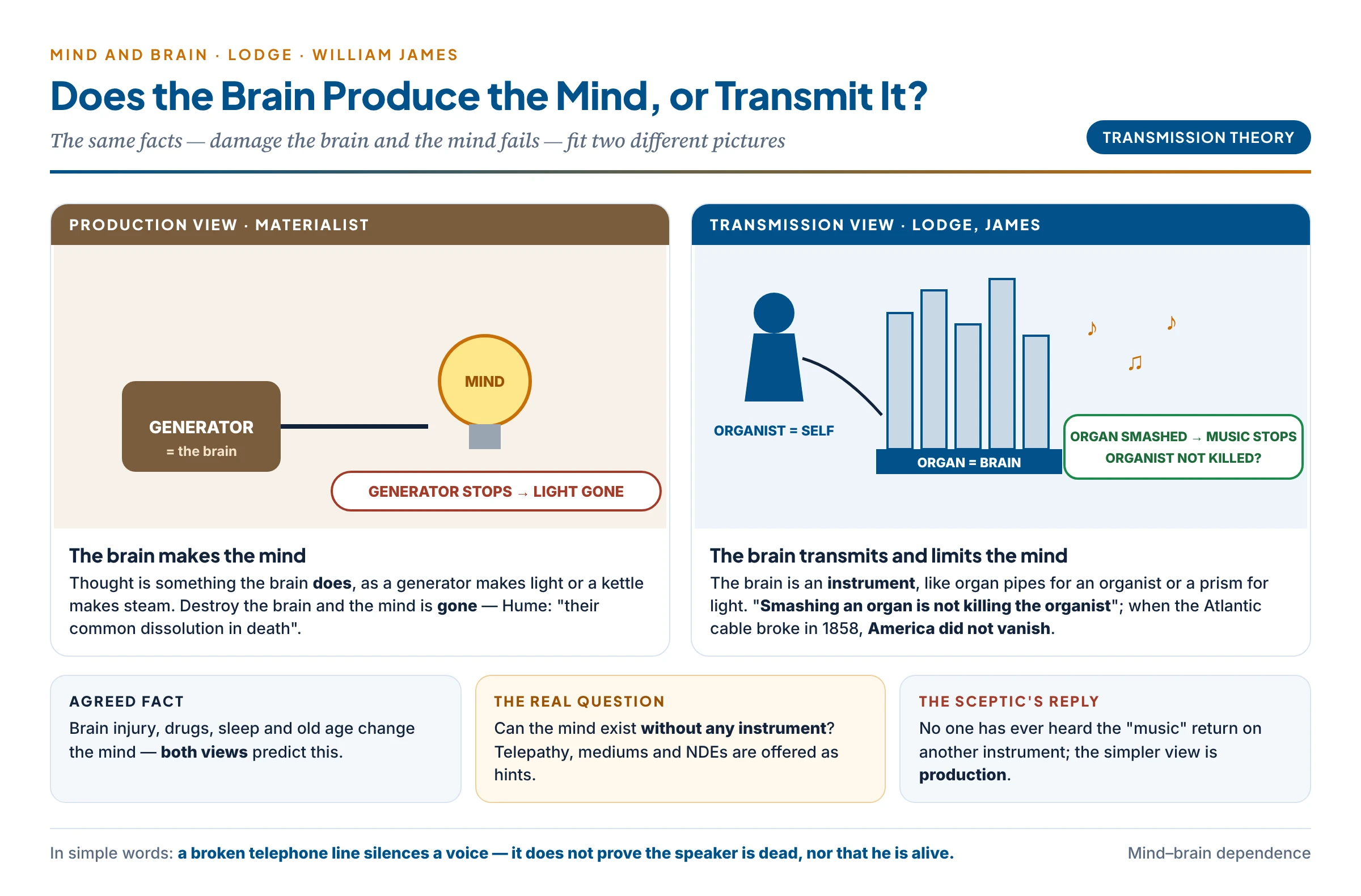
- The brain as instrument: the brain is the link between the psychical and the physical. Death breaks the link and so stops all manifestation — which is superficially taken for annihilation. But the argument “brain damaged, memory fails; brain destroyed, memory ceases” silently assumes that what is not manifest does not exist.
- “Cutting off or damaging communication is not the same as destroying the communicator; nor is smashing an organ killing the organist.”
- When the Atlantic cable broke in 1858, communication between England and America stopped — but neither country was destroyed.
- Telepathy: if one mind can affect another directly, then “though individuality is dependent upon brain for physical manifestation, it may not be dependent on brain for existence“.
- Three regions of further evidence: (1) the psychological — genius, vision, dream, premonition, clairvoyance; (2) the physiological — heightened sensation, automatism (automatic speech and writing), alleged materialisation through mediums; (3) the pathological — dislocations of personality.
- Caution: Lodge admits much evidence is weak, some valueless, and the field has been “discredited by much professional fraud“; no automatic message should be assumed genuine without proof — yet in a few cases the evidence for the communicator’s identity is “remarkably strong”.
- The subliminal self: drawing on F.W.H. Myers, Lodge suggests that our conscious self is only a fraction of a larger personality. In cases of multiple personality, the deeper state remembers what the ordinary state forgot. So at death we may wake into a larger consciousness — “death may be an awaking rather than a sleeping“.
- The ship’s hull: we are like the hull of a ship below the water-line, knowing nothing of the deck, the sails, the compass and the captain — so we should not presume that we know the universe, or ourselves, completely.
- Mental pathology: as hysteric patients (with lapses of memory and sensation) stand to normal people, so we may stand to a higher possible state — some men of genius have already shown what that state might be.
- The religious objection: some say scientific study of immortality encroaches on faith. Lodge replies that knowledge strengthens belief; the domain of religion is infinite and cannot be diminished by subtraction; if there are things we are not meant to know, we shall never know them.
The transmission theory
- William James (in his lecture on human immortality) distinguished two views of the brain’s role:
- Productive function — the brain produces thought, as a kettle produces steam.
- Transmissive function — the brain transmits, filters and limits a consciousness that exists beyond it, as a prism colours light or organ pipes shape the air blown through them.
- Mind–brain dependence fits both views equally; so it does not disprove survival.
A critical assessment of the evidence
- ESP experiments: in card-guessing tests with five symbols, chance gives about 20 per cent hits; some subjects scored far above chance, with odds reported in millions to one — though the results have been criticised and remain controversial. Telepathy, if real, does not behave like radiation: it is not weakened by distance and has no known organ.
- Mediums explained by telepathy: two women filled their minds with an imaginary character from an unpublished novel; a reputable medium then described him as a visitor from beyond the grave. A “direct voice” medium produced the spirit of one “Gordon Davis“, who remembered his death — until it was found that Gordon Davis was alive, trying to sell a house. Such cases suggest mediums may unconsciously draw the “spirits” from their clients’ minds.
- Apparitions: “meaningful hallucinations” may be telepathic; ghosts may be “psychic footprints” — traces left by the dead, not their presence.
- Near-death experiences (NDEs): people resuscitated after being declared dead report a loud noise, a dark tunnel, a world of light, meeting dead relatives, a “being of light”, a life review, a border, and being sent back — often with an out-of-body view of their own body. Afterwards they typically lose the fear of death.
- Recent research:
- A large study of cardiac-arrest patients in US and UK hospitals (published in 2023) found that some survivors recalled lucid experiences of death, including a purposeful review of their lives, and that brain activity linked to thought sometimes returned during CPR.
- Another 2023 study recorded a surge of high-frequency (gamma) brain activity in some dying patients after ventilator removal — suggesting that vivid near-death experiences may be produced by the dying brain itself.
- Verdict: whether NDEs are the first phase of another life or the last flicker of a brain losing oxygen cannot yet be decided. Caution should lead to further research, not closed minds — and one should not confuse “absence of knowledge with knowledge of absence“.
- Most scientists regard parapsychology as pseudoscientific, because its results are hard to repeat and conflict with well-established laws of science.
Common confusion
Does telepathy prove survival after death? No. Telepathy, even if real, shows only that living minds may influence each other without the senses. It may weaken the materialist claim that mind is nothing but brain, and it may even explain away many “messages from the dead” (the medium reading the sitter’s mind). Survival needs further evidence — that a particular dead person’s memory and character are still active.
10. The Pragmatic Argument
- Claim: the effects of believing in immortality are so salutary — hope, courage, moral seriousness, comfort in grief — that they may be taken as evidence for its truth. William James’s “will to believe” allows us to adopt a belief that is a live, forced and momentous option when evidence cannot decide.
- Criticisms:
- This is no argument: usefulness is not truth.
- The effects need not be salutary: belief in eternity may lead to slackening of effort to improve this world. Indian thought, which takes the soul to be eternal, has been described by Albert Schweitzer as “world- and life-negating” — though this charge is disputed.
In simple words
Lodge’s favourite comparison: if the telephone line to a friend in America is cut, his voice stops — but you would not conclude that America has sunk. The brain may be such a line. The materialist replies: perhaps — but no one has ever heard the voice come back on another line. Both sides agree on the facts (no brain, no message); they disagree on what the facts mean.
Immortality in the Hindu Tradition
Vedic beginnings
- The early Vedas hope for long life on earth and, after death, a place in the world of the fathers (pitṛloka) or in heaven (svarga) with the gods. The Vedic prayer asks to be freed “from death, not from immortality”.
- Two paths after death: the path of the fathers (pitṛyāna), leading to return and rebirth, and the path of the gods (devayāna), leading to Brahman and no return.
The Upaniṣads — immortality through knowledge of the self
- The prayer: “Lead me from the unreal to the real, from darkness to light, from death to immortality” (mṛtyor mā amṛtaṃ gamaya).
- Naciketas and Yama (Kaṭha Upaniṣad): the boy Naciketas, sent to the house of Death, is granted three boons. For the third he asks: “When a man dies, some say he is, some say he is not — this I would know.” Yama tempts him with wealth, long life, kingdoms and pleasures; Naciketas refuses — these “wear away the vigour of the senses“. He chooses the good (śreyas) over the pleasant (preyas). Yama then teaches:
- “The knowing self is not born; it does not die. It has not come from anywhere, nor has it become anything. Unborn, eternal, everlasting, ancient, it is not slain when the body is slain.”
- “Like corn a mortal ripens; like corn he is born again” — the cycle of rebirth.
- The self is hidden in all beings and is realised by the sharpened intellect of the one who has controlled the senses (the chariot image — Article 1).
- “When all the desires that dwell in the heart are cast away, then the mortal becomes immortal and attains Brahman here.“
In simple words
Imagine Death himself offering you a palace, a hundred-year life, endless wealth and every pleasure — if only you stop asking what happens after death. Naciketas says no: “Keep your chariots, your songs and dances; no one is ever satisfied by wealth.” The story teaches that the question of immortality is not idle curiosity — it is the choice between the pleasant (what feels good now) and the good (what is truly worth having).
- Bṛhadāraṇyaka Upaniṣad: as a caterpillar, reaching the end of a blade of grass, draws itself onto another, so the self, leaving one body, moves on to another; “as one acts, so one becomes” — the root of karma and rebirth.
- Key Upaniṣadic idea: true immortality (amṛtatva) is not endless rebirth but knowledge of the ātman — “the knower of Brahman becomes Brahman“. Endless rebirth is, in fact, “repeated death” (punarmṛtyu).
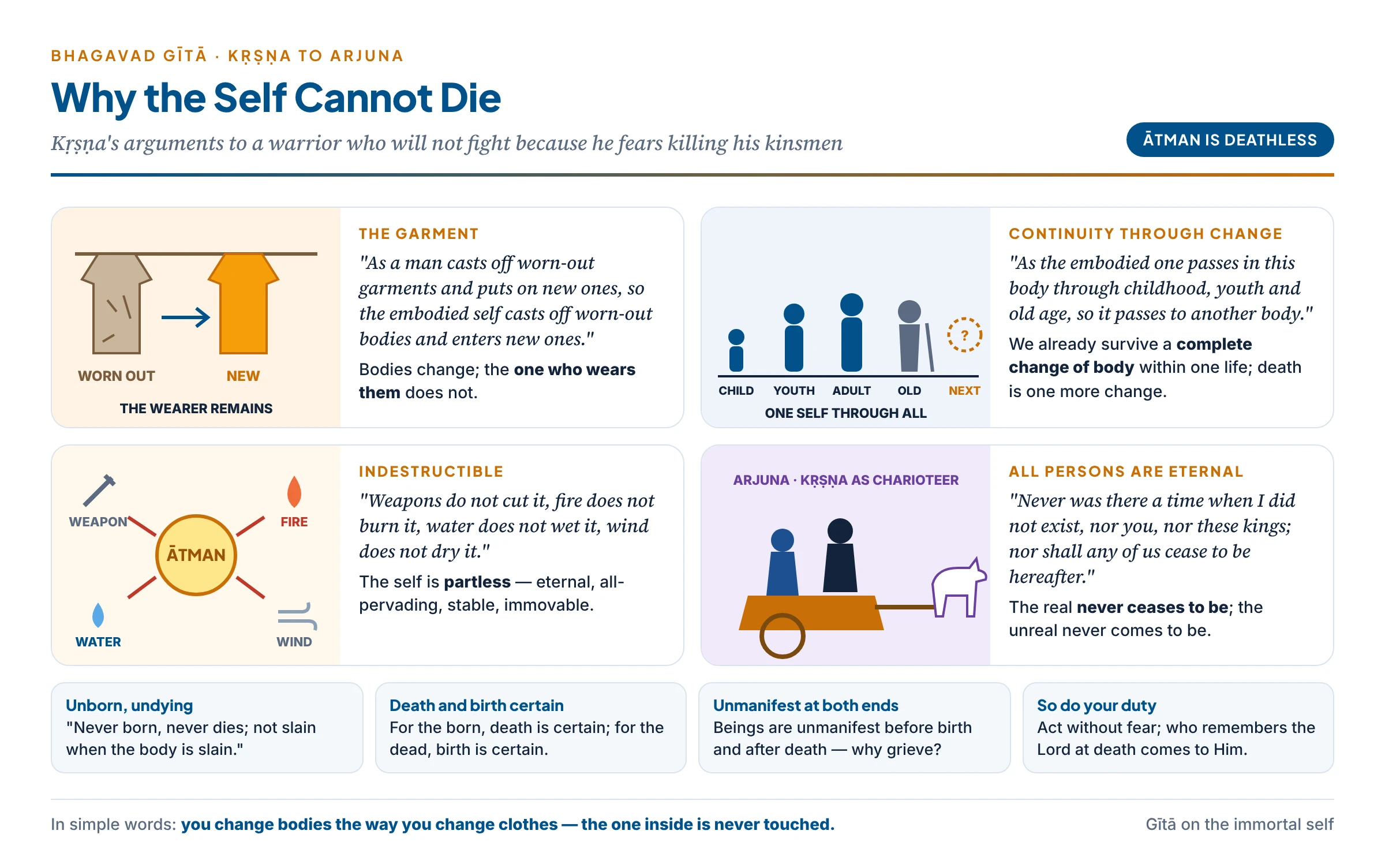
The Bhagavad Gītā’s arguments for the immortality of the self Arjuna, refusing to fight because he would kill his kinsmen, is answered by Kṛṣṇa with a series of arguments:
- Eternity of all persons: “Never was there a time when I did not exist, nor you, nor these kings; nor shall any of us cease to be hereafter.“
- Continuity through change: “As the embodied one passes in this body through childhood, youth and old age, so it passes to another body; the wise are not deluded by this.”
- The real cannot cease: “The unreal has no being; the real never ceases to be.” The self is the real; bodies are perishable.
- Unborn and undying: the self “is never born and never dies; it is not slain when the body is slain” — the Kaṭha verse repeated.
- Indestructible by any means: “Weapons do not cut it, fire does not burn it, water does not wet it, wind does not dry it. It is uncuttable, unburnable… eternal, all-pervading, stable, immovable, everlasting.”
- The garment: “As a man casts off worn-out garments and puts on new ones, so the embodied self casts off worn-out bodies and enters new ones.”
- Death and birth are certain: “For the born, death is certain; for the dead, birth is certain; so you should not grieve over the unavoidable.”
- Beings are unmanifest at both ends: “Beings are unmanifest in their beginning, manifest in the middle, and unmanifest again at the end — what is there to grieve about?”
- Even on the materialist view, grief is useless: “Even if you think the self is constantly born and constantly dies, you should not grieve” — what is born must die.
- The moral conclusion: since the self cannot be killed, one should do one’s duty (svadharma) without fear; and “whoever, remembering Me at the time of death, leaves the body, comes to My being” — the link between immortality and devotion.
Immortality in the Hindu darśanas (systems)
- Nyāya–Vaiśeṣika: the self is an eternal, partless substance; proofs from desire, aversion, effort, pleasure, pain and cognition; the newborn’s instincts prove a past life.
- Sāṃkhya–Yoga: puruṣa is pure, eternal consciousness; the subtle body carries impressions from life to life.
- Mīmāṃsā: an eternal self is needed to enjoy the fruits of ritual (heaven) in a future life — the Vedic injunctions would be pointless otherwise.
- Advaita: the ātman is Brahman, eternal and unborn; immortality is realisation, possible even in this life (jīvanmukti).
- Viśiṣṭādvaita and Dvaita: the soul is eternal and retains its individuality; immortality is personal life with God in Vaikuṇṭha.
- Bhakti saints: the devotee seeks not merely survival but eternal love and service of God.
Distinctive features of Hindu immortality
| Feature | Hindu tradition | Typical Western view |
|---|---|---|
| Direction | Eternal both ways — no beginning, no end | Soul created; immortal only forward |
| Number of lives | Many (saṃsāra) | One |
| Value of endless life | Endless rebirth is bondage to be ended | Endless life is the hope |
| True immortality | Mokṣa — beyond birth and death | Eternal life with God |
| Ground | Śruti, reasoning, realisation; and the needs of karma | Revelation, metaphysical and moral arguments |
| Who has souls | All living beings | Usually humans only |
Indian Connect — Indian Connect — Kant and karma
- Kant: the moral law demands perfection and justice; one life is not enough; so we postulate immortality and God.
- Karma theory: the moral order demands that each reaps what he sows; one life is not enough; so the soul passes through many lives — and in most schools no God is needed to administer the law.
- Both are moral arguments for survival. The difference: Kant’s afterlife is an endless upward progress; for Indian thought an endless chain of lives is imperfection and sorrow — the goal is release from it.
Critical Evaluation
What These Arguments Achieve
- They show that belief in immortality is rationally motivated — by justice, love, the infinite reach of moral and spiritual life — even if not proved.
- Kant rightly separates knowledge from rational hope: immortality becomes an object of moral faith, not of science.
- Psychical research and NDE studies keep the question empirically open.
Where They Fall Short
- Moral and theistic arguments presuppose what is disputed — an objective moral law needing completion, or a good God with purposes for persons.
- Teleological arguments meet Hume’s point that human powers are proportioned to this life.
- Conservation arguments yield at most impersonal continuation.
- Psychical evidence is contested, often explained by telepathy, fraud or the dying brain, and hard to repeat.
- Hindu arguments rest largely on śruti, which persuades only those who accept its authority; their reasoning adds the needs of karma, which is itself disputed.
Critics and Defenders
Criticism — The critics
- Hume: justice argument assumes unseen divine attributes; eternal punishment is unjust; powers proportioned to this life; desire proves nothing.
- Analytic critics: “ought implies can” means we are not obliged to the impossible; morality has point without immortality.
- Scientists: psychical results are unrepeatable; mediums can be explained by telepathy or fraud; NDEs by the dying brain.
- The endless-duration objection: endless personal duration means endless repetition; paradise without risk has no moral meaning.
- Cārvāka and Buddhism: there is no permanent self to survive.
Defence — The defenders
- Kant: not a proof but a postulate — a moral agent must hope that the Highest Good is possible.
- Theists: a loving Creator would not be a “divine playboy” who discards the souls he made.
- Lodge and James: the brain may transmit, not produce, the mind; breaking the cable does not destroy America.
- Hick: some mediumistic cases remain impressive and puzzling; “absence of knowledge is not knowledge of absence”.
- Upaniṣads and Gītā: the self is known not by proof but by realisation; the real never ceases to be.
Cross-Tradition Comparison
| Argument | Western form | Indian form |
|---|---|---|
| Moral | Kant: holiness needs endless progress | Karma: deeds need many lives to bear fruit |
| Justice | God must reward and punish after death | The law of karma distributes fruits impersonally (or through Īśvara in Nyāya) |
| Theistic | God’s love will not let persons perish | Rāmānuja, Madhva: the Lord eternally sustains souls; grace grants release |
| Teleological | Human powers exceed one life (Lodge’s genius) | The human birth is rare and precious, the doorway to mokṣa |
| Empirical | Psychical research, mediums, NDEs | Jātismara (memory of past births), yogic knowledge of past lives |
| Experiential | Spinoza: “we feel and know that we are eternal” | Ātma-sākṣātkāra — direct realisation of the deathless self |
Synthesis (Siddhānta)
- Kant’s moral argument turns immortality from an object of knowledge into an object of rational faith: the moral law commands holiness, holiness needs an endless progress, and so an endlessly continuing self must be postulated. Its weaknesses — “ought implies can” cuts both ways, endless progress never arrives, moral demands do not create facts — show it yields hope, not proof.
- The theistic, justice and teleological arguments depend on the goodness and purposes of God and meet Hume’s sharp replies; the conservation arguments yield at most impersonal continuation; psychical research remains open but contested.
- The Hindu tradition grounds immortality in śruti, in the needs of karma, and in realisation: the self is unborn and undying, but endless rebirth is bondage, and true immortality (amṛtatva) is mokṣa.
- Contemporary relevance:
- Near-death research and studies of the dying brain make the old debate partly scientific.
- Digital immortality and “mind uploading” projects revive the question of what must continue for me to continue.
- In palliative care, belief in some continuation (or acceptance of finitude) shapes how people face death.
- Balanced view: none of these arguments proves immortality, but together they show why the belief is held by reflective people in every tradition — and why it is better treated as a rational hope than a demonstrated fact.
“Never was there a time when I did not exist, nor you, nor these kings.” — Bhagavad Gītā
Previous Year Questions
- 2021Discuss the concept of immortality of soul with special reference to Hindu tradition.
- 2014What are the arguments given in favour of immortality of soul?
- 2002What is meant by immortality of soul? Analyse the argument of the Bhagvad Gita in this regard.