

Notions of God: Attributes; Relation to Man and the World (Indian and Western).
Official Syllabus: Paper II, Section B, Unit 1
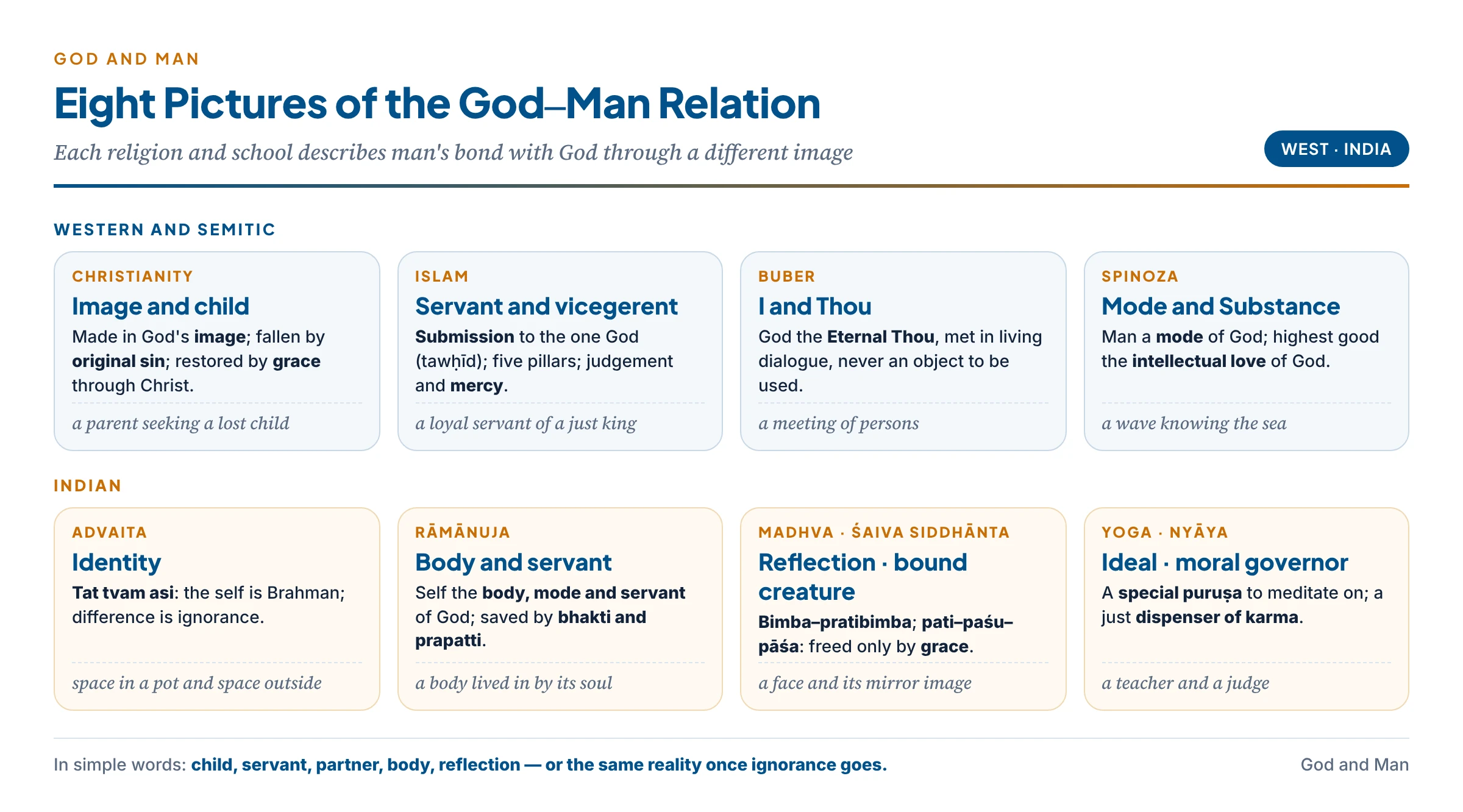
The last question about God is the most personal one: what is God to man, and what is man to God? Religions answer it in very different ways. Man is God’s image and child (Christianity), God’s servant who submits (Islam), a partner in a living dialogue (Buber), a mode of God’s body who serves him (Rāmānuja), a reflection wholly dependent on him (Madhva), or identical with the Absolute once ignorance goes (Śaṅkara). Some Indian schools give God only a helping role (Yoga, Nyāya); some religions leave God out and put man in relation to the world and its law (Buddhism, Jainism, Confucianism). This article covers all these relations, the place of prayer and worship, man’s relation to the world in the oriental religions, and closes with a comparative map of notions of God.
In simple words
Think of the many ways a person can relate to a great teacher: as a child to a parent, as a servant to a master, as a friend to a friend, as a student who one day knows what the teacher knows, or as a mirror catching the teacher’s light. Religions describe man’s relation to God through exactly such pictures — and each picture shapes how people pray, live and hope.
Context & Problem
Three Questions in Every God–Man Relation
- What is man’s status before God? Creature, child, servant, part, reflection, or the same reality?
- What does God do for man? Creates, reveals, commands, judges, forgives, gives grace, liberates — or nothing beyond being an ideal.
- What does man owe God? Faith, obedience, love, worship, prayer, surrender (prapatti), meditation, knowledge (jñāna), or right action.
Why the Answers Differ
- The notion of God decides the relation. A personal God invites love, prayer and surrender; an impersonal Absolute invites knowledge and realisation; a God who is only a perfect puruṣa (Yoga) invites meditation.
- The goal of salvation (soteriology) differs.
- Hinduism — mokṣa, release from the cycle of birth and death (saṃsāra), by the paths of knowledge (jñāna-mārga), devotion (bhakti-mārga) and action (karma-mārga).
- Buddhism — nirvāṇa, the end of craving and suffering, through the four noble truths and the noble eightfold path (right view, resolve, speech, conduct, livelihood, effort, mindfulness, concentration).
- Judaism — blessedness with God, here and perhaps hereafter, by keeping the divine commandments (mitzvot): the Sabbath, the synagogue, the festivals, obedience to Jewish Law (Torah).
- Christianity — spiritual transformation and eternity with God, through God’s grace shown in Christ’s atonement for sin, received by faith and the sacraments, and lived out by keeping God’s law in gratitude.
- Islam — blessedness in paradise through submission to God’s law and by God’s mercy, lived through the five pillars: the declaration of faith (shahāda), five daily prayers (ṣalāh), almsgiving (zakāh), fasting (ṣawm), and the pilgrimage to Mecca (ḥajj).
Core Doctrine
Man and God in Christianity
- Created in God’s image (imago Dei). God created man in his own image on the final day of creation. Both points matter for man’s status:
- The final day — man is the crown of creation, the greatest of the creatures on earth.
- In God’s image — man is essentially a spiritual being, able to know, love and choose like his Creator.
- Dominion and stewardship. God gave man dominion over created things — today often read as stewardship (care for creation), not exploitation.
- Body and immortal soul. Besides a perishable body, man has an immortal soul: the death of the body is not the death of the soul. Yet the soul is finite and can never become the infinite God.
- Total dependence. Man depends on God for his existence and his salvation. Salvation comes by obeying God’s commandments and believing in Jesus Christ as the Son of God.
- The Trinity. God exists as Father, Son and Holy Spirit — one God in three persons. Man meets God as Creator (Father), Redeemer (Son) and indwelling Helper (Spirit).
- Original sin. All human beings are born in sin because of Adam’s disobedience — eating the forbidden fruit of the Tree of Knowledge in the Garden of Eden. Because of it man was sent into a world of suffering.
- Redemption and grace. God, as a loving father, promised redemption and sent his only Son, Jesus, to show the right path and to bear the burden of man’s sin through his own suffering. Salvation is a gift of grace (charis), received through faith; good works follow from gratitude.
- Free will. God has given man freedom to choose and to act; man may use it for good or evil — which explains moral evil and makes man responsible.
- Judgement Day. God will judge each person by his deeds and send him to heaven or hell. For many Christians salvation is impossible without Christ: “I am the way and the truth and the life. No one comes to the Father except through me” (John 14:6).
- Rapture. Some branches of American evangelicalism hold that at the end time all living and resurrected believers will rise “in the clouds, to meet the Lord in the air”.
- Love as the bond. “God is love”; man’s duty is to love God with all his heart and his neighbour as himself.
Man and God in Islam
- Tawḥīd (absolute oneness). Belief in one God is the foundation of Islam. God created the universe and has power over everything in it; he is unique and exalted above everything he creates; his greatness cannot be compared with his creation.
- Man created to worship. God created everything for a purpose, and humankind with a simple purpose — to worship him. The purpose of all creation is to submit to God; the word islām means submission, and a muslim is “one who submits”.
- Man as servant and vicegerent. Man is God’s servant (‘abd) and his vicegerent (khalīfa) on earth, entrusted with the world.
- No Trinity, no incarnation. Islam rejects the Trinity and the divinity of Jesus, which it compares to polytheism (shirk, associating partners with God); Jesus is a prophet.
- Revelation through prophets. God communicates with his creation through revelations given to prophets. The Qur’an is the verbatim word of God revealed to Muhammad, the final prophet (in all main branches).
- A personal, responsive God. God responds whenever a person in need or distress calls on him; he is “nearer than the jugular vein“.
- Judgement Day (Yawm al-Qiyāmah, Yawm ad-Dīn). One of the six articles of faith: the annihilation of all creatures, the resurrection of the body, and the judgement of all, where each person’s deeds are shown with justice.
- Sufism. The mystical strand of Islam speaks of love between God and man and of passing away of the self in God (fanā’) — a relation of lover and Beloved.
In simple words
In Islam the relation is like that of a loyal servant to a just and merciful king: the servant’s honour lies in obeying, and the king rewards loyalty with mercy. In Christianity it is more like a child who disobeyed and a parent who comes looking for him and pays his debts out of love.
Western Philosophers on God and Man
- Martin Buber — I–Thou. Man relates to things as I–It (using, measuring, controlling) and to persons as I–Thou (meeting, dialogue, whole-hearted presence). God is the Eternal Thou, who can never become an It; every true I–Thou meeting with another person or with nature is a glimpse of the Eternal Thou. Religion is a living relation, not a set of doctrines about God.
- Spinoza — intellectual love of God (amor Dei intellectualis). Man is a mode of the one Substance. His highest good is to understand everything as following from God’s nature; this knowledge brings intellectual love of God, which is part of the infinite love with which God loves himself. Freedom is understanding necessity, not escaping it.
- Schleiermacher — religion is the feeling of absolute dependence on God.
- Kierkegaard — the individual stands alone before God; faith is a leap, a passionate commitment beyond reason. “The function of prayer is not to influence God, but rather to change the nature of the one who prays.“
- Kant — God is a postulate of practical reason, needed so that virtue and happiness can finally be joined; religion is “the recognition of all our duties as divine commands“. Man relates to God through moral duty, not through ritual.
- Pascal — “the God of Abraham, Isaac and Jacob, not of the philosophers“: man needs a living God of the heart.
Man and God in Yoga
- God as a special puruṣa (puruṣa-viśeṣa). Sāṃkhya has no God (nirīśvara); Yoga admits God (hence called seśvara Sāṃkhya, “Sāṃkhya with God”). Patañjali defines God as “a special puruṣa untouched by afflictions (kleśa), actions (karma), their fruits (vipāka) and latent impressions (āśaya)“.
- His features.
- Eternally free — never bound, unlike the liberated souls who were once bound.
- The seat of unsurpassed knowledge — the “seed of omniscience” is complete in him.
- The teacher of even the ancient teachers, being unlimited by time.
- Designated by the sacred syllable OṂ (praṇava); its repetition (japa) with meditation on its meaning leads to him.
- Why accept such a God?
- The Vedas say God exists.
- Law of continuity — knowledge and power exist in degrees; there must be an upper limit, a being of perfect knowledge and power.
- God is responsible for the association and dissociation of puruṣa and prakṛti, which are themselves unintelligent and cannot come together on their own (a point of later commentators).
- Devotion to God is the surest and quickest means to samādhi and thereby liberation.
- Man’s relation to God — devotion (Īśvara-praṇidhāna).
- It is one of the niyamas (observances) of the eightfold path, and part of kriyā-yoga (with austerity and self-study).
- Patañjali lists it as an alternative route to samādhi: “or by devotion to God“.
- It removes obstacles (illness, doubt, sloth and others) and leads to inward-turned consciousness.
- God is the yogi’s ideal and teacher — a model of the pure, free puruṣa that the yogi seeks to become.
- Critical estimate.
- God is not the creator, preserver or destroyer of the world — prakṛti evolves by itself.
- He does not reward or punish; he has no role in bondage, karma or liberation directly.
- Innumerable puruṣas and prakṛti are co-eternal with him and limit him.
- The end of life is not union with God but separation of puruṣa from prakṛti (kaivalya); devotion is a means, not the goal.
- Yoga does not explain the relation between God and the other puruṣas; nor do liberated puruṣas share God’s divinity.
- Hence critics call the Yoga God a “loosely attached” appendage — of practical (meditative) rather than metaphysical or religious value. Defenders reply that Yoga’s interest is practical, and as an object of meditation and an ideal God does real work: a personal focus that steadies the mind.
Common confusion
Does God in Yoga give grace? The sources differ, so be clear. Patañjali’s God is not a creator, judge or saviour, and liberation comes through discrimination and samādhi. But the classical commentary says that God, pleased by the yogi’s devotion, favours him and makes samādhi come quickly. So God’s “grace” in Yoga is help towards samādhi, not forgiveness of sins or gift of salvation as in Christianity or Rāmānuja.
Man and God in Nyāya
- God as the moral governor. God (Īśvara) is the efficient cause of the world who arranges the atoms according to the unseen merit and demerit (adṛṣṭa) of souls — the dispenser of the fruits of karma, as a just ruler gives each his due.
- Many eternal souls. Souls are eternal substances, distinct from God and from one another; consciousness is an accidental quality of the soul.
- Liberation through knowledge. Liberation (apavarga) is release from all pain through true knowledge of the sixteen categories; devotion helps, and later Nyāya (Udayana) gives God’s grace a larger role.
- Relation. God is the ruler and guide; man is the ruled, reaping what he sows under God’s just administration.
Man and God in Advaita: Tat Tvam Asi
- Identity, not relation. The individual self (jīva) is in reality identical with Brahman: “That thou art” (tat tvam asi), “I am Brahman” (ahaṃ brahmāsmi). The jīva is Brahman appearing as limited through ignorance (avidyā) and the limiting adjuncts (upādhi) of body and mind — like space in a pot that seems separate from the space outside.
- Two standpoints.
- Empirical (vyāvahārika) — the jīva is distinct from Īśvara, the personal Lord, who creates, rules and dispenses karma; worship and devotion are real and useful here.
- Ultimate (pāramārthika) — there is neither jīva nor Īśvara as separate realities; only Brahman.
- Place of devotion. Śaṅkara stresses knowledge (jñāna) for liberation, but bhakti and karma-yoga purify the mind (citta-śuddhi) and prepare it for knowledge.
- Liberation. Liberation is realising what one always was; it can come in this life (jīvanmukti). The knower of Brahman becomes Brahman.
- Criticism. Theists object that identity ends the relation of love and worship: “I want to taste sugar, not become sugar” (a devotional saying). If man is God, who is saved, and from what?
Man and God in Viśiṣṭādvaita: Rāmānuja
- The soul (jīva). Real, eternal, atomic (aṇu) in size, a knower, doer and enjoyer; its essence is consciousness and bliss, and it has attributive knowledge (dharmabhūta-jñāna) that contracts in bondage and expands in liberation. Souls are many: bound (baddha), liberated (mukta) and eternally free (nitya).
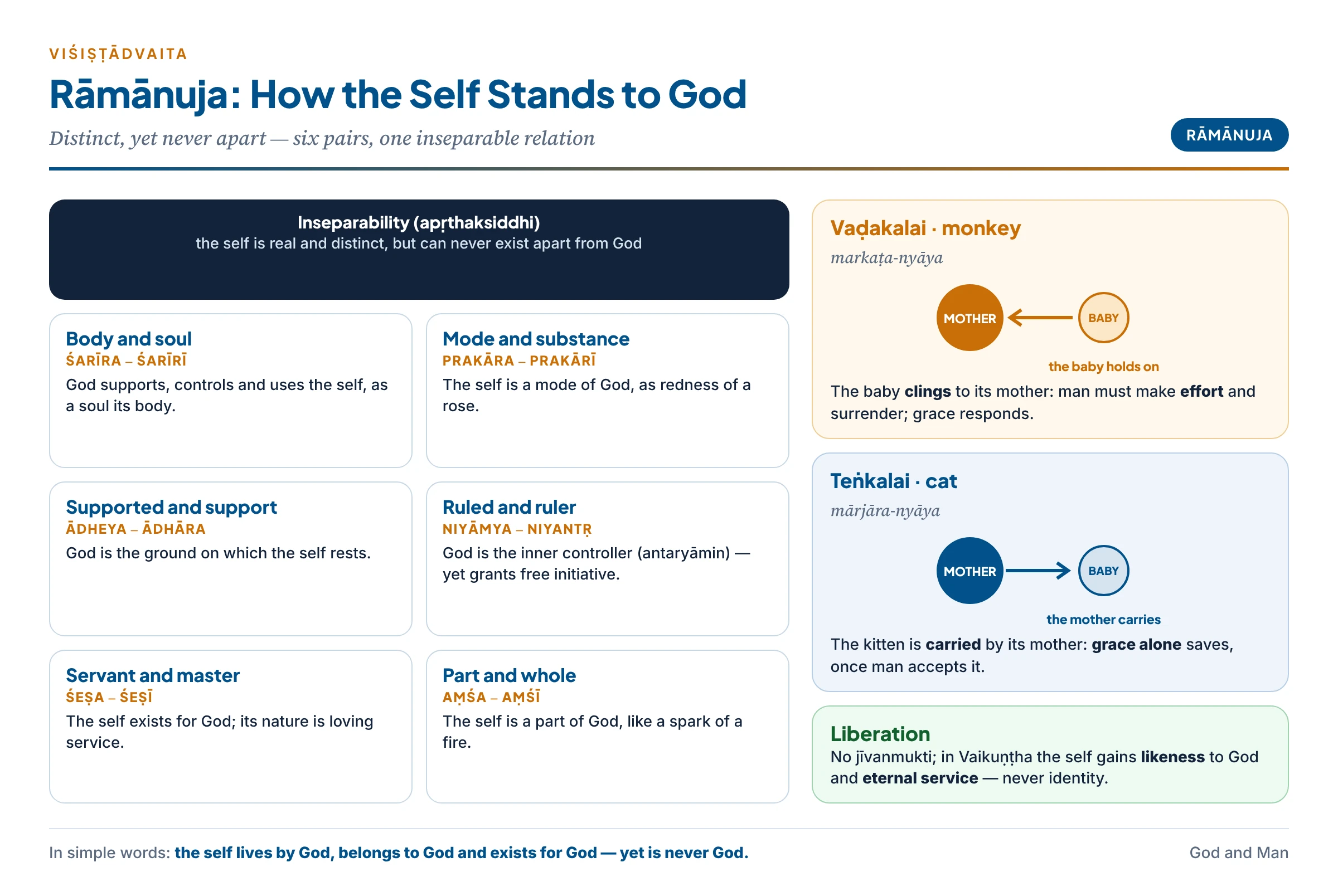
- The God–self relation. The self and God are inseparably related (apṛthaksiddhi) — distinct, yet never apart. Rāmānuja describes this through several pairs:
- Body and soul (śarīra–śarīrī) — the self is God’s body: something God supports, controls and uses for his purposes.
- Mode and substance (prakāra–prakārī) — the self is a mode of God, as redness is a mode of the rose.
- Supported and support (ādheya–ādhāra) — God is the ground of the self.
- Controlled and controller (niyāmya–niyantṛ) — God is the inner controller (antaryāmin) of the self.
- Servant and master (śeṣa–śeṣī) — the self exists for God; its essence is service (kaiṅkarya).
- Part and whole (aṃśa–aṃśī) — the self is a part of God, like a spark of fire.
- Free will. Though God is the inner controller, he grants the self freedom to initiate its actions; God permits (anumantā) and supports them and gives their fruits. So the self is responsible.
- The way: bhakti and prapatti.
- Bhakti is loving, continuous meditation (upāsanā, dhyāna) on God, like an unbroken flow of oil, prepared by karma-yoga and jñāna-yoga.
- Prapatti is total self-surrender, open to all regardless of caste or learning; God’s grace responds to it.
- The later Vaḍakalai (northern) school holds the monkey analogy (markaṭa-nyāya): the baby monkey must cling to its mother — man must make effort. The Teṅkalai (southern) school holds the cat analogy (mārjāra-nyāya): the kitten is carried by its mother — grace does everything.
- Liberation. No liberation in this life (no jīvanmukti). The liberated self goes to God’s abode (Vaikuṇṭha), attains likeness (sāmya) to God in bliss and knowledge, but not identity and not God’s cosmic powers of creation; it enjoys eternal loving service.
- Difficulties.
- If God is the inner controller, how is the self free?
- If selves are God’s body, do their sins and sufferings touch God? (Rāmānuja: no — as the soul is untouched by the body’s defects.)
- Advaitins ask how a part can be eternally distinct from its whole.
In simple words
A body cannot exist or act without the soul that lives in it, yet the body is not the soul. Rāmānuja says the self is like that body to God: it lives by God, belongs to God and exists for God’s purposes — yet it is never God.
Man and God in Dvaita: Madhva
- Bimba–pratibimba (original and reflection). The soul is a reflection of God, as the image in a mirror reflects the face. A reflection resembles the original and depends on it entirely, but is not the original and has no existence of its own.
- Five differences (pañca-bheda). Between God and soul, God and matter, soul and soul, soul and matter, and matter and matter — all eternal and real.
- Absolute dependence. God alone is independent (svatantra); souls and matter are dependent (paratantra).
- Gradation of souls (tāratamya). Souls differ in nature: some fit for liberation, some eternally in saṃsāra, some for eternal darkness — a doctrine close to predestination.
- The way. Bhakti grounded in knowledge of God’s greatness (māhātmya-jñāna), and God’s grace — without which no one is liberated; Vāyu acts as the mediator.
- Liberation. The liberated soul enjoys bliss according to its capacity, always distinct from God.
Man and God in Śaiva Siddhānta and Sikhism
- Śaiva Siddhānta — pati, paśu, pāśa. Śiva is the Lord (pati); the soul is the bound creature (paśu); the bonds (pāśa) are āṇava (innate impurity, the sense of smallness), karma and māyā. Śiva’s grace (arul) frees the soul through the guru; the liberated soul attains Śiva-likeness, united with him in love but not dissolved.
- Sikhism. One God (Ik Oṅkār), formless and beyond (nirguṇa) yet personally present (saguṇa). Without devotion man lives in illusion, ruled by five evils — lust, anger, greed, attachment and pride (haumai, ego) — and must cultivate their opposites: self-control, forgiveness, contentment, love of God and humility. Liberation comes by remembering the Name (nām simran), living by God’s will (hukam), and God’s grace (nadar). The langar (community kitchen) in every gurdwara expresses the equality of all before God.
Bhakti: Grace and the Forms of Devotion
- The Gītā’s call. “Abandon all duties and take refuge in Me alone; I shall release you from all sins; do not grieve.” Bhakti offers salvation through love and surrender to a personal God.
- Forms of relation (bhāvas). Devotees relate to God as servant (dāsya), friend (sakhya), parent to child (vātsalya) or lover (mādhurya) — Hanumān, Arjuna, Yaśodā, Rādhā; Mīrābāī and Āṇḍāḷ saw God as their beloved.
- Grace (anugraha, prasāda). In theistic Vedānta and Śaivism, liberation finally comes by God’s grace, met by the devotee’s surrender — close to Christian grace and Islamic mercy.
- The nine forms of devotion — hearing, singing, remembering, serving, worshipping, saluting, serving as a servant, friendship and self-surrender.
Prayer and Worship
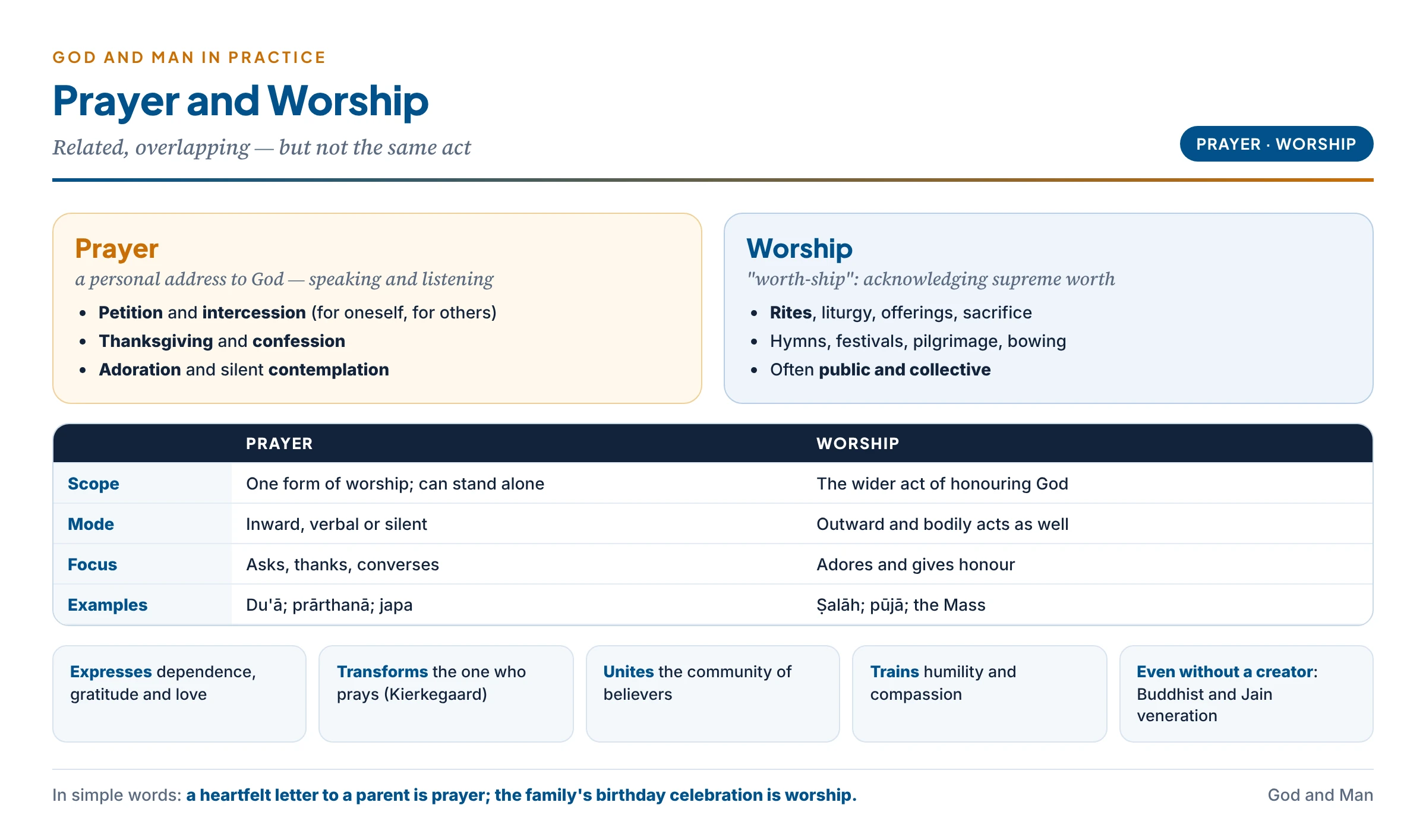
- Prayer. A personal address to God — in words or in silence — of petition, intercession (for others), thanksgiving, confession, adoration or contemplation. Its core is communion: speaking with God and listening.
- Worship. The acknowledgement of supreme worth (Old English weorthscipe, “worth-ship”) through acts of reverence: rituals, sacrifice, liturgy, offerings, festivals, pilgrimage. It is often public and collective.
- Distinction.
- Scope — worship is the wider act of honouring God; prayer is one form of worship, though it can also stand alone.
- Mode — prayer is mainly inward and verbal; worship includes outward and bodily acts (bowing, offering, singing, processions).
- Focus — prayer often asks or converses; worship adores and gives honour without asking.
- Setting — prayer can be private and spontaneous; worship is often communal and prescribed.
- Examples — Islam distinguishes ṣalāh (prescribed ritual worship five times a day) from du’ā (personal supplication); Hindus distinguish pūjā (ritual worship with offerings) from prārthanā (prayer), japa and kīrtan.
- Their place in religion.
- Expression of the God–man relation — dependence, gratitude and love become acts.
- Transformation of the one who prays — Kierkegaard’s point; Gandhi called prayer “the key of the morning and the bolt of the evening“.
- Community and identity — common worship binds believers together.
- Moral training — humility, gratitude, self-examination, compassion.
- Even non-theistic religions have analogues: Buddhists venerate the Buddha and meditate; Jains worship the tīrthaṅkaras as ideals, not as givers of favours; Yoga’s devotion is meditation on an ideal. So worship does not always need a creator God — the object can be an ideal or a liberated being.
- Objections.
- Can prayer change God? An omniscient, immutable God already knows and wills the best; petition seems pointless. (Replies: God may will some goods through prayer, as through other causes; and prayer changes us.)
- Kant — trying to win God’s favour by ritual is “religious illusion” (fetish-service); only a good moral life truly pleases God.
- Freud and Marx — prayer is wish-fulfilment or the “opium” that consoles the oppressed.
- Pantheism and Advaita — if God is all, there is no other to pray to; worship survives only at the empirical level.
In simple words
Writing a heartfelt letter to a parent is like prayer — personal, in your own words, sometimes asking, sometimes thanking. Celebrating the parent’s birthday with the whole family — gifts, songs, a ceremony — is like worship. The letter can be part of the celebration, but they are not the same thing.
Man and the World in the Oriental Religions
- Hinduism.
- The world — God’s creation, body or play (līlā) for theists; an appearance (māyā) for Advaita.
- Man’s place — an eternal self (ātman) bound by karma in the cycle of saṃsāra; life is ordered by dharma and the four aims (puruṣārthas: dharma, artha, kāma, mokṣa) and the four stages of life (āśramas).
- Attitude — both world-affirming (the householder’s life, the Gītā’s desireless action, niṣkāma karma) and world-transcending (renunciation, saṃnyāsa); the ideal is lokasaṃgraha (the welfare of the world) and vasudhaiva kuṭumbakam (“the world is one family”).
- Buddhism.
- The world — a stream of dependently arising (pratītyasamutpāda), impermanent (anicca) events, marked by suffering (dukkha) and without a permanent self (anattā); no creator God.
- Man’s place — a changing bundle of five aggregates (skandhas), bound by craving; the task is to see through the world, not to escape into another.
- Attitude — the middle path between indulgence and self-torture; compassion (karuṇā) for all beings; in Mahāyāna the bodhisattva vows to save all beings, and Nāgārjuna says saṃsāra and nirvāṇa are not two — liberation is a new way of seeing this very world. Four sublime states (brahma-vihāras): loving-kindness, compassion, sympathetic joy, equanimity.
- Jainism.
- The world — real, uncreated and eternal, made of souls (jīva) and non-souls (ajīva); no creator God.
- Man’s place — a soul weighed down by karmic matter; every living being, even plants and atoms of earth and water, has a soul.
- Attitude — non-violence (ahiṃsā) to all life, the five vows, many-sidedness (anekāntavāda), and ascetic withdrawal to free the soul; the liberated soul (siddha) rises to the top of the universe.
- Daoism.
- The world — the spontaneous flow of the Dao, the nameless Way, through the interplay of yin and yang.
- Man’s place — one part of nature, at his best when he follows it.
- Attitude — harmony with nature, non-forcing action (wu wei), naturalness (ziran), simplicity, like water that yields yet wears away rock.
- Confucianism.
- The world — a moral order under Heaven (Tian); little speculation about God or the afterlife.
- Man’s place — essentially social: a member of family and state, bound by the five relationships (ruler–subject, father–son, husband–wife, elder–younger brother, friend–friend).
- Attitude — this-worldly moral cultivation: humaneness (ren), ritual propriety (li), filial piety (xiao), righteousness; the goal is the noble person (junzi) and a harmonious society.
- Shinto.
- The world — full of kami, sacred powers present in mountains, rivers, trees, ancestors.
- Man’s place — a child of the kami, living in community with nature and ancestors.
- Attitude — purity, gratitude, festivals and harmony with nature and community.
- Compare and contrast.
- Common ground — man is part of a larger order (dharma, Dao, Heaven, kami); the world is not merely matter to be used; ethical discipline and harmony are central; most see the world as cyclic.
- Differences — the Indian religions (Hinduism, Buddhism, Jainism) seek liberation from bondage in saṃsāra; the Chinese and Japanese religions (Daoism, Confucianism, Shinto) seek harmony within this world. Jainism stresses ascetic withdrawal; Confucianism social engagement; Daoism natural spontaneity; Buddhism insight and compassion; Hinduism holds both renunciation and engagement.
- Contrast with the West — the Semitic faiths give man dominion over a created world with a linear history and one life; the oriental religions mostly see man as a participant in a cyclic, sacred cosmos — a view now drawn on in environmental ethics.
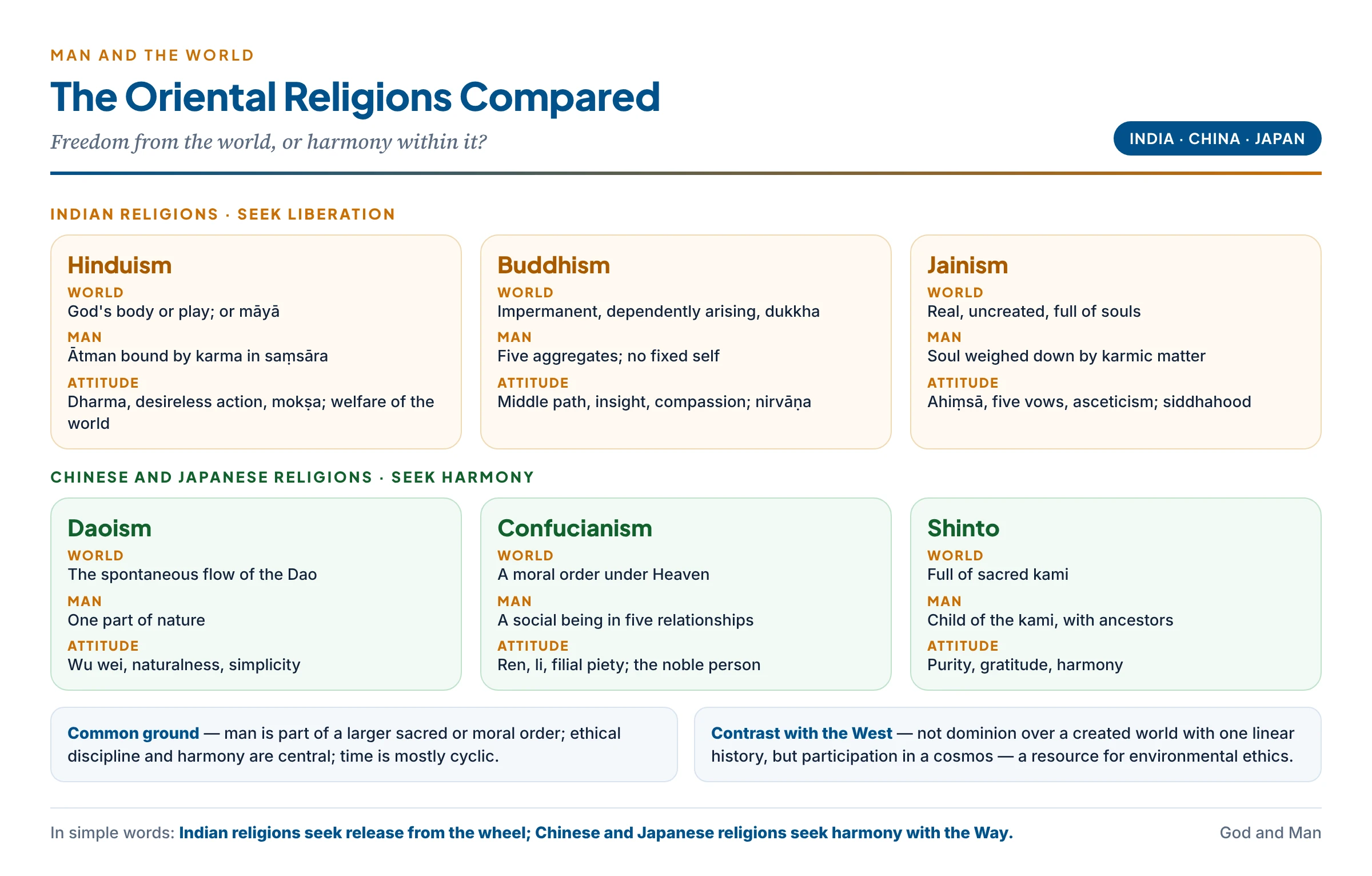
| Religion | The world is | Man’s place | Right attitude |
|---|---|---|---|
| Hinduism | God’s body or play; or māyā | Ātman bound by karma | Dharma, desireless action, mokṣa |
| Buddhism | Impermanent, dependently arising, dukkha | A bundle of aggregates; no fixed self | Middle path, insight, compassion, nirvāṇa |
| Jainism | Real, uncreated, full of souls | Soul weighed down by karmic matter | Ahiṃsā, vows, asceticism |
| Daoism | The flow of the Dao | Part of nature | Wu wei, naturalness, harmony |
| Confucianism | A moral order under Heaven | A social being in five relationships | Ren, li, filial piety |
| Shinto | Full of kami | Child of the kami | Purity, gratitude, harmony |
Indian Connect — Indian relations of man to God at a glance
- Tat tvam asi (Advaita) — identity; realise it through knowledge.
- Śeṣa–śeṣī and śarīra–śarīrī (Rāmānuja) — servant and body of God; reach him through bhakti and prapatti.
- Bimba–pratibimba (Madhva) — reflection wholly dependent on the original; saved by grace.
- Pati–paśu–pāśa (Śaiva Siddhānta) — bound creature freed by Śiva’s grace.
- Īśvara-praṇidhāna (Yoga) — devotion to the perfect puruṣa as a means to samādhi.
- Moral governor (Nyāya) — God dispenses the fruits of karma.
Comparative Map of Notions of God
| School / religion | God’s nature | God and world | God and man | Goal |
|---|---|---|---|---|
| Nyāya-Vaiśeṣika | Eternal, omniscient soul | Efficient cause only; atoms co-eternal | Moral governor, dispenser of karma | Apavarga through knowledge |
| Sāṃkhya | No God | Prakṛti evolves by itself | None | Kaivalya by discrimination |
| Yoga | Special puruṣa | Not creator | Ideal and teacher; devotion helps | Kaivalya through samādhi |
| Mīmāṃsā | No creator; Vedas eternal | World eternal | Duty, not devotion | Heaven, then release |
| Advaita | Nirguṇa Brahman; Īśvara empirical | World an appearance (vivarta) | Identity (tat tvam asi) | Realisation; jīvanmukti |
| Viśiṣṭādvaita | Saguṇa Brahman, Nārāyaṇa | World God’s body (real transformation) | Body, mode, servant | Eternal service; prapatti |
| Dvaita | Viṣṇu, wholly independent | Efficient cause; matter dependent | Reflection, dependent | Bliss by grace, distinct |
| Jainism, Buddhism | No creator God | World uncreated / dependently arising | Perfected beings as ideals | Siddhahood; nirvāṇa |
| Christianity | Triune personal God | Creation from nothing; sustains | Image, child; grace through Christ | Eternal life with God |
| Islam | One God (tawḥīd) | Creator and sustainer | Servant and vicegerent; submission | Paradise by mercy |
| Deism | Rational first cause | Made and left | No relation | Moral life by reason |
| Spinoza | Substance with infinite attributes | God or Nature | Man a mode; intellectual love | Freedom through understanding |
| Process theism | Dipolar, growing | World in God; God in world | Fellow-sufferer who understands | Shared creative advance |
Critical Evaluation
Objections (Pūrva-pakṣa)
- Dependence versus autonomy. Feuerbach says God is man’s own nature projected outside; Nietzsche and Sartre say a God who commands takes away man’s freedom and dignity; Kant insists morality must be autonomous. If man is a servant or a body of God, where is his own worth?
- Grace versus freedom. If everything depends on grace (Teṅkalai, Calvinist predestination, Madhva’s gradation of souls), man’s effort and responsibility seem pointless — and eternal damnation seems unjust.
- Exclusivism. Claims such as “No one comes to the Father except through me” seem to condemn the followers of other religions; pluralists (Hick, Vivekananda) object.
- Identity dissolves religion. Advaita’s identity of self and Brahman seems to leave no one to worship, love or be saved.
- Non-theistic religions. Buddhism, Jainism and Confucianism show that man’s relation to an ordered world can be the heart of religion without God.
Criticism — Critics
- Feuerbach — man’s relation to God is man’s relation to his own projected essence.
- Nietzsche, Sartre — a commanding God diminishes man.
- Freud, Marx — prayer and dependence are illusion and consolation.
- Advaita (against theists) — difference between man and God is ignorance.
- Theists (against Advaita) — identity makes devotion impossible.
Defence — Defenders and strengths
- Augustine, Aquinas — dependence on God is the fulfilment, not the loss, of freedom: “our heart is restless until it rests in Thee”.
- Buber — the I–Thou relation dignifies both partners.
- Rāmānuja — service to God is the self’s true nature and joy.
- Kierkegaard — prayer changes the one who prays.
- Śaṅkara — devotion purifies; knowledge fulfils.
Synthesis (Siddhānta)
- One question, many pictures. Child, servant, partner, body, reflection, ray of the same light — each picture captures one side of the God–man relation: dependence, obedience, dialogue, belonging, likeness, identity.
- The relation follows the notion of God. A personal God grounds love, prayer and grace; an impersonal Absolute grounds knowledge and realisation; a God who is only an ideal grounds meditation and imitation; no God at all turns religion towards man’s relation with the world and its moral order.
- Prayer and worship give the relation a living form; at their best they transform the worshipper rather than bargain with God.
- The oriental religions add a vital lesson: man belongs to a larger cosmic and moral order, with which he must live in harmony or from whose bondage he must be freed.
- Contemporary relevance. An inclusive, dialogical view of the God–man relation (Buber, Gandhi, Vivekananda, Hick) supports inter-religious harmony; a sense of man as steward or participant rather than master of the world supports ecological ethics; a God who calls for service links devotion with social justice (seva, langar, zakāh, Christian charity).
“Our heart is restless until it rests in Thee.” — Augustine
Previous Year Questions
- 2022Explain the relation between the God and the Self according to Rāmānujācārya.
- 2020Distinguish between prayer and worship and determine their place in religion.
- 2019Discuss the relationship between man and God according to any one of the religions in India.
- 2017Critically discuss the relationship of man with God in the Yoga system of philosophy.
- 2016Compare and contrast the relation of man to the world in the oriental religions.
- 2012Søren Kierkegaard clarified that “The function of prayers is not to influence God but rather to change the nature of one who prays.” Comment on this statement.