

Notions of God: Attributes; Relation to Man and the World (Indian and Western).
Official Syllabus: Paper II, Section B, Unit 1
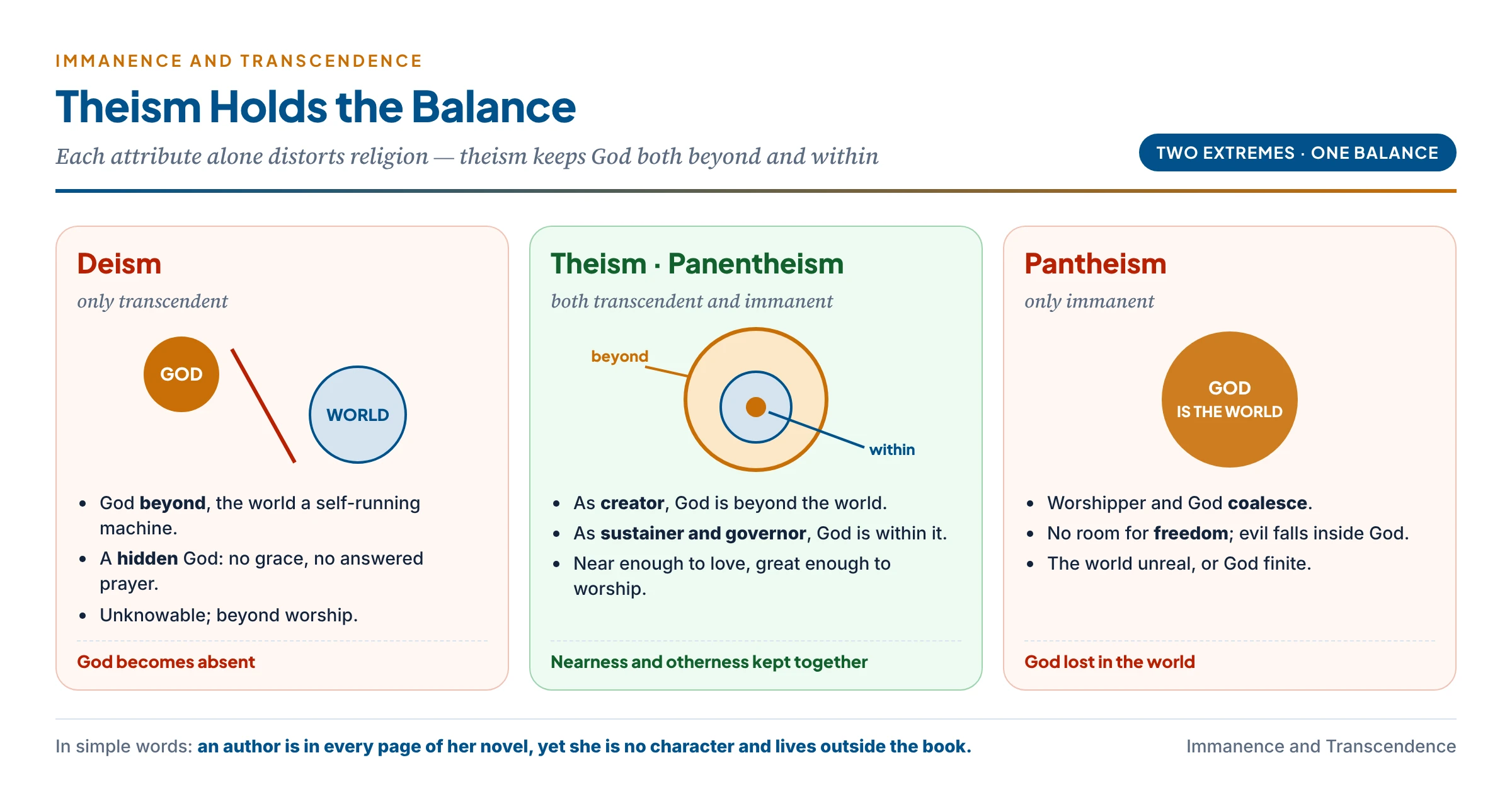
Every serious conception of God has to answer two questions at once: Is God beyond the world? and Is God within the world? To say God is transcendent is to say God is other than, greater than and not limited by the world; to say God is immanent is to say God is present in, indwelling and active within the world. Deism stresses the first, pantheism the second; theism and panentheism try to hold both. This article explains the two ideas and their varieties, why each alone fails, how theism holds God to be both, how immanence and transcendence fit together with omnipresence and infinitude, whether God is really immanent or transcendent, the status of man between the two, and the provocative claim that “to be man is to strive to be God” — with Indian and Western voices throughout.
In simple words
Think of the author of a great novel. She is in every page — her mind shapes every sentence, every character speaks with her imagination — yet she is not any character, and she lives outside the book, far larger than it. That is immanence and transcendence together: present in every part, confined to none.
Context & Problem
Two Meanings to Keep Clear
- Transcendence (Latin transcendere, to climb beyond) means that God is:
- Ontologically other — not one thing among things, not a part of the world; the world depends on God, not God on the world.
- Unlimited — not confined by space, time or any finite form.
- Epistemically beyond — exceeding all human concepts (“neti, neti”; the “wholly other”).
- Morally holy — beyond every imperfection.
- Immanence (Latin immanere, to remain within) means that God is:
- Indwelling — present in every part of the world, “occupying every fibre” of what God indwells.
- The vital, sustaining power — like the impetus in an egg that turns it into a chick.
- The ground or stuff — that of which everything is a modification.
- Inwardly near — present in the depth of the human self (the inner controller, the voice of conscience).
- Immanence is not mere omnipresence. A security camera network is “everywhere” in a building but in nothing; omnipresence says God is present to all things, immanence says God dwells in them as their inner life and ground.
Why the Balance Matters
- For worship — a God only within coalesces with the worshipper and cannot be worshipped; a God only beyond is hidden and unreachable.
- For morality — a transcendent God gives a standard above us; an immanent God gives inner strength and makes every creature sacred.
- For the world’s value — transcendence protects God from the world’s evil; immanence protects the world from being godless.
Core Doctrine
Transcendence Alone: The Deist Extreme
- God beyond, world self-running. The deist God made the world a perfect machine and has no logical relation with its ongoing events.
- Consequences.
- A hidden God — unconcerned with human affairs, beyond worship and knowledge.
- Dualism — God and world mutually exclusive, as in Descartes.
- Unknowability — revelation must come in “by the back door”, yet cannot make the unknowable known.
- No grace, no miracles, no answered prayer.
Immanence Alone: The Pantheist Extreme
- God within, world divine. In pantheism, God is the immanent principle of everything, “without being transcendent at the same time“.
- Consequences.
- No worship — deity and worshipper coalesce.
- No freedom — the indwelling spirit decides even our innermost choices.
- Evil in God — the world’s imperfections become God’s.
- The world illusory, or God limited — if God is all, the finite world is unreal; if the world is finite, so is God.
Theism: God Both Transcendent and Immanent
- The theist formula. God is a supernatural person who creates, sustains and governs a value-evolving world. As creator, God is beyond the world; as sustainer and governor, God is within it. The world depends on God for its being and its qualities; God does not depend on the world.
- Classic statements.
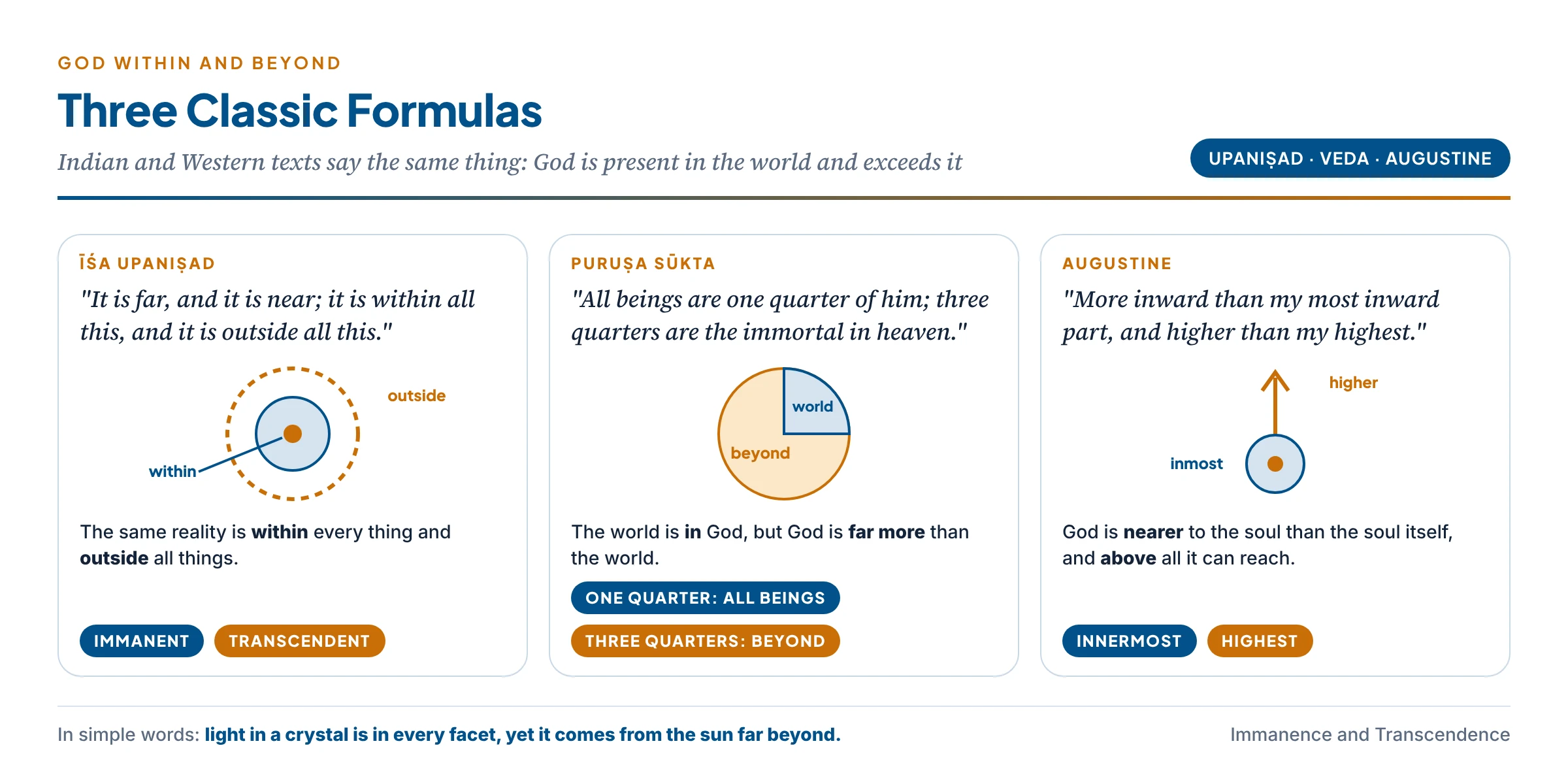
- Augustine — God is “more inward than my most inward part and higher than my highest” (interior intimo meo et superior summo meo).
- Aquinas — God is in all things by power (all is subject to God), by presence (all is open to God’s knowledge) and by essence (God is the cause of their very being) — yet God is wholly other than any creature.
- The Qur’an — God is “nearer to man than his jugular vein” (immanence) and “there is nothing whatever like unto Him” (transcendence). Islamic theology speaks of tanzīh (God’s incomparability) and tashbīh (God’s likeness to creatures) as two necessary sides.
- The Hebrew prophets — God is “the Holy One in your midst“: holy (beyond) yet in the midst (within).
- Christianity — God the Father beyond all, the Son incarnate in history, the Spirit indwelling believers.
- Indian statements.
- Īśa Upaniṣad — “It moves and it moves not; it is far and it is near; it is within all this, and it is outside all this.“
- Puruṣa Sūkta — “All beings are one quarter of him; three quarters are the immortal in heaven.” The world is in God, but God is far more than the world.
- Bhagavad Gītā — “By Me, in My unmanifest form, this universe is pervaded; all beings abide in Me, but I do not abide in them … behold My divine mystery.”
- Rāmānuja — God is immanent in the whole world as its inner controller (antaryāmin), the soul of nature, and yet in essence transcends it — the soul–body relation.
- Śaṅkara — by the two standpoints he reconciles God’s immanence (the world, while it appears, is in God) with his transcendence (God is never touched by its imperfections).
- Modern Western accents.
- Karl Barth — God is the “wholly other“; we know God only because God reveals himself — a strong stress on transcendence against liberal theology’s God-in-culture.
- Paul Tillich — God is not “a being” above others but the ground of being (being-itself): present in all that is, yet never one item among items.
- Hegel — the Absolute Spirit realises itself in nature and history (immanence), yet is the whole that is more than any stage (transcendence).
- Teilhard de Chardin, process theism — God is at work within cosmic evolution, drawing it towards a goal (the Omega Point) that lies ahead of and beyond it.
- Paradox, not contradiction. God is not “inside” and “outside” in the same sense. God is immanent as ground, life and presence, transcendent in being, perfection and freedom. A contradiction affirms and denies the same thing in the same respect; here the respects differ.
In simple words
Light shining through a crystal is in every facet — it makes the crystal sparkle — yet the light is not made of crystal and does not depend on it; it comes from the sun far beyond. God’s presence in the world is like the light in the crystal: wholly present, never contained.
Immanence, Transcendence, Omnipresence and Infinitude
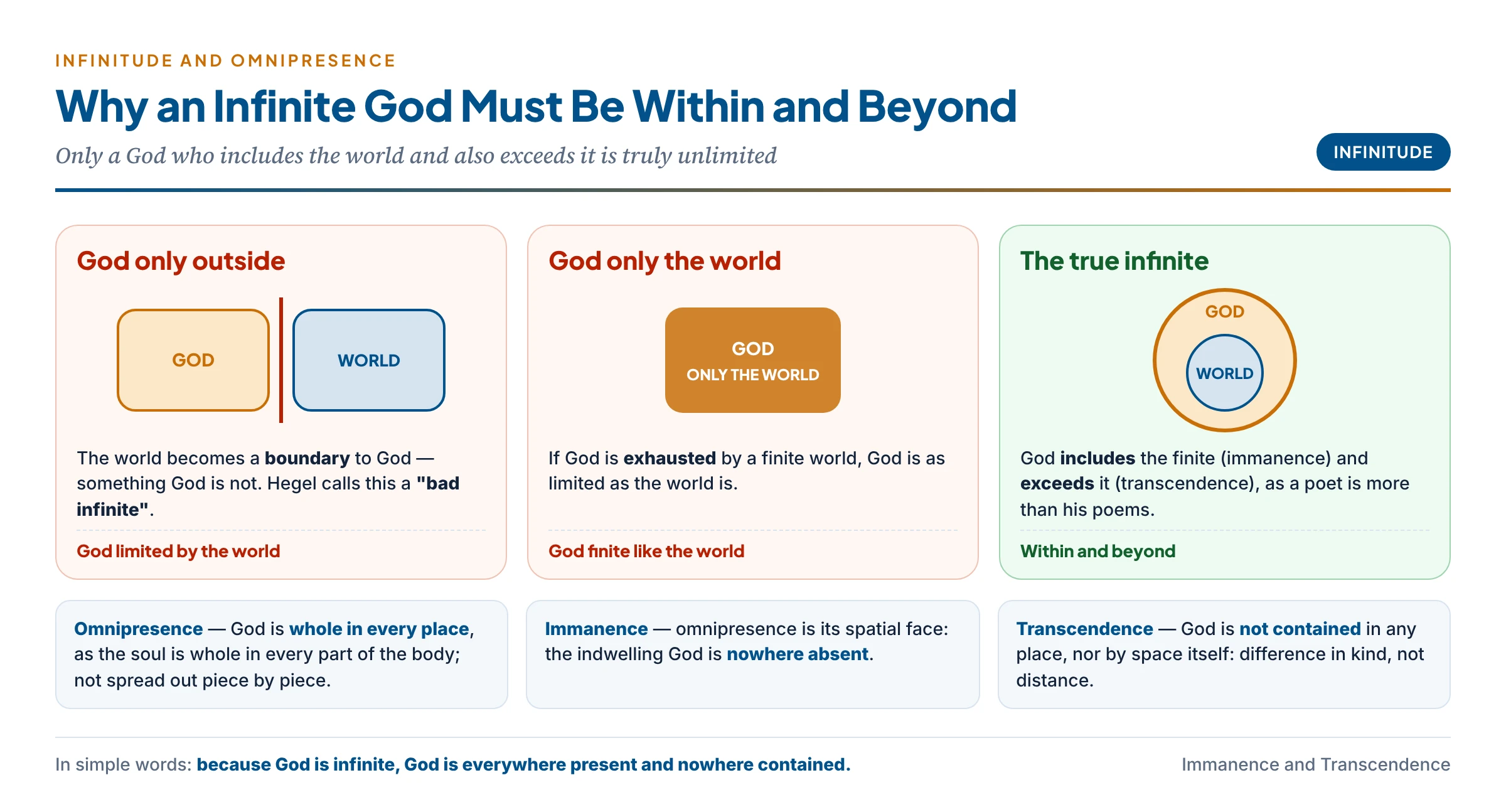
- Omnipresence. God is present everywhere — not by being spread out, part here and part there, but whole in every place, as the soul (in Augustine’s analogy) is whole in every part of the body. Omnipresence is the spatial expression of immanence: the indwelling God is nowhere absent.
- Infinitude. God is unlimited. This leads to both attributes:
- Infinitude requires immanence. If God stood only outside the world, the world would be a boundary to God — something God is not — and God would be limited by it. Hegel called such an infinite, set over against the finite, a “bad (spurious) infinite“. The true infinite must include the finite within itself. So an infinite God must be in the world.
- Infinitude requires transcendence. An infinite God cannot be exhausted by a finite world — “the world does not exhaust the creativity of God”, as a poet is not exhausted by his poems. So an infinite God must also be beyond the world.
- How they fit together. Omnipresence expresses God’s immanence in all places; transcendence expresses that God is not confined to any place or to space itself; infinitude is the ground of both. Hence the classical theist can say: because God is infinite, God is everywhere present (immanent) and nowhere contained (transcendent).
- Two errors avoided. Spatial pantheism (God as a very large body spread through space) confuses omnipresence with extension; spatial deism (God far away in the sky) confuses transcendence with distance. Transcendence is difference in kind, not distance in space; immanence is presence as ground, not being one more thing in the world.
In simple words
Your mind is present in every part of a letter you write — its thoughts are in every word — yet your mind is not spread out across the paper, a bit per word. It is whole in every line. That is how theists understand omnipresence: God wholly present everywhere, not divided up into pieces of space.
Is God Really Immanent or Transcendent?
- For transcendence.
- Worship and holiness require a God beyond us — “To whom then will you liken God?”
- The problem of evil — a transcendent God is not identical with a world of suffering.
- Freedom — a God distinct from us leaves room for our own choices.
- Religious experience — the numinous is of a “wholly other“.
- For immanence.
- Mystical experience — of God within, the Self of all (Upaniṣads, Sufis, Christian mystics).
- Science-and-religion — God works through natural processes, not by external interference.
- Ethics and ecology — if God dwells in all, every being is sacred (“open morality”).
- Infinity — a God only outside would be limited.
- Verdict. God is both, in different respects. A God only transcendent becomes absent; a God only immanent becomes indistinguishable from the world. The great theisms (and panentheisms) are attempts to keep the nearness and the otherness of God together.
In simple words
A good teacher is inside the classroom — guiding, encouraging, correcting every student — yet the teacher is not one of the students and knows far more than the class does. Being among them does not make the teacher one of them; being above them does not make the teacher absent.
Common confusion
Does transcendence mean that God is far away — “up in the sky”? No. Transcendence is difference in kind, not distance in space. A transcendent God is not located somewhere else; God is not located at all, being the source of space itself. That is why the same God can be “nearer than the jugular vein” (immanent) and “unlike anything” (transcendent). Popular imagery of a God “above” is a symbol, not a map.
The Status of Man between Immanence and Transcendence
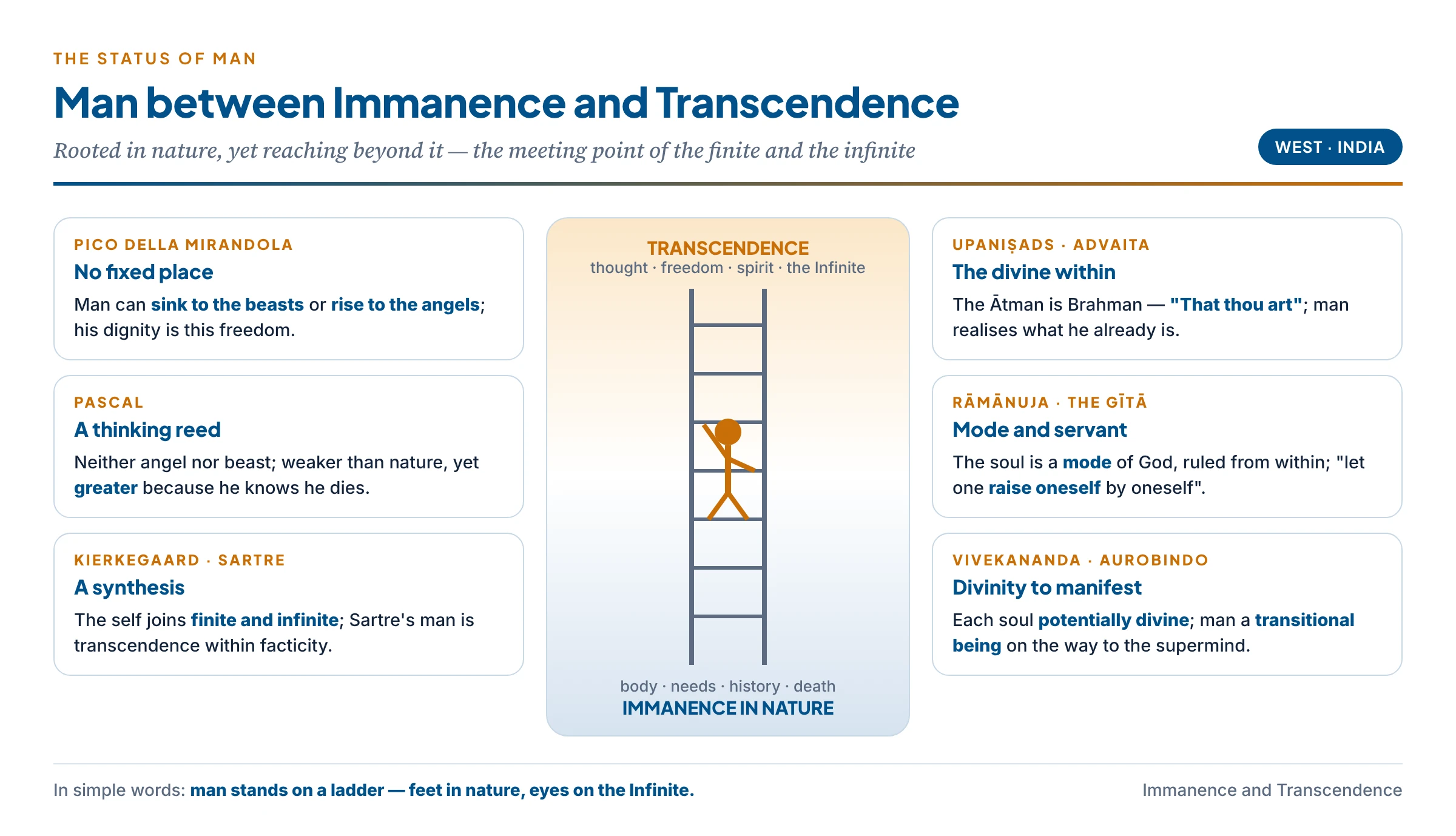
- Man stands at the meeting point. Human beings are part of nature — bodies, needs, death — yet they can think beyond nature, ask about the infinite, judge themselves by ideals and seek God. Man is the place where immanence and transcendence meet.
- Western voices.
- Pico della Mirandola — man has no fixed place in the chain of being; he can sink to the beasts or rise to the angels — his dignity is this freedom.
- Pascal — man is “neither angel nor beast“; a “thinking reed” — the weakest thing in nature, yet greater than the universe that crushes him, because he knows he dies.
- Kierkegaard — the self is a synthesis of the finite and the infinite, the temporal and the eternal; anxiety and despair arise when one side is lost; the self finds rest only by “resting transparently in the power that established it“.
- Existentialists — Sartre’s human being is transcendence (always going beyond what it is) within facticity (the given situation); Heidegger’s Dasein is “ahead of itself“, always projecting beyond.
- Imago Dei — in Judaism and Christianity man is made in the image of God: a creature (immanent in nature) bearing the mark of the Creator (open to transcendence).
- Indian voices.
- Upaniṣads and Advaita — the divine is immanent in man as the Ātman, identical with Brahman (“That thou art“); man’s task is to realise what he already is.
- Rāmānuja — the soul is a mode (prakāra) of God, dependent on God as the body on the soul; God dwells in it as antaryāmin, yet transcends it; man’s fulfilment is loving service, not identity.
- The Gītā — “Let one raise oneself by oneself; let one not degrade oneself” — man can climb or fall.
- Vivekananda — “Each soul is potentially divine; the goal is to manifest this divinity within.”
- Aurobindo — man is a transitional being, not the last term of evolution; through Integral Yoga he can rise to the supermind and become a gnostic being, manifesting the Divine in matter.
- Human birth is precious — a rare chance (manuṣya-janma durlabha) to attain liberation.
- Balanced view. Man is immanent in nature and history and transcends them in thought, freedom and spirit. Religion is the disciplined self-transcendence of a finite being towards the Infinite that is also present within him.
In simple words
A tree is rooted in the soil — it needs water, minerals and sun, and it will one day fall. Yet it keeps growing upwards towards the light. Man is like that tree: rooted in nature, always reaching beyond it.
“To Be Man Is to Strive to Be God”
- Sartre’s version. In Being and Nothingness Sartre writes: “To be man means to reach toward being God. Or if you prefer, man fundamentally is the desire to be God.” Consciousness (being-for-itself) is a lack that longs to become a solid, self-founded being (in-itself-for-itself) — a being that is its own cause. That is the idea of God. But this synthesis is impossible; so “man is a useless passion“. For Sartre, the striving is real but its object does not exist.
- Feuerbach and Nietzsche. For Feuerbach, “God” is man’s own essence — love, wisdom, power — projected outside himself; to recover it is to make man the highest being for man. Nietzsche, after “the death of God”, calls man to surpass himself towards the Übermensch.
- Christian tradition: deification and its danger.
- Theosis. Eastern Christianity teaches that “God became man so that man might become God” (Athanasius) — not by nature but by grace, sharing in the divine life; and the call to be “perfect as your heavenly Father is perfect”.
- Hubris. The first sin was the serpent’s promise, “you shall be like gods” — pride that refuses dependence. So striving to be God can be the highest aim (by grace) or the root of sin (by pride).
- Indian traditions.
- Advaita — not “becoming” God but realising one’s identity with Brahman: “the knower of Brahman becomes Brahman” (brahmavid brahmaiva bhavati). Striving removes ignorance, not distance.
- Jainism — every soul can become a perfect siddha, with infinite knowledge, bliss and power — divine without a creator.
- Buddhism — every being can attain Buddhahood.
- Aurobindo — the divinisation of human life — “a divine life on earth”.
- Rāmānuja and Madhva reject identity: the liberated soul attains likeness (sāmya, sādharmya) to God and eternal service, never becomes God; the devotee’s joy is to remain distinct and love.
- Evaluation. The statement captures something true about human beings: self-transcendence — the restless drive towards infinity, perfection and self-sufficiency. Whether this striving is fulfilment (theosis, realisation, Buddhahood, divine life), delusion (Sartre’s useless passion), projection (Feuerbach) or pride (the sin of Eden) depends on one’s view of God. A balanced religious view: man rightly strives to become godlike — in knowledge, love and goodness — while remembering his dependence; the striving is fulfilled by grace or realisation, not by self-assertion.
Indian Connect — The divine within and the divine beyond
- Tat tvam asi and ahaṃ brahmāsmi express immanence in its most radical form: the Divine is the Self.
- Śeṣa–śeṣī (servant–master) in Rāmānuja keeps transcendence: God is the Self of the self, but never identical with it.
- The Indian tradition thus offers both answers to “man striving to be God”: realise the divinity within (Advaita) or serve and resemble the God beyond (Viśiṣṭādvaita, Dvaita).
Common confusion
Did Sartre mean that human beings can become God? No — the opposite. Sartre’s point is that the desire to be God is the basic structure of human consciousness, but that the goal — a being that is both free consciousness and solid, self-caused being — is self-contradictory. Hence “man is a useless passion”. The sentence is often quoted as if it were a religious exhortation; in Sartre it is an atheist diagnosis.
Critical Evaluation
Objections (Pūrva-pakṣa)
- Contradiction. How can God be both “inside” and “outside” the world? (Reply: different respects — ground and presence vs being and perfection.)
- Unknowability. A transcendent God is beyond concepts; then how can we speak of God at all? (Reply: analogy, symbol, negation; revelation and experience.)
- Immanence threatens freedom and purity. An indwelling God seems to do everything and to share in evil. (Reply: God as ground, not as the doer of our acts; evil as privation or as the misuse of freedom.)
- Transcendence threatens relevance. A God beyond may become irrelevant to a scientific world. (Reply: transcendence is the condition of God’s being the ground of everything, including science’s laws.)
- Humanist critique. Talk of man “between” immanence and transcendence projects human aspiration into the heavens (Feuerbach); the “transcendent” is just human ideals.
Critics and Defenders
Criticism — Critics
- Deists — God’s transcendence excludes intervention.
- Spinoza, naturalists — only immanence: God is Nature.
- Feuerbach — transcendence is projected human essence.
- Sartre — the desire to be God is a useless passion.
- Logical positivists — “transcendent” claims are unverifiable.
Defence — Defenders and strengths
- Augustine, Aquinas — God more inward than the inmost, higher than the highest; present by power, presence and essence.
- Īśa Upaniṣad, Gītā, Puruṣa Sūkta — God far and near, within and beyond.
- Rāmānuja — antaryāmin yet transcendent; the soul–body model.
- Kierkegaard, Pascal, Pico — man’s dignity lies in the tension of finite and infinite.
- Aurobindo, Vivekananda — divinity within, to be manifested.
Cross-Tradition Comparison
| Transcendence | Immanence | Holding both | |
|---|---|---|---|
| Judaism, Christianity, Islam | The Holy One; “nothing is like unto Him” (tanzīh) | Spirit within; “nearer than the jugular vein” (tashbīh) | Creator and sustainer; Incarnation; Augustine and Aquinas |
| Vedānta | Nirguṇa Brahman, neti neti; three quarters beyond | Ātman within; antaryāmin; Brahman in all | Śaṅkara’s two standpoints; Rāmānuja’s soul–body; Gītā 9.4 |
| Modern Western | Barth’s “wholly other”; Otto’s numinous | Spinoza; process theism; Teilhard | Tillich’s ground of being; Hegel’s true infinite |
| Man’s place | Imago Dei; called beyond himself | Part of nature; mortal | Pascal’s thinking reed; Kierkegaard’s synthesis; Aurobindo’s transitional being |
Synthesis (Siddhānta)
- Two truths, one God. Transcendence secures God’s otherness, holiness and freedom; immanence secures God’s nearness, presence and sustaining power. Each alone distorts religion — into a hidden God (deism) or a God lost in the world (pantheism).
- Infinitude is the key. Because God is infinite, God must include the finite (immanence) and exceed it (transcendence); omnipresence is the way the infinite is whole in every place.
- Man mirrors this structure. Rooted in nature yet reaching beyond it, man is the meeting point of immanence and transcendence; his religious life is a striving to realise or serve the Divine that is both within and beyond him.
- “To strive to be God” names the deepest human longing. Interpreted as pride or projection, it is criticised; interpreted as growth into godlikeness by grace or realisation, it is the goal of most religions.
- Contemporary relevance. Immanence inspires ecological reverence and a sense of the sacred in all life; transcendence guards against idolising any nation, ideology or technology. A balanced religious philosophy needs both — a God near enough to love and great enough to judge.
“It is far, and it is near; it is within all this, and it is outside all this.” — Īśa Upaniṣad
Previous Year Questions
- 2023In what sense is God both immanent and transcendent in theism? Discuss.
- 2016Show how the attributes of immanence and transcendence of God go with omnipresence and infinitude.
- 2014Elucidate the status of man in the realm of between immanence and transcendence.
- 2009“To be man is to strive to be God.” Discuss.