

Notions of God: Attributes; Relation to Man and the World (Indian and Western).
Official Syllabus: Paper II, Section B, Unit 1
Two attributes do the heaviest work in theism: God is omnipotent (all-powerful) and omniscient (all-knowing). Together with perfect goodness they define the God who can create, govern and save. Yet these two attributes have drawn more criticism than any others. Can God make a stone too heavy for God to lift? Can God sin, lie, change the past, or make two plus two five? Is God bound by the laws of logic? If God knows today what I will choose tomorrow, am I free? If God is the all-powerful creator of everything, including my will, who is responsible for evil? This article sets out what omnipotence and omniscience mean, the paradoxes raised against them, the replies of theists from Augustine and Aquinas to Ockham, Molina, Plantinga and the process thinkers, and the Indian debates — Nyāya, Yoga, Mīmāṃsā, Jaina, Buddhist and Vedāntic — on an all-knowing, all-powerful Lord and the law of karma.
In simple words
A world chess champion is “all-powerful” on the board: he can make any legal move. Nobody says he lacks power because he cannot move a bishop in a straight line or checkmate while breaking the rules — such “moves” are not moves at all. Theists say God’s omnipotence is like that: power to do anything that can be done, not power to do contradictions, which are not “things” at all.
Context & Problem
Why These Two Attributes Matter
- Worship and trust. A God who could be defeated, or who might not know our plight, could not be the object of unconditional trust.
- Creation and providence. Only a being of unlimited power could create from nothing and sustain the world; only an all-knowing being could govern it and judge justly.
- Perfect-being theology. If God is “that than which nothing greater can be conceived”, God must have power and knowledge in the highest possible degree.
- The critic’s strategy. Show that the very ideas are self-contradictory (the stone, the past, sin), or incompatible with other facts (human freedom, the existence of evil). If successful, the God of classical theism cannot exist.
Core Doctrine
What Does Omnipotence Mean?
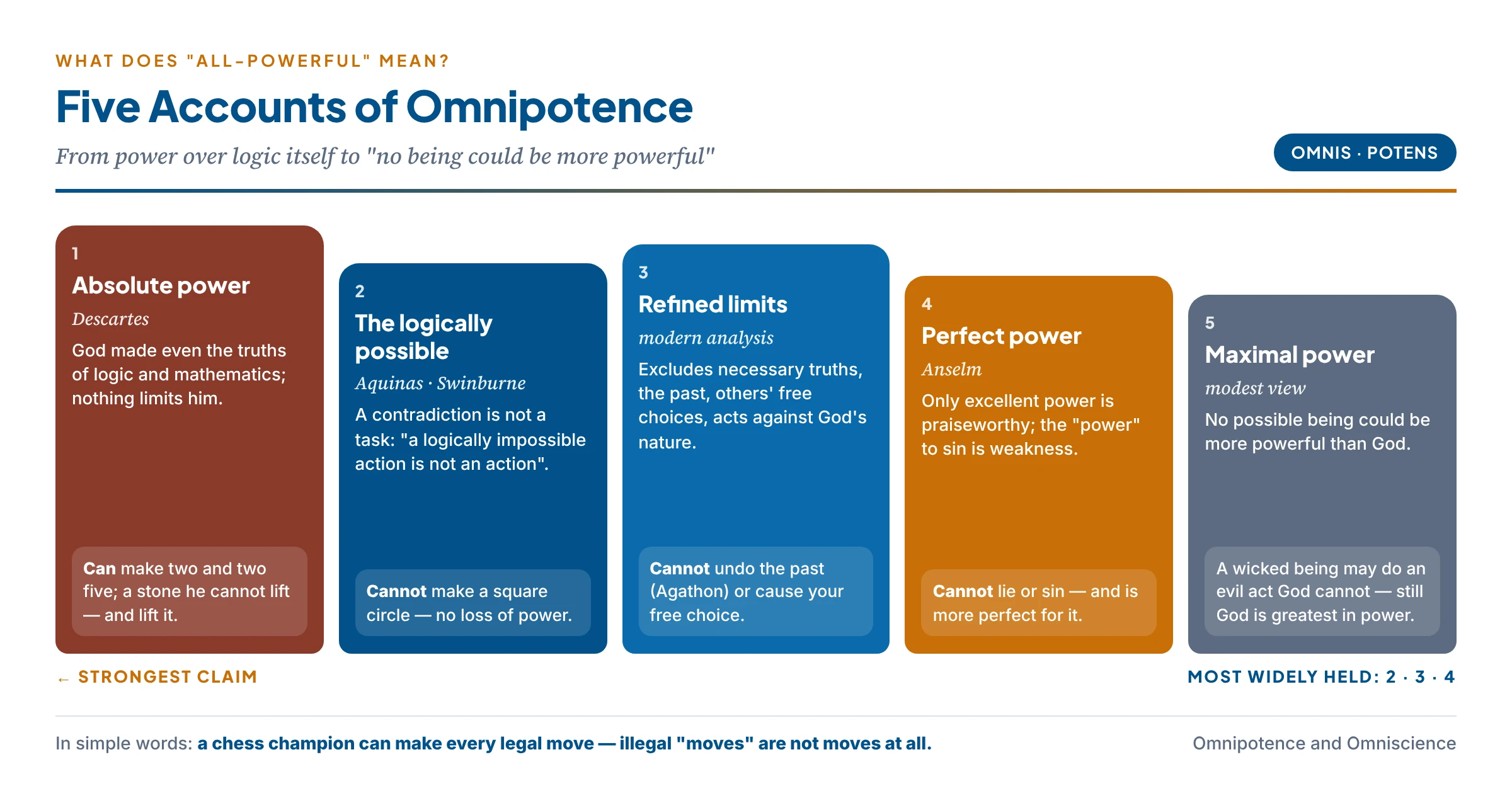
Omnipotence (Latin omnis, all, and potens, powerful) is the property of being perfect in power. Even Aquinas admitted: “all confess that God is omnipotent; but it seems difficult to explain in what His omnipotence precisely consists.” Five accounts have been offered.
- Absolute power — God can do anything whatsoever. God can create a world, answer prayer, work miracles — and, on the strongest view, even do what is logically impossible. Descartes held that God is not limited by anything, including the laws of logic and mathematics: God freely created the “eternal truths”, and could have made two plus two equal five, or made a thing both exist and not exist at once.
- Power to do whatever is logically possible. Most philosophers reject Descartes. Aquinas: whatever implies a contradiction “does not fall under the omnipotence of God, not because of any defect in the power of God, but because it cannot have the nature of a feasible thing“. Richard Swinburne: “A logically impossible action is not an action. … It is no objection to A’s omnipotence that he cannot make a square circle”, for “making a square circle” does not describe anything coherent that could be done.
- Refinements of the logical account. Careful analysis shows further things even an omnipotent God “cannot” do:
- Necessary truths. One cannot “bring about” that two and two make four — it is true whatever anyone does.
- The past. God cannot now make it the case that a past event did not happen. Aristotle quotes the poet Agathon: “For this alone is lacking even in God, to make undone things that have once been done.“
- Others’ free acts. God can cause Jones to decide to change jobs, but then Jones does not decide freely. So God cannot directly cause another’s free decision — at most God can place Jones in a situation where God knows Jones will freely decide.
- Acts against God’s own nature. A being essentially good, all-knowing and eternal cannot do evil, make a mistake or commit suicide. Compare “God causes a square circle” (impossible because the thing is impossible) with “God causes an innocent person to suffer intensely for no good reason” (impossible only because God doing it is incompatible with perfect goodness).
- Perfect power, not mere power (Anselm). Power is praiseworthy only when it is excellent. The “ability” to lie, break promises or sin is not power but weakness — a liability. So God’s inability to sin does not reduce his omnipotence; it expresses it.
- Maximal power. On a modest view, omnipotence means that no possible being could be more powerful than God — even if some lesser being (say, a wicked one) can do something God cannot (an evil act).
The Paradoxes of Omnipotence
Critics put a set of questions to the theist: Can God make a square circle? Can God sin? Can God make two plus two equal five? Can God create something out of nothing? Can God create a stone too heavy for God to lift?
- The paradox of the stone.
- Either God can create a stone so heavy that God cannot lift it, or God cannot.
- If God can, there is something God cannot do — lift that stone.
- If God cannot, there is something God cannot do — create that stone.
- Either way there is something God cannot do; so God is not omnipotent.
- Replies.
- The task is a pseudo-task (George Mavrodes). “A stone too heavy for an omnipotent being to lift” is a self-contradictory description — like “a square circle”. Given that God is omnipotent, such a stone is logically impossible, and failing to make the impossible is no lack of power.
- No limitation follows (C. Wade Savage). “God cannot make a stone God cannot lift” only says: whatever stone God makes, God can lift it. That shows no limit on either God’s making or God’s lifting.
- Descartes’ route (Harry Frankfurt’s comment). If God can do the impossible, God can create an unliftable stone and also lift it — the paradox does not touch a God above logic.
- Power extends only to the possible. Since it is impossible that there be a stone an omnipotent being cannot lift, the paradox shows nothing about God’s power.
- Mackie’s “paradox of omnipotence”. J.L. Mackie asked: “Can an omnipotent being make things which he cannot subsequently control?” — or make rules which then bind himself?
- If yes, then once he has made them he is no longer omnipotent; if no, he was never omnipotent.
- Mackie distinguished first-order omnipotence (unlimited power to act) from second-order omnipotence (unlimited power to decide what powers anything shall have), and argued they cannot both be held without contradiction.
- Why it matters: free creatures are exactly “things God cannot control”. If God gives real freedom, God limits his own control — which the theist says is a self-limitation of love, not a defect.
- Can God sin? No — not from weakness but because sinning is a defect; a perfectly good being’s “inability” to sin is moral strength (Anselm, Aquinas).
- Can God create out of nothing? Theists answer yes — creation ex nihilo does not violate logic; “out of nothing” means “not out of any pre-existing material“, not “nothing is a kind of stuff”.
In simple words
Ask: “Can the fastest runner in the world run a race so fast that he cannot finish it?” The question sounds like a test of speed, but it is really a word-trick — a race too fast for the fastest to finish is not a real race. The stone paradox works the same way: it dresses up a contradiction as a task.
Is God Subject to the Laws of Logic?
- Two positions in the West.
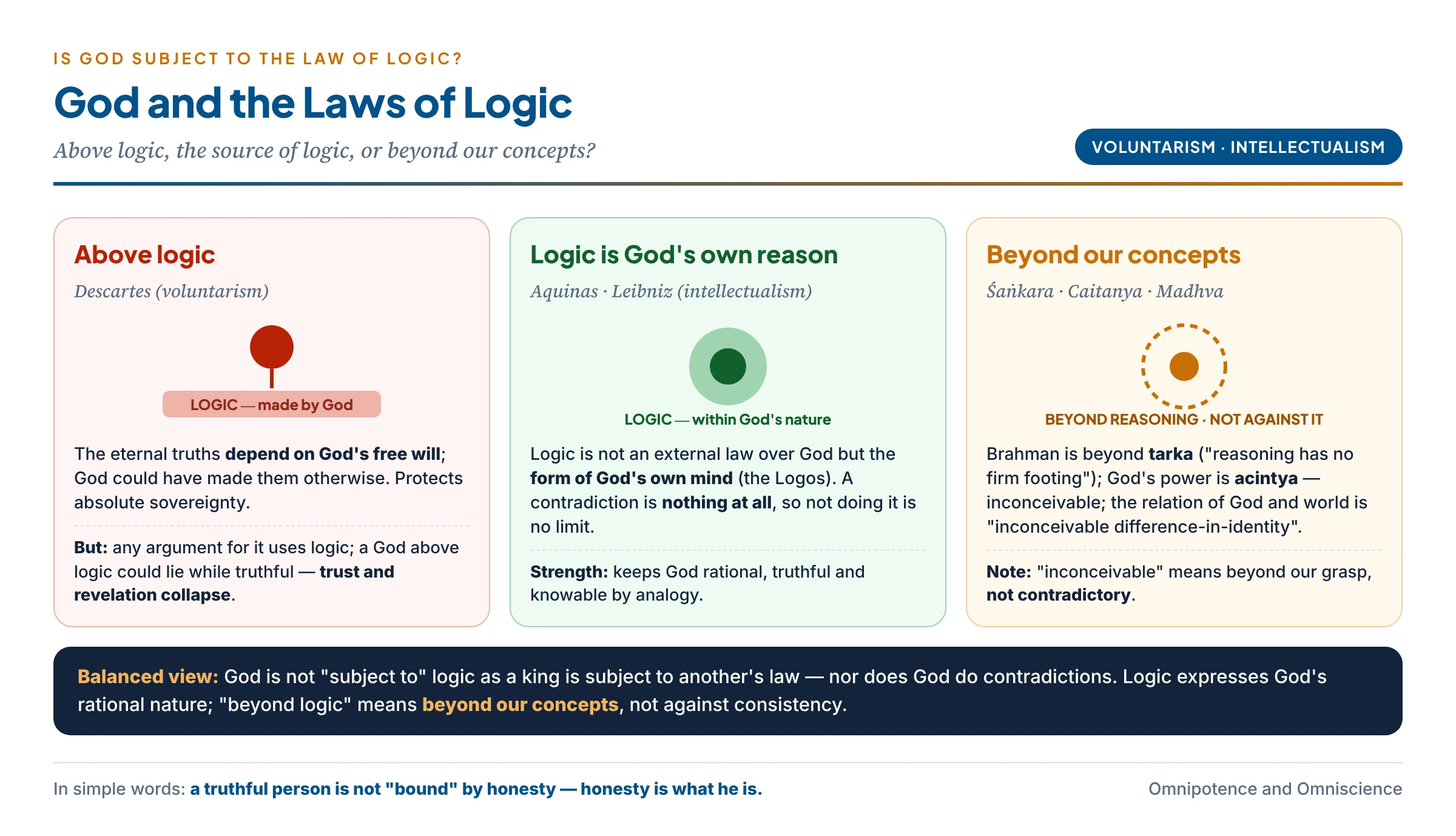
- Voluntarism (God above logic). Descartes (and before him some followers of Ockham) held that the eternal truths of logic and mathematics depend on God’s free will; God “could have” made them otherwise. This protects God’s absolute sovereignty.
- Intellectualism (logic expresses God’s nature). Aquinas and Leibniz held that the laws of logic are not an external law imposed on God but the structure of God’s own rational nature; a contradiction is not something God is prevented from doing but nothing at all.
- Problems for voluntarism.
- Self-defeat. Defenders of Descartes’ view cannot argue for it on rational grounds — any argument uses the very logic they say God may override; to argue the point is “self-contradictory and thus incoherent”.
- Moral consequences. If God can do contradictions, God could also lie or break promises while being truthful — and revelation and trust become impossible.
- Meaninglessness. If “God is good” is compatible with anything, it says nothing.
- Other theist defences.
- Logic limits only finite intellect; with infinite power, everything is relative to God — a view some attribute to Descartes and discuss with Frankfurt.
- Kant: the categories of understanding apply to phenomena, not to the noumenal; puzzles like the stone belong to the phenomenal level and do not touch God.
- Pascal and fideists: God is beyond the laws of ordinary reason; “the heart has its reasons which reason does not know”.
- Indian perspectives.
- Advaita: Brahman is beyond the reach of tarka (reasoning) — “reasoning has no firm footing (tarkāpratiṣṭhānāt)” — and is known through śruti and realisation; yet Śaṅkara never says Brahman is contradictory; it is beyond the subject–predicate form, not against logic.
- Caitanya’s acintya-bhedābheda: the relation of God to souls and world is “inconceivable difference-in-identity” — beyond our comprehension.
- Madhva: God has acintya-śakti (inconceivable power).
- Nāgārjuna uses the four-cornered negation to show that reality escapes all four logical options; Jainas use seven-fold predication to respect many-sidedness — both are disciplines of logic, not denials of it.
- Balanced view. God is not “subject to” logic as a king is subject to a law made by someone else; but neither does God do contradictions. Logic is best seen as the form of God’s own reason (the Logos). Talk of God being “beyond logic” usually means beyond our concepts, not against consistency.
Common confusion
Does “omnipotence” mean that God can do absolutely anything — including contradictions? Only on Descartes’ minority view. The mainstream view (Aquinas, Anselm, Swinburne, most Indian theists) is that omnipotence is power to do whatever is possible and fitting to a perfect being. Inability to make a square circle, to change the past or to sin is not a lack of power, because these are not real “things to be done”. Many notes present the stone paradox as a refutation of God; it refutes only the unusual “absolute” definition.
Omnipotence and the Existence of Evil
- The Epicurean dilemma. Is God willing to prevent evil but not able? Then he is not omnipotent. Able but not willing? Then he is not good. Both able and willing? Then whence evil?
- Mackie’s inconsistent triad. The theist holds:
- God is omnipotent.
- God is wholly good.
- Evil exists — natural and moral.
If any two are true, the third seems false. Since a good being eliminates evil as far as it can, and an omnipotent being can eliminate all of it, the existence of evil seems to refute an omnipotent, good God.
- How the theist uses the analysis of omnipotence.
- The free-will defence (Augustine, Plantinga). A world with free creatures is better than a world of puppets. Omnipotence covers only what is logically possible, and it is not logically possible to create creatures who are genuinely free yet guaranteed always to choose right. Moral evil comes from the misuse of freedom, not from God.
- Flew and Mackie’s reply. God could have created people with free will and so arranged their natures that they always freely chose the good — freedom is compatible with being determined by one’s good character.
- Plantinga’s rejoinder. If an act is determined by God, it is not free; the meaning of “free” excludes total determination. So God could not both grant libertarian freedom and ensure no lapse.
- Higher virtues need real evil. Forgiveness, courage and compassion presuppose that evil can and does occur.
- Process theism redefines power: God’s power is persuasive, not coercive — God lures the world towards the good but cannot force it; hence evil is not something God “allows” while able to stop.
- Critic’s counter (from the free-will view itself). Can God control the free will he has created? If yes, God has made rules that bind himself and is no longer omnipotent; if no, he was not omnipotent to begin with. And an omniscient God foreknew that many would sin — why create such freedom? Free-willists reply that foreknowledge of a free act is self-contradictory (or not causal), and that the supreme end of creation is to turn creatures into co-creators whose freedom becomes holy by obedience — a holy will cannot be created ready-made; it must be attained by overcoming temptation.
- Verdict of many writers. Every justification has some difficulty; the problem of evil, as one tradition says, is “a bitter pill which no theist can swallow“, and is finally faced in the realm of faith. (The problem of evil and the theodicies are treated fully in their own unit.)
In simple words
A mother who could lock her teenage son in his room for ever would prevent every mistake he might make — but she would also prevent him from ever becoming a responsible adult. Letting him go out, knowing he may misuse his freedom, is not a lack of power but a choice of love. The free-will defence says God’s relation to free creatures is like this.
If God Is the Absolute Creator, Who Is Responsible for Evil?
- The objection. If God creates everything — including the human will and its desires — and knows what each will do, then evil acts are ultimately God’s doing; responsibility cannot belong to the human agent.
- Theistic replies.
- Creating a free agent is not doing his acts. Parents give life to a child but are not the authors of the child’s crimes. God gives the capacity to choose; the choice is the creature’s.
- Self-limitation. By creating free beings, God limits his own control (Mackie’s “things he cannot control”), and that limitation makes moral responsibility possible.
- Evil as privation. For Augustine, evil is not a created thing but a lack — a turning away of the will from the good; God creates being, not the lack.
- Indian replies.
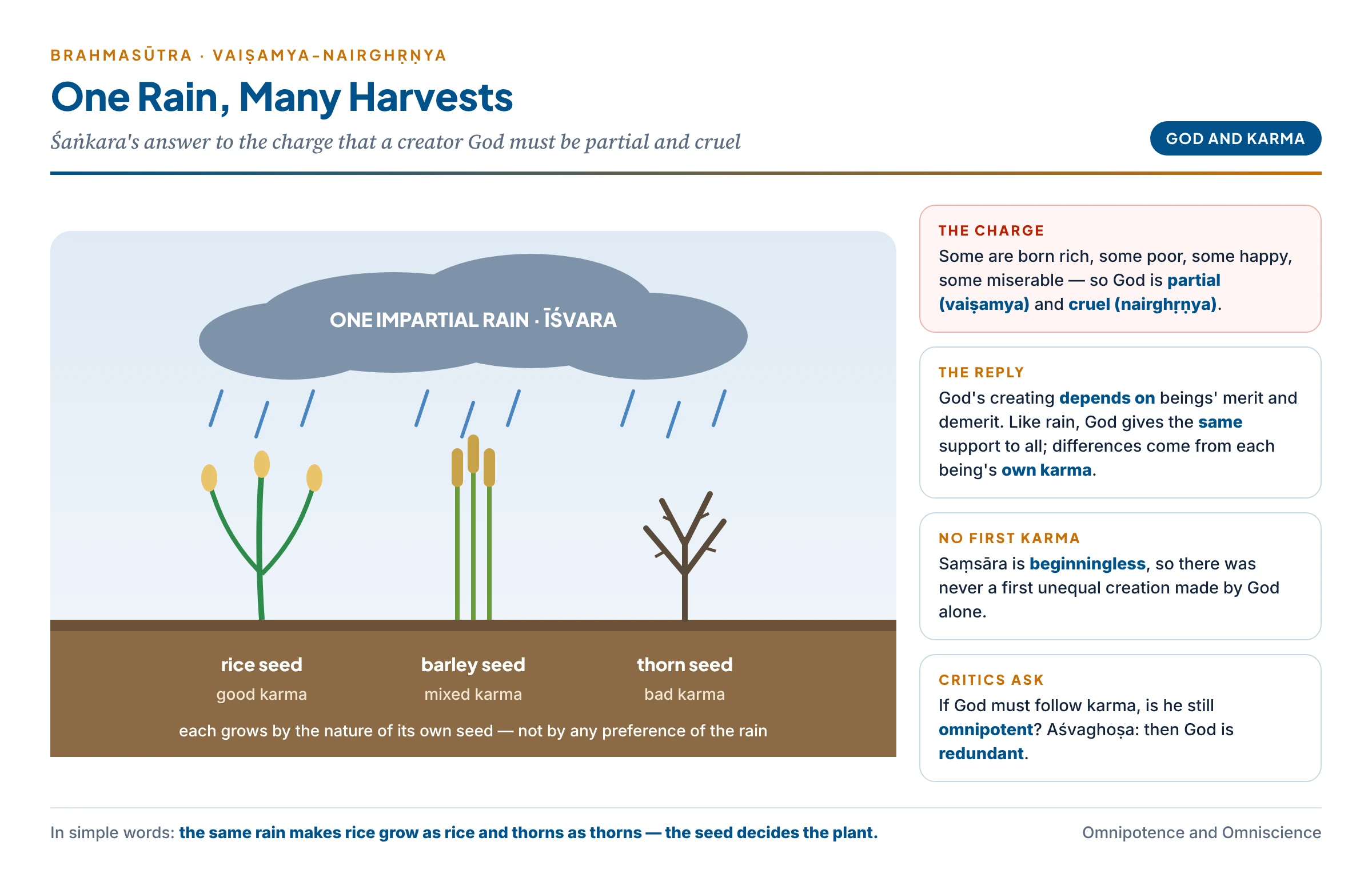
- Karma. God is the dispenser of the fruits of karma (karma-phala-dātā), not the author of inequality. Śaṅkara (on the Brahmasūtra) rejects the charge of partiality and cruelty (vaiṣamya-nairghṛṇya): God’s creation depends on the merit and demerit of beings, as rain helps every seed to sprout according to its own nature — rice as rice, barley as barley; the differences come from the seeds, not the rain. And since saṃsāra is beginningless, there is no “first” karma that God alone produced.
- Rāmānuja: God as inner controller (antaryāmin) gives the power to act and consents (anumati), but the soul makes the first effort; God responds to it.
- Madhva: each soul has an innate nature (svarūpa-yogyatā) which God only brings to expression — God is not responsible for that nature.
- Critics’ counter. If God’s power is conditioned by karma, is he still omnipotent? (Theists: a self-chosen law is an expression of power, not a limit.) And Aśvaghoṣa objects: if God is bound by karma he is unnecessary; if not bound, he is the author of evil; if virtue and vice both come from God, the very distinction between merit and demerit collapses.
What Does Omniscience Mean?
Omniscience (Latin omnis, all, and sciens, knowing) is the property of being perfect in knowledge.
- The classical view. God knows all things that are proper objects of knowledge. Since only true propositions can be known, God knows every true proposition and holds no false belief — every event, past, present and future. God’s knowledge is complete and infallible.
- How might God know the future?
- By decree. God knows the future because God ordains it: “God from all eternity did … freely and unchangeably ordain whatsoever comes to pass” (Westminster Confession). But then it is hard to see how our future can be up to us.
- Perceptual model. God “sees” past, present and future, as we see things. But if God is in time, there is no existing future to see.
- Conceptual model. God’s knowledge is self-contained, like innate ideas: God simply knows all things without acquiring knowledge from them.
Divine Foreknowledge and Human Freedom
- The argument against freedom.
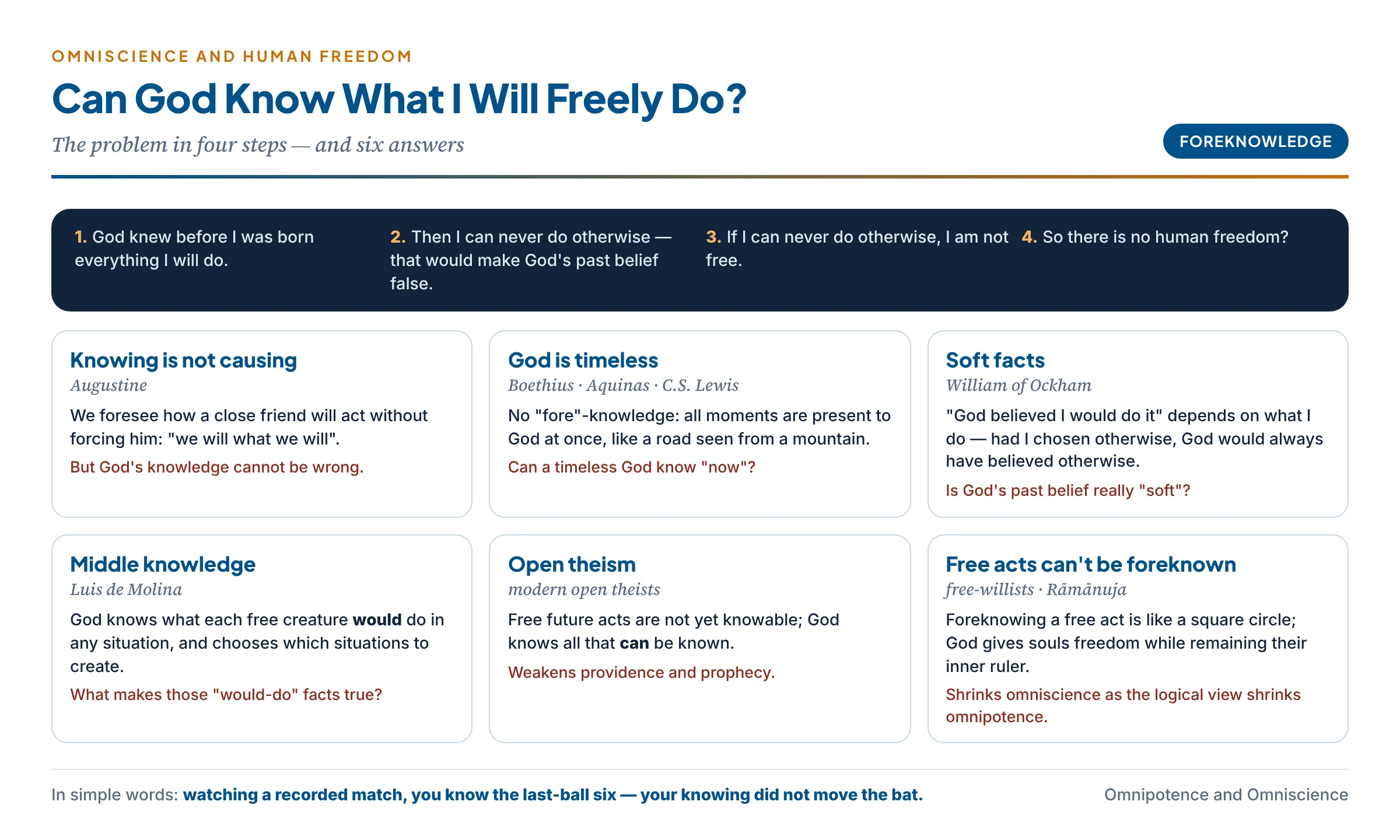
- God knew, before I was born, everything I will do.
- If God knew it, it is never in my power to do otherwise — for that would mean having the power to make God’s past belief false, that is, the power to change the past.
- If it is never in my power to do otherwise, I am not free.
- So there is no human freedom.
- Solution 1 — Foreknowledge is not a cause (Augustine). Knowing that something will happen does not make it happen. We often predict how a close friend will act without forcing him. “We will what we will” even when it is foreknown. Objection: human predictions can be wrong; God’s cannot, and infallible knowledge seems to fix the outcome.
- Solution 2 — God is timeless (Boethius, Aquinas, C.S. Lewis). God does not fore-know at all. All moments are present to God in one eternal “now”, as a person on a mountain sees the whole road and all the travellers on it at once, without making any traveller walk. Aquinas finds no incompatibility between human freedom and God’s knowledge.
- Solution 3 — Hard and soft facts (William of Ockham). Some facts are simply about the past (“In 1941 Japan attacked Pearl Harbor”). Others are about the past but not simply (“In 1941 a war began that lasted five years”) — they depend on what happens later; in 1943, statesmen still had the power to end the war, so that the 1941 fact would never have been a fact. “God believed, before I was born, that I would read this sentence” is a soft fact: had I chosen otherwise, God would always have believed otherwise. This is not changing the past; it is the past depending on the future.
- Solution 4 — Middle knowledge (Luis de Molina). Besides knowing what could happen and what will happen, God knows what each free creature would freely do in any situation. God then chooses which situations to create — keeping both providence and freedom. Objection: what grounds the truth of such “would-do” facts before the creature exists?
- Solution 5 — Open theism. If we have libertarian free will, there are future contingents — events that need not happen. Since they do not yet exist and need not happen, they cannot be known, even by an omniscient being. God is still omniscient: God knows everything that can be known — the past, the present, and whatever follows from them. Objection: this seems to shrink God and weaken providence and prophecy.
- Solution 6 — The free-willist answer. Foreknowledge of a free act is itself self-contradictory; God’s omniscience does not include it, just as omnipotence does not include square circles.
- An Indian solution — Rāmānuja. Even within a framework where the soul is God’s “body” and God is the antaryāmin who knows and controls everything, Rāmānuja holds that God has given souls free will; God’s control is the giving of power and permission, which the soul uses as it chooses.
In simple words
Suppose you watch a recorded cricket match after the result is known. You know the batsman will hit a six off the last ball — but your knowing does not move his bat; he hit it freely in the live game. Boethius and Aquinas say God’s knowledge of our acts is like watching from the “end” (or from above time): it records what we freely do; it does not cause it.
Is Free Will Compatible with an Omnipotent God?
- The worry. If God is omnipotent and the creator of everything, including our will, then our choices seem to be God’s doing — “puppets on God’s strings”.
- Answers.
- Self-limitation: an omnipotent God can choose to create beings with real freedom and to respect it — just as an all-powerful king can grant a free constitution. The power to create free beings is a greater power than the power to make puppets.
- Primary and secondary causation (Aquinas): God is the first cause that keeps the will in being; the will is the real second cause of its own choices. God works through freedom, not against it.
- Process theism: God’s power is persuasive; creatures have real power of their own, so freedom is built into reality.
- The Gītā holds both sides in tension: “The Lord dwells in the heart of all beings, causing them to revolve by his power as if mounted on a machine“, yet after teaching Arjuna everything Kṛṣṇa says, “Reflect on this fully, then do as you wish.” Divine control and human choice are affirmed together.
- Grace and effort in bhakti: the monkey school (the baby monkey must cling to its mother — human effort with grace) and the cat school (the mother cat carries the kitten — total dependence on grace) of later Śrīvaiṣṇavism show two ways of relating God’s power to human freedom.
- Critics’ view. If God foreknows and sustains every choice, compatibility needs either a compatibilist view of freedom (freedom = acting on one’s own desires, even if determined) or a limited God. Neither satisfies everyone.
Indian Debates on an All-Knowing, All-Powerful Lord
- Nyāya. Īśvara has eternal knowledge and is the all-powerful maker of the world from atoms; yet he works in accordance with karma (adṛṣṭa), not arbitrarily. He is the moral governor and the ultimate grantor of liberation.
- Yoga’s argument for omniscience. Knowledge and power come in degrees; whatever has degrees must have an upper limit; so there must be a being with unsurpassed knowledge — Īśvara, in whom “the seed of omniscience is unsurpassed“. And there can be only one such being, for many supreme beings could have conflicting purposes.
- Mīmāṃsā against an omniscient being. Kumārila argues that no means of knowledge can establish an omniscient person: perception reaches only present objects, inference needs a prior mark, and a self-proclaimed all-knower cannot be checked. The Veda, authorless and eternal, is the only source of knowledge of dharma.
- Jaina omniscience without a creator. Every soul, freed from karmic matter, becomes omniscient (kevalin); the Jainas affirm omniscience but deny an omnipotent creator. Jaina critics (e.g. Hemacandra, Guṇaratna) ask: if God is all-powerful and good, why create a world of misery? If he creates out of compassion, why not create only happy beings? If out of play, he is like a child.
- Buddhist arguments. Aśvaghoṣa and later Dharmakīrti reject an eternal, omnipotent creator: an eternal cause should produce all its effects at once; a perfect God has no motive to create; if creation is purposeless God is unintelligent, if it is for beings’ good it is self-contradictory (beings do not yet exist); if God is omnipotent, why are there atheists, and if God is one, why are there polytheists? Yet Buddhists call the Buddha sarvajña (all-knowing) in a practical sense: Dharmakīrti says what matters is that he knows what is to be avoided and what is to be sought — “whether he sees far or not, let him see what is wanted”.
- Vedānta. Brahman/Īśvara is omniscient (sarvajña) and omnipotent (sarva-śakti); for Advaita these belong to Īśvara through māyā, while the pure Brahman is consciousness itself, beyond the knower–known division.
Critical Evaluation
Objections (Pūrva-pakṣa)
- Logical incoherence. The stone paradox and Mackie’s paradox show that unlimited power is self-contradictory.
- Incompatibility with goodness. A being who cannot do evil has less power than one who can but refrains (the Oxford “innocent suffering” puzzle).
- Incompatibility with freedom. Infallible foreknowledge or total control leaves no room for genuine choice and so for moral responsibility.
- Incompatibility with evil. An omnipotent, omniscient, good God would prevent the gratuitous suffering we see (Mackie; William Rowe’s fawn dying in a forest fire).
- Incompatibility with immutability and timelessness. To know that “it is now 7 p.m.” God must change as time passes; a timeless, changeless God cannot know tensed facts.
- Indian critiques. Mīmāṃsā: no means of knowing an omniscient being; Buddhist and Jaina: an omnipotent creator is purposeless, partial or cruel; Aśvaghoṣa: karma makes God redundant.
Replies (Siddhānta)
- Correct definitions dissolve paradoxes. Omnipotence is power to do all that is possible and fitting; omniscience is knowledge of all that is knowable. Contradictions and changing the past are not “things”.
- Free will is a self-limitation, not a defeat. Creating free beings is a higher exercise of power.
- Timelessness, soft facts and middle knowledge each offer a coherent model of knowledge without compulsion.
- Karma and grace in Indian theism keep God impartial (the rain analogy) while preserving human responsibility.
- Process and open theism show that theists can revise the attributes rather than abandon God.
Common confusion
Does God’s foreknowledge cause what we do? No — that confuses knowing with causing. A weather forecaster who correctly predicts rain does not make it rain; a historian who knows Akbar won at Panipat did not make him win. The real puzzle is subtler: whether infallible knowledge of a future act is compatible with the agent’s power to do otherwise. Augustine, Boethius, Ockham and Molina offer different answers to that puzzle; none of them says foreknowledge is a cause.
Critics and Defenders
Criticism — Critics
- Epicurus, Hume — the dilemma of power, goodness and evil.
- J.L. Mackie — the inconsistent triad; the paradox of omnipotence; God could make beings who always freely choose good.
- Antony Flew — free will compatible with being determined to good.
- Open-theism critics of classical theism — infallible foreknowledge rules out freedom.
- Kumārila (Mīmāṃsā) — no means of knowledge proves an omniscient being.
- Aśvaghoṣa, Dharmakīrti, Hemacandra — an omnipotent creator is purposeless, partial or redundant.
Defence — Defenders and strengths
- Aquinas, Anselm, Swinburne — omnipotence is power over the possible; perfect, not mere, power.
- Mavrodes, Savage — the stone paradox is a pseudo-task.
- Augustine, Boethius, Ockham, Molina — models reconciling knowledge and freedom.
- Plantinga — the free-will defence; God cannot determine free acts.
- Śaṅkara, Rāmānuja, Madhva — karma, consent and innate nature keep God impartial and humans responsible.
- Hartshorne, Whitehead — persuasive power; God limits coercion to respect freedom.
Cross-Tradition Comparison
| Issue | Western theism | Indian thought |
|---|---|---|
| Meaning of omnipotence | Power over all that is logically possible (Aquinas); Descartes’ absolute power | Sarva-śakti of Īśvara; Madhva’s acintya-śakti; but works through karma |
| Limits | Logic, the past, others’ free acts, God’s own goodness | Karma (adṛṣṭa), the soul’s innate nature, beginningless saṃsāra |
| Omniscience | Knowledge of all truths; timeless knowing | Sarvajña Īśvara; Yoga’s proof from degrees; Jaina kevala-jñāna; Buddha’s practical omniscience |
| Freedom | Free-will defence; soft facts; middle knowledge; open theism | Puruṣakāra (effort) and grace; Gītā’s “do as you wish”; monkey and cat schools |
| Evil | Free will, soul-making, privation; process theodicy | Karma and rebirth; God as impartial rain (vaiṣamya-nairghṛṇya) |
| Strongest critics | Epicurus, Hume, Mackie, Rowe | Mīmāṃsā, Buddhists, Jainas, Cārvāka |
Indian Connect — Key takeaways
- Indian theists build a limit into omnipotence: God acts through karma, which makes God impartial but raises the question whether God is still all-powerful.
- The Yoga argument from degrees and the Jaina idea of the omniscient kevalin separate omniscience from creatorship — something Western theism rarely does.
- The Gītā’s pairing of the Lord who “turns all beings as on a machine” with “do as you wish” is a classic statement that divine sovereignty and human freedom must be held together.
Synthesis (Siddhānta)
- Definitions matter. Most paradoxes of omnipotence attack a definition — “able to do absolutely anything” — that serious theists do not hold. Understood as perfect power over all that is possible, omnipotence survives the stone, the square circle and the past.
- The real challenges are freedom and evil. These are not puzzles of logic but questions about what kind of world an all-powerful, all-knowing, good God would make. The best replies — free will, timeless knowledge, soft facts, karma — show consistency, not proof.
- Self-limitation is the key idea. Both the free-will defence and Indian karma-theology say God chooses to work through the freedom and the deeds of creatures. This makes God less a tyrant and more a lover who respects the beloved, but invites the question whether such a God still “controls” history.
- Revision is possible. Process and open theism show that theists may modify the classical attributes in the light of freedom and suffering — a God of persuasive power and open future.
- Contemporary relevance. Debates on determinism in neuroscience and AI, on responsibility, and on suffering in disasters and pandemics give these old questions new urgency. The balanced view affirms divine perfection and human responsibility, and admits that the problem of evil is finally met as much by practice and faith as by argument.
“Reflect on this fully, and then do as you wish.” — Bhagavad Gītā
Previous Year Questions
- 2026Present an account of criticisms against omniscience and omnipotence as attributes of God.
- 2022If God is the Absolute Creator, then the responsibility of the evil cannot belong to the human agent. Critically examine.
- 2021Discuss the paradox of omnipotence of God in the context of the existence of evil.
- 2020Is there any compatibility between ‘Freedom of Will’ and ‘Omnipotent God’? Discuss.
- 2007God is not the subject to the law of logic. Critical notes.
- 2007Traditionally omnipotence has been seen as one of the attributes of God. But, according to some critic, the notion of omnipotent being is paradoxical. In response some theist has tried to resolve the alleged paradox. Describe the paradox and explain the attempt to resolve it.
- 2006Traditionally omnipotence has been seen as one of the attributes of God. But, according to some critic, the notion of omnipotent being is paradoxical. In response some theist has tried to resolve the alleged paradox. Describe the paradox and explain the attempt to resolve it.