

Caste Discrimination: Gandhi and Ambedkar.
Official Syllabus: Paper II, Section A, Unit 10
The debate between Gandhi and Ambedkar is the most important philosophical argument in modern Indian social thought. Both wanted to end untouchability; both were committed to non-violence and democracy; yet they disagreed on almost everything else — the meaning of varṇa, the nature of Hinduism, the role of religion, the village, the state and the law, the value of separate electorates, the agent of change (the caste Hindu’s conscience or the untouchable’s own power), and even the name of the oppressed. This article reconstructs the debate in its historical stages (the Round Table Conference, the Communal Award, the Yerawada fast and Poona Pact, the 1936 exchange over Annihilation of Caste, Ambedkar’s 1945 indictment), sets out the basic differences point by point, shows where they converged, compares their views on secular democracy, and asks what each got right.
In simple words
Two doctors attend the same patient — an old house with a cracked foundation. One, who grew up in the house and loves it, says: “The house is sound; the cracks are later additions. Let the family repent its neglect and repair them.” The other, who was made to live in its cattle-shed, says: “The cracks are in the foundation; I have lived with them all my life. Either rebuild the foundation, or I will leave and build elsewhere.” That is the Gandhi–Ambedkar debate: reform from love of the house versus rebuild from the experience of its basement.
Context & Problem
Two Standpoints
- Gandhi spoke as a caste Hindu reformer — a sanātanī Hindu who saw untouchability as the sin of his own community, to be removed by its penance and change of heart (Articles 3–4).
- Ambedkar spoke as an untouchable — one who had felt caste from below, and who saw it as a system of power sanctified by religion, to be annihilated by the self-organisation of the oppressed, by law, and if necessary by leaving Hinduism (Articles 5–7).
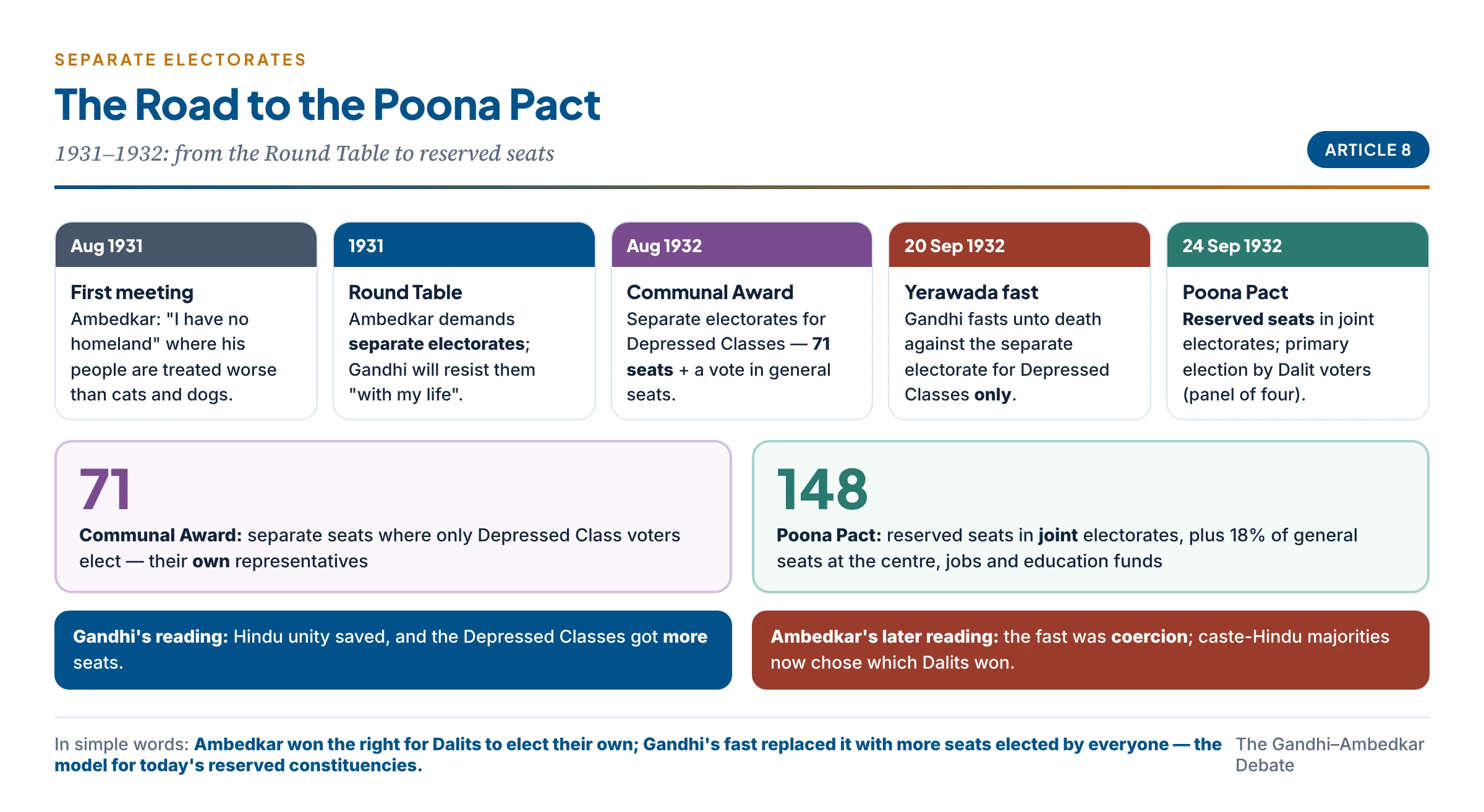
- Their first meeting (August 1931) captures the gap: when Gandhi spoke of the motherland, Ambedkar replied that he had no homeland — how could he call a land and a religion his own where his people were treated worse than cats and dogs, and were not allowed even to drink water?
Core Doctrine
The Stages of the Debate
1. The Round Table Conference (1931) — who represents the untouchables?
- Ambedkar demanded separate electorates for the Depressed Classes — constituencies in which only they would vote for their own representatives — because representatives elected by caste-Hindu majorities would be caste-Hindu nominees.
- Gandhi claimed that the Congress — and he himself — represented the untouchables; separate electorates would vivisect Hinduism and fix the untouchables as a separate community for ever. He would not sell the vital interests of the untouchables “even for the sake of winning the freedom of India”, and would resist separate electorates “with my life”.
2. The Communal Award (August 1932)
- The British Prime Minister Ramsay MacDonald‘s award gave the Depressed Classes separate electorates (71 seats in the provincial legislatures) plus a vote in the general constituencies — a “double vote”.
3. The Yerawada fast and the Poona Pact (September 1932)
- Gandhi began a fast unto death in Yerawada jail (20 September 1932) against the separate electorate for the Depressed Classes.
- The pressure on Ambedkar: Gandhi’s death would have been blamed on him and might have exposed Dalits to violence across India. After days of negotiation he signed the Poona Pact (24 September 1932).
- The terms:
- No separate electorates; instead reserved seats for the Depressed Classes within joint electorates.
- 148 reserved seats in the provincial legislatures (instead of 71); 18% of the general seats in the central legislature.
- A two-stage election for reserved seats: a primary election in which only Depressed Class voters chose a panel of four candidates, followed by election in the joint electorate.
- Fair representation in public services and earmarked funds for education.
- Two readings:
- Gandhi’s: the Pact saved Hindu unity and gave the Depressed Classes more seats.
- Ambedkar’s (later): the fast was coercion; reserved seats in joint electorates let caste-Hindu majorities choose which Dalits would win, so Dalit legislators became dependent on caste-Hindu parties. In 1945 he wrote that there was nothing noble in the fast — “it was a foul and filthy act”.
- Legacy: reserved seats in joint electorates became the model for Articles 330 and 332 of the Constitution.
In simple words
Imagine a class where the back-benchers are allowed to elect their own class monitor. Then the rule is changed: they get two monitor posts instead of one — but the whole class votes, and the front-benchers are the majority. More posts, but the front-benchers now decide which back-benchers become monitors. That, in a nutshell, is why Gandhi saw the Poona Pact as a gain and Ambedkar came to see it as a loss.
4. The Harijan campaign and Ambedkar’s distance (1932–1935)
- Gandhi launched the Harijan Sevak Sangh; Ambedkar, briefly associated with it, wanted it to fight for civil rights (access to wells, schools, jobs) rather than offer charity, and found that it was run by caste Hindus as a body of penitents — he withdrew.
- At Yeola (1935) he announced that he would not die a Hindu; Gandhi replied that religion is not a house or a cloak to be changed at will.
5. The exchange over Annihilation of Caste (1936–37) Gandhi’s “A Vindication of Caste” (Harijan, July 1936)
- Respect for the challenge: Ambedkar’s indictment is a challenge every Hindu must take seriously.
- The texts quoted are not authoritative: many passages are interpolations; what is contrary to reason and morality cannot be scripture.
- Judge a religion by its best: a religion is to be judged not by its worst specimens but by the best it has produced — the saints Caitanya, Jñānadeva, Tukārām, Tiruvalluvar, Ramakrishna and others.
- Caste has nothing to do with religion: it is a custom, harmful to spiritual and national growth.
- Varṇa and āśrama are healthy: the law of varṇa teaches that each of us must earn our bread by following the ancestral calling; it defines duties, not rights; all callings are equal.
- Untouchability is a sin that must and will go.
Ambedkar’s “A Reply to the Mahatma” (1937)
- The masses follow the śāstras as they are: arguing about authentic and interpolated texts is futile; ordinary Hindus observe caste because they believe the śāstras command it.
- The saints did not fight caste: they preached spiritual equality before God but never campaigned against caste and untouchability in society; the test of a religion is the conduct of the ordinary man, not of a few saints.
- Varṇa is caste under another name: a law of hereditary calling is bondage — the son of a scavenger is compelled to remain a scavenger.
- Gandhi’s own life refutes his varṇa: born a Bania, he never followed trading; he became a lawyer and politician. If the Mahatma does not follow his ancestral calling, why must the scavenger?
- Varṇa is impossible and degrading (the critique of cāturvarṇya, Article 6).
6. Ambedkar’s indictment (1943–45)
- In What Congress and Gandhi Have Done to the Untouchables (1945) Ambedkar argued that Gandhi’s anti-untouchability campaign was a political strategy to keep the untouchables within the Hindu fold and the Congress, not a programme of emancipation.
- “Gandhism is a paradox”: it seeks freedom from foreign domination — destroying the existing political structure — while trying to keep intact a social structure that allows the domination of one class by another on hereditary grounds.
- He objected to the name Harijan as patronising: “soothing names” do not change status.
The Basic Differences
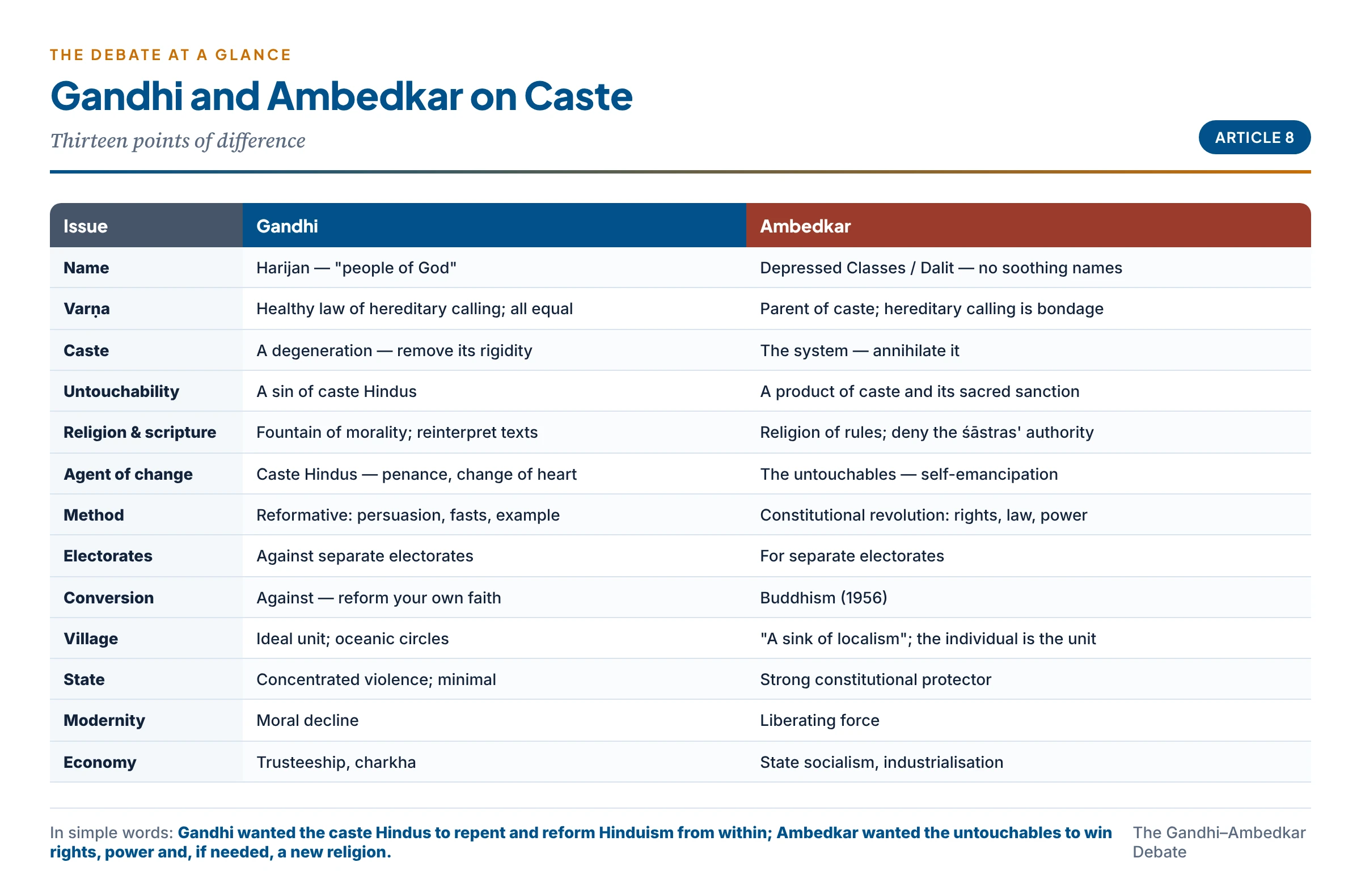
| Issue | Gandhi | Ambedkar |
|---|---|---|
| Name of the oppressed | Harijan — “people of God” | Depressed Classes, untouchables, Scheduled Castes (later Dalit) — soothing names serve no purpose |
| Varṇa | A healthy law of hereditary calling; duties without privilege; all equal | Varṇa is the parent of caste; hereditary calling is bondage; cāturvarṇya impossible and degrading |
| Caste (jāti) | A degeneration, an excrescence — remove its rigidity | The system itself — must be annihilated |
| Untouchability | A sin of caste Hindus; not part of true Hinduism | A product of the caste system and its sacred sanction |
| Religion | The fountain of morality; to be followed faithfully and reformed from within | Must be judged by reason and morality; Hinduism is a religion of rules, to be replaced by a religion of principles — or left |
| Scripture | Reinterpret; reject interpolations | Deny the authority of the śāstras |
| Agent of change | Caste Hindus, through penance and change of heart | The untouchables themselves — self-emancipation |
| Method | Reformative: persuasion, fasting, example, gradual social reform | Revolutionary (but constitutional): rights, law, political power, education, agitation |
| Separate electorates | Opposed — would divide Hindus permanently | Demanded — the socially segregated need their own political voice |
| Conversion | Opposed — reform your own religion | The final remedy — Buddhism (1956) |
| Village | The ideal unit — village republics, oceanic circles | “A sink of localism, a den of ignorance” — the individual is the unit |
| State | Concentrated violence; minimal state; enlightened anarchy | A strong, democratic, constitutional state to protect individuals from social tyranny |
| Modern civilisation | Industrialisation and urbanisation bring moral decline | Modernisation is a liberating force — untouchables should use it fully |
| Economy | Trusteeship, charkha, village industries | State socialism, land reform, industrialisation |
| Programme | Persuade Hindus to accept the dignity of labour and fraternise with Harijans | Untouchables to shed inferiority, challenge irrational beliefs, use state welfare and education |
| Underlying philosophy | Spiritual — the search for Truth, harmony of classes | Social justice — liberty, equality, fraternity; justice before harmony |
In simple words
Imagine a factory where one group of workers has been made to do the dirtiest jobs for generations. Gandhi goes to the owners and says, “You have sinned; repent, share your lunch with them, honour their work.” Ambedkar goes to the workers and says, “Get educated, form a union, win seats on the board, change the factory rules — and if the owners’ rulebook says you are born to clean, burn the rulebook.” Both want the humiliation to end. They differ on who must act and what must change.
Why They Differed — Deeper Roots
- Standpoint: Gandhi saw caste from above as a moral failing of his own community; Ambedkar from below, as a structure of domination.
- Philosophy of change: Gandhi’s ends–means and satyāgraha required converting the oppressor; Ambedkar’s liberal-constitutional view required rights that do not depend on the oppressor’s goodwill.
- View of religion: for Gandhi, Hinduism’s essence (Truth, ahiṃsā) was pure and caste a corruption; for Ambedkar, caste was sanctified by Hinduism’s own texts, so the religion itself had to change.
- View of modernity: Gandhi’s critique of modern civilisation versus Ambedkar’s faith in modern education, law, cities and industry as escape routes from caste.
- Unity vs justice: Gandhi feared that separate electorates and conversion would break Hindu and national unity; Ambedkar held that unity built on injustice is not worth preserving.
- Matter and spirit? Many notes say Ambedkar was a “materialist” and Gandhi a “spiritual” teacher — more precisely, Ambedkar was a rationalist concerned with socio-economic justice who nevertheless saw the need for a religion of principles (Article 7).
Common confusion
Did Gandhi oppose separate electorates for all communities, and did Ambedkar “betray” the untouchables at Poona? Neither is accurate. Gandhi’s 1932 fast was against separate electorates for the Depressed Classes only — he had accepted the Communal Award’s separate electorates for Muslims and others as a fact. And Ambedkar did not betray his people: under the threat of Gandhi’s death (and possible reprisals against Dalits) he negotiated 148 reserved seats — more than double the Award’s 71 — and a primary election in which only Dalits chose the panel. He later regretted the loss of separate electorates and criticised the fast as coercion.
Points of Convergence
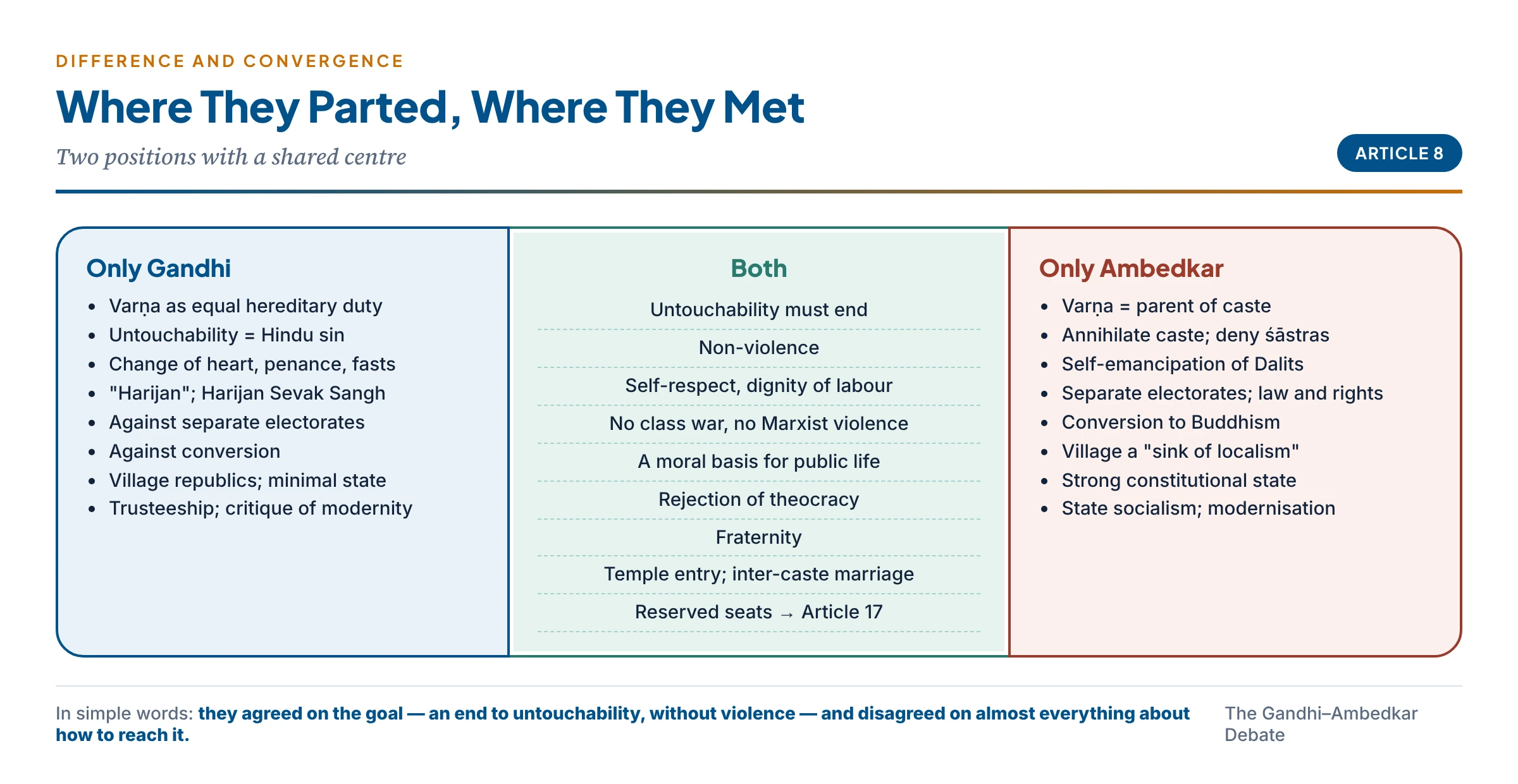
- Both condemned untouchability as a moral and social evil, and both made its abolition a national issue.
- Both were non-violent: Gandhi through satyāgraha; Ambedkar through constitutional means — he called unconstitutional methods the “grammar of anarchy” and preferred the Buddha’s persuasion to Marx’s violence.
- Both stressed self-respect and dignity of labour: Gandhi honoured the scavenger’s work; Ambedkar asked Dalits to refuse degrading tasks and raise their self-respect — both asked the untouchables to give up carrion-eating and degrading customs.
- Both rejected class war and Marxist violence.
- Both believed in a moral and religious foundation for public life — Gandhi in Truth, Ambedkar in the Buddha’s Dhamma; both rejected theocracy.
- Both valued fraternity: Gandhi’s sarvodaya and Ambedkar’s social endosmosis both aim at a society of mutual respect.
- Both supported temple entry and inter-caste marriage — Gandhi from 1946 would bless only marriages with a Harijan partner; Ambedkar called inter-marriage the real remedy.
- Both shaped the outcome: the Poona Pact’s reserved seats became the constitutional model; Article 17 abolished untouchability; the Constitution reflects Gandhi’s moral climate and Ambedkar’s legal architecture.
Gandhi and Ambedkar on the Philosophical Foundations of Secular Democracy
Gandhi
- Religion as morality: religion, understood as Truth and non-violence, must inform public life — “politics without religion is a death-trap” — but no particular religion should rule.
- Separation of state and religion: religion is a personal affair; the state should look after secular welfare; if he were dictator, religion and state would be separate.
- Sarva Dharma Samabhāva: equal respect for all religions — secularism as a fellowship of religions.
- Democracy as swaraj: decentralised, non-violent, built on duties and village self-rule; the minority’s safety rests on the goodwill of the majority.
Ambedkar
- Secular state, not anti-religious state: a secular state does not mean that it ignores the religious sentiments of the people; it means that the state may not impose any particular religion on the people.
- The state may reform religion for justice: religious practices that deny equality (untouchability, temple exclusion, women’s disabilities) can and must be regulated — hence Article 17, Article 25(2)(b) and the Hindu Code Bill.
- Constitutional morality above social and religious morality; fraternity as the soul of democracy.
- Safeguards against communal majorities: in India the majority is communal, so minorities need constitutional guarantees, not goodwill.
- Buddhist ethics — prajñā, karuṇā, samatā — as the moral basis of democracy.
Is there a difference? Yes, in foundation and method, though both reject theocracy and want religion’s moral content in public life:
| Point | Gandhi | Ambedkar |
|---|---|---|
| Moral foundation | Truth, ahiṃsā — a reformed Hinduism open to all faiths | Liberty, equality, fraternity — from the Buddha and constitutional morality |
| State and religion | Separate; state neutral; reform by persuasion | Neutral but interventionist where religion denies equality |
| Minorities | Majority’s goodwill and duties | Constitutional safeguards and representation |
| Unit of democracy | The village, the community | The individual citizen |
| Secularism means | Equal respect for all religions | No state religion + social reform through law |
In simple words
Two hosts promise to treat guests of every faith equally. One says, “I respect every guest’s prayers, and I will persuade my family to behave well.” The other says, “I respect every guest’s prayers — and I am writing house rules, so that if anyone in my family insults a guest, the rules protect him, whatever my family feels.” Both are secular hosts; Gandhi was the first, Ambedkar the second.
Critical Evaluation
What Each Got Right
Gandhi
- Caste lives in hearts and habits; laws without moral change stay on paper — the persistence of untouchability after 1950 proves him partly right.
- He moved millions of caste Hindus to see untouchability as a sin and made it a national cause.
- Non-violence prevented the caste question from becoming a civil war.
Ambedkar
- Caste is a structure of power and endogamy sanctified by religion; moral appeals alone leave it intact.
- The oppressed must be agents of their own liberation, with enforceable rights and political power.
- Varṇa cannot be cleaned of hierarchy; hereditary calling is bondage.
- Modern institutions — education, law, cities, industry — are the real escape routes from caste.
Assessment
- From the socio-economic and political perspective Ambedkar’s views are more realistic; from the moral and spiritual perspective Gandhi’s appeal to conscience remains important. The solution lies in combining Gandhi’s moral persuasion with Ambedkar’s structural and legal approach — which is, in effect, what the Constitution attempted.
- But the balance has tilted: on the core questions — varṇa, the village, the need for law and representation, inter-marriage — later history (including Gandhi’s own late turn to inter-caste marriage) moved towards Ambedkar’s position.
Critics and Defenders
Criticism — Ambedkar’s critique of Gandhi
- Varṇa is caste: “a law of ancestral calling” is a law of bondage — and Gandhi himself did not follow it.
- Paternalism: “Harijan” and the Harijan Sevak Sangh made Dalits objects of caste-Hindu charity.
- Coercion: the 1932 fast forced Dalits to give up separate electorates.
- Saints are not the test: the conduct of ordinary Hindus, shaped by the śāstras, is.
- Gandhism is a paradox: political freedom with social domination.
Defence — Gandhi’s case (and his defenders’)
- Unity: separate electorates would have vivisected Hindu society and the nation.
- Morality: lasting change must come from the heart of the oppressor; law alone cannot make people treat others as equals.
- Judge a religion by its best, and reform it from within; caste is a custom, not religion.
- Growth: Gandhi moved steadily towards inter-caste marriage and the abolition of caste.
- Complementarity: his moral campaign made Ambedkar’s constitutional provisions acceptable to the majority.
Cross-Tradition Comparison
| Theme | Gandhi–Ambedkar | Western parallel |
|---|---|---|
| Reform from within vs exit | Reform Hinduism vs convert to Buddhism | Albert Hirschman‘s “voice vs exit”; Luther reforming vs breaking from the Church |
| Conscience vs rights | Change of heart vs enforceable rights | Martin Luther King (appeal to conscience) vs Malcolm X (self-assertion, self-defence); the abolitionist Douglass: “power concedes nothing without a demand” |
| Moral persuasion vs law | Satyāgraha vs constitution | King: “the law cannot make a man love me, but it can keep him from lynching me” |
| Representation | Joint vs separate electorates | Debates on minority representation and majority–minority districts in the United States |
| Community vs individual | Village republic vs individual citizen | Communitarians vs liberals (Sandel vs Rawls) |
Indian Connect — Indian Connect — the synthesis in the Constitution
- Article 17 (abolition of untouchability) — Gandhi’s moral cause, Ambedkar’s legal drafting.
- Articles 330 and 332 (reserved seats) — the Poona Pact made permanent.
- Article 25(2)(b) (temple entry) and the Hindu Code laws — Ambedkar’s reform of religion through law, building on Gandhi’s temple-entry campaigns.
- Article 40 (village panchayats) — Gandhi’s vision as a directive principle; the individual as the bearer of fundamental rights — Ambedkar’s.
Synthesis (Siddhānta)
- The debate unfolded in stages — the Round Table (separate electorates), the Communal Award, the Yerawada fast and Poona Pact (148 reserved seats in joint electorates), the Harijan campaign, the 1936–37 exchange (“A Vindication of Caste” vs “A Reply to the Mahatma”), and Ambedkar’s 1945 indictment (“Gandhism is a paradox”).
- Basic differences: varṇa (healthy law vs parent of caste), caste (excrescence vs system), untouchability (Hindu sin vs product of caste), religion (reform vs reject authority), agent (caste Hindus vs the untouchables), method (reformative persuasion vs constitutional revolution), electorates, conversion, village, state, modernity and economy — rooted in standpoint (above vs below) and in philosophy of change.
- Convergence: anti-untouchability, non-violence, dignity and self-respect, rejection of class war, a moral basis for public life, fraternity, inter-caste marriage, and the shared outcome of reserved seats and Article 17.
- Secular democracy: both reject theocracy and want religion’s moral content in public life; Gandhi grounds it in Truth and equal respect for all faiths, Ambedkar in constitutional morality, fraternity, minority safeguards and state-led social reform.
- Assessment: Gandhi’s moral persuasion and Ambedkar’s structural transformation are complementary, but on the key questions of varṇa, law and representation, history has largely vindicated Ambedkar — while Gandhi’s insistence that caste must die in the heart remains true.
“I would not sell the vital interests of the untouchables even for the sake of winning the freedom of India.” — M.K. Gandhi, Round Table Conference, 1931
Previous Year Questions
- 2025Present a detailed account of the debate between Gandhi and Ambedkar on the issue of caste discrimination.
- 2019Examine whether there is any difference between the views of Mahatma Gandhi and Dr. Babasaheb Ambedkar on the philosophical foundations of secular democracy.
- 2014What are the basic differences between Gandhi and Ambedkar regarding caste discrimination?
- 2012What were Gandhi’s views on varna and jāti? Critically discuss Ambedkar’s disagreement with Gandhi’s treatment of varna.