

Caste Discrimination: Gandhi and Ambedkar.
Official Syllabus: Paper II, Section A, Unit 10
Ambedkar was not only a critic of caste but a builder of remedies. Where Gandhi relied on the conscience of caste Hindus, Ambedkar relied on the self-organisation of the oppressed, on law and the state, on economic transformation, and finally on a new religion of equality. “Educate, agitate, organise” summed up his method; the Constitution of India and the Hindu Code Bill were his legal monuments; Navayāna Buddhism was his spiritual answer. This article traces the phases of his struggle, his measures for eliminating caste discrimination, his ideas on Dalit revolution, democracy, constitutional morality, the state, socialism and women, his role as constitution-maker, his conversion to Buddhism and his reading of “Buddha or Karl Marx” — “man must grow materially as well as spiritually” — and assesses his contribution to social change in independent India.
In simple words
If a river regularly floods one village, you can pray that it will change course, or you can build embankments, dig channels and move the village to higher ground. Ambedkar respected moral appeals, but he trusted embankments: schools that lift people out of hereditary work, laws that punish discrimination, seats in legislatures that give the oppressed a voice, jobs and land that end dependence, and a religion that does not tell them they deserve to suffer.
Context & Problem
Ambedkar’s Perspective — School of Thought
- Primarily a liberal: a great advocate of the rule of law, constitutional methods and individual rights; he preferred constitutional means for the redressal of grievances.
- Later a democratic socialist: political democracy cannot survive without social and economic democracy.
- Finally a Buddhist: morality and fraternity need a religious foundation of reason and compassion.
- Self-emancipation: the cause of the untouchables can be promoted only by the untouchables themselves — not by caste-Hindu charity.
- A threefold strategy: social uplift, political enlightenment and spiritual awakening of the untouchables.
- Recognition: Nehru called him a symbol of revolt against all the oppressive features of Hindu society; for his role in framing the Constitution he is often called the “modern Manu” — the law-giver who replaced the old law of inequality with a law of equality.
Core Doctrine
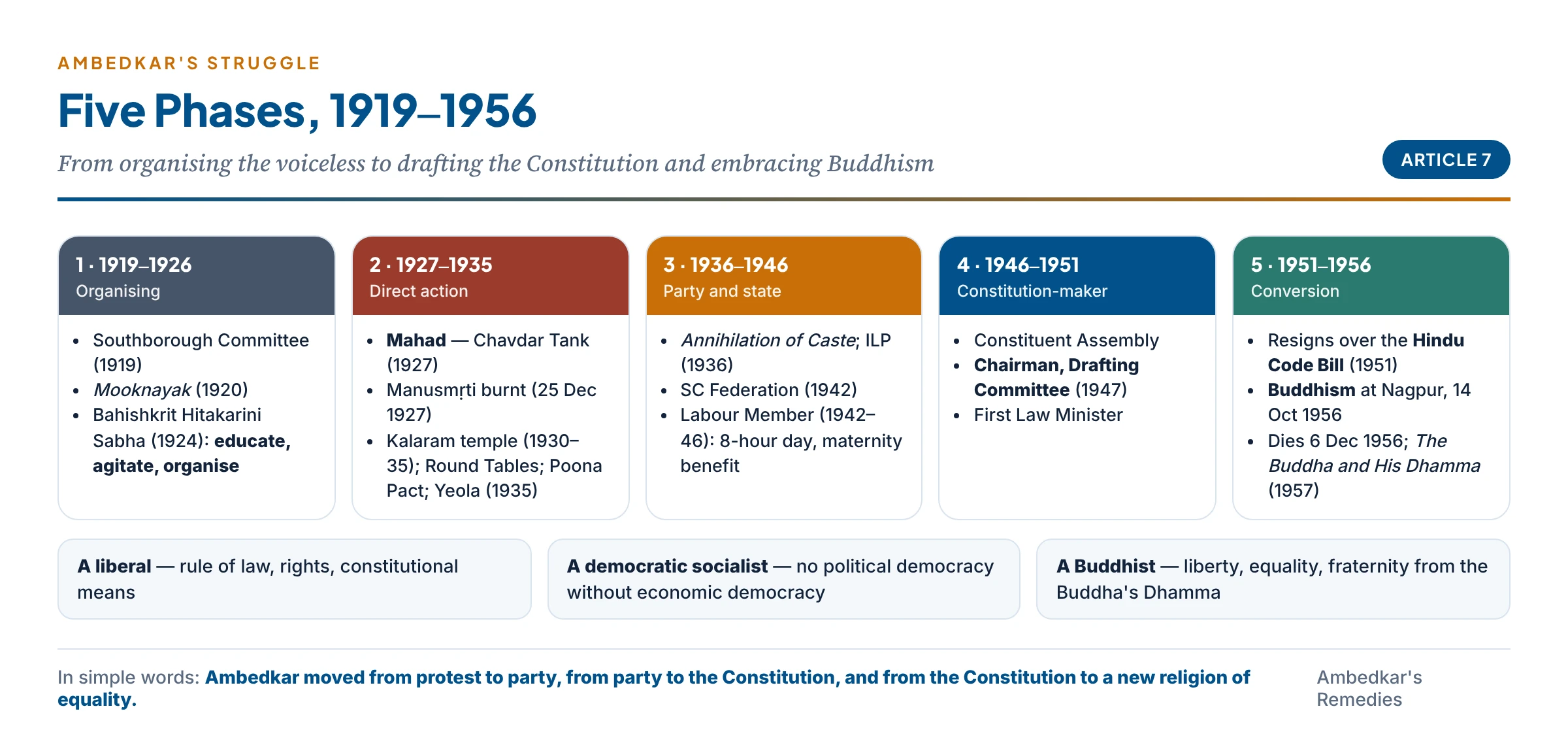
The Phases of Ambedkar’s Struggle
Phase 1 — Organising the untouchables (about 1919–1926)
- Evidence before the Southborough Committee (1919) on franchise, demanding separate representation for the Depressed Classes.
- Newspapers: Mooknayak (“Leader of the Voiceless”, 1920), later Bahishkrit Bharat (1927).
- Bahishkrit Hitakarini Sabha (1924), whose motto became “Educate, Agitate, Organise”; depressed-class conferences; petitions to the government for education and civic rights.
Phase 2 — Direct action (1927–1935)
- Mahad Satyagraha (March 1927): the Bombay Legislative Council had resolved (1923) that untouchables could use public water sources; when Ambedkar led thousands to drink from the Chavdar Tank at Mahad, caste Hindus attacked them and “purified” the tank.
- Burning of the Manusmṛti (25 December 1927) at the second Mahad conference — a public rejection of the law of inequality; this marks his acceptance as the leader of the untouchables.
- Kalaram Temple Satyagraha at Nashik (1930–35) for temple entry.
- Round Table Conferences (1930–32): demand for separate electorates; the Communal Award (1932) granted them; Gandhi’s fast forced the Poona Pact (Article 8).
- Yeola declaration (1935): “I was born a Hindu because I had no control over this, but I shall not die a Hindu.”
Phase 3 — Party politics and opposition to the Congress (1936–1946)
- Annihilation of Caste (1936); Independent Labour Party (1936) — combining caste and class issues; Scheduled Castes Federation (1942).
- Labour Member of the Viceroy’s Executive Council (1942–46): reduced the working day to eight hours, supported maternity benefit for women workers and employment exchanges.
- Sharp critiques of the Congress and Gandhi — Mr. Gandhi and the Emancipation of the Untouchables (1943), What Congress and Gandhi Have Done to the Untouchables (1945).
Phase 4 — Constitution-maker (1946–1951)
- He set aside the demand for separate electorates and co-operated with the Congress in making the Constitution: member of the Constituent Assembly, Chairman of the Drafting Committee (August 1947), and independent India’s first Law Minister.
Phase 5 — Disillusionment and conversion (1951–1956)
- Resigned from the cabinet (1951) when the Hindu Code Bill was stalled by orthodox opposition.
- Concluded that within Hinduism there was no solution to caste and untouchability; embraced Buddhism at Nagpur on 14 October 1956 with several lakh followers; died on 6 December 1956. The Buddha and His Dhamma was published in 1957. He was awarded the Bharat Ratna in 1990.
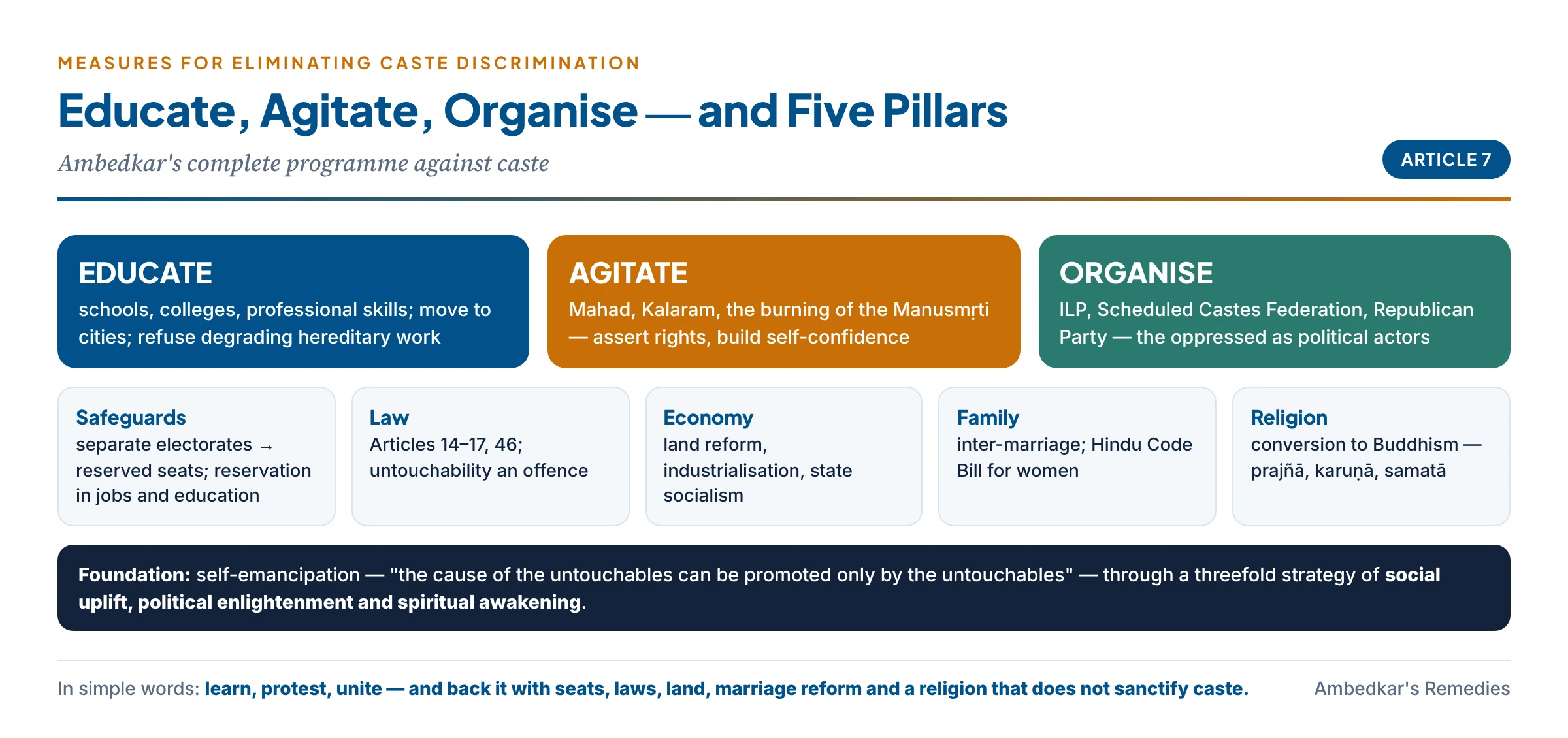
Measures for Eliminating Caste Discrimination
1. Self-help by the untouchables (his five practical steps)
- Refuse traditional “untouchable” work — carrying carcasses, scavenging, eating carrion — which kept them in degradation.
- Become educated and professionally qualified, and move to the cities, where caste is weaker and modern jobs are open.
- Be represented at all levels of government by their own representatives.
- The state must play a positive role in the welfare of all citizens.
- Abolish caste — even priestly functions should be performed by trained persons of any caste under state supervision.
2. Education — “Educate”
- Education as the key to self-respect and mobility; he founded the People’s Education Society (1945), Siddharth College in Bombay (1946) and Milind College in Aurangabad (1950).
3. Agitation — “Agitate”
- Satyāgraha for rights: Mahad (water), Kalaram (temple), the burning of the Manusmṛti — not to win the oppressor’s heart but to assert rights and build the self-confidence of the oppressed.
4. Organisation — “Organise”
- Political organisation of the oppressed: the Independent Labour Party, the Scheduled Castes Federation, and (planned by him, founded after his death) the Republican Party of India.
5. Political safeguards
- Separate electorates (later accepted as reserved seats): those who are socially segregated should be politically represented by people of their own choice.
- Reservation in legislatures, education and public employment — written into the Constitution.
6. Law and the Constitution
- Abolition of untouchability (Article 17), prohibition of discrimination (Articles 15 and 16), equality before law (Article 14), promotion of the educational and economic interests of the weaker sections (Article 46), reserved seats (Articles 330, 332), special officers and commissions.
7. Economic transformation
- Land reform, industrialisation, state ownership of key industries — breaking the economic dependence of the landless untouchables on landowners (see State Socialism below).
8. Inter-marriage and annihilation of the sacred basis of caste (Article 6).
9. Conversion — a new religion of equality (see Navayāna below).
10. Women’s rights — the Hindu Code Bill; Dalit women’s dignity.
In simple words
Gandhi’s method was like a teacher trying to make a bully feel ashamed. Ambedkar’s method was like a lawyer and union leader working with the bullied: teach them (educate), protest with them (agitate), unite them (organise), get the school rules changed (law), give them their own place on the student council (representation) — and if the school itself teaches that bullying is holy, change schools (conversion).
The Dalit Revolution
- Indian society on the verge of collapse: its regeneration cannot be postponed, and the caste Hindus are unfit to lead it.
- Dalits as the new proletariat: in India a genuine proletariat in the Marxist sense does not exist; the Dalits are the most oppressed — victims of caste, feudalism, capitalism and imperialism at once — and so the vanguard of revolution; their revolutionary potential is greater than that of the Western proletariat because society gives them no opportunity to rise.
- True democracy will come when the untouchables come out of their deep slumber and struggle for dignity.
- The technique: revolution through constitutional means — law, representation, education — not violence.
- Critical evaluation: critics on the left said his acceptance of Buddhism showed political passivism and pacifism; the Poona Pact was a political defeat; despite leading the oppressed he did not adopt the philosophy of class struggle. Yet mainstream revolutions are violent, and Ambedkar’s non-violent constitutional revolution — like Gandhi’s peaceful one — achieved lasting change; his contribution to Dalit emancipation is undeniable.
Democracy — Political, Social, Economic
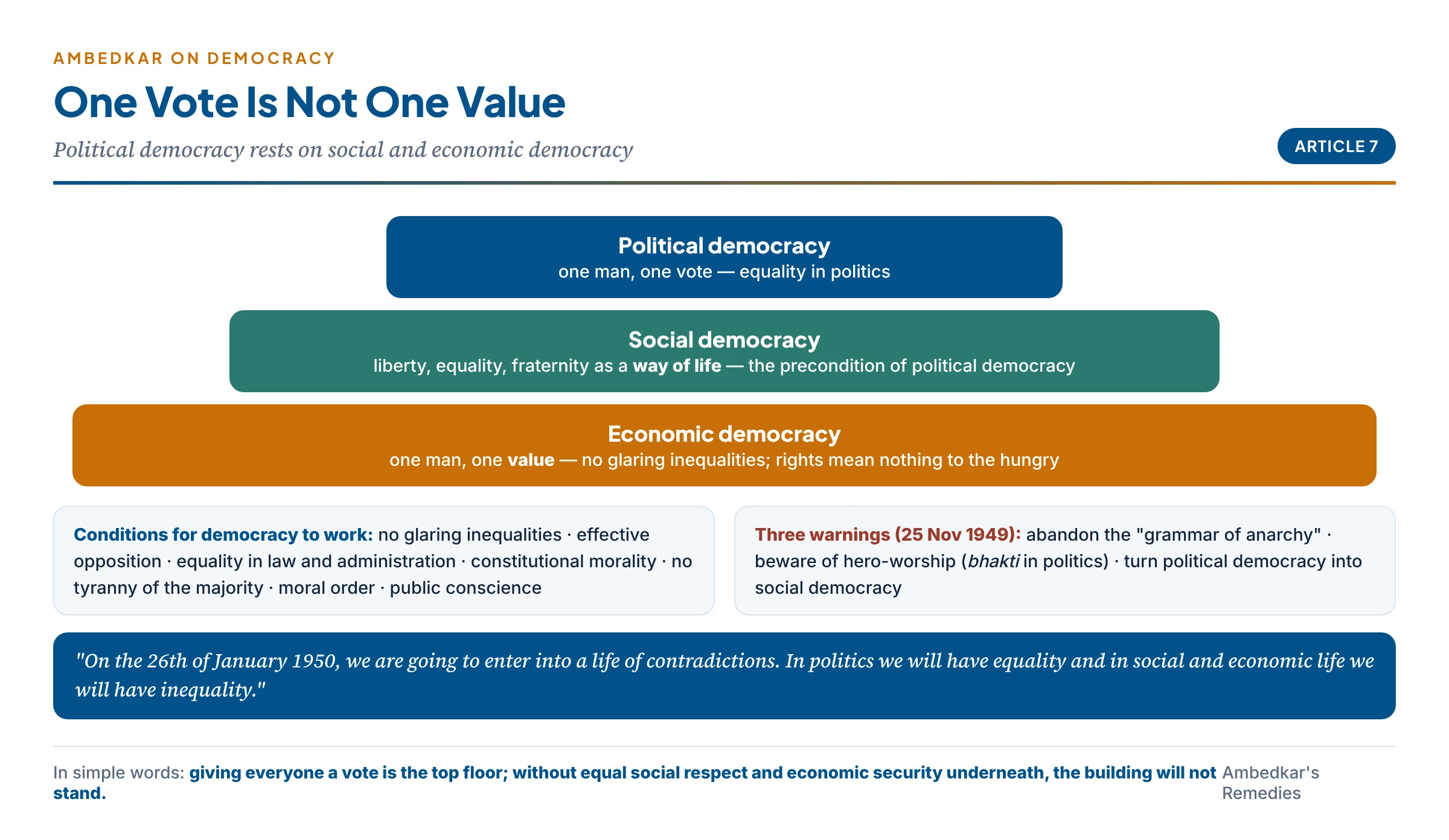
1. Social democracy must precede political democracy
- Society can be more oppressive than the state; it has more means and scope of exploitation. So social reform must precede political reform — people must first have rights, then the power to protect them; reversing the order is a blunder.
- Democracy is inconsistent with caste: democracy rests on fraternity; people divided by caste cannot form a nation — a nation needs not only similar customs but a deep sense of spiritual sharing, which caste prevents.
2. Definition
- Democracy is “a form and a method of government whereby revolutionary changes in the economic and social life of the people are brought about without bloodshed” (1952).
3. Conditions for the successful working of democracy
- No glaring inequalities in society — no oppressed class, no privileged class.
- An effective opposition — the veto of the people, applied between elections.
- Equality in law and administration.
- Observance of constitutional morality.
- No tyranny of the majority over the minority — the minority must feel safe.
- A moral order in society.
- Public conscience — people who feel indignation at wrong done to others, not only to themselves.
- In segmented societies, he argued, minorities need safeguards (even separate electorates) because majorities are communal, not political.
4. Parliamentary or presidential?
- He valued parliamentary democracy — it ends hereditary rule, makes representatives seek the people’s confidence at intervals, and gives law-making to elected representatives.
- But for India he once proposed (States and Minorities, 1947) a non-parliamentary, fixed executive in which minorities would be represented, because in Britain the majority is political (it can change), while in India the majority is communal (it is permanent) — a parliamentary majority could tyrannise permanently over minorities.
- Self-government is not enough; it must be good government: impartial justice, clean administration, government above sectional interests, and government that raises the socio-economic standards of the people.
5. The three warnings (Constituent Assembly, 25 November 1949)
- Abandon unconstitutional methods — civil disobedience, non-cooperation and satyāgraha are justified only when constitutional methods are closed; under a constitution they are “the grammar of anarchy“.
- Beware of hero-worship — “in politics, bhakti or hero-worship is a sure road to degradation and to eventual dictatorship”.
- Make political democracy a social democracy — a union of the trinity of liberty, equality and fraternity, which cannot be divorced from one another.
“On the 26th of January 1950, we are going to enter into a life of contradictions. In politics we will have equality and in social and economic life we will have inequality. In politics we will be recognising the principle of one man one vote and one vote one value. In our social and economic life, we shall… continue to deny the principle of one man one value.” — B.R. Ambedkar
6. Constitutional morality
- Quoting the historian George Grote, Ambedkar told the Assembly (4 November 1948) that constitutional morality — respect for the forms of the constitution, self-restraint, freedom of criticism — “is not a natural sentiment. It has to be cultivated.” In India “democracy is only a top-dressing on an Indian soil which is essentially undemocratic”.
- The Supreme Court has invoked Ambedkar’s constitutional morality to place constitutional values above popular or religious morality (for example in Navtej Singh Johar, 2018, and the Sabarimala case, 2018).
The Village — “A Sink of Localism”
- Against the Gandhian romance of village republics, Ambedkar asked: “What is the village but a sink of localism, a den of ignorance, narrow-mindedness and communalism?” (Constituent Assembly, 4 November 1948).
- The village is where dominant castes rule and untouchables live outside its boundary; the individual, not the village, must be the unit of the Constitution. (Panchayati Raj entered the Constitution only as a directive principle, Article 40, until the 73rd Amendment of 1992.)
The State
- A functionalist theory: the state is important because it provides internal security and security against external invasion; he did not idealise the state like Hegel, yet expected citizens to perform their duties to it. The state is a means, as in liberal theory.
- State over society: since the laws of society (caste) can be more tyrannical than those of the state, he preferred a strong, democratic state that protects individuals from social tyranny — the reverse of Gandhi’s distrust of the state.
- Against civil disobedience once constitutional remedies exist — it leads to anarchy; grievances must be redressed through constitutional measures.
In simple words
For a Dalit labourer in 1940, the village landlord and caste council were far more dangerous than the police station. Gandhi feared a strong state would crush village self-rule; Ambedkar feared that without a strong, law-bound state the village would crush the untouchable. That is why he trusted courts, constitutions and elected legislatures more than “village republics” — and why he asked the oppressed to use the ballot and the courtroom rather than street disobedience once those were open.
State Socialism
- Why socialism: it grew from his concern for the untouchables, who are low in both the social and the economic hierarchy. Political democracy without economic democracy is meaningless; fundamental rights mean nothing to the unemployed — a hungry man can be forced to give up his rights for subsistence.
- State socialism through the constitution (States and Minorities, 1947):
- Key and basic industries owned and run by the state.
- Agriculture as a state industry, with land let to villagers as collective farms — ending landlordism and the dependence of the landless.
- Insurance as a state monopoly.
- These to be placed in the constitution itself, beyond the reach of ordinary legislative majorities.
- Democratic, not dictatorial: socialism must come through parliamentary democracy and law, with land reforms, industrialisation and modernisation, and the reduction of inequalities — not through the dictatorship of the proletariat.
- Outcome: the Constitution did not adopt state socialism; its spirit survives in the Directive Principles (Articles 38, 39, 46).
Ambedkar on Women
- Manu degraded women: women were denied equal rights in education and property and placed under lifelong male vigilance; in Hindu society women could not be free in any respect.
- Buddhism gave women equality — entry into the Saṅgha, freedom to seek liberation.
- “I measure the progress of a community by the degree of progress which women have achieved.” (1942)
- The Hindu Code Bill: equal rights of inheritance for daughters, monogamy, divorce, adoption, guardianship and maintenance. Orthodox resistance stalled it; he resigned (1951). It was later enacted in parts — the Hindu Marriage Act (1955), the Hindu Succession Act (1956), the Hindu Minority and Guardianship Act (1956) and the Hindu Adoptions and Maintenance Act (1956).
- Dalit women: he addressed Dalit women’s conferences, urging education, self-respect, and the abandonment of degrading customs — recognising the intersection of caste and gender.
Ambedkar as Constitution-Maker
His acknowledged legacy
- Articles 14, 15, 16, 17 — equality, non-discrimination, equal opportunity, abolition of untouchability; the reservation framework; detailed safeguards for the Scheduled Castes, Scheduled Tribes and religious minorities; constitutional remedies (Article 32, which he called “the very soul of the Constitution and the very heart of it”).
- A flexible federation: he explained that the Constitution could be unitary or federal according to the requirements of time and circumstances — federal in normal times, with strong central powers in emergencies.
Why his role is sometimes called “debatable”
- He said he had done what he was asked to do as a technical draftsman; in 1953, in anger, he even said he would be the first person to burn the Constitution if it were misused against minorities.
- The Constitution also reflects the ideas of Nehru, Patel, Azad and Rajendra Prasad.
- Several of his own preferences were not adopted:
- He favoured a presidential-type executive — a parliamentary one was adopted.
- He wanted separate electorates — the Constitution adopted reserved seats in joint electorates.
- He called villages “dens of ignorance” — yet a directive principle on Panchayati Raj was included.
- He pleaded for state socialism — it was not embodied.
- Assessment: none of this reduces his influence; as Chairman of the Drafting Committee he piloted the text, defended it in the Assembly and gave it its social-justice core.
Navayāna Buddhism — “Man Must Grow Materially as well as Spiritually”
1. Why a religion at all?
- Ambedkar rejected Marxist atheism: society needs a moral sanction; religion, rightly understood, is the foundation of morality, and morality the foundation of a free society.
- “Religion is for man, not man for religion.“
2. Why not stay a Hindu?
- Hinduism’s sacred authority sanctifies caste; a religion that denies self-respect, equality and learning is a sickness (Article 5).
3. Why Buddhism?
- It is rational (no blind faith, no authority of the Veda), moral (morality takes the place of God), egalitarian (no caste in the Saṅgha), and Indian (conversion would not “denationalise” Dalits).
- Its three principles: prajñā (understanding, against superstition), karuṇā (compassion), samatā (equality).
- Islam and Christianity were considered and rejected — partly because caste had entered them in India, partly because conversion to them would cut converts off from Indian culture.
4. Navayāna (“the new vehicle”)
- In The Buddha and His Dhamma (1957) Ambedkar re-read Buddhism as a social gospel:
- Dukkha is not only personal suffering but the suffering caused by exploitation and injustice.
- Karma does not mean that one’s birth is deserved — he rejected the idea that the low-born suffer for past-life sins.
- The Dhamma is social: it concerns the relation of man to man; its aim is to make the world a just place.
- The 22 vows at the Nagpur conversion included renouncing worship of Hindu deities and rituals, belief in the equality of all human beings, and following the Buddha’s path of prajñā, śīla and karuṇā.
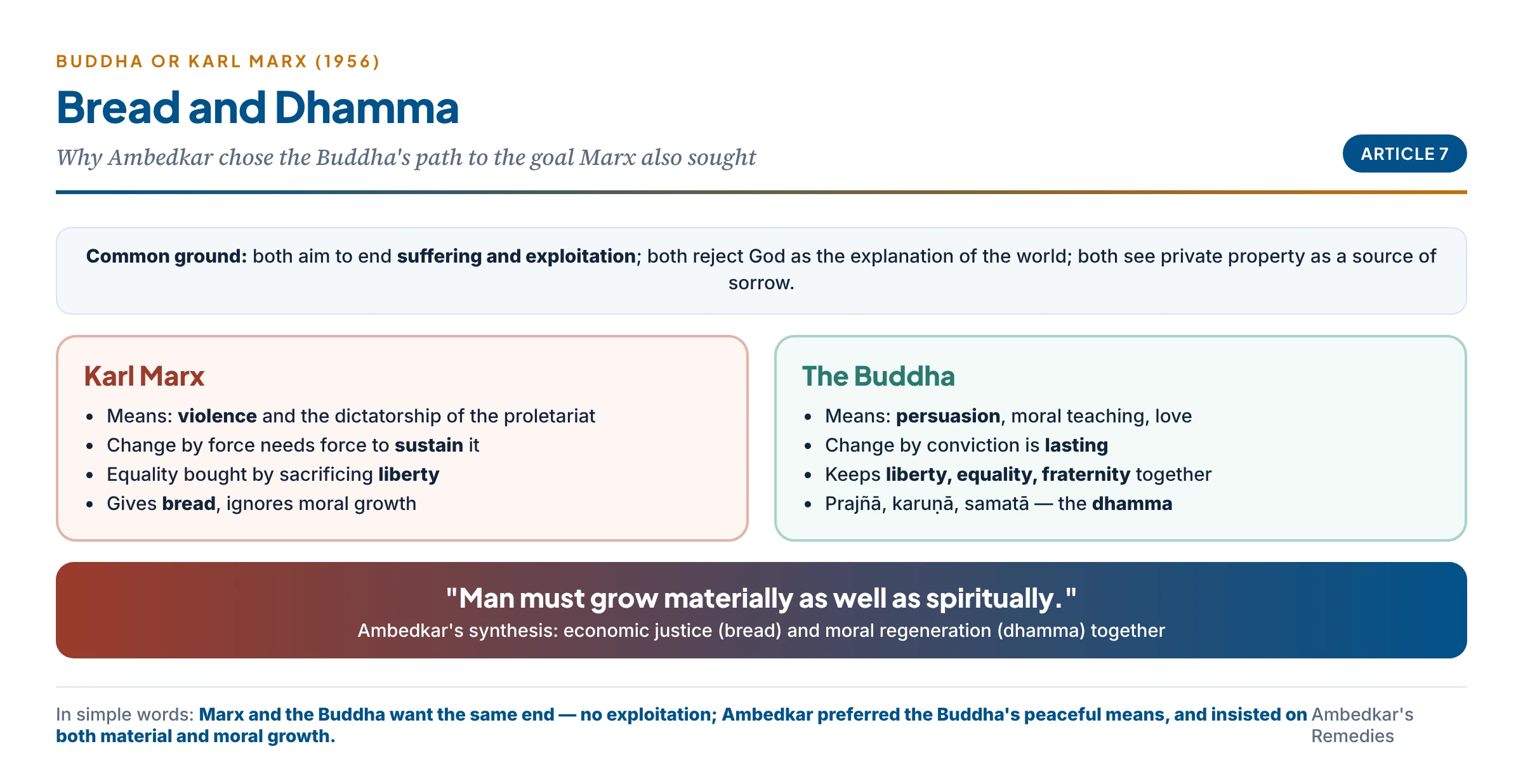
5. “Buddha or Karl Marx” (1956)
- Common ground: both aim to end suffering and exploitation; both reject God as the explanation of the world; both see private property as a source of sorrow.
- Differences:
- Means — the Buddha used persuasion, moral teaching and love; Marx’s communists use violence and dictatorship.
- Permanence — change by force needs force to sustain it; change through conviction is lasting.
- Freedom — communism sacrifices liberty for equality; the Buddha’s way keeps liberty, equality and fraternity together.
- His conclusion: “Man must grow materially as well as spiritually.” Communism can give bread but not the moral growth that makes people free and fraternal; Buddhism gives the spiritual basis. Society needs both — economic justice and moral regeneration — the French Revolution’s liberty, equality, fraternity realised through the Buddha’s Dhamma.
In simple words
A starving man cannot meditate, and a well-fed man without conscience may become a tyrant. Ambedkar’s “man must grow materially as well as spiritually” means a just society needs two kinds of food: bread — land, jobs, wages — and dhamma — reason, compassion, equality. Marx offered the first without the second; caste Hinduism offered neither to the untouchable. Navayāna was his attempt to offer both.
Common confusion
Was Ambedkar a “materialist” opposed to religion? No. Some notes call him a materialist concerned only with socio-economic welfare, in contrast with the “spiritual” Gandhi. Ambedkar did put socio-economic justice at the centre, but he rejected materialism as a complete philosophy — he criticised the Marxists for ignoring religion and morality, held that society needs a moral (religious) foundation, and ended his life by founding a religious movement. The contrast is not matter vs spirit but two different religions: Gandhi’s reformed Hinduism of duty and Ambedkar’s Buddhism of equality.
Critical Evaluation
Ambedkar’s Contribution to Social Change in Independent India
- The Constitution of social justice: equality, non-discrimination, abolition of untouchability, reservation, constitutional remedies — the legal frame of modern India.
- Legal rights for women: the Hindu Code Bill, later enacted in four Acts, transformed marriage, divorce and inheritance.
- Labour rights: the eight-hour day, maternity benefit, employment exchanges.
- Dalit consciousness: from Mooknayak to the Dalit Panthers and the Bahujan movement — the oppressed became political actors in their own right.
- A religious revolution: the Navayāna movement gave millions a new identity of dignity.
- Educational institutions and the ideal of education as liberation.
- Constitutional morality and fraternity — concepts the courts now use to protect individual dignity against social and religious majorities.
- Global influence: his ideas inform debates on caste, race and discrimination worldwide.
Strengths and Criticisms of Ambedkar’s Approach
Strengths
- Social-justice advocacy: his emphasis on equality, dignity and rights shaped policies and perspectives towards an inclusive society.
- Constitutional framework: affirmative action, reservation and anti-discrimination provisions are testimony to his vision.
- Historical contextualisation: by tracing the origins of caste hierarchy he gave a comprehensive account of structural inequality (Article 5).
- Empowerment through education: breaking the cycle of ignorance and discrimination.
Criticisms
- Annihilation vs reservation: reservation addresses immediate needs but may not eradicate deep-seated prejudice; some argue it even keeps caste alive as a category (Article 9).
- Implementation gap: despite the legal framework, caste discrimination continues on the ground.
- Intersectionality: some critics argue that the emphasis on caste can overshadow gender, religion and class — though Ambedkar himself wrote powerfully on women and class.
- Political appropriation: parties across the spectrum invoke Ambedkar for electoral gain, diluting his radical ideas.
- Global relevance: his framework is specific to Indian caste, and needs adaptation for other contexts.
- Evolving dynamics: new forms of caste (in markets, digital spaces, the diaspora) may need new analysis.
- Leftist critique: conversion to Buddhism was a retreat from class struggle; the Poona Pact a political defeat.
Critics and Defenders
Criticism — Critics of Ambedkar’s remedies
- Gandhians: separate electorates and conversion would divide Hindu society; change must come from hearts.
- Marxists: Buddhism and constitutionalism are reformist; caste is rooted in class.
- Hindu nationalists and traditionalists: his attack on the śāstras was too harsh; reform from within was possible.
- Some Dalit critics: reservation created a “creamy layer” and co-option rather than annihilation.
Defence — Defenders of Ambedkar’s remedies
- Self-emancipation: the oppressed must be agents, not objects of charity.
- Law and the state give enforceable rights where conscience fails.
- Economic democracy: no real liberty without bread and land.
- Navayāna gives dignity and a moral foundation without caste.
- The Constitution — his most lasting achievement — has made equality the law of the land.
Cross-Tradition Comparison
| Theme | Ambedkar | Western thinker |
|---|---|---|
| Social tyranny | Society more oppressive than the state | J.S. Mill: the tyranny of custom and opinion |
| Democracy as a way of life | Social democracy, fraternity | Dewey: democracy as associated living |
| Economic democracy | State socialism through the constitution | Fabians, democratic socialists; Laski |
| Constitutional morality | Must be cultivated | George Grote; Rawls‘s public reason |
| Religion and morality | Religion as the basis of moral society; Buddhism | Against Marx‘s “opium”; close to Durkheim (religion and social cohesion) |
| Civil disobedience | “Grammar of anarchy” under a constitution | Rawls: civil disobedience only in a nearly just society, after legal means fail |
| Women’s progress | Measure of a community’s progress | J.S. Mill, The Subjection of Women |
Indian Connect — Indian Connect — Ambedkar and the Buddha’s Dhamma
- The Buddha rejected birth-based worth (Article 2); Ambedkar made this the core of a modern, social Buddhism.
- Prajñā, karuṇā, samatā match his political trinity — liberty (understanding), fraternity (compassion), equality (samatā) — “my social philosophy… may be said to be enshrined in three words: liberty, equality and fraternity… I have derived them from the teachings of my master, the Buddha.”
Synthesis (Siddhānta)
- Ambedkar’s remedies combined self-help (refuse degrading work, educate, move to cities), “educate, agitate, organise”, political safeguards (separate electorates, then reserved seats), law and the Constitution (Articles 14–17, 46, reservation), economic transformation (land reform, industrialisation, state socialism), inter-marriage, women’s rights (Hindu Code Bill) and conversion to a religion of equality.
- His social philosophy holds that social democracy must precede political democracy; democracy is a bloodless method of revolutionary change, resting on fraternity, constitutional morality and public conscience; the village is a sink of localism and the individual the unit; the state is a means to protect individuals from social tyranny; economic democracy is the condition of rights.
- Navayāna reinterprets Buddhism as a social gospel; in “Buddha or Karl Marx” he chose persuasion over violence and concluded that man must grow materially as well as spiritually — bread and dhamma together.
- His contribution to social change in independent India — the Constitution, women’s legal rights, labour reforms, Dalit consciousness and Buddhism, constitutional morality — is unmatched, though the implementation gap and the paradox of caste-based remedies remain.
- Contemporary relevance: debates on sub-classification of SCs, the creamy layer, caste census, campus discrimination and constitutional morality all revolve around his ideas (Article 9).
“I measure the progress of a community by the degree of progress which women have achieved.” — B.R. Ambedkar
Previous Year Questions
- 2021Discuss the views of Dr. B.R. Ambedkar regarding caste-discrimination in Indian society. What are the measures suggested by him for its elimination? Explain.
- 2020State and examine B.R. Ambedkar’s contribution towards social changes in Independent India.
- 2015“Man must grow materially as well as spiritually.” Evaluate this statement of Ambedkar.