

Caste Discrimination: Gandhi and Ambedkar.
Official Syllabus: Paper II, Section A, Unit 10
Annihilation of Caste (1936) is Ambedkar’s most famous work and the most powerful philosophical attack on caste ever written. It was prepared as the presidential address to a Hindu reform body in Lahore, which cancelled the conference when it read the text; Ambedkar published it himself. In it he argues that caste cannot be reformed — it must be annihilated; that caste is a “division of labourers”, an enemy of efficiency, public spirit, nationhood and democracy; that the remedy is not inter-dining but inter-marriage; that caste lives in the mind and is held there by the sanctity of the śāstras, which must therefore be destroyed; and that the ideal society is one of liberty, equality and fraternity — “social endosmosis”. This article explains the background, the arguments, the critique of cāturvarṇya, the programme of reform, the idea of social endosmosis and its relevance for today’s debates on identity and the politics of difference.
In simple words
A house is infested with termites. One builder says, “Paint the walls, fix the doors, let the family eat together in the hall.” Another says, “Paint won’t help — the termites live inside the beams; unless you replace the beams, the house will collapse.” Ambedkar was the second builder. The beams, for him, were the religious beliefs that make caste feel sacred; dinners and new names were only paint.
Context & Problem
The Undelivered Address
- The invitation: the Jat-Pat-Todak Mandal (“Society for the Break-up of Caste”), a Hindu reformist body of Lahore, invited Ambedkar to preside over its annual conference in 1936.
- The conflict: when the organisers read the draft, they objected to passages attacking the Vedas and śāstras and to his statement that this would probably be his last address to Hindus as a member of the Hindu faith (he had declared at Yeola, in 1935, that though born a Hindu he would not die a Hindu). They asked him to cut them; he refused.
- The outcome: the conference was cancelled; Ambedkar published the speech himself (May 1936). The second edition (1937) added the exchange with Gandhi, who replied in his weekly Harijan (“A Vindication of Caste”), and Ambedkar’s reply to the Mahatma (Article 8).
The Question Ambedkar Set Himself
- Not “how to remove untouchability?” but “how to destroy caste?” — untouchability is only the lowest storey of the caste tower; remove the tower.
Core Doctrine
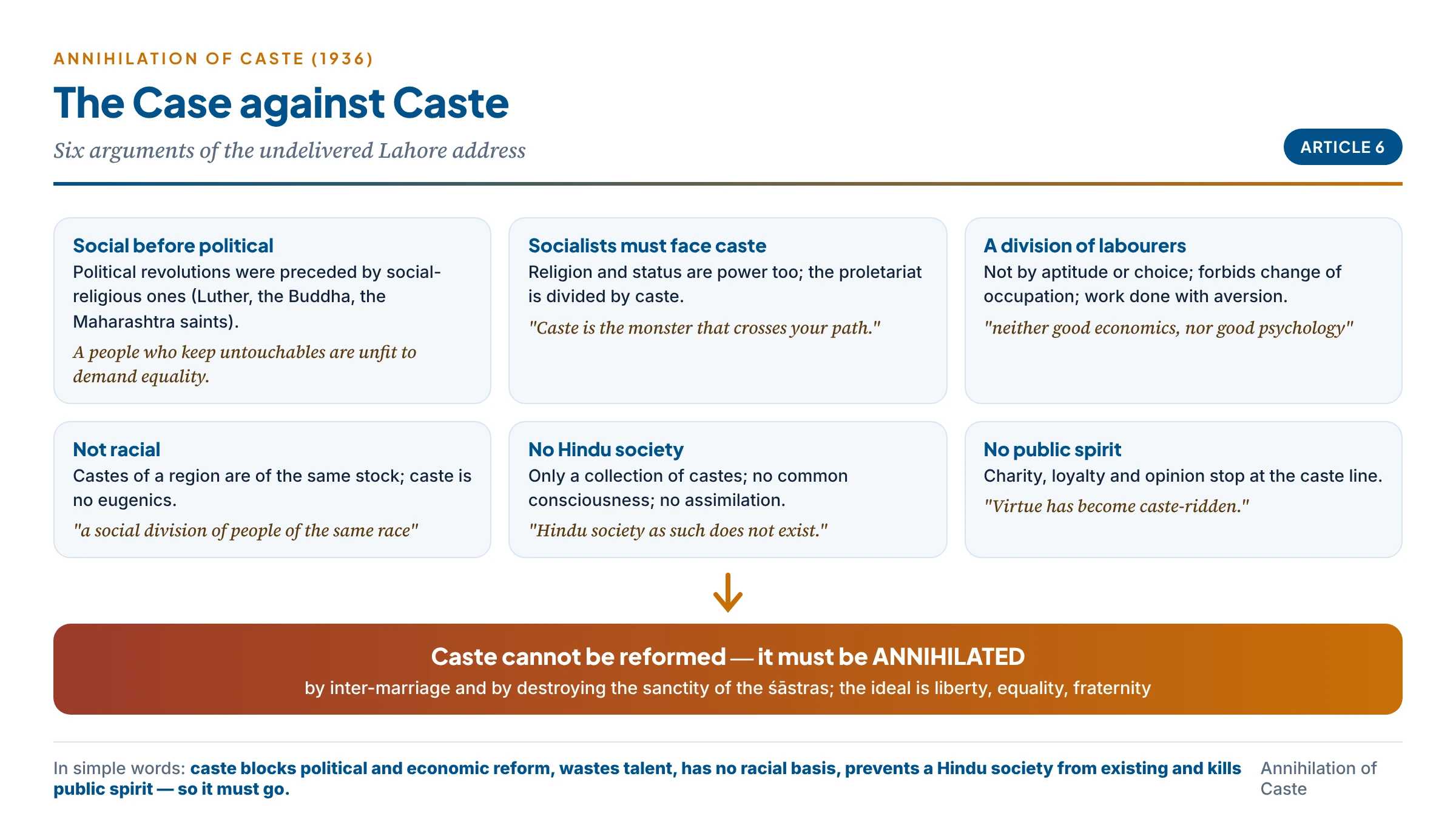
1. Social Reform Must Come before Political Reform
- The history of the Congress: in the 1880s–90s Indian nationalists split into a political reform party (the Congress) and a social reform party (the National Social Conference). The political party won; the Social Conference faded — and with it the attack on caste.
- Ambedkar’s answer to the political reformers: those who said “social reform can wait for swaraj” forgot that political revolutions have always been preceded by social and religious revolutions:
- Luther’s Reformation preceded the political emancipation of Europe; the Puritans shaped England and America.
- The Buddha’s religious and social revolution preceded the Mauryan empire.
- The saints of Maharashtra prepared the way for Shivaji; Guru Nanak prepared the way for the Sikh political rise.
- Why it matters: a people who treat a fifth of their own number as untouchable are not fit to claim political rights from others on the ground of equality.
- Examples of tyranny he cited:
- Under the Peshwas in Poona, untouchables had to tie a broom behind them to sweep away their footprints and hang an earthen pot from their necks to spit into, so as not to “pollute” the road.
- In Central India (1928), caste Hindus forced the Balai community to accept humiliating rules — no gold or silver ornaments, no fine clothes, menial service without wages — and punished those who refused.
- Village after village saw Dalits beaten for wearing clean clothes, sending children to school or eating ghee at a feast.
2. Socialists Must Face Caste
- The Indian socialist says economic reform is all that matters; Ambedkar replied that economic power is not the only power — religion and social status are sources of power too (the priest rules the common man as surely as the magistrate).
- The Indian proletariat is not united: will a Brahmin worker and an untouchable worker act together in a revolution while one regards the other as polluting?
- “Turn in any direction you like, caste is the monster that crosses your path. You cannot have political reform, you cannot have economic reform, unless you kill this monster.”
3. Caste Is Not a Division of Labour but a Division of Labourers
- The defence: caste is only a division of labour, and every civilised society needs one.
- Ambedkar’s reply:
- “Caste System is not merely a division of labour. It is also a division of labourers.” No civilised society divides labourers into watertight compartments and grades them one above the other.
- Not spontaneous, not by aptitude: in caste, labour is assigned not by natural aptitude or choice but by the social status of the parents — it is a division based on dogma, not ability.
- Harmful to industry: industry is never static — techniques change; caste forbids a person to change his occupation even when it no longer feeds him — a direct cause of unemployment.
- Degrading work done with aversion: many traditional occupations are regarded as degraded; people forced into them work with aversion, not with interest — an inefficiency that no economy can afford.
- Verdict: caste is neither good economics, nor good psychology, nor a good social principle.
4. Caste Does Not Preserve Racial Purity
- “The Caste system does not demarcate racial division. The Caste system is a social division of people of the same race.” The Brahmin of Punjab and the Chamar of Punjab are of the same stock.
- Not eugenics: caste was not a scientific breeding programme; it has not produced a physically superior people — the Hindus, he said bitterly, are physically a “C3” people (unfit by army standards).
5. “Hindu Society as Such Does Not Exist”
- “Hindu society as such does not exist. It is only a collection of castes.” Each caste is conscious only of itself; the Hindus have no common consciousness except, perhaps, during a riot with Muslims.
- Not even a federation: castes do not unite; each lives a life of its own.
- Anti-social spirit: the exclusiveness of castes is like the hostility of nations to one another — an anti-social spirit. Hindus never assimilated tribal peoples; shuddhi (reconversion) failed because a convert has no caste to enter; Hindus could never be a missionary religion.
6. Caste Has Destroyed Public Spirit, Charity and Opinion
- Public spirit: a Hindu’s public is his caste; responsibility, loyalty and charity stop at the caste boundary.
- Public charity: generosity flows only to one’s own caste; there is no sympathy for the deserving of another caste.
- Public opinion: impossible — there is no single public.
- “Virtue has become caste-ridden and morality has become caste-bound.”
7. The Ideal Society — Liberty, Equality, Fraternity
- “If you ask me, my ideal would be a society based on Liberty, Equality and Fraternity.”
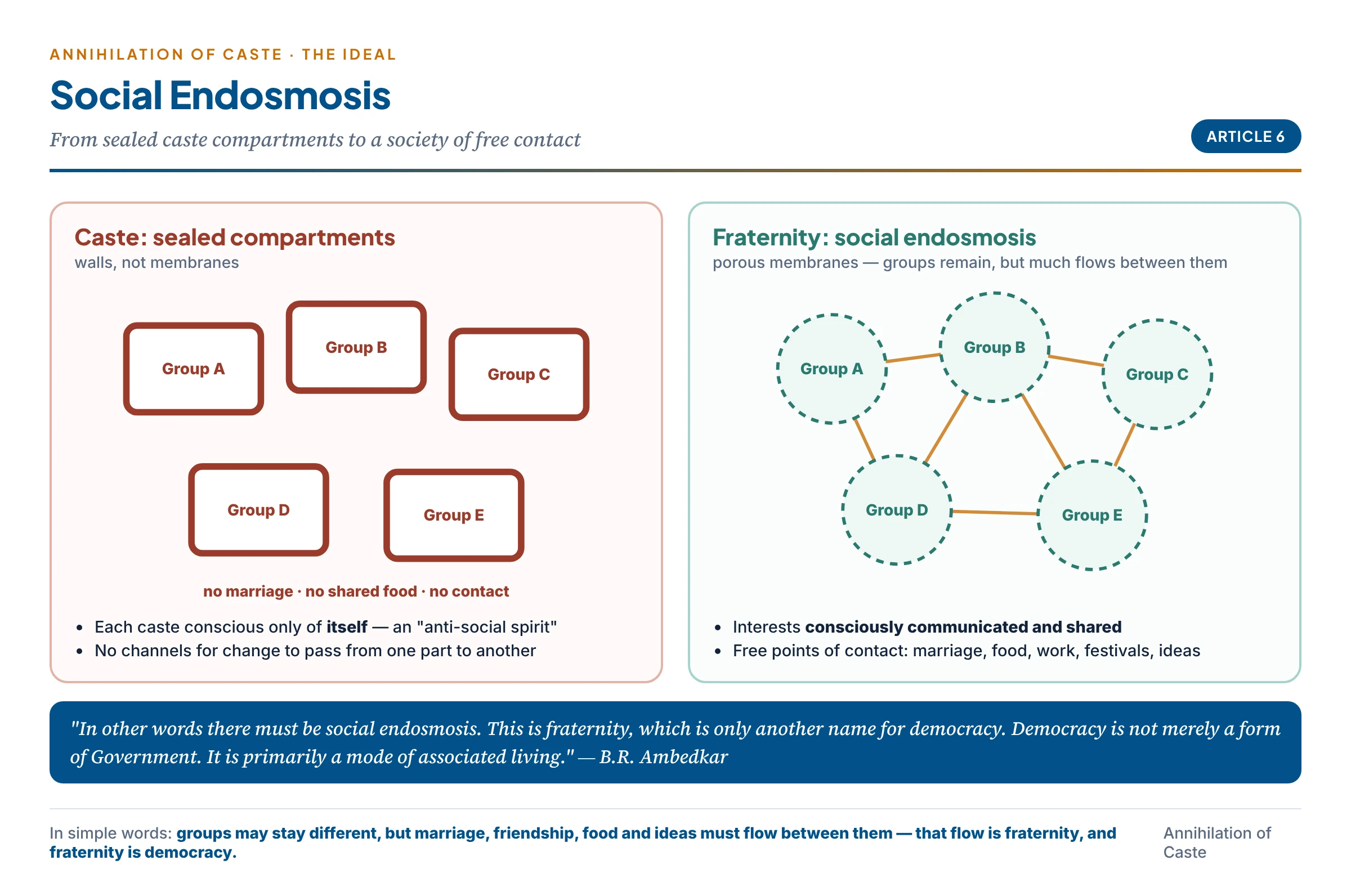
- Fraternity — social endosmosis:
- “An ideal society should be mobile, should be full of channels for conveying a change taking place in one part to other parts. In an ideal society there should be many interests consciously communicated and shared. There should be varied and free points of contact with other modes of association. In other words there must be social endosmosis. This is fraternity, which is only another name for democracy.”
- Democracy is not merely a form of government: “it is primarily a mode of associated living, of conjoint communicated experience. It is essentially an attitude of respect and reverence towards one’s fellow men” — an idea taken from his teacher John Dewey (Democracy and Education, 1916).
- Liberty: no one objects to liberty of movement, life and limb, and property; but liberty must also mean the freedom to choose one’s profession — which caste denies; to deny it is to perpetuate slavery.
- Equality: men are not equal in physical heredity, social inheritance or personal effort. But since a statesman cannot classify millions of people by their real worth, he must treat all alike — “equality may be a fiction but nonetheless one must accept it as the governing principle“. Treating people unequally by birth is the worst kind of classification, because birth is the one thing no person has earned.
In simple words
Biologists call osmosis the passage of fluids through a membrane between two cells, so that each takes something from the other. Caste builds walls, not membranes: nothing passes — no marriage, no food, no friendship, no shared festivals. Ambedkar’s “social endosmosis” means turning the walls into membranes: groups can remain different, but ideas, sympathy and people flow freely between them. That flow is fraternity, and fraternity, he said, is “only another name for democracy”.
8. The Critique of Cāturvarṇya (the Fourfold Varṇa)
Reformers such as the Arya Samāj proposed to replace caste with cāturvarṇya based on worth (guṇa-karma) rather than birth. Ambedkar rejected even this.
- The labels betray it: why keep the old names Brāhmaṇa, Kṣatriya, Vaiśya, Śūdra? They carry centuries of hierarchy; a learned man labelled “Brāhmaṇa” and a labourer labelled “Śūdra” will be treated as high and low, whatever the theory says.
- People cannot be sorted into four classes: human beings differ endlessly; to classify them into four rigid classes is impossible. Plato made the same mistake in the Republic — dividing people into three classes as if their qualities were fixed and clear-cut; modern psychology shows every individual is unique.
- It needs penal sanction: such a system cannot be maintained without punishment of those who cross over — which is why Manu prescribed brutal penalties, and why, in the Rāmāyaṇa, Rāma killed the Śūdra Śambūka for performing penance reserved for the higher varṇas.
- What about women? Will women be classified by their own qualities, or by their husbands’ varṇa? Either answer exposes the absurdity.
- It degraded the Śūdras: cāturvarṇya denied the Śūdras education, arms and property; it prevented the masses from rebelling, because those who could have revolted were deprived of knowledge and weapons. “There cannot be a more degrading system of social organisation than the Chaturvarnya.”
- The Gītā’s guṇa-karma is not a remedy: whatever the theory, in practice varṇa has always been by birth.
In simple words
Suppose a school abolishes the old “A, B, C, D” sections that were decided by parents’ income, and announces new sections by merit — but keeps calling them “A, B, C, D”, fixes the number at four, and punishes any child who tries to move. Everyone would still treat “Section D” children as the poor ones. That is Ambedkar’s point about a “reformed” cāturvarṇya: old labels, fixed boxes and punishment make it the old system in new clothes.
Common confusion
Did Ambedkar oppose only the corrupt caste system and accept a “pure” varṇa based on merit? No — this is the most common misreading. Ambedkar rejected both. The Arya Samāj and Gandhi wanted to keep cāturvarṇya (by worth, or by hereditary duty without hierarchy). Ambedkar argued that cāturvarṇya is impossible (people cannot be sorted into four classes), dangerous (the old labels carry the old hierarchy), and violent (it can only be enforced by punishment, as Manu and the Śambūka story show). For him varṇa was the parent of caste, not its innocent ideal.
9. Caste among Non-Hindus — Why the Hindu Case Is Different
- Muslims, Sikhs and Christians in India also have caste divisions. But for them caste is a social practice without religious sanction; it is not regarded as sacred, and they will give it up when social conditions change. For Hindus, caste is religiously sanctified — which makes it far harder to remove.
10. How Is Caste to Be Destroyed? — The Programme
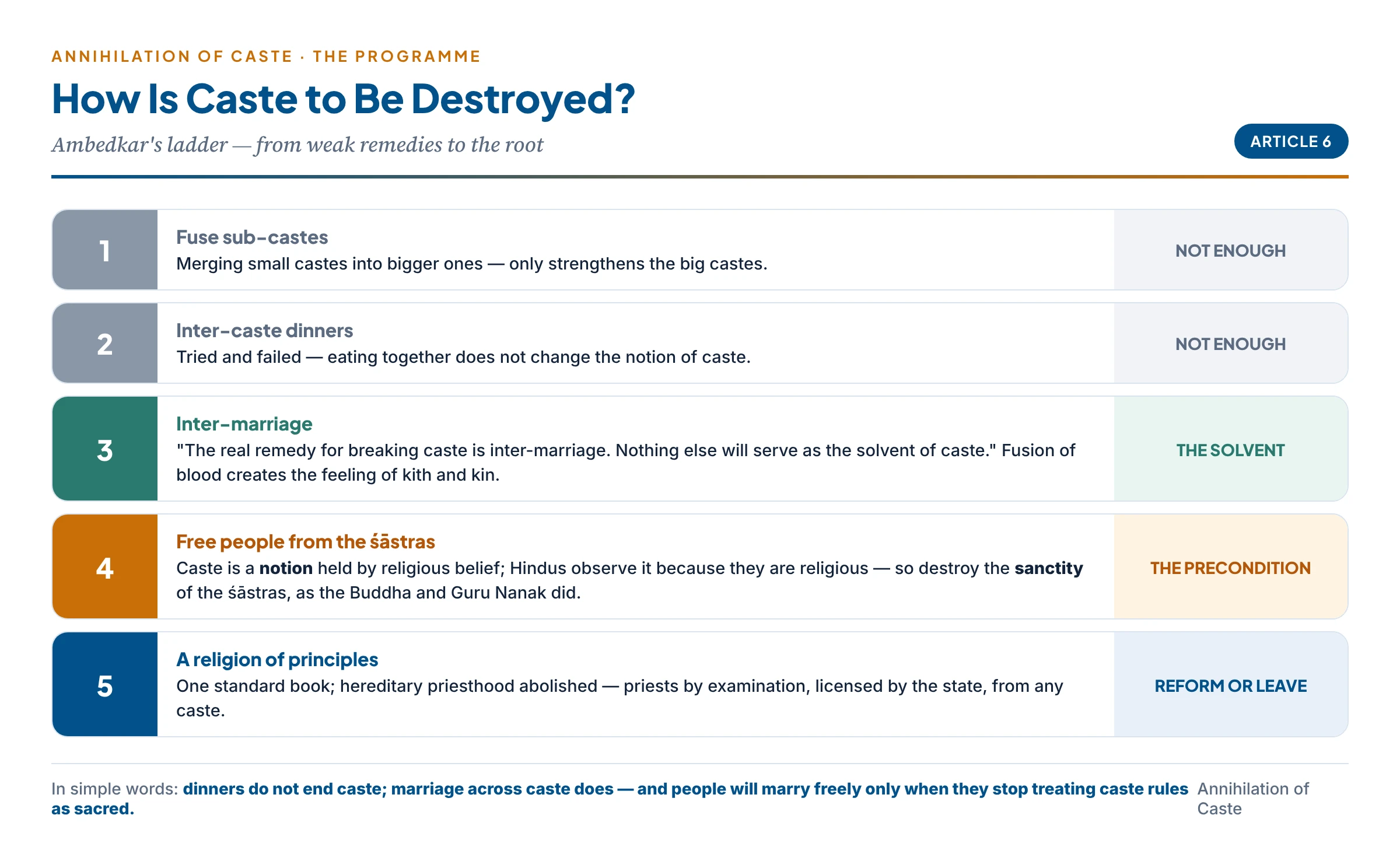
1. Insufficient remedies
- Abolishing sub-castes (fusing small castes into larger ones) — would only strengthen the bigger castes.
- Inter-caste dinners — tried and failed; eating together does not change the notion of caste.
2. The real remedy — inter-marriage
- “The real remedy for breaking Caste is inter-marriage. Nothing else will serve as the solvent of Caste.” Only the fusion of blood can create the feeling of being kith and kin; where society is already well knit, inter-marriage is an ordinary event; where it is not, inter-marriage is the means of knitting it.
3. Why Hindus resist — caste is a notion
- “Caste is not a physical object like a wall of bricks or a line of barbed wire which prevents the Hindus from co-mingling… Caste is a notion, it is a state of the mind.” Its destruction means a notional change.
- People are not wrong — their religion is: Hindus observe caste not because they are inhuman but because they are deeply religious. “What is wrong is their religion, which has inculcated this notion of caste.”
- The enemy is the śāstras: the reformer must destroy the belief in the sanctity of the śāstras. It is futile to argue that the śāstras, properly interpreted, do not support caste — the common man follows them as they are; the reformer must take the stand the Buddha and Guru Nanak took — deny their authority.
- “You must apply the dynamite to the Vedas and the Shastras, which deny any part to reason, to Vedas and Shastras, which deny any part to morality.”
- “Make every man and woman free from the thraldom of the Shastras” — and they will inter-dine and inter-marry without being asked.
4. Rules vs principles — reforming Hindu religion itself
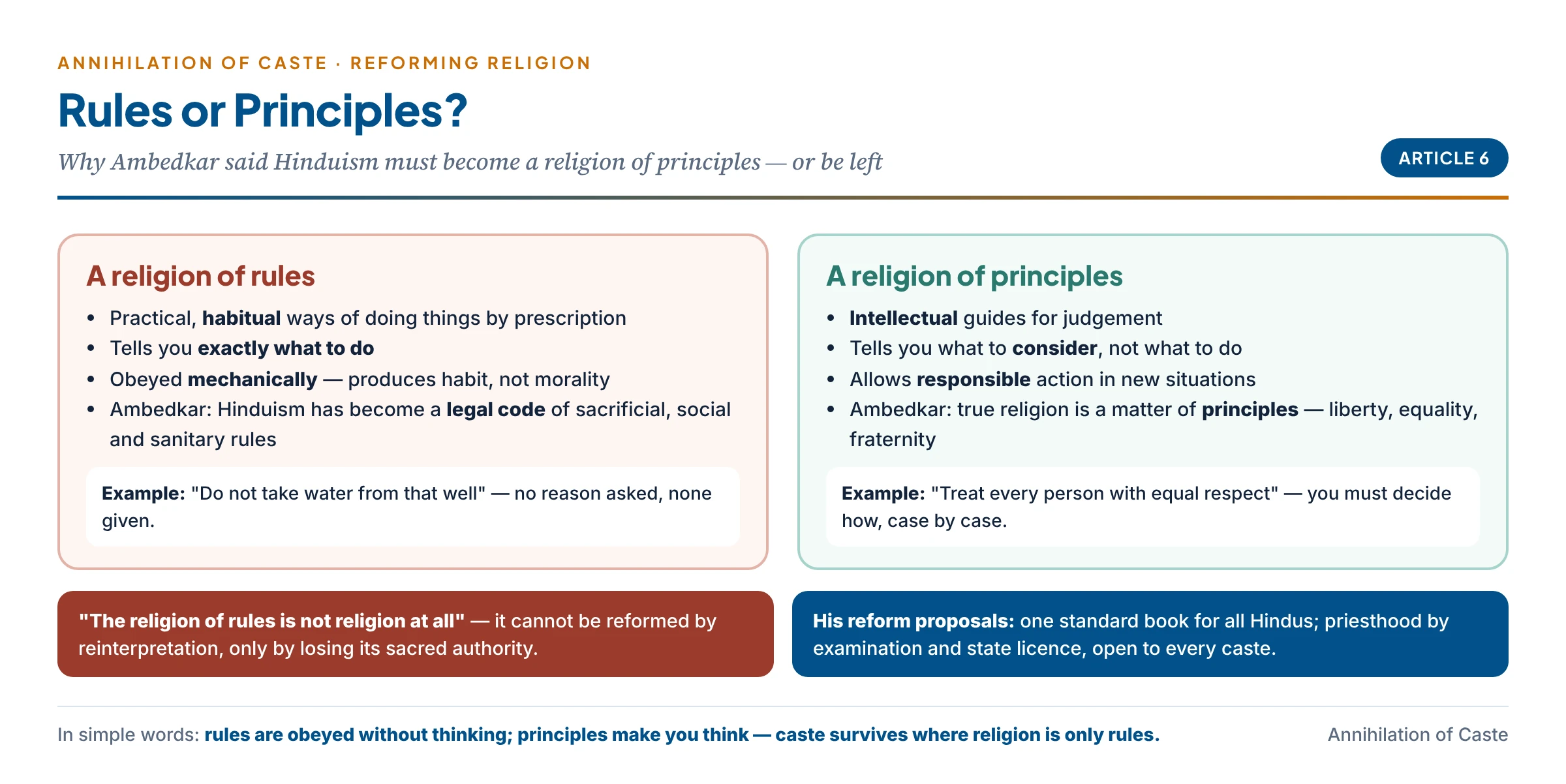
- Rules are practical, habitual ways of doing things according to prescription; they tell you exactly what to do and are obeyed mechanically.
- Principles are intellectual guides for judging and acting responsibly in new situations; they tell you what to consider, not what to do.
- Hinduism, Ambedkar argued, is a mass of rules — sacrificial, social, political, sanitary — a legal code, not a religion of principles. A religion of rules produces habit, not morality; “the religion of rules is not religion at all”.
- His proposals for reform (if Hindus wish to keep their religion):
- One standard book of Hindu religion, acceptable to all Hindus; all other texts to lose their sacred authority.
- Abolish hereditary priesthood: priests to be appointed by examination, licensed (sanad) by the state, subject to the ordinary law, and limited in number — any Hindu, of any caste, eligible.
- These steps would kill Brahminism — and with it the sanction of caste.
In simple words
A traffic rule says “stop at the red light” — follow it and you need not think. A principle says “drive so that no one is harmed” — it makes you think at every turn, even where there is no signal. A society that only follows inherited rules (“do not take water from that well”) never asks why; a society of principles asks it every day. Ambedkar wanted Hindus to move from the first to the second.
5. The obstacles
- The Brahmins are the intellectual class of Hindus, but they will not lead a revolt against their own privilege; the secular Brahmin (in politics and professions) and the priestly Brahmin are kith and kin.
- Reason and morality are the two weapons of a reformer — and the śāstras deny Hindus the freedom to use reason.
6. His conclusion
- Hindus must ask: is there anything fixed, eternal and sanātana? Must the whole past be preserved, or only what is useful? Will they make their religion one of principles?
- He told his audience that this would probably be his last address to Hindus as a member of the Hindu faith — the decision that led, twenty years later, to his conversion to Buddhism (1956).
Critical Evaluation
The Social and Political Significance of the Annihilation of Caste
Social significance
- Caste as a system, not a sin of some: it moved the debate from untouchability to caste itself.
- Inter-caste marriage as the decisive reform — today encouraged by schemes such as the Dr. Ambedkar Scheme for Social Integration through Inter-Caste Marriages, and by courts’ protection of inter-caste couples against “honour” violence.
- Critique of religion: a demand that religion be judged by reason and morality — a charter for rational, humanist reform.
- Women: by exposing endogamy, it ties caste reform to the liberation of women.
Political significance
- Democracy as a way of life: political democracy needs social democracy — the theme of his last speech to the Constituent Assembly (Article 7).
- Fraternity in the Constitution: the Preamble promises fraternity, assuring the dignity of the individual — Ambedkar’s social endosmosis written into law.
- Article 17 (abolition of untouchability), Article 15 (non-discrimination) and Article 25(2)(b) (throwing open Hindu religious institutions to all classes) carry his programme into the Constitution.
- A global text: it is read today in debates on race, caste and discrimination worldwide.
Criticisms
- Gandhi’s reply: Ambedkar judged Hinduism by its worst practices; the true test of a religion is its best exponents — the saints; caste is not essential to Hinduism; varṇa is a healthy law (Article 8).
- Too harsh on Hinduism: reformers argue that Hinduism has rich egalitarian resources (Upaniṣads, Bhakti, Vivekananda, Narayana Guru) and can be reformed from within.
- “Dynamite the śāstras” alienates: attacking sacred texts may harden the orthodox instead of persuading them.
- Inter-marriage cannot be forced: in a liberal society marriage is a free choice; the state can only encourage and protect it.
- The paradox of identity: the policies that came from his struggle — reservation, caste census — use caste as a category, which may keep it alive (Article 9).
- Unfinished: caste has not been annihilated; it has adapted — in politics, marriage markets, urban housing.
Social Endosmosis and the Politics of Difference
What the “politics of difference” says
- Thinkers such as Iris Marion Young and Charles Taylor argue that justice requires recognising group differences — giving disadvantaged groups voice, representation and special rights, rather than treating everyone as identical citizens (see SP Unit 06).
How social endosmosis relates to it
- Agreement: Ambedkar too demanded group-specific remedies — separate electorates, reserved seats, reservation — because formally “equal” treatment in a caste society preserves inequality. He recognised that the oppressed need their own voice.
- Difference: but his end-goal is not permanently separate identities; it is endosmosis — groups whose boundaries are porous, where people marry, eat, work and think across lines. Identity is a starting point for justice, not a destination.
- A warning to identity politics: if group identity becomes a closed membrane — each group speaking only to itself, defending its own — it reproduces the very anti-social spirit Ambedkar condemned in caste.
- A warning to “difference-blind” liberalism: but if we ignore difference and insist on uniformity, we deny the history of exclusion and leave the privileged in place.
- Relevance today: social endosmosis suggests a middle path — recognition plus interaction: affirmative action and integrated schools and housing; protection of minority cultures and freedom to leave them; caste data for justice and encouragement of inter-caste marriage; digital spaces that connect rather than echo chambers that seal.
Indian Connect — Indian Connect — endosmosis in the Constitution
- Fraternity in the Preamble (added by Ambedkar’s Drafting Committee) is endosmosis as a constitutional value.
- Article 15(2) opens shops, wells, tanks, roads and public places to all; Article 17 abolishes untouchability; Article 25(2)(b) opens temples — each removes a wall between groups.
- Courts protecting inter-caste and inter-faith couples (for example, Lata Singh v. State of U.P., 2006; Shakti Vahini v. Union of India, 2018, against “honour” killings and khap panchayats) apply Ambedkar’s “real remedy” in law.
Critics and Defenders
Criticism — Critics of Annihilation of Caste
- Gandhi: judge a religion by its saints, not its sinners; varṇa is a law of duty, not of hierarchy.
- Hindu reformers: Hinduism can be reformed from within without rejecting the śāstras.
- Liberals: inter-marriage is a private choice; the state cannot “annihilate” a social identity.
- Critics of identity politics: the caste-based remedies that followed keep caste alive.
Defence — Defenders of Annihilation of Caste
- It identifies the mechanism (endogamy) and the sanction (sacred texts) — reform that ignores them fails.
- Division of labourers and graded inequality remain the best descriptions of caste.
- Social endosmosis gives democracy a social meaning — fraternity, associated living.
- Its demand that religion be judged by reason and morality is the heart of modern ethics.
- Its programme entered the Constitution — Articles 15, 17, 25(2)(b) and the Preamble’s fraternity.
Cross-Tradition Comparison
| Theme | Ambedkar | Western thinker |
|---|---|---|
| Democracy as associated living | Social endosmosis; fraternity | John Dewey, Democracy and Education |
| Equality as a governing fiction | Treat all alike since none can be graded fairly | Rawls‘s equal basic liberties; Kant‘s equal dignity |
| Critique of classes by nature | Cāturvarṇya and Plato’s error | Plato‘s Republic; Popper‘s critique of Plato’s closed society |
| Rules vs principles | Religion of rules vs religion of principles | Kant‘s autonomy vs heteronomy; Dworkin‘s rules vs principles in law |
| Religion and revolution | Social-religious revolution precedes political | Weber on the Protestant ethic; Luther and the Reformation |
| Politics of difference | Recognition as a means, endosmosis as the end | Iris Marion Young, Charles Taylor |
Synthesis (Siddhānta)
- Annihilation of Caste (1936), the undelivered Lahore address, argues that social reform must precede political reform; that socialists must face caste; that caste is a division of labourers, not of labour — neither good economics, psychology nor social principle; that it is not racial; that Hindu society does not exist — only a collection of castes with an anti-social spirit, without public spirit, charity or opinion.
- Its ideal is liberty, equality and fraternity — fraternity as social endosmosis, democracy as associated living (Dewey); equality as a governing principle even if men are unequal.
- It rejects even a merit-based cāturvarṇya — labels, impossibility of classification (Plato’s error), need for penal sanction (Manu, Śambūka), the problem of women, the degradation of the Śūdras.
- Its programme: inter-marriage as the real solvent; caste as a notion held by the sanctity of the śāstras, which must be destroyed; a religion of principles, not rules — one book, priesthood by examination; else, leave Hinduism.
- Significance: it shifted the debate from untouchability to caste itself, placed fraternity at the heart of democracy and shaped the Constitution; its social endosmosis offers a path between closed identity politics and difference-blind uniformity — recognition as means, interaction as end.
“Caste is not a physical object like a wall of bricks… Caste is a notion, it is a state of the mind.” — B.R. Ambedkar, Annihilation of Caste
Previous Year Questions
- 2026How has Ambedkar applied the concept of ‘Social Endosmosis’ for annihilation of castes. Evaluate its relevance for contemporary debates on identity and the politics of difference.
- 2023Critically analyse the social and political significance of Ambedkar’s notion of annihilation of caste.
- 2015Evaluate Ambedkar’s critique of caste system.