

Political Ideologies: Anarchism; Marxism and Socialism
Official Syllabus: Paper II, Section A, Unit 5
Article 2 described what anarchists believe. This article tests their central claim: can any state ever have legitimate authority, and can society do without political authority altogether? The question sits at the heart of political philosophy, the problem of political obligation: why should I obey the law? Robert Paul Wolff gave the most famous philosophical answer: since our highest duty is to be morally autonomous, no state can have a genuine right to command us. Others say more modestly that no actual state has so far justified its authority. Against them stand Hobbes, Locke, Kautilya, Marx and Nozick, each in a different way, all arguing that some authority is necessary. The article ends with the questions UPSC keeps asking: Is every state illegitimate? Do unconditional rights lead to anarchy? Did the pandemic push society towards anarchy? Should we subscribe to anarchism?
In simple words
Your elder brother tells you, “Do your homework.” If you do it because you see it is good for you, you are following your own judgement; his order made no difference. If you do it only because he said so, you have handed over your judgement to him. Wolff says the state is always in this position: either we obey it because we already agree (so its authority adds nothing), or we obey just because it commands (so we give up our moral freedom). Either way, the state’s right to command disappears.
Context & Problem
Power, Authority and Legitimacy
- Power is the ability to make people do what they would not otherwise do: by force, reward or threat. A robber with a gun has power.
- Authority is the right to command and to be obeyed: the claim that the commanded person has a duty to obey because it is commanded. A traffic policeman claims authority.
- De facto authority: people actually accept the commands and obey (the state is effective).
- De jure (legitimate) authority: the state truly has the right to command, and people really do have a duty to obey.
- Legitimacy is the quality that turns power into rightful authority. Max Weber named three sources people actually accept: tradition (the king’s line), charisma (the hero-leader) and legal-rational rules (the constitution).
- Anarchism’s challenge is aimed at de jure authority: anarchists admit the state is powerful and effective; they deny it is rightful.
The Problem of Political Obligation
- Political obligation is a moral duty to obey the laws of one’s state because they are the laws, and not only because they happen to be good or because one fears punishment.
- Classical answers: consent (Locke), gratitude (Socrates in the Crito), fair play (Hart, Rawls), natural duty of justice (Rawls), membership of a community (Dworkin), utility (Bentham), the common good (Green).
- The anarchist reply: none of these succeeds. So there is no general duty to obey the state.
Core Doctrine
Robert Paul Wolff: The Conflict of Autonomy and Authority
In In Defense of Anarchism (1970), Wolff built his case on a Kantian idea of moral freedom.
The argument, step by step:
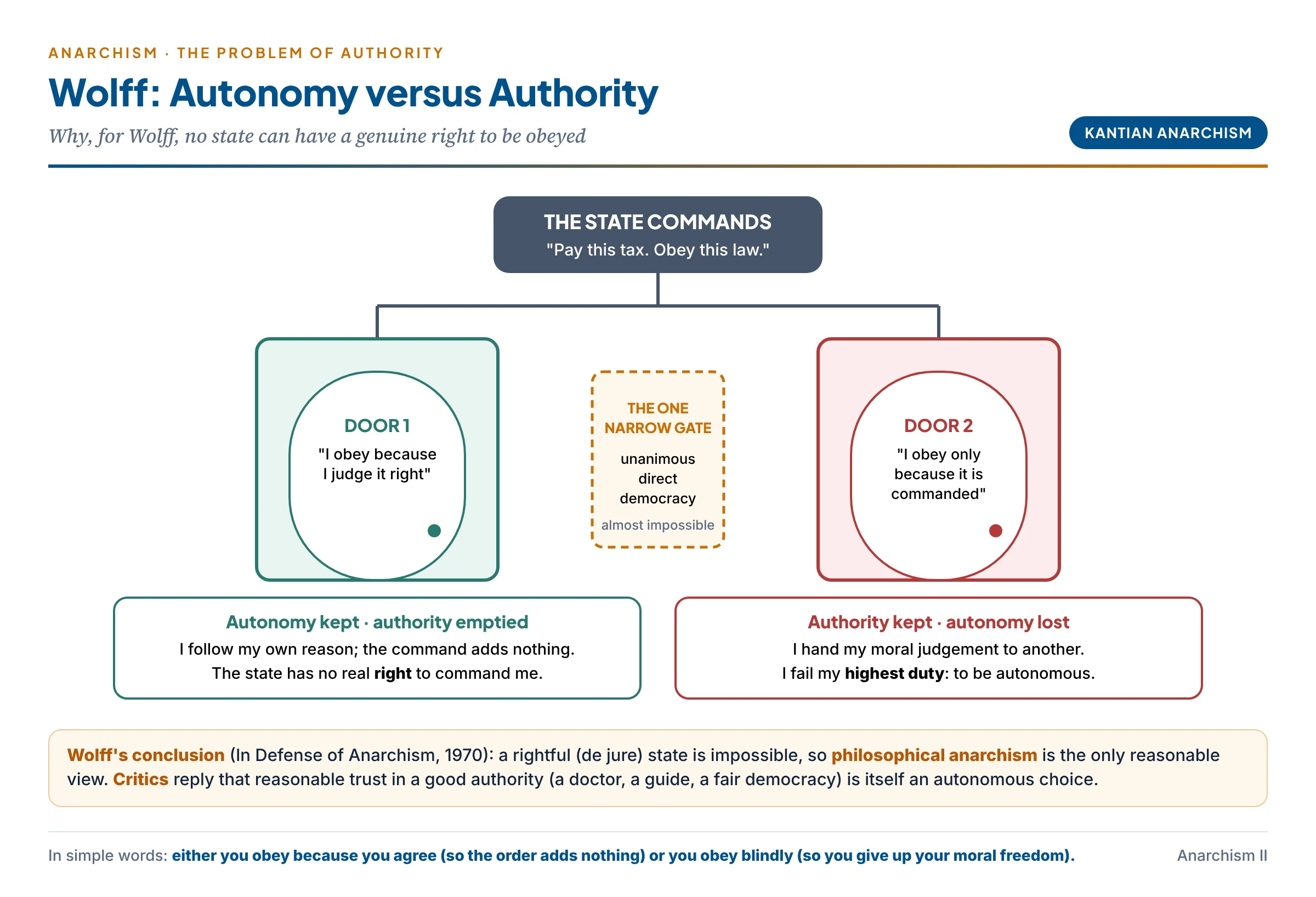
- Every rational adult has a primary duty to be autonomous. Autonomy (from Greek autos, self, and nomos, law) means giving the moral law to oneself: taking full responsibility for one’s actions, and deciding what to do by one’s own reasoning, not by another’s command.
- Authority means the right to command, with a matching duty in the subject to obey simply because it is commanded, whatever the content of the command.
- The two clash:
- If I obey a law because I judge it to be right, I am acting autonomously, but then I am not obeying the state’s authority; I am obeying my own reason, and the law adds nothing.
- If I obey a law only because the state commands it, I am obeying authority, but I have given up my autonomy, which is my highest duty.
- Conclusion: a legitimate (de jure) state is logically impossible. “The concept of a de jure legitimate state would appear to be vacuous, and philosophical anarchism would seem to be the only reasonable political belief for an enlightened man.”
Wolff tests the usual escape routes:
- Social contract and consent: if I promise to obey, I bind my future will; but a promise to obey whatever is commanded is a promise to give up autonomy. Besides, few people ever actually consented.
- Majority democracy: the minority is still forced to obey decisions it rejects. Being outvoted is still being commanded.
- Representative democracy: even worse; the citizen obeys representatives, not even the majority.
- Unanimous direct democracy: here every law has been agreed by every citizen, so authority and autonomy coincide. Wolff accepts this is the one legitimate form, but it is so restricted (one dissenter blocks all action) that it offers no serious hope of ever being embodied in an actual state.
What Wolff does not say:
- He does not say we must revolt or break every law. A philosophical anarchist may obey a law because it is good, or for prudence (fear of punishment, wish for order).
- He says only that the state’s command, as such, never creates a moral duty. Each law must earn obedience by its content.
Common confusion
Was Kant an anarchist, since Wolff bases his argument on Kant’s autonomy? No. Kant used autonomy to ground morality, not to reject the state. He argued that rational beings have a duty to leave the state of nature and enter a lawful civil state, and he denied any right of revolution. Wolff borrows Kant’s idea of autonomy but draws a conclusion Kant himself rejected.
Criticisms of Wolff
- Autonomy is not the only or highest value. Security, justice, cooperation and care for others also matter; it is implausible that autonomy always overrides them.
- Reasonable deference is not loss of autonomy. I follow my doctor’s advice or a pilot’s instructions because I have good reason to think they know better. Joseph Raz’s “service” view: an authority is legitimate when following it helps me act on the reasons that apply to me better than I could alone. Obeying such authority is an autonomous choice.
- Coordination needs authority. Whether we drive on the left or the right does not matter, but everyone must do the same. A law that settles the matter gives everyone a real reason to obey, whatever their private judgement.
- Autonomy grows inside authority. Children become autonomous only through education, family and community, all of which involve authority. Autonomy is a capacity to be developed, and political institutions help develop it.
- The promise problem. If autonomy forbids binding my future will, then every promise and contract would also be illegitimate. Even Simmons, himself a philosophical anarchist, calls Wolff’s a priori argument a “failed attempt”.
- Democracy as shared autonomy. Rousseau and Habermas argue that citizens are autonomous together when they make laws in fair public discussion. Being outvoted in a fair process is not the same as being commanded by a master.
In simple words
On a trek through unknown mountains you follow the guide’s route even when you would have chosen another path. You have not given up your judgement; your judgement told you the guide knows the mountain better. Raz says a good authority is like that guide: obeying it is a reasoned choice, not surrender.
“All States Always and Everywhere Are Illegitimate and Unjust”
This 2023 question quotes the strongest form of anarchism. It is useful to separate two kinds.
A priori (absolute) anarchism:
- Claims that by its very nature no state can ever be legitimate, whatever it does.
- Grounds: the nature of the state (coercion, monopoly of force, claim to obedience) conflicts with moral liberty or autonomy. Wolff is the standard example.
A posteriori (contingent) anarchism:
- Claims that a state could in principle be legitimate, but in fact none (or almost none) meets the conditions.
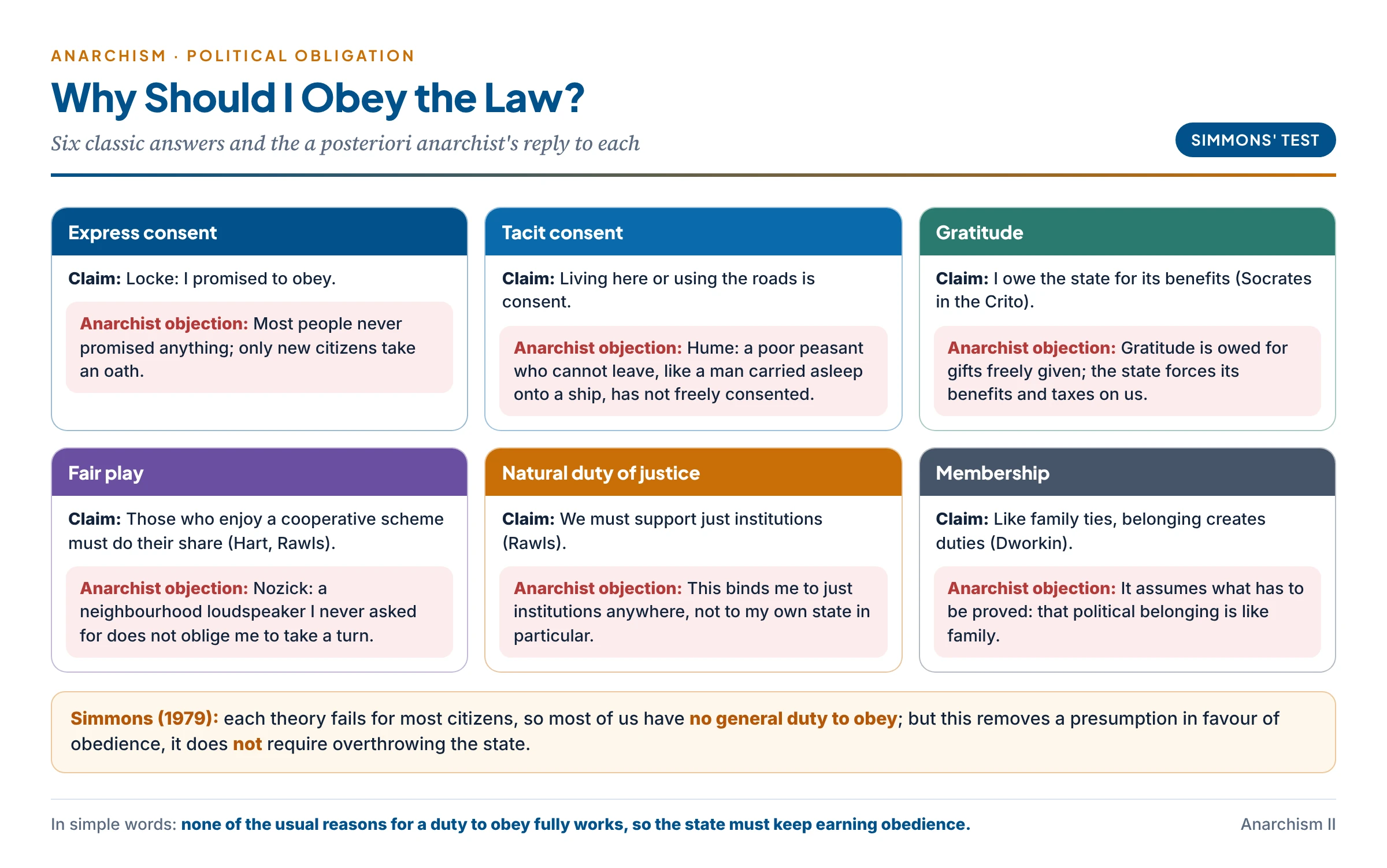
- A. John Simmons (Moral Principles and Political Obligations, 1979): he examines every theory of obligation and finds that each fails for most citizens of actual states:
- Express consent: most people never promised anything; only naturalised citizens take an oath.
- Tacit consent (Locke: by living in a country or using its roads, you consent): Hume’s objection: a poor peasant who knows no other language and has no money to leave can hardly be said to consent freely, any more than a man carried on board a ship while asleep consents to the captain by not jumping into the sea.
- Gratitude: we owe gratitude for benefits freely given, but the state forces its benefits and taxes on us.
- Fair play (Hart, Rawls): those who accept the benefits of a cooperative scheme must do their share. Nozick’s reply: if neighbours set up a public-address system and broadcast for an hour each day, I am not obliged to take my turn just because I hear it. Benefits received unasked do not create obligation.
- Natural duty of justice (Rawls): we must support just institutions; but this binds us to just institutions anywhere, not to our own state in particular.
- Membership / associative obligation (Dworkin): like family ties; critics reply that this assumes what is to be proved.
- Simmons’s conclusion: most people have no general political obligation. But he also argues that philosophical anarchists do not need to oppose or abolish states; state illegitimacy simply removes any strong presumption in favour of obedience.
Evaluating the strong claim:
- In its favour: every state uses coercion; many states are unjust (colonial rule, apartheid, dictatorships, discrimination); “legitimate” states have committed wars, genocide and torture.
- Against it:
- From “many” to “all” is a leap. That many states are unjust does not prove that every possible state is.
- Legitimacy comes in degrees. A constitutional democracy with rights, courts and free elections is more legitimate than a dictatorship; treating them as equally illegitimate hides real differences.
- Justice is not only about the state. Without a state, injustice by private power (warlords, gangs, monopolies, dominant castes) may be worse.
- Legitimacy can rest on functions, not only on consent: protecting rights, providing public goods and settling disputes fairly can justify authority (Raz, Rawls’s duty of justice).
- Balanced conclusion: the claim is best read as a powerful warning: the burden of proof lies on the state, which must keep earning legitimacy. It is not a proven truth about all states.
Anarchy, Individual Freedom and State Sovereignty
- The classical theory of sovereignty (Bodin, Hobbes, Austin) makes the state’s power supreme, unlimited and indivisible: the sovereign’s command is law, and subjects owe habitual obedience.
- The anarchist sees a direct contradiction: if the individual is free to live by conscience, no one can have supreme power over them; if the state is sovereign, the individual’s freedom exists only by its permission.
- Ways of reconciling the two:
- Liberal constitutionalism: sovereignty is limited by rights, rule of law, separation of powers and judicial review; the individual is free in a protected sphere (Locke, Mill).
- Popular sovereignty (Rousseau): the people as a whole are sovereign; obeying the general will is obeying oneself.
- Pluralism (Laski): the state is one association among many; sovereignty is shared and limited by the loyalties people owe to church, union and community.
- Gandhi’s swarāj: real sovereignty lies in self-rule of individuals and villages; the state should be minimal.
- Conclusion: absolute sovereignty and absolute individual freedom cannot both hold. Modern democracies live with a balance: limited, accountable sovereignty and protected but not unlimited freedom.
Do Unconditional Rights Lead to Anarchy?
- The worry: if every individual has rights that are unconditional, with no limits for public order, others’ rights or the common good, then each person becomes a little sovereign. Every law that limits a right would be illegitimate, and conflicts between rights could not be settled. Society would dissolve into anarchy.
- Supporting thinkers:
- Bentham called natural, absolute rights “nonsense upon stilts”: talk of rights that no law can limit is “anarchical”, an invitation to rebellion.
- Burke feared that abstract “rights of man” would destroy the institutions that make actual liberty possible.
- Replies:
- Unconditional rights limit the state but need not abolish it. Locke’s natural rights led to a limited state whose very purpose is to protect them; Nozick’s near-absolute rights led to a minimal state, not to anarchy.
- Rights have built-in limits. My liberty ends where yours begins (Mill’s harm principle). Almost no theorist holds rights to be unconditional in the sense of unlimited.
- Rights need recognition and enforcement. Rights are claims recognised by society (Laski, Green); without an authority to enforce them, rights are weakest. So taking rights seriously leads towards an accountable state, not away from it.
- Some rights are rightly absolute (freedom from torture, from slavery), and recognising them makes states more just, not anarchic.
- The Indian Constitution protects fundamental rights but subjects most of them to reasonable restrictions (for example Article 19(2)–(6)); only a few are near-absolute, such as Article 21’s protection of life and personal liberty, which cannot be suspended even in an emergency (Articles 20 and 21, after the 44th Amendment).
- Conclusion: unconditional rights would lead to anarchy only if every right were also unlimited and self-enforcing. Properly understood, rights are a limit on authority, and need authority to be secured.
Did the Pandemic Push Society Towards Anarchism?
The 2020 paper asked whether the COVID-19 pandemic would lead to anarchism. Two pictures of human nature were tested.
- The Hobbesian picture: fear makes people selfish: panic buying, hoarding of medicines and oxygen, black markets, attacks on health workers, and the breakdown of order in places where the state was weak.
- The Kropotkin picture: crisis brings out mutual aid: community kitchens, neighbourhood volunteer groups, gurdwara and temple langars, citizens organising oxygen and hospital beds through social media, and doctors working beyond duty.
- What actually happened to the state:
- The state became stronger, not weaker: lockdowns, curfews, emergency laws (in India the Epidemic Diseases Act, 1897, and the Disaster Management Act, 2005), surveillance apps and border closures.
- People largely accepted this authority, because coordinated action (testing, vaccination, lockdowns) needed it.
- But the crisis also exposed the limits of the state: the migrant workers’ long march home in 2020 and shortages during the second wave in 2021 pushed citizens to help one another directly.
- Conclusion: the pandemic did not lead to anarchism as a political system. It did show that voluntary cooperation is real and vital, and that it works best alongside a capable, accountable state, not in its absence. Rebecca Solnit’s study of disasters (A Paradise Built in Hell, 2009) makes a similar point: in disasters, ordinary people usually cooperate, while “elite panic” about public disorder often does more harm.
In simple words
In a flood, neighbours pass food over walls and carry the old to safety. No government ordered them; that is Kropotkin’s mutual aid. But the boats, the dams, the doctors and the vaccines came from a coordinated authority. The lesson of a crisis is not “no state” but “a state that leaves room for neighbours”.
Can Political Authority Be Dispensed With Completely?
Arguments that it can (anarchist):
- Order without law exists already: families, friendships, clubs, open-source software communities, village commons and markets run mostly on voluntary norms.
- Mutual aid is natural (Kropotkin); disasters show it.
- Federations of free associations can coordinate large tasks (the postal union, railway timetables and the internet’s technical standards arose largely by agreement).
- Restorative and community justice can replace prisons for many offences.
- Removing the state removes its violence: wars, police brutality, prisons.
Arguments that it cannot (critics):
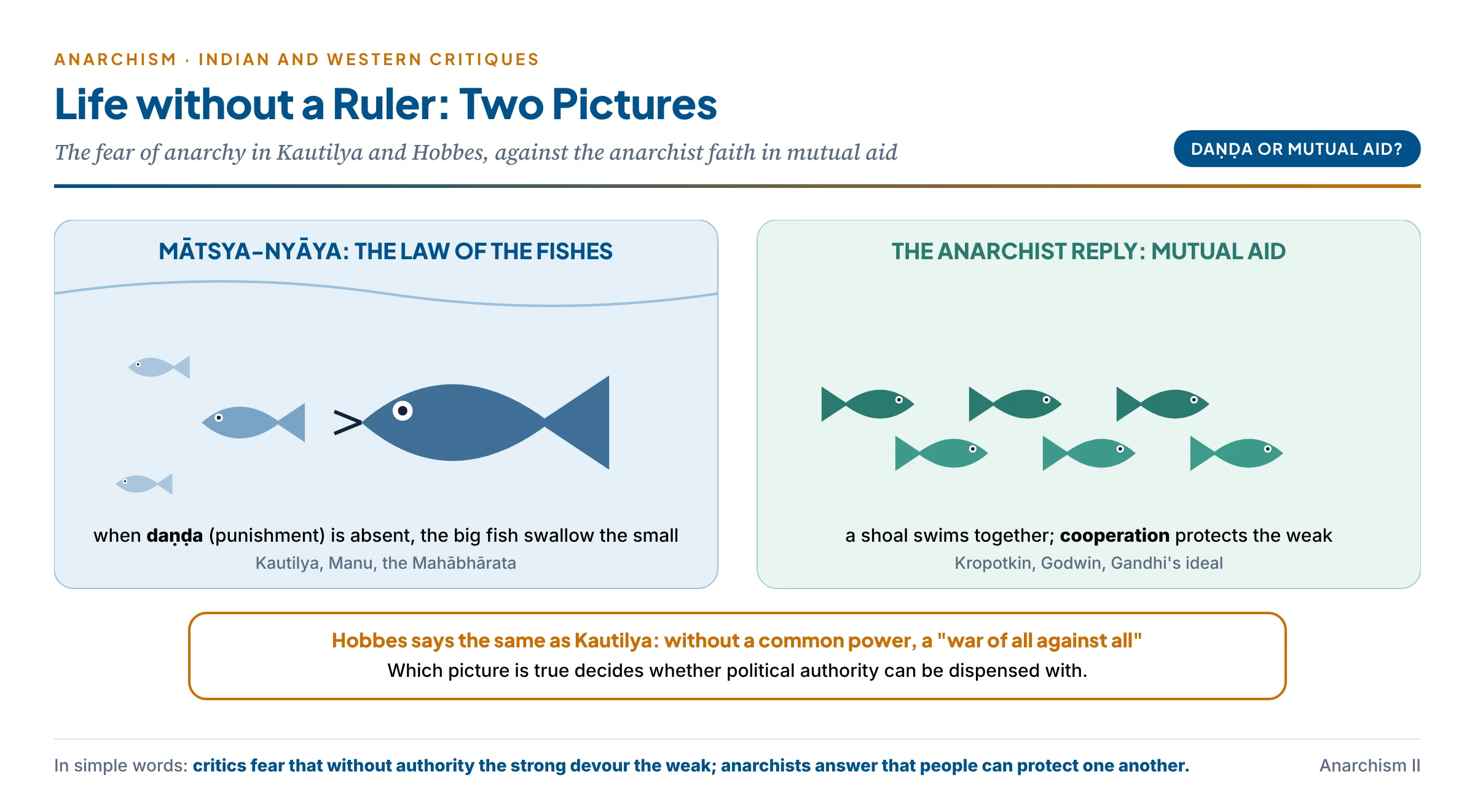
- Hobbes: without a common power to keep all in awe, people live in a state of nature that is a war of all against all; “covenants, without the sword, are but words”.
- Locke’s “inconveniences” of the state of nature: there is no settled, known law, no impartial judge, and no power to enforce just decisions. Each person becomes judge in their own case.
- The free-rider problem: public goods such as defence, clean air, roads and vaccination benefit everyone, so each person is tempted to let others pay. Some authority must ensure contribution.
- Scale and complexity: modern societies of hundreds of millions need coordination: currency, infrastructure, planning, international treaties.
- External danger: a stateless society can be conquered. Anarchist Catalonia was crushed in the Spanish Civil War.
- Protection of the weak: without a state, power passes to gangs, warlords, landlords, dominant castes or corporations. Failed or collapsing states such as Somalia in the 1990s, Iraq after the fall of Saddam Hussein, Libya and Syria show the result: not freedom but chaos and violence.
- Global problems: terrorism, communal violence, pollution, climate change, drug cartels, cross-border terrorism and pandemics demand more coordinated authority, even global governance, not less. Anarchy is “terribly inadequate” here.
- Engels, “On Authority” (1872): a factory, a railway or a ship at sea cannot run without some authority; and a revolution is “the most authoritarian thing there is”.
- Nozick: even starting from anarchy, people would buy protection from agencies; one dominant protective agency would emerge and become, quite justly, a minimal state.
Balanced answer:
- Coercive political authority cannot be dispensed with completely in large, complex, unequal societies, at least not yet.
- It can be reduced, decentralised and made accountable. Many functions can pass to communities, cooperatives and voluntary bodies (the principle of subsidiarity: decide at the lowest level that can handle the matter).
- The anarchist ideal is valuable as a direction of travel: from command to consent, from coercion to cooperation.
Marx versus Bakunin: The Great Debate
Marxists and anarchists both want a stateless, classless society. They split on how to get there, and on what the state is.
| Point | Marx (and Engels) | Bakunin (and the anarchists) |
|---|---|---|
| Root of oppression | Class exploitation; the state is its product | Authority itself; the state is an independent source of domination |
| Order of abolition | Abolish classes first; the state then withers away | Abolish the state and capital together, at once |
| Transitional stage | Dictatorship of the proletariat needed | Rejects any transitional state: it would become permanent |
| Organisation | Centralised workers’ party; take state power | Federation of free communes and unions from below |
| Revolutionary class | Industrial proletariat | All the oppressed: workers, peasants, even the poorest outcasts |
| Means | Political action, including elections where useful | Direct action; refuse electoral politics |
| Warning | Anarchists are utopian; ignore material conditions | Marxist state will create a “red bureaucracy” (the “People’s Stick”) |
- History’s verdict is mixed: anarchists were right that the Soviet “transitional” state became a permanent, bureaucratic dictatorship; Marxists were right that small anarchist experiments could not defend themselves against organised states.
Do You Subscribe to Anarchism?
A balanced position (asked in 2018) can be built in three steps:
- Accept its critical insight: authority must always justify itself (Chomsky); state power is dangerous; voluntary cooperation is real and valuable.
- Reject its complete programme: a stateless society cannot yet protect the weak, provide public goods or meet global threats; anarchist strands also contradict one another.
- Adopt its spirit inside democracy: decentralisation (73rd and 74th Amendments), civil liberties, cooperatives, civil society, restorative justice and non-violent protest. As one evaluation puts it, the answer to the tyranny anarchism exposes lies in better political models, such as democratic socialism in the Scandinavian countries, rather than in abolishing the state.
Critical Evaluation
Critical Estimate of Anarchism
- Utopian and non-coherent: it lacks an agreed account of the society that should replace the state.
- It sees only the negative side of the state and ignores its protective, welfare and developmental roles.
- It sees only the positive side of human nature.
- Hobbes, who lived through the English Civil War, wrote that even a bad coercive authority is better than the chaos of none; Iraq after the fall of Saddam Hussein is a modern example.
- Anarcho-syndicalism may replace the state monster with a group monster.
- The state is needed against terrorism, radicalism, communal violence and pollution; without it, chaos follows, as in Syria or Iraq.
- Global warming, drug cartels and cross-border terrorism require stronger global governance that supplements states.
Significance of Anarchism
- It draws attention to the tyranny of economic and political power that makes people’s lives miserable, though the solution lies in better political models, not in abolition.
- In some situations it has real ideological value:
- Anarchist (libertarian) capitalism reacts against over-intervention by the state that blocks enterprise and merit.
- Anarcha-feminism arose as a response to patriarchy.
- When normal institutions fail or oppress, as under British colonial rule, resistance to authority becomes justified.
- But anarchist ideas are products of particular times and cannot be applied universally; used against legitimate democratic governments they become dangerous. Naxalism in India is an example of violent rejection of a democratic state.
- In a democracy people can be treated as ends in themselves, as anarchists want, and democracy offers a way to use state institutions peacefully.
- Anarchy is best seen as a response to oppressive political systems rather than a system of government. Noam Chomsky: authority is not self-justifying; it must prove its legitimacy, and if it cannot, it should be dismantled.
Critics and Defenders
Criticism — Critics
- Hobbes and Kautilya: without a sovereign power, the strong devour the weak.
- Locke: the state of nature lacks known law, an impartial judge and enforcement.
- Engels: complex production and revolution itself require authority.
- Raz: legitimate authority helps us act on our own reasons better; obeying it is not giving up autonomy.
- Nozick: a minimal state arises justly out of anarchy.
- History: failed states bring warlords, not freedom.
Defence — Defenders and strengths
- Wolff: no command creates a duty merely by being a command; each law must earn obedience.
- Simmons: every theory of political obligation fails for most citizens.
- Bakunin: the “People’s Stick” prophecy came true.
- Chomsky: the burden of proof always lies on authority.
- Experience: disasters and pandemics show mutual aid is real.
Cross-Tradition Comparison
| Point | Western debate | Indian thought |
|---|---|---|
| Fear of anarchy | Hobbes: war of all against all | Mātsya-nyāya, the “law of the fishes” in which big fish eat small fish when daṇḍa (punishment) is absent: Kautilya, Manu, the Mahābhārata |
| Justification of authority | Contract, consent, fair play | Daṇḍa protects dharma; the king exists for yogakṣema (the welfare and security of the people) |
| Limits on authority | Rights, constitution | Rājadharma: the king bound by dharma; an unrighteous king may be resisted (Mahābhārata) |
| Self-rule ideal | Wolff’s autonomy, Kant | Swarāj: self-mastery first, then self-government (Gandhi) |
| Golden age without state | Godwin, Kropotkin | Kṛta yuga of the Śānti Parva: people protected one another through dharma |
Indian Connect — Indian takeaways
- Kautilya: if daṇḍa is not used, mātsya-nyāya prevails, and the strong swallow the weak. This is a Hobbesian argument two thousand years earlier, and the classic Indian answer to the anarchist.
- Yet Indian thought also limited authority: daṇḍa used too harshly frightens people; too mildly, it is despised; used justly, it makes people devoted to dharma (Arthaśāstra).
- Gandhi combined both sides: the ideal is enlightened anarchy, but since it is never fully realised, the best practical state is the one that governs least (Article 10).
Synthesis (Siddhānta)
- Wolff proves less than he claims: autonomy does not require refusing every authority, because reasonable, accountable and coordinating authority can serve autonomy. But his challenge rightly shifts the burden of proof onto the state.
- Simmons’s a posteriori anarchism is more persuasive: it shows that most of us never consented, and that the classical theories of obligation are weaker than we assume. That supports civil disobedience and conscientious objection, not abolition of the state.
- “All states are illegitimate” is false as a universal claim but true as a warning: legitimacy is earned, partial and revocable.
- Unconditional rights do not lead to anarchy; they lead to a limited and accountable state.
- Political authority cannot be dispensed with completely, but it can be reduced, decentralised and democratised. The anarchist dream works best as a compass, not as a blueprint.
Previous Year Questions
- 2023Critically examine the anarchist’s view that “all States always and everywhere are illegitimate and unjust.”
- 2022Does the idea of unconditional rights necessarily lead to anarchy? Critically examine.
- 2021Discuss anarchism as a political ideology. Is it possible to dispense with political authority completely? Give reasons for your answer.
- 2020Do you think that the prevailing pandemic will lead to anarchism in society? Discuss.
- 2018Do you subscribe to the political ideology of Anarchists? Justify your answer.
- 2017Discuss in the context of Anarchy whether the freedom of an individual is consistent with the sovereignty of the state?
- 2007Critically examine – “Acceptance of the authority of the state is inconsistent with the highest duty of mankind, ‘the duty to act autonomously‘” (Robert Paul Wolff).
- 2006Critically – “Acceptance of the authority of the state is inconsistent with the highest duty of mankind, ‘the duty to act autonomously‘” (Robert Paul Wolff).