

Sovereignty: Austin, Bodin, Laski, Kautilya.
Official Syllabus: Paper II, Section A, Unit 2
The Arthaśāstra of Kauṭilya is the most important text of ancient Indian political thought, and the only one in the UPSC syllabus that offers a complete Indian theory of the sovereign state. Kautilya does not define the state in one sentence, as Bodin or Austin do. Instead he describes it as a living body with seven limbs — the Saptāṅga theory: the ruler (svāmī), the minister (amātya), the territory with its people (janapada), the fort (durga), the treasury (kośa), the army (daṇḍa) and the ally (mitra). At the head stands the king, whose sovereignty is exercised through daṇḍanīti — the science of government and punishment — and is directed by dharma towards one end: the security and happiness of the subjects. This article covers Kautilya and the Arthaśāstra, its view of human nature and the origin of kingship, each of the seven elements in detail, why Kautilya thought sovereignty is hierarchical, dharma, daṇḍa and the sources of law, rājadharma and welfare, whether his sovereign is a despot, a comparison with Bodin, and the relevance of his ideas for a modern democracy. Kautilya’s theory of external sovereignty — the maṇḍala of states — follows in Article 6.
In simple words
Think of the human body. The head thinks and decides; the eyes see; the hands defend; the stomach stores and feeds; the legs carry the whole weight; the ears hear what friends and strangers say. No limb can work alone, and if one falls sick the whole body suffers — but if the head is lost, everything is lost. Kautilya sees the state in exactly this way: seven limbs working as one body, with the king as its head.
Context & Problem
Kautilya and His Book
- The author. Tradition identifies Kauṭilya with Cāṇakya (also called Viṣṇugupta), the brahmin minister who helped Chandragupta Maurya overthrow the Nanda dynasty and found the Mauryan empire in the late fourth century BCE.
- Rediscovery. The text was lost for centuries. It was rediscovered in 1905 by R. Shamasastry in Mysore, published in 1909 and translated into English in 1915. J. J. Meyer produced a German translation, T. Ganapati Sastri found further manuscripts and wrote a commentary, and R. P. Kangle prepared the standard critical edition in three volumes.
- Structure. 15 books (adhikaraṇas), 150 chapters and 180 topics. They cover the training and duties of the king, ministers and spies, the bureaucracy and the duties of officials, forts and settlements, revenue, industries and mines, trade and commerce, civil and criminal law, the suppression of anti-social elements and sedition, financial crises, the six-fold foreign policy, calamities, military campaigns, guilds and corporations, secret methods against enemies, and a glossary of technical terms.
- A compiler as well as an author. Kautilya openly says he has collected the teachings of earlier masters — Bṛhaspati, Uśanas (Śukra), Bhāradvāja, Viśālākṣa, Parāśara and others — and he often states their view and then his own (“thus says Kauṭilya“). The science of politics clearly had a long history before him.
- Not mainly economics. Although artha means “wealth”, the book is far more about politics and administration than economics; its central concern is the practical government of a state and the relations between states.
Common confusion
Was the whole Arthaśāstra written by Chāṇakya in the fourth century BCE? That is the traditional view, and it is how the text is usually introduced. Many modern scholars, studying its language and contents, think the surviving text grew in layers — older treatises, a “Kauṭilya” recension, and a later revision — between roughly the second century BCE and the third century CE. For the purposes of political philosophy, what matters is the theory the text presents, which is consistent and coherent, whoever finally edited it. It is safe to say: “attributed to Kauṭilya, minister of Chandragupta Maurya”.
Artha and the Four Sciences
- What is artha? Artha is the means of livelihood — wealth, prosperity and the territory that produces it. The Arthaśāstra is “the science of acquiring and protecting the earth (territory)”.
- Artha comes first. Of the three aims of life (trivarga) — dharma (duty), artha (wealth) and kāma (pleasure) — Kautilya holds that artha is primary, because dharma and kāma depend on it. Under a well-run state, people can pursue kāma, and only when the first three are secure can mokṣa (liberation) be sought. In this sense all the goals of human life depend on the proper working of the state.
- The four sciences (vidyās):
- Ānvīkṣikī — philosophy or critical reasoning (Sāṃkhya, Yoga and Lokāyata); Kautilya calls it the lamp of all sciences, the means of all actions and the support of all duties.
- Trayī — the three Vedas; the basis of dharma and the social order.
- Vārtā — economics: agriculture, cattle-rearing and trade.
- Daṇḍanīti — the science of government (literally, “the policy of the rod”); the guarantee that the other three can flourish.
The Society Behind the Text
- Prosperity and order. The Mauryan empire described in the Arthaśāstra — and in the Greek ambassador Megasthenes’ accounts — was prosperous: fertile land, mineral wealth, double rainfall, many crafts, and security of life and property (theft was rare and houses were often left unlocked).
- A busy economy. Rivers and roads linked the empire; goods moved down the Ganga to Champa and Varanasi, along the Yamuna to Kausambi and on to Sind. Towns charged octroi; prices of everyday goods were declared and checked daily; weights and measures were inspected.
- A mixed economy. The state ran key industries (weapons), managed forests (elephant forests were a state monopoly) and dairy farms, regulated trade and market hours — while allowing wide private enterprise.
- Social care. The state supported the poor, orphans, the aged, the helpless, the infirm, pregnant women and newborn children; families had to support their dependants; rules covered divorce, separation and remarriage; public health and sanitation were regulated (throwing garbage on roads was an offence, carcasses had to be removed, adulteration of food and medicine was fined, negligent physicians were punished).
- Social hierarchy with liberal rules. Kautilya accepted the varṇāśrama order, but softened it: brahmins could face capital punishment, śūdras could give evidence in court, artisans were protected, the children of slaves were protected, and he declared that “an Ārya shall never be subjected to slavery“. The legal chapters are not a code but a generalisation of common law in the light of a political doctrine.
The Problem: The Law of the Fishes
- Mātsya-nyāya. Without government, says Kautilya, the law of the fishes prevails: the big fish swallow the small. In the absence of punishment (daṇḍa), the strong devour the weak; in its presence, the weak can resist the strong.
- The origin of kingship. Through a dialogue in the text, Kautilya reports a tradition: oppressed by the law of the fishes, the people chose Manu Vaivasvata as their king and agreed to give him one-sixth of their grain and one-tenth of their merchandise, along with gold, as his share. In return the king guaranteed their security and welfare.
- A contract of protection. This is a kind of social contract: taxes in exchange for protection. It makes the king’s authority conditional on his duty to protect — a theme that runs through the whole Arthaśāstra.
Indian Connect — Mātsya-nyāya and the state of nature
The law of the fishes is India’s version of what Hobbes called the state of nature, “the war of every man against every man”. Both thinkers derive the need for a strong sovereign from the same fear: without a common power, the strong destroy the weak. But Kautilya’s sovereign is bound by dharma and the duty of welfare, while Hobbes’s is bound only by the subjects’ right to self-preservation.
Core Doctrine
Kautilya’s Idea of Sovereignty
- Sovereignty for Kautilya is the supreme authority of the state, embodied in the king: the power to make laws, command obedience and punish those who disobey.
- Monarchy. He takes monarchy for granted and favours hereditary monarchy for continuity, with succession by the eldest son (primogeniture) where the son is fit — an unfit prince could be passed over.
- A strong, expanding state. He champions a strong, stable monarchy that grows into an empire; the ideal of the cakravartin (universal ruler) points to a domain stretching from the Himalayas to the sea.
- Paternal and benevolent. The state is paternal in character and benevolent in spirit; the king should treat his subjects as a father treats his children.
- First servant of the state. Kautilya’s conception of state power is striking for its comprehensiveness: power is the aggregate of the prakṛtis (elements), and the ruler is the first servant of the state, with an explicit normative duty to bring prosperity and security to the people.
- Politics separated from religion. Kautilya makes a clear distinction between religion and politics: the state’s own claims — security, prosperity, order — rather than priestly authority, decide political action. In this sense he replaces the primacy of religion with the claim of state sovereignty, while still upholding dharma and the social order.
The Saptāṅga Theory: The State as an Organism
- Seven limbs. The constituent elements of the state are called prakṛtis or aṅgas (limbs); hence Saptāṅga (seven-limbed) theory.
- An old Indian theory. It appears in the Rāmāyaṇa and Mahābhārata, in the Manusmṛti, the Yājñavalkya Smṛti, the Nītisāra of Kāmandaka and the Śukranīti. Kautilya gives it its fullest and most practical form.
- Organic unity. The state is not a loose collection of parts, each with its own interest and moving at its own will; it is an organic whole, like a body, in which each limb supports the others.
- A later text maps the limbs onto the body: the king is the head, the minister the eyes, the ally the ears, the treasury the mouth, the army the mind, the fort the arms and the territory the legs.
- A tree picture is also used: the king is the root, the ministers the trunk, the military chiefs the branches, the soldiers the leaves, the people the flowers and the prosperity of the country the fruit.
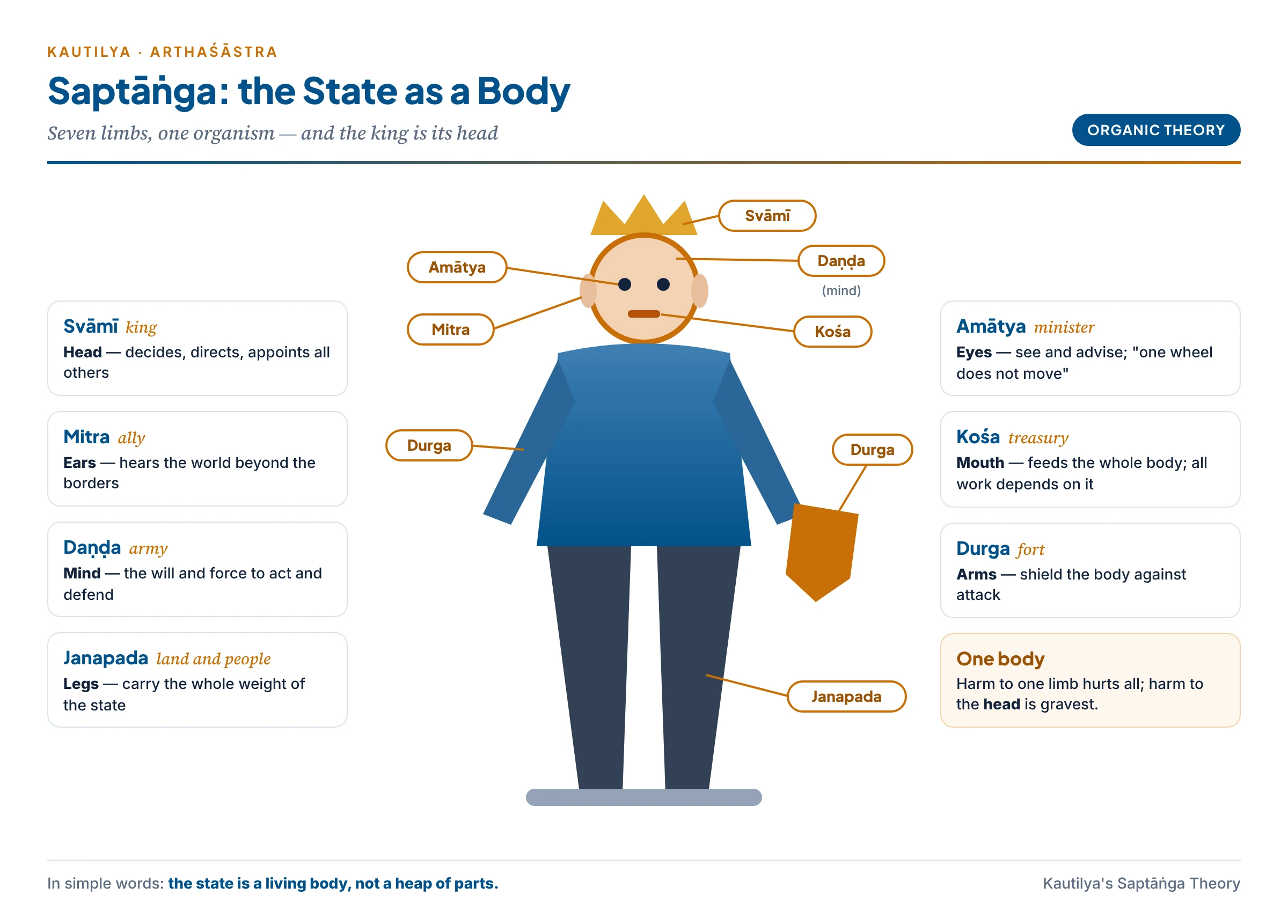
1. Svāmī — The Ruler
- Placed on the highest pedestal. The king is the most important element; all the others are guided and moulded by him.
- Qualities of the ideal king. Kautilya groups many qualities into four sets:
- Ābhigāmika — qualities that attract others: noble birth, piety, truthfulness, gratitude, generosity, approachability, respect for elders, energy, and the ability to keep feudatories (sāmantas) under control.
- Prajñā — intellectual qualities: desire to learn, listening, grasping, retaining, understanding, reflecting, and firm grounding in the science of politics. Intellectual strength ranks highest.
- Utsāha — energy: bravery, quickness of decision, determination, skill.
- Ātma-sampat — personal excellence: eloquence, self-control, freedom from vices, dignity, a pleasant manner.
- A native and a noble. The ideal king is a native of the territory, of noble birth, inspires confidence, is easily approachable, truthful, pious and sharp-witted.
- Self-discipline. He must conquer the six enemies within — lust, anger, greed, pride, arrogance and excessive joy. “A king who has not mastered his senses soon perishes.”
- A disciplined day. The king’s day and night are divided into eight parts each, with fixed times for hearing reports, receiving petitions, consulting ministers, inspecting the army, studying and rest. He must never keep petitioners waiting at his door.
- Duties of the king. Protect the people; save the weak from being exploited by the strong; treat all varṇas according to dharma; know war and diplomacy; uphold dharma and law in all cases; defend the state against enemies; use daṇḍa to curb anti-social elements; appoint honest, dedicated ministers; increase the state’s resources; look after the forts, the janapada and the kingdom; and above all, work for the all-round progress of the people.
- Sovereign in a limited sense. The king is superior to all and the most important element — but he is not an Austinian sovereign free from all law. He must rule according to daṇḍanīti and the prevailing customs and traditions, and look after each element by its own rules.
2. Amātya — The Minister
- “One wheel alone does not move.” A ruler, however able, cannot govern alone; just as a chariot cannot move on one wheel, the king needs ministers and must listen to their advice. Manu, Yājñavalkya, Śukra, Bhāradvāja and Bhīṣma in the Mahābhārata say the same.
- Who are amātyas? The term covers all high officers — councillors and executive heads. At its top is the chief minister (mantrin, mahāmātya, pradhāna-amātya), the second-highest dignitary, sometimes even a king-maker.
- Qualities. Native, of good family, learned (especially in the dharmaśāstra), wise, brave, diplomatic, energetic, efficient, honest, tolerant, far-sighted, loyal, healthy — and able to win the confidence of the city and country people. Above all, they must keep secrets.
- Three grades. Those with all the qualities may be chief ministers; those with half or a quarter become middle or lower ministers.
- Tests of integrity (upadhā). Officials were tested secretly through spies:
- Dharma test (temptation to disloyalty on religious grounds) — those who passed went to the civil courts (dharmasthīya) and criminal courts (kaṇṭakaśodhana).
- Artha test (temptation of money) — those who passed became revenue collector (samāhartā) and treasurer (sannidhātā).
- Kāma test (temptation of lust) — guards of the pleasure-grounds and the royal household.
- Bhaya test (fear) — the king’s bodyguard.
- Those who passed all tests became ministers; those who failed all were sent to mines, forests, elephant forests and factories.
- Eighteen high officials (tīrthas) included the chief counsellor (mantrin), the priest (purohita), the commander-in-chief (senāpati), the crown prince (yuvarāja), the chief of the palace gate, the head of the royal household, the officer in charge of prisons, the revenue collector, the treasurer, the officer who issues royal orders, the army chief, the head of the capital city, the chief judge, the head of mines and factories, the president of the council, the officer in charge of the army’s upkeep, the officer in charge of forts, and the warden of the frontiers (antapāla). Envoys and the intelligence service supported them.
- Secret counsel. Good and secret advice is the armour of the king and the very basis of the state’s growth; ministers were called the heart and soul of the king. Almost every function of the state — agriculture, forts, new settlements, punishment of criminals, tax collection, the growth of the janapada — depended on them.
In simple words
Before a bank hands someone the keys to its vault, it checks his record, tests his honesty and watches how he behaves when money is within reach. Kautilya’s upadhā tests did the same for royal officials: a person was trusted with courts, revenue, the palace or the king’s life only after passing the test that matched the temptation of that job.
3. Janapada — Territory and People
- Land and population together. Janapada literally means “the place where the people settle”; it includes both the territory and its inhabitants.
- Good land. Free from rocky, saline, uneven and thorny tracts, wild beasts and wilderness; rich in fertile soil, timber, mines and elephant forests; watered by rivers; with good sites for villages and towns and good communications.
- Good people. Industrious, loyal, disciplined and devoted to dharma.
- The foundation of the other elements. Forts, treasury and army all depend on the janapada; Kautilya ranks it above the fort in importance.
- Settling new land. The king may revive an old janapada or found a new one by inviting people from other countries or by increasing his own population.
- Villages. Each village was to have 100 to 500 families, mostly cultivators, with villages one or two krośas apart so that they could help each other; boundaries marked by trees, rivers or hills.
- Administration. The revenue collector divided the janapada into four parts and classified villages into three kinds — those exempt from tax, those that supplied soldiers, and those that paid taxes in grain, cattle, gold or labour — keeping records of their population and produce.
- Frontiers. Forts at the borders under the warden of the frontiers; forest tribes were employed to guard the outer regions.
- The ruler of the earth. A king whose janapada is rich and prosperous, with happy subjects and faithful ministers, may be called pṛthvīpati — lord of the whole earth.
4. Durga — The Fort
- Defence and safety. The fortified capital protects the people from enemies and from natural calamities; it is also an arsenal and a shelter in war.
- Four kinds of fort:
- Audaka — surrounded by water, like an island.
- Pārvata — on a mountain or built of rock.
- Dhānvana — in a desert.
- Vana — in a dense forest.
- The first two protect the janapada in emergencies; the last two give shelter to the king and others.
- Town planning. The capital (nagara) should be built on a naturally beautiful, defensible site on the advice of experts, with walls, ditches, gates, six royal roads, the palace, temples, markets, armouries, separate quarters for each class and for officials, and storehouses. Undesirable people were to be settled at the frontiers.
5. Kośa — The Treasury
- Everything depends on finance. “All undertakings depend on the treasury; therefore the king shall look to the treasury first.” The army, the forts and even alliances depend on it.
- Lawful and full. The treasury must be lawfully acquired by the king or his ancestors, full of gold, silver and gems, and rich enough to survive a long period without income.
- Treasury and army. The army protects only the treasury, but the treasury maintains both the army and the forts; without it, the army may desert and join the enemy. A treasury can be moved in an emergency; a fort cannot.
- Taxation.
- The normal land tax was one-sixth of the produce (ṣaḍbhāga); customs and fines added to revenue. The main taxpayers were farmers, traders and artisans; those who gave labour service to the state were exempt.
- Taxes were collected once a year, without harassment or torture.
- A famous image: the king should collect revenue as one plucks ripe fruit from a garden, avoiding unripe fruit, which causes anger and destroys the source.
- Emergency taxes with consent. In war or economic crisis the king could raise extra taxes (up to a third or a quarter of the produce), but first he had to inform the people of the emergency, explain why the tax was needed, collect it according to their capacity and without harassment. Frontier areas and poor regions were exempt.
- Honest officials. The treasurer and collector were punished severely for fraud or bribery. Kautilya knew how hard this was: just as it is impossible not to taste honey placed on the tongue, so it is impossible for an official handling the king’s money not to taste a little of it.
6. Daṇḍa (Bala) — The Army
- The coercive arm of the state. The army protects all subjects in emergencies and carries out the king’s policy; without it, the state can neither protect its people nor survive.
- Composition. Infantry, cavalry, chariots and elephants, under a commander-in-chief (senāpati), usually a kṣatriya, though the king could appoint others.
- Seven kinds of troops:
- Maula — hereditary, permanent troops (the most reliable).
- Bhṛta — hired troops.
- Śreṇī — troops of guilds and corporations.
- Mitra — troops of an ally.
- Amitra — troops taken from an enemy or a conquered land.
- Āṭavika — forest tribes.
- Utsāhika — volunteers and adventurers who fight for plunder.
- The first three are the most dependable.
- Intelligence. Spies were placed in towns, the countryside and the territories of feudatories; markets, public places, roads and assemblies were watched.
- Policy. The king should first try to avoid war; he may attack weak kings and ally with stronger ones. War and diplomacy are the two chief instruments for keeping enemies in check. A strong army can turn even an enemy into a friend.
7. Mitra — The Ally
- Why an ally is a limb of the state. Including the ally among the elements shows how important inter-state relations were — and presupposes some kind of international order. A king without friends easily falls prey to attack.
- The ideal ally has six qualities: hereditary (a friend of long standing), constant, under control (dependable), not likely to turn hostile, capable of great help and quick to help in time of need.
- Natural and acquired allies. An ally may be natural (sahaja) — bound by family ties or position — or acquired (kṛtrima) — won by protection or benefits.
- Friendship with ethics. A true friend is a person of virtue; a greedy, unjust neighbour is likely to become an enemy. Friendship rests not only on political and military advantage but also on socio-ethical principles.
- Gold and friendship. “Gold and friendship” are the fruits of war and diplomacy respectively; allies help the king defend himself and pursue prosperity, and keep a balance among kings.
- Article 6 explains how the ally fits into the maṇḍala of states.
| Element | Meaning | Modern equivalent |
|---|---|---|
| Svāmī | The ruler | Head of state / sovereign authority |
| Amātya | Ministers and officials | Executive and civil service |
| Janapada | Territory with people | Territory and population |
| Durga | Fortified capital | Defence infrastructure; capital |
| Kośa | Treasury | Economy and public finance |
| Daṇḍa | Army | Armed forces and police |
| Mitra | Ally | Diplomacy and alliances |
Why Sovereignty Is Hierarchical
The elements are not equal. Kautilya ranks them, and that ranking is why his sovereignty is called hierarchical.
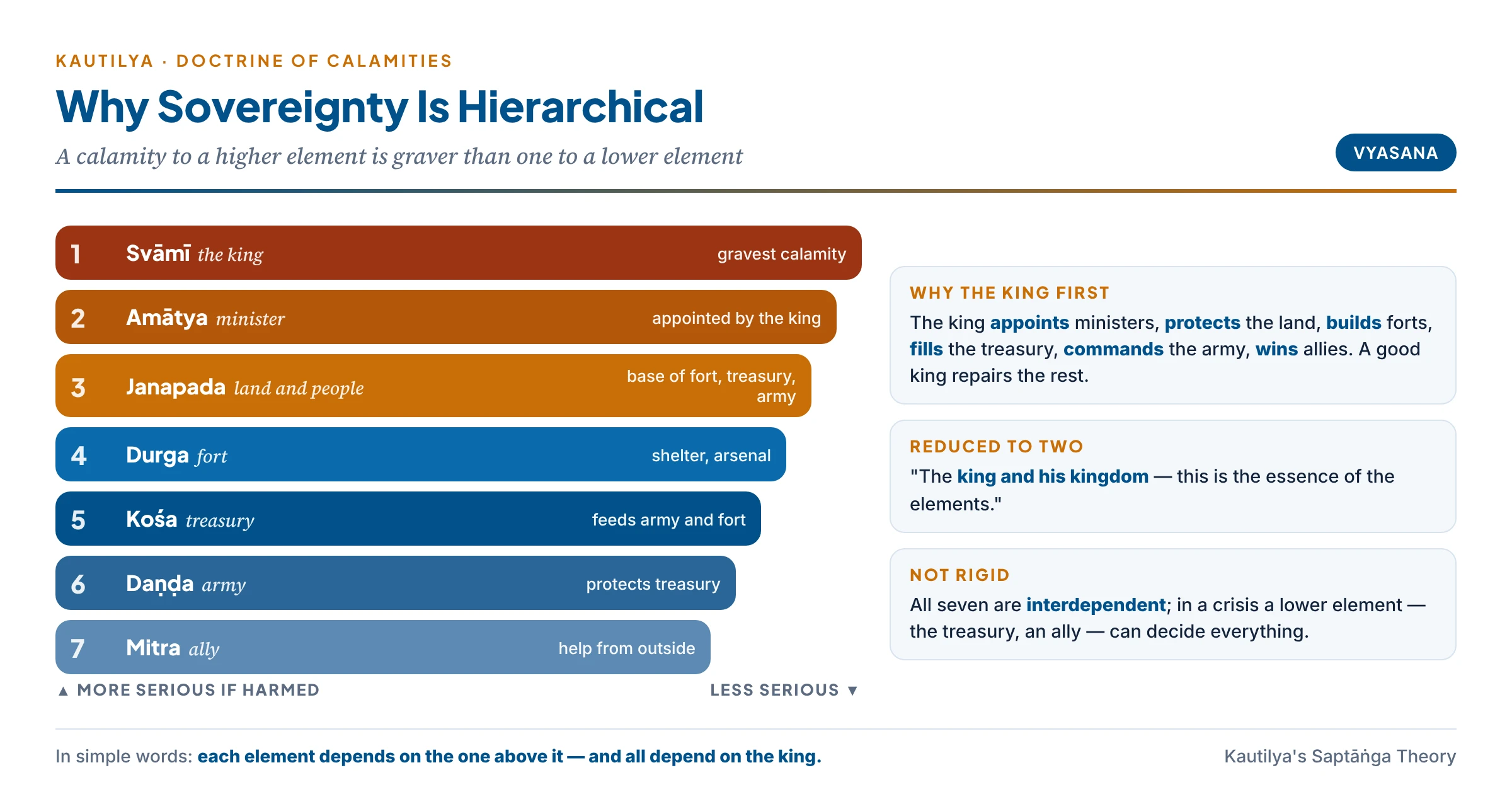
- The order of the list is an order of importance. Kautilya places the king first, then minister, territory, fort, treasury, army and ally.
- The doctrine of calamities (vyasana). In the eighth book he asks: if two elements suffer a calamity, which is more serious? Earlier teachers argued that a calamity of the minister, the territory, the fort, the treasury or the army was graver than that of the element before it. Kautilya rejects each claim: a calamity befalling an element higher in the list is more serious than one befalling an element lower down. The calamity of the king is the most serious of all.
- Why the king comes first. The king appoints the ministers, protects the territory, builds the forts, fills the treasury, commands the army and wins the allies. A good king can repair the other elements; a bad king ruins them all.
- Reduced to two. Kautilya even sums up the seven in two: “The king and his kingdom — this is the essence of the elements.” The king symbolises sovereignty; the kingdom is the field over which it is exercised.
- Hierarchy in administration. Below the king come the chief minister, the high officials, the department heads and the village headmen — a graded chain of command.
- Hierarchy among states. In foreign policy, states are ranked as the conqueror, enemies, allies, the middle king and the neutral king (Article 6).
- Hierarchy in society. The state upholds a ranked social order of varṇas and āśramas.
But not a rigid hierarchy.
- Interdependence. All elements are needed; their importance also depends on what each achieves. No other ancient thinker worked out the inter-relations of the elements in such detail.
- Pragmatism. Kautilya admits that in particular circumstances a lower element may become decisive — a treasury crisis or a powerful ally can matter more than anything else for a time.
- Distinctive. By putting the king clearly at the top, Kautilya separates himself from earlier schools that gave first place to some other element.
In simple words
In a cricket team, the captain sets the field, chooses the bowlers and decides the batting order. If the best bowler is injured, the team suffers; but if the captain makes bad decisions, even great players lose. That is why Kautilya ranks the king’s calamity as the worst — the captain shapes how every other player is used.
Dharma: The Moral Foundation
- Three meanings of dharma in the Arthaśāstra:
- Social duty — the duties of each varṇa and āśrama.
- Moral law based on truth.
- Civil law — the law administered in the courts.
- The king and dharma. The king must be devoted to dharma; all his actions should accord with it. When dharma is violated, the king’s punishment restrains the wrongdoers — for if dharma is transgressed, the ruler himself is ruined.
- Dharma-pravartaka. When all dharmas decline, the king becomes the promoter of dharma, establishing the four-fold varṇa order and protecting morality. In concrete terms, this meant defending a social order based on family, property and varṇa.
- The central place of dharma. A state was good or bad according to how far it made dharma flourish. The basic aims of the state in Indian tradition were dharma, peace and order, security and justice.
- Duties common to all. Non-violence, truthfulness, purity, freedom from malice, compassion and forbearance. Fulfilling one’s own duty (svadharma) leads to heaven and endless bliss. Kautilya fined those who renounced the world without providing for their families, and those who violated the duties of their station.
Daṇḍa and Daṇḍanīti: Sovereignty in Action
- Daṇḍa literally means “rod” — the coercive power of the state to punish. Daṇḍanīti is the science of its proper use: the science of government.
- Four purposes of daṇḍanīti:
- To acquire what has not been acquired.
- To protect what has been acquired.
- To increase what has been protected.
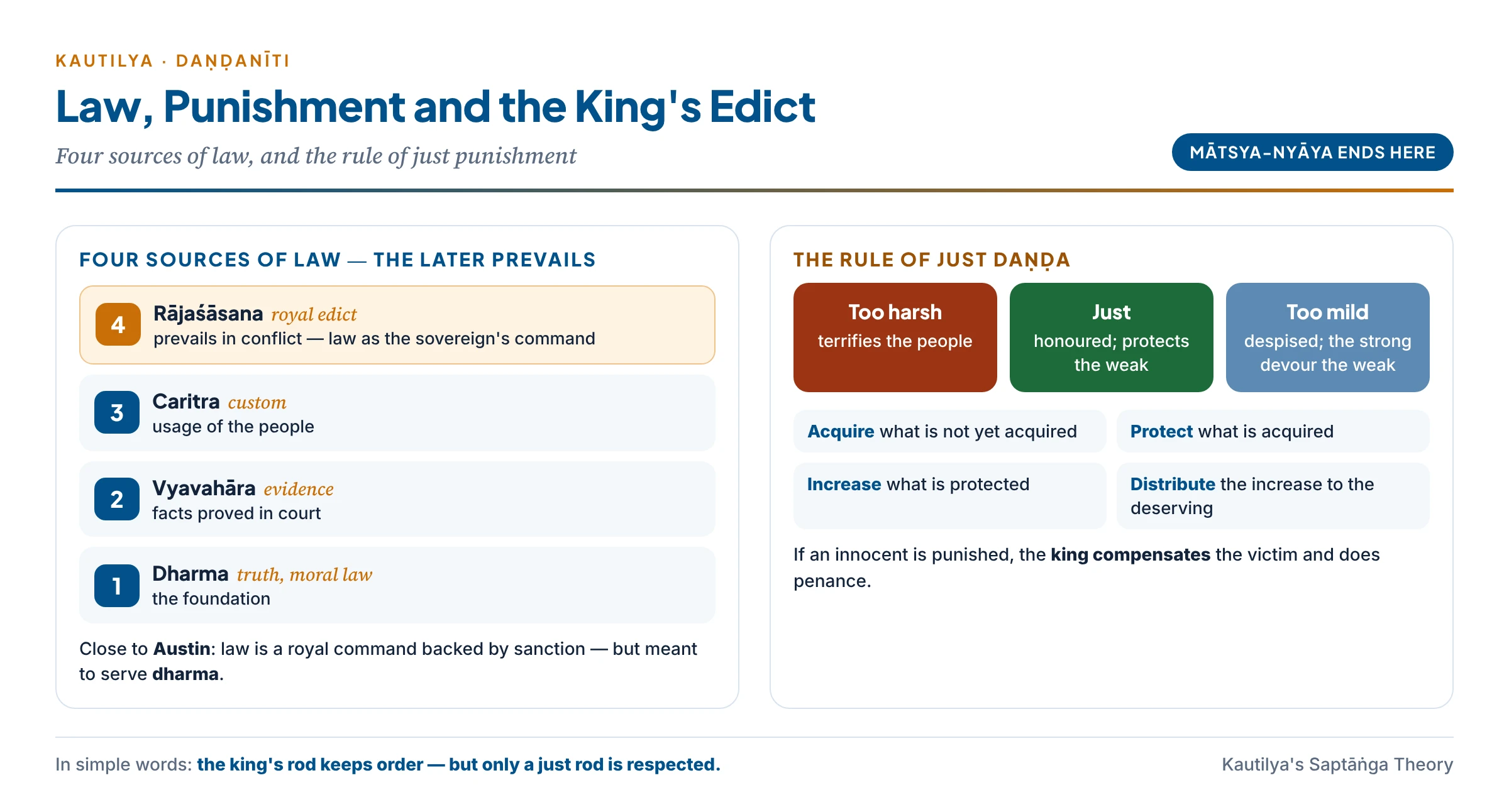
- To distribute what has been increased among the deserving.
- Daṇḍa keeps the world in order. Without it, the law of the fishes returns; with it, the weak can live with dignity. Daṇḍa makes the other three sciences — philosophy, the Vedas and economics — possible.
- Neither too harsh nor too mild. “A king severe with the rod terrifies the people; a king mild with the rod is despised; a king just with the rod is honoured.” Punishment must be in proportion to the offence and applied after due consideration.
In simple words
A teacher who punishes every small mistake harshly makes the class afraid and resentful; a teacher who never punishes anything is laughed at and the bullies take over. The teacher who is firm but fair is respected, and the weak children feel safe. That is Kautilya’s just daṇḍa.
- Why daṇḍa is needed. Kautilya has a realistic, even pessimistic, view of human nature: people are driven by passions that only the king’s daṇḍa can control.
- Law as command. For Kautilya, law is a human creation, a royal command enforced by sanction — the backbone of political rule and the basis of the Mauryan judicial system. In this he anticipates Austin by some two thousand years.
- Courts. Civil courts (dharmasthīya) and criminal courts (kaṇṭakaśodhana — “removal of thorns”), each with three judges; justice was decentralised for speed, but summons and decrees ran in the king’s name, and the king was at the head of the judicial system.
- The king answerable for justice. If an innocent person was punished or a culprit escaped through the king’s fault, the king had to compensate the victim and even perform penance — a striking extra-political sanction on the sovereign.
- The broad scope of daṇḍanīti. It covers war, diplomacy, social, economic and religious affairs, and civil and judicial administration — everything that the state does.
The Four Sources of Law
Kautilya names four “feet” of law:
- Dharma — truth and moral law.
- Vyavahāra — evidence and transactions (the facts proved in court).
- Caritra — custom and the usage of the people.
- Rājaśāsana — the royal edict.
- The later prevails over the earlier. When they conflict, custom overrides evidence, and the king’s edict overrides all — provided it accords with dharma and reason. This makes the king’s command the supreme authority in conflicts between kinds of law — the most “Austinian” feature of Kautilya.
- Another list in the tradition names dharma, judicial precedent, custom and equity (nyāya); in both, the king’s authority settles the final question.
Rājadharma: The Duty of Kingship
- An ancient idea. Rājadharma — the duty of the king — runs from the Vedas through the dharmasūtras, the Mahābhārata (whose Śānti Parva devotes more than a hundred chapters to it), the Manusmṛti and, above all, the Arthaśāstra.
- The golden age without a king. The Mahābhārata recalls an age when there was no king and no coercion, and people were guided by dharma alone; kingship became necessary only when dharma declined. Manu exalts dharma as the supreme principle: protected, it protects; violated, it destroys.
- Checks on the king. In the epic, ministers did not hesitate to rebuke the king; the king had to respect the views of brahmins, the heads of guilds and the people. The connection between king and people rested on mutual advantage: the king protected the people and did what pleased them in return for the taxes he received.
- Flexibility. Classical theory recognised that a ruler may sometimes have to depart from the letter of the law in order to preserve it; rājadharma was therefore defined flexibly.
- The limits are moral but real. The restrictions on the king were not formal-legal, but they were powerful: a king who was arbitrary, incompetent or against dharma ceased to be a true king and could be removed — tradition even speaks of tyrants struck down.
- Āpad-dharma — duty in calamity. In famine, flood, fire, drought, epidemic or invasion, the king must open his treasury, give shelter in the fort, supply food, clothes, money and security, treat all equally and consult his ministers and allies. The people in turn should support the king, for without a king their lives and property cannot be protected.
Welfare: The End of the State
“In the happiness of his subjects lies the king’s happiness; in their welfare, his welfare. Whatever pleases himself he shall not consider good, but whatever pleases his subjects he shall consider good.” — Kautilya
- Yoga-kṣema. The aim of the state is yoga (acquiring what is needed) and kṣema (securing what is acquired) — prosperity and security for all.
- Welfare as sacrifice. Kautilya compares the king’s devotion to the welfare of his subjects to the performance of a religious sacrifice; his vow is the readiness to act for them.
- “Strength is power; happiness is the end.” Power is the means; the happiness of the people is the goal.
- More than order. The ends of the state are not merely the maintenance of order and protection, but the highest self-development of the people — something close to a modern welfare state.
Kautilya’s sovereignty in different spheres:
| Sphere | Kautilya’s position |
|---|---|
| Legal | A just and well-regulated legal system; the king upholds and enforces law and ensures fair administration |
| Political | A strong, centralised system under a wise ruler; the king supreme in decision-making |
| Economic | Extensive policies for self-sufficiency and prosperity; state control over resources, trade and revenue |
| Cultural | Not discussed separately, but a harmonious, well-regulated society implies recognition of customs and diversity |
| Individual | Individual well-being within a well-governed state; protection of rights and duties within a just order |
| International | Pragmatic diplomacy; recognising other states’ independence while protecting one’s own (Article 6) |
Critical Evaluation
Does Kautilya’s Sovereignty Turn into Despotic Rule?
Arguments that it does:
- Centralisation. All power is concentrated in the king; there is no assembly with a share of sovereignty and no role for citizens in governance.
- Espionage and surveillance. An elaborate secret service watched officials, citizens and even the king’s family; security comes at the expense of liberty.
- Ethically doubtful means. Kautilya permits deceit, secret killing, false accusation and manipulation against enemies and traitors for reasons of state.
- The edict above custom. The king’s command overrides other sources of law.
- Harsh punishments for many offences.
- Hierarchy. The varṇa order is upheld, with unequal duties and penalties.
- Max Weber’s verdict. “Truly radical ‘Machiavellianism’… is classically expressed in Indian literature in the Arthaśāstra of Kautilya…: compared to it, Machiavelli’s The Prince is harmless.”
Arguments that it does not:
- Dharma binds the king. He is the protector, not the author, of the moral order; an adharmic king loses legitimacy.
- Welfare is the purpose. The happiness and security of the subjects is the explicit end of rule; the king’s own pleasure counts for nothing against theirs.
- The council of ministers. The king must consult; “one wheel does not move”.
- Accountability. The king must compensate for miscarriages of justice; officials are tested and punished for corruption.
- Consent for emergency taxes and the duty of explaining crises to the people.
- Protection of the weak — workers, women, children of slaves, the poor and the sick.
- The ruler as first servant, bound by daily duties and the needs of his subjects.
Verdict: Kautilya’s sovereign is best described as a benevolent, welfare-oriented monarch — sometimes called an enlightened despot. The danger of despotism is real, because the checks on him are moral and customary, not legal and institutional; the intention of the theory, however, is the protection and happiness of the people. Much depends, as critics note, on the wisdom of the ruler.
Kautilya and Bodin Compared
| Point | Kautilya (Saptāṅga) | Bodin |
|---|---|---|
| Approach | Practical statecraft; an organic theory of seven elements | Juristic theory of sovereignty and its marks |
| Definition of the state | Seven interdependent limbs, headed by the king | A rightly ordered government of households with sovereign power |
| Sovereign | The king, one element among seven but the highest | The prince (or ruling body) holding absolute, perpetual power |
| Indivisible? | Effectively yes — centred in the king | Yes; no mixed state |
| Law | Four sources; the royal edict prevails in conflict | Law is the sovereign’s command; positive law cannot bind him |
| Limits | Dharma, custom, ministers, welfare duty | Divine and natural law, fundamental laws, property, contracts |
| Taxation | One-sixth; emergency taxes explained to people | New taxes need consent |
| Purpose | Yoga-kṣema — security and happiness of subjects | Order and peace in a well-ordered commonwealth |
| External side | The maṇḍala of states and six-fold policy | Mutual recognition of sovereign states |
| Danger | Benevolent despotism; espionage | Absolutism |
- Common ground: both want a strong, central authority to end disorder (the law of the fishes; the Wars of Religion); both bind the sovereign by a higher moral law that no subject can enforce; both care about fair taxation.
- Difference: Kautilya’s theory is organic and practical — it describes all the parts of a working state; Bodin’s is juristic — it defines the abstract quality of supreme legal power. Kautilya’s sovereign is defined by duties and welfare; Bodin’s by rights and marks. Bodin is closer to modern constitutionalism (consent to tax, fundamental laws); Kautilya to the modern welfare and administrative state.
Is Kautilya’s Sovereignty Applicable to a Democracy? Its Relevance Today
What still applies:
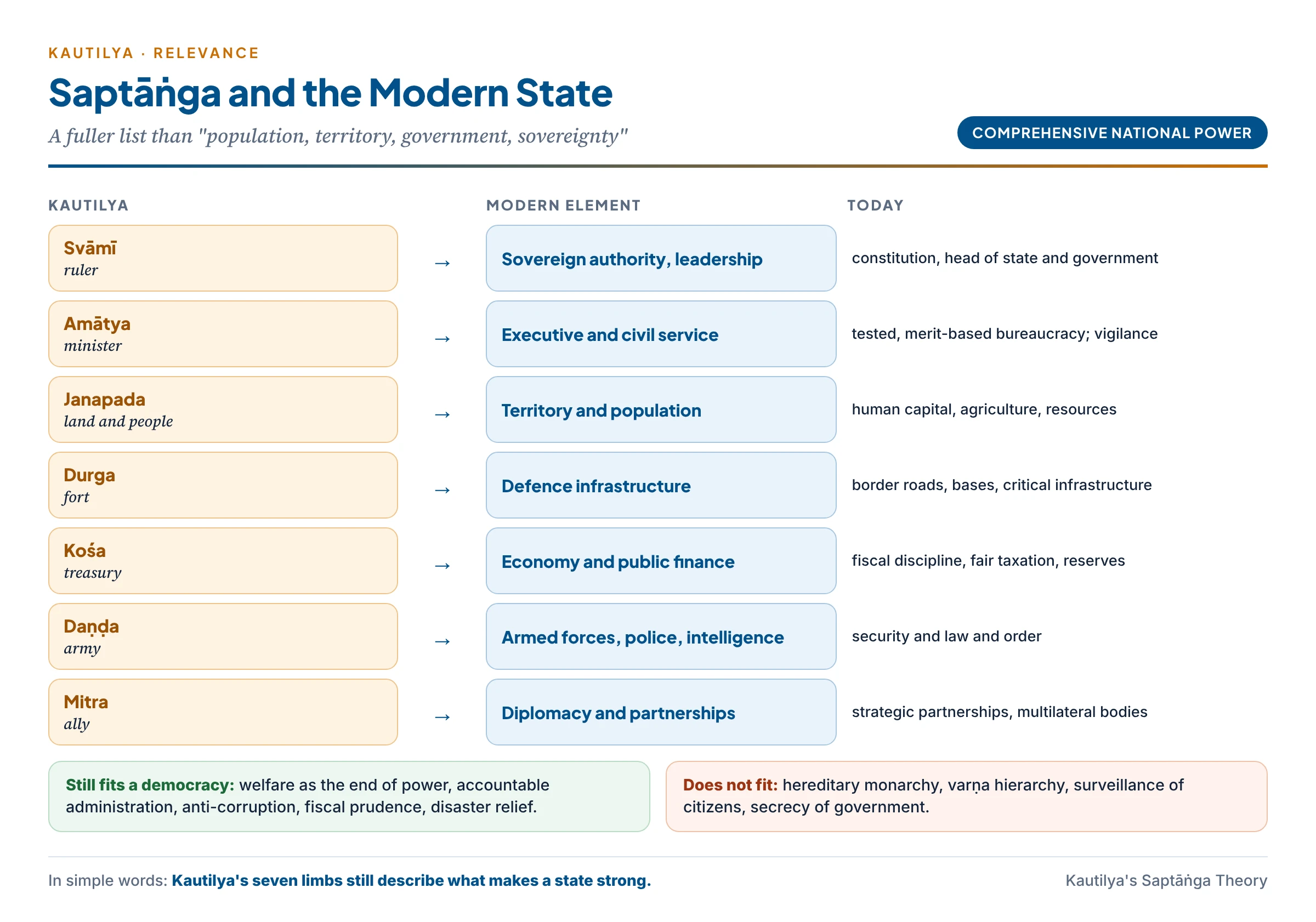
- A fuller idea of the state. The modern definition (population, territory, government, sovereignty) is thinner than Kautilya’s, which adds economy, defence infrastructure, armed forces and alliances — close to today’s idea of comprehensive national power.
- Welfare as the purpose of power. “In the happiness of his subjects lies the king’s happiness” is the spirit of the Directive Principles and the welfare state.
- A tested, merit-based civil service. The upadhā tests and grades of ministers anticipate competitive examinations, probation and vigilance checks.
- Anti-corruption. His honey-on-the-tongue warning and the many ways of embezzlement he lists are still used in discussions of public integrity.
- Fiscal prudence. A strong treasury, fair taxation “like plucking ripe fruit”, and explaining emergency levies to the people.
- Rule of law and proportionate punishment — just daṇḍa, neither too harsh nor too mild.
- Disaster management. Āpad-dharma prescribes relief, shelter and public works in calamities.
- Intelligence and internal security. Modern states still need them.
- Present-day interest. India’s Ministry of Finance has hosted the Kautilya Economic Conclave, and the Indian Army’s Project Udbhav (launched in October 2023 with the United Service Institution of India) studies the Arthaśāstra and other classical texts to build an indigenous strategic vocabulary.
What does not apply:
- Hereditary monarchy and the absence of popular sovereignty.
- Varṇa hierarchy — contrary to equality before the law (Articles 14–17).
- Surveillance of citizens and secret methods — contrary to the right to privacy and the rule of law.
- Secrecy of government — contrary to transparency and the Right to Information.
- Moral rather than institutional checks — a democracy needs courts, elections and a free press, not only a virtuous king.
Verdict: The monarchical form of Kautilya’s sovereignty does not fit a democracy, but its substance does: the state as an organic whole of interdependent elements, power as the means and welfare as the end, accountable and competent administration, fiscal discipline, and realism in security. Read with the Constitution’s guarantees of rights and accountability, much of the Arthaśāstra remains a practical handbook of good governance.
Criticisms and Replies
Criticisms:
- Authoritarianism — power concentrated in the ruler, individual freedom limited.
- Ethical concerns — espionage, deceit and manipulation as tools of state.
- Limited role of citizens — no participation in governance.
- Security at the expense of liberty — a strong army and pervasive surveillance.
- Risk of tyranny — no balanced distribution of power.
- Depends on a wise ruler — the ethical ideal fails if the king is not virtuous.
Replies:
- Realism in governance — a strong ruler was a pragmatic response to the dangers of the age.
- Adaptability — his principles are flexible and can be applied in different contexts.
- Effective governance — a strong central authority brings stability and protection.
- Ethical governance — his methods look Machiavellian, but his goal is the welfare of the state, and dharma tempers the use of power.
- Historical context — his ideas must be read against the conditions of ancient India: invasion, fragmentation and disorder.
Critics and Defenders
Criticism — Critics
- Liberals: no popular sovereignty, no rights against the king, pervasive surveillance.
- Moralists and Weber: a doctrine of reason of state more ruthless than Machiavelli.
- Egalitarians: the varṇa order makes justice unequal.
- Constitutionalists: checks on the king are moral and customary, not enforceable.
- Realists of power: everything depends on a wise king — a weak foundation.
Defence — Defenders and strengths
- Welfare state: the happiness of the subjects is the explicit end of sovereignty.
- Comprehensive theory: the seven elements and their inter-relations form the fullest ancient analysis of the state.
- Rule of law: proportionate punishment, courts, the king’s liability for injustice.
- Administrative science: tested officials, departments, revenue and audit — astonishingly modern.
- Realism with ethics: strategy serves dharma and the people’s security.
Cross-Tradition Comparison
Kautilya and Western Thinkers
| Point | Kautilya | Aristotle | Machiavelli | Hobbes |
|---|---|---|---|---|
| Starting point | Law of the fishes | Man is a political animal | Corruption and disunity of Italy | War of all against all |
| The state | Organic body of seven limbs | Natural community for the good life | A prince’s creation and possession | An artificial person created by contract |
| Purpose | Security and happiness of subjects | Good life, virtue | Holding and strengthening power | Peace and security |
| Means | Daṇḍa, diplomacy, espionage, dharma | Law, education, the mean | Force and cunning; appearances | Absolute sovereign power |
| Ethics in politics | Strategy serves dharma and welfare | Politics is part of ethics | Politics separated from ordinary morality | Morality created by the sovereign’s law |
- Kautilya and Aristotle. Contemporaries of a kind, both advisers to great conquerors (Chandragupta and Alexander), both students of declining republics (the saṅghas and the Greek poleis), both holders of an organic theory of the state, both drawing general laws from history, and both rejecting a life of pure contemplation in favour of active service. Neither mentions his pupil’s conquests. But the Politics is a work of philosophy; the Arthaśāstra became a handbook for princes. Aristotle looked to a virtuous elite and the rule of impersonal law; Kautilya to a scientific statecraft under a definite king.
- Kautilya and Machiavelli. The Arthaśāstra and The Prince are the world’s most famous treatises on the art of kingship; both analyse realistically how a ruler gains and keeps power, and both teach flexibility in a changing world. Kautilya wrote some eighteen centuries earlier. Machiavelli lamented the weakness of Italy; Kautilya the disorder that followed foreign invasion and the need to build an empire. But Machiavelli’s main argument is notably free of moral principle and pessimistic about the world; Kautilya grounds strategy in dharma and the welfare of the people, and sees decline as the result of lethargy, misgovernment and improvidence rather than fate. To some, Kautilya is the evil adviser of tyrants; to others, the spokesman of freedom from foreign domination and of good government.
Indian Connect — Key takeaways
- Kautilya’s organic theory places India’s political thought alongside Aristotle’s, not merely Machiavelli’s.
- His law as royal command backed by daṇḍa anticipates Austin, but his dharma and welfare limits are closer to Bodin’s natural law.
- The Arthaśāstra shows that a systematic, secular science of the state existed in India centuries before modern Europe.
Synthesis (Siddhānta)
- The core insight. Sovereignty, for Kautilya, is not an abstract legal quality but the working of a whole organism — seven interdependent elements, headed by a king whose power is exercised through daṇḍanīti and justified by the security and happiness of the people.
- Hierarchy with interdependence. The king’s calamity is the gravest because the king shapes every other element; yet no element can be neglected, and circumstances can raise any of them to first importance.
- Strong but bound. The king is supreme over all other sources of law and commands a vast administration, yet he is bound by dharma, liable for injustice, obliged to consult, and devoted to yoga-kṣema. His sovereignty is benevolent rather than arbitrary — though its checks depend on the king’s character.
- Contemporary relevance.
- Comprehensive national power — the Saptāṅga list is a better guide to state capacity than the thin four-element definition.
- Governance — merit-based, tested and accountable administration; anti-corruption; fiscal discipline.
- Welfare — “In the happiness of the subjects lies the happiness of the king” remains the best one-line statement of the purpose of power.
- A warning — without institutional checks, even a welfare state can slide into surveillance and despotism; democracy supplies what Kautilya left to the king’s conscience.
“Strength is power; happiness is the end.” — Kautilya
Previous Year Questions
- 2024What insights does the Arthaśāstra offer with regard to the concept of sovereignty? Does it have any relevance in the modern times? Critically discuss.
- 2021Discuss Kautilya’s contribution regarding the concept of sovereignty. Is it applicable in a democratic form of government? Explain.
- 2019Discuss how far Austin’s concept of sovereignty goes along with Kautilya’s concept of sovereignty.
- 2018Discuss Kautilya’s concept of sovereignty in the light of ‘Dandaniti’.
- 2017Discuss whether Kautilya’s concept of sovereignty turns into a despotic rule. How far is it comparable to Bodin’s concept? Discuss.
- 2011Compare and contrast Kautilya’s ‘Saptanga’ Theory of the Sovereign State with Bodin’s theory of sovereignty.
- 2010Why did Kautilya think that sovereignty is hierarchical? Explain.
- 2008Critically examine Kautilya’s saptang theory of sovereign state.