

Sovereignty: Austin, Bodin, Laski, Kautilya.
Official Syllabus: Paper II, Section A, Unit 2
John Austin (1790–1859) gave sovereignty its sharpest legal form. Where Bodin had wrapped the sovereign in divine and natural law, Austin stripped the idea down to an observable fact: in every independent political society there is a determinate human superior whom the bulk of the people habitually obey, and who obeys no one else. Whatever that superior commands, backed by a threat of punishment, is law. This is the monistic or legal theory of sovereignty, also called the command theory — clear, logical and enormously influential, and also the most attacked theory in the syllabus. This article covers Austin’s life and aims, his theory of law as command, his famous definition of sovereignty and its four tests, the characteristics that follow from it, how he applied it to Britain and the United States, whether it is compatible with democracy, how it differs from Hobbes, its significance, and the criticisms of Maine, Hart, the sociological jurists and the pluralists.
In simple words
A mother tells her son: “Finish your homework, or no television tonight.” There is a wish (finish the homework), a threat (no television) and a duty (the son is now bound to do it). The mother is obeyed habitually — not just once — and she does not take orders on this matter from anyone else in the house. In Austin’s language, she is the sovereign of the household and her order is a law. Austin says every state works the same way, only on a larger scale.
Context & Problem
Life and Works
- Born in Suffolk, England, in 1790; served briefly in the army, then trained as a barrister.
- Utilitarian circle. A close associate of Jeremy Bentham and James Mill; he shared their aim of reforming English law on rational principles.
- First professor of jurisprudence at the new University of London (University College) from 1826. His lectures were thinly attended in his lifetime.
- Main work: The Province of Jurisprudence Determined (1832) — the first part of his lectures. The full Lectures on Jurisprudence were published after his death by his wife, Sarah Austin.
- Founder of analytical jurisprudence — the study of the basic concepts of law (law, right, duty, sanction, sovereignty) as they actually are.
The Problem He Wanted to Solve
- Confusion between law and morality. Natural-law writers (and judges like Blackstone) said that a human law contrary to God’s law or natural law is not really law. Austin thought this confused two questions: what the law is, and what it ought to be.
- His famous principle: “The existence of law is one thing; its merit or demerit is another.” A law may be bad and still be law.
- A science of law. He wanted exact definitions of law and sovereignty, so that jurisprudence could become a science like geometry — starting from clear definitions and drawing consequences.
- His sources. Bodin (sovereignty), Hobbes (law as the command of the sovereign) and Bentham (law as the expression of a sovereign’s will, utilitarian reform).
In simple words
A doctor may think smoking is bad for you, but whether it is illegal is a different question. Austin wants lawyers to keep these two questions apart. First ask “Is this the law?” — a question of fact about who commanded what. Only then ask “Is this a good law?” — a question of morality and utility.
Core Doctrine
Law as Command
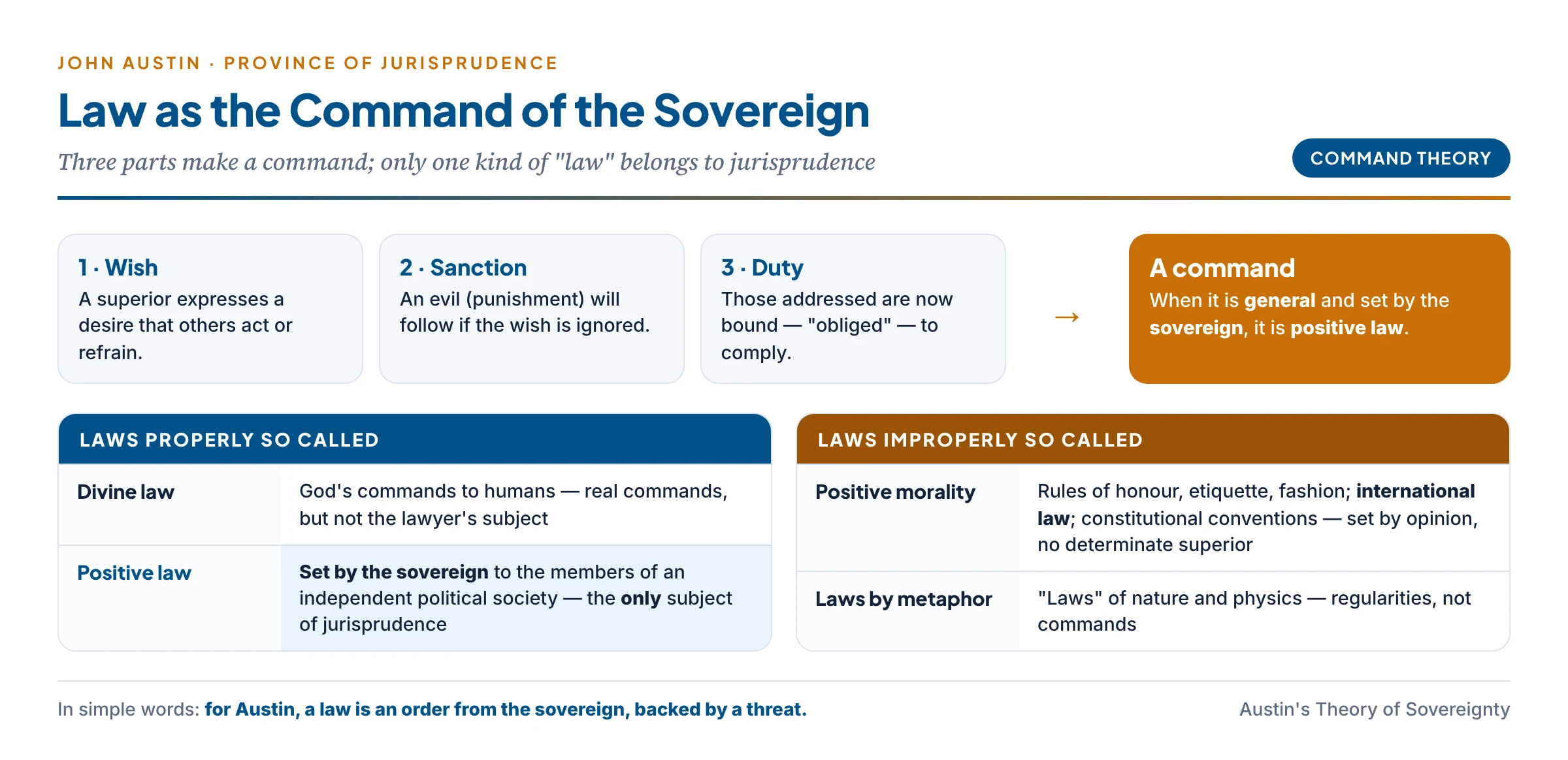
- A command has three elements:
- A wish or desire expressed by one person that another should do or not do something.
- A sanction — an evil (punishment) that will follow if the wish is not obeyed.
- A duty — the person commanded is bound, or “obliged”, because of the threatened sanction.
- Command, duty and sanction are three sides of one relation: where there is a command there is a duty, and where there is a duty there is a sanction.
- Laws are general commands — commands that oblige a class of persons to a class of acts, not one-off orders.
- Positive law — law strictly so called, the subject of jurisprudence — is a general command set by a sovereign to members of the independent political society in which he is sovereign.
Austin’s map of “laws”:
| Kind | Example | Is it law in the strict sense? |
|---|---|---|
| Divine law | God’s commands to human beings | Law properly so called, but not the subject of jurisprudence |
| Positive law | Acts of Parliament, judge-made law adopted by the sovereign | Yes — the only subject of jurisprudence |
| Positive morality | Rules of honour, etiquette, fashion; international law; constitutional conventions | No — set by opinion, not by a determinate superior |
| Laws by metaphor | “Laws” of nature, laws of physics | No — there is no command, only regularity |
- Two striking consequences:
- International law is not law but “positive morality” — there is no sovereign above states to command them.
- Constitutional law that claims to limit the sovereign is, against the sovereign, only positive morality — the sovereign cannot be legally bound.
Austin’s Definition of Sovereignty
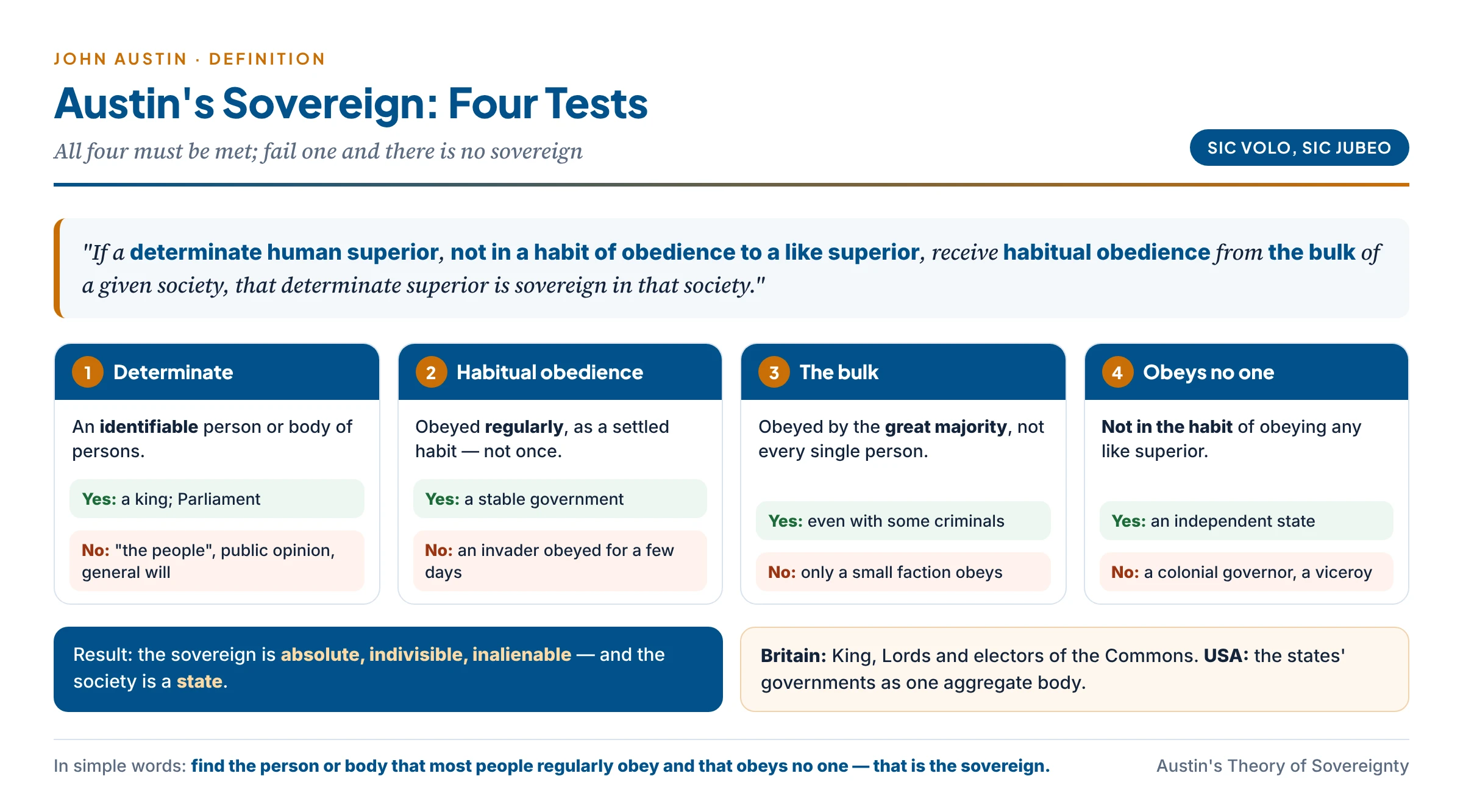
“If a determinate human superior, not in a habit of obedience to a like superior, receive habitual obedience from the bulk of a given society, that determinate superior is sovereign in that society, and the society (including the superior) is a society political and independent.” — John Austin
The definition contains four tests. A sovereign exists only where all four are met.
- Determinate. The sovereign must be an identifiable person or body of persons — a king, an assembly, a council. Vague entities such as “the people at large”, “public opinion”, “the general will” or “natural law” cannot be sovereign, because no one can say exactly who they are or what they have commanded.
- Human superior. The sovereign is a human being or group, not God or an abstraction; “superior” means having the power to inflict evil on others if they disobey.
- Habitual obedience from the bulk.
- Habitual — not occasional. An invader who is obeyed for a few days, or a gang leader obeyed once at gunpoint, is not sovereign.
- The bulk — the great majority, not every single person. Criminals and rebels who disobey do not destroy sovereignty as long as most people obey.
- Not in a habit of obedience to a like superior. The sovereign does not itself habitually obey anyone else. A colonial governor or a viceroy, however powerful, obeys his home government, so he is not sovereign. This test gives the external side of sovereignty — independence.
- The result: a society where these conditions hold is “political and independent” — a state. For Austin, the state exists only where there is sovereignty on one side and subjection on the other.
- Austin’s spirit is summed up in the Latin phrase “Sic volo, sic jubeo” — “Thus I will, thus I command.”
Characteristics of Austinian Sovereignty
- Determinateness — sovereignty belongs to a definite person or body, never to an abstraction.
- Absoluteness (legal unlimitedness) — the sovereign’s legal power has no limits. Any body that could legally limit it would itself be the sovereign. Constitutional “limits” bind the sovereign only morally.
- Indivisibility — sovereignty may be formally distributed among several organs, but it cannot be genuinely divided; examine any system closely and one supreme body will emerge as the real sovereign. Austin rejected the American idea that sovereignty is divided between the Union and the states.
- Inalienability — the sovereign cannot transfer its sovereignty without ceasing to be sovereign.
- Universality (all-comprehensiveness) — it extends to every person and association in the territory.
- Permanence and exclusiveness — it lasts with the state, and there is only one in each state.
- What Austin rejects: popular sovereignty, the general will, divine right and natural law as the basis of sovereignty. Sovereignty rests on a fact — habitual obedience — not on consent, contract or God.
- Not an idealist. Unlike Hegel, Austin does not say the state is the embodiment of reason or morality; he only describes where legal power lies.
- Not irresponsible. He does not praise arbitrary rule. The sovereign is legally above all individuals and groups, but should govern by the principle of utility — the greatest happiness of the greatest number.
| Sphere | Austin’s position |
|---|---|
| Legal | Supreme legal authority in a determinate body — monarch or assembly — that makes and enforces law |
| Political | Power to issue commands backed by credible sanctions; no external control |
| International | States are legally independent; international law is positive morality, not true law |
| Economic | Not discussed separately; trade and property fall under the sovereign’s commands |
| Cultural | Not addressed; cultural rights exist only as the legal system recognises them |
| Individual | Individuals are subjects; their rights are created by the sovereign’s law, not natural |
Where Is the Sovereign? Austin’s Applications
- Britain. Austin located sovereignty in the King, the House of Lords and the electors of the House of Commons. Members of the Commons, he said, are only trustees for the electors, who delegate their share of sovereignty to them for the life of a Parliament.
- The United States. Since the federal and state governments each have limited powers, Austin located sovereignty in “the states’ governments as forming one aggregate body” — in practice, the body that can amend the Constitution.
- Why these answers matter. Bringing the electorate into the sovereign body was an attempt to fit democracy into the theory — but it also made the “determinate” sovereign much less determinate. Critics seized on this (below).
In simple words
Try finding the “boss” of a large housing society. The secretary runs daily affairs, the committee passes resolutions, but the committee itself can be removed by the general body of members, and only the general body can change the society’s bye-laws. Austin’s method is to keep climbing until you reach the body that can overrule everyone and is overruled by no one. In Britain he climbed all the way to the voters; in the USA, to the body that can amend the Constitution.
Common confusion
Did Austin say sovereignty must always be one person — a king? No. Austin’s sovereign is a “determinate human superior“, which may be one person or a body of persons — a monarch, an aristocratic council or a democratic assembly. What must be determinate is the identity of the sovereign, not its size. That is why Austin could apply his theory to Britain’s King-in-Parliament and even to the electorate.
Is Austin’s Theory Compatible with Democracy?
Ways in which it fits democracy:
- The sovereign can be a democratic body. Nothing in the definition requires a monarch; a legislature elected by universal suffrage can be the determinate superior. Austin himself included the electors in Britain’s sovereign.
- Every democracy needs a final legal authority. Laws passed by a majority must be binding even on those who voted against them. Austin explains why: they are commands of the sovereign body.
- Parliamentary sovereignty. Britain — a stable democracy — still treats Parliament as legally unlimited. Austin’s theory, refined by Dicey into legal and political sovereignty, describes it well: Parliament is the legal sovereign, the electorate the political sovereign.
- Legal positivism is neutral. By separating law from morality, Austin’s theory can describe any form of government; it does not itself favour dictatorship.
Ways in which it clashes with democracy:
- Unlimited power versus rights. Modern democracy protects fundamental rights that even a majority cannot override. A legally unlimited sovereign leaves rights at its mercy.
- Obedience from fear, not consent. Austin explains obedience by sanctions; democracy rests on consent and legitimacy. A sovereign obeyed only through fear is a formal sovereign, not a democratic one.
- Once in power, not bound by the people. The sovereign’s authority may come from the people, but once established, Austin’s sovereign is not legally bound by the will of the people between elections.
- Public opinion ignored. Austin pays no attention to public opinion, the free press and civil society, which are the life of democracy.
- Constitutional democracies. In India and the USA, the constitution is supreme, courts strike down laws and powers are divided. No organ is an Austinian sovereign.
- Federalism. Locating sovereignty in an “aggregate body” of state governments is artificial; in practice, sovereignty in a federation is shared.
Verdict: Austin’s theory is compatible with parliamentary democracy as a description of where legal authority lies, but incompatible with constitutional, rights-based democracy unless the “sovereign” is located in the people acting through the constitution’s amending power. Its value is legal clarity; its weakness is political realism.
Indian Connect — Austin and the Indian Constitution
- India’s Parliament is not an Austinian sovereign: its laws can be struck down for violating fundamental rights, and since Kesavananda Bharati (1973) it cannot amend the Constitution’s basic structure.
- If one asks Austin’s question — “who has the last word?” — the answer in India is the Constitution, interpreted by the Supreme Court, resting on “We, the people“.
- Yet Austin’s command model fits ordinary Indian law: an Act of Parliament is a general command backed by penalties, enforced by courts and police.
Austin and Hobbes: Similar Conclusions, Different Roads
| Point | Thomas Hobbes | John Austin |
|---|---|---|
| Main work | Leviathan (1651) | The Province of Jurisprudence Determined (1832) |
| Aim | A political philosophy: why we need a sovereign, and why we must obey | A science of law: what law and sovereignty are |
| Method | From human nature and the state of nature to the social contract | Analytical — define concepts and draw consequences; no state of nature |
| Origin of sovereignty | A covenant of each with all, authorising the sovereign | A fact — habitual obedience; no contract needed |
| Ground of obedience | Fear of death and the desire for peace; we authorised the sovereign | Fear of sanctions; habit |
| Natural law | Exists as dictates of reason (seek peace, keep covenants) | Not law at all for jurisprudence; at most divine law or morality |
| Limits | Subjects keep the right of self-preservation — they may resist an order to kill themselves | No legal limits at all |
| Justice | The sovereign cannot be unjust to subjects, since justice is created by his laws | Law may be unjust; its merit is a separate question |
| Shared ground | Sovereignty absolute, indivisible; law is the sovereign’s command | Same |
- In one line: Hobbes justifies absolute sovereignty; Austin describes it. Hobbes builds a moral and psychological argument; Austin offers a legal analysis that claims to be morally neutral.
The Significance of Austin’s Theory
- Clarity and precision. The most exact definition of sovereignty ever given; it tells a lawyer exactly where to look for the source of law.
- Separation of law and morality — the founding principle of legal positivism, carried forward by Kelsen and Hart.
- Analytical jurisprudence — law became an object of systematic study.
- Legal sovereignty — the basis of the doctrine of parliamentary sovereignty in Britain.
- Logical coherence. Pluralist or dualist theories, pushed to the end, need a final authority to settle conflicts — and so return to monism. Austin’s theory is logically consistent, even if practically limited.
- Law reform. Treating law as a human command opened it to rational, utilitarian reform rather than reverence for ancient custom.
Critical Evaluation
The Main Criticisms
- History does not support it (Sir Henry Maine). Maine studied India and early societies and found that most rules of life came from custom, not commands. His most famous example is Maharaja Ranjit Singh of Punjab: “At first sight there can be no more perfect embodiment than Ranjit Singh of sovereignty as conceived by Austin… but he never made a law.”
- Ranjit Singh had absolute power and could have done anything, yet the rules his subjects lived by came from immemorial usage, which he never dared to change. Sovereignty in history is limited by custom and internal considerations.
- Inapplicable to real states. Asked where the sovereign is in England or the USA, Austin gave shifting answers — Parliament, the King, the Lords, the electors, the “aggregate body” of state governments. A theory that cannot find its sovereign in the world’s leading states is not a good description.
- No clear line between legal and political sovereignty. Having made the King-in-Parliament sovereign, Austin struggled to include the electorate. Legal sovereignty is never absolute because it is shaped by political forces — a distinction later made clear by Dicey.
- Hostile to popular sovereignty. Critics such as Sidgwick, Clark and Ritchie argued that Austin ignores public opinion and the general will. A sovereign supported by force alone is a formal sovereign, not one aligned with the real will of the people.
- A wrong idea of law. Law did not begin as commands; it grew out of customs of the people (historical school). The sociological jurist Léon Duguit argued that law arises from social solidarity and binds the state itself; MacIver showed that the state’s laws are bounded by the mores and values of the community. Laski added that people obey law for many reasons — habit, agreement, moral conviction, self-interest — not only fear of sanctions.
- Neglect of voluntary associations. The pluralists argued that churches, trade unions, universities and professional bodies also command loyalty and make binding rules in their own spheres. An all-comprehensive sovereign is incorrect as a description and dangerous as an ideal (Article 4).
- International law. Calling international law “positive morality” no longer fits a world of treaties, international courts, the WTO’s dispute-settlement and the UN Security Council.
- Federal states. As Laski noted, in federations like the USA one cannot point to Austin’s single sovereign; powers are genuinely shared and courts arbitrate between them.
- Moral blindness. A purely factual theory of sovereignty can be used to legitimise any regime that is habitually obeyed — including a totalitarian one.
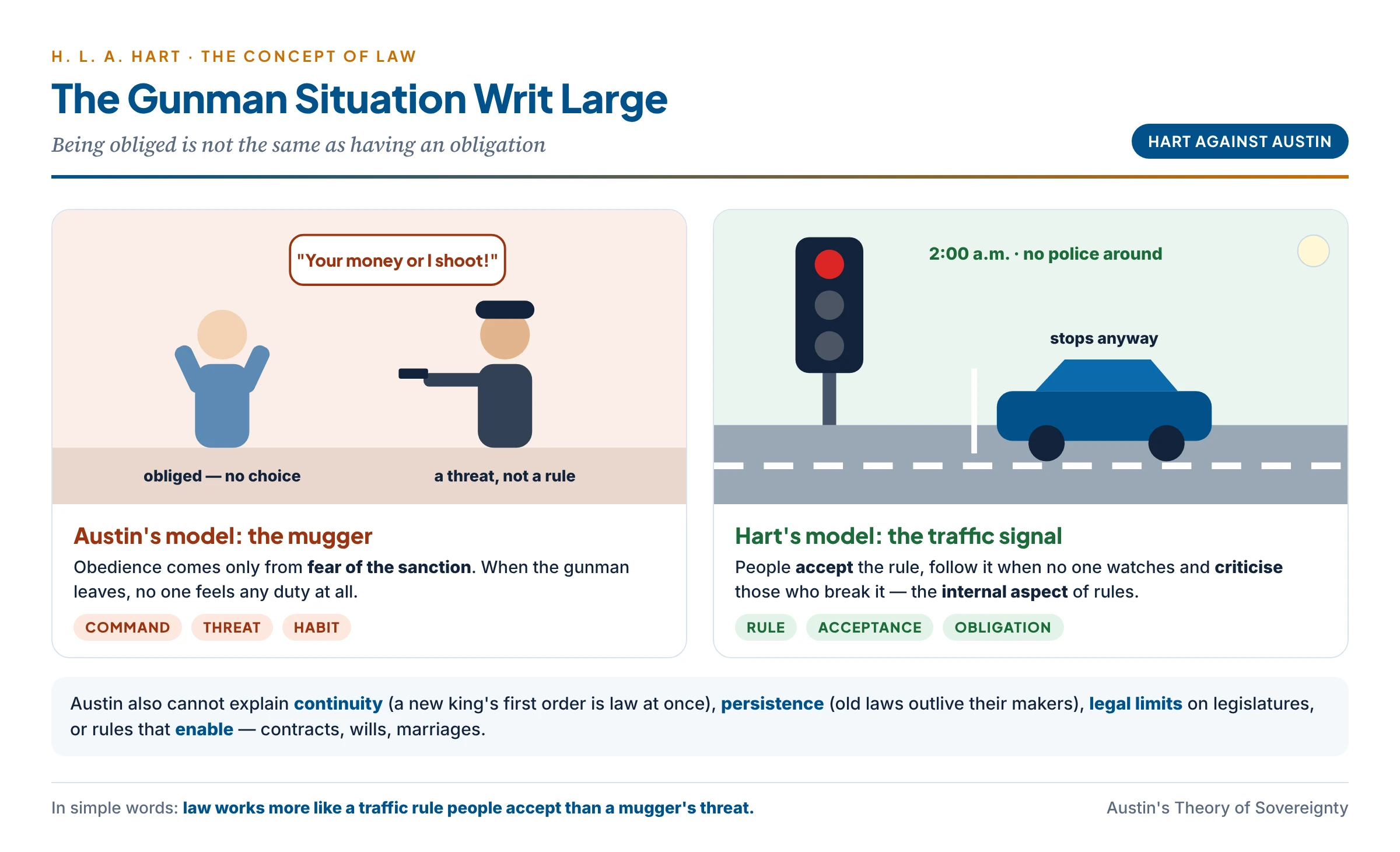
Hart’s Critique: “The Gunman Situation Writ Large”
The most powerful modern critique came from the legal philosopher H. L. A. Hart (The Concept of Law, 1961).
- Being obliged versus having an obligation. A bank robber who says “hand over the money or I shoot” makes you obliged to obey — you have no choice. But you have no obligation to obey him. Austin’s theory turns all law into “the gunman situation writ large” and cannot explain why citizens feel they ought to obey law.
- Habits versus rules. A habit is just regular behaviour (“I go to the cinema on Saturdays”). A rule has an internal aspect: people use it as a standard, criticise those who break it and accept the criticism as justified. Law consists of accepted rules, not mere habits of obedience.
- Continuity. When an old king dies and his son takes the throne, there is no habit yet of obeying the son — so on Austin’s theory there would be a gap with no sovereign and no law. In fact the new king’s first orders are law at once, because there is an accepted rule of succession.
- Persistence. Laws made by a sovereign long dead are still law. Why, if law is the command of a living superior who is habitually obeyed?
- Legal limits on legislatures. Many legal systems do place legal limits on the supreme legislature (bills of rights, entrenched clauses), and courts enforce them. Austin’s theory says this is impossible.
- Power-conferring rules. Laws that let people make contracts, wills or marriages are not commands backed by threats; they enable rather than oblige.
- Laws bind their makers. Legislators are themselves bound by the laws they make; a command is usually addressed to others.
Hart’s alternative: law is a union of primary rules (which impose duties) and secondary rules (which say how rules are recognised, changed and applied). At the base lies a rule of recognition, accepted by officials — not a sovereign obeyed out of habit.
In simple words
Compare a mugger and a traffic signal. You obey the mugger only because he has a knife; when he leaves, you feel no duty at all. You stop at a red light even at 2 a.m. with no police in sight, because you accept the rule and would criticise a driver who jumped it. Hart says real law is like the traffic signal; Austin’s theory makes it look like the mugger.
Laski’s Grounds against Austin (in brief)
Laski attacked Austin on historical, legal, moral, political and international grounds — history shows no unlimited sovereign; law is not mere command; the state’s commands deserve obedience only when they are morally right; in practice power is shared among associations and in federations; and absolute sovereignty in foreign affairs leads to war. Article 4 develops each ground.
Replies and Strengths
- Austin is doing legal analysis, not history or sociology. Maine’s and Duguit’s points describe how law arises and why people obey; Austin asks what makes a rule legally valid in a developed system. Those are different questions.
- Every legal system still needs a final authority. Hart’s rule of recognition and Kelsen’s basic norm are themselves ways of answering Austin’s question — where does legal authority stop?
- Clarity has value. In disputes about which body has the last word (Centre versus state, court versus legislature), Austin’s question is the right one to ask.
- Moral neutrality is a strength for lawyers. Separating what the law is from what it ought to be lets critics attack bad laws clearly, instead of pretending that unjust laws are “not really law”.
Critics and Defenders
Criticism — Critics
- Maine: custom, not command, rules most societies — Ranjit Singh never made a law.
- Hart: law is a system of accepted rules, not the gunman situation writ large; Austin cannot explain continuity, persistence or legal limits.
- Duguit and MacIver: law springs from social solidarity and the community’s values; the state is bound by law.
- Laski and the pluralists: sovereignty is shared among associations; absolute sovereignty is a dangerous fiction.
- Democrats: Austin ignores public opinion, consent and rights.
Defence — Defenders and strengths
- Logical consistency: every legal order needs a final authority; Austin names it.
- Legal positivism: the separation of law and morality remains basic to modern jurisprudence.
- Parliamentary sovereignty: his theory still describes the British constitution’s core.
- Clarity for courts and lawyers: the question “who has the last word?” settles real disputes.
- Moral honesty: calling a bad law a law, and then criticising it, is clearer than denying it is law.
Cross-Tradition Comparison
Austin and Kautilya
| Point | Austin | Kautilya |
|---|---|---|
| Sovereign | Determinate human superior — person or body | The king (svāmī), head of the seven elements |
| Nature of law | Command of the sovereign backed by sanction | The king’s edict (rājaśāsana) backed by daṇḍa (punishment); prevails over custom when they conflict |
| Limits | None legally | Dharma, custom, ministers’ counsel, the duty of welfare |
| Aim | Analysis of law; utility | Protection and happiness of the subjects (yoga-kṣema) |
| External side | Not obeying any like superior | The maṇḍala of states; independence and expansion |
| Method | Analytical jurisprudence | Practical statecraft |
Indian Connect — Key takeaways
- Daṇḍa and sanction. Kautilya’s idea that without daṇḍa the strong swallow the weak (mātsya-nyāya, the law of the fishes) is very close to Austin’s idea that law needs a sanction — and to Hobbes’s war of all against all.
- But not a pure command theory. Kautilya’s king is the protector and promoter of dharma; his commands are meant to serve the welfare of the people. Austin deliberately keeps morality out of the definition of law.
- Article 7 answers the 2019 question — how far Austin’s concept goes along with Kautilya’s — in full.
Synthesis (Siddhānta)
- The core insight. Austin isolated the legal core of sovereignty: in every developed legal system there is a final law-making authority whose commands courts enforce. His definition — determinate, habitually obeyed, obeying no one — remains the clearest statement of that idea.
- What it leaves out. Custom, consent, public opinion, morality, associations, constitutional limits and international law — everything that makes sovereignty political and legitimate rather than merely legal.
- The modern resolution. Hart replaced the sovereign with accepted rules; democracies replaced the unlimited legislature with a supreme constitution resting on the people. Both still answer Austin’s question about the final source of law — they just answer it better.
- Contemporary relevance.
- Parliamentary sovereignty in Britain, and the debates over it after Brexit, are Austinian debates.
- Centre–state disputes in federations turn on Austin’s question: who has the last word?
- Legal positivism shapes how courts separate the validity of a law from its wisdom.
- Warning: a theory that equates law with whatever the habitually obeyed ruler commands can lend respectability to authoritarian rule; constitutional limits are the corrective.
“The existence of law is one thing; its merit or demerit is another.” — John Austin
Previous Year Questions
- 2021How is Austin’s theory of sovereignty compatible with democracy? Discuss.
- 2019Discuss how far Austin’s concept of sovereignty goes along with Kautilya’s concept of sovereignty.
- 2016On what grounds does Laski criticize Austin’s concept of sovereignty?
- 2014Explain the significance of John Austin’s theory of sovereignty. How does it differ from that of Hobbes?
- 2012Who amongst Austin, Bodin and Laski is the most consistent in his analysis of the concept of sovereignty?
- 2009Compare Bodin’s and Austin’s views on sovereignty.