

Mīmāṃsā: Theory of Knowledge.
Official Syllabus: Paper I, Section B, Unit 18
Is knowledge true by itself, or must its truth be certified from outside? This is the question of prāmāṇya — the validity of knowledge — and it produced the most famous quarrel in Indian epistemology. Mīmāṃsā holds svataḥ-prāmāṇya-vāda: every cognition is valid by itself — its validity arises from the same causes that produce it and is known as soon as it arises — while invalidity comes from outside, from defects in its causes or from a later contradicting cognition. In short: believe unless there is reason to doubt. Nyāya holds the opposite, parataḥ-prāmāṇya-vāda: a cognition is born neutral, and both its truth and its falsity are settled later, by external tests such as successful action. UPSC has asked about this debate nine times.
In simple words
In a court of law the accused is innocent until proven guilty. Nobody has to prove his innocence first; it is the starting point, and only evidence can overturn it. Mīmāṃsā treats every cognition like that accused: true until proven false. Nyāya is like a stricter court where every witness’s statement counts for nothing until it has been cross-checked.
Context & Problem
- The word. Prāmāṇya = validity, truth (the property of being a pramāṇa); svataḥ = “from itself”, intrinsic; parataḥ = “from another”, extrinsic. Aprāmāṇya = invalidity.
- Two questions about validity.
- Origin (utpatti): What produces the validity of a cognition — the same causes that produce the cognition, or some extra cause?
- Ascertainment (jñapti): How is validity known — by the same means that know the cognition, or by some later test?
- The Mīmāṃsā motive. If validity always needed outside proof, the Veda would need outside confirmation too — and its statements about dharma and heaven cannot be confirmed by perception or inference. By holding that all cognition is self-valid, Mīmāṃsā lets the Veda stand on its own legs (Article 3). But the theory is offered as a general truth about knowledge, and defended on general grounds.
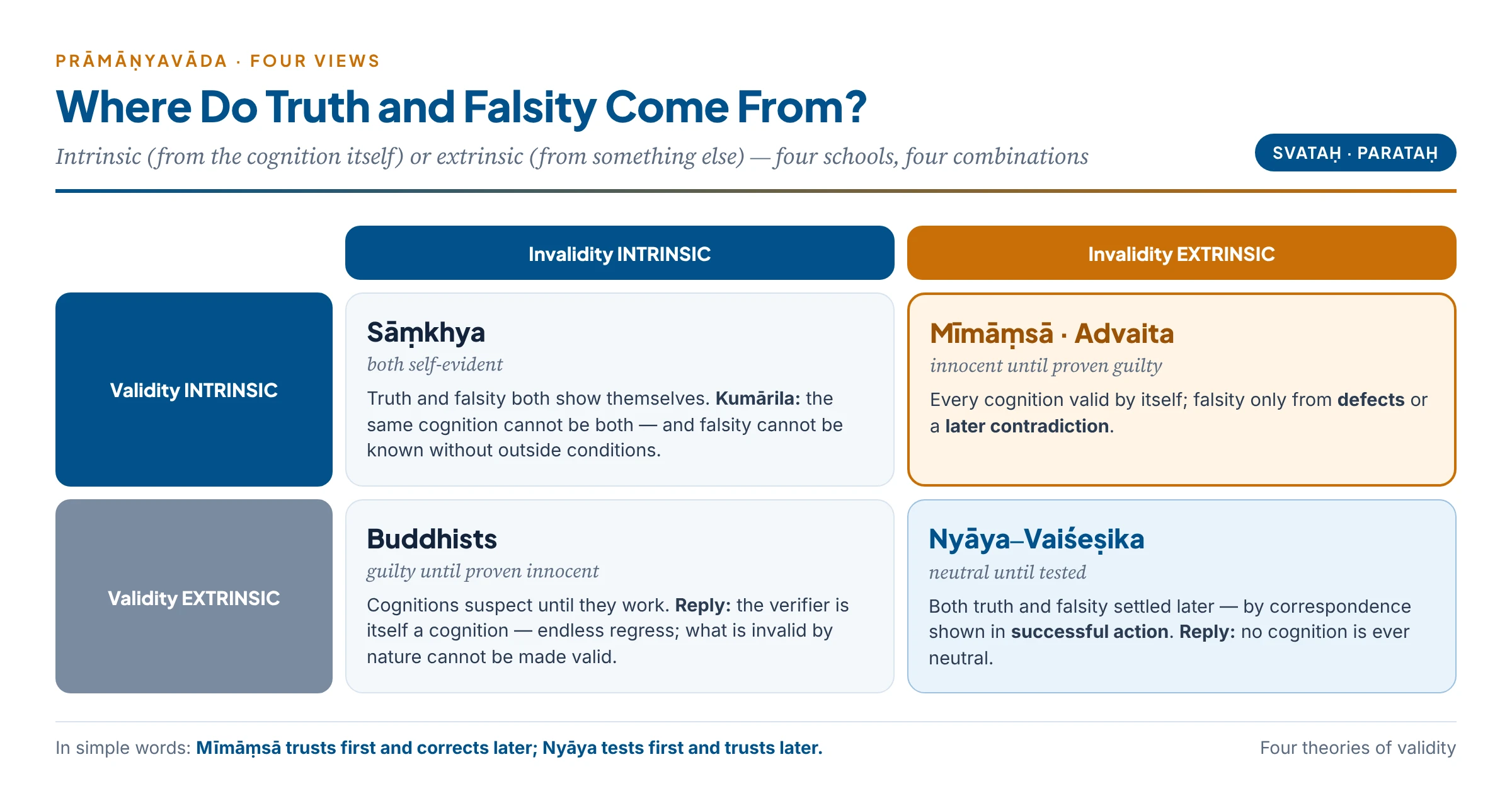
- Four logically possible views. Mādhava’s Sarva-darśana-saṅgraha lists them:
| School | Validity | Invalidity |
|---|---|---|
| Sāṃkhya | Intrinsic | Intrinsic |
| Buddhists | Extrinsic | Intrinsic |
| Nyāya–Vaiśeṣika | Extrinsic | Extrinsic |
| Mīmāṃsā (and Advaita) | Intrinsic | Extrinsic |
Core Doctrine
1. Intrinsic Validity in Two Senses
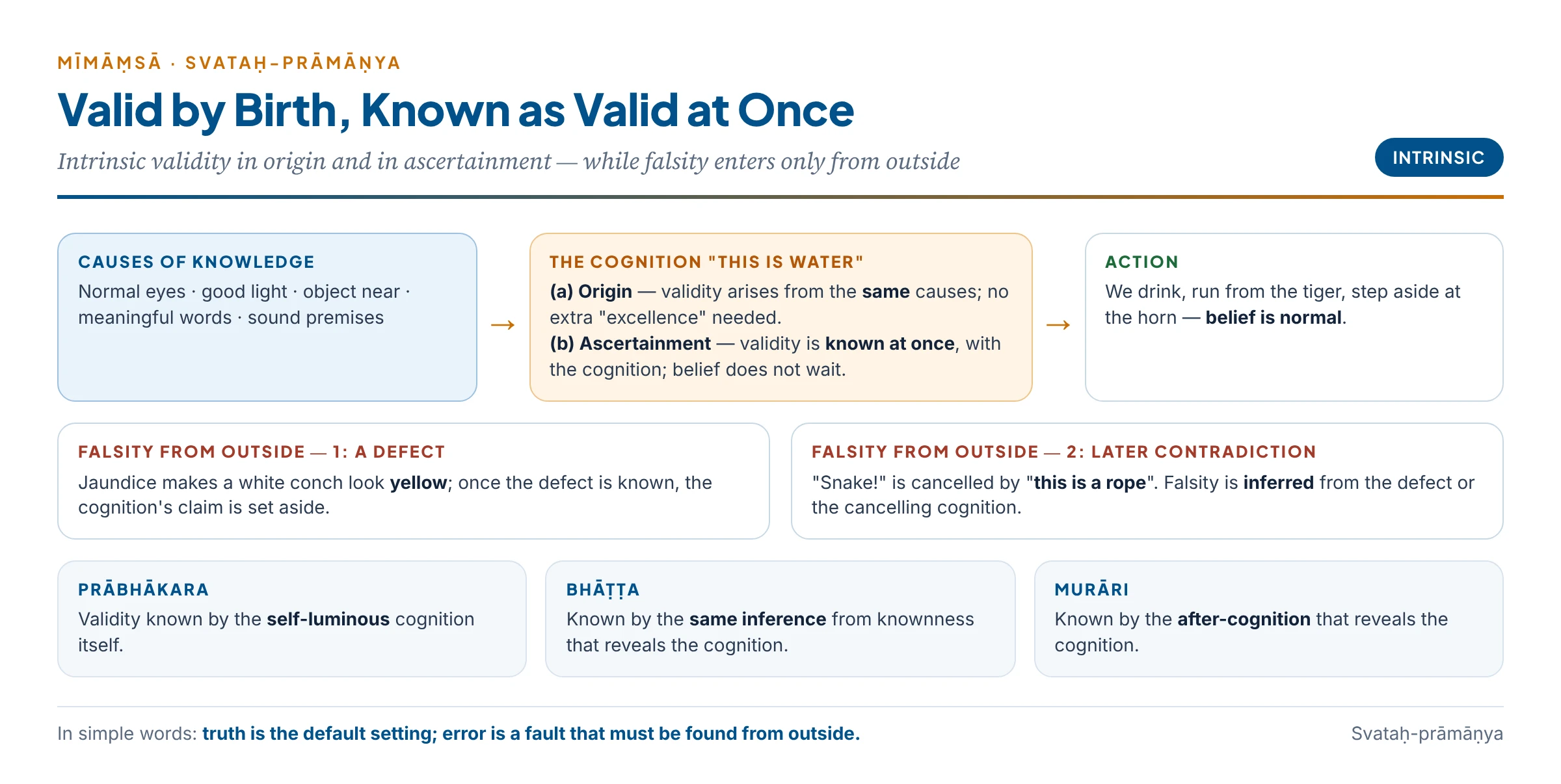
- (a) In origin — prāmāṇyaṃ svataḥ utpadyate. The validity of knowledge arises from the very conditions that give rise to that knowledge, and not from any extra conditions. When normal eyes light on an object in good daylight, the cognition that arises is already valid; no additional “excellence” (guṇa) in the causes is needed.
- (b) In ascertainment — prāmāṇyaṃ svataḥ jñāyate ca. The validity is also believed or known as soon as the knowledge arises; belief does not wait for verification by another cognition (an inference, say).
- Truth is self-evident. Whenever any knowledge arises, it carries with it an assurance of its own truth. As a lamp shows both itself and other things, knowledge shows both its object and its own validity.
- Belief is normal, disbelief exceptional. As perception, inference or testimony arise, we implicitly accept them, unless compelled by contrary evidence to doubt them or to infer their falsity. “On this unsuspecting faith in our knowledge our life runs smoothly.”
2. Extrinsic Invalidity (Parataḥ Aprāmāṇya)
- Falsity comes from outside. Invalidity is not intrinsic; it is due to extraneous factors, and it is known only by extraneous means.
- Two ways a cognition is shown false.
- Defect in the causes (kāraṇa-doṣa). A person with jaundice sees a white conch as yellow: the cognition is invalidated by the defect in the eye (the bile).
- A later contradicting cognition (bādhaka-jñāna). A rope is taken for a snake; the cognition is set aside by the later cognition “this is a rope“.
- Falsity is inferred. In such cases we infer the falsity of the cognition from the existence of defective conditions or from the contradicting cognition. Truth is self-evident; falsity is inferred.
- When conditions are known to be bad, no knowledge arises. If the eyes are known to be jaundiced, the light insufficient, the premises doubtful or the words meaningless, then no knowledge — and no belief — arises at all, so long as the grounds for doubt remain.
In simple words
Put on yellow sunglasses and a white wall looks yellow. The fault is not in seeing as such; it is in the glasses — an extra, outside factor. Take them off and the wall is white again. Mīmāṃsā says all falsity is like this: it comes from an added defect (jaundice, bad light, distance) or is shown by a later correction — never from cognition as such.
3. Arguments for Intrinsic Validity
- (1) The evidence of action. In daily life, whenever a cognition arises we act on it at once, without testing it. “As soon as we perceive a tiger we run away; as soon as we infer the approach of a car from its horn we guard our steps.” If I see water I drink it; if I see fire I avoid it. This shows that we believe a cognition as soon as we have it.
- (2) Error is a later discovery. Error is discovered only later, by sublation. The cognition “this is a snake” is accepted at first, and only when corrected do we know it was false. Validity is original; falsity is secondary.
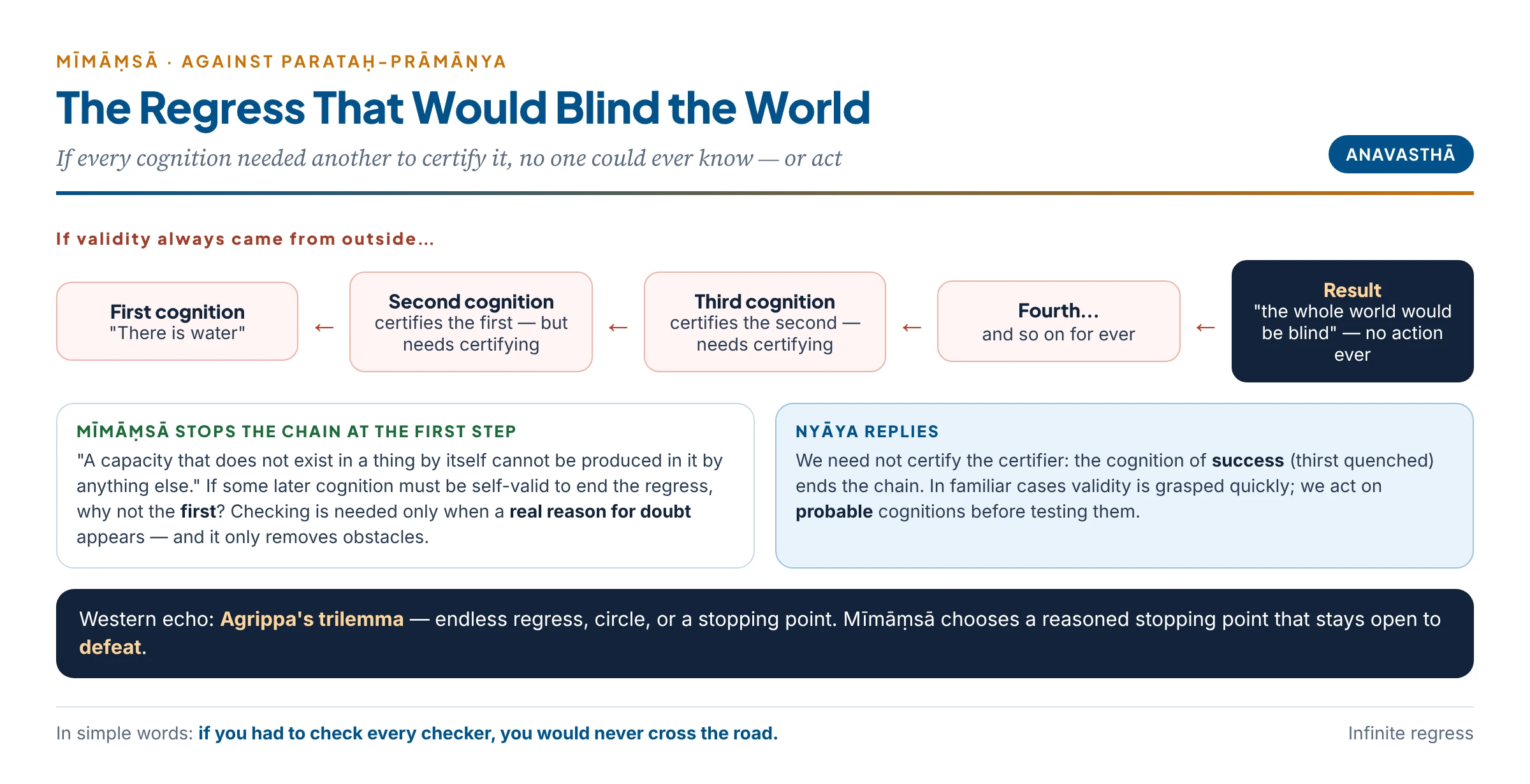
- (3) The infinite regress (anavasthā). If every cognition had to be certified by another cognition before we could trust it, the certifying cognition, being itself a cognition, would need certification by a third, and so on endlessly. Nothing could ever be known, and life would stop: “if we are to wait for verifying our knowledge with the never-ending series of inferences, we should have to wait for ever before we could act on any knowledge.” Kumārila’s commentators say that otherwise “the whole world would be blind“. And if, to stop the regress, some later cognition is admitted to be self-valid, why not admit it of the first cognition?
- (4) A capacity cannot be borrowed. Kumārila’s key verse: “All pramāṇas should be understood to be valid by themselves; for a capacity that does not exist in a thing by itself cannot be produced in it by anything else.” If the first cognition had no power to make known, no later cognition could give it that power.
- (5) No neutral knowledge. Nyāya says a cognition arises neutral — neither valid nor invalid — and gets its value later. But we never experience a neutral cognition; every cognition comes either believed or doubted. A cognition “devoid of all logical value” is no knowledge at all.
- (6) “Excellences” are only absence of defects. Nyāya says validity needs an extra excellence (guṇa) in the causes — sound organs, good light. Mīmāṃsā replies that these are not extra conditions but part of the normal conditions of knowledge; “excellence” means only freedom from defect. Without them there would be no knowledge and no belief at all. Excellences do not create validity; they only suppress defects.
- (7) Verification only removes obstacles. It is true that when there is a positive cause for doubt, we use a verifying inference. But this does only the negative work of removing the obstacles to knowledge. Once they are removed, knowledge arises from its usual conditions — and with it, its validity and our belief in it.
- (8) The Veda. Belief in authority arises the same way: on hearing a meaningful sentence we at once believe it unless there is reason for doubt. So the authority of the eternal Veda stands on its own; all Mīmāṃsā does is refute the grounds on which its infallibility might be doubted, and so prepare the mind to accept it.
In simple words
When your friend says “the shop is closed today”, you turn back — you do not first phone the shop, check a website and ask a neighbour. And if you did insist on checking, you would have to check the website too, and the neighbour… you would never get home. Mīmāṃsā says this is how all knowing works: we trust first, and check only when something gives us a reason.
4. How Validity Is Known: The Three Mīmāṃsā Schools
All Mīmāṃsakas accept intrinsic validity; they differ on how it is ascertained, because they differ on how knowledge itself is known (Article 6).
- Prabhākara. Cognition is self-luminous; in revealing itself it reveals its own validity. And since all apprehension is true (error being only non-discrimination, Article 8), every cognition is valid as such: “all cognitions as cognitions are valid; their invalidity is due to their disagreement with the real nature of their objects”.
- Kumārila. Cognition is not self-luminous but inferred from knownness; the same inference that reveals the cognition reveals its validity. “The validity of knowledge consists in its apprehending an object; it is set aside by discrepancies such as its disagreement with the real nature of the object.”
- Murāri Miśra. Cognition is known by a later after-cognition (“I know this pot”), and the same after-cognition grasps its validity — still intrinsic, since no further test is needed.
| Point | Prābhākara | Bhāṭṭa | Murāri |
|---|---|---|---|
| Validity arises from | The cognition’s own causes | The cognition’s own causes | The cognition’s own causes |
| Validity is known by | The self-luminous cognition itself | The inference from knownness that reveals the cognition | The after-cognition that reveals the cognition |
| Is there a “false” cognition? | No — only incomplete ones | Yes — but falsity is extrinsic | Yes — falsity extrinsic |
Common confusion
Does svataḥ-prāmāṇya mean that every cognition is true and that we never need to check? No. It means that every cognition is presumptively valid — valid unless and until a defect in its causes or a contradicting cognition is found. It is a theory of default trust, not of infallibility. Mīmāṃsakas freely admit error (Kumārila) or incomplete cognition (Prabhākara), and they admit that when there is a real ground for doubt, verification is needed. What they deny is that verification creates validity, or that we must verify before we may believe. Some notes put the Bhāṭṭa–Prābhākara difference as “Kumārila says the distinction between validity and invalidity arises only through later experience” — what is meant is that, for Kumārila, invalidity is known later (extrinsically), while validity is known with the cognition.
5. The Nyāya Theory: Parataḥ-prāmāṇya-vāda
- Knowledge is neutral at birth. For Nyāya, knowledge is neither valid nor invalid in itself. It arises simply as knowledge — a manifestation of an object — and the question of its validity arises afterwards.
- Validity in origin is extrinsic. Validity is due to an excellence (guṇa) in the causes of knowledge (sound organs, adequate light, a reliable speaker); invalidity is due to a defect (doṣa). Both are extra to the bare causes of cognition.
- Validity in ascertainment is extrinsic. Validity is known by a subsequent test:
- Correspondence is the nature of truth: a cognition is true if it corresponds to its object (yathārtha).
- Successful activity is the test of truth: a cognition is known to be true when it leads to fruitful action (saṃvādi-pravṛtti, pravṛtti-sāmarthya); false when it leads to failure (visaṃvāda). “Fire must burn and cook and shed light; if it does not, it is no fire.”
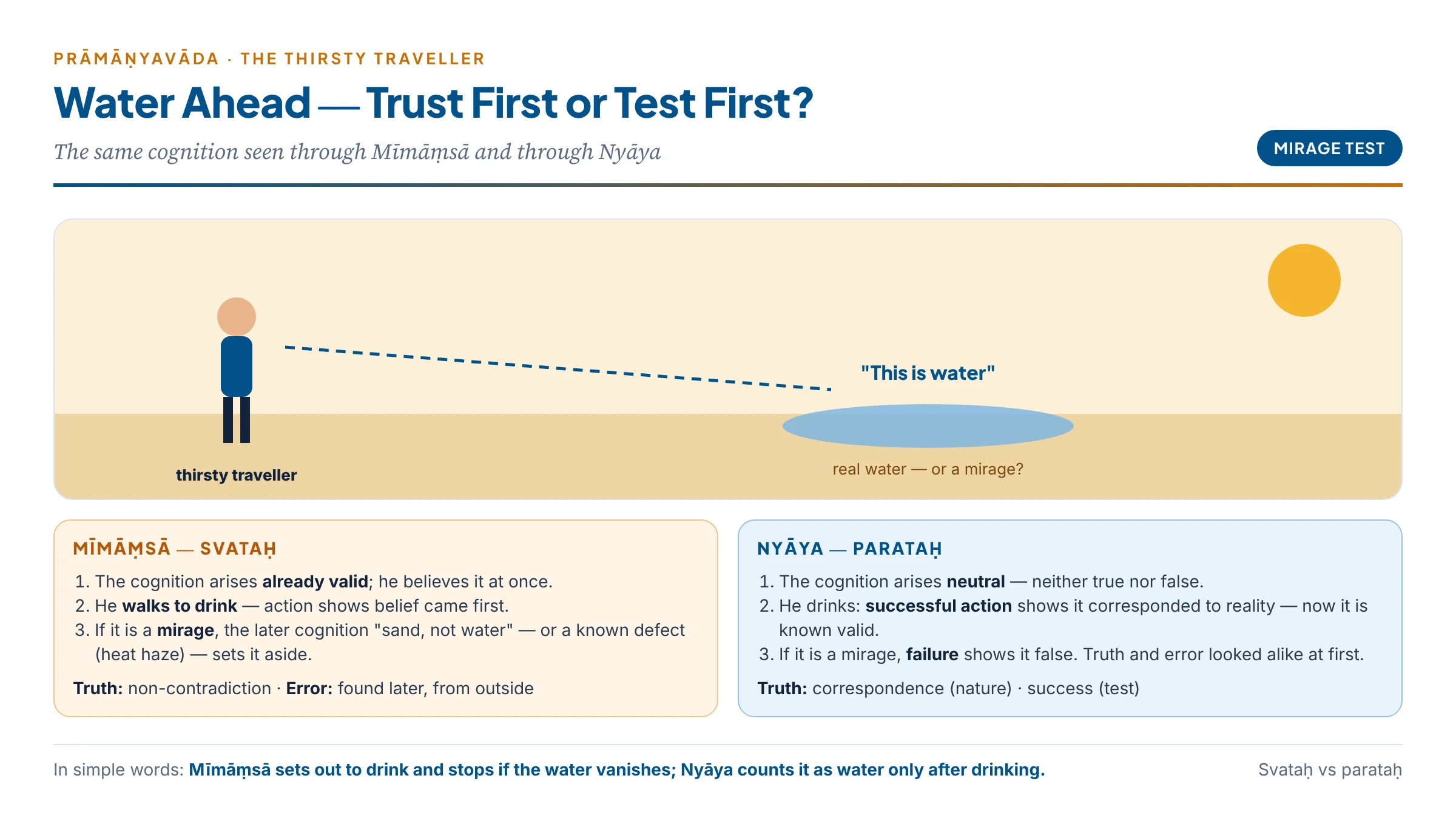
- The water example. A traveller sees water in the distance. At first it is only a cognition. If he goes near and drinks it, quenching his thirst, the cognition is validated; if he finds a mirage, it is invalidated. So validity is known extrinsically.
- Realistic and pragmatic. Nyāya’s theory is realistic about the nature of truth (correspondence) and pragmatic about its test (success).
- Arguments for extrinsic validity.
- Truth and error look alike at first. A true and a false cognition — water and mirage — appear exactly the same when they arise. So validity cannot be intrinsic: if it were, false cognitions would be valid too.
- Correspondence must be checked. Validity is correspondence with reality, and that cannot be known at the moment of cognition, only through later confirmation.
- Practical success. We know a cognition is valid when it works; failure reveals falsity.
- Inconsistency charge. Mīmāṃsā treats good conditions (sound eyes, light) as intrinsic to knowledge when it is valid, but treats bad conditions as external causes when it is invalid. It is more consistent to say that knowledge is valid or invalid according to external conditions both ways.
- Illusion would count as knowledge. If every cognition is valid by itself, the illusion of silver in a shell is also “valid” at the moment it arises.
6. The Great Debate: Mīmāṃsā’s Criticism of Nyāya
- (1) Regress. If the validity of the first cognition must be known by a second (the cognition of success, or of the excellence of the causes), then the second needs a third, and so on. Nyāya’s theory makes knowledge impossible.
- (2) Neutral knowledge is an impossibility. There is no third alternative between valid and invalid; we never experience neutral knowledge.
- (3) Activity comes before verification. We act on the cognition of water before we drink. If the cognition were neutral, we would never set out to drink at all. So belief in validity precedes the “test” that is supposed to create it.
- (4) Excellences are unknown. No special “excellence” in the causes of knowledge is ever perceived; what we find is only the absence of defects.
- (5) Success means non-contradiction. Nyāya’s “fruitful activity” really means only absence of contradiction — which is the Mīmāṃsā criterion. Correspondence means only true representation of the object, which is part of what produces valid knowledge in the first place.
- (6) An indefinite list. Nyāya never specifies how many extraneous conditions are needed to validate a cognition. If the number is not fixed, what counts as validated will vary from person to person, time to time and place to place.
- (7) The Veda. Many valid cognitions — memories of the past, testimony about distant places, the Veda’s knowledge of dharma — cannot be tested by action at all.
7. Nyāya’s Replies
- No need to verify the verifier. Vātsyāyana answered the regress long before Kumārila: we do sometimes certify our claims without having to certify the certifiers. The cognition of success (drinking water) is not about guiding further action and does not need further proof; the chain stops there.
- Familiar cases. In familiar situations (water I drink every day from my own tap) validity is known almost at once by a quick inference from similarity with past successes; only in unfamiliar situations does real testing take place.
- Acting on probability. We act on cognitions before testing them not because we know them valid but because acting is often cheap and the cognition is probably true; doubt and action can coexist.
- Truth is not self-evident. Self-evidence would make error impossible to explain; the mirage and the real water come with the same “assurance”.
- Default trust is Nyāya’s too. Nyāya itself works with a rule like “innocent until reasonably challenged“: cognitions are taken as true in practice unless there is reason to doubt. The real disagreement is over whether this practical trust amounts to knowing that they are valid.
In simple words
A new employee is trusted from the first day to do her job; the company does not wait for a year of audits before letting her work — but it checks if a complaint comes in. That is Mīmāṃsā. A different company makes every new employee work unpaid until each task is verified — that is Nyāya. The first is faster; the second is more cautious.
8. Kumārila’s Critique of the Other Two Views
- Against Sāṃkhya (both intrinsic). The same cognition cannot be both intrinsically valid and intrinsically invalid — that is a plain contradiction. If Sāṃkhya means that valid cognitions reveal their validity and invalid ones their invalidity, by themselves, then it would be impossible to tell them apart, because invalidity cannot be known without external conditions.
- Against the Buddhists (validity extrinsic, invalidity intrinsic). If knowledge is not intrinsically valid, it can never be validated afterwards: the second cognition that is supposed to validate the first is itself knowledge and therefore intrinsically invalid, needing a third — ad infinitum. Pārthasārathi adds: if a cognition is intrinsically invalid, nothing outside can make it valid; to say it is intrinsically invalid and depends on external conditions for validity is self-contradictory.
9. Intrinsic and Extrinsic Validity Compared
The 2025 paper asked for the main points of difference between the two theories.
| Point | Svataḥ-prāmāṇya (Mīmāṃsā) | Parataḥ-prāmāṇya (Nyāya) |
|---|---|---|
| Meaning | Validity is intrinsic, known by itself | Validity is extrinsic, known through external conditions |
| Propounders | Mīmāṃsā (all three schools), Advaita Vedānta | Nyāya–Vaiśeṣika |
| Origin of validity | The same causes that produce the cognition | An extra excellence (guṇa) in the causes |
| Ascertainment of validity | At once, with the cognition | Later — by successful action or coherence |
| Status of a fresh cognition | Valid unless defeated | Neutral until tested |
| Nature of error | Arises from defects; known when sublated | Arises from defects; known when action fails |
| Theory of truth | Non-contradiction (self-consistency), plus true representation | Correspondence (nature) and success (test) |
| Example | “This is water” is valid unless proved false | “This is water” becomes valid after drinking |
| Main argument | Infinite regress; no neutral knowledge | Truth and error look alike; correspondence needs checking |
| Philosophical tendency | Reduces scepticism; trust is the default | Critical verification; avoids premature belief |
| Goal | Self-evidence of knowledge and scriptural authority | Logical certainty through external proof |
Indian Connect — Correspondence, coherence and pragmatism
- Nyāya’s theory is often compared to the correspondence theory of truth (nature) combined with pragmatism (test). Mīmāṃsā’s is compared to the coherence theory, because its criterion is non-contradiction.
- But Mīmāṃsā is a realist, not an idealist: it agrees that valid knowledge must truly represent an external object. Its “coherence” is only the absence of contradiction among cognitions, not the coherence of an Absolute whole.
- Because it treats cognition as immediate apprehension, Mīmāṃsā avoids the standard criticism of coherence theories — that a chain of merely mediate cognitions “would be like a lever without a fulcrum“.
10. How Is the Validity of a Statement Determined?
The 2013 paper asked how the validity of a statement is determined, and to examine the extrinsic theory in that context.
- Nyāya (extrinsic). A statement is valid because its speaker is reliable (āpta) — one who knows the truth and wishes to tell it — and this reliability must be known; its truth is confirmed by successful action on it. Even the Veda is valid because its author, God, is reliable.
- Mīmāṃsā (intrinsic). A meaningful statement produces belief at once, unless it is known to come from an unreliable speaker; its validity needs no proof, only the absence of defeaters. The Veda, having no speaker, has no defects at all.
- Examination of the extrinsic theory for statements.
- Strength: it explains why we rightly distrust some speakers and why scientific claims are tested.
- Weakness: we could rarely act on testimony if we had first to establish each speaker’s reliability — a child learning from its mother could learn nothing.
- Weakness: establishing reliability itself relies on other testimony and memory, inviting the regress.
Critical Evaluation
Objections to Svataḥ-prāmāṇya
- Error. If every cognition carries an assurance of truth, false cognitions carry the same assurance. Then the assurance is worthless (Nyāya).
- Dogmatism. “Believe unless refuted” may protect any belief, including superstition; it shifts the burden of proof unfairly onto the critic.
- Motivated theory. The doctrine was designed to protect the Veda, whose claims can never be refuted because they can never be tested. Unfalsifiable claims gain an easy victory.
- Buddhists. Self-validity confuses the occurrence of a cognition with its truth; some cognitions are validated intrinsically, others only by success (Śāntarakṣita).
- Psychology vs logic. That we act at once on our cognitions is a fact about behaviour; it does not show that they are known to be true.
Mīmāṃsā’s Replies
- Assurance and error. The assurance is defeasible; error is the exceptional case discovered by sublation, and exceptions do not destroy the normal claim. “The falsification of the truth-claim in some cases does not affect the normal acceptance of it.”
- Dogmatism. Doubt is always allowed when there is a reason; what is rejected is doubt without reason.
- Unfalsifiable Veda. A source whose claims are never contradicted remains valid by the general principle; critics must show a defect or a contradiction, which they cannot.
- Logic, not just psychology. The regress argument is logical: if validity needed external certification, no validity could ever be established.
Critics and Defenders
Criticism — Critics
- Nyāya: true and false cognitions look alike; validity needs correspondence and success; illusion would count as valid; the good-conditions/bad-conditions treatment is inconsistent.
- Buddhists: occurrence is not truth; validity is sometimes intrinsic, sometimes extrinsic.
- Rationalist critics: default trust can shelter superstition; the theory was built to protect the Veda.
- Sāṃkhya: invalidity, too, can be intrinsic.
Defence — Defenders and strengths
- The regress argument is decisive against requiring certification before belief.
- Neutral cognition is never experienced; belief comes with knowing.
- “Excellence” is only absence of defect; success is only absence of contradiction.
- Doubt needs a reason — a principle shared by Peirce, Reid and Wittgenstein.
- Explains how testimony, memory and everyday perception can be trusted without endless checking.
- Advaita and even Nyāya’s own practice adopt default trust.
Cross-Tradition Comparison
Validity of Knowledge East and West
| Indian view | Claim | Western parallel |
|---|---|---|
| Svataḥ-prāmāṇya | Trust a cognition unless there is reason to doubt | Thomas Reid: our faculties deserve trust by default; Swinburne’s principle of credulity: things are probably as they seem unless there is special reason to think otherwise |
| Doubt needs a reason | Verification only removes obstacles | Peirce: “let us not pretend to doubt in philosophy what we do not doubt in our hearts”; Wittgenstein (On Certainty): doubt itself needs grounds |
| Falsification decisive | Error is known by later sublation | Popper: theories are never verified, only falsified |
| Regress of justification | Certifying cognitions need certifying | Agrippa’s trilemma: regress, circle or dogmatic stop; Mīmāṃsā takes a reasoned “stop” — foundationalism of a defeasible kind |
| Parataḥ-prāmāṇya (nature) | Truth is correspondence | Russell: correspondence theory |
| Parataḥ-prāmāṇya (test) | Truth shown by successful action | William James: the true is “what works”; pragmatism |
| Methodical doubt | Rejected — no doubt without reason | Descartes: doubt everything that can be doubted — the opposite strategy |
Validity across Indian Schools
| School | Validity | Invalidity | Note |
|---|---|---|---|
| Mīmāṃsā | Intrinsic | Extrinsic | Belief normal, disbelief exceptional |
| Advaita Vedānta | Intrinsic | Extrinsic | The witness reveals cognition and its validity |
| Nyāya–Vaiśeṣika | Extrinsic | Extrinsic | Correspondence and success |
| Sāṃkhya | Intrinsic | Intrinsic | Both self-evident |
| Buddhists | Extrinsic (some later: mixed) | Intrinsic | Every cognition suspect until it works |
Indian Connect — Key takeaways
- The svataḥ–parataḥ debate is India’s version of the Western debate between foundationalist default trust and evidentialist verification.
- Mīmāṃsā wins on the regress and on how belief actually works; Nyāya wins on the need to justify claims under challenge.
- A modern synthesis — “default and challenge” — keeps both: we are entitled to our cognitions by default, but must answer relevant challenges.
Synthesis (Siddhānta)
- Svataḥ-prāmāṇya-vāda: the validity of a cognition arises from its own causes and is known together with it; invalidity comes from outside — from defects in the causes or a contradicting cognition. Belief is normal, disbelief the exception.
- The arguments: we act at once on cognitions; error is a later discovery; certification by another cognition leads to an infinite regress; a capacity cannot be borrowed; neutral cognition does not exist; “excellence” is only absence of defect; verification only removes obstacles.
- The three Mīmāṃsā schools agree on intrinsic validity but differ on how it is known — by the self-luminous cognition (Prabhākara), by the inference from knownness (Kumārila), or by the after-cognition (Murāri).
- Nyāya’s parataḥ-prāmāṇya-vāda: cognition is born neutral; validity comes from excellences and is known by correspondence shown in successful action; truth and error look alike at first.
- Which is adequate? Mīmāṃsā gives the better account of how knowledge gets started and avoids the regress; Nyāya gives the better account of how disputed claims are justified. The most adequate view combines them: cognitions are innocent until reasonably challenged — as Nyāya itself concedes in practice — but a challenged cognition must be defended by evidence.
- Contemporary relevance.
- Law: the presumption of innocence and the burden of proof embody intrinsic validity’s logic.
- Science: Popper’s emphasis on falsification mirrors “falsity is known later, from outside”.
- Everyday trust: we rely on maps, teachers, news and experts by default — the Reid–Mīmāṃsā view of testimony — while staying alert to defeaters such as known bias.
“All pramāṇas should be understood to be valid by themselves; for a capacity that does not exist by itself cannot be produced by anything else.” — Kumārila Bhaṭṭa
Previous Year Questions
- 2025Delineate the main points of difference between the theory of intrinsic validation (svataḥ prāmāṇyavāda) and theory of extrinsic validation (parataḥ prāmāṇyavāda) in classical Indian philosophy.
- 2017Explain the theory of validity of knowledge (prāmāṇyavāda) according to Mīmāṃsā. How do they criticize the Nyāya theory of validity?
- 2015Elaborate Nyāya-Mīmāṃsā debate on Prāmāṇyavāda.
- 2013How is the prāmāṇya (validity/truth) of a statement determined? Examine in this context the theory of parataḥ prāmāṇyavāda.
- 2012Discuss the views of Mīmāṃsā and Nyāya on the theory of Prāmāṇyavāda. Which of them do you find adequate? Give reasons for your answer.
- 2011How do Mīmāṃsakas defend Svataḥ Prāmāṇyavāda against the Naiyāyika criticism? Discuss.
- 2002What is Svataḥ prāmāṇyavāda according to Mīmāṃsakas? Is their explanation of error consistent with it? Discuss fully.
- 1999What is self-validity of knowledge? Examine the Pūrva-Mīmāṃsaka arguments against the theory of extrinsic validity of knowledge.
- 1997Svataḥ-prāmāṇya and parataḥ-prāmāṇya. Notes.