

Mīmāṃsā: Theory of Knowledge.
Official Syllabus: Paper I, Section B, Unit 18
When I see a pot, I know the pot. But how do I know that I know it? Is the knowing itself known — and if so, by the same act, by a later act, or only indirectly, from its effects? This question — “How do I know that I know?” — produced three famous answers in classical India. Prabhākara says knowledge is self-luminous: like a lamp, it reveals itself, its object and its owner at one stroke — the triple revelation (tripuṭī-pratyakṣa). Kumārila says knowledge is an invisible act that is never directly perceived; we infer it from a new property it leaves on the object — “knownness” (jñātatā). Nyāya says a first cognition is known by a second, introspective cognition — “I know the pot” (anuvyavasāya). The answers matter, because how knowledge is known decides how its validity is known (Article 7).
In simple words
A torch lights up the room — and you do not need a second torch to see the first one; its own light shows it. That is Prabhākara. Footprints in the snow show that someone walked here, though you never saw the walker. That is Kumārila: we know our knowing from the mark it leaves on the object. A security camera filming a guard is a second record of what the guard saw. That is Nyāya: one cognition is watched by another.
Context & Problem
- Two levels of knowledge.
- First-order knowledge of an object: “This is a pot.” Nyāya calls it vyavasāya (“determination”).
- Second-order knowledge of that knowledge: “I know (that this is) a pot.“
- Three questions bundled together.
- Is a cognition known at all — always, sometimes, or never?
- If known, is it known by itself or by another cognition?
- How is the self — the knower — known?
- Why Mīmāṃsā cared. If knowledge is valid by itself (Article 7), the obvious question is: valid for whom, and known to be valid how? Each school’s answer to “how is knowledge known” fixes its answer to “how is validity known”.
- The opponents.
- Nyāya — cognitions are known by later introspection; validity is known extrinsically.
- Buddhists (Dignāga, Dharmakīrti) — every cognition is self-aware (svasaṃvedana).
- Advaita Vedānta — consciousness itself is self-luminous (svaprakāśa); the witness (sākṣī) reveals every mental state.
Core Doctrine
1. Prabhākara: The Triple Revelation (Tripuṭī-pratyakṣa-vāda)
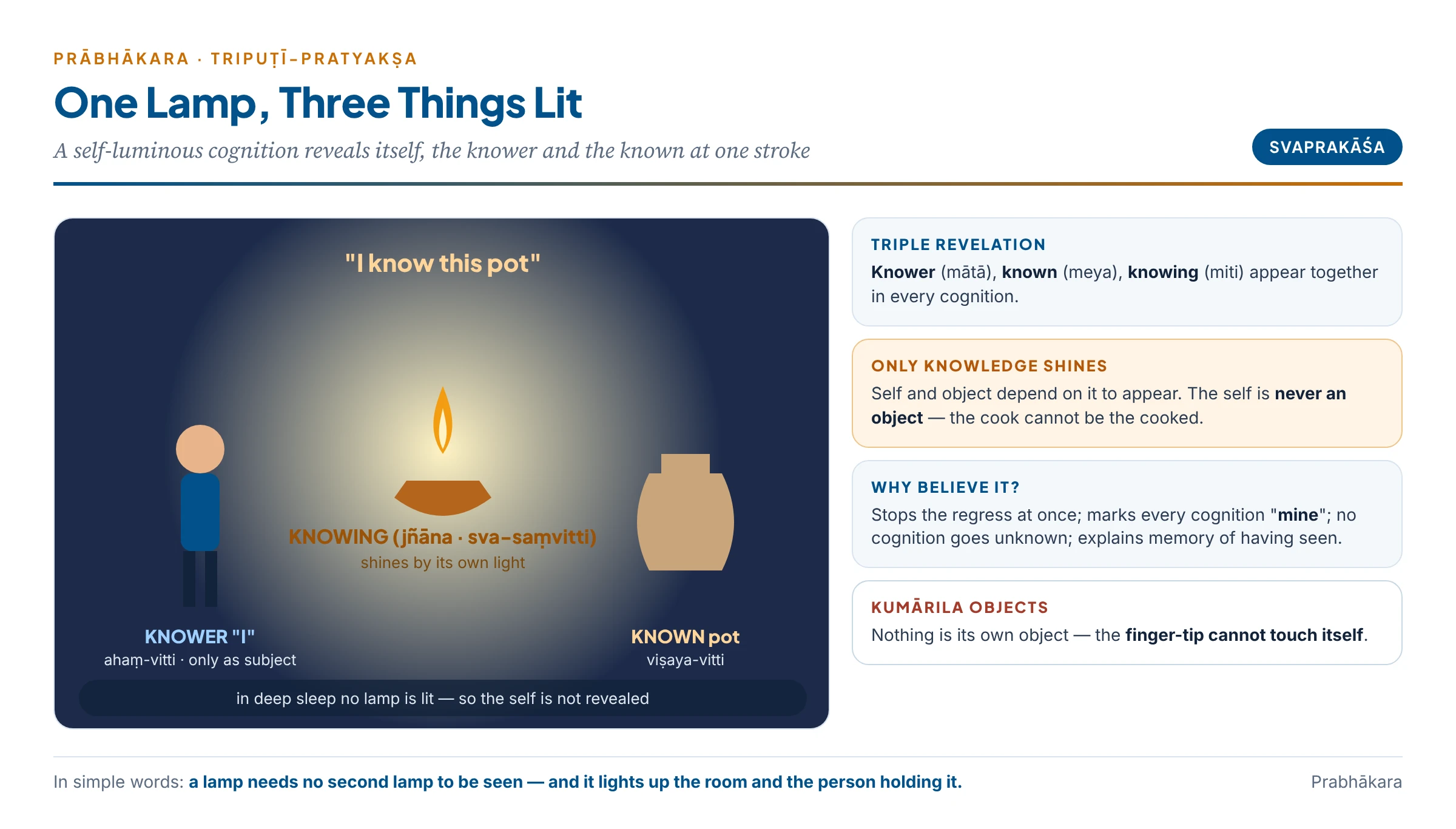
- Knowledge is self-luminous. Knowledge (jñāna, saṃvit) is self-luminous (svayaṃ-prakāśa): it manifests itself and needs nothing else for its manifestation.
- Three things at once. Knowledge, as it reveals itself, simultaneously reveals its subject and its object. In every act of knowing there is a triad (tripuṭī):
- The knower (jñātā, mātā) — revealed as “I” (ahaṃ-vitti);
- The known (jñeya, meya) — revealed as the object (viṣaya-vitti);
- The knowing (jñāna, miti) — revealed by itself (sva-saṃvitti).
- The example. In “I know this pot“: “I” is the knower, “pot” the object, “know” the knowing. All three appear together in one cognition; we do not first know the pot and later notice that we know it.
- Knowledge is the light; self and object are lit. The self and the object are not self-luminous; they depend on knowledge for their manifestation. Only knowledge shines by itself. Hence:
- The self is not self-luminous. In deep sleep there is no cognition, so the self is not revealed — we are not aware of ourselves then.
- The self is always subject, never object. It is revealed only as the knower within each cognition. It can never be known as an object, because the same thing cannot be both the doer and the thing done to in one act — as the cook cannot be the cooked (karma–kartṛ–virodha).
- Knowledge is not eternal. Though self-luminous, a cognition arises and vanishes; as it does so it reveals the self and the object along with itself.
- The lamp. A lamp illuminates a pot and also itself; it does not need a second lamp to be seen. Knowledge is like that.
In simple words
Think of a selfie. In one click the photo shows the scene behind you, you in front, and — by being a photo at all — the fact that a photo was taken. Prabhākara says every cognition is a selfie of this kind: one act shows the object, the knower and the knowing together.
2. Arguments for Self-Luminosity
- (1) No regress. If each cognition needed a second cognition to be known, the second would need a third, and so on without end; nothing would ever be known. A self-luminous cognition stops the regress at the first step.
- (2) My knowledge and yours. If the self did not appear as subject in every cognition, we could not distinguish my knowledge from another’s. Every cognition comes already marked “mine”.
- (3) Knowledge is never unknown. There is no such thing as a cognition that occurs but is unknown to its owner — I cannot see the pot and be wholly unaware of seeing it.
- (4) Memory. Later I remember “I saw the pot“. I could not remember having seen unless the seeing was known when it happened; and it was known by nothing else.
3. Kumārila: Knowledge Known by Inference from “Knownness” (Jñātatā-vāda)
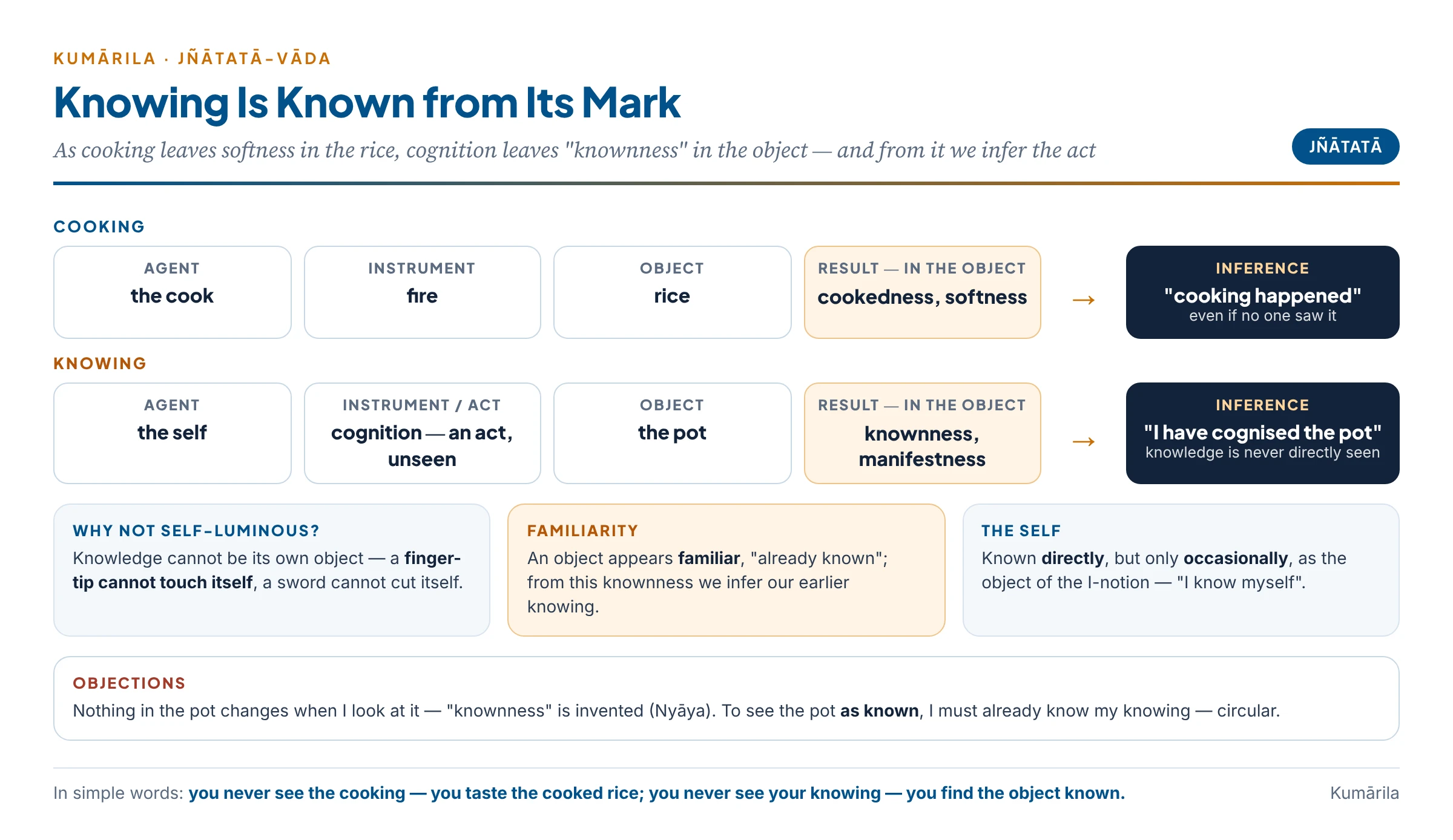
- Knowledge is not self-luminous. Kumārila denies that knowledge reveals itself. Knowledge by its very nature cannot be its own object — just as a finger-tip cannot touch itself, a sword cannot cut itself, and an acrobat cannot climb on his own shoulders.
- Knowledge is an act. Cognition is a mode of the self — an act (kriyā) or a process (vyāpāra) by which the self relates to an object. It is a modal change (pariṇāma) in the self and is adventitious, not essential. Being an act, it is not perceptible.
- The act leaves a mark on the object. When a cognitive act occurs, the object acquires a new feature — knownness or manifestness (jñātatā, prākaṭya): the pot now stands before me as known, lit up, familiar.
- We infer the cognition from this mark. We perceive the knownness in the object and from it infer that a cognition must have taken place: “The pot is known; knownness is produced by a cognitive act; therefore I have cognised the pot.”
- The cooking analogy. An act involves four things — an agent (kartā), an object (karma), an instrument (karaṇa) and a result (phala). In cooking rice: the cook is the agent, the rice the object, the fire the instrument, and the cookedness or softness of the rice the result. The act of cooking belongs to the cook, but its result appears in the rice. One who did not see the cooking can infer from the softness of the rice that cooking took place. In the same way, the act of cognition belongs to the self, but its result — knownness — appears in the object; and from it we infer the cognition.
- Familiarity. Put simply: whenever we perceive an object, it appears either unfamiliar or familiar. If it appears familiar — previously known — then from this character of knownness we infer that we had a knowledge of it. Knowledge is known indirectly.
- Knowledge is the link. Knowledge is the “third thing” between knower and known: it relates the self to the object and enables the self to know it; it is inferred because, without it, the object could never have become known.
In simple words
You come home and find the dal cooked and steaming. You did not see anyone cook — but the softness of the dal tells you cooking happened. Kumārila says we never “see” our own act of knowing either. We see the pot standing out as known to us, and from that mark we infer that we must have cognised it.
4. How the Self Is Known: Bhāṭṭa vs Prābhākara
- Bhāṭṭa. The self is not revealed every time an object is known; it is known occasionally. When we reflect on ourselves we know the self as the object of self-consciousness — the “I-notion” (ahaṃ-vitti, ahaṃ-pratyaya). Here the self is directly revealed; only the cognition is inferred.
- Prābhākara’s objection. Self-consciousness in this sense is untenable: the self cannot be both subject and object of the same act, any more than food can be both the cook and the cooked. The functions of subject and object are incompatible (karma–kartṛ–virodha). The self is revealed only as subject, in every cognition.
- Bhāṭṭa replies.
- If the self were revealed whenever an object is known, we would always have the judgment “I know this pot“. But usually we simply think “this is a pot“; self-consciousness comes only sometimes. So it is something different from object-consciousness.
- The opposition between subject and object is more verbal than real. If it were real, the Vedic injunction “Know the self” and everyday judgments like “I know myself” would be meaningless.
- If the self could never be an object, how could we remember our past self? In memory the past self is not the knower of the present memory; it is its object. So the self can be an object of knowledge.
5. Nyāya: A Second Cognition (Anuvyavasāya)
- Cognition is not self-luminous. Like Kumārila, Nyāya denies that a cognition reveals itself.
- It is known by introspection. First there is the cognition “this is a pot” (vyavasāya). Then the inner sense (manas) perceives that cognition, producing a second cognition: “I know the pot” (anuvyavasāya, “after-cognition”). In this after-cognition the self, the first cognition and its object are all revealed.
- Answering the regress. Nyāya denies that every cognition must be known. The after-cognition need not itself be known by a third. A cognition can exist and do its work — guide action — without being cognised; it is known only when we turn our attention to it.
- Validity known later. The after-cognition tells us that we have a cognition; whether that cognition is true is known extrinsically — by inference from successful action (Article 7).
- Against Kumārila. Nyāya finds “knownness” an unnecessary new property: nothing in the pot changes when I look at it. And if knownness is perceived in the object, the cognition producing it could be directly perceived by the inner sense instead.
6. Murāri Miśra: The Third Path
- Agreement with Nyāya on the means: a cognition is known by a later after-cognition (anuvyavasāya): “I know the pot”.
- Disagreement with Nyāya on validity: the same after-cognition that grasps the first cognition also grasps its validity — so validity is known intrinsically, as all Mīmāṃsakas hold. And unlike Nyāya, Murāri allows no element of doubt in the first cognition.
7. The Four Answers Compared
The 2024 paper asked: “How do I know that I know?” with reference to the Naiyāyikas, the Bhāṭṭa and the Prābhākara.
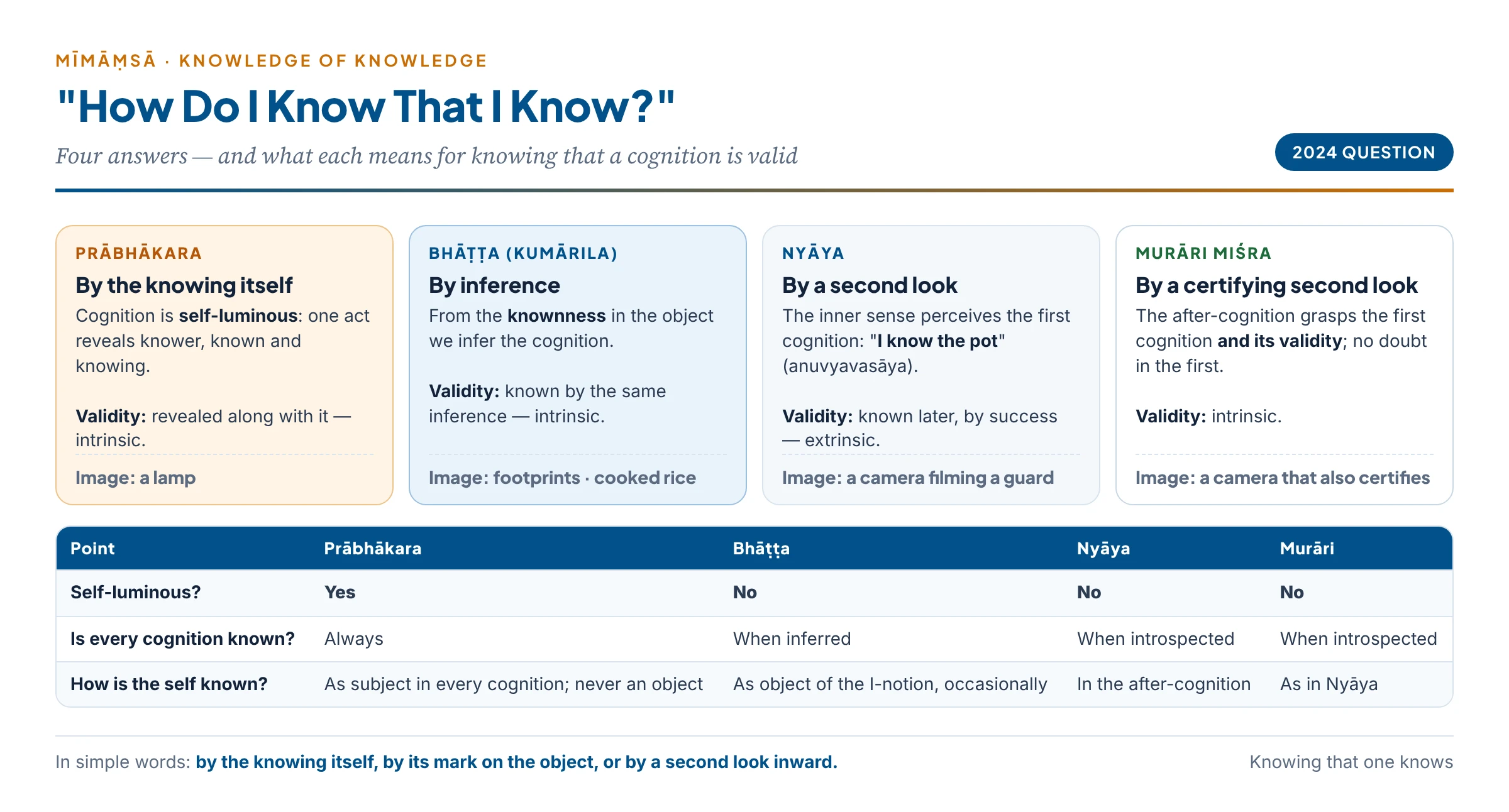
| Point | Prābhākara | Bhāṭṭa (Kumārila) | Nyāya | Murāri Miśra |
|---|---|---|---|---|
| Is a cognition self-luminous? | Yes | No | No | No |
| How is it known? | By itself, at once | By inference from knownness in the object | By a later introspective perception (anuvyavasāya) | By anuvyavasāya |
| Is every cognition known? | Yes — always | Only when inferred | Only when introspected | Only when introspected |
| How is the self known? | As subject in every cognition; never as object | As object of the I-notion, occasionally | In the after-cognition, through the inner sense | As in Nyāya |
| How is validity known? | Together with the self-revealed cognition (intrinsic) | By the same inference that reveals the cognition (intrinsic) | By a later test — success or coherence (extrinsic) | By the same after-cognition (intrinsic) |
| Image | A lamp | Footprints / cooked rice | A camera filming a guard | A camera that also certifies |
Common confusion
Is Prabhākara’s doctrine called “Tripiṭī-pratyakṣa-vāda”? No — the correct word is tripuṭī (“a group of three”, from puṭa, a fold or cup), not “tripiṭī”. Some notes misspell it. Tripuṭī-pratyakṣa-vāda means “the doctrine that the triad — knower, known and knowing — is directly revealed in every cognition”. Do not confuse it with jñātatā-vāda (Kumārila’s knownness theory) or with the Nyāya anuvyavasāya.
8. Does Self-Luminosity Lead to Intrinsic Validity?
The 2018 paper asked whether admitting self-luminosity (svayaṃprakāśa-vāda) necessarily leads to admitting intrinsic validity (svataḥ-prāmāṇya-vāda), with reference to the Naiyāyikas, the Mīmāṃsakas and the Advaita Vedāntins.
- Why one might think so. If a cognition reveals itself, nothing outside it is needed to know it; and if knowing a cognition already includes knowing it as it is (as a true grasp of its object), then its validity too would be known from within.
- The positions.
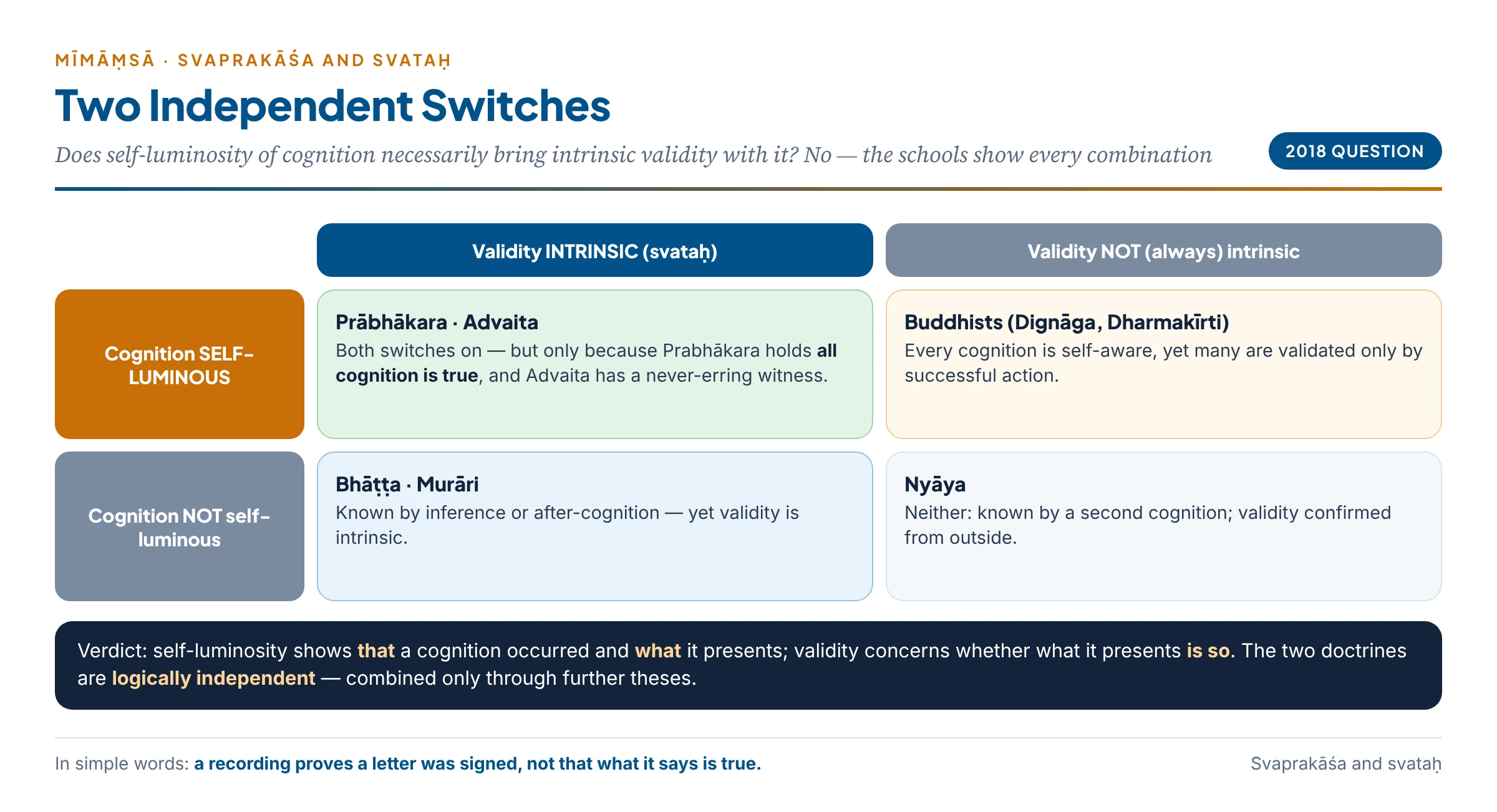
- Prabhākara: cognition is self-luminous and intrinsically valid. Since every apprehension is true for him, the self-revealing cognition reveals itself as true. Here the two doctrines go together — but because of his further view that no cognition is false.
- Advaita Vedānta: consciousness is self-luminous (svaprakāśa); mental states (vṛttis) are revealed by the self-luminous witness (sākṣī), which grasps both the state and its validity. So Advaita too holds both doctrines, and links them through the witness.
- Bhāṭṭa: cognition is not self-luminous (it is inferred), yet validity is intrinsic — the same inference that reveals the cognition reveals its validity. So intrinsic validity does not need self-luminosity.
- Murāri: cognition is not self-luminous (known by after-cognition), yet validity is intrinsic. Again, intrinsic validity without self-luminosity.
- Nyāya: cognition is neither self-luminous nor intrinsically valid.
- Buddhists (Dignāga, Dharmakīrti): every cognition is self-aware (svasaṃvedana), yet its validity is not always intrinsic — for many cognitions it is established only by successful action (arthakriyā); later Buddhists (Śāntarakṣita) say some cognitions are validated intrinsically and some extrinsically. So self-luminosity without (uniform) intrinsic validity.
In simple words
A CCTV recording proves that a letter was signed in the office at 3 p.m. — it shows that the signing happened. It does not prove that what the letter says is true. Self-luminosity is like the recording: it shows that a cognition has occurred. Intrinsic validity is a further claim — that what the cognition says is so.
| School | Self-luminous? | Intrinsically valid? |
|---|---|---|
| Prābhākara | Yes | Yes |
| Advaita Vedānta | Yes (consciousness / witness) | Yes |
| Bhāṭṭa | No | Yes |
| Murāri Miśra | No | Yes |
| Nyāya | No | No |
| Buddhists | Yes (svasaṃvedana) | Not always |
- The conclusion. The answer is no — not necessarily.
- Self-luminosity tells us that a cognition has occurred and what it presents; validity concerns whether what it presents is so. Knowing that I have a cognition is not yet knowing that it is true.
- The Buddhist case shows self-luminosity without uniform intrinsic validity; the Bhāṭṭa and Murāri cases show intrinsic validity without self-luminosity. The two doctrines are logically independent.
- They fit naturally together only when self-luminosity is joined to a further thesis — Prabhākara’s “all cognition is true”, or Advaita’s self-luminous witness that is never in error.
Indian Connect — Advaita’s place in the debate
- Advaita sides with Prabhākara that consciousness is self-luminous, but locates self-luminosity in the eternal witness, not in passing cognitions.
- It sides with Kumārila in rejecting Prabhākara’s view that the self is unconscious in itself.
- And it accepts the Mīmāṃsā doctrine of intrinsic validity (Article 7).
Critical Evaluation
Objections to Prabhākara
- Self-luminous but momentary? If cognition is self-luminous, it seems to be a kind of consciousness; yet Prabhākara makes it a passing quality of an unconscious self. A self that is lit only by its passing cognitions is not itself a knower.
- Not every cognition carries “I”. As the Bhāṭṭa says, most cognitions are simply “this is a pot”, without any explicit “I know”.
- Kumārila’s finger-tip. Nothing can be its own object; self-luminosity looks like a cognition knowing itself, which is impossible.
Objections to Kumārila
- Knownness is a fiction. Nothing changes in the pot when I look at it; “knownness” adds a mysterious property to objects (Nyāya).
- Circularity. To perceive the pot as known, I must already be aware of my knowing it — so the inference presupposes what it infers.
- Immediacy. It is implausible that I learn of my own present seeing only by inference; my awareness of seeing seems direct.
- Idealist slide. If what is known first is a property of the object (knownness) produced by cognition, objects begin to depend on knowing.
Objections to Nyāya
- Regress or unknown cognitions. Either the after-cognition must be known (regress), or there are cognitions that are never known — which seems strange.
- Memory. If the first cognition was not known when it occurred, how can I later remember “I saw the pot”?
A Balanced Evaluation
- Prabhākara is right that knowledge is self-revealing and that the self as subject is involved in every knowing and can never be just an object; but wrong to make the self an unconscious substance with knowledge as a passing quality.
- Kumārila is right that the self is not explicitly revealed in every cognition, and that self-consciousness is a higher and later state; but wrong to deny the self-luminosity of knowledge and to make it something only inferred.
- Both, under the influence of Nyāya–Vaiśeṣika realism, treat the self as a substance; Advaita will say that the real self is the transcendental knower, identical with self-luminous consciousness.
Critics and Defenders
Criticism — Critics
- Against Prabhākara: nothing can be its own object (Kumārila’s finger-tip); not every cognition contains “I”; an unconscious self lit by passing cognitions is not a knower.
- Against Kumārila: knownness is an invented property; the inference is circular; self-awareness feels immediate.
- Against Nyāya: either an endless regress or cognitions that are never known; memory of past seeing is unexplained.
- Advaita against all three: only the eternal witness is truly self-luminous.
Defence — Defenders and strengths
- Prabhākara: stops the regress at once; explains why every cognition is “mine”; explains memory of having known.
- Kumārila: respects the fact that we usually attend to objects, not to our knowing; the cooking analogy fits “knowing” as an act with a result.
- Nyāya: matches the experience of introspection — turning attention inward.
- Murāri: combines introspection with intrinsic validity.
- The debate maps closely onto modern theories of consciousness.
Cross-Tradition Comparison
Knowing That One Knows: East and West
| Indian view | Claim | Western parallel |
|---|---|---|
| Prābhākara tripuṭī | Every cognition reveals itself, its object and its subject | Brentano: every mental act is secondarily aware of itself; Sartre: the pre-reflective cogito — consciousness is non-positionally aware of itself |
| Prābhākara on the self | The self is always subject, never object; absent in deep sleep | Kant: the “I think” accompanies representations but is not an object of experience; Hume: “I never can catch myself… without a perception” |
| Bhāṭṭa jñātatā | We infer our knowing from its effect on the object | Ryle: we know minds (even our own) largely from outward signs; we know acts by their results |
| Bhāṭṭa self as object | The self known occasionally as object of “I” | Descartes: “I think, therefore I am” — the self grasped in reflection |
| Nyāya anuvyavasāya | A second, introspective cognition | Locke: “reflection”, an inner sense perceiving the mind’s operations; higher-order thought theories of consciousness |
| Advaita sākṣī | A self-luminous witness of all mental states | Husserl’s transcendental ego |
Self-Luminosity across Indian Schools
| School | Cognition known how | Self known how |
|---|---|---|
| Prābhākara | By itself (svaprakāśa) | As subject in each cognition |
| Bhāṭṭa | Inferred from knownness | As object of the I-notion |
| Nyāya | By after-cognition through manas | In the after-cognition |
| Buddhists | Self-aware (svasaṃvedana) | No permanent self |
| Advaita | By the witness (sākṣī) | The self is self-luminous consciousness |
Indian Connect — Key takeaways
- The question “How do I know that I know?” divides the two Mīmāṃsā schools more sharply than almost any other.
- Prabhākara answers like Brentano and Sartre; Nyāya like Locke and the higher-order theorists; Kumārila takes an original indirect route of his own.
- Self-luminosity and intrinsic validity are independent doctrines that some schools happen to combine.
Synthesis (Siddhānta)
- Prabhākara: knowledge is self-luminous; every cognition reveals at one stroke the knower, the known and itself (tripuṭī); the self is lit only by cognition and is always subject, never object.
- Kumārila: knowledge is an act of the self, never directly perceived; it leaves knownness (jñātatā) in its object, from which the act is inferred — as cooking is inferred from cooked rice; the self is known occasionally as the object of the I-notion.
- Nyāya: a cognition is known by a later introspective perception (anuvyavasāya); Murāri agrees but holds that this after-cognition also grasps validity.
- So “How do I know that I know?” gets three answers: by the knowing itself, by inference from its mark, and by a second look.
- Self-luminosity does not necessarily entail intrinsic validity: Bhāṭṭa and Murāri have intrinsic validity without self-luminosity, and the Buddhists self-awareness without uniform intrinsic validity; Prabhākara and Advaita combine them only through further theses.
- Contemporary relevance.
- Consciousness studies: “higher-order” theories (a mental state is conscious when another state represents it) versus “self-representational” theories (it represents itself) replay Nyāya versus Prabhākara.
- Psychology of metacognition: knowing that one knows — or “feeling of knowing” — is studied experimentally, and is often inferential, as Kumārila would expect.
- Artificial intelligence: a system that “knows that it knows” (calibrated confidence) needs a second-order process — the Nyāya model.
“Knowledge by its very nature cannot be its own object, just as the finger-tip cannot touch itself.” — The Bhāṭṭa Mīmāṃsakas
Previous Year Questions
- 2024How do I know that I know? Answer this question with reference to the Naiyāyikas, the Bhāṭṭa Mīmāṃsakas and the Prābhākaras.
- 2018Does the admission of Svayamprakāśavāda necessarily lead to the admission of Svataḥprāmāṇyavāda? Discuss after the Naiyāyikas, the Mīmāṃsakas and the Advaita Vedāntins.