

Mīmāṃsā: Theory of Knowledge.
Official Syllabus: Paper I, Section B, Unit 18
Arthāpatti — “postulation” or “presumption” — is one of the two pramāṇas that Mīmāṃsā added to the Nyāya list. It is the knowledge we get when two facts we are sure of seem to clash, and we are forced to suppose a third fact that alone can reconcile them. The classic case: Devadatta is growing fat, yet never eats during the day — so he must eat at night. Nobody saw him eat at night; no rule says “all fat people eat at night”; yet we know it. Mīmāṃsā insists this knowledge cannot be explained as perception, inference, comparison or testimony, so it needs a pramāṇa of its own. Nyāya replies that it is only a disguised inference. UPSC has asked about this debate four times, including the 2024 question about a topper never seen studying.
In simple words
Your phone battery was at 20% last night and is at 100% this morning, though you are sure you did not charge it. You immediately think: “Someone charged it while I slept.” You did not see it happen and you are not applying any rule you learned. The two facts simply cannot both be true unless something else happened. That forced supposition is arthāpatti.
Context & Problem
- The word. Artha = “fact” or “thing”; āpatti = “supposition” or “falling into”. Arthāpatti is “the supposition of a fact” — knowledge that resolves the conflict between two facts by presuming a third.
- Who accepts it. Prabhākara, Kumārila and the Advaita Vedāntins accept arthāpatti as an independent pramāṇa. Nyāya, Vaiśeṣika, Sāṃkhya and the Buddhists reduce it to inference; the Cārvāka rejects it altogether.
- Why the question matters. If arthāpatti is only inference, Mīmāṃsā’s list shrinks; if it is a distinct pramāṇa, then there is a kind of knowledge — explanatory knowledge — that the syllogism cannot capture. For Mīmāṃsā much depends on it: some of its central doctrines (apūrva, the power of words) are themselves known by arthāpatti (section 8).
Core Doctrine
1. What Arthāpatti Is
- Definition. Arthāpatti is the necessary supposition of an unperceived fact which alone can explain a phenomenon that demands explanation.
- The structure.
- There is a fact to be explained — the explanandum (upapādya).
- It cannot be understood in any way without supposing some other fact — the explainer (upapādaka).
- Affirming this explainer is arthāpatti. Its typical form is: “this cannot otherwise be accounted for” (anyathā-anupapatti).
- Its source. It arises out of a demand for explanation — a search for the ground of something already known.
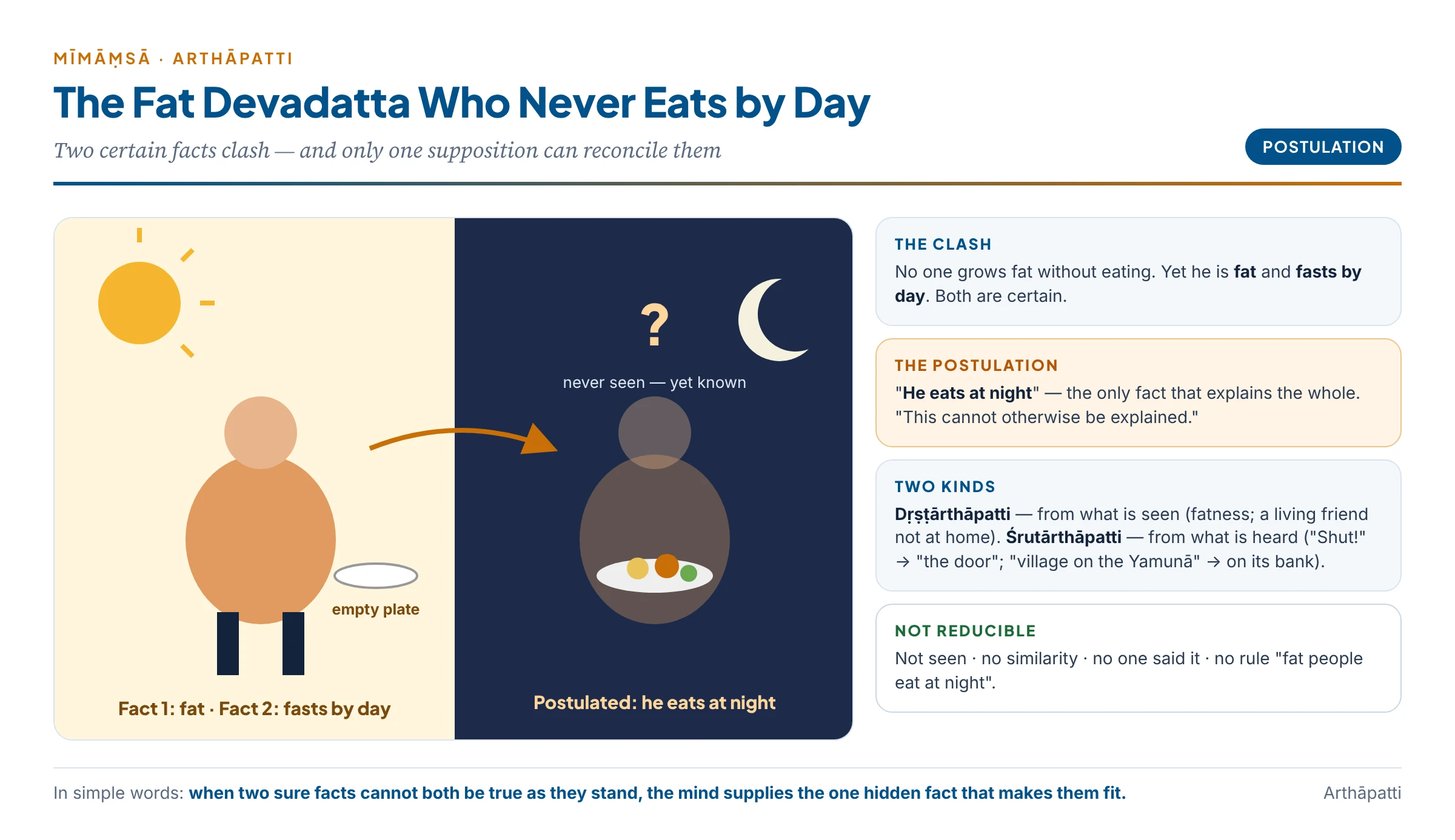
- The classic example — fat Devadatta.
- Fact 1: Devadatta is growing fat (observed).
- Fact 2: Devadatta fasts during the day (observed).
- Background: no one grows fat without eating.
- Conflict: fatness and fasting cannot both be true as they stand.
- Postulation: “Devadatta eats at night.” This alone explains the whole — fasting by day together with increasing fatness.
2. More Examples from Daily Life and Language
- The absent friend. We call on a friend and do not find him at home, though we are sure he is alive. We say: “He must be somewhere outside.” This alone explains how a living man is not at home.
- The village on the river. Told that a person comes from a village “on the Yamunā“, we understand that the village is on the bank of the Yamunā — a village cannot be in a river.
- Missing words. When some words are omitted from a sentence, we supply them. Hearing “Shut!” we supply “the door“; hearing “Shut up“, we supply “your mouth” — without them the meaning is incomplete.
- Figurative meaning. When the primary meaning of a word does not fit the context, we suppose a secondary meaning: told “Industry is the key to success“, we take “key” to mean “means“, not a metal key.
3. Two Kinds of Arthāpatti
- Dṛṣṭārthāpatti — postulation from what is seen. It explains something perceived: the fatness of a man who fasts by day; the absence from home of a man known to be alive.
- Śrutārthāpatti — postulation from what is heard. It explains the meaning of words heard: supplying the missing word in “Shut!”, taking “Yamunā” as “the bank of the Yamunā”, or — if Devadatta’s father tells us “Devadatta, who is alive, is not at home” — presuming that he is elsewhere. Here the conflicting facts come from testimony, not perception.
- Arising from any pramāṇa. Kumārila shows that the facts that call for postulation may be known by any pramāṇa. For example, from seeing that fire burns, we postulate in fire a power to burn (śakti); from hearing that a sacrifice performed now brings heaven later, we postulate an unseen potency (apūrva).
Common confusion
Is “He who performs Agnihotra lives until the end of his life — so if a man is alive, he must be performing Agnihotra” an example of śrutārthāpatti? No — that example, found in some notes, is garbled. It reverses the logic: nothing in “being alive” forces us to suppose any ritual. Standard examples of śrutārthāpatti are: hearing that “Devadatta, who is alive, is not at home” and supposing he is elsewhere; supplying “the door” after hearing “Shut!”; understanding “the village on the Yamunā” as “on its bank“. The Vedic case Mīmāṃsā really uses is apūrva: the Veda says a sacrifice yields heaven, the sacrifice ends at once, heaven comes much later — so an enduring unseen potency must link them.
4. Why Arthāpatti Is Not Any Other Pramāṇa
- Not perception. We do not see Devadatta eat at night. No sense touches the postulated fact.
- Not comparison. It is not knowledge of similarity. We cannot compare Devadatta with others who fast by day — many who fast by day are thin.
- Not testimony. No one told us he eats at night. (In śrutārthāpatti the starting facts are heard, but the postulated fact is not stated by anyone.)
- Not inference. This is the real battleground (section 5). The short answer: there is no invariable concomitance (vyāpti) between fatness and eating at night — we cannot say “wherever there is fatness, there is eating at night“, as we can say “wherever there is smoke, there is fire”.
In simple words
Inference is like a train on rails: from the station “smoke” you ride a known track (the rule) to the station “fire”. Arthāpatti is like a detective at a puzzle: two clues contradict each other, and the detective works backwards to the one hidden fact that makes them consistent. Inference runs forward from a sign to a consequence; arthāpatti runs backward from a puzzle to its ground.
5. The Debate with Nyāya: Can Arthāpatti Be Reduced to Inference?
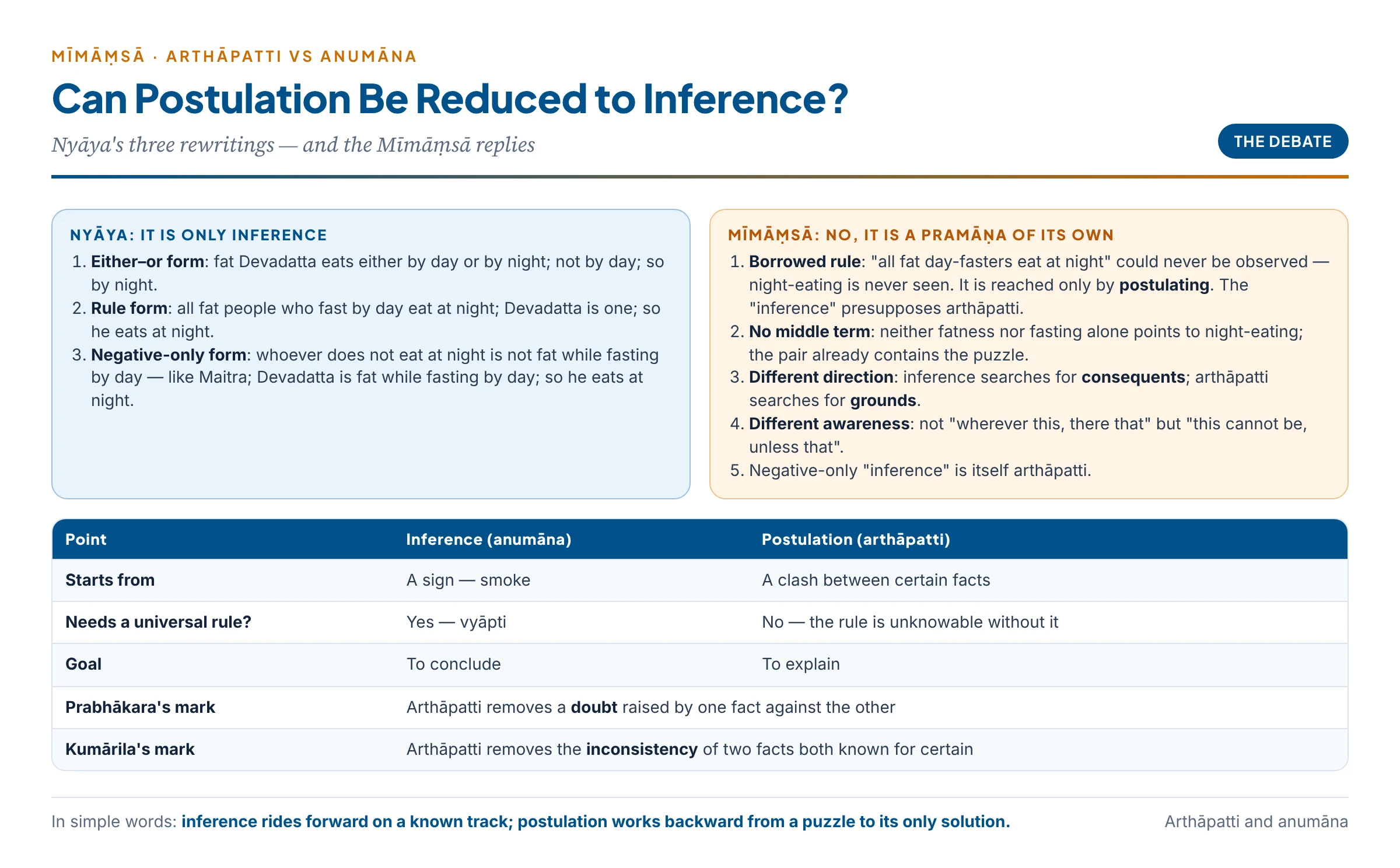
- Nyāya’s reduction. Every arthāpatti, says Nyāya, can be rewritten as an inference.
- Disjunctive form. “Fat Devadatta eats either by day or by night; he does not eat by day; therefore he eats by night.” Likewise: “Living Devadatta is either at home or elsewhere; he is not at home; therefore he is elsewhere.”
- Categorical form. “All fat persons who do not eat by day eat at night; Devadatta is a fat person who does not eat by day; therefore Devadatta eats at night.” And: “All living persons who are not at home are elsewhere; Devadatta is a living person not at home; therefore he is elsewhere.”
- Negative-only form (kevala-vyatirekī anumāna). “Whoever does not eat at night is not fat while fasting by day — like Maitra, who eats by day; Devadatta is fat while fasting by day; therefore Devadatta is not one who does not eat at night”, i.e. he eats at night. The rule is known from negative cases alone.
So “arthāpatti” is just inference that Mīmāṃsakas have not recognised.
- The Mīmāṃsā refutation.
- Where would the universal premise come from? The rule “all fat people who fast by day eat at night” could never be learned from observation, because the night-eating is exactly what is never seen. The only way to reach such a rule is by postulating night-eating in each case — that is, by arthāpatti itself. So the “inference” presupposes arthāpatti; it cannot replace it.
- No proper middle term. In inference the middle term (hetu) must be a sign present in the subject and connected with the conclusion by vyāpti. Here neither fact alone can serve as the middle term — fatness alone does not point to night-eating, nor does fasting alone. Both together might be taken as the middle term — but the combination “fat-yet-fasting-by-day” already contains the problem whose solution is the conclusion; a middle term should not include the conclusion.
- A different direction. Inference starts from an established fact and concludes to what follows from it — a search for consequents. Arthāpatti starts from a conflict among facts and looks for what would explain them — a search for grounds. We use syllogism to draw conclusions from given facts, not to explain given facts.
- A different awareness. In inference we are aware “wherever there is A, there is B“. In arthāpatti we are aware “A cannot be so unless B” — the felt inexplicability of the facts drives the knowledge.
- Negative-only inference is really arthāpatti. Mīmāṃsā (and Advaita) do not accept a purely negative (kevala-vyatirekī) inference as inference at all. The cases Nyāya puts under it are exactly the cases of arthāpatti.
- Comparison table.
| Point | Inference (anumāna) | Postulation (arthāpatti) |
|---|---|---|
| Starts from | An established sign (smoke) | A conflict between established facts |
| Direction | From ground to consequent — search for consequents | From consequent to ground — search for grounds |
| Needs a universal rule? | Yes — vyāpti is essential | No — the rule could not even be known without it |
| Middle term | A sign in the subject | None; neither fact alone, and the pair already contains the problem |
| Awareness | “Wherever A, there B” | “A cannot be, unless B” |
| Purpose | To conclude | To explain |
6. Prabhākara and Kumārila: Doubt or Inconsistency?
Both accept arthāpatti, but they explain what distinguishes it from inference differently.
- Prabhākara — doubt.
- There is an element of doubt in arthāpatti, absent from inference. From the undoubted perception of smoke we infer fire.
- In arthāpatti, one of the two perceived facts is made doubtful by the other. When we see that Rāma is not in his house and know that he is alive, the presumption that he is outside arises only when his “being alive” is put in doubt by his absence.
- Arthāpatti removes this doubt and reconciles the two apparently inconsistent facts. Since inference contains no doubt, arthāpatti is not inference.
- Kumārila — inconsistency, not doubt.
- There is no doubt in arthāpatti. We perceive Rāma’s absence and we know for certain that he is alive.
- If our knowledge of his being alive were doubtful, it could not be a sound basis for presumption.
- What arthāpatti removes is the mutual inconsistency of two well-ascertained facts, by presuming a third. In inference there is no such inconsistency.
- What both agree on. In arthāpatti there is no middle term at all — so no vyāpti, and so no inference.
| Point | Prabhākara | Kumārila |
|---|---|---|
| What triggers arthāpatti | Doubt about one fact, caused by the other | Inconsistency between two certain facts |
| Status of the starting facts | One made doubtful | Both certain |
| What arthāpatti removes | The doubt | The apparent inconsistency |
| Why it is not inference | Inference has no doubt; no middle term | Inference has no inconsistency; no middle term |
In simple words
You see a friend’s car parked outside her house, and her phone is ringing unanswered. Prabhākara says: the car makes you doubt whether she is out — and arthāpatti settles the doubt (“she is home but busy”). Kumārila says: there is no doubt at all; you are sure of both facts, and they simply do not fit together until you suppose a third.
7. Arthāpatti and Hypothesis
- A resemblance. Arthāpatti resembles an explanatory hypothesis in Western logic — a supposition made to explain facts.
- The difference. It lacks the tentative, provisional character of a hypothesis. What is known by arthāpatti is not merely entertained “to be tested”, but believed as the only possible explanation.
- The objection. Critics say that this is just where arthāpatti is weak: a supposition is only probable; there may be other explanations. If so, it cannot be a pramāṇa, which must give certainty.
- The reply. Arthāpatti operates only when there is no other explanation; where several explanations are possible, there is no arthāpatti, only doubt.
8. The Logical Necessity of Arthāpatti for Mīmāṃsā
The 2016 paper asked why it was logically necessary for Mīmāṃsā to treat arthāpatti as an independent pramāṇa.
- (1) Some knowledge has no vyāpti behind it. In explanatory cases the universal rule cannot be observed (the explaining fact is never seen). If only inference were allowed, such everyday knowledge would be unaccounted for.
- (2) Apūrva. The Veda says a sacrifice brings heaven; the sacrifice ends at once; heaven comes later. These facts conflict unless something endures in between. So Mīmāṃsā postulates an unseen potency — apūrva — by śrutārthāpatti. Without arthāpatti, its whole theory of ritual efficacy would have no pramāṇa.
- (3) Śakti. The power to burn in fire, the power to sprout in a seed, the power of a word to convey meaning — none is perceived; each is postulated to explain observed effects. Mīmāṃsā’s doctrine of potency rests on arthāpatti.
- (4) Interpreting the Veda. Vedic sentences are often elliptical; filling them out, and choosing secondary meanings when the primary meaning fails, is śrutārthāpatti. A school of interpretation needs it constantly.
- (5) The eternity of words. Śabara argues that a word must endure beyond its utterance, since speech is for another: if the word perished the moment it was spoken, the hearer could never grasp its meaning. This, too, is an argument from the impossibility of explaining communication otherwise.
- (6) Keeping inference honest. Treating explanation as inference would force Mīmāṃsā to accept rules (like “all fat day-fasters eat at night”) that are unknowable. Keeping arthāpatti separate preserves the strictness of inference.
In simple words
A post-dated cheque is handed over today but pays out next month; something must hold the value in between — the bank account. Mīmāṃsā reasons the same way about ritual: the act is over today, the reward comes after death, so something must hold its power in between. That “account” is apūrva — and it is known only by postulation.
Indian Connect — Advaita’s use of arthāpatti
- Advaita Vedānta accepts arthāpatti exactly as the Bhāṭṭa does and uses it widely.
- Māyā is understood through arthāpatti: the Upaniṣads teach that Brahman is one and changeless, yet we experience a many, changing world; to reconcile the two, an inexplicable power — māyā — must be postulated.
- The substratum of an illusion is likewise postulated: the illusory snake must appear on something real.
9. The Case of the Topper Never Seen Studying
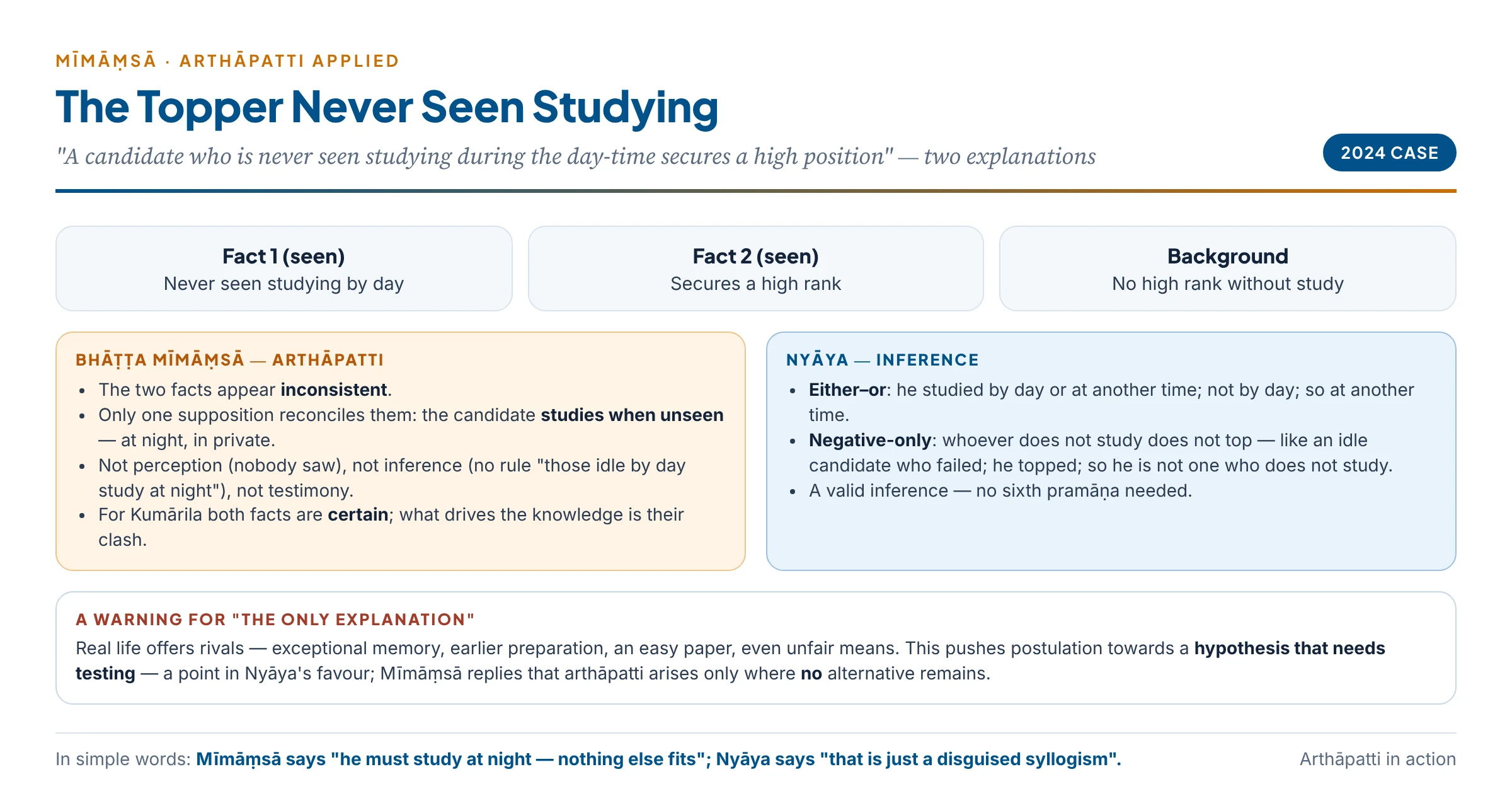
The 2024 paper put the doctrine to work: “A candidate who is never seen to be studying during the day-time secures a high position in a competitive exam.” How would the Bhāṭṭa Mīmāṃsakas and the Naiyāyikas explain the success?
- The facts.
- The candidate is never seen studying by day (observed).
- The candidate secures a high rank (observed).
- Background: a high rank in a competitive exam is not achieved without study.
- The Bhāṭṭa explanation — arthāpatti.
- The two observed facts appear inconsistent.
- The inconsistency is removed only by postulating that the candidate studies when unseen — at night, or in private.
- This knowledge is not perception (no one saw the study), not inference (there is no observed rule “those not seen studying by day study at night”), not comparison, not testimony. It is arthāpatti — the Devadatta pattern applied to a topper.
- For Kumārila the starting facts are certain (no doubt about the rank or the day-time idleness); what drives the knowledge is their inconsistency.
- The Nyāya explanation — inference.
- Disjunctive: “This candidate studied either by day or at some other time; not by day; therefore at some other time.”
- Negative-only: “Whoever does not study at all does not secure a high rank — like an idle candidate who failed; this candidate secured a high rank; therefore this candidate is not one who does not study.”
- The knowledge is a valid inference based on a negative concomitance; no new pramāṇa is needed.
- Evaluating the two.
- For Nyāya: the reasoning clearly can be set out as a syllogism.
- For Mīmāṃsā: the “universal” premises are themselves reached only because we first postulate unseen study; and the mind’s actual movement is from a puzzle to its solution.
- A warning. Real life offers other explanations — exceptional memory, earlier preparation, an easy paper, even unfair means. This shows the danger of calling any postulate “the only explanation”, and it pushes arthāpatti towards a hypothesis that needs testing — a point in Nyāya’s favour.
Critical Evaluation
Objections to Arthāpatti
- Nyāya: it is disjunctive or negative-only inference; the “search for grounds” versus “search for consequents” is a psychological difference, not a logical one.
- Buddhists: the Devadatta case is inference supported by memory (of the rule that eating causes fatness). Multiplying pramāṇas beyond necessity is epistemologically redundant.
- Cārvāka: presumption is mere guesswork without empirical foundation — it posits what no one perceives.
- Hypothesis objection: a supposition is at best probable; a pramāṇa must be certain. “Only possible explanation” is rarely provable.
- Against Prabhākara: if arthāpatti begins in doubt, its conclusion inherits doubt and cannot be valid knowledge (Kumārila’s own objection).
- Even Advaitins who accept it admit that critics have some force in saying it overlaps with inference.
Mīmāṃsā’s Replies
- The universal is borrowed. Any syllogism that “reduces” arthāpatti uses a premise known only through arthāpatti — so the reduction is circular.
- Logic follows knowledge. That a piece of knowledge can be rewritten as a syllogism does not show that it arose from one; pramāṇas are distinguished by how knowledge actually arises.
- Certainty. When the facts are certain and no alternative explanation exists, the postulated fact is as certain as they are.
- Against redundancy. A pramāṇa is “redundant” only if another pramāṇa actually gives the same knowledge in the same way — which, here, none does.
Critics and Defenders
Criticism — Critics
- Nyāya: arthāpatti is disjunctive or negative-only inference.
- Buddhists: inference plus memory; an unnecessary extra pramāṇa.
- Cārvāka: guesswork without perception.
- Logicians: at best a probable hypothesis; “only explanation” is seldom proven.
- Kumārila against Prabhākara: a doubtful premise cannot ground knowledge.
Defence — Defenders and strengths
- The universal premise of the “inference” is itself known only by postulation — the reduction is circular.
- It captures explanatory knowledge — reasoning from puzzle to ground — which the syllogism does not describe.
- It is used constantly in language (ellipsis, secondary meaning) and daily life.
- It grounds Mīmāṃsā’s doctrines of apūrva and śakti, and Advaita’s māyā.
- It anticipates modern abduction and inference to the best explanation.
Cross-Tradition Comparison
Arthāpatti and Western Thought
| Point | Arthāpatti | Western parallel |
|---|---|---|
| Reasoning to an explanation | From conflicting facts to their only ground | Peirce’s abduction: “the surprising fact C is observed; if A were true, C would follow; hence there is reason to suspect A” |
| Best explanation | The only possible explanation | Inference to the best explanation (Harman) — but IBE admits rivals and degrees |
| Hypothesis | Not tentative — believed | Scientific hypothesis — tentative, to be tested (Popper) |
| Conditions of possibility | “This cannot be unless that” | Kant’s transcendental argument: given experience, its necessary conditions must hold |
| Detective reasoning | Fat Devadatta eats at night | Sherlock Holmes: “when you have eliminated the impossible, whatever remains… must be the truth” |
| Filling gaps in speech | Śrutārthāpatti — “Shut!” → “the door” | Grice’s implicature: hearers infer what speakers leave unsaid |
Arthāpatti across Indian Schools
| School | Status | Explanation |
|---|---|---|
| Prābhākara | Independent pramāṇa | Removes doubt between two facts |
| Bhāṭṭa | Independent pramāṇa | Removes inconsistency between two certain facts |
| Advaita Vedānta | Independent pramāṇa | As Bhāṭṭa; used for māyā and the substratum of illusion |
| Nyāya, Vaiśeṣika, Sāṃkhya | Not independent | Disjunctive or negative-only inference |
| Buddhists | Not independent | Inference plus memory |
| Cārvāka | Rejected | Guesswork |
Indian Connect — Key takeaways
- Arthāpatti is the Indian name for reasoning to the ground of a puzzle.
- Its defenders and critics are really debating whether explanation is a special kind of knowing or only a kind of deduction.
- The same question divides modern philosophers of science on abduction.
Synthesis (Siddhānta)
- Arthāpatti is the necessary supposition of an unperceived fact that alone reconciles apparently conflicting facts — fat Devadatta who fasts by day must eat at night.
- It is of two kinds: dṛṣṭārthāpatti (from what is seen) and śrutārthāpatti (from what is heard — missing words, secondary meanings, apūrva).
- It is not perception (the fact is unseen), comparison (no similarity), testimony (no one says it) or inference (no vyāpti, no proper middle term; the “universal” is itself reached by postulation; it searches for grounds, not consequents).
- Prabhākara finds its mark in doubt; Kumārila in the inconsistency of certain facts.
- Nyāya rewrites it as disjunctive, categorical or negative-only inference; Mīmāṃsā replies that the rewriting is circular and misdescribes how the knowledge arises.
- It is logically necessary for Mīmāṃsā because its doctrines of apūrva, śakti and Vedic interpretation rest on it.
- Contemporary relevance.
- Medicine: a doctor reasons from conflicting symptoms to the one disease that explains them.
- Science: postulating unseen entities (dark matter, to reconcile observed galaxy rotation with visible mass) is a modern arthāpatti — though science keeps it tentative.
- Law: circumstantial evidence — “the accused was seen entering, the jewels are gone, no one else had access” — works by postulation.
“Arthāpatti is the presumption of a thing, because something seen or heard cannot otherwise be explained.” — Śabara
Previous Year Questions
- 2024“A candidate who is never seen to be studying during the day-time secures a high position in a competitive exam.” How would the Bhāṭṭa Mīmāṃsakas and the Naiyāyikas explain the success of this candidate? Discuss.
- 2022How do Mīmāṃsakas refute the Nyāya view that Implication (arthāpatti) is reducible to Inference (anumāna) and establish Implication as an independent means of valid knowledge (pramāṇa)? Critically discuss.
- 2016What is the logical necessity for the Mīmāṃsās to treat ‘arthāpatti’ as an independent Pramāṇa? Discuss.
- 2014Can arthāpatti (postulation) be reduced to Anumāna (inference)? Discuss it from Mīmāṃsā point of view.