

Mīmāṃsā: Theory of Knowledge.
Official Syllabus: Paper I, Section B, Unit 18
The first three pramāṇas — perception (pratyakṣa), inference (anumāna) and comparison (upamāna) — are shared by Mīmāṃsā with Nyāya, but Mīmāṃsā gives each of them its own twist. Its account of perception insists that even the first, wordless glimpse of an object is real knowledge that guides action. Its inference is lean and practical, content with three steps instead of Nyāya’s five. And its comparison is not about learning what a word means, as Nyāya holds, but about knowing that a remembered thing is similar to what we now see — “my cow at home is like this wild gavaya“. The 2026 paper asked exactly this: how does the Nyāya view of upamāna differ from the Mīmāṃsā view?
In simple words
You walk into a dark cinema hall from bright sunlight. For a moment you see only vague shapes — “something there”. A second later: “rows of seats, a man in a red shirt“. The first glimpse is nirvikalpa (indeterminate) perception; the second is savikalpa (determinate). Mīmāṃsā says the first glimpse is already genuine knowledge — the second only makes explicit what was already given.
Context & Problem
- Shared ground. Mīmāṃsā accepts the four pramāṇas of Nyāya — perception, inference, comparison and testimony — and adds two more of its own (Articles 4 and 5). On perception and inference the two schools are close; on comparison they part company.
- Why perception matters to a Vedic school. Mīmāṃsā’s realism rests on perception: the world is real because perception shows it to be so (Article 1). But perception also has a limit: it grasps only what is present to the senses, so it can never reveal dharma, which is supersensible. This is why the Veda is needed.
- The opponents.
- Buddhists (Dignāga, Dharmakīrti): only wordless, concept-free perception of the bare particular (svalakṣaṇa) is real perception; every judgment with names and classes is mental construction.
- Grammarians (Bhartṛhari): there is no wordless perception at all — all awareness is shot through with language.
- Some Vedāntins: what is first given is pure existence without distinctions.
- Mīmāṃsā’s middle path. Both wordless and judgmental perception are real and valid, and the second only develops what the first already contains.
Core Doctrine
1. Definitions of Perception
- Prabhākara: perception is direct apprehension (sākṣāt pratītiḥ pratyakṣam). Śālikanātha adds that in every perception three things are revealed together — the object known, the knower, and the knowing itself (the theory of triple revelation, Article 6).
- Kumārila: perception is direct knowledge produced by the proper contact of the sense-organs with an existing object, free from defects. Like early Nyāya, he describes a chain of contacts:
- the self with the mind (manas);
- the mind with the sense-organ;
- the sense-organ with the object.
- Only the existing. The object of perception must be something existing (sat) and present. This is why perception can never grasp dharma, future fruits, or absence (for absence the Bhāṭṭa needs a separate pramāṇa, Article 5).
- A small physical difference. Nyāya says the organ of hearing is ether (ākāśa) enclosed in the ear-hole; Mīmāṃsā says it is space (dik) enclosed in the ear-hole.
- Five external senses and the mind. Smell, taste, sight, touch and hearing perceive external objects; manas perceives inner states — pleasure, pain, desire, cognition.
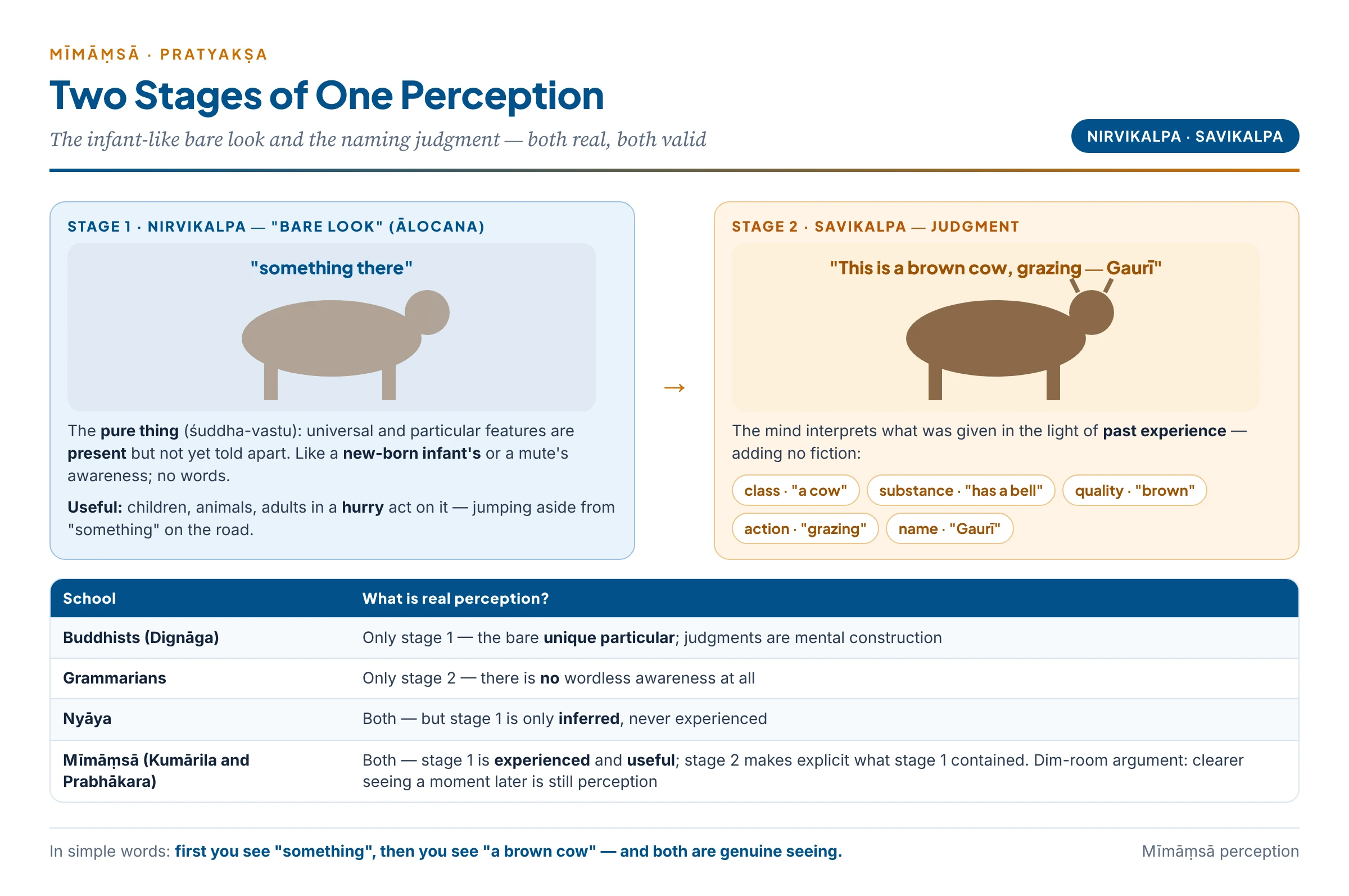
2. Two Stages: Nirvikalpa and Savikalpa
- Nirvikalpa (indeterminate) perception — “bare awareness”.
- At the first moment of sense–object contact, there arises a bare awareness of the object — Kumārila calls it ālocana (“mere looking”). We know that the object is, but not yet what it is.
- It is like the cognition of a new-born infant or a mute person: real, but not put into words.
- Its object is the pure thing (śuddha-vastu) — the individual which is the bearer of both universal and particular features. Both the generic and the specific features are present in it, but they are not yet distinguished from each other, because we have not yet compared the object with other things.
- Savikalpa (determinate) perception — “judgment”.
- At the next moment, the mind interprets what is given in the light of past experience, and we understand what the object is: to what class it belongs, what quality, action and name it has.
- It is expressed in judgments such as “This is a man“, “This man has a stick“, “This is white“, “This is moving“, “This is Rām” — the five determinations by class, substance, quality, action and name.
- The second stage adds no fiction. In savikalpa perception the mind only interprets what was given in the first; it adds no imaginary predicate. If we had not perceived a man, and a white one, at first, how could we later judge that it was a man and white — and not a cow and not black? Hence perception, though it contains interpretation, is not necessarily imaginary or illusory, as some Buddhists and some Vedāntins hold.
- Against the Buddhist. What is first given is not a structureless unique particular (svalakṣaṇa) with no class character; and against some Vedāntins, it is not pure existence without any differentiating property. The world’s diverse objects with their characteristics are given to the mind at the very first moment.
In simple words
A baby sees a dog. She takes in everything — four legs, wagging tail, brown fur — but has no word “dog” and no idea of “animal”. That is nirvikalpa. Later, the same sight makes the adult say “a brown dog, wagging its tail“. Nothing new was invented; the adult has simply sorted and named what the baby also saw.
3. How Mīmāṃsā Differs from Nyāya on Nirvikalpa
- Nyāya: indeterminate perception is a stage we infer afterwards, as a hypothesis needed to explain determinate perception. It is never experienced as such; “all perception we have is determinate”.
- Mīmāṃsā: indeterminate perception is a part of normal experience — the vague, primitive stage of perception, the awareness of the “that” before the “what“. And it is useful:
- It is the basis of action for children and animals, and for adults whose mental growth is imperfect.
- Even normal adults act on it when they are in a hurry or confusion — jumping aside from “something” on the road before knowing it is a stone.
- Both stages are valid. Kumārila and Prabhākara both hold nirvikalpa and savikalpa perception to be valid knowledge; the determinate stage is valid because it grasps features that the first stage did not grasp explicitly.
- The dim-room argument. Kumārila answers the Buddhist objection that a judgment aided by memory and words cannot be perception: when you walk into a dim room from bright sunlight, you do not see the objects at once, though your eyes are in contact with them; a moment later you see them clearly. The later, clearer awareness is still perception, because the sense is still in contact with the same object. Memory and words help; they do not turn perception into imagination. (But if you glance and shut your eyes, and then judge “that was a table”, that judgment rests on memory alone and is not perception.)
Common confusion
Does Prabhākara reject nirvikalpa perception and hold that all perception is determinate? No. Some notes say that “Mīmāṃsā, especially the Prabhākara tradition, rejects the twofold division”. This is wrong. Both Prabhākara and Kumārila accept two stages — nirvikalpa and savikalpa — and both hold both stages valid. The thinkers who deny wordless perception are the Grammarians (for whom all awareness is penetrated by words), and the Jainas recognise only determinate perception. What is true is that Mīmāṃsā insists on the immediacy of perception, in which subject, object and cognition are revealed together (Prabhākara’s triple revelation).
4. Inference (Anumāna)
- Broadly the Nyāya account. Inference is knowledge of an unperceived object (the probandum, sādhya) in a place (the subject, pakṣa) through the perception of a sign (liṅga, hetu) that is invariably connected with it (vyāpti) — fire on the hill from smoke.
- Definitions in the two schools.
- Śālikanātha (Prābhākara): inference is the uncontradicted knowledge of one part of a known connection, from seeing the other part — seeing smoke, one knows the fire with which smoke is known to be connected.
- Bhāṭṭa: inference is the cognition of what is not near (not present to the senses), resulting from the perception of what is pervaded by it.
- Less formalism. Mīmāṃsā does not stress logical formalism. For it, inference is simply the recognition of an unseen fact from a seen sign, grounded in a previously known universal relation. The essential thing is the practical grasp of the concomitance between hetu and sādhya.
- Three members, not five. Nyāya sets out inference-for-others in five steps (thesis, reason, example, application, conclusion). Mīmāṃsā (like Vedānta) holds that three are enough — either the first three (thesis, reason, example) or the last three (example, application, conclusion). This brings the Indian syllogism close to Aristotle’s.
| Five-membered (Nyāya) | Mīmāṃsā, first form | Mīmāṃsā, second form |
|---|---|---|
| The hill has fire (thesis) | The hill has fire | — |
| Because it has smoke (reason) | Because it has smoke | — |
| Wherever smoke, there fire, as in a kitchen (example) | Wherever smoke, there fire, as in a kitchen | Wherever smoke, there fire, as in a kitchen |
| This hill has smoke (application) | — | This hill has smoke |
| Therefore the hill has fire (conclusion) | — | Therefore the hill has fire |
In simple words
When a friend says “It must have rained — the road is wet“, nobody asks her to add “and wet roads mean rain, and this road is wet, therefore…”. Three steps — the claim, the reason, an example — are enough to convince. Mīmāṃsā trims inference to this everyday size; Nyāya’s five steps are for formal debate.
- Prābhākara points. Inference is apprehension, not memory (so it is valid knowledge). Some Prābhākaras even hold that a natural, inseparable relation like smoke–fire can be grasped from a single observation, rather than only through many repeated observations.
- A subordinate role. Nyāya made inference a precise instrument of logic and debate; Mīmāṃsā treats it as a pragmatic aid, useful but subordinate to perception and, above all, to scriptural testimony, which alone reveals dharma.
- Two kinds as in Nyāya. Inference for oneself (svārtha) and for others (parārtha) are accepted; the formal steps matter only for the latter.
5. Comparison (Upamāna): The Mīmāṃsā View
- The definition. Knowledge arises from comparison when, on perceiving a present object to be like an object perceived in the past, we come to know that the remembered object is like the perceived one.
- The two classic examples.
- Rat and mouse. On seeing a rat, a person notices that it is like the mouse he saw earlier, and so gets the knowledge: “that mouse, seen in the past, is like this rat“.
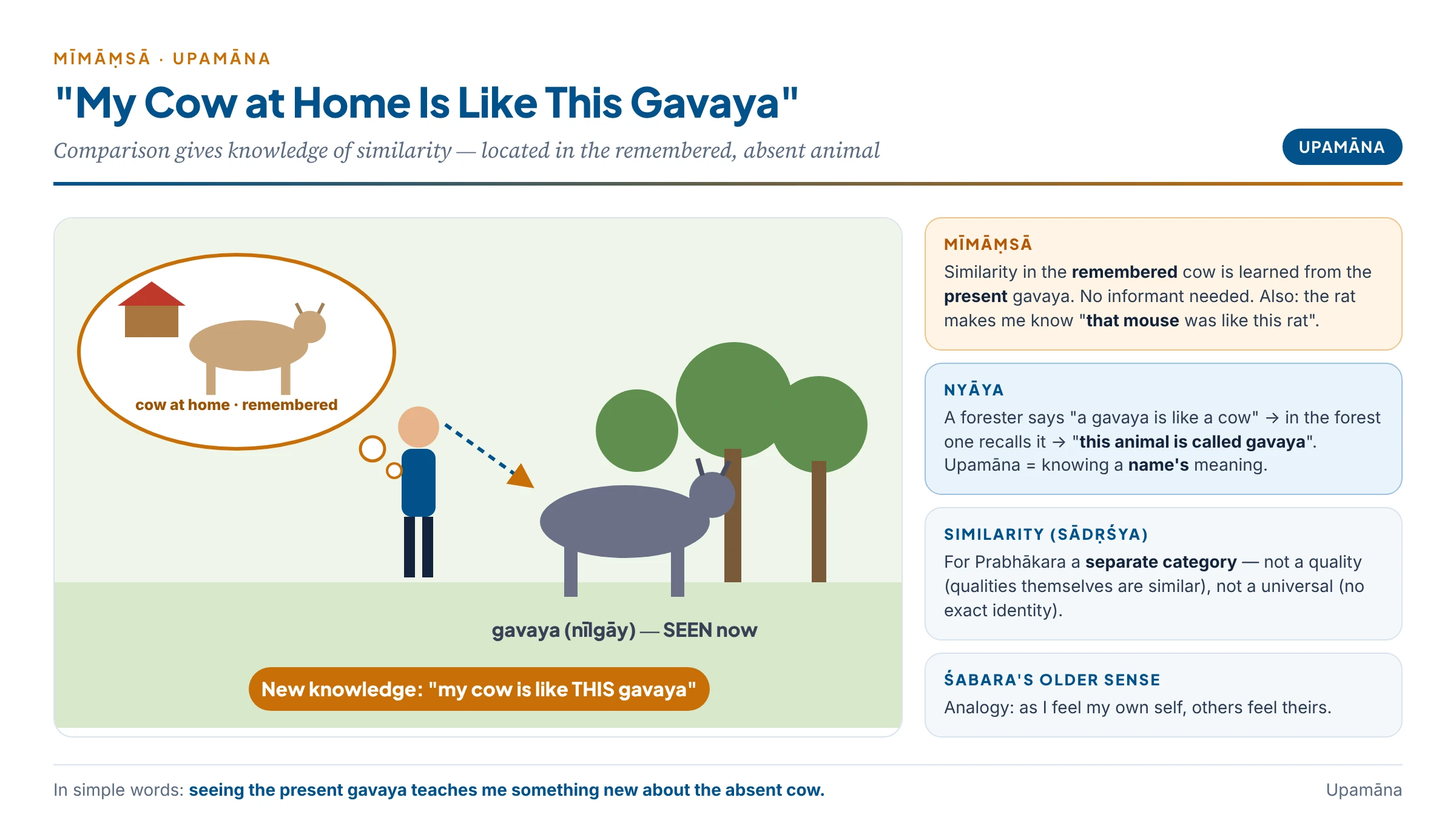
- Cow and gavaya. A person who has seen a cow at home goes to the forest, finds a gavaya (nīlgāy, wild ox) and perceives its similarity to the cow. He thereby comes to know: “my cow at home is like this gavaya” (gavaya-sadṛśī madīyā gauḥ).
- What exactly is known. The object of upamāna is similarity (sādṛśya) — but specifically, the similarity residing in the remembered, absent object (the cow), learned through the similarity seen in the present object (the gavaya).
- No forester needed. A person need not be told by anyone that a gavaya resembles a cow. Anyone who has seen a cow and happens to see a gavaya remembers the cow as similar to it. This knowledge of similarity is comparison.
In simple words
You meet your friend’s brother for the first time and think, “He looks like Rahul.” Then a second thought comes on its own: “So Rahul looks like him.” You did not see Rahul just now, and you never knew this fact before — you learned something new about the absent Rahul from the present brother. That second thought is upamāna in the Mīmāṃsā sense.
6. Why Comparison Is a Separate Pramāṇa
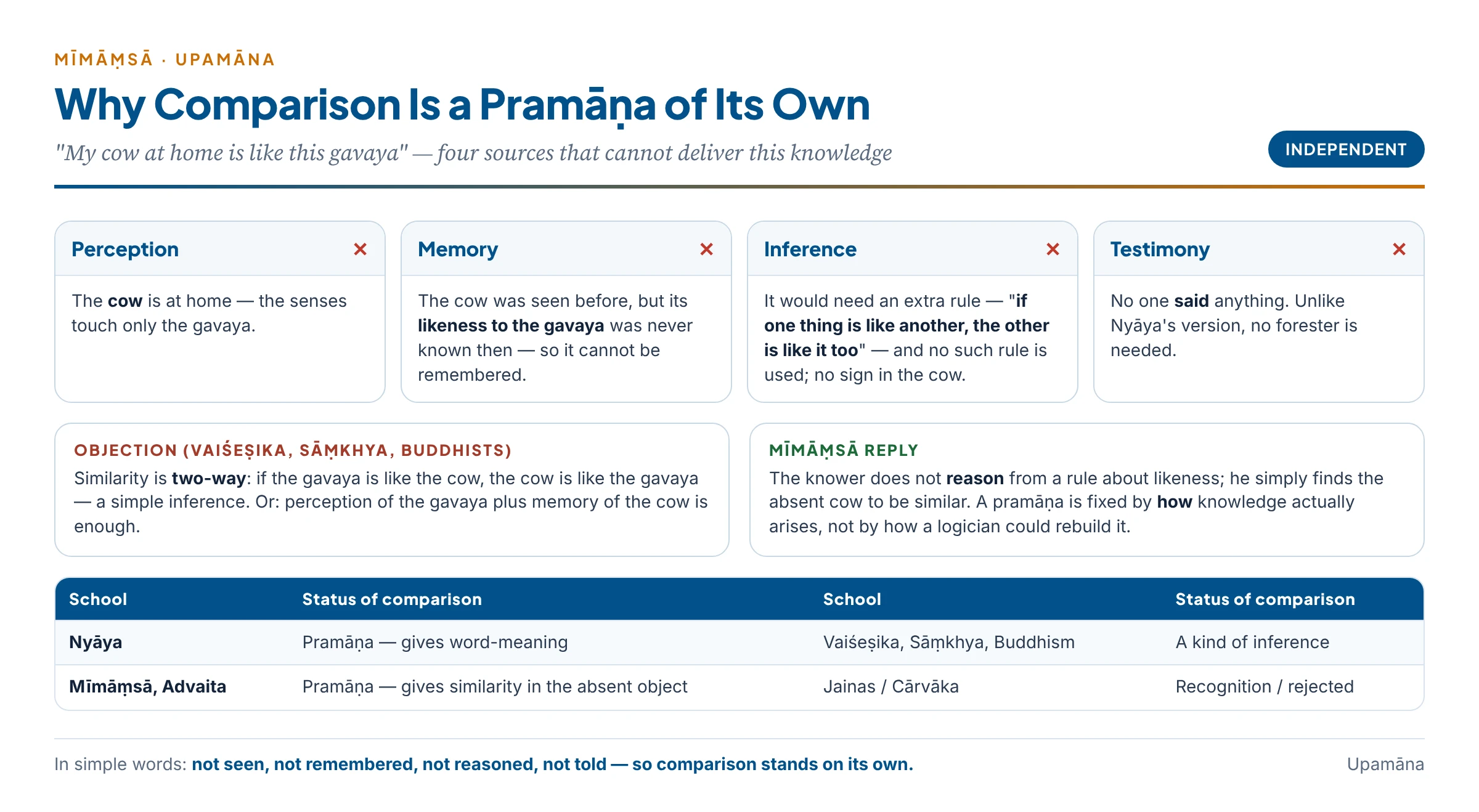
- Not perception. The object known to be similar — the cow at home, the mouse seen before — is not perceived now. The senses are in contact with the gavaya, not the cow.
- Not memory. The cow was perceived in the past, but its similarity to the gavaya was not known then (the gavaya had not yet been seen). So this similarity cannot simply be remembered.
- Not inference. From “this gavaya is like the cow” we cannot infer “the cow is like this gavaya” unless we add another premise such as “all things are similar to the things that are similar to them“. No such universal premise (vyāpti) is actually used when we arrive at the knowledge; and there is no sign (liṅga) present in the cow from which to infer.
- Not testimony. It obviously does not arise from anyone’s words.
- Hence it is given an independent place among the pramāṇas.
7. Similarity as a Category
- Prābhākara makes similarity (sādṛśya) an independent category of reality — the object of upamāna.
- Not a quality (guṇa): a quality cannot belong to another quality, but qualities themselves can be similar (“this red is like that red”). So similarity is not a quality.
- Not a universal (sāmānya, jāti): a universal is something exactly identical in many individuals (cowness in all cows). Similarity is not complete identity — the gavaya and the cow share features partly.
- Kumārila does not make similarity a separate category; he places it under the existing categories (Article 1).
8. Śabara’s Older Understanding: Upamāna as Analogy
- A different sense. The account above is the one generally accepted by later Mīmāṃsakas. But Śabara seems to understand upamāna as what Western logic calls an analogical argument — “knowledge of an unperceived object as similar to a known object”.
- His example: other selves. “Just as you feel the existence of your own self, so by analogy you can believe that others also feel the existence of their own selves.” This is very close to the Western argument from analogy for other minds (J. S. Mill).
9. The Nyāya View and the Debate
- Nyāya’s upamāna. Comparison is the knowledge of the relation between a name and the thing named (saṃjñā-saṃjñi-sambandha), through similarity.
- A town-dweller who does not know what a gavaya is hears from a forester: “A gavaya is like a cow.“
- In the forest he sees an animal like a cow and recalls the forester’s words.
- He then knows: “This is the animal called gavaya” (ayaṃ gavaya-śabda-vācyaḥ).
For Nyāya this word–object knowledge is a separate pramāṇa, not reducible to perception, inference or testimony.
- The Mīmāṃsā critique of Nyāya. What Nyāya calls comparison is not a new source at all:
- that the animal in front of me is like a cow — that is known by perception;
- that an animal like a cow is called “gavaya” — that is a recollection of what the forester said (testimony);
- that this animal is therefore a gavaya — that is an inference from the last two.
So the Nyāya case breaks into perception, memory of testimony and inference.
- Nyāya’s counter-charge. Mīmāṃsā underplays the linguistic side of comparison: without upamāna, how would anyone learn the referent of a new word from a description? Comparison bridges words and things.
- Mīmāṃsā’s reply. The meaning of words is known from testimony (and from elders’ usage); comparison gives knowledge of resemblance, not of semantics. Word–object relations come from language, not from looking.
| Point | Nyāya | Mīmāṃsā |
|---|---|---|
| Definition | Knowledge of the relation between a word and its object, through similarity | Knowledge of similarity between two objects — in the remembered one |
| Example | Hears “a gavaya is like a cow” → sees the animal → “This is a gavaya“ | Sees a gavaya, recalls the cow → “My cow is like this gavaya“ |
| Where the similarity is located | In the perceived animal (gavaya) | In the remembered, absent animal (cow) |
| Is prior testimony needed? | Yes — the forester’s statement is essential | No — anyone who has seen a cow can have it |
| Role of language | Central: comparison yields word–meaning | Secondary: word–meaning comes only from testimony |
| Status | Independent pramāṇa (one of four) | Independent pramāṇa (one of five or six) |
| Orientation | Linguistic and logical; semantics | Ritual and scriptural; resemblance between things |
Indian Connect — Reading the debate
- Nyāya’s upamāna is really a theory of how we learn names — close to learning a word from a definition plus a sighting.
- Mīmāṃsā’s upamāna is a theory of how we learn about absent things from present ones — an extension of knowledge by similarity.
- Both agree that comparison is not mere perception — they disagree on what it delivers.
10. What Other Schools Say
- Cārvāka: comparison is not a pramāṇa at all; it gives no reliable knowledge even of the denotation of words.
- Vaiśeṣika, Sāṃkhya and the Buddhists: comparison is only a form of inference (or perception plus inference).
- Jainas: comparison is a kind of recognition (pratyabhijñā), not a separate pramāṇa.
- Advaita Vedānta: accepts comparison as one of six pramāṇas — and in the Mīmāṃsā sense: what comparison yields is the knowledge “my cow is like this gavaya“.
Common confusion
Does Advaita Vedānta reject upamāna as a separate pramāṇa? No. Some notes include a section on “Advaita Vedānta’s criticism of upamāna”, saying Advaita reduces comparison to perception plus memory. Advaita in fact accepts six pramāṇas — perception, inference, comparison, testimony, postulation and non-perception — exactly the Bhāṭṭa list, and it explains comparison as Mīmāṃsā does: knowledge of similarity in the remembered cow. The reductionist argument (“seeing the likeness is just perception aided by memory; the name comes from the forester’s testimony”) is a real objection, but it belongs to the Vaiśeṣika–Buddhist side, and Advaita uses it only against the Nyāya version of comparison.
Critical Evaluation
Objections
- Against the Mīmāṃsā account of perception.
- Buddhist: once memory and words enter, we have conceptual construction, not perception. The “dim room” shows only that perception takes time, not that judgment is perception.
- Grammarian: there is no wordless awareness at all; even the infant’s experience is shaped by latent language. Nirvikalpa is a myth.
- Nyāya: Mīmāṃsā cannot observe nirvikalpa perception; the moment we notice it, it has become determinate. It can only be inferred.
- Against the three-membered inference. Nyāya replies that for convincing others in debate, the full five steps (with application and conclusion) make the reasoning explicit; dropping steps leaves room for doubt.
- Against Mīmāṃsā upamāna.
- Reduction to inference. Similarity is a symmetrical relation: if A is like B, B is like A. So “the cow is like the gavaya” follows logically from “the gavaya is like the cow” — a simple inference, not a new pramāṇa.
- Reduction to perception plus memory. Seeing the gavaya evokes the memory of the cow, and the likeness is grasped in that combined act — nothing more is needed.
- Triviality. Even if separate, the knowledge it gives (“my cow is like this gavaya”) seems too thin to justify a whole pramāṇa.
- Against Śabara’s analogy. The argument from analogy for other minds is notoriously weak — a generalisation from one case (my own).
Mīmāṃsā’s Replies
- Perception. As long as the sense is in contact with the same object, the clearer awareness is perception — help from memory does not cancel this. And wordless perception is experienced in hurry and in infants and animals, not merely inferred.
- Symmetry is not used. The knower does not reason from “all similarity is symmetrical” — he simply finds that the cow at home is like this animal. A pramāṇa is defined by how the knowledge actually arises, not by whether a logician could reconstruct it as an inference.
- Not perception. The cow is absent; nothing in perception touches it.
- Usefulness. Knowledge of resemblance matters in practice: in ritual interpretation, the details of a model sacrifice are extended to a derived one that resembles it (atideśa); in daily life we constantly learn something about an absent thing from a present thing that resembles it.
Critics and Defenders
Criticism — Critics
- Buddhists: judgment with names is construction, not perception.
- Grammarians: there is no wordless perception at all.
- Nyāya: nirvikalpa is only inferred; five steps are needed to convince others; Mīmāṃsā upamāna ignores language.
- Vaiśeṣika, Sāṃkhya, Buddhists: comparison is inference — similarity is symmetrical.
- Cārvāka: comparison gives no knowledge at all.
Defence — Defenders and strengths
- Both stages of perception are real and useful — a balanced middle path between Buddhist and Grammarian extremes.
- The dim-room argument shows memory can assist perception without replacing it.
- Three members suffice for valid reasoning, as Aristotle also held.
- Mīmāṃsā upamāna explains how we learn about absent things from present ones, with no informant needed.
- Similarity as a separate category (Prābhākara) captures partial likeness that “quality” and “universal” cannot.
Cross-Tradition Comparison
Perception, Inference and Comparison East and West
| Point | Mīmāṃsā | Western parallel |
|---|---|---|
| Two stages of perception | Nirvikalpa (bare look) → savikalpa (judgment) | Kant: intuitions without concepts are blind; William James: “raw unverbalised experience” vs perceptual judgment |
| Given is already structured | First awareness contains universal and particular undistinguished | Gestalt psychology: we perceive organised wholes, not raw sensations |
| Perception aided by memory | Dim-room argument | Locke: ideas of sensation worked on by the mind; modern “theory-laden” perception |
| Three-membered inference | First three or last three members | Aristotle’s syllogism: two premises and a conclusion |
| Comparison of absent with present | “My cow is like this gavaya” | Learning by analogy; no exact Western pramāṇa of this kind |
| Analogy for other selves | Śabara’s upamāna | J. S. Mill‘s argument from analogy for other minds |
Upamāna across Indian Schools
| School | Status of upamāna | What it gives |
|---|---|---|
| Nyāya | Independent pramāṇa | Word–object relation (“this is a gavaya”) |
| Mīmāṃsā (both schools) | Independent pramāṇa | Similarity in the remembered object (“my cow is like this”) |
| Advaita Vedānta | Independent pramāṇa | As in Mīmāṃsā |
| Vaiśeṣika, Sāṃkhya, Buddhism | Not independent | A kind of inference |
| Jainism | Not independent | A kind of recognition (pratyabhijñā) |
| Cārvāka | Rejected | Nothing reliable |
Indian Connect — Key takeaways
- On perception, Mīmāṃsā stands with Nyāya against the Buddhists and Grammarians: both stages are real and valid.
- On inference, it trims Nyāya’s five steps to three.
- On comparison, it turns the Nyāya theory around: from “this is called X” to “the absent thing is like this” — the view Advaita later adopts.
Synthesis (Siddhānta)
- Perception for Mīmāṃsā is direct apprehension of an existing object through sense contact; it has two stages — nirvikalpa (bare, infant-like awareness of the pure thing) and savikalpa (judgment naming class, substance, quality, action and name) — and both are valid.
- Against Buddhists and Grammarians, Mīmāṃsā holds that the first awareness already contains what the judgment makes explicit, and that memory may assist perception without turning it into imagination.
- Inference follows Nyāya in substance but needs only three members and serves as a practical aid subordinate to scripture.
- Comparison is the knowledge of similarity in a remembered object, learned from a present one — “my cow is like this gavaya”. It is not perception, memory, inference or testimony, and needs no informant; its object, similarity, is for Prabhākara a separate category.
- Nyāya makes comparison the source of word–meaning; Mīmāṃsā replies that word–meaning comes from testimony and that the Nyāya case is perception plus memory plus inference.
- Contemporary relevance.
- Cognitive science distinguishes early, pre-conceptual visual processing from later categorisation — close to nirvikalpa and savikalpa.
- Child development: infants respond to objects long before they have words, as Mīmāṃsā says of nirvikalpa.
- Analogical reasoning — learning about one case from a similar case — is central to legal reasoning (precedent) and to artificial intelligence.
“There is first a mere looking, an indeterminate cognition, like that of an infant or a mute, born of the pure object.” — Kumārila Bhaṭṭa
Previous Year Questions
- 2026Present an account of Upamāna as an instrument of knowledge (Pramāṇa). How is Nyāya view of Upamāna different from Mīmāṃsā view? Discuss.