

Yoga: Citta; Cittavṛtti; Kleśas; Samādhi; Kaivalya.
Official Syllabus: Paper I, Section B, Unit 17
The Yoga Sūtra ends with one word: kaivalya. It comes from kevala, “alone”, and means aloneness, isolation, absolute independence — the state in which the seer (Puruṣa) stands by itself, no longer confused with the seen (Prakṛti). Every element of Yoga leads here: the stilling of citta (Articles 2–3), the burning of the kleśas (Article 4), the eight limbs (Article 5), the stages of samādhi (Article 6) and devotion to Īśvara (Article 7). Patañjali’s last sūtra describes it as the return of the guṇas to their source, “their purpose fulfilled”, and the establishment of the power of consciousness in its own nature. This article explains what bondage is, the steps by which it ends, the nature of kaivalya, liberation in life (jīvanmukti), how Yoga’s kaivalya differs from Sāṃkhya, Jaina, Buddhist, Nyāya and Advaita liberation, how Patañjali’s Yoga compares with Sri Aurobindo’s Integral Yoga, and the main criticisms of this austere ideal.
In simple words
An actor has played one role for so long that he believes he is the character — he weeps at its sorrows and fears its death. One day the play ends. The costume comes off, the stage lights go out, the audience leaves. The actor is simply himself again, at rest. Kaivalya is the self after the play of Prakṛti has ended: not gaining anything new, just no longer lost in a role.
Context & Problem
- The goal of the whole system. “The whole purpose of Yoga philosophy is the spiritual effort for perfection (liberation) of the self through control over body, mind and senses and through right discrimination between Prakṛti and Puruṣa.”
- What needs explaining.
- How is Puruṣa, eternally free, bound at all?
- What exactly ends that bondage?
- What is the state that follows — is it bliss, blankness, or something else?
- Can it be attained while living?
- The shared frame. Like Sāṃkhya, Yoga holds that Puruṣa is pure, inactive consciousness and that bondage is mistaken identity. But Yoga adds a detailed practical path and a psychology of the mind that explain how the mistake is maintained and how it is undone.
Core Doctrine
1. What Is Bondage According to Yoga?
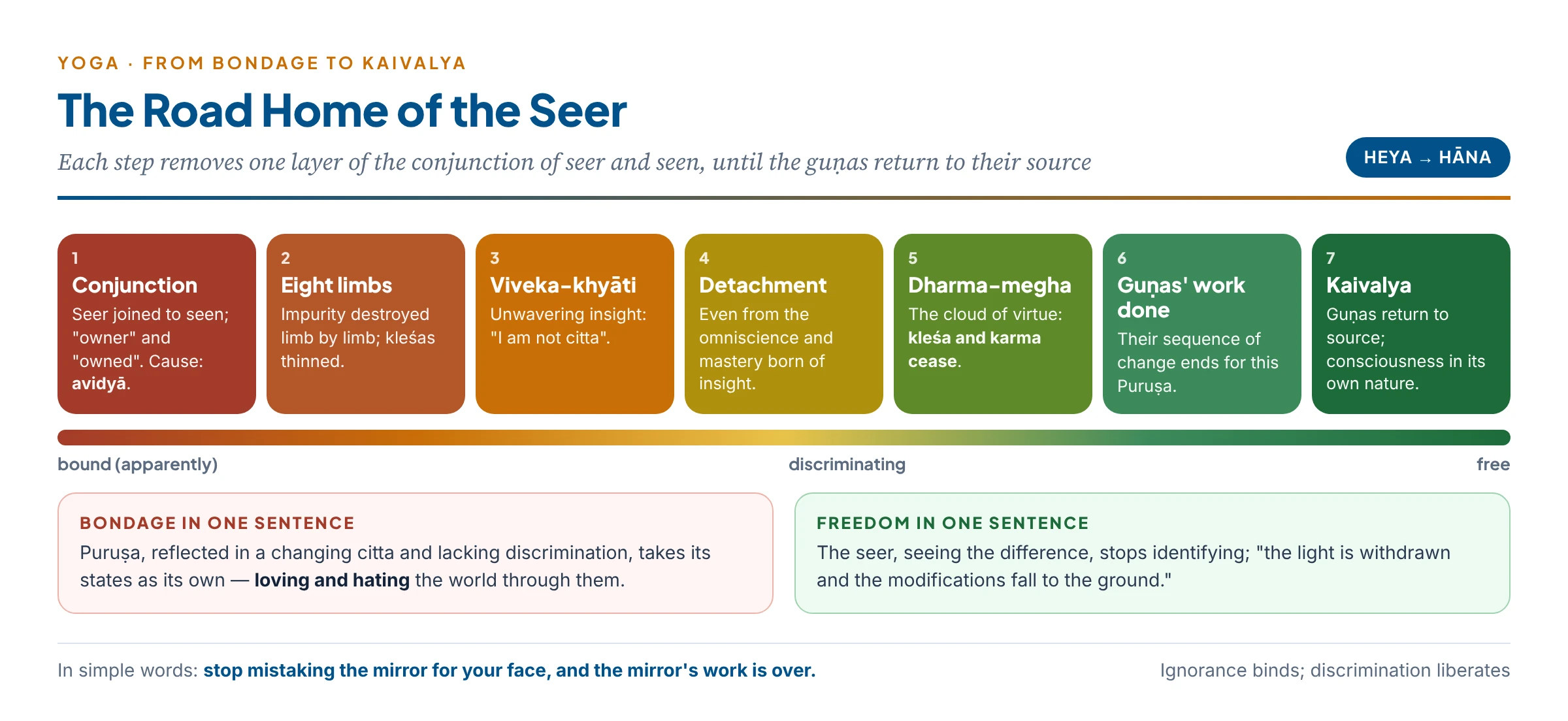
- Bondage as conjunction. “The cause of what is to be avoided is the conjunction (saṃyoga) of the seer and the seen.” The seer is Puruṣa; the seen is Prakṛti in the form of citta, the senses, the body and the world.
- The purpose of the seen. “The seen … exists for the sake of experience (bhoga) and liberation (apavarga).” Prakṛti acts for Puruṣa: first to give it experience, finally to free it.
- The nature of the conjunction. “The conjunction is the cause of the recognition of the nature of the owner and the owned” — the seer takes the seen as “mine” and “me”.
- The cause of the conjunction. “Its cause is avidyā.” Ignorance — taking the non-self for the self — keeps seer and seen together (Article 4).
- How it works in experience.
- Citta changes into vṛttis; Puruṣa is reflected in them.
- Without discrimination, Puruṣa identifies with them — “I am happy”, “I am angry”, “I am dying”.
- The kleśas colour the vṛttis, drive action, lay down karma and impressions, and ripen as new births.
- “This means bondage for the self.”
- Bondage is apparent. Puruṣa never really changes; “Puruṣa as reflected in the citta wrongly identifies itself with this reflection and becomes apparently bound”. The jīva — citta with Puruṣa’s reflection — is the one that suffers and transmigrates.
2. How Bondage Ends: The Steps to Kaivalya
- Discrimination is the means. “Unwavering discriminative knowledge (aviplavā viveka-khyāti) is the means of removal.” The yogī must see, directly and without lapse, that Puruṣa and citta are different.
- The eight limbs bring it about. “From the practice of the limbs of yoga, as impurity is destroyed, the light of knowledge shines forth up to discriminative insight.” Practice and detachment, kriyā-yoga and devotion to Īśvara support it.
- Seven-fold final insight. The insight of the discriminating yogī reaches its peak in seven stages — knowing that what is to be avoided is known, its cause removed, removal achieved, the means perfected, and that the mind’s work is done, the guṇas are dissolving and the self abides alone.
- The end of self-identification. “For one who sees the distinction, the cultivation of the sense of self (in the mind) ceases.” “Then the mind, inclined towards discrimination, gravitates towards kaivalya.”
- Supreme detachment — even from omniscience. “By detachment even from that (the omniscience and mastery born of discrimination), the seed of defect being destroyed, kaivalya follows.”
- The cloud of virtue. “When one has no interest even in the highest knowledge, from constant discrimination arises the samādhi called the cloud of dharma (dharma-megha). From that comes the cessation of afflictions and karma.”
- The guṇas’ work is done. “Then, their purpose fulfilled, the sequence of transformations of the guṇas comes to an end.”
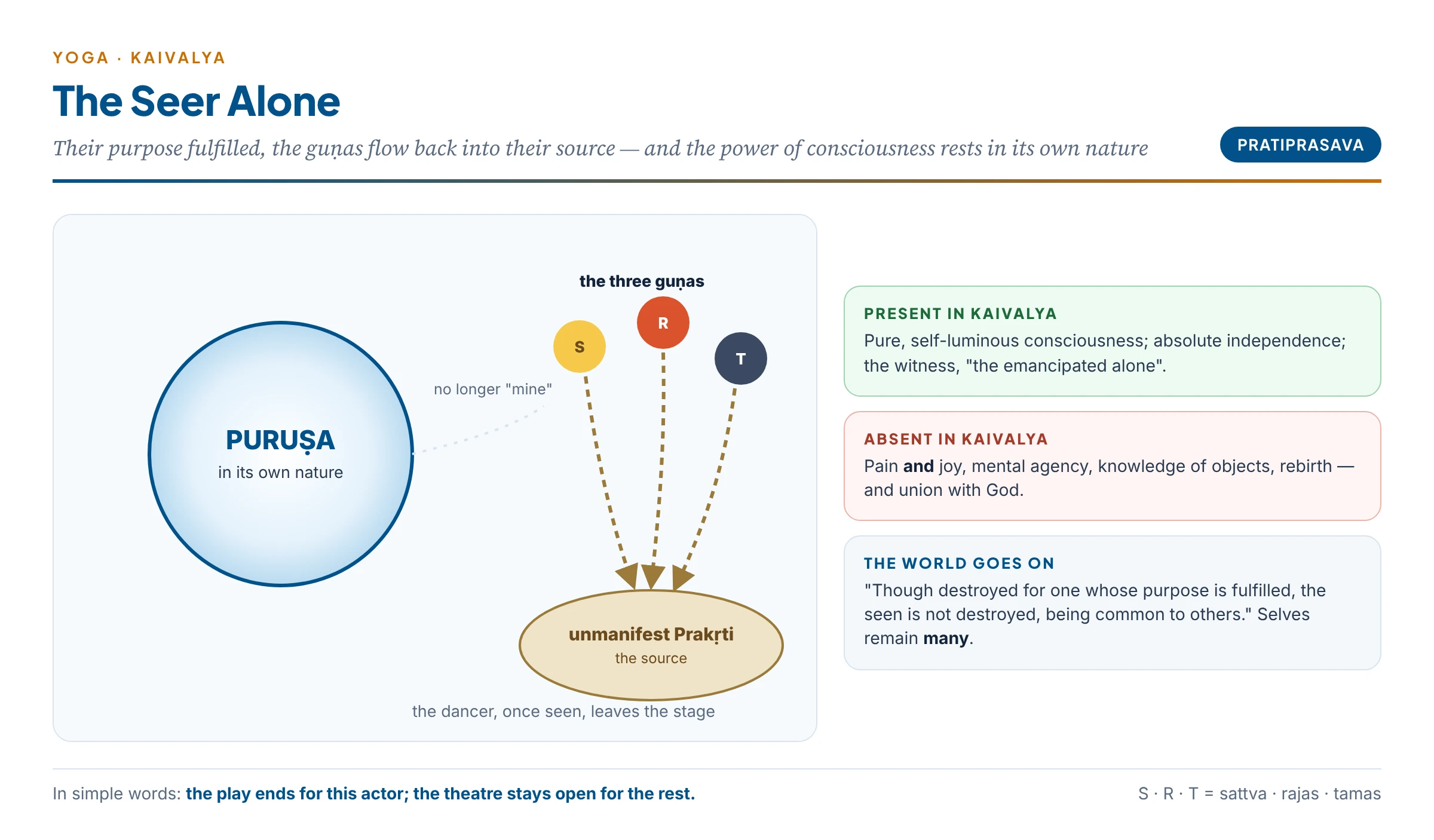
- Kaivalya. “Kaivalya is the return to their source (pratiprasava) of the guṇas, now empty of purpose for Puruṣa; or it is the power of consciousness established in its own nature.”
Common confusion
Do the guṇas, at kaivalya, go into “pratisarga”? No. Some notes use the word pratisarga (cosmic dissolution) for what happens to the guṇas at liberation. Patañjali’s word is pratiprasava — “return to the source“, “re-absorption”. For the liberated Puruṣa the guṇas, their purpose fulfilled, flow back into unmanifest Prakṛti. This is not the dissolution of the whole universe: the world continues for others, because “though destroyed for one whose purpose is fulfilled, the seen is not destroyed, being common to others”.
3. The Nature of Kaivalya
- The meaning. Kaivalya is “aloneness”, “absolute isolation”, “absolute independence“. It is “the permanent disentanglement of Puruṣa from Prakṛti”.
- The seer in its own nature. “Then the seer abides in its own nature” — the first promise of the Yoga Sūtra is fulfilled at its end. Puruṣa “realises that it is neutral, a witness (sākṣī), indifferent (udāsīna), the emancipated alone (kevala), self-luminous”.
- The withdrawal of light. “When the Puruṣa realises that it is completely isolated and is only a passive spectator … it ceases to identify itself with its reflection in the citta, with the result that the light is withdrawn and the modifications of the citta fall to the ground.” It is “the return of the Puruṣa to its original perfection.”
- Equal purity. “Kaivalya comes when the sattva (the purest part of the mind) and Puruṣa become equal in purity” — the mind is so transparent that it no longer distorts, and then it falls away.
- Prakṛti “falls off”. Prakṛti, “having served its purpose”, ceases its play for that Puruṣa, like a dancer who leaves the stage once seen.
- What is absent in it. It is free from pain, from joy, from mental agency and from rebirth. There is no bliss, because bliss too is a state of sāttvika citta.
- Many liberated selves. “Unlike Advaita Vedānta, kaivalya is not merging into a cosmic Brahman, but the independent, eternal transcendence of an individual Puruṣa” — the plurality of selves remains.
- Not union with God. “The end of human life is not union with God, but only the separation of Puruṣa from Prakṛti” (Article 7).
In simple words
A mirror reflected your face for years, and you kept checking it to know who you were. One day you no longer need the mirror — you know yourself directly. The mirror is not smashed; others may still use it. But for you, it has done its work. Kaivalya is the self no longer needing the mirror of the mind.
4. Appraising Yoga’s Soteriology
Yoga’s theory of salvation can be summed up in one line: “So long as there are changes and modifications in citta, the self is reflected therein and, in the absence of discriminative knowledge, identifies itself with them.”
- Strengths.
- A precise diagnosis. Bondage is located in identification with mental states, not in the world or the body as such.
- A complete method. Every link of the chain — kleśas, vṛttis, karma, saṃskāras — has a matching remedy.
- Consistency. Since Puruṣa never really changes, liberation is the end of a mistake, not a change in the self; it cannot be lost once truly attained.
- Experiential. Its claims are to be verified by practice, not merely believed.
In simple words
A patient recovering from fever is asked, “Are you happy now?” He says, “I am not happy or sad — I am simply well.” Kaivalya is closer to this wellness than to a party: not a thrill of pleasure, but the end of the disease that made pleasure and pain swing back and forth.
- Weaknesses.
- Who is bound? Puruṣa is inactive, citta unconscious; the subject of bondage and striving is unclear.
- A negative goal. Kaivalya is free from pain but also from joy and knowledge of objects — it may look like an “existence indistinguishable from that of a stone”.
- Asocial. Liberation is individual isolation; it gives no positive place to love, service or society.
- Prakṛti relative. If the world “ends” for the liberated but continues for others, Prakṛti looks less like an absolute reality.
- Overall. Yoga’s soteriology is psychologically profound and methodically complete; its picture of the final state is its most debated part.
5. Jīvanmukti: Liberation While Living
- Is it possible? Yes. When discriminative insight is firm and the seeds of the kleśas are burnt, the yogī is free while still embodied. His remaining activity flows through unafflicted (akliṣṭa) modifications: “akliṣṭa vṛttis are the mental activities of a jīvanmukta”.
- Why the body continues. Karma that has already begun to bear fruit (prārabdha) must run out, just as a potter’s wheel keeps turning for a while after the potter has stopped pushing it.
- His action leaves no trace. “The karma of the yogī is neither white nor black” — it binds no further.
- Final kaivalya. “Immediately or after a while the body breaks and liberation is obtained.” The disembodied state is final kaivalya (videha-mukti).
- Two liberations, one goal. Sāṃkhya and Yoga both speak of jīvanmukti (liberation in life) and videhamukti (liberation at death).
In simple words
Switch off a ceiling fan: the power is cut at once, yet the blades go on turning for a while before they stop. The jīvanmukta is like that fan — the “power” of ignorance has been switched off, but the body keeps moving on the momentum of past karma until it comes to rest in final kaivalya.
| Point | Jīvanmukti (in life) | Videhamukti / final kaivalya |
|---|---|---|
| Body | Continues by the momentum of past karma | Falls away |
| Mind | Unafflicted vṛttis only | Re-absorbed into Prakṛti |
| New karma | None (“neither white nor black”) | None |
| Rebirth | No more | None |
| Image | Potter’s wheel still turning | Wheel at rest |
Indian Connect — Jīvanmukti in Advaita and in Yoga
- Advaita Vedānta makes jīvanmukti central: once ignorance is destroyed by knowledge of Brahman, one is free here and now, and the body continues like the potter’s wheel. Liberation is the realisation of identity with Brahman, full of bliss (ānanda).
- Yoga also accepts jīvanmukti, but its final goal is isolation of a distinct Puruṣa, without bliss, and reached by meditative practice as much as by knowledge.
- So both agree that liberation can be lived; they differ on what is realised (identity vs isolation) and how (knowledge vs nirodha).
Critical Evaluation
1. Criticisms of Kaivalya
- Negative and empty. A state without knowledge of objects, without joy and without activity seems no better than unconsciousness. Critics say this is “liberation” only in name.
- Like Nyāya’s stone. The same objection Vedānta raises against Nyāya’s liberation — “an existence like a stone” — applies to Yoga’s kaivalya.
- Selfish and asocial. It is the freedom of one Puruṣa; the Gītā‘s karma-yoga and Advaita’s bliss both reject such a negative, withdrawn ideal. It offers no positive role for the world.
- No real bondage, no real liberation. If Puruṣa is always free, the whole drama of bondage and release becomes unreal, and Yoga drifts towards Advaita.
- Plurality problem. Many liberated Puruṣas, all pure consciousness with no qualities, cannot be told apart — so what makes them many?
- God’s role. If liberation does not involve God, why bring God in? If it does, the self-effort model is weakened (Article 7).
2. Replies
- Not unconsciousness but pure consciousness. Sleep and swoon are tamas states; kaivalya is the self-luminous seer, beyond all guṇas. It lacks objects, not consciousness.
- Beyond pleasure is not pain. Joy belongs to sattva and is always tied to change; a freedom beyond pleasure and pain is not a lack but a higher peace.
- The liberated in life act. The jīvanmukta lives and acts — with friendliness, compassion and non-violence — but without bondage.
- The method is social. The yamas — non-violence, truth, non-stealing, continence, non-possession — are social virtues; the path to isolation runs through ethical life with others.
Critics and Defenders
Criticism — Critics
- Negative goal: no knowledge of objects, no joy — like a stone.
- Asocial: private isolation, no place for love and service.
- Unreal drama: if Puruṣa is always free, bondage and release are fictions.
- Plurality: qualityless liberated selves cannot be told apart.
- Gītā and Advaita: prefer active service or blissful identity.
Defence — Defenders and strengths
- Pure consciousness: free of objects, not of awareness.
- Peace beyond pleasure: joy is a changing sāttvika state; freedom is beyond it.
- Lived freedom: the jīvanmukta acts with compassion, without bondage.
- Ethical path: the way to kaivalya runs through the social yamas.
- Consistent: the end of a mistake cannot be lost once attained.
Cross-Tradition Comparison
Kaivalya in Jainism and in Yoga
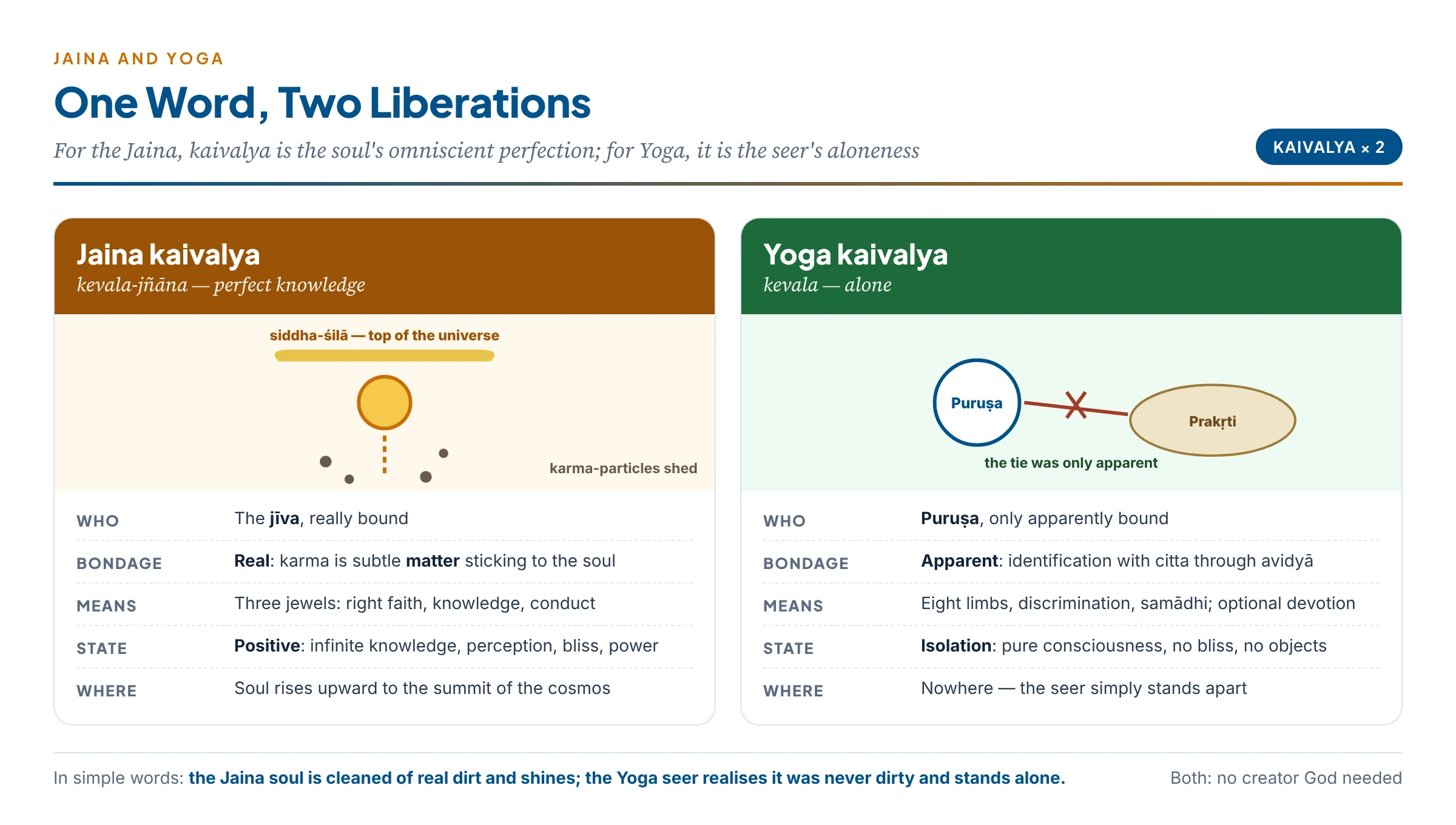
| Point | Jaina kaivalya | Yoga kaivalya |
|---|---|---|
| Who is freed | The jīva (soul), really bound by karma | Puruṣa, only apparently bound |
| Nature of bondage | Real: karma is subtle matter that flows into and sticks to the soul | Apparent: identification with citta through avidyā |
| Means | Three jewels: right faith, right knowledge, right conduct; stopping and shedding karma | Eight limbs, discrimination, samādhi; optional devotion to God |
| State | Positive: infinite knowledge, infinite perception, infinite bliss, infinite power | Isolation: pure consciousness; no bliss, no knowledge of objects |
| Where | The liberated soul rises to the top of the universe (siddha-śilā) | No place; the seer simply ceases to identify with Prakṛti |
| God | None; the liberated are perfected souls | Īśvara as an aid |
| Same word, different idea | Kaivalya = omniscience (kevala-jñāna) | Kaivalya = aloneness of the seer |
Liberation across the Schools
| School | Name | Nature of the liberated state |
|---|---|---|
| Sāṃkhya | Kaivalya | Isolation of Puruṣa through knowledge alone; no God |
| Yoga | Kaivalya | Isolation of Puruṣa through nirodha and discrimination; God as aid |
| Jainism | Kaivalya / mokṣa | Soul’s infinite knowledge, perception, bliss, power |
| Buddhism | Nirvāṇa | Extinction of craving; no self that is liberated |
| Nyāya–Vaiśeṣika | Apavarga | Self free from pain and from all qualities, even consciousness |
| Advaita | Mokṣa | Identity of Ātman with Brahman — pure being, consciousness, bliss |
| Viśiṣṭādvaita | Mokṣa | Soul’s loving service of God, sharing his bliss but distinct |
- Sāṃkhya and Yoga. Same goal, different emphasis: Sāṃkhya stresses knowledge; Yoga insists that knowledge becomes liberating only through practice and samādhi, and allows grace-assisted progress through Īśvara.
- Theological and non-theological liberation. Sāṃkhya (no God), Yoga (God as aid) and Nyāya or Vedānta (God central) show a spectrum. The essential difference is who finally liberates — one’s own discrimination (non-theological) or divine grace (theological) — and whether liberation is isolation or communion.
Indian Connect — Key takeaways
- The same word — kaivalya — means omniscient perfection in Jainism and aloneness of the seer in Yoga.
- Yoga’s liberation is closest to Sāṃkhya’s and farthest from Advaita’s: plural, blissless, and not union.
- Rebirth in Sāṃkhya–Yoga is caused by aviveka (absence of discrimination) and stopped by viveka-jñāna with the eight limbs — a neat pairing of cause and cure.
Patañjali’s Yoga and Sri Aurobindo’s Integral Yoga
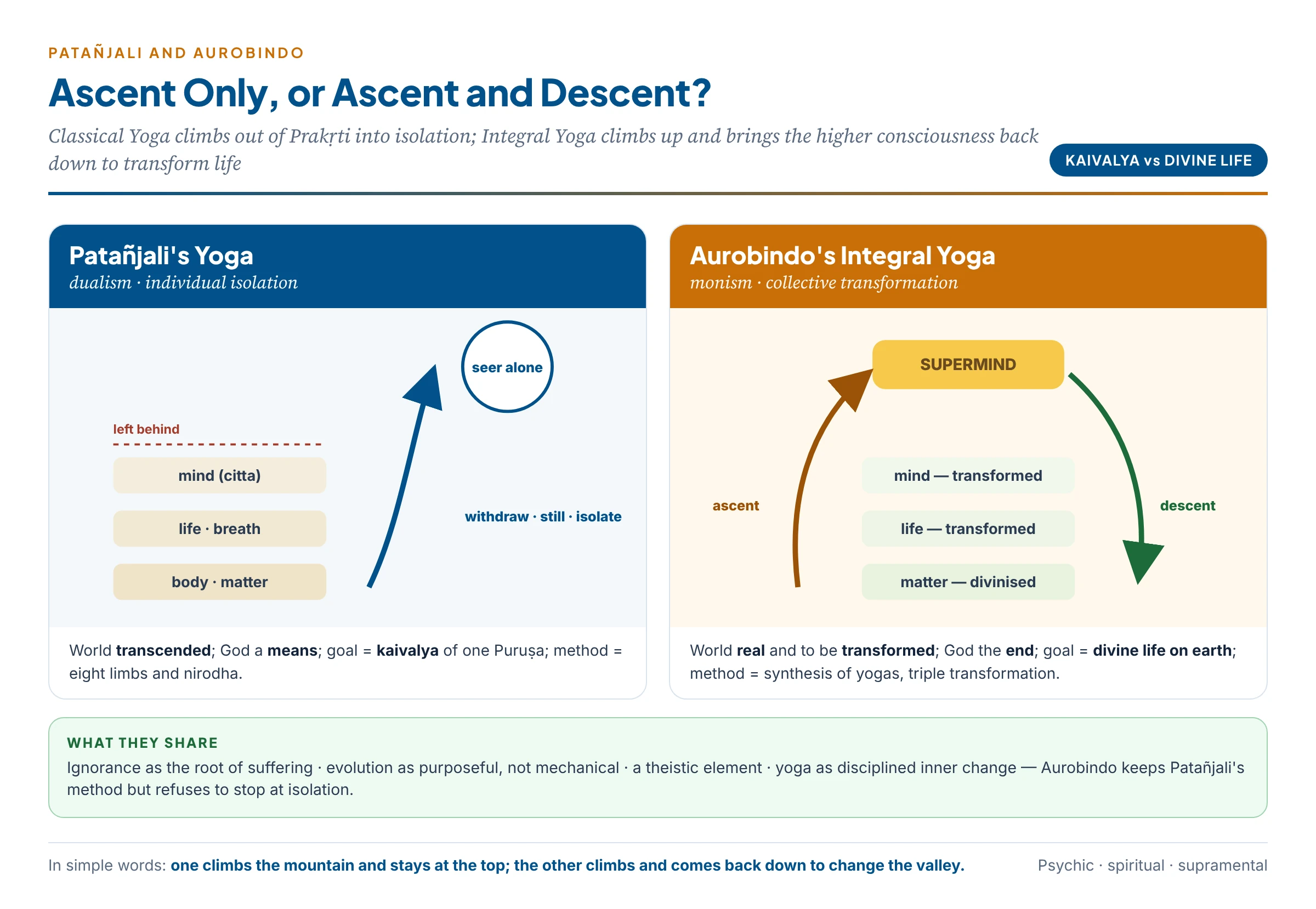
| Point | Patañjali’s Yoga | Aurobindo’s Integral Yoga |
|---|---|---|
| Metaphysics | Dualism of Puruṣa and Prakṛti | Monism: one Divine Reality (Saccidānanda) |
| World | To be transcended; Prakṛti withdraws | Real, the Divine’s own expression; to be transformed |
| Movement | Ascent only — from body to mind to self | Double movement: ascent of the soul and descent of the Divine |
| Goal | Individual isolation (kaivalya) | Realisation of the Supermind and supramental transformation and divine life on earth, for humanity as a whole |
| God | A means to samādhi, not the goal | The supreme reality and the end |
| Method | Eight limbs; cessation of the mind’s modifications | Synthesis of all yogas — knowledge, works, devotion, Rāja- and Haṭha-yoga; aspiration, rejection, surrender |
| Stages | From restless mind to restrained mind; samprajñāta to asamprajñāta | Triple transformation: psychic, spiritual, supramental |
- Similarities. Both see ignorance as the root of suffering; both treat evolution as teleological, not mechanical; both are, in their way, theistic; both use yoga as a disciplined method of spiritual change; both value concentration and the turning of consciousness inward.
- Why Integral Yoga claims to be an advance.
- It includes Patañjali’s method but does not stop at the individual’s escape; it seeks to bring the higher consciousness down into life, mind and body.
- It is world-affirming: the world is not a prison to be left but a field for the Divine.
- It is collective: the aim is the transformation of humanity, a “divine life on earth”, not only personal release.
- A fair reply for Patañjali. Integral Yoga’s goal rests on a monistic metaphysics that Patañjali does not share; within dualism, isolation is the consistent end. And Patañjali’s precision about the mind remains the foundation that later yogas, including Aurobindo’s, build upon.
Western Parallels
- Plotinus. The soul’s “flight of the alone to the Alone” — strikingly close in words to kaivalya, but ending in union with the One.
- Spinoza. Freedom as release from the bondage of the passions through understanding — like Yoga’s freedom from the kleśas, but without a separate self beyond nature.
- Stoics. Apatheia, freedom from disturbing passions, as the wise man’s peace — a this-worldly cousin of Yoga’s tranquillity.
Synthesis (Siddhānta)
- Bondage is the conjunction of seer and seen, caused by avidyā, kept alive by the kleśas and the vṛtti–karma–saṃskāra cycle. It is apparent: Puruṣa never really changes.
- Liberation comes through unwavering discriminative insight, produced by the eight limbs, practice and detachment, and samādhi; supreme detachment even from omniscience leads to the cloud of virtue, which ends kleśa and karma.
- Kaivalya is the return of the guṇas to their source (pratiprasava) and the power of consciousness established in its own nature — aloneness, absolute independence, free from pain and joy, agency and rebirth. The world continues for others; the selves remain many; there is no union with God.
- Jīvanmukti is possible: the liberated yogī lives on with unafflicted modifications until the body falls, like a potter’s wheel slowing to rest.
- Compared with others, Yoga’s kaivalya is negative beside Jaina omniscience and Advaita bliss, individual beside Aurobindo’s collective transformation, and practice-based beside Sāṃkhya’s knowledge.
- A balanced view. As a psychology of freedom from identification, Yoga’s soteriology is profound; as a picture of the final state, it is austere and has been criticised as empty and asocial — criticisms it answers by distinguishing pure consciousness from unconsciousness and by grounding the path in ethics.
- Contemporary relevance.
- Freedom from over-identification — with roles, possessions, opinions or online identities — is a live concern of modern psychology; Yoga gives it a radical form.
- Inner freedom in public life. An administrator who acts without the kleśas — without greed, fear or ego — acts more fairly; the jīvanmukta’s “actions that leave no trace” is an ideal of selfless duty.
- Debate on the good life. Yoga’s peace beyond pleasure offers a counterpoint to a culture that equates happiness with ever-increasing pleasure.
“Kaivalya is the return of the guṇas to their source, empty of purpose for Puruṣa; or it is the power of consciousness established in its own nature.” — Patañjali, Yoga Sūtra
Previous Year Questions
- 2025Explain the nature of God and its role in Kaivalya in Yoga philosophy.
- 2024“So long as there are changes and modifications in citta, the self is reflected therein, and, in the absence of discriminative knowledge, identifies itself with them.” Present an appraisal of Yoga soteriology in the light of the above statement.
- 2017Is there an essential difference between the concept of liberation in theological and non-theological approaches of life? Discuss.
- 2016Differentiate the concept of ‘Kaivalya’ as discussed in Jaina and Yoga philosophies.
- 2016Discuss Aurobindo’s views on ‘Evolution’ and ‘Involution’. How do they differ from traditional Yoga philosophy?
- 2015What is bondage according to Yoga philosophy? Explain the method of attaining Kaivalya in Patañjali’s Yoga Sūtra.
- 2014How is Sri Aurobindo’s integral yoga an advancement over Patañjali’s yoga? Discuss.
- 2013Explain the possibility of Jīvanmukti. Critically compare it with the Yoga account of Kaivalya.
- 2009Conception of Kaivalya according to Yoga. Short notes.
- 2009Compare Patañjali’s Yoga with Integral Yoga expounded by Aurobindo, bringing out clearly points of similarity and dissimilarity.