

Yoga: Citta; Cittavṛtti; Kleśas; Samādhi; Kaivalya.
Official Syllabus: Paper I, Section B, Unit 17
Yoga’s most visible difference from Sāṃkhya is that it accepts God — Īśvara, “the Lord”. But Yoga’s God is unlike the God of most theistic traditions. He is not the creator, preserver or destroyer of the world; he does not reward or punish; he cannot simply grant liberation. Patañjali defines him as a special Puruṣa (puruṣa-viśeṣa) — a self that has never been touched by affliction, karma, its fruits or its impressions. He is omniscient, the teacher of the most ancient sages, and is designated by the sacred syllable Om. Devotion to him (Īśvara-praṇidhāna) is a powerful, though optional, means to samādhi and so, indirectly, to liberation. This article explains the nature of Īśvara, the proofs for his existence, his role in samādhi and kaivalya, the relation between man and God in Yoga, how Yoga’s proofs differ from Nyāya’s, and the long debate about whether God is necessary — or only “loosely attached” — in Yoga.
In simple words
Think of a great swimming coach who has never once drowned and never will. He does not create the river, and he cannot swim for you. But looking at him gives you confidence, his instructions remove your mistakes, and keeping your eyes on him helps you hold your stroke. In Yoga, Īśvara is something like this: an ever-free ideal and teacher, not the maker of the river.
Context & Problem
- Sāṃkhya without God. Classical Sāṃkhya is nirīśvara (atheistic): Prakṛti evolves by itself for the sake of Puruṣa, karma works by itself, and liberation comes through knowledge. God is unprovable and unnecessary.
- Yoga with God. Yoga is seśvara: “As distinguished from the Sāṃkhya, the Yoga is theistic. It admits the existence of God on both practical and theoretical grounds.” Hence the name Seśvara Sāṃkhya.
- Practical first, theoretical later. “Patañjali himself has not felt the necessity of God for solving any theoretical problem of philosophy. For him God has more a practical value than a theoretical one.” Devotion to God “forms a part of the practice of yoga”. But “the subsequent commentators … evince also a theoretical interest in God and discuss … the proofs for the existence of God.” So “the Yoga system has come to have both a theoretical and a practical interest in the Divine Being.”
- The problem. How can a dualist system with many inactive Puruṣas and a self-moving Prakṛti make room for God — and what work can such a God do?
Core Doctrine
1. The Definition: A Special Puruṣa
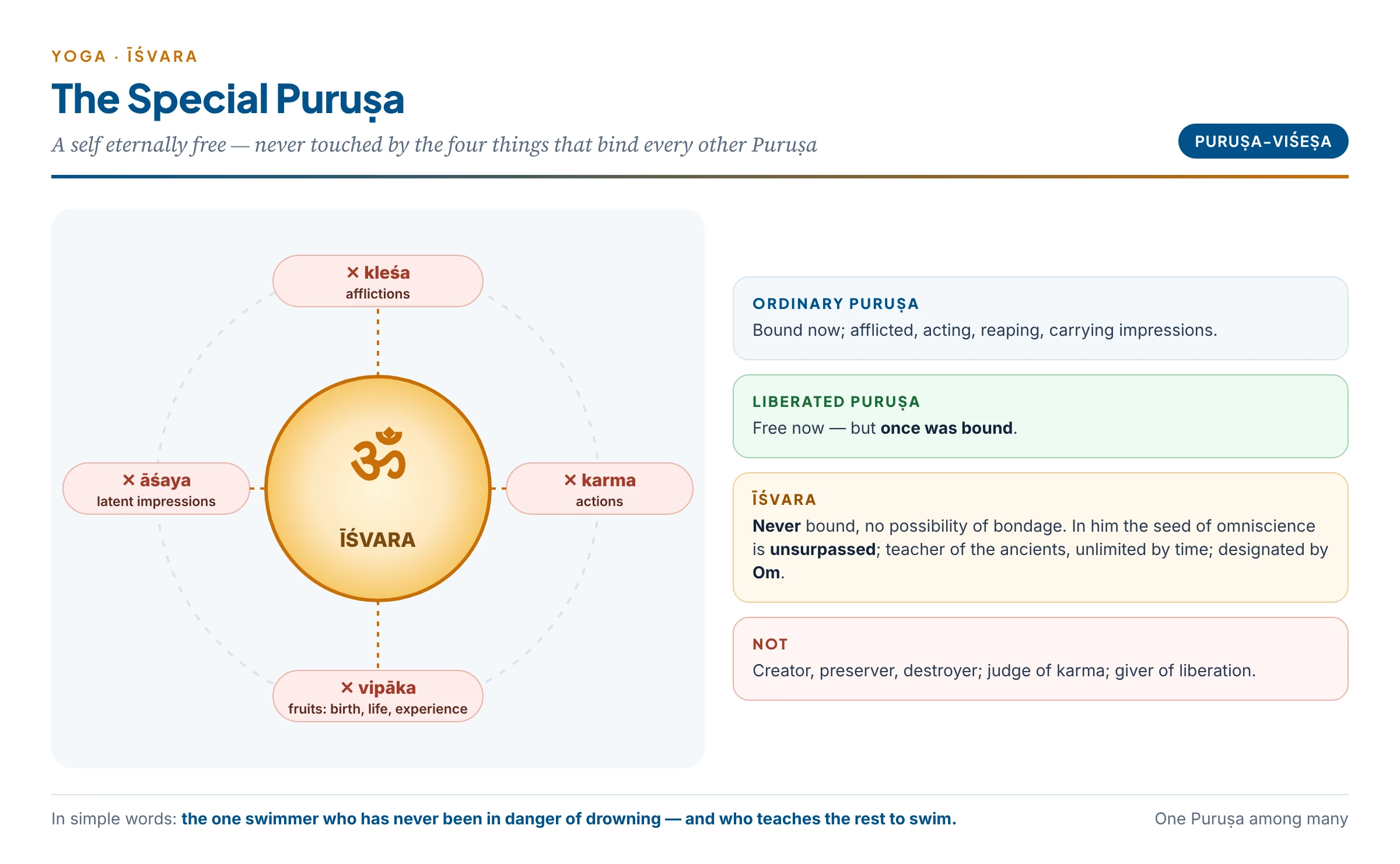
“Īśvara is a special Puruṣa, untouched by afflictions, actions, their fruits and their latent impressions.” — Patañjali, Yoga Sūtra
- Four things that never touch him.
- Kleśa — the five afflictions: ignorance, egoism, attachment, aversion, clinging to life.
- Karma — actions, good, bad or mixed.
- Vipāka — the fruits of action: birth, life-span and experience.
- Āśaya — the latent deposits of karma and impressions in the mind.
- “Special” — how he differs from other Puruṣas.
- Ordinary selves are “more or less subject to the afflictions”; they act, reap consequences and are “infected and influenced by the latent impressions of their past experiences”.
- Liberated selves are now free, but “it cannot be said that they were always free”. They were once bound.
- Īśvara alone is “eternally free“: he “was never bound nor has any possibility of being bound”. “It is God and God alone who is eternally free from all defects.”
- Still a Puruṣa. He is “one among infinite Puruṣas, differing only in that he was never bound by Prakṛti”. He is not a third kind of reality beside Puruṣa and Prakṛti.
2. The Attributes of Īśvara
- Omniscience. “In him the seed of omniscience is unsurpassed” (tatra niratiśayaṃ sarvajña-bījam). His knowledge is perfect and unlimited.
- The first teacher. “He is the teacher even of the ancients, being unlimited by time.” He is “the teacher of the ṛṣis and the teacher of the Veda”.
- Om (praṇava). “His designator is Om.” Om is the word that stands for him.
- Japa and meditation. “Its repetition and meditation on its meaning” is the practice of devotion. “From this comes the attainment of inward consciousness and the removal of obstacles.”
- Perfection. He is “omniscient, omnipotent and omnipresent”, “perfection incarnate”, “purest knowledge”; “there is no one equal to or better than him in virtue” — “God is the name of him who excels all virtue“.
- Later Yoga adds more. Commentators describe him as “the Supreme Ruler of the world, with infinite knowledge, unlimited power and wisest desires”, able to “maintain the whole world by his mere wish”. Vyāsa says he takes on a body of pure sattva out of compassion, to teach and uplift beings. These are later, more theistic developments.
- Formless, yet meditated on through form. God “does not have any form”, but since the mind needs a support, the devotee may meditate on him as vast as the sky or as subtle as a point; the sound Om is his chief symbol.
3. What Īśvara Is Not
- Not the creator, preserver or destroyer. “God of Yoga is not the creator, preserver or destroyer of this world. He is only a special Puruṣa.” Evolution and dissolution are the work of Prakṛti.
- Not the judge of karma. “He does not reward or punish the souls.” The law of karma works by itself.
- Not unlimited in being. “Innumerable Puruṣas and Prakṛti, all eternal and absolute, are there to limit him.”
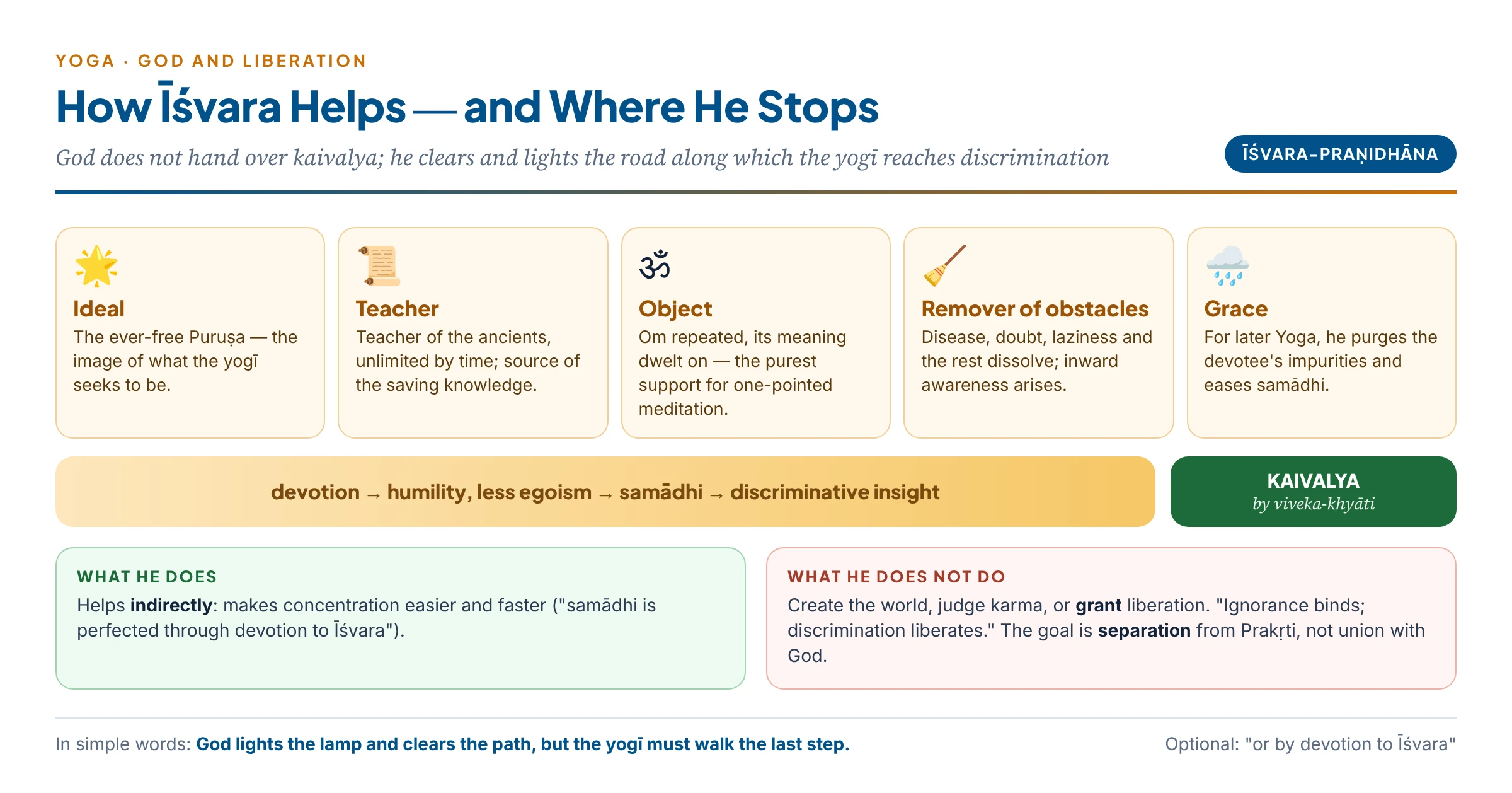
- Not the giver of liberation. “He cannot grant liberation. He can only remove the obstacles in the upward progress of the devotees. Directly he has nothing to do with the bondage and the liberation of the Puruṣas. Ignorance binds and discrimination liberates.”
- Not the goal. “The end of human life is not union with God, but only the separation of Puruṣa from Prakṛti.”
Common confusion
Is Yoga’s Īśvara the creator of the world, as in Nyāya or Vedānta? Not in Patañjali. Some lecture notes present the Yoga God as “creator and destroyer of the universe” and give the design argument (sunrise, ocean, orderly world) or a chain of causes back to a first cause (parents, grandparents, and so on) as Yoga proofs. Patañjali’s Īśvara is not a creator; Prakṛti evolves by itself. Later commentators give him a role in bringing Puruṣa and Prakṛti together and apart — but even then he is a guiding intelligence, not the maker of matter. The design argument belongs to Nyāya and Western natural theology, not to Patañjali.
4. The Proofs for the Existence of God in Yoga
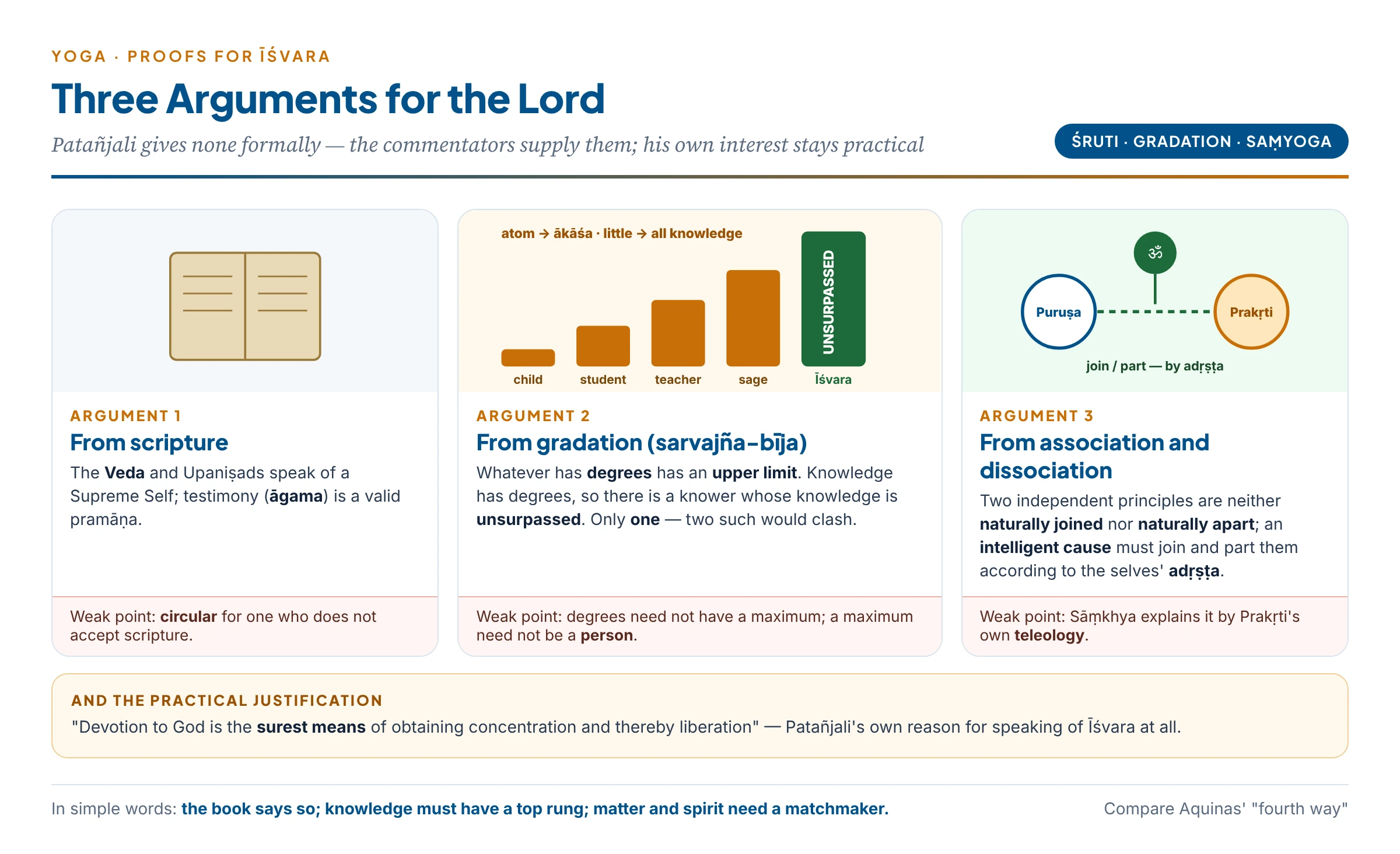
Patañjali himself gives no formal proof; the arguments come from the commentators.
1. The argument from scripture (śruti).
- “The Vedas, the Upaniṣads and other important scriptures speak of the existence of God as the Supreme Self who is also the ultimate reality and the final goal of the world. Therefore God exists in the way in which the scriptures testify.”
- Yoga accepts testimony (āgama) as a pramāṇa, so scripture counts as evidence.
2. The argument from gradation — the “law of continuity” (sarvajña-bīja).
- “Whatever has degrees must have a lower and an upper limit.”
- Example: magnitudes run from the smallest (the atom) to the greatest (ākāśa, space). Knowledge and power also come in degrees — some know a little, some know more.
- “So there must be a person who possesses perfect knowledge and perfect power. Such a supreme person is God.”
- Only one. “There cannot be any self who is equal to God in power and knowledge, for in that case there will be conflict and clash of desires and purposes between them, and a consequent chaos in the world.”
3. The argument from association and dissociation (saṃyoga–viyoga).
- “The creation of the world is due to the association of Puruṣa with Prakṛti, and its dissolution to their dissociation.”
- “Puruṣa and Prakṛti, being two independent principles, cannot be said to be naturally related or associated. Nor are they naturally dissociated, for that would make their relation inexplicable.”
- “So there must be an intelligent cause which effects their association and dissociation, according to the unseen moral deserts (adṛṣṭa) of individual selves.”
- “No individual self can guide and control its adṛṣṭa, because it has no clear understanding about it. Therefore, there must be a perfect and omniscient Being” who brings Puruṣa and Prakṛti together or apart “according as the adṛṣṭas of the individual selves require”. “Without his guidance Prakṛti cannot produce just that order of the world which is suited to the moral education and final emancipation of individual selves.”
4. The pragmatic argument — devotion works.
- “Devotion to God is the surest means of obtaining concentration and thereby liberation.”
- This is less a proof than a practical justification: the effectiveness of devotion in calming the mind shows the value of the idea of God.
In simple words
On a ladder of knowledge, a child knows a little, a student more, a teacher more, a great scientist still more. Yoga asks: if knowledge keeps rising in degrees, must there not be a top rung — knowledge that cannot be surpassed? That top rung, it says, is Īśvara. The argument is like saying that if there are warmer and warmer days, there must be a maximum warmth.
5. Īśvara-praṇidhāna: Devotion to God
- Three places in the Yoga Sūtra. Devotion to Īśvara appears:
- as an alternative path to samādhi — “or by devotion to Īśvara”;
- as one of the three parts of kriyā-yoga (with austerity and self-study);
- as the last of the five niyamas — “from devotion to Īśvara comes the perfection of samādhi”.
- What it means. “Meditation of and resignation to God”; surrender of the ego and of the fruits of action to him.
- How it helps.
- Reduces egoism. Surrender weakens asmitā, the false “I”, and the desires that flow from it.
- Removes obstacles. The nine obstacles — disease, doubt, laziness and the rest — are removed by japa of Om (Article 3).
- Gives a perfect object. God, eternally pure, is the best object for one-pointed meditation.
- Grace. For the later commentators, God “is not only an object of meditation, like other objects, but is the Supreme Lord who, by his grace, purges away the sins and evils in the life of his devotee and makes the attainment of yoga easier”.
- Effort still needed. “While the grace of God can work wonders in our life, we, on our part, must make ourselves deserving recipients of it through love and charity, truthfulness and purity, constant meditation of and complete resignation to God.”
- Optional, not compulsory. The little word “or” (vā) shows that devotion is a choice: practice and detachment also lead to samādhi.
In simple words
A student preparing for a hard exam can study alone with discipline — or study under a teacher he trusts completely and to whom he hands over his worry. Both can succeed, but the second is often faster and lighter, because the burden of the anxious “I” is set down. Īśvara-praṇidhāna is this setting down of the ego before the perfect teacher.
6. The Role of God in Samādhi and Kaivalya
- In samādhi. Īśvara is the special Puruṣa to whom the yogī surrenders; the guru whose guidance removes obstacles; the source of grace that may “catalyse the final stages” of asamprajñāta; and the purest object of meditation (Article 6).
- In kaivalya. God does not directly grant kaivalya. His role is indirect:
- As ideal — he shows what an ever-free Puruṣa is; the yogī seeks to become like him in freedom, not one with him.
- As teacher — the source of the knowledge that leads to discrimination.
- As remover of obstacles — through devotion and japa.
- As helper of samādhi — which ripens into discriminative insight, the real cause of kaivalya.
- The final cause of kaivalya is still viveka-khyāti — “ignorance binds and discrimination liberates”.
7. The Relation between Man and God in Yoga
- Ideal and seeker. God is the perfect example of a Puruṣa that is never confused with Prakṛti; man is a Puruṣa that has become confused. The relation is that of model and imitator.
- Teacher and disciple. God is “the teacher even of the ancients”; man learns from him through the tradition of seers and scripture.
- Lord and devotee. Man surrenders to God; God, for the later commentators, responds with grace.
- No union, no merging. Unlike Vedānta or bhakti traditions, the goal is not to merge into God or live in his presence for ever. “The end of human life is not the union with God, but only the separation of Puruṣa from Prakṛti.” In liberation the yogī is like Īśvara (free), but remains a distinct Puruṣa.
In simple words
A disciple who admires a great master does not want to become the master’s body or live inside him; he wants to become free and wise as the master is. Yoga’s relation to God is like this: the yogī seeks God’s likeness in freedom, not a merging into him.
- An unexplained relation. Yoga gives “no explanation of the relation between God and other Puruṣas”. And: “Do Puruṣas share God’s divinity in liberation? If not, it is certainly disappointing” for human potential.
Critical Evaluation
1. Criticisms of Yoga’s Īśvara
- “Certainly unsatisfactory.” A God who neither creates, nor judges, nor liberates, and is limited by countless co-eternal selves and Prakṛti, seems too weak to be God.
- Loosely attached. Many scholars, such as Garbe and Radhakrishnan, hold that God is “loosely attached” to Yoga — a “practical pedagogical device rather than an organic metaphysical cornerstone”. The system works without him: practice and detachment suffice.
- Inconsistency with dualism.
- A Puruṣa cannot act. If Īśvara is a Puruṣa, he is inactive like all Puruṣas; how can he will, teach, guide or grant grace?
- Omniscience needs a mind. Knowledge in Sāṃkhya–Yoga belongs to buddhi; a pure Puruṣa has no mental modifications. How can he be omniscient? (Hence Vyāsa’s idea of a body of pure sattva — which itself is Prakṛti.)
- A third category? If he is quite unlike other Puruṣas, is he a new kind of reality beyond Puruṣa and Prakṛti?
- Interaction. If he moves Prakṛti to join or separate it from Puruṣa, he breaks the strict non-interaction that dualism requires.
- Violates parsimony. If liberation can be achieved by practice and detachment alone, adding God is unnecessary (lāghava, the principle of simplicity).
- Deistic and peripheral. He is like a “constitutional monarch” — honoured, but without real power over the world.
- The proofs are weak.
- Gradation: that a quality has degrees does not prove that it has a maximum, still less that the maximum exists in a person (there is no largest number).
- Scripture: circular for those who do not accept scripture.
- Association: Sāṃkhya already explains it by Prakṛti’s teleology — she acts for the sake of Puruṣa, as milk flows for the calf.
- From rival schools.
- Sāṃkhya: God is unnecessary; a perfect being has no motive to act.
- Mīmāṃsā: karma needs no supervisor.
- Advaita: a God limited by other Puruṣas cannot be the Absolute.
- Nyāya: Yoga does not go far enough — God should be the creator and moral governor.
- Cārvāka: God is imperceptible; inference and scripture are not valid.
2. Defences
- Practical value is real value. A God who is an object of devotion, an ideal and a remover of obstacles is psychologically and spiritually powerful, whatever his metaphysical role.
- Consistency preserved. By not making God a creator, Yoga keeps its dualism intact and avoids the problem of evil — a God who does not create cannot be blamed for suffering.
- An archetype of the goal. Some scholars see Īśvara as the “macro-yogin” — the archetype of what every yogī seeks: a Puruṣa never lost in Prakṛti. This makes him organic to the system, not an afterthought.
- “Yoga is Sāṃkhya made consistent.” Later Yoga argues that Sāṃkhya cannot explain how inactive Puruṣa and unconscious Prakṛti come together; an intelligent cause who regulates their association by adṛṣṭa fills this gap.
- Better than Sāṃkhya. “It occupies a better position than the Sāṃkhya in so far as it admits the existence of God and relies mostly on actual experiences.”
Critics and Defenders
Criticism — Critics
- Too weak: not creator, judge or liberator — “certainly unsatisfactory”.
- Loosely attached: practice and detachment suffice without him.
- Dualism strained: an inactive Puruṣa cannot know, will or help.
- Weak proofs: degrees need not have a personal maximum.
- Nyāya: God must be creator; Sāṃkhya: God is superfluous.
Defence — Defenders and strengths
- Practical power: devotion calms the mind and removes obstacles.
- No problem of evil: a non-creator God is not responsible for suffering.
- Archetype: the ever-free Puruṣa is the very ideal of yoga.
- Fills a gap: an intelligent cause for the meeting and parting of Puruṣa and Prakṛti.
- Undogmatic: devotion is offered as an option, not imposed.
Cross-Tradition Comparison
Nyāya and Yoga on the Existence of God
| Point | Nyāya | Yoga |
|---|---|---|
| Nature of God | Creator (efficient cause) of the world from eternal atoms; moral governor | A special Puruṣa, never bound; not a creator |
| Main proofs | From effects (kāryāt), from the first combination of atoms (āyojanāt), from support (dhṛtyādeḥ), from words and conventions (padāt), from the authority of the Veda (pratyayataḥ, śruteḥ, vākyāt), from number (saṅkhyā-viśeṣāt), from unseen merit (adṛṣṭāt) | From scripture, from gradation of knowledge, from the association and dissociation of Puruṣa and Prakṛti |
| Method | Mainly inference from the world as an effect | Partly scripture and gradation; mainly practical |
| Common ground | Scripture; God as the guide of adṛṣṭa; God’s role in starting cosmic activity | Scripture; God regulating association by adṛṣṭa |
| Role in liberation | Grace aids; true knowledge liberates | Devotion aids samādhi; discrimination liberates |
| Unique | Cosmological, causal argument | The gradation argument (upper limit of knowledge) |
- Do the Yoga philosophers prove God in the same way as the Naiyāyikas? Partly. Both appeal to scripture, and Yoga’s association–dissociation argument resembles Nyāya’s argument from the first motion of atoms and from adṛṣṭa: unconscious matter and unknowing selves need an intelligent guide. But Yoga does not argue from the world as an effect needing a maker, because for Yoga Prakṛti is the material cause and evolves by itself. Its distinctive argument — from degrees of knowledge to an unsurpassed knower — has no direct counterpart in Nyāya. And Yoga’s main interest is practical: God as the object of devotion and the aid to samādhi.
Indian Connect — Key takeaways
- Sāṃkhya (no God) → Yoga (God as aid and ideal) → Nyāya (God as creator and governor) → Vedānta (God as Brahman’s lordly aspect or as the Absolute itself): Indian thought offers a spectrum of theisms.
- Yoga’s Īśvara is closest in spirit to a teacher-ideal; Nyāya’s to an architect; Advaita’s (Īśvara) to the Absolute appearing as Lord.
- On man–God relation: Yoga seeks likeness in freedom, not union; bhakti schools seek loving union; Advaita seeks identity.
Western Parallels
- Aquinas’ fourth way. “There is a gradation in things — more and less good, true, noble — so there must be something that is best.” This is strikingly close to Yoga’s gradation argument.
- Aristotle’s Unmoved Mover. A perfect being who moves the world as an object of love and imitation, not as a maker — rather like Yoga’s Īśvara as ideal.
- Deism. A God who does not intervene in the world resembles the “constitutional monarch” picture of Yoga’s Īśvara.
- Kant. God as a postulate of practical reason, needed for the moral life rather than proved by theory — similar to Patañjali’s practical interest in God.
- The problem of evil. Because Yoga’s God is not a creator, it escapes the classic Western problem of how a good, all-powerful creator allows evil.
Synthesis (Siddhānta)
- Īśvara is a special Puruṣa, untouched by afflictions, karma, its fruits and impressions; eternally free, never bound; omniscient (the unsurpassed seed of omniscience), the teacher of the ancients, designated by Om.
- He is not the creator, preserver or destroyer, not a judge, not limitless in being, and does not directly grant liberation.
- Proofs: scripture; the gradation of knowledge to an upper limit; the need for an intelligent cause of the association and dissociation of Puruṣa and Prakṛti; and the practical efficacy of devotion.
- Role: through Īśvara-praṇidhāna — an optional path, a part of kriyā-yoga and a niyama — he reduces egoism, removes obstacles, gives the purest object of meditation and, for later Yoga, grace. Kaivalya itself comes from discrimination.
- Man–God relation: ideal and seeker, teacher and disciple, lord and devotee — but not union.
- A balanced view. Philosophically, Yoga’s God sits uneasily in a dualism of inactive selves; practically, he is a powerful aid and the very image of the yogī’s goal. Patañjali’s “or” — devotion as one way among others — is a mark of an undogmatic theism.
- Contemporary relevance.
- Spirituality without dogma. Yoga’s optional theism lets believers and non-believers share the same practice, one reason for its worldwide spread.
- Psychology of surrender. Modern research on acceptance and letting go echoes Īśvara-praṇidhāna as a way of reducing ego-driven stress.
- Interfaith dialogue. A God who is a teacher and ideal rather than a sectarian deity offers common ground across traditions.
“Īśvara is the teacher even of the ancients, for he is not limited by time.” — Patañjali, Yoga Sūtra
Previous Year Questions
- 2025Explain the nature of God and its role in Kaivalya in Yoga philosophy.
- 2022Discuss the nature and different stages of Samādhi as per Patañjali Yoga and examine the role of Īśvara in it.
- 2018How do the Naiyāyikas prove the existence of God? Do the Yoga philosophers prove God in the same way? If yes, how? And if no, why? Give reasons for your answer.
- 2017Critically discuss the relationship of man with God in the Yoga system of philosophy.
- 1992“There is no need for God in Sāṃkhya and Yoga systems, as these are fully consistent even without the idea of God.” Notes.