

Sāṃkhya: Prakṛti; Puruṣa; Causation; Liberation.
Official Syllabus: Paper I, Section B, Unit 16
If every effect pre-exists in its material cause (Article 1), then the whole world — mountains and rivers, bodies and brains, even our thoughts and feelings — must pre-exist in some first material cause. Sāṃkhya calls it Prakṛti: one, eternal, unconscious, ever-active “nature” in its unmanifest state, from which everything except the conscious self unfolds. Prakṛti is not a lump of stuff with qualities; it is the balance of three intertwined strands — sattva, rajas and tamas — whose play explains why the same world can delight, disturb and bore us. This article explains what Prakṛti is, its many names, how it differs from the manifest world, Īśvarakṛṣṇa’s five proofs for it (and which proof shows that there is only one Prakṛti), the three guṇas and their two kinds of change, and the criticisms of the doctrine.
In simple words
Think of the unpainted canvas, the paints and the painter’s energy before a picture exists. Every possible picture is “in” them, waiting. Prakṛti is like the paint-box of the universe in a perfectly mixed, quiet state: nothing is drawn yet, but everything that will ever be drawn is already there as a possibility. When the colours start to separate and dominate one another, pictures — worlds — appear.
Context & Problem
Why Sāṃkhya Needs Prakṛti
- From causation to a first cause. All objects of the world, including our body, mind, senses and intellect, are limited and dependent things, produced by the combination of elements. The world is a series of effects, so it must have a cause.
- Not the self. The cause cannot be Puruṣa, the conscious self, since the self is neither a cause nor an effect of anything, and an intelligent principle cannot transform itself into the unintelligent world.
- Not atoms. The cause cannot be the atoms of earth, water, fire and air (as the Cārvākas, Buddhists, Jainas and Nyāya–Vaiśeṣika hold), because atoms cannot explain subtle products such as mind, ego and intellect, and because many scattered atoms cannot explain the unity of the universe.
- The cause must be subtler than its effects and pervade them — as a seed pervades and is subtler than the tree, or a wish is subtler than the dream-object it produces.
- Conclusion. The ultimate cause is an unconscious, uncaused, eternal, all-pervading, extremely subtle and ever-ready power that evolves and dissolves the world in a cyclic order — Prakṛti.
- No cause of the first cause. If Prakṛti had a cause, that cause would need a cause, and so on to infinity (anavasthā). Wherever we stop, the first cause we reach is what Sāṃkhya calls the root nature (mūla-prakṛti, parā prakṛti).
The Two Ultimate Realities at a Glance
- Sāṃkhya’s whole metaphysics rests on two principles. Puruṣa — pure, inactive, conscious; Prakṛti — unconscious, dynamic, the source of all material and mental phenomena. Everything else is a product of Prakṛti.
- Prakṛti as material cause, Puruṣa as spectator. Prakṛti is the material cause (upādāna-kāraṇa) of the world; Puruṣa is the conscious witness in whose presence it evolves (Article 3). Unlike Puruṣa, which is many, Prakṛti is one.
- The dancer image. Prakṛti is compared to a dancer who performs only when watched: it manifests the world only in the presence of Puruṣa, and withdraws when the spectator has seen enough (Article 5).
Core Doctrine
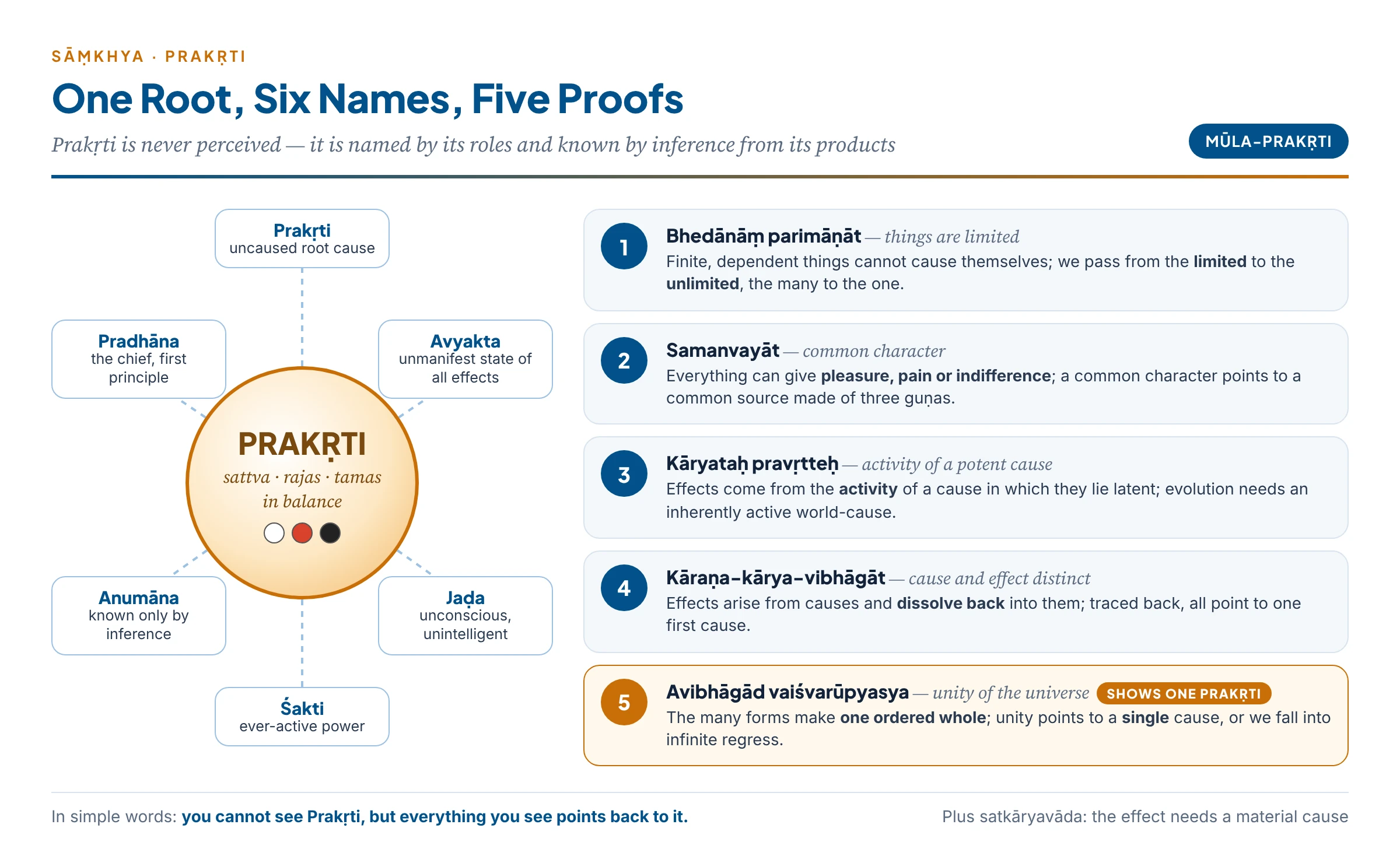
1. The Names of Prakṛti
Each name brings out one aspect of the same principle.
- Prakṛti — “that which precedes creation”, the original or root state; as the uncaused cause.
- Pradhāna — “the chief” or “the first principle” of the universe.
- Avyakta — “the unmanifest”, the state in which all effects are latent.
- Anumāna — “the inferred”: it is so subtle that it cannot be perceived and is known only by inference from its products.
- Jaḍa — “the unconscious”, the non-intelligent principle.
- Śakti — “power”: the ever-active, unlimited energy; motion is inherent in it (as rajas).
- Mūla-prakṛti — “root nature”, the supreme root cause.
- Poetic names. Sāṃkhya writers salute Prakṛti, in the words of an old Upaniṣadic verse, as “the red-white-dark, the unborn one” who brings forth many creatures, and describe her as the “nurse and receptacle of all generation” — red, white and dark being the colours of rajas, sattva and tamas.
2. The Nature of Prakṛti
- Uncaused, independent, absolute, one and eternal, beyond production and destruction — unlike its products, which are caused, dependent, relative, many and temporary.
- Unmanifest and imperceptible because of its extreme subtlety, not because it is non-existent; we infer it from its products.
- Unconscious, since it is the source of the inanimate world.
- Ever-active. Motion is inherent in Prakṛti in the form of rajas. If motion were not inherent in it, no outside agency could give it motion; and if motion once ceased, it could never reappear. So Prakṛti is always changing, even in dissolution (see section 6).
- Partless and indivisible. It has no parts; the guṇas are not its pieces.
- Container of all effects. The entire world of objects is implicit in the “bosom” of Prakṛti. Evolution is the explicit manifestation of this world; dissolution is its return to Prakṛti.
- Material and efficient cause. Sāṃkhya treats Prakṛti as both the material and the efficient cause of the world, since no God is admitted; Puruṣa’s role is only that of a witness whose presence occasions its activity.
3. Manifest and Unmanifest (Vyakta and Avyakta)
Sāṃkhya defines Prakṛti by contrasting it with its products, the manifest (vyakta) world, and with Puruṣa.
| Feature | Manifest world (vyakta) | Unmanifest Prakṛti (avyakta) | Puruṣa |
|---|---|---|---|
| Caused? | Caused (has a cause) | Uncaused | Uncaused |
| Eternal? | Non-eternal | Eternal | Eternal |
| Pervasive? | Limited, not all-pervading | All-pervading | All-pervading |
| Active? | Active, moving | Active in itself (ever-changing) | Inactive |
| Number | Many | One | Many |
| Dependent? | Dependent, resting on something | Independent | Independent |
| Parts? | Composed of parts | Partless | Partless |
| Dissolves? | Dissolves back into its cause | Does not dissolve | Does not dissolve |
| Made of guṇas? | Yes | Yes — it is the guṇas in balance | No — beyond the guṇas |
| Conscious? | Unconscious | Unconscious | Conscious |
| Object of experience? | Yes | Yes | No — always the subject |
| Productive? | Yes (some products) | Yes — the source of all | No — neither cause nor effect |
- The point of the table. The manifest and the unmanifest are alike in being material, unconscious, objective and made of the guṇas; they differ as effect and cause. Puruṣa is opposite to both in being conscious and beyond the guṇas, though like Prakṛti it is uncaused and eternal.
In simple words
Water helps here. Frozen on a Himalayan peak it is ice; in a hill stream it is lively; in the ocean it is salty and vast; drawn up into a mango it is sweet juice. One water, many manifest forms, each shaped by where it is. Sāṃkhya uses this very image: one Prakṛti, through different mixtures of its guṇas, appears as the endless variety of the world.
4. The Five Proofs for the Existence of Prakṛti
Since Prakṛti cannot be perceived, Īśvarakṛṣṇa gives five inferential proofs in one verse: bhedānāṃ parimāṇāt, samanvayāt, kāryataḥ pravṛtteś ca, kāraṇa-kārya-vibhāgāt, avibhāgād vaiśvarūpyasya.
- (1) Bhedānāṃ parimāṇāt — “because particular things are limited”.
- The argument. All individual things in the world — from the intellect down to the earth — are limited, dependent, conditional and finite. They cannot be the cause of their own creation, and the finite cannot be the cause of the universe.
- The inference. We must pass from the limited to the unlimited, from the conditional to the unconditional, from the temporary to the permanent, from the many to the one. This unlimited, eternal, all-pervading source is Prakṛti.
- (2) Samanvayāt — “because of homogeneity” (common character).
- The argument. The world is an amalgam of every variety of object, yet all objects share three common characters: each can produce pleasure, pain and indifference.
- The inference. Things with common characters must have a common source with those characters — a cause composed of the three guṇas. This is Prakṛti.
- (3) Kāryataḥ pravṛtteś ca — “because of the activity of a cause” (potency).
- The argument. Every effect arises from the activity of a potent cause in which it was present in an unmanifest form. Evolution is the manifestation of what was involved.
- The inference. The world of objects, being effects, must be implicitly contained in some world-cause in which the activity that generates evolution is inherent. That is Prakṛti.
- (4) Kāraṇa-kārya-vibhāgāt — “because of the distinction between cause and effect”.
- The argument. Every effect has a cause; cause and effect are distinct as the implicit and explicit states of one process. A limited effect cannot be its own cause.
- The process of return. An effect arises from its cause and is re-absorbed into it at destruction. So particular objects arise from particular causes, these from more general causes, and so on to the first cause. At dissolution, the physical elements resolve into subtler elements, these into still subtler energies, until all products are resolved into unmanifest Prakṛti.
- The inference. The effects point to a single world-cause in which the whole universe is latent — Prakṛti.
- (5) Avibhāgād vaiśvarūpyasya — “because of the undividedness of the universe” (unity).
- The argument. The many forms of the universe (vaiśvarūpya) together form one ordered whole; they merge and dissolve into one another and finally into one cause. The world is not a heap of unconnected pieces.
- The inference. The unity of the universe points to a single cause. If we did not accept one root cause, we would face an infinite regress of causes. That one cause is Prakṛti.
- A sixth ground: satkāryavāda. All effects pre-exist in their material cause. The material cause of the world cannot be Brahman (it is conscious and the world is not) or scattered atoms (they cannot produce the subtle elements). So the material cause is Prakṛti.
In simple words
Look at every product in a big supermarket. Biscuits, soap, shirts, phones — all different, yet every one is priced, barcoded and delivered by the same trucks. You would rightly infer one company system behind them. Sāṃkhya reasons the same way: everything in the world, however different, shares the same “barcode” — the power to please, pain or bore — and the same limited, dependent nature. So there must be one source behind them all.
5. Which Proof Shows That Prakṛti Is One?
- The key proof: avibhāgād vaiśvarūpyasya. The unity of the universe directly points to a single cause. Many independent causes could not produce one interconnected, ordered whole in which everything finally merges into one source; and a chain of causes without one root would lead to infinite regress. So this proof shows not only that Prakṛti exists but that it is one.
- Other proofs point the same way.
- Samanvayāt. One set of common characters (pleasure, pain, indifference) in all things points to one common source.
- Bhedānāṃ parimāṇāt. The passage is from “the many to the one“, from limited causes to one unlimited cause.
- Kāraṇa-kārya-vibhāgāt. Tracing effects back, cause by cause, we reach one first cause in which all are absorbed.
- Why the plurality of causes fails. If there were many Prakṛtis, each would be limited by the others — and limited things need a cause; so they would not be ultimate.
- An irony noticed by critics. Sāṃkhya rightly reduces all material causes to one Prakṛti; yet it keeps many Puruṣas. Critics, especially Advaitins, ask why the same logic of unity is not applied to the selves (Articles 4 and 6).
6. The Three Guṇas
- What “guṇa” means here. Not a “quality” or “attribute” in the Nyāya–Vaiśeṣika sense. The guṇas are the constituents or elements of Prakṛti. Prakṛti is not a substance having the guṇas; it is the guṇas held in equilibrium (guṇānāṃ sāmyāvasthā). Prakṛti is nothing apart from them.
- Not parts either. Prakṛti is partless; the guṇas are inseparable aspects that always go together.
- Why they are called “guṇa”. The word has three senses, and each fits:
- “Secondary” or “subservient” — they serve the purpose of Puruṣa, not their own.
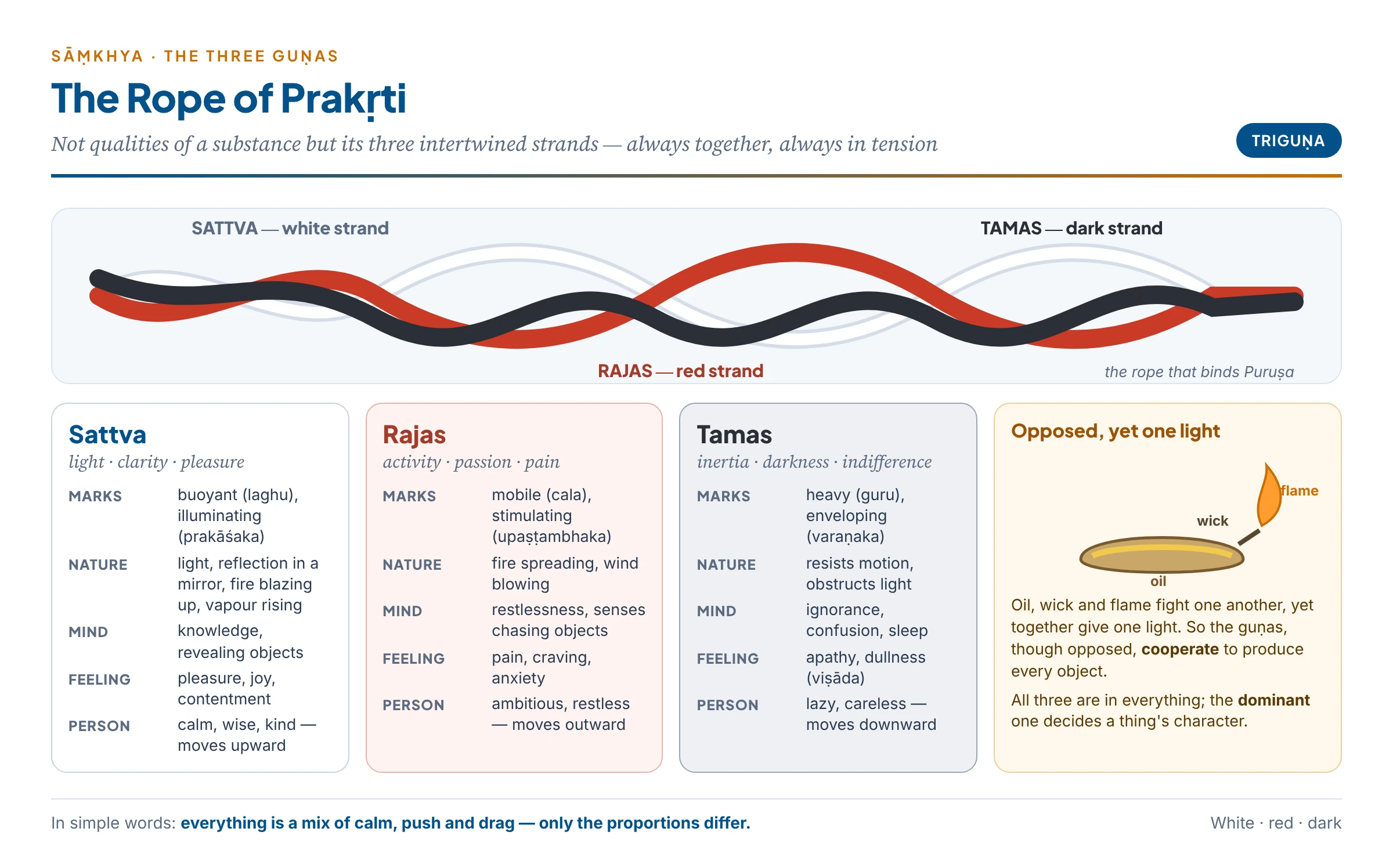
- “Strand of a rope” — they are intertwined like three strands making up the rope of Prakṛti that binds Puruṣa.
- “Attribute” — only in the loose sense that Prakṛti alone is the substance and they are its constituents.
- How they are known. Being subtle, the guṇas are not perceived; they are inferred from their effects — pleasure, pain and indifference — since cause and effect share one nature.
In simple words
The same thing pleases one person, pains another and leaves a third cold. A cuckoo’s song delights the artist, irritates his sick friend and means nothing to the busy farmer. A rose delights a young lover, saddens a dying man and leaves the gardener indifferent. Victory in war thrills the winner, crushes the loser and leaves a neutral country unmoved. Since the effect reveals the cause, Sāṃkhya concludes that everything is made of three constituents that produce pleasure (sattva), pain (rajas) and indifference (tamas).
7. Sattva, Rajas and Tamas in Detail
- Sattva — the principle of light and pleasure.
- Meaning. From sat, “real, existent”; the guṇa closest to reality and knowledge.
- Marks. Buoyant or light (laghu) and illuminating (prakāśaka); its colour is white.
- In nature. The luminosity of light, the power of reflection in a mirror or crystal, the upward movement of things — fire blazing up, vapour rising, the winding motion of air.
- In the mind. The manifestation of objects in consciousness, clarity, knowledge; the tendency of the senses, mind and intellect to reveal.
- In feeling. Pleasure in all its forms — satisfaction, joy, happiness, contentment.
- In character. A sattva-dominated person is calm, disciplined, kind, selfless and drawn to truth, ethics and spirituality.
- Its place in liberation. Sattva brings the clarity and discrimination that lead towards liberation — yet it is still part of Prakṛti and must finally be transcended.
- Rajas — the principle of activity and pain.
- Meaning. Linked with rañj, “to colour, to stir”; it excites and disturbs balance. Its colour is red.
- Marks. Mobile (cala) and stimulating (upaṣṭambhaka) — it moves and makes other things move.
- In nature. It is why fire spreads and the wind blows.
- In the mind. It makes the senses run after objects and the mind restless.
- In feeling. Pain and restlessness; desire, craving, ambition, dissatisfaction, anxiety.
- Its role. Sattva and tamas are in themselves inactive; rajas supplies the energy by which they perform their functions. Without rajas there would be no creation and no life — but it binds the self through desire and the cycle of karma.
- In character. A rajas-dominated person is ambitious, competitive, restless, driven by ego and recognition.
- Tamas — the principle of inertia and indifference.
- Meaning. “Darkness”; its colour is black or dark.
- Marks. Heavy (guru) and enveloping or obstructing (varaṇaka) — the opposite of sattva’s lightness and light.
- Against rajas. It restrains activity; it counteracts motion.
- In the mind. It obstructs manifestation, producing ignorance, confusion and bewilderment (moha), sleep, drowsiness and laziness.
- In feeling. Apathy or indifference (viṣāda).
- Its role. Tamas is needed for rest, sleep and stability; but when dominant it is the main cause of ignorance and keeps Puruṣa entangled in Prakṛti.
- In character. A tamas-dominated person is lazy, careless, dull, prone to harmful habits and denial. Sattva leads upward, rajas outward, tamas downward.
| Guṇa | Nature | Marks | In feeling | In the person | Images |
|---|---|---|---|---|---|
| Sattva | Light, purity, harmony | Buoyant, illuminating | Pleasure, joy | Calm, wise, kind | White; sunrise; clear mind; noble action |
| Rajas | Activity, passion, energy | Mobile, stimulating | Pain, restlessness | Ambitious, restless | Red; noon; fire; restless effort |
| Tamas | Inertia, darkness | Heavy, enveloping | Indifference, delusion | Lazy, dull, confused | Black; night; sleep; intoxication |
8. How the Guṇas Relate to One Another
- Conflict and cooperation. The guṇas are always opposed and yet always working together. They are never separate, and none can produce anything without the other two.
- The lamp. Just as the oil, the wick and the flame — opposed to one another (oil and fire, the wick burning away) — cooperate to produce one light, so the three guṇas, with opposed natures, cooperate to produce the objects of the world.
- All three in everything. Every object, great or small, fine or gross, contains all three guṇas — in different proportions.
- Preponderance decides nature. Each guṇa tries to dominate the others; the predominant guṇa determines a thing’s character. That is why we classify things as good, bad or indifferent; pure, impure or neutral; intelligent, active or slothful — according to whether sattva, rajas or tamas prevails.
- Ever-changing. Change belongs to the very essence of the guṇas; they cannot stay unchanged even for a moment.
In simple words
A couplet by the Hindi poet Rasalīna makes the three guṇas vivid. The eyes of the beloved are white, red and dark, full of nectar, intoxication and poison. When they pierce the lover’s heart he knows the joy of life (remembering her — sattva), the agony of restlessness (separation — rajas) and the stillness of death (love so intense that he forgets everything and lies inert — tamas). One glance, three effects: the same thing, three strands.
9. Two Kinds of Change: Svarūpa and Virūpa Pariṇāma
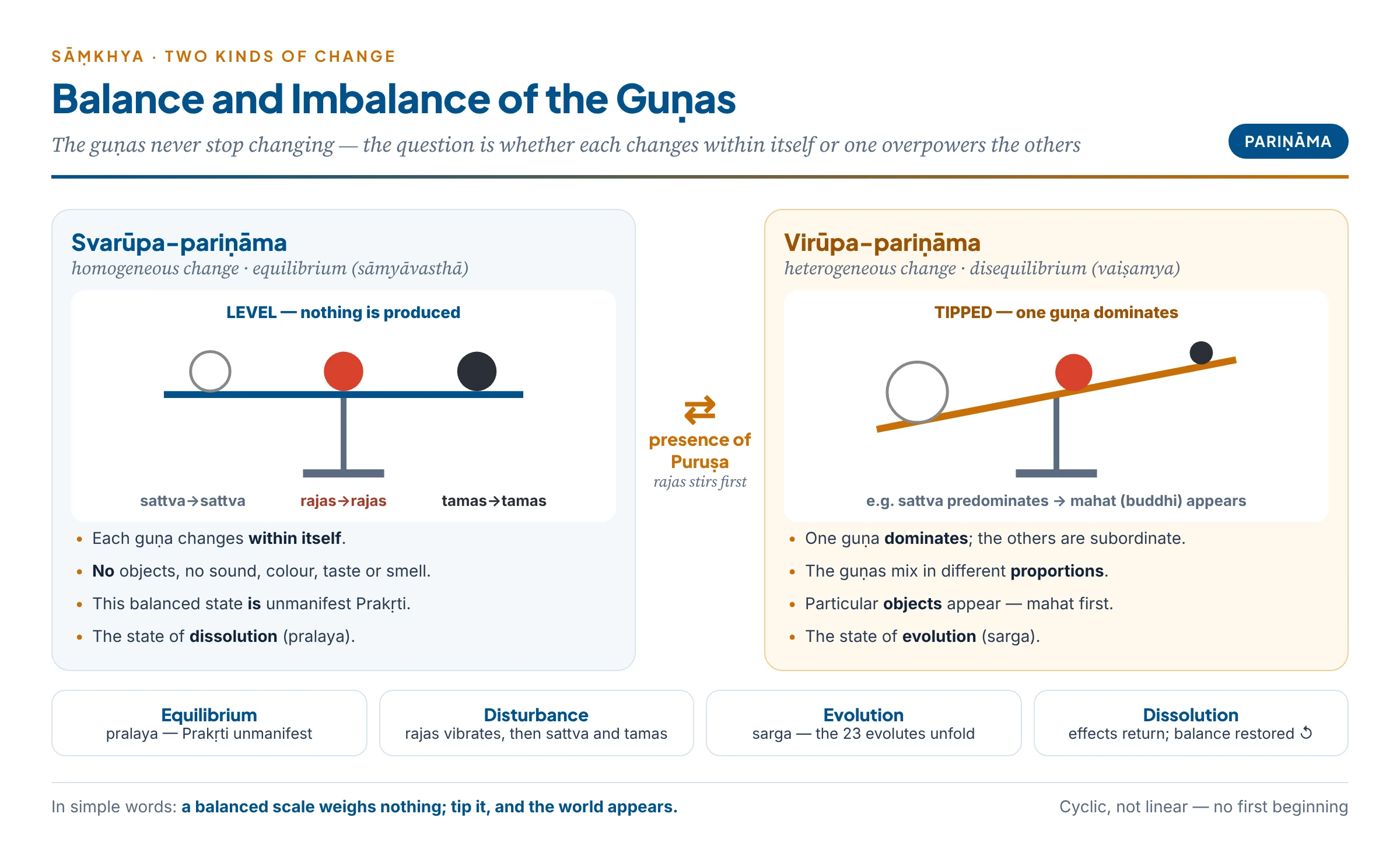
- Svarūpa-pariṇāma — homogeneous change (also called sarūpa or sajātīya pariṇāma).
- What happens. Each guṇa changes within itself — sattva into sattva, rajas into rajas, tamas into tamas — without disturbing the others.
- Result. The guṇas stay in balance (sāmyāvasthā). Nothing is produced: no objects, no sound, touch, colour, taste or smell. There is change without motion.
- When. This is the state of dissolution (pralaya) — and it is exactly what Sāṃkhya calls Prakṛti in its unmanifest state.
- Virūpa-pariṇāma — heterogeneous change.
- What happens. One guṇa dominates the others, which become subordinate; they mix, separate and combine in different proportions.
- Result. Particular objects are produced — this is the starting point of the world’s evolution (sarga).
- How it starts. Rajas is disturbed first and makes sattva and tamas vibrate; a tremendous commotion arises in Prakṛti. Sattva (manifestation) and rajas (activity), formerly held in check by tamas, now come forward. What disturbs the balance — the presence of Puruṣa — is the subject of Article 3.
- A cycle without beginning. Creation is cyclic, not linear: periods of evolution (sarga) and dissolution (pralaya) alternate without beginning.
Common confusion
Is evolution the “pralayāvasthā” and is sāmyāvasthā a different state from pralaya? Many notes label the state of creation as “pralayāvasthā” and draw a table setting sāmyāvasthā (“before creation”) against pralayāvasthā (“after dissolution”). Both are mistaken. Pralaya means dissolution, and the state of dissolution is the state of equilibrium of the guṇas — sāmyāvasthā, with only homogeneous change. The state of evolution is the state of disequilibrium (vaiṣamyāvasthā), with heterogeneous change (virūpa-pariṇāma). Since the cycle of creation and dissolution has no beginning, there is no special “first” equilibrium before all creation that differs from the equilibrium after each dissolution.
10. The Guṇas Beyond Sāṃkhya
- Bhagavad Gītā. The Gītā takes over the three guṇas to explain action, bondage and liberation: faith, food, charity, knowledge, action and even happiness are classified as sāttvika, rājasika or tāmasika, and the liberated person is “beyond the guṇas” (guṇātīta). But in the Gītā, Prakṛti is the power of God, not an independent principle.
- Āyurveda and daily life. Indian medicine, diet (sāttvika food), music and ethics use the guṇa scheme to describe temperaments and ways of life.
Indian Connect — One root, many forms — Indian and Western echoes
- Advaita keeps Sāṃkhya’s account of the guṇas and the manifest world but turns Prakṛti into māyā, the power of Brahman, with no independent reality.
- The Greek Anaximander spoke of an indefinite, boundless source (apeiron) from which opposites separate out and to which they return — strikingly like the unmanifest Prakṛti and its guṇas.
- Plato’s “receptacle”, the “nurse of all becoming” in the Timaeus, and Aristotle’s prime matter are Western forms of an indeterminate material principle — but neither is self-moving like Prakṛti.
- Empedocles’ two forces, Love and Strife, which unite and separate the elements, recall the cooperation and conflict of the guṇas.
Critical Evaluation
Are the Proofs Adequate?
- Strengths.
- The proofs are inferential and argue from features of experience everyone admits — limitation, common character, causal regularity, unity.
- The unity argument gives a strong reason for one root rather than many scattered atoms.
- Prakṛti explains the mental as well as the physical world without bringing in God.
- Weaknesses.
- Limitation does not prove one unlimited cause. Many limited things could depend on many limited causes in an endless network; finitude alone does not lead to a single infinite cause.
- Pleasure, pain and indifference are relations to minds, not intrinsic features of things; the same rose is pleasant or painful depending on the perceiver. So the “common character” may lie in the experiencer, not in a common material cause.
- Unity may be the unity of law rather than of a single substance; the order of nature can be explained by laws connecting many things.
- Satkāryavāda is assumed. Several proofs rely on the pre-existence of effects, which Nyāya and the Buddhists reject (Article 1).
- An eternal, unchanging-in-essence cause cannot produce change. The Buddhist logicians argue that an eternal cause would produce all its effects at once; if it needs accessories, they are the real causes.
Rival Schools against Prakṛti
- Nyāya–Vaiśeṣika.
- Prakṛti is hypothetical — never perceived and not inferable with certainty.
- Infinite regress: if Prakṛti is “made of” guṇas, what is the substratum of the guṇas themselves?
- An unconscious Prakṛti cannot produce an ordered, purposeful universe without an intelligent agent, Īśvara.
- Advaita Vedānta.
- Śaṅkara rejects Prakṛti as a reality independent of Brahman; Brahman alone is the ultimate cause, and Prakṛti is only māyā, an appearance due to ignorance.
- Sāṃkhya’s dualism violates non-duality and cannot explain how two independent realities interact (Article 6).
- Buddhism.
- There is no permanent substance at all.
- A Prakṛti that is eternal and unchanging in essence yet changing in manifestation is self-contradictory.
- Dependent origination explains evolution without any permanent substratum; Prakṛti is unnecessary metaphysical baggage.
- Cārvāka. Prakṛti cannot be perceived, so it does not exist; the observable elements are enough to explain the world.
- Yoga’s qualification. Patañjali’s Yoga accepts Prakṛti but adds Īśvara, so that Prakṛti works under divine guidance rather than on its own.
Sāṃkhya’s Replies
- On being hypothetical. Much that is real is subtle and known only by inference — the sense-organs themselves are known this way. Not being perceived because of subtlety is not the same as not existing.
- On the substratum of the guṇas. The guṇas need no further substratum: they are the ultimate substance; asking for a substance beneath them repeats the very regress Prakṛti is meant to stop.
- On intelligence. Prakṛti’s activity is purposive without being conscious, like a tree bearing fruit or milk flowing for the calf (Article 3).
- On atoms. Atoms cannot explain mind, ego and intellect; Prakṛti can, because it is subtler than the physical elements.
- On the Buddhists. Without an enduring material, the continuity and regularity of change are left unexplained.
Critics and Defenders
Criticism — Critics
- Nyāya: Prakṛti is a hypothesis; the guṇas need a substratum; unconscious matter cannot produce order without God.
- Śaṅkara: Prakṛti is māyā, not an independent reality; dualism breaks non-duality.
- Buddhists: no permanent substance; an eternal cause cannot act in succession; dependent origination is enough.
- Cārvāka: the imperceptible is unreal; the four elements suffice.
- Logical critics: finitude does not prove one infinite cause; pleasure and pain belong to the perceiver, not the thing.
Defence — Defenders and strengths
- One root explains the unity of a world that is physical and mental.
- The guṇas give a single scheme for matter, mind, feeling and character.
- The subtle can be known by inference, as the senses themselves are.
- Prakṛti stops the infinite regress of causes without appealing to God.
- The scheme shaped the Gītā, Yoga, Āyurveda and Indian ethics.
Cross-Tradition Comparison
Prakṛti and Western Ideas of Matter
| Point | Sāṃkhya’s Prakṛti | Western parallel |
|---|---|---|
| Indeterminate first stuff | Unmanifest, balanced, without sound, colour or form | Anaximander’s boundless (apeiron); Aristotle’s prime matter |
| Nurse of becoming | “Unborn mother”, “nurse and receptacle of all generation” | Plato’s receptacle, the “nurse of all becoming” (Timaeus) |
| Self-moving | Ever-active; motion inherent as rajas | Heraclitus: everything flows; Bergson’s élan vital |
| One substance, many modes | One Prakṛti, many evolutes | Spinoza: one substance, infinite modes — but Spinoza’s substance is also thought |
| Opposed forces cooperating | Sattva, rajas, tamas in conflict and cooperation | Empedocles: Love and Strife; Hegel: unity of opposites |
| Mind as material | Intellect, ego, mind are products of Prakṛti | Materialists (Hobbes); but unlike them Sāṃkhya keeps a separate conscious self |
| Cyclic universe | Endless cycles of evolution and dissolution | Stoic cycles of conflagration; some modern cyclic cosmologies |
Indian Connect — Key takeaways
- Prakṛti is Sāṃkhya’s answer to the question “what is the one stuff behind mind and matter?” — a question the Greeks asked about matter alone.
- The three guṇas give India a unified theory of nature, psychology and ethics; their use in the Gītā made them part of everyday Indian thought.
- Advaita later keeps the guṇas but demotes Prakṛti to māyā, the power of Brahman — the decisive change from dualism to non-dualism.
Synthesis (Siddhānta)
- Prakṛti is the one, uncaused, eternal, all-pervading, partless, unconscious and ever-active root of everything except the self — called pradhāna, avyakta, anumāna, jaḍa and śakti.
- It is the unmanifest cause of the manifest world; both are material and made of the guṇas, while Puruṣa is conscious and beyond them.
- Its existence is inferred by five proofs — limitation, common character, potency, the cause–effect distinction and the unity of the universe; the last shows most clearly that Prakṛti is one.
- Prakṛti is the three guṇas — sattva (light, pleasure), rajas (activity, pain) and tamas (inertia, indifference) — always in conflict and cooperation, like the oil, wick and flame of a lamp.
- In dissolution the guṇas change homogeneously and stay balanced; in evolution they change heterogeneously, one dominating the others, and the world appears — in an endless cycle.
- A balanced view. The proofs are suggestive rather than conclusive: they establish a strong case for one material ground of the world, but they assume satkāryavāda and treat relations to perceivers (pleasure, pain) as features of things. The doctrine’s lasting achievement is a unified account of matter and mind without God.
- Contemporary relevance.
- Physics. The idea of a primordial, undifferentiated state whose symmetry breaks to produce the variety of the universe is a striking modern parallel to the disturbance of the guṇas’ balance.
- Psychology. Researchers have built questionnaires to measure sāttvika, rājasika and tāmasika temperaments, and the guṇa scheme is used in counselling and wellness.
- Lifestyle and diet. Sāttvika diet and routines remain part of Indian health culture.
- Ecology. Prakṛti as “nature” that serves all beings has become a resource for Indian environmental ethics.
“We bow to the unborn one — red, white and dark — who brings forth many creatures like herself.” — Śvetāśvatara Upaniṣad (the image Sāṃkhya applies to Prakṛti)
Previous Year Questions
- 2021Explain the Sāṃkhya’s view on three guṇas (guṇa-traya) and their modifications.
- 2019Which Sāṃkhya proof for the existence of Prakṛti actually shows that there can be only one Prakṛti? Justify your answer.
- 2014Are the arguments given in favour of existence of Prakṛti adequate in Sāṃkhya’s philosophy? Discuss.
- 2007Explain the Sāṃkhya doctrine of three guṇas.
- 1999The Sāṃkhya arguments for the existence of Prakṛti. Notes.
- 1996Explain the Sāṃkhya conception of Prakṛti. Discuss the role it plays in the Sāṃkhya metaphysics.
- 1993Explain and examine the Sāṃkhya arguments for the existence of Prakṛti and Puruṣa.