

Nyāya–Vaiśeṣika: Theory of Categories; Theory of Appearance; Theory of Pramāṇa; Self, Liberation; God; Proofs for the Existence of God; Theory of Causation; Atomistic Theory of Creation
Official Syllabus: Paper I, Section B, Unit 15
Every inference rests on a universal relation between the mark and what it indicates — “wherever there is smoke, there is fire“. Nyāya calls this relation vyāpti (“pervasion”) and calls it the nerve of inference: without it, smoke tells us nothing about fire. But how can a universal relation be known? We have seen smoke with fire a few hundred times; the rule claims it holds everywhere and always — on distant planets and in the remote future. This is the problem of induction, raised in India by the Cārvāka and in Europe by Hume. This article explains what vyāpti is, its kinds, the condition (upādhi) that spoils a false vyāpti, the six steps by which Nyāya establishes it (vyāptigraha), the role of tarka (hypothetical reasoning) and of the perception of universals, and Nyāya’s reply to the Cārvāka sceptic.
In simple words
Every time you have switched on a fan, it has started turning. Does “switching on” always bring “turning”? Not if the power is off, the wire is cut or the motor is burnt. The switch–fan link holds only on condition that there is power. A true universal rule must hold without any such hidden condition. Nyāya’s whole theory of vyāpti is a careful method for making sure that a rule we rely on has no hidden “if”.
Context & Problem
Why Vyāpti Is the Crux
- Inference needs a universal premise. In “the hill has fire because it has smoke”, the conclusion is justified only if all smoke is accompanied by fire. This universal relation is the logical ground of inference (Article 3).
- The sceptic’s attack. The Cārvāka argued that vyāpti can never be known (Unit 12):
- Perception shows only particular cases, here and now — not all cases, past, future and distant.
- Inference cannot supply it, because every inference already needs a vyāpti — that would be circular or an infinite regress.
- Testimony is itself a kind of inference, and comparison gives only the meaning of words.
- Even if no counter-case has been seen, a hidden condition (upādhi) may exist that we have not noticed.
- The stakes. If vyāpti cannot be known, inference collapses — and with it Nyāya’s proofs of the self, of God and of the atoms, and every other school’s reasoning too.
Core Doctrine
1. What Vyāpti Is
- Literal meaning. Vyāpti means “pervasion“. It is a relation between two things of which one pervades the other.
- Vyāpya — the pervaded: what is always accompanied by the other — smoke.
- Vyāpaka — the pervader: what always accompanies it — fire.
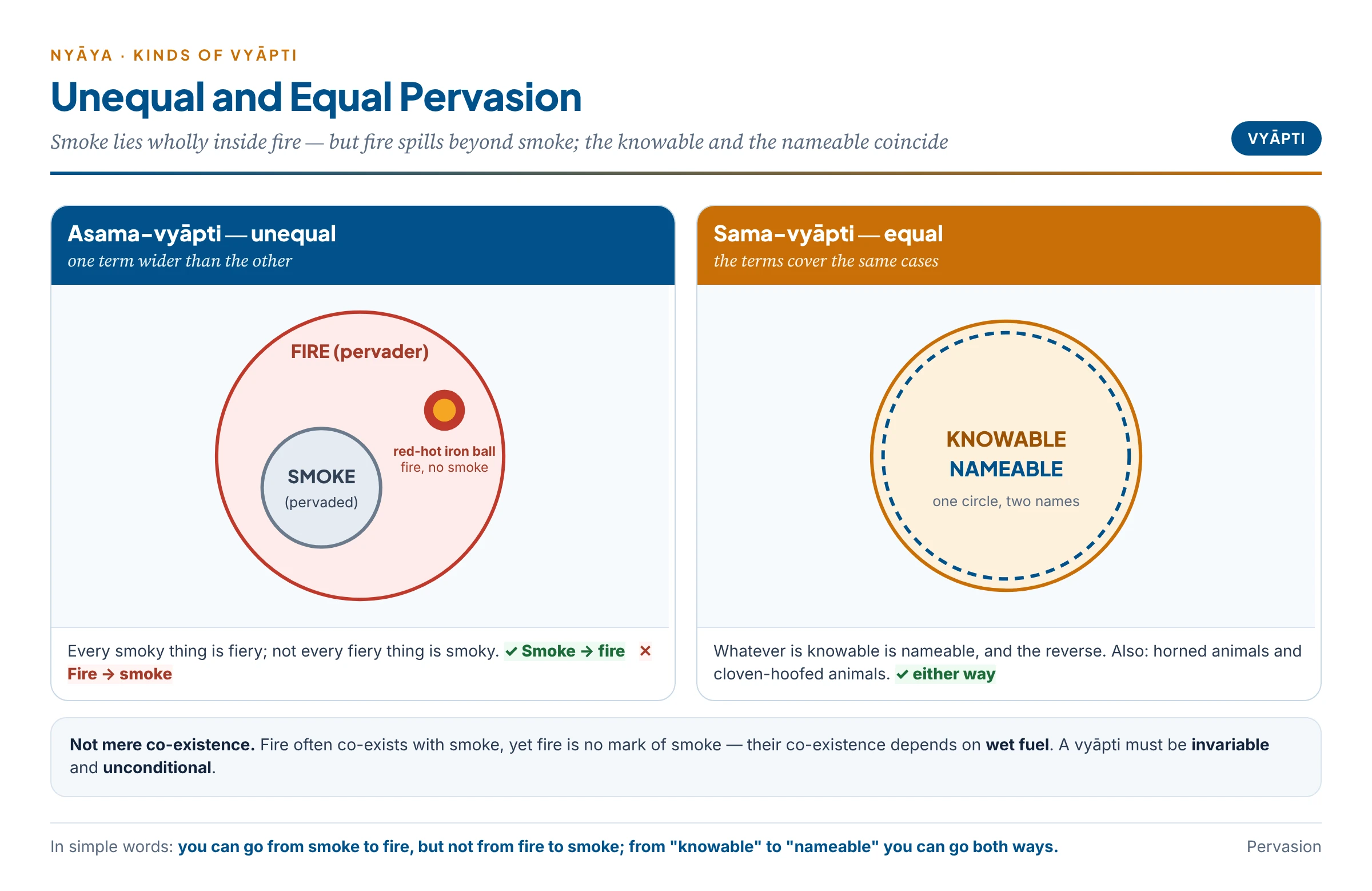
- “Smoke is pervaded by fire” means every case of smoke is a case of fire. It does not mean every fire has smoke: a red-hot iron ball is fire without smoke.
- Not mere co-existence. Two things may often be found together without any vyāpti. Fire often co-exists with smoke, yet fire is no sign of smoke, because their co-existence depends on a further condition — wet fuel.
- Definition. Vyāpti is the invariable and unconditional relation of concomitance between the hetu and the sādhya — niyata anaupādhika sambandha: niyata (invariable, without exception) and anaupādhika (free from any condition).
- Across all times. A vyāpti claims that the relation holds in past, present and future — that is why its knowledge is philosophically difficult.
2. Kinds of Vyāpti
- By the extension of the terms.
- Asama-vyāpti (or viṣama-vyāpti) — unequal extension. One term is wider than the other. All smoky things are fiery, but not all fiery things are smoky. We can infer fire from smoke, not smoke from fire.
- Sama-vyāpti — equal extension. The terms cover exactly the same cases, so either can be inferred from the other. “Whatever is knowable is nameable, and whatever is nameable is knowable.” Another stock example: animals with horns and animals with cloven hoofs.
- By the mode of observation.
- Anvaya-vyāpti — positive. “Wherever there is smoke, there is fire” — known from cases of agreement in presence.
- Vyatireka-vyāpti — negative. “Wherever there is no fire, there is no smoke” — known from cases of agreement in absence.
- These ground the positive-only, negative-only and joint inferences of Article 3.
3. Upādhi: The Hidden Condition
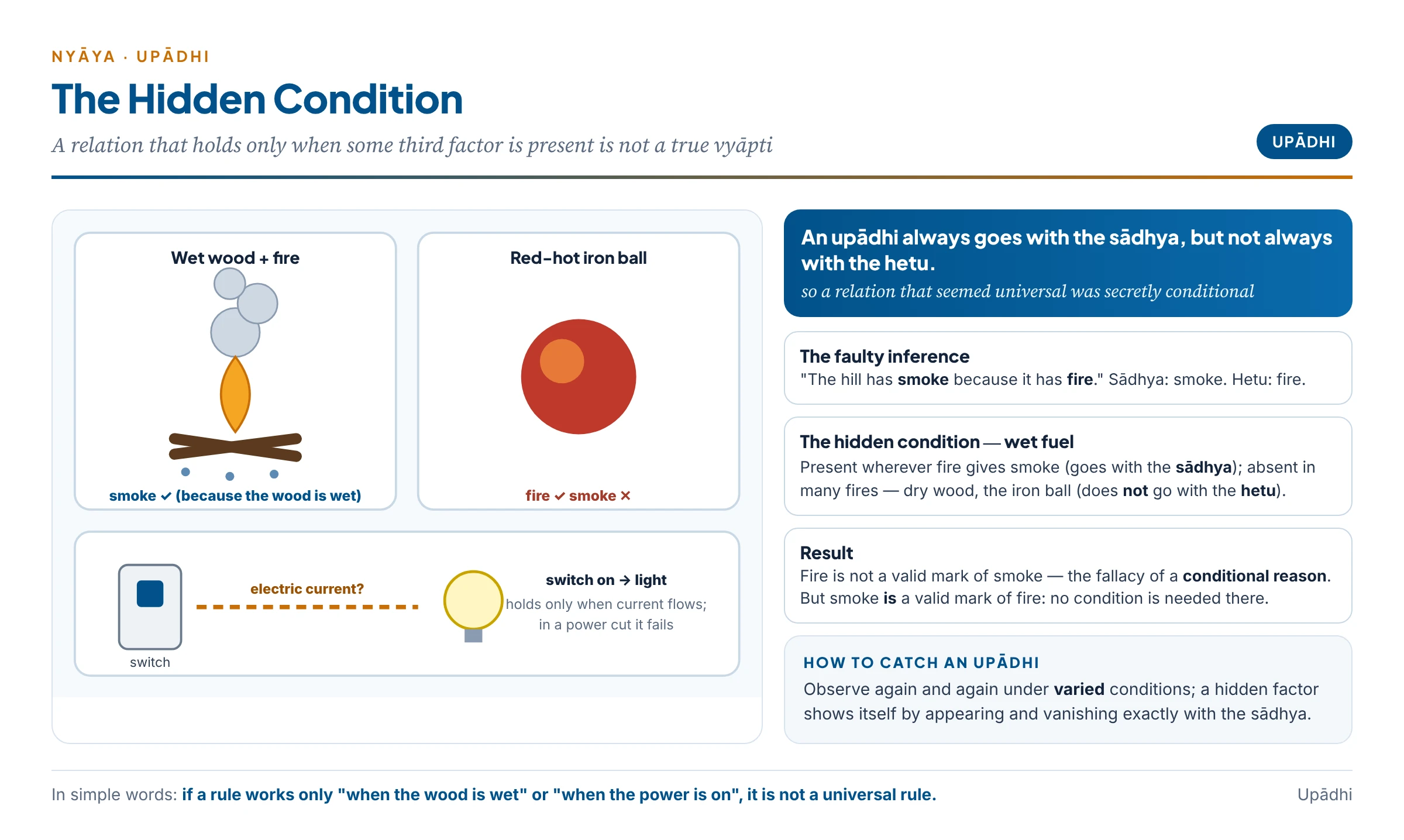
- Meaning. An upādhi is a condition on which an apparent concomitance secretly depends. If the relation between two things holds only when some third factor is present, it is not a vyāpti.
- Definition. An upādhi is a factor that always accompanies the sādhya (it is co-extensive with the major term) but does not always accompany the hetu (it is not co-extensive with the middle term).
- The stock example — wet fuel. Suppose someone infers “the hill has smoke because it has fire“.
- The sādhya is smoke; the hetu is fire.
- Wet fuel is present wherever there is smoke from fire — it accompanies the sādhya.
- But wet fuel is not present wherever there is fire — dry wood, a red-hot iron ball — it does not accompany the hetu.
- So the fire–smoke relation is conditional on wet fuel; fire is not a valid mark of smoke. This is the fallacy of vyāpyatvāsiddha (Article 3).
- The modern example — the switch. “Wherever I switch on, the room lights up.” The electric current must be present wherever there is light, but it is not present wherever there is switching on (a power cut). The current is the upādhi; switching on is not an unconditional mark of light.
- Why upādhi matters. It is the reason mere repeated co-occurrence is not enough: a relation may hold in every case we have seen simply because a hidden condition happened to be present each time.
4. How Vyāpti Is Known: The Six Steps (Vyāptigraha)
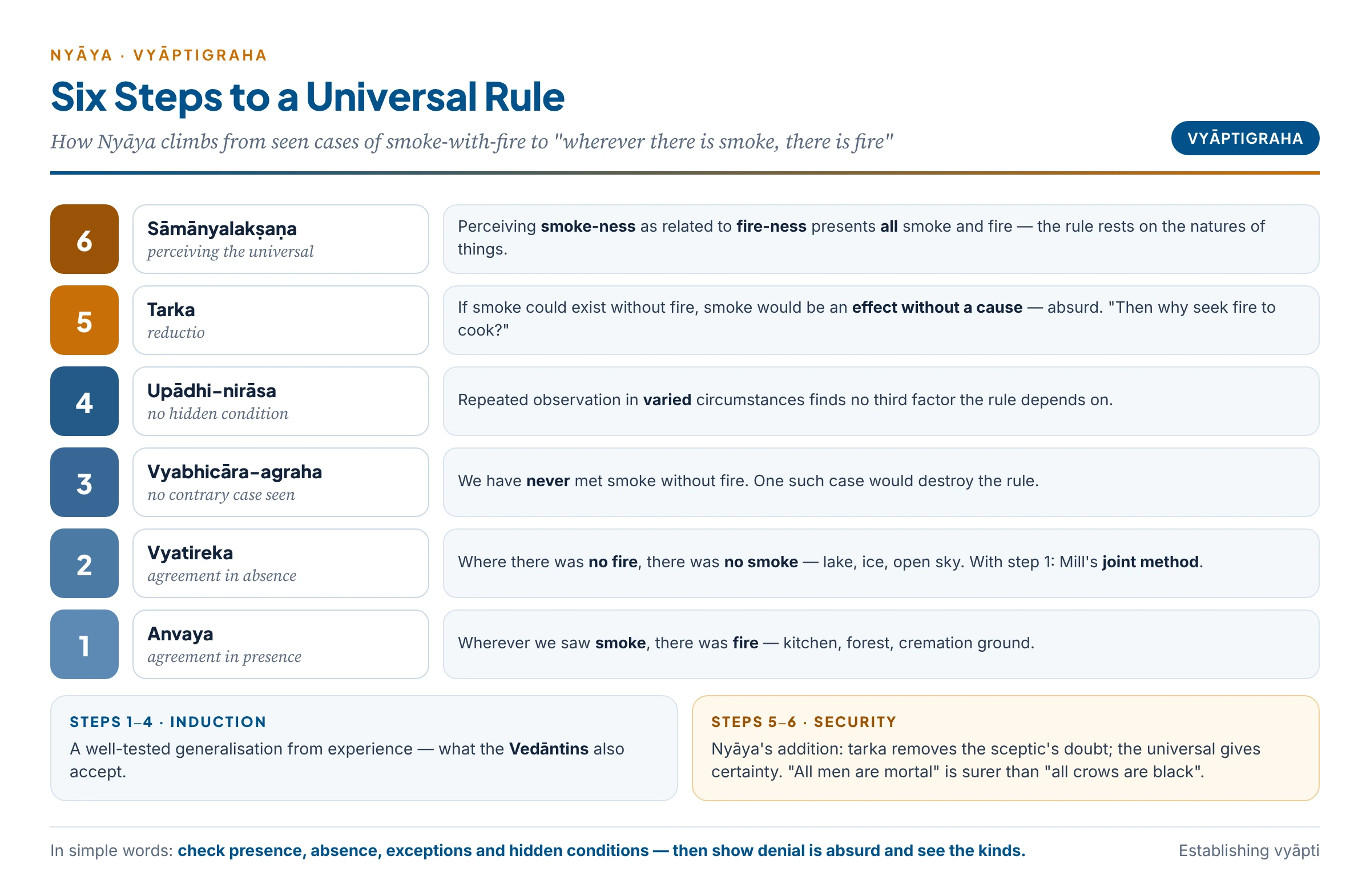
Nyāya agrees with the Vedāntins that vyāpti is learnt from uncontradicted experience of the relation between two things, not from some a priori principle. But it goes further, supplementing experience with tarka and the perception of universals. The method has six steps:
- Anvaya — agreement in presence.
- In every case where one is present, the other is also present: wherever we have seen smoke, we have seen fire (kitchen, forest, cremation ground).
- Vyatireka — agreement in absence.
- In every case where the sādhya is absent, the hetu is absent: in the lake, the ice, the open sky — no fire, no smoke.
- Steps 1 and 2 together correspond to Mill’s joint method of agreement in presence and absence.
- Vyabhicāra-agraha — non-observation of any contrary instance.
- We have never observed smoke without fire. If even one counter-case appears, the claimed rule is destroyed.
- Upādhi-nirāsa — elimination of hidden conditions.
- We check whether the concomitance depends on some third factor. Is there anything always present with the sādhya but not always with the hetu? To find out, we make repeated observation under varied circumstances (bhūyo-darśana) — dry wood, wet wood, oil, coal — so that a hidden condition, if there is one, would show itself by being present or absent exactly when the sādhya is. Finding none, we conclude the relation is unconditional.
- Tarka — hypothetical reasoning.
- We show that denying the rule leads to absurdity (Section 5).
- Sāmānyalakṣaṇa — perception of the universal.
- We perceive the relation between smoke-ness and fire-ness, which grounds the rule for all cases (Section 6).
- The order of the method. The first four steps are inductive; they give a well-tested generalisation. The sceptic may still say: “Granted, no exception so far — but who knows about distant regions or the future?” Tarka answers this doubt; sāmānyalakṣaṇa supplies the ground of universality.
5. Tarka: Hypothetical Reasoning
- What tarka is. Tarka is an indirect argument that supports a conclusion by showing the absurdity of its opposite. It is one of the sixteen padārthas but not a pramāṇa — it does not by itself give knowledge of an object; it defends knowledge gained otherwise. It corresponds roughly to the reductio ad absurdum of Western logic.
- How it supports vyāpti.
- Suppose “all smoky things are fiery” is false.
- Then its contradictory must be true: “some smoky things are not fiery” — smoke can exist without fire.
- But fire is the known cause of smoke; smoke without fire would be an effect without a cause.
- This contradicts the law of universal causation.
- So the supposition is false, and the original vyāpti stands.
- Silencing the obstinate sceptic — practical contradiction (vyāghāta). If someone insists that effects may sometimes arise without causes, he contradicts his own conduct: “If there can be an effect without a cause, why do you seek fire to light your lamp or cook your food?” Doubt that cannot be lived is not a real doubt.
- Udayana’s maxim on doubt. “If there is doubt, there is inference; if there is no doubt, all the more so. Doubt is limited by practical contradiction; tarka is the limit of doubt.”
- To doubt that smoke implies fire, one must already be using inference (doubt itself presupposes reasons).
- Doubt cannot go on without end; it stops where it would contradict one’s own practice.
- Tarka is the instrument that brings doubt to that stopping point.
- Tarka as challenge. Through tarka the Naiyāyika says, in effect: “Show me one case of smoke without fire, and I will give up my rule.” Until the sceptic can, the rule stands. (Compare Popper: a universal law is accepted until falsified.)
- Kinds of tarka. Later Nyāya lists typical forms of absurdity that tarka exposes:
- Ātmāśraya — self-dependence: a thing depending on itself.
- Anyonyāśraya — mutual dependence: two things each depending on the other.
- Cakraka — circular dependence through several links.
- Anavasthā — infinite regress.
- Pramāṇa-bādhitārtha-prasaṅga — a consequence contradicted by a valid pramāṇa.
In simple words
A friend says: “Maybe that smoke has no fire under it.” Tarka replies: “Then you must believe smoke can come from nothing. If so, why do you buy a matchbox every time you want to light the stove?” Tarka does not show you the fire; it shows that denying the fire leads to absurdity.
6. Sāmānyalakṣaṇa: Perceiving the Universal
- The final doubt. Even after observation and tarka, a gap remains: a generalisation from particulars as particulars (“these smokes had fire”) cannot give the certainty of “all smoke has fire”.
- Crows and men. Compare “all crows are black” with “all men are mortal”. We can easily imagine a grey or brown crow; we cannot seriously imagine an immortal man. Why the difference? Because crows happen to be black as far as we have seen, but men are mortal because they are men — mortality is tied to the nature of man.
- So induction rests on universals. A true universal proposition rests on the perception of a relation between universals: manhood and mortality, smoke-ness and fire-ness. When I perceive smoke-ness as related to fire-ness, all smoke and all fire — past, present and future — are presented to me as such through these universals (the extraordinary perception explained in Article 2).
- Induction re-described. The essence of induction is not “some men are mortal, therefore all men are mortal” — that would be an illicit leap from “some” to “all”. It is a generalisation through the knowledge of class-essences underlying the particulars.
Common confusion
Does Nyāya establish vyāpti simply by counting many cases? No. Counting many cases (repeated observation) is only one step. Nyāya explicitly holds that observation of particulars as particulars can never yield the certainty of “all”. It adds the elimination of hidden conditions, tarka to remove the sceptic’s doubt, and finally the perception of the universal — smoke-ness related to fire-ness — so that the rule rests on the nature of the things, not on a tally of instances. The Vedāntins, by contrast, are content with uncontradicted experience of agreement.
7. How Other Schools Explain Vyāpti
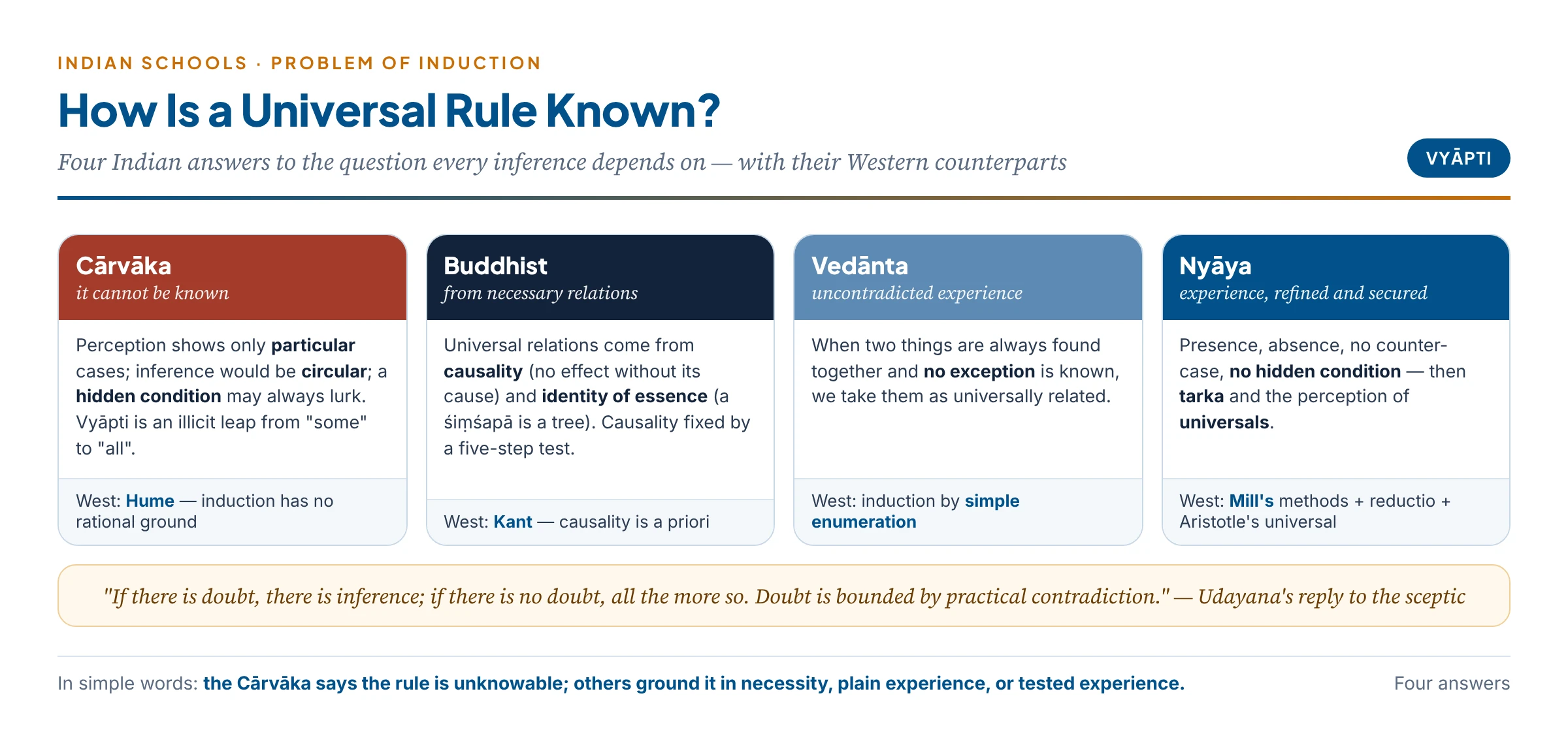
- Cārvāka — it cannot be known. Only perception is valid; perception gives particulars; so vyāpti is an “illicit generalisation”. Even the elimination of hidden conditions is incomplete, for we cannot perceive all possible conditions.
- Buddhists — from two a priori relations. Vyāpti is guaranteed by:
- Tadutpatti — causality. If two things are cause and effect, they are universally related, since no effect exists without its cause. The causal relation is fixed by the five-step method (pañcakāraṇī): neither cause nor effect is perceived → the cause is perceived → the effect immediately follows → the cause disappears → the effect immediately disappears.
- Tādātmya — identity of essence. If two things share an essence, they are universally related: whatever is a śiṃśapā (a kind of tree) is a tree; men are animals because animality belongs to their essence.
- These principles are like Kant’s a priori categories: conditions of experience, not products of it.
- Vedānta — simple enumeration. Vyāpti comes from the uncontradicted experience of agreement in presence: when two things are always found together and no exception is known, we take them as universally related.
- Nyāya — experience, refined and secured. Agrees with Vedānta that vyāpti comes from experience, not from a priori principles; goes beyond it with elimination of conditions, tarka and sāmānyalakṣaṇa.
| School | How vyāpti is known | Western parallel |
|---|---|---|
| Cārvāka | It cannot be known | Hume — no rational ground for induction |
| Buddhist | From causality and identity of essence — necessary principles | Kant — causality as an a priori category |
| Vedānta | From uncontradicted experience of agreement | Induction by simple enumeration |
| Nyāya | Observation (presence, absence, no counter-case) + elimination of conditions + tarka + perception of universals | Mill’s methods + reductio + Aristotle’s grasp of the universal |
8. Nyāya’s Reply to the Cārvāka
The 2022 paper asked how the Naiyāyikas answer the Cārvāka’s objections and establish inference as an independent means of knowledge; the 2016 paper asked whether the Cārvāka view of vyāpti is acceptable to them.
- (a) The Cārvāka’s rejection is itself an inference. To say “inference is invalid” is to argue from observed failures of inference to all inferences. The sceptic uses the very method he denies — his position is self-refuting.
- (b) Doubt presupposes inference. Udayana: if there is doubt, there is inference. One doubts only when there is some reason for doubt; reasons are inferences.
- (c) Life without inference is impossible. Without inference one could not know other minds, the past, the absence of fire in water, or even that one’s own perception is reliable. The Cārvāka himself avoids fire because he expects it to burn — an inference.
- (d) Even the Cārvāka distinguishes true and false perception. That distinction needs a criterion perception alone cannot give.
- (e) Vyāpti is a natural relation, not a mere habit. The relation of smoke and fire is in things (a natural relation, svābhāvika sambandha), grounded in causation and in the universals smoke-ness and fire-ness.
- (f) The method answers the hidden-condition worry. Repeated observation in varied circumstances is designed to expose conditions; tarka shows that denying the rule leads to absurdity; and the perception of universals grounds universality.
- (g) Inference is independent. It cannot be reduced to perception: its object (fire behind the hill) is not perceived, and its instrument is the knowledge of a universal relation, which perception alone does not give.
In simple words
A man says: “Never trust predictions — all predictions are unreliable, because the ones I checked failed.” He has just made a prediction about all future predictions, from a few past cases. The Cārvāka who rejects inference “because no rule from past cases can cover all cases” is doing exactly what he forbids.
- Is the Cārvāka view acceptable to the Naiyāyikas? No — for the reasons above. But Nyāya learnt from it: its careful doctrines of upādhi, tarka and sāmānyalakṣaṇa were sharpened precisely to answer the Cārvāka doubt.
9. Is Nyāya’s Answer Adequate?
- Strengths.
- The six steps form a rigorous method of induction — far more careful than simple enumeration.
- Upādhi theory anticipates the modern search for confounding variables.
- Tarka makes clear that universal rules are held open to refutation but accepted until refuted.
- Grounding vyāpti in natural relations and universals gives it more than psychological force.
- Weaknesses.
- No complete elimination. We can never prove that all possible hidden conditions have been eliminated.
- Tarka presupposes causation. It relies on the law of universal causation, itself a universal proposition — the sceptic may say the question has only been pushed back.
- Sāmānyalakṣaṇa by fiat. Perception of universals as the ground of induction looks like a device invented to close the gap; and if one perception of smoke-ness gives all smoke, the earlier steps seem redundant.
- Buddhist objection. Universals are not real, so they cannot be perceived.
- Balanced verdict. Nyāya does not achieve logical certainty from finite experience — no theory does. But it offers the most systematic Indian account of how a universal rule may be responsibly held: tested, freed of hidden conditions, defended against doubt, and grounded in the natures of things. Its weak point is the very one modern philosophy calls the problem of induction.
Critical Evaluation
Objections (Pūrva-pakṣa)
- Cārvāka: vyāpti is an illicit generalisation; hidden conditions can never be ruled out; inference is circular.
- Buddhist: experience alone cannot give necessity; only causality and identity of essence can — and universals are not real.
- Vedānta: sāmānyalakṣaṇa is unnecessary; uncontradicted experience suffices.
- Modern critics: tarka assumes the law of causation; perception of universals answers the problem by decree.
Defences and Strengths
- Self-refutation of radical scepticism: the denial of inference is an inference.
- Practical contradiction (vyāghāta) limits doubt to what can be lived.
- A multi-layered method — observation, variation, elimination, reductio, insight into kinds — matches the practice of science.
- Openness to refutation: a single counter-case would overthrow a vyāpti.
Critics and Defenders
Criticism — Critics
- Cārvāka: perception sees only particulars; vyāpti is guesswork; hidden conditions can always lurk.
- Buddhists (Dharmakīrti): necessity needs causality or identity of essence, not tally of cases.
- Vedāntins: perception of universals is superfluous — uncontradicted experience is enough.
- Modern critics: tarka rests on the causal law; sāmānyalakṣaṇa solves induction by fiat.
Defence — Defenders and strengths
- The sceptic’s denial of inference is itself an inference.
- Doubt needs reasons and stops at practical contradiction — “why seek fire to cook?”
- Elimination of upādhi through varied observation is a genuine scientific method.
- Grounding rules in universals explains why “all men are mortal” is surer than “all crows are black”.
Cross-Tradition Comparison
Nyāya and the Western Problem of Induction
| Issue | Nyāya | Western parallel |
|---|---|---|
| The problem | How is “wherever smoke, there fire” known for all times and places? | Hume — no rational ground for expecting the future to resemble the past |
| Positive and negative instances | Anvaya and vyatireka | Mill’s methods of agreement, difference and the joint method |
| Hidden condition | Upādhi — wet fuel, electric current | Confounding variable; Mill’s warning about plurality of causes |
| Varied observation | Bhūyo-darśana | Bacon’s tables of presence, absence and degrees |
| Reductio | Tarka — denying the rule makes smoke causeless | Reductio ad absurdum; Popper’s falsifiability |
| Limits of doubt | Doubt must be livable (vyāghāta); “if there is doubt, there is inference” | Wittgenstein, On Certainty: doubt presupposes certainty; Moore’s common sense |
| Necessity of the rule | Grounded in universals and natural relations | Aristotle — grasping the universal in the particular; Kant — causality a priori |
Indian Connect — Key takeaways
- The Cārvāka–Nyāya debate is the Indian problem of induction, about two thousand years before Hume.
- Nyāya’s upādhi is the classical Indian discovery of the confounding variable.
- Tarka combines the reductio of formal logic with a pragmatic limit on doubt that modern philosophers reach through Wittgenstein and Moore.
- The Buddhist appeal to causality and identity of essence anticipates Kant; the Vedānta view is plain enumerative induction; Nyāya stands closest to Mill and Aristotle combined.
Synthesis (Siddhānta)
- Vyāpti is the invariable, unconditional concomitance of hetu and sādhya — “smoke is pervaded by fire” — and is the nerve of inference.
- It may be of equal or unequal extension, positive or negative.
- A false vyāpti hides an upādhi — a condition that goes with the sādhya but not with the hetu (wet fuel, electric current).
- Nyāya establishes vyāpti by agreement in presence and absence, no counter-case, elimination of conditions through varied observation, then secures it by tarka and grounds it in the perception of universals.
- Against the Cārvāka, Nyāya shows that the denial of inference is self-refuting, that doubt presupposes inference, and that practical life is impossible without it.
- Contemporary relevance.
- Medicine and public health. Before declaring that a drug cures a disease, trials look for hidden conditions (age, diet, placebo effect) — the elimination of upādhi.
- Data science. “Correlation is not causation”: a correlation may hide a third factor. Nyāya’s distinction between mere co-existence and vyāpti is the same warning.
- Science policy. Scientific laws are held until refuted — the tarka attitude.
- Everyday reasoning. Stereotypes are false vyāptis — generalisations from limited cases that ignore conditions.
“If there is doubt, there is inference; if there is no doubt, all the more so. Doubt is bounded by practical contradiction; tarka is the boundary of doubt.” — Udayana
Previous Year Questions
- 2022How do Naiyayikas respond to Carvaka’s objections against inference (anumana) and establish inference as an independent means of knowledge? Critically discuss.
- 2018Is Carvakas rejection of inference acceptable to the other systems of Indian philosophy? If not, why? Do you think the views of other systems to be justified? Give reasons for your answer.
- 2016What would be Carvaka’s view on Vyapti? Can this view be acceptable to the Naiyayikas? Give reasons for your answer.
- 2013Analyse the Nyaya concept of vyapti and examine its relation with tark.
- 2008Discuss critically Nyaya notion of Vyapti.
- 2001Evaluate the Nyaya-Vaisesika theory of the nature of Vyapti.
- 2000The Nyaya view of our knowledge of generalizations (Vyapti). Short Notes.
- 1999Explain the Nyaya-Vaisesika theory of vyapti and vyapti-jnana.
- 1994What is ‘Vyapti’? How is it known? Discuss with special reference of the Nyaya System.
- 1990What is Universal relation (Vyapti) according to the Nyaya? How is it ascertained?