

Nyāya–Vaiśeṣika: Theory of Categories; Theory of Appearance; Theory of Pramāṇa; Self, Liberation; God; Proofs for the Existence of God; Theory of Causation; Atomistic Theory of Creation
Official Syllabus: Paper I, Section B, Unit 15
Inference (anumāna) is the second pramāṇa of Nyāya and the heart of Indian logic. Literally anu + māna means “knowledge that follows” other knowledge: from smoke seen on a hill we know the fire we do not see. But not every “because” gives knowledge. Nyāya therefore analysed inference into its three terms, its psychological steps and its logical ground; laid down the famous five-membered syllogism (pañcāvayava) for proving a truth to others; classified inferences in three ways; fixed five marks that a valid reason (hetu) must have; and listed the five fallacies (hetvābhāsa) that arise when a reason only looks valid. This article covers all of these. The deeper question — how we know the universal relation (vyāpti) on which every inference rests — is the subject of Article 4.
In simple words
You come home and find the street wet, puddles everywhere, but the sky is now clear. Without seeing it, you know: “It rained here.” You did not perceive the rain; you inferred it from the wet street, because you know that wherever streets are wet like this, it has rained — and you have checked that no water tanker or burst pipe explains it. That is anumāna: a mark you see (wet street), a rule you know (wet streets go with rain), and a conclusion about what you do not see.
Context & Problem
Why Inference Needs a Theory
- Most of our knowledge goes beyond what we see. We know of fires behind hills, rain upstream, the motion of the moon, the existence of other minds and of our own self — none of it directly perceived.
- But inference can mislead. “The hill is fiery because it is knowable” sounds like an inference, yet it proves nothing. “Sound is eternal because it is produced” even proves the opposite. We need rules that separate a genuine reason from a pseudo-reason.
- The Cārvāka challenge. The materialists denied that inference is a pramāṇa at all: the universal relation it needs can never be known (Unit 12). Nyāya’s careful theory of inference is in large part a reply.
- Inference for others. Debate was central to Indian intellectual life. A school needed a standard form in which a proof could be laid out so that an opponent could check every step — hence the five-membered syllogism.
Core Doctrine
1. What Inference Is
- Definition. Anumāna is the knowledge of an unperceived thing through the knowledge of a mark (liṅga) that is invariably related to it. Gautama says inference is “preceded by perception” (tat-pūrvakam) and is of three kinds.
- Mediate knowledge. Unlike perception, inference is indirect: it reaches its object only through a mark.
- Two classic illustrations.
- “The hill is fiery, because it smokes, and whatever smokes is fiery.”
- “Devadatta is mortal, because he is a man, and all men are mortal.”
- In one sentence. Inference is “the process of ascertaining, not by perception or direct observation, but through the medium of a mark, that a thing possesses a certain character.”
2. The Three Terms (and the Instances Around Them)
Every inference contains three terms — the Indian counterparts of the minor, major and middle terms of the Western syllogism.
| Indian term | Western name | Meaning | In “the hill has fire, because it has smoke” |
|---|---|---|---|
| Pakṣa | Minor term | The subject about which something is to be proved | The hill |
| Sādhya | Major term | The property to be proved of the subject | Fire |
| Hetu (also liṅga, sādhana) | Middle term | The reason or mark that links the two | Smoke |
| Sapakṣa | Similar instance | A place where the sādhya is known to be present | The kitchen — fire and smoke |
| Vipakṣa | Dissimilar instance | A place where the sādhya is known to be absent | A lake — no fire, no smoke |
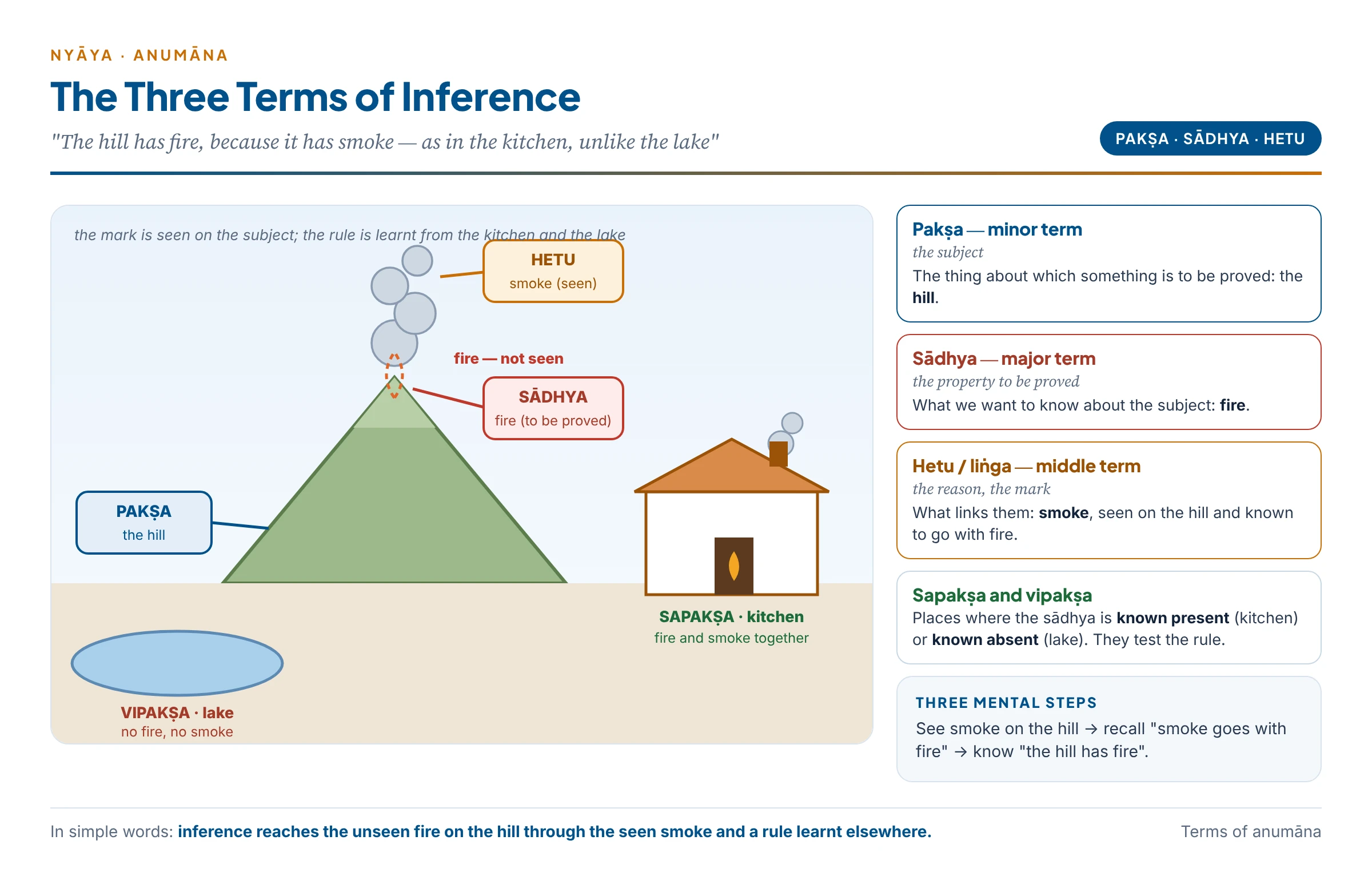
3. How an Inference Happens — and What Grounds It
- Three steps in the mind of the one who infers.
- Apprehension of the mark in the subject — “I see smoke on the hill” (pakṣadharmatā-jñāna).
- Recollection of the universal relation — “wherever there is smoke there is fire” (vyāpti-smaraṇa).
- Cognition of the conclusion — “the hill has fire” (anumiti).
- The two grounds of inference.
- Logical ground — vyāpti. The invariable, unconditional relation between hetu and sādhya. It guarantees the conclusion and is called the “nerve of inference“.
- Psychological ground — parāmarśa. The combined cognition “this hill has smoke which is always accompanied by fire” — the mark known as present in the subject and as pervaded by the sādhya (vyāpti-viśiṣṭa-pakṣadharmatā-jñāna). It is the immediate cause of the conclusion.
- The “third look” at the mark (tṛtīya-liṅga-parāmarśa). We see smoke first in the kitchen together with fire (where we learn the rule); we see smoke a second time on the hill; the third cognition sees the hill’s smoke as the kind of smoke that goes with fire. This third cognition is parāmarśa — the decisive step.
- Three conditions of a valid inference.
- Pakṣadharmatā — the mark must be present in the subject (smoke on the hill).
- Vyāpti — the mark must be universally related to the sādhya (smoke always with fire).
- Avyabhicāra — the relation must not be contradicted by any case of smoke without fire.
4. Inference for Oneself and Inference for Others
- Svārthānumāna — inference for oneself. A person sees smoke on a hill, remembers that smoke goes with fire, and concludes that there is fire. It needs no formal statement; it happens in the mind in the three steps above.
- Parārthānumāna — inference for others. Having inferred the fire, the person wants to convince someone who doubts it. Now the reasoning must be stated publicly, in a fixed order, with no gap. Nyāya requires five members (avayava).
5. The Five-Membered Syllogism (Pañcāvayava)
| # | Member | Function | Fire example | Mortality example |
|---|---|---|---|---|
| 1 | Pratijñā (thesis) | States what is to be proved | The hill has fire. | Ram is mortal. |
| 2 | Hetu (reason) | States the reason | Because it has smoke. | Because he is a man. |
| 3 | Udāharaṇa (example) | States the universal rule with a known instance | Wherever there is smoke there is fire, as in a kitchen. | All men are mortal, as Socrates, Kant, Hegel. |
| 4 | Upanaya (application) | Applies the rule to the present case | This hill has such smoke (smoke invariably accompanied by fire). | Ram too is a man. |
| 5 | Nigamana (conclusion) | Draws the conclusion, now proved | Therefore the hill has fire. | Therefore Ram is mortal. |
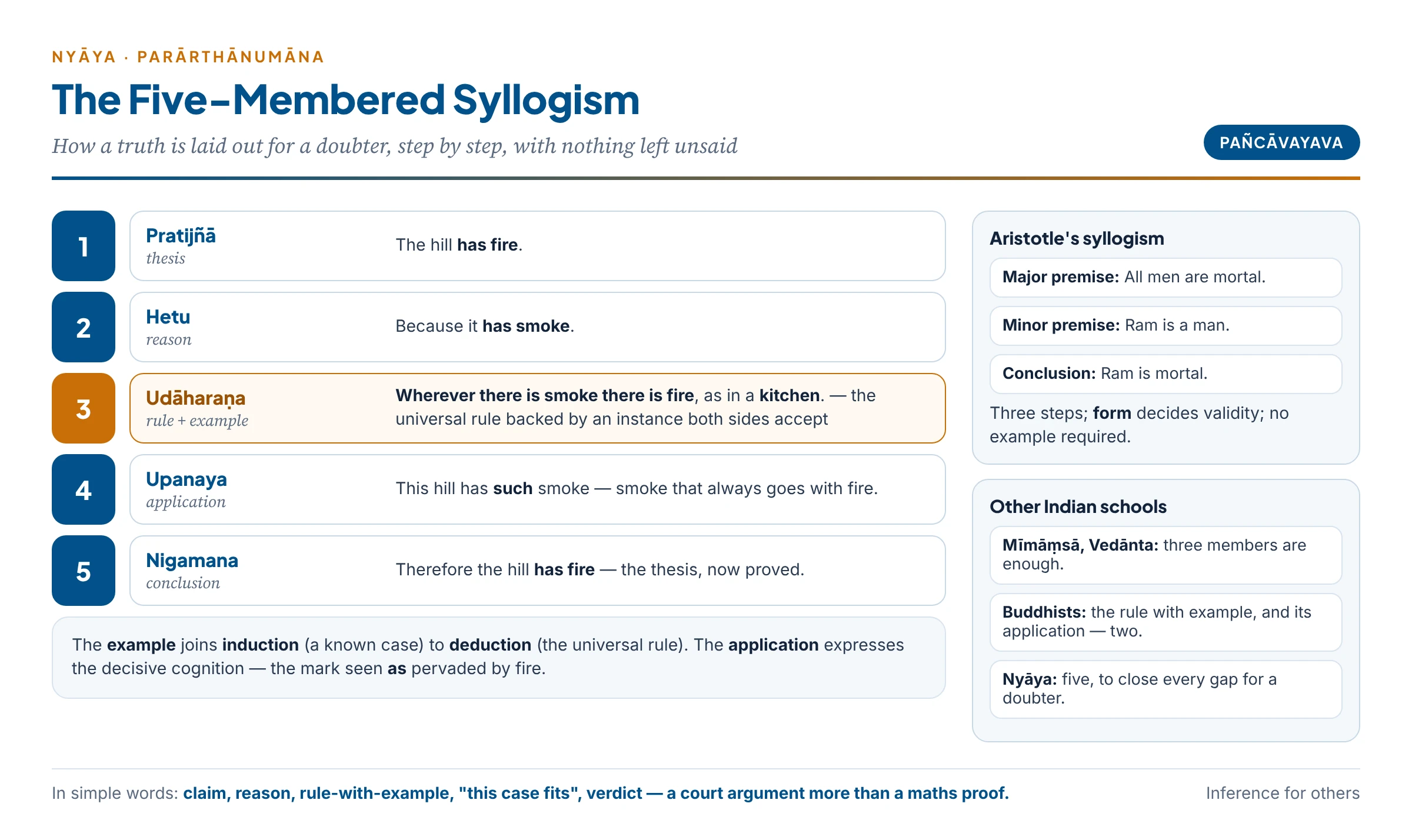
- The heart is the udāharaṇa. It joins a universal rule (deduction) to a concrete instance (induction). The example (dṛṣṭānta) must be one that both parties accept — everyone agrees that smoke and fire go together in a kitchen.
- The upanaya expresses the decisive step. “This hill has such smoke” — smoke qualified as pervaded by fire — is the verbal form of parāmarśa, the third look at the mark.
- Why repeat the thesis as the conclusion? The first member states a claim in doubt; the last states the same proposition as proved. The listener sees exactly what has been established.
- Order is fixed and must not be changed.
- Other schools.
- Mīmāṃsā and Vedānta hold that three members suffice — either the first three (thesis, reason, example) or the last three (example, application, conclusion).
- Buddhist logicians (Dharmakīrti) reduce the statement to two: the universal rule with an example, and its application to the case — the rest is understood.
- Nyāya’s answer. Five members are needed for full demonstration to a doubter in debate: each step closes a gap the opponent might exploit.
6. The Indian and the Aristotelian Syllogism
| Point | Nyāya five-membered syllogism | Aristotelian syllogism |
|---|---|---|
| Number of propositions | Five (three in the mind for oneself) | Three |
| Order | Thesis first, conclusion last; the universal rule in the middle | Major premise, minor premise, conclusion |
| Nature | Deductive and inductive together — the rule is backed by an example | Mainly deductive and formal |
| Truth of premises | Must be materially true — the example must be real and accepted | Validity depends on form; true premises are a separate matter |
| Fallacies | Material (hetvābhāsa) — defects in the reason’s relation to facts | Mainly formal — undistributed middle, illicit major |
| Purpose | Persuading a doubter; arriving at truth | Demonstration; teaching of necessary truths |
| Psychological side | Includes the thinker’s steps (apprehension, recollection, parāmarśa) | Purely logical relations between propositions |
- “Formally valid and materially true.” Indian inference is a combined deductive–inductive reasoning; every inference is meant to be both formally correct and true to fact. Hence Indian logic does not split inferences into “deductive” and “inductive” the way Western logic does.
In simple words
Aristotle’s syllogism is like a mathematical proof — if the form is right, the conclusion follows. Nyāya’s syllogism is like a court argument — the lawyer states the claim, gives the reason, cites the rule with a precedent everyone accepts, shows that this case fits the precedent, and asks for the verdict. Both are valid; Nyāya’s is built for persuading a doubter with facts.
7. Three Classifications of Inference
(a) By purpose — psychological classification.
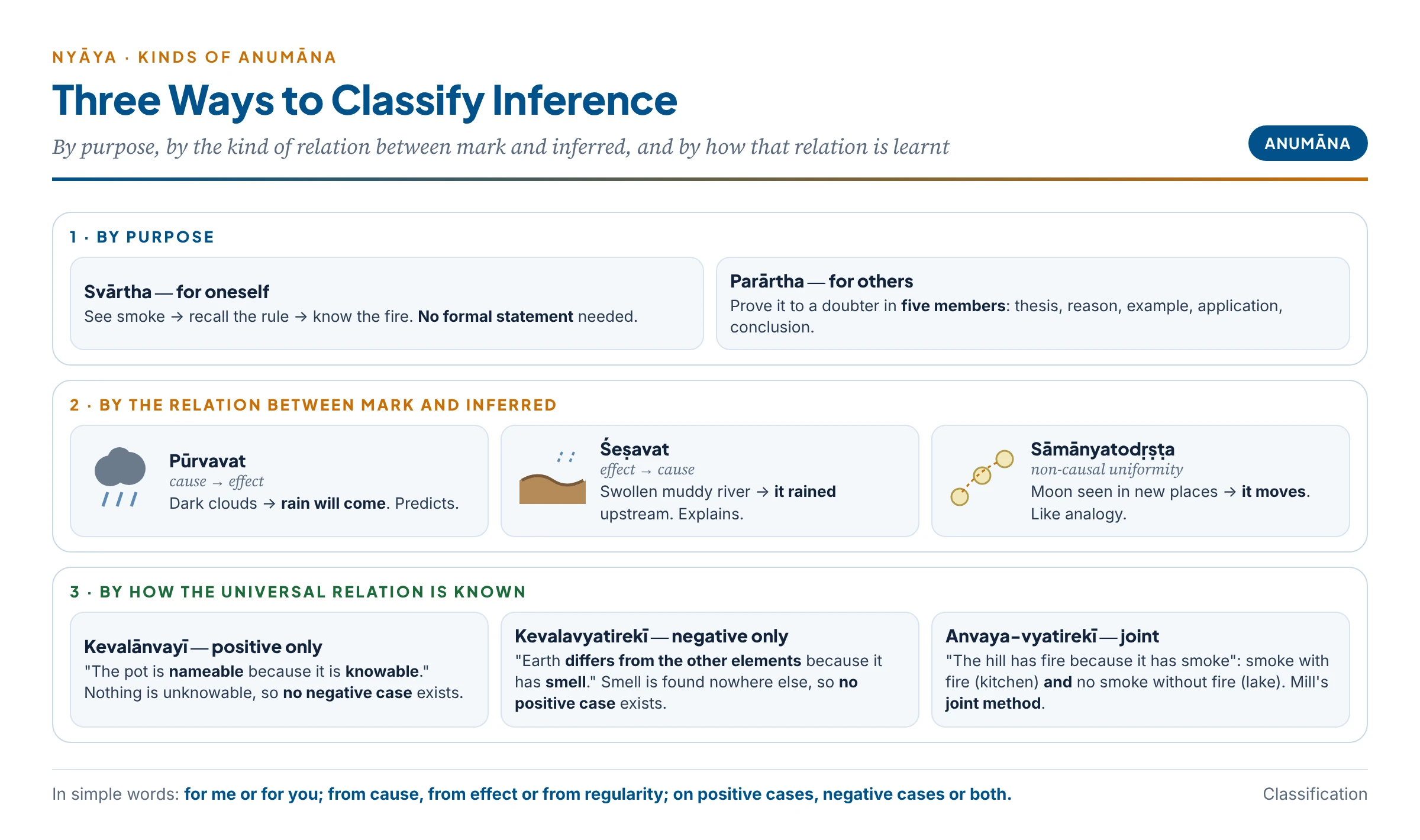
- Svārtha (for oneself) and parārtha (for others), explained above.
(b) By the nature of the universal relation — pūrvavat, śeṣavat, sāmānyatodṛṣṭa.
- Pūrvavat — from cause to effect.
- We infer an unperceived effect from a perceived cause: dark heavy clouds → rain will come.
- It predicts the future.
- Śeṣavat — from effect to cause.
- We infer an unperceived cause from a perceived effect: a swollen, swift, muddy river → it has rained upstream.
- It explains the past.
- Sāmānyatodṛṣṭa — from general observation, not causation.
- The mark and the inferred are neither cause nor effect of each other; they are simply found together in experience.
- Moon’s motion. Seeing the moon in different positions at different times, we infer that it moves — because elsewhere change of position always goes with motion — though we never see the moon move.
- Horns and hoofs. Seeing an unknown animal’s horns, we infer that it has cloven hoofs.
- The self. Desire, aversion and cognition are qualities; qualities need a substance; so there must be a substance — the self — though we never see it.
- This kind of inference is close to the argument from analogy.
- Pūrvavat and śeṣavat rest on causal uniformity (“scientific induction”); sāmānyatodṛṣṭa on non-causal uniformity.
- An older reading. Early commentators also read pūrvavat as inference “from what was previously seen together”, and śeṣavat as inference by elimination (pariśeṣa): sound is not a substance and not an action; so it must be a quality.
(c) By the method of knowing the vyāpti — logical classification.
- Kevalānvayī — positive only.
- The vyāpti is known only by agreement in presence, because there is no negative instance at all.
- “All knowable objects are nameable; the pot is knowable; so the pot is nameable.” Nothing is unknowable or unnameable — we cannot find a single counter-case to examine.
- In form it is a syllogism in Barbara.
- Kevalavyatirekī — negative only.
- The vyāpti is known only by agreement in absence, because there is no positive instance apart from the subject itself.
- “Whatever is not different from the other elements has no smell; earth has smell; so earth is different from the other elements.” Smell is found only in earth, so no other case can show smell together with “difference from other elements”.
- Here a negative premise yields an affirmative conclusion — against the canons of formal logic — yet Bradley admitted such reasoning as a special case of negative inference.
- Anvaya-vyatirekī — positive and negative.
- The vyāpti is known by both agreement in presence and agreement in absence — Mill’s joint method.
- “All smoky objects are fiery; the hill is smoky; so the hill is fiery.” And: “No non-fiery object is smoky; the hill is smoky; so the hill is fiery.”
Common confusion
Is “sound is non-eternal because it is produced” an example of a purely positive (kevalānvayī) inference? No. Some notes give it as one. A kevalānvayī inference is one with no possible negative instance at all — like “knowable → nameable”, where nothing is unknowable. But for “produced → non-eternal” there are negative instances: eternal things like ether, time and space are not produced. So this inference uses both positive and negative instances; it is anvaya-vyatirekī. The textbook examples are: kevalānvayī — “the pot is nameable because it is knowable”; kevalavyatirekī — “earth differs from the other elements because it has smell”.
(d) A further division — by the kind of object.
- Dṛṣṭārtha — the inferred is perceptible in principle (fire behind the hill can be seen if we go there).
- Adṛṣṭārtha — the inferred is never perceptible to ordinary senses: the self from desire and memory, God from the world as an effect, adṛṣṭa (unseen merit) from unequal fortunes.
8. The Five Marks of a Valid Hetu (Pañca-rūpa)
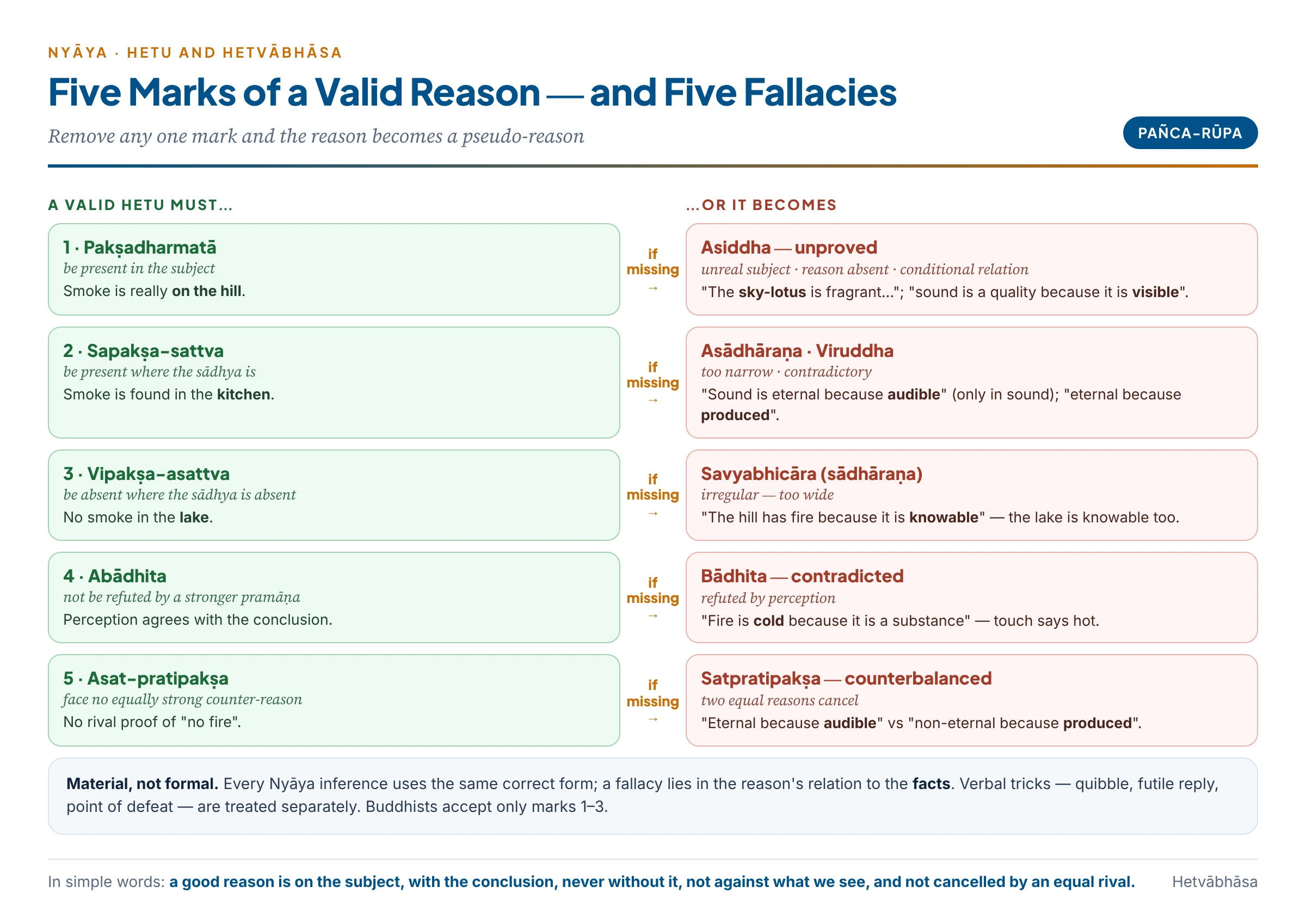
The 2026 and 2017 papers asked what makes an inferential sign valid. A genuine hetu must have five characteristics:
- Pakṣadharmatā — present in the subject.
- Smoke must actually be on the hill.
- Sapakṣa-sattva — present in similar instances.
- Smoke must be found where fire is known to be present — in the kitchen.
- Vipakṣa-asattva — absent from dissimilar instances.
- Smoke must be absent where fire is known to be absent — in the lake.
- Abādhita-viṣayatva — its conclusion is not contradicted by a stronger pramāṇa.
- The reason must not be used to prove what perception already denies — such as the coldness of fire.
- Asat-pratipakṣatva — no equally strong counter-reason.
- There must be no rival reason, equally strong, that proves the opposite conclusion.
In simple words
Think of a blood test for a disease. A good marker must (1) actually show up in this patient, (2) show up in everyone who has the disease, (3) never show up in healthy people, (4) not contradict what the doctor can plainly see, and (5) not be cancelled by another equally reliable test pointing the other way. A hetu is valid on exactly these five conditions.
- The Buddhist “three marks” (trairūpya). Dignāga and Dharmakīrti accept only the first three — presence in the subject, presence in similar instances, absence from dissimilar instances. Nyāya adds the last two to cover conflicts with other pramāṇas and with other inferences.
- Adjustments for special inferences. In a purely positive inference there are no dissimilar instances, so the third mark cannot apply; in a purely negative inference there are no similar instances, so the second cannot apply. The marks hold “as far as applicable”.
- Why five? The first three secure the vyāpti and its application; the last two secure the conclusion against being overturned — by perception or by a counter-argument.
9. Hetvābhāsa: The Fallacies of Inference
- Meaning. Hetvābhāsa means “a reason that appears to be, but is not, a valid reason“. It is a pseudo-hetu.
- Material, not formal. In Indian logic every inference is stated in the same correct form; so if an inference fails, the fault lies in the material relation of the reason to the facts, not in the form. Hence the hetvābhāsas are material fallacies. Errors due to ambiguous words — which Aristotle classed as fallacies “in language” — are treated separately under chala (quibble), jāti (futile reply) and nigrahasthāna (point of defeat).
- Five kinds, each violating one of the five marks:
In simple words
A detective says: “The butler did it, because he was in the house.” But everyone was in the house — the reason fits the innocent as well as the guilty (irregular). “Because he loved the victim” — that argues against him (contradictory). “Because his fingerprints are on the knife” — but the gardener’s equally clear prints point elsewhere (counterbalanced). “Because of his twin brother’s confession” — he has no twin (unproved). “Because he was seen at midnight” — but CCTV shows him abroad (contradicted). These are the five hetvābhāsas.
(1) Savyabhicāra — the irregular (inconclusive) reason.
- Also called anaikāntika — “not invariably concomitant”. The reason goes with both the presence and the absence of the sādhya, so it leads to no single conclusion.
- “The hill has fire because it is knowable” — knowable things include the fiery kitchen and the fireless lake.
- “All bipeds are rational; swans are bipeds; so swans are rational” — bipeds include rational and non-rational creatures.
- Three sub-kinds.
- Sādhāraṇa — too wide. Present in similar and dissimilar instances: “the hill has fire because it is knowable”.
- Asādhāraṇa — too narrow. Present only in the subject, in no similar or dissimilar instance: “sound is eternal because it is audible” — audibility belongs to sound alone.
- Anupasaṃhārin — non-exclusive. The subject is everything, so no instance is left to test the rule: “all things are non-eternal because they are knowable”.
(2) Viruddha — the contradictory reason.
- The reason proves the opposite of what it is meant to prove.
- “Sound is eternal because it is produced” — whatever is produced is non-eternal.
- “Air is heavy because it is empty” — emptiness disproves heaviness.
- Difference from savyabhicāra. Savyabhicāra fails to prove the conclusion; viruddha disproves it.
(3) Satpratipakṣa — the counterbalanced reason.
- The reason is met by another reason of equal strength proving the opposite.
- “Sound is eternal because it is audible” is countered by “sound is non-eternal because it is produced, like a pot”. The two cancel; neither conclusion follows; doubt remains.
- Difference from viruddha. In viruddha the reason itself proves the opposite; in satpratipakṣa a different reason does.
(4) Asiddha — the unproved reason (also called sādhyasama, “as unproved as the conclusion”).
- The reason is not established in the subject — so it cannot prove anything about it.
- Three sub-kinds.
- Āśrayāsiddha — the subject does not exist. “The sky-lotus is fragrant because it is a lotus, like a pond-lotus” — there is no sky-lotus to have lotus-ness.
- Svarūpāsiddha — the reason cannot belong to the subject. “Sound is a quality because it is visible” — sound is heard, never seen.
- Vyāpyatvāsiddha — the relation is conditional. “The hill has smoke because it has fire” — fire yields smoke only on the condition of wet fuel (an upādhi), so fire is not a true mark of smoke.
(5) Bādhita — the contradicted reason.
- The conclusion is refuted by a stronger pramāṇa, usually perception.
- “Fire is cold because it is a substance” — touch shows that fire is hot.
- “Sugar is sour because it produces acidity” — taste shows it is sweet.
- Ancient Nyāya called it kālātīta or kālātyayāpadiṣṭa — “a reason put forward too late“, after its conclusion has already been disproved.
- Difference from satpratipakṣa. In satpratipakṣa an inference is opposed by another inference; in bādhita it is refuted by perception or another non-inferential pramāṇa.
10. Fallacies Mapped onto the Five Marks
The 2023 paper asked for the fallacies in relation to the five characteristics of a valid middle term.
| Mark of a valid hetu | What it guards | Fallacy when it fails | Example |
|---|---|---|---|
| Pakṣadharmatā — in the subject | The reason really belongs to the subject | Asiddha (all three kinds) | “The sky-lotus is fragrant…”; “sound is visible” |
| Sapakṣa-sattva — in similar cases | The reason is found where the sādhya is | Asādhāraṇa savyabhicāra; viruddha (found only where the sādhya is absent) | “Sound is eternal because audible” |
| Vipakṣa-asattva — absent from dissimilar cases | The reason is never found where the sādhya is absent | Sādhāraṇa savyabhicāra; viruddha | “Fire because knowable”; “eternal because produced” |
| Abādhita — not refuted by a stronger pramāṇa | The conclusion fits perception | Bādhita | “Fire is cold because a substance” |
| Asat-pratipakṣa — no equal counter-reason | No rival proof of the opposite | Satpratipakṣa | “Eternal because audible” versus “non-eternal because produced” |
- The New Nyāya view. Gaṅgeśa redefined a fallacy as a fact which, if known, blocks the inference — for instance, the known absence of fire on the hill blocks the conclusion that the hill has fire. Every fallacy opposes one of three claims an inference makes: the conclusion, the universal relation, or the presence of the reason in the subject.
Common confusion
Is satpratipakṣa just “two people arguing”? No. A satpratipakṣa arises only when the counter-reason is of equal strength — itself well-founded. If an opponent merely says “the hill has no fire because it is a wet place”, that does not make a genuine smoke-inference fallacious: wetness is no proof of the absence of fire. In a real satpratipakṣa, each reason is as good as the other, so the mind is left in doubt — as with “sound is eternal because audible” against “sound is non-eternal because produced”.
11. Fallacies of Debate: Chala, Jāti and Nigrahasthāna
These belong to the sixteen padārthas (Article 1) and cover the verbal and dialectical errors that Western logic treats as fallacies of language.
- Chala — quibble. Twisting a word’s sense: “the boy is nava-kambala” (has a new blanket) attacked as “he does not have nine blankets”.
- Jāti — futile reply. An objection based on a mere likeness or unlikeness: “Sound is non-eternal because it is produced, like a pot” answered by “No — sound is eternal because, like the sky, it is bodiless.” There is no universal relation between bodilessness and eternity — pleasure is bodiless and fleeting.
- Nigrahasthāna — point of defeat. Arising from misunderstanding or not understanding: shifting one’s thesis, contradicting oneself, using a fallacious reason, failing to answer.
Critical Evaluation
Objections (Pūrva-pakṣa)
- Cārvāka. Inference rests on a universal relation that can never be known — we see only some cases; hidden conditions may exist; testimony and inference cannot supply it without circularity (Article 4).
- Buddhist. Only three marks are needed; universals are constructions; Nyāya’s five members are redundant — the rule and its application suffice.
- Mīmāṃsā and Vedānta. Three members suffice; the five-step form is repetitive — the thesis appears twice.
- Formal logicians. The five-membered form mixes logic and rhetoric; the kevalavyatirekī inference breaks the canons of the syllogism; the psychological steps (recollection, parāmarśa) belong to psychology, not logic.
- Western critics. Nyāya does not separate validity (form) from soundness (true premises) clearly, and has no theory of formal fallacies.
Defences and Strengths
- Designed for real argument. The five members are meant to convince a doubter in debate; repetition makes the proof transparent and each gap answerable.
- Logic joined to fact. Requiring an accepted example keeps reasoning tied to experience — a safeguard against valid-but-false syllogisms.
- Precision about reasons. The five marks and five fallacies give a complete checklist for testing any reason — far more detailed on material fallacies than Aristotle.
- Psychology is not a fault. Nyāya studies knowledge as an event in the knower; describing its steps is part of its epistemology.
- Negative reasoning. The kevalavyatirekī inference captures a real form of reasoning that classical formal logic missed and later logicians (Bradley) accepted.
Critics and Defenders
Criticism — Critics
- Cārvāka: the universal relation behind every inference is unknowable; inference is guesswork.
- Dignāga, Dharmakīrti: three marks suffice; five members are redundant.
- Mīmāṃsakas, Vedāntins: three members are enough; the five-step form repeats itself.
- Formal logicians: Nyāya mixes logic with rhetoric and psychology; negative-only inference breaks syllogistic rules.
Defence — Defenders and strengths
- The five members are built for public proof: every gap an opponent might attack is closed.
- The example ties the universal rule to accepted fact — reasoning is both valid and true.
- Five marks and five fallacies form an exhaustive test of a reason.
- Studying inference as an event of knowing is a strength of epistemology, not a confusion.
- Negative-only inference, endorsed by Bradley, shows Nyāya saw forms Aristotle missed.
Cross-Tradition Comparison
Nyāya, Aristotle and Modern Logic
| Issue | Nyāya | Western parallel |
|---|---|---|
| Terms | Pakṣa, sādhya, hetu | Minor, major, middle terms |
| Form | Five members; thesis first | Three propositions; conclusion last (Aristotle) |
| Basis of the major premise | Vyāpti known by observation, tarka and perception of universals | Aristotle: induction (epagōgē) from particulars; Mill: methods of agreement and difference |
| Types of inference | Cause → effect, effect → cause, non-causal | Prediction, explanation, analogy |
| Logical classification | Positive-only, negative-only, joint | Mill’s method of agreement, method of difference, joint method |
| Fallacies | Material — defects of the reason | Mainly formal (undistributed middle); informal fallacies of language |
| “Too narrow” reason | Asādhāraṇa — found only in the subject | A sample of one; hasty generalisation |
| Counterbalanced reasons | Satpratipakṣa | Kant’s antinomies — equally strong proofs of opposite theses |
| Unreal subject | Āśrayāsiddha — the sky-lotus | Russell’s “the present King of France” — claims about non-existent subjects |
Indian Connect — Key takeaways
- The Nyāya syllogism is deductive and inductive at once; Western logic separated the two and then struggled to reconnect them (the problem of induction).
- The Nyāya list of fallacies is a list of ways a reason can fail the facts, close to modern informal logic and the logic of evidence.
- Satpratipakṣa anticipates the structure of Kant’s antinomies; āśrayāsiddha anticipates Russell’s puzzle of empty names.
Synthesis (Siddhānta)
- Inference is knowledge of the unperceived through a mark universally related to it; its logical ground is vyāpti and its psychological ground is parāmarśa — the mark seen in the subject as pervaded by the sādhya.
- For oneself, inference is a three-step mental process; for others, it is set out in five members — thesis, reason, example, application, conclusion.
- Classifications: for oneself or for others; cause-to-effect, effect-to-cause or non-causal; positive-only, negative-only or joint.
- A valid reason has five marks; when one is missing, a fallacy results — irregular, contradictory, counterbalanced, unproved or contradicted.
- Contemporary relevance.
- Scientific method. Prediction (clouds → rain), explanation (muddy river → rain) and analogy (moon’s motion) map onto how science reasons from evidence.
- Law and policy. Courts weigh counterbalanced evidence (satpratipakṣa), reject claims contradicted by direct evidence (bādhita) and ask whether a reason actually applies to the accused (asiddha).
- Critical thinking and media literacy. “Too wide” reasons (every famous person did X, so X causes fame) and “too narrow” ones (one case) are everyday versions of savyabhicāra.
- Artificial intelligence. Explainable AI asks a system to show its reason, its rule and an example — the Nyāya five members in modern dress.
“Inference is knowledge preceded by perception; it is of three kinds.” — Gautama, Nyāya-sūtra
Previous Year Questions
- 2026According to Nyāya view of inference (Anumāna), what are the characteristics that ascertain the validity of inferential sign (Hetu)? Discuss.
- 2023Elucidate Naiyāyikas account of fallacies of the middle term in relation to five characteristics of valid middle term.
- 2017Explain the conditions of valid hetu as propounded in Nyaya philosophy.
- 2009Hetvabhasa according to Nyaya.
- 2004Nature and kind of anumanas according to Nyaya. Short Notes.
- 1998Discuss the nature and structure of inference according to the Nyaya philosophy and explain the importance of the various steps of pararthanumana.
- 1995What is meant by hetvabhasa in Indian logic? Is it formal or material? What according to Nyaya are its kinds? Explain.
- 1995How do we get valid knowledge according to Nyaya Philosophy. Explain the concept of ‘Anumana’ in this context.