

Nyāya–Vaiśeṣika: Theory of Categories; Theory of Appearance; Theory of Pramāṇa; Self, Liberation; God; Proofs for the Existence of God; Theory of Causation; Atomistic Theory of Creation
Official Syllabus: Paper I, Section B, Unit 15
Nyāya and Vaiśeṣika are two orthodox (āstika) schools that grew up as partners. Vaiśeṣika maps what exists — the categories of reality and the atoms of matter. Nyāya maps how we know what exists — the sources of valid knowledge (pramāṇa), the rules of correct reasoning, and the tests that separate truth from error. Together they form one allied system (samāna-tantra) of logical realism: the world exists independently of our minds, and it can be known as it is, provided we use the right instruments of knowledge. This first article lays the foundation for the whole unit — the sixteen topics of Nyāya, the meaning of valid knowledge (pramā), why memory is excluded from it, how a cognition is itself known (anuvyavasāya), and the famous Nyāya doctrine that the validity of knowledge is extrinsic (parataḥ prāmāṇyavāda).
In simple words
You buy a new thermometer. When it shows 98.6°F, how do you know the reading is right? Nyāya’s answer: the reading itself does not carry a guarantee. Its truth depends on whether the thermometer was sound (no defect in the instrument), and you confirm it when the reading fits what happens next — the patient recovers when treated for the fever the thermometer showed. Knowledge, for Nyāya, is like that reading: it shows an object, but its truth is checked from outside — by the soundness of its causes and the success of the action it leads to.
Context & Problem
Two Allied Systems (Samāna-tantra)
- Nyāya — the school of logic. The word nyāya means “rational argument” or “the method by which a conclusion is reached”. Nyāya is the Indian science of correct thinking. It goes by several names, each showing one side of its work:
- Tarkaśāstra — the science of reasoning.
- Pramāṇaśāstra — the science of the sources of knowledge.
- Hetuvidyā — the science of reasons (causes and grounds).
- Vādavidyā — the science of debate.
- Ānvīkṣikī — the science of critical examination; ancient texts list it beside the Vedas, economics and politics as one of the four sciences.
- Founder and text. Nyāya was founded by Akṣapāda Gautama (also called Gotama), author of the Nyāya-sūtra in five books. Dates given range widely; most notes place him around the 2nd century BCE. He must not be confused with Gautama the Buddha.
- Vaiśeṣika — the school of categories. Vaiśeṣika was founded by Kaṇāda, author of the Vaiśeṣika-sūtra. His name means “atom-eater” — tradition says he lived on grains picked from fields after harvest. He is also called Kaṇabhuk (“eater of particles”), Aulūkya (“son of Ulūka”) and Kāśyapa (after his lineage). The school takes its name from viśeṣa, “particularity” — the category that keeps every eternal thing distinct.
- Why “allied”? The two systems agree on almost everything that matters:
- Realism — the world of many things exists independently of the knower.
- Pluralism — reality consists of many substances (atoms, selves, minds, space, time), not one.
- Soteriology — this life is full of suffering; suffering is due to ignorance of reality; liberation (apavarga) is the absolute end of suffering; and it is reached through right knowledge of reality (tattva-jñāna).
- Division of labour — Vaiśeṣika supplies the metaphysics (prameya-śāstra: what there is); Nyāya supplies the epistemology and logic (pramāṇa-śāstra: how it is known). Over time Nyāya accepted the Vaiśeṣika categories and Vaiśeṣika accepted the Nyāya logic.
- Where they differ.
| Point | Nyāya | Vaiśeṣika |
|---|---|---|
| Main interest | Logic, epistemology, debate | Ontology, categories, atomism |
| Number of pramāṇas | Four — perception, inference, comparison, testimony | Two — perception and inference (comparison and testimony are reduced to inference) |
| Classification of “topics” | Sixteen padārthas — topics of a complete philosophical inquiry | Seven padārthas — categories of all that exists |
| Founding text | Nyāya-sūtra (Gautama) | Vaiśeṣika-sūtra (Kaṇāda) |
Growth of the Tradition
- Ancient Nyāya (prācīna-nyāya). Gautama’s sūtras were explained and defended in a long chain of commentaries, each answering the attacks of rival schools (especially the Buddhists):
- Vātsyāyana (Pakṣilasvāmin) — Nyāya-bhāṣya.
- Uddyotakara — Nyāya-vārttika.
- Vācaspati Miśra — Nyāya-vārttika-tātparya-ṭīkā.
- Udayana — Tātparya-pariśuddhi, the Nyāya-kusumāñjali (the classic proof of God) and the Ātma-tattva-viveka.
- Jayanta Bhaṭṭa — Nyāya-mañjarī.
- Vaiśeṣika commentators. Praśastapāda’s Padārtha-dharma-saṅgraha systematised the categories; Śrīdhara (Nyāya-kandalī) and Udayana (Kiraṇāvalī) commented on it; Śivāditya’s Saptapadārthī fixed the list of seven categories.
- New Nyāya (navya-nyāya). It begins with Gaṅgeśa’s Tattva-cintāmaṇi (14th century). It flourished first in Mithilā and later in Navadvīpa in Bengal. It turned Nyāya into a precise technical logic of relations, concepts and absences.
- Syncretist Nyāya–Vaiśeṣika. Later manuals such as Annambhaṭṭa’s Tarka-saṅgraha and Viśvanātha’s Bhāṣā-pariccheda present the two systems as one.
Common confusion
Did Gautama found Nyāya in Bengal? No. Some handouts say “Gotama flourished in Bengal”. What flourished in Bengal was New Nyāya (navya-nyāya), many centuries later — first in Mithilā (Bihar) with Gaṅgeśa, and then at Navadvīpa in Bengal. Gautama’s own place and date are uncertain; he belongs to the ancient period, long before the Bengal school.
Why Begin with Knowledge?
- Logical realism. Realism holds that tables, trees and atoms exist whether or not anyone knows them; idealism holds that objects exist only as related to some mind. Nyāya is a realism based on argument — not on faith, feeling or scripture alone. Hence it is called logical realism.
- Metaphysics presupposes epistemology. To claim that the world is real, we must first know what knowledge is, what its sources are, and how true knowledge differs from false. So a theory of reality must rest on a theory of knowledge.
- Knowledge for liberation. Nyāya is not logic for its own sake. Its ultimate end, like that of every Indian system, is liberation — the absolute cessation of suffering. Wrong knowledge (mithyā-jñāna) is the root of bondage; right knowledge of reality removes it (Article 12 traces this chain in detail).
- Four parts of Nyāya. The whole system may be studied in four parts: (1) the theory of knowledge, (2) the theory of the physical world, (3) the theory of the individual self and its liberation, and (4) the theory of God.
The Sixteen Padārthas of Nyāya
Gautama’s first sūtra lists sixteen topics (padārtha) whose true knowledge leads to the highest good. They are not “categories of existence” like the seven of Vaiśeṣika; they are the complete toolkit of a philosophical inquiry — what we know with, what we know, and how a debate is properly conducted.
| # | Padārtha | Meaning | Simple example |
|---|---|---|---|
| 1 | Pramāṇa | Means of valid knowledge | Perception, inference, comparison, testimony |
| 2 | Prameya | Object of valid knowledge | Self, body, senses, mind, liberation (twelve items) |
| 3 | Saṃśaya | Doubt — wavering between alternatives | “Is that a man or a post?” |
| 4 | Prayojana | End-in-view, purpose | Seeking water when thirsty |
| 5 | Dṛṣṭānta | Example accepted by both sides | The kitchen, where smoke goes with fire |
| 6 | Siddhānta | Established doctrine of a school | “The soul is a substance whose consciousness is separable” |
| 7 | Avayava | Member of the five-step syllogism | Thesis, reason, example, application, conclusion |
| 8 | Tarka | Hypothetical argument (reductio) | “If there were no fire, there could be no smoke” |
| 9 | Nirṇaya | Certain conclusion after weighing both sides | Settled knowledge after inquiry |
| 10 | Vāda | Honest discussion aimed at truth | Teacher and student examining a question |
| 11 | Jalpa | Wrangling aimed only at victory | A lawyer using any trick to win |
| 12 | Vitaṇḍā | Cavil — only refuting, never defending one’s own view | Destroying the other side without stating your own |
| 13 | Hetvābhāsa | Pseudo-reason, fallacy of inference | “Sound is eternal because it is produced” |
| 14 | Chala | Quibble — twisting the speaker’s words | “The boy is nava-kambala (has a new blanket)” twisted to “he does not have nine blankets” |
| 15 | Jāti | Futile reply based on false analogy | “Sound is eternal because, like the sky, it is bodiless” |
| 16 | Nigrahasthāna | Point of defeat in debate | Shifting one’s thesis; failing to understand the other side |
- The twelve prameyas (objects whose knowledge matters for liberation): self (ātman), body (śarīra), senses (indriya), their objects (artha: smell, taste, colour, touch, sound), cognition (buddhi), mind (manas), activity (pravṛtti — of speech, mind and body), defects (doṣa — attachment, aversion, delusion), rebirth (pretyabhāva), fruit (phala — pleasure and pain), suffering (duḥkha) and liberation (apavarga).
- Why debate-topics? A system of logic must lay down the rules of reasoning and of fair debate. Without doubt, purpose, example, hypothetical reasoning and settled conclusion, no inquiry can proceed; without knowing quibbles and fallacies, no debate can be judged.
Core Doctrine
1. What Knowledge Is
- Knowledge means cognition. Nyāya uses jñāna, buddhi (cognition), upalabdhi (apprehension) and anubhava (experience) for the same thing. Knowledge is the manifestation of objects (artha-prakāśa).
- The lamp analogy. “Just as the light of a lamp reveals physical things, so knowledge reveals its objects.” Knowledge reveals both the subject and the object, which are quite distinct from the knowledge itself.
- Knowledge is a quality of the self. Cognition is a quality (guṇa) of the soul — not its essence. It arises when the self is joined to the mind, the mind to a sense organ, and the sense organ to an object. In dreamless sleep, when this chain is broken, there is no cognition (Article 12).
- One cognition at a time. The mind (manas) is atomic; it can join only one sense at a time. When we seem to see and hear at once, the cognitions actually follow each other very fast — like a firebrand whirled in a circle that looks like a ring of fire.
2. The Map of Knowledge
- Knowledge is first divided into anubhava (presentative cognition — experience of an object present now) and smṛti (memory — representative cognition, a reproduction of past experience). Each can be valid (yathārtha) or non-valid (ayathārtha).
| Valid (yathārtha) | Non-valid (ayathārtha) | |
|---|---|---|
| Anubhava (presentative) | Pramā — perception, inference, comparison, testimony | Apramā — doubt, error, hypothetical argument |
| Smṛti (memory) | True memory (of a true experience) | False memory (of a false experience) |
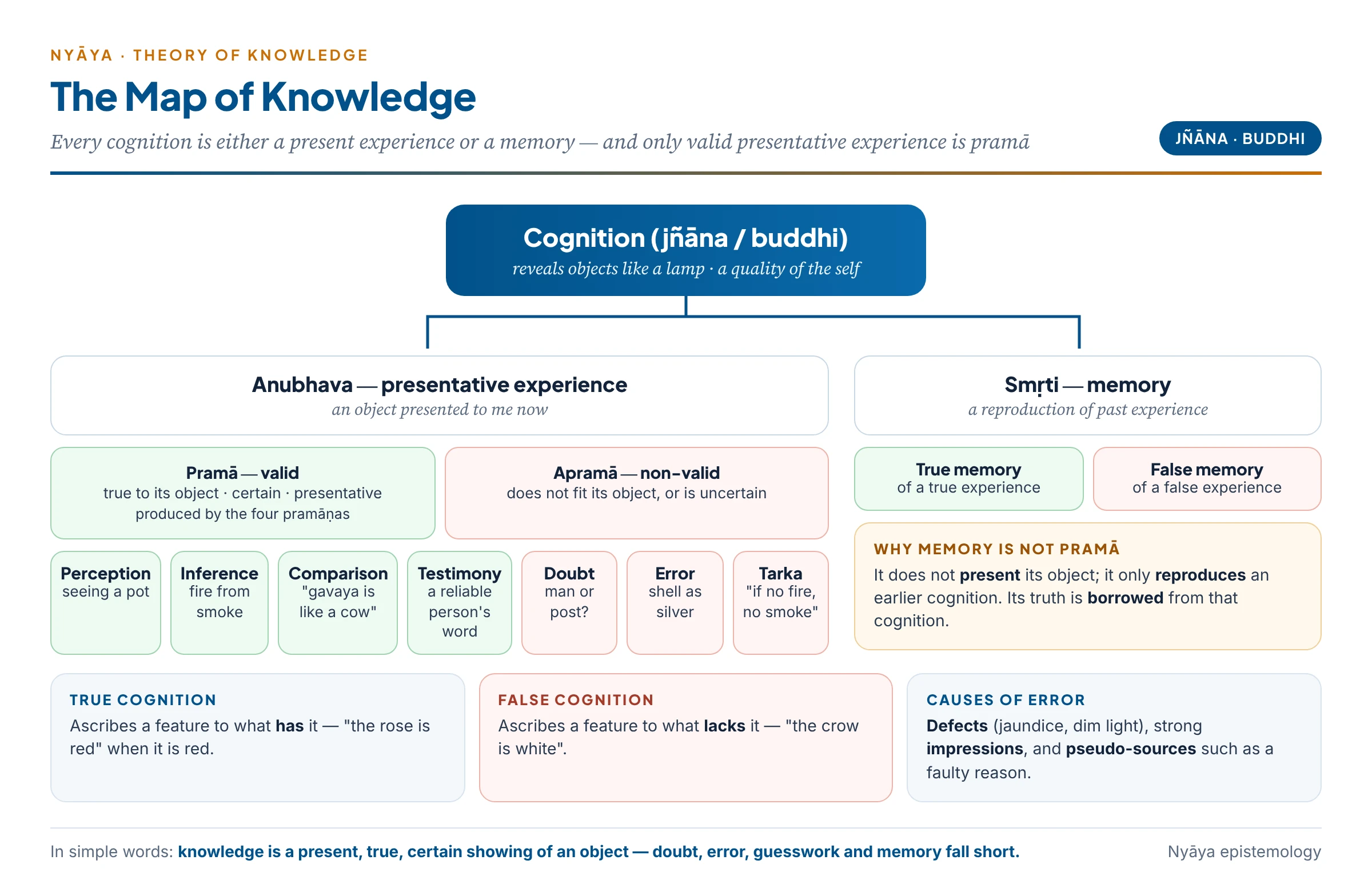
- Valid presentative knowledge (pramā) is divided into perception (pratyakṣa), inference (anumiti), comparison (upamiti) and verbal knowledge (śābda) — each produced by its own pramāṇa (Articles 2–5).
- Non-valid presentative knowledge (apramā) has three forms:
- Doubt (saṃśaya) — uncertainty between alternatives: “Is that figure in the distance a man or a post?” Doubt is a positive state — awareness of conflicting features in one thing — not mere absence of knowledge.
- Error (viparyaya or bhrama) — a definite but false cognition: seeing silver in a shell, or a snake in a rope at twilight. The person has no doubt, yet the cognition does not fit its object (Article 6).
- Hypothetical argument (tarka) — “If there were no fire, there could not be smoke.” Tarka supports knowledge already gained by inference, but by itself it does not present any object, so it is not pramā (Article 4).
- Causes of non-valid knowledge.
- Defects (doṣa) in the sense organ, the mind or the conditions — jaundice, dim light, distance.
- Strong impressions (saṃskāra) — a vivid memory or fear that colours what we see.
- Pseudo-pramāṇa (pramāṇābhāsa) — something that looks like a valid source but is not, such as an inference from a faulty reason.
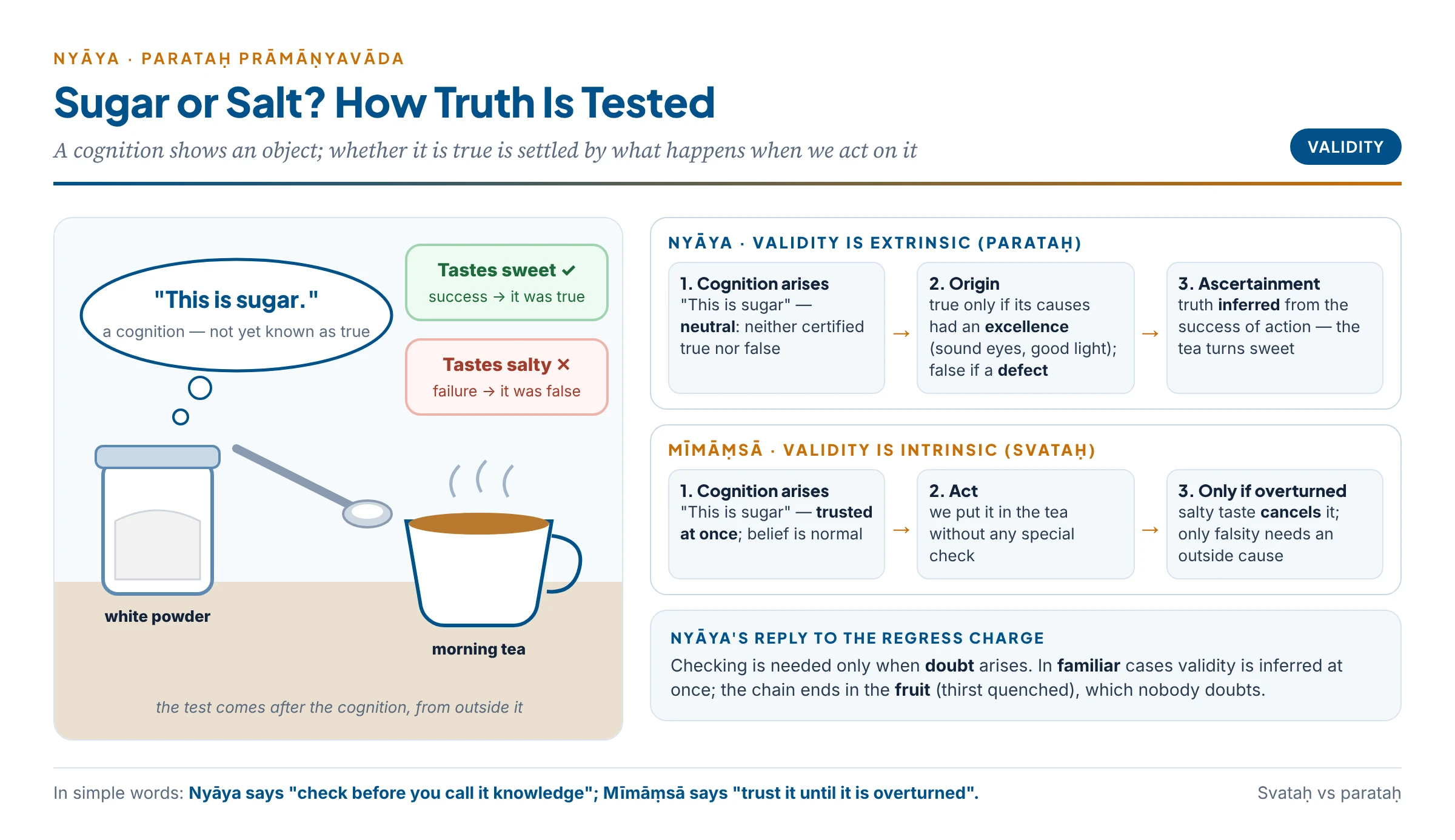
- Everyday test. The salt-and-sugar case: we take a white powder to be sugar; if it is salt, our cognition was false — the colour matched but the thing did not.
3. Pramā: Valid Knowledge
- Definition. Pramā is yathārtha-anubhava — a presentative cognition that agrees with its object. It is:
- Yathārtha — true to the object, presenting it as it is and not as something else.
- Anubhava — a fresh presentation, not a reproduction (this excludes memory).
- Asandigdha — certain, free from doubt.
- Abādhita — not cancelled by later valid knowledge.
- The New Nyāya formula. A cognition is true when it ascribes a feature to something that actually has that feature — tadvati tat-prakāraka: “the red rose is red”. It is false when it ascribes a feature to something that lacks it — tad-abhāvavati tat-prakāraka: “the crow is white”.
- Examples.
- Seeing a cow and knowing “this is a cow” — pramā.
- Taking a shell to be silver — apramā (error).
- Remembering that fire is hot — true, but not pramā, because it is memory, not a fresh presentation.
Common confusion
Is “novelty” (anadhigata — “not already known”) a mark of Nyāya pramā? No. Several notes list “it must be new” among the Nyāya marks of valid knowledge. Novelty is the Mīmāṃsā criterion, especially of Kumārila: for him, knowledge must grasp what was not already known, and memory fails this test. Nyāya does not demand novelty: a continuous series of cognitions of the same pot (“pot… pot… pot…”) is still valid for Nyāya. Nyāya excludes memory for a different reason — memory is not presentative experience (anubhava); it only reproduces a past one.
4. Why Memory Is Not Pramā (Nyāya and Prābhākara)
The 2024 paper asked why both the Prābhākaras and the Naiyāyikas reject memory as a source of knowledge. They agree on the conclusion, but for different reasons — and Kumārila adds a third.
- Nyāya’s grounds.
- Memory is not anubhava. Pramā is presentative experience. Memory merely reproduces an earlier experience; the object is not presented to the self now, only recalled.
- No new pramāṇa. If memory were a pramāṇa, it would need a fifth source besides perception, inference, comparison and testimony. But memory has no source of its own — it arises only from the impression (saṃskāra) left by an earlier cognition.
- It may not fit the object as it now is. Memory presents its object “as it was” (“that pot I saw”); the object may have changed or perished. Its truth is only borrowed from the original experience: a memory of a true experience is true, a memory of an error is false.
- Memory is not worthless. Nyāya divides memory itself into true and false; it simply denies it the status of pramā, the product of a pramāṇa.
- Prābhākara’s grounds.
- Pramāṇa is anubhūti. For Prabhākara, a valid cognition is simply direct apprehension (anubhūti), and every apprehension is valid.
- Memory is dependent. Memory is not an apprehension in its own right; it depends entirely on a previous apprehension. It is excluded not because it is false, but because it is not independent.
- Kumārila’s grounds. Memory lacks novelty (anadhigatatva): it reveals nothing that was not already known.
| School | Is memory pramā? | Main reason |
|---|---|---|
| Nyāya | No | Not presentative (anubhava); reproduces a past cognition; validity borrowed |
| Prābhākara | No | Not independent apprehension; depends on a prior one |
| Bhāṭṭa | No | Lacks novelty — reveals nothing new |
| Jaina | Yes — as a form of indirect knowledge (smṛti) | It can be true and guide action |
5. The Pramāṇa Tetrad: Knower, Known, Knowledge, Means
- Every act of knowing involves four factors:
- Pramātā — the knower, the self.
- Prameya — the object known.
- Pramā (or pramiti) — the valid cognition, the result.
- Pramāṇa — the means or instrument of valid cognition.
- Pramāṇa as the decisive instrument. Among the many causes of a cognition, the pramāṇa is the karaṇa — the most efficient cause (sādhakatama), the factor immediately after which the result appears.
- The axe analogy. In felling a tree, the axe is the instrument (karaṇa); the blow (the contact of axe and tree) is its operation (vyāpāra); the falling of the tree is the result. In visual perception, the eye is the instrument, the eye–object contact is the operation, and the perception is the result. Ancient Nyāya often calls the contact itself the pramāṇa, because the result follows it at once.
6. Pramāṇa and Pramāṇaphala: The Debate with the Buddhists
The 2025 paper asked for the debate between Naiyāyikas and Buddhists on the means (pramāṇa) and the result (pramāṇaphala) of knowledge.
- The Nyāya view — instrument and result are different.
- Like axe and cutting. An instrument and what it produces are two distinct things. The pramāṇa (sense-contact, the knowledge of a mark, the hearing of words) is one event; the pramā it produces is another.
- A chain of instruments. What is a result at one stage can be an instrument at the next. Sense-contact produces indeterminate perception; this serves as the instrument of determinate perception (“this is a pot”); that in turn leads to the cognition that the object is to be taken, avoided or ignored (hāna-upādāna-upekṣā-buddhi).
- Realist motive. Keeping instrument and result apart keeps the object outside the cognition: knowledge reveals an independent world.
- The Buddhist view (Dignāga and Dharmakīrti) — one cognition, two aspects.
- No separate instrument. A cognition has no instrument outside itself. The same cognition is called the “means” when we attend to its taking the form of the object (sākāratā), and the “result” when we attend to its awareness of the object (adhigama) or self-awareness (sva-saṃvitti).
- Why? If the instrument were outside the cognition — the eye, or a contact — we would need a further instrument to know that instrument, and so on.
- The Nyāya reply. Action and instrument cannot be identical: the cutting is not the axe. To call one cognition both cause and effect of itself is a contradiction; and the Buddhist theory, which makes the object’s form part of the cognition, slides toward idealism (Unit 14, Article 7 discusses the Buddhist side).
In simple words
Think of a camera and a photograph. Nyāya says: the camera (the means) and the photo (the result) are two different things, and the photo shows a scene that exists outside both. The Buddhist says: in knowing, there is no camera apart from the picture — the picture, seen as “taking the shape of the scene”, is the means; the same picture, seen as “showing the scene”, is the result.
7. The Four Pramāṇas — and Why Only Four
- The four sources (each has its own article):
| Pramāṇa | Its result | Key definition | Example |
|---|---|---|---|
| Pratyakṣa (perception) | Perceptual knowledge | Cognition produced by sense–object contact — non-verbal, non-erroneous, definite | Seeing a pot |
| Anumāna (inference) | Inferential knowledge | Knowledge of the unperceived through a mark invariably related to it | Fire on the hill from smoke |
| Upamāna (comparison) | Knowledge of a word’s referent | Knowing an object through its similarity to a known one, guided by a description | “A gavaya is like a cow” |
| Śabda (testimony) | Verbal knowledge | The statement of a trustworthy person (āpta) | A teacher telling a child that Japan lies across the sea |
- Perception is the base. Inference, comparison and testimony all presuppose perception — the smoke must be seen, the animal must be seen, the words must be heard.
- Other proposed pramāṇas are reduced.
- Arthāpatti (postulation) — accepted by Mīmāṃsā and Advaita. It is the assumption of an unperceived fact to reconcile two facts that seem to conflict: “Fat Devadatta never eats by day” → he must eat at night. Nyāya reduces it to a negative inference (kevala-vyatirekī anumāna): “Whoever is fat but does not eat by day eats at night; Devadatta is fat and does not eat by day; so he eats at night.”
- Anupalabdhi (non-apprehension) — accepted by the Bhāṭṭas and Advaitins as the special source of our knowledge of absence. Nyāya says absence is perceived (through a special relation with its locus) or inferred (Article 9).
- Sambhava (inclusion) — “he has a hundred, so he has ten” — reduced to inference.
- Aitihya (tradition) — “they say a spirit lives in this tree” — testimony if the source is reliable, otherwise worthless.
- Ceṣṭā (gesture) — reduced to inference or testimony.
- The 2024 “candidate” puzzle. “A candidate who is never seen studying during the day-time secures a high position in a competitive exam.”
- Bhāṭṭa answer — postulation. Two well-established facts — he never studies by day; he tops the exam — seem to conflict. To reconcile them, we postulate a third fact: he studies at night (or has studied in some unseen way). No universal rule is consulted; the conflict itself demands the explanation. Kumārila stresses that both facts must be certain; Prabhākara adds that the conflict creates a doubt which the postulation removes.
- Naiyāyika answer — inference. The same knowledge is reached by inference from a universal rule: “Whoever succeeds in such an exam has studied at some time; this candidate does not study by day; so he studies at night.” Or in negative form: “No one who studies neither by day nor by night tops such an exam.”
- The Mīmāṃsā rejoinder (2022 question). Arthāpatti is a search for the ground of a fact; inference moves from a ground to its consequence. In postulation we never consciously think of a universal rule before grasping that Devadatta eats at night; the conflict strikes first. And neither of the conflicting facts can serve as a middle term, so no proper vyāpti exists.
- The Nyāya counter-reply. The “conflict” is felt only because we already know the general truth that no one grows fat without eating; that general truth is exactly the vyāpti that makes the reasoning an inference.
- Who accepts how many pramāṇas?
| School | Number | Pramāṇas accepted |
|---|---|---|
| Cārvāka | 1 | Perception |
| Buddhism, Vaiśeṣika | 2 | Perception, inference |
| Sāṃkhya, Yoga, Viśiṣṭādvaita | 3 | Perception, inference, testimony |
| Nyāya | 4 | Perception, inference, comparison, testimony |
| Prābhākara Mīmāṃsā | 5 | Adds postulation |
| Bhāṭṭa Mīmāṃsā, Advaita Vedānta | 6 | Adds postulation and non-apprehension |
8. Truth: Its Nature and Its Test
Nyāya separates two questions that are often confused: what truth is, and how we test it.
- Nature of truth — correspondence. A cognition is true when it agrees with the nature of its object. Your cognition of the rose as red is true if the rose really is red.
- Test of truth — successful activity. We test truth by inference from the success or failure of the action it prompts — pravṛtti-sāmarthya (fruitful activity) or pravṛtti-visaṃvāda (disappointed activity).
- Sugar or salt. You put a spoonful of white powder into your tea. The tea tastes sweeter — your cognition “this is sugar” was true. If it tastes salty, the cognition was false.
- Water or mirage. You see “water” in the distance, walk up and drink it; your thirst is quenched — the cognition is confirmed. If it was a mirage, it is exposed.
- Fire. “Fire must burn, cook and give light. If it does not, it is no fire.”
- Correspondence and pragmatism together. Nyāya’s definition of truth is a correspondence theory; its test of truth is pragmatic. Truth does not consist in success; success is the sign from which we infer truth.
9. Parataḥ Prāmāṇyavāda: Validity Is Extrinsic
- The question. When a cognition arises, does it carry its validity with it, or is validity added and known from outside? Parataḥ means “from another”; prāmāṇya means “validity”. Nyāya holds that validity is extrinsic in two senses.
- (a) Extrinsic in origin (utpatti). The ordinary causes of a cognition produce a cognition — but not its truth. Truth needs an additional excellence (guṇa) in the causes; falsity needs an additional defect (doṣa).
- A man with sound eyes sees a conch as white — the excellence of healthy vision produces a true cognition.
- A man with jaundice sees the same conch as yellow — the defect produces an error.
- Each pramāṇa has its own excellence: for perception, a proper contact of the sense with the object and all its features; for inference, a genuine mark; for testimony, a reliable speaker and correct grasp of the sentence; for comparison, real similarity.
- (b) Extrinsic in ascertainment (jñapti). The cognition by which we know that we have a cognition does not tell us that it is true. We come to know its truth later, by inference from successful activity: “Had this cognition not been true of its object, it would not have led to successful action; it did; so it is true.”
- Knowledge is neutral at birth. A cognition, when it arises, is neither self-certified as true nor as false; it simply presents an object. Both validity and invalidity are determined from outside. Hence Nyāya holds parataḥ prāmāṇya and parataḥ aprāmāṇya.
- Familiar and unfamiliar cases. Later Nyāya adds a realistic refinement. In familiar situations (abhyāsa-daśā) — drinking from the same tap every day — the validity of our cognition is inferred instantly, from the cognition’s being of a kind that has always succeeded. Only in unfamiliar situations (anabhyāsa-daśā) — water seen for the first time in a desert — does doubt arise and a separate verification become necessary.
- Why Nyāya holds this view.
- True and false cognitions look alike at first. The mirage-water and the real water feel the same while we see them; if validity were self-evident, we could never be deceived.
- Doubt is possible. We often ask, “Was I right?” If every cognition announced its own truth, no one would ever doubt.
- Consistency. It is arbitrary to say that the same set of conditions is intrinsic when knowledge is true and extrinsic when it is false; both should be treated alike.
- Realism. Truth is a relation to an independent object; such a relation cannot be read off from the cognition alone.
10. “How Do I Know That I Know?” — Anuvyavasāya
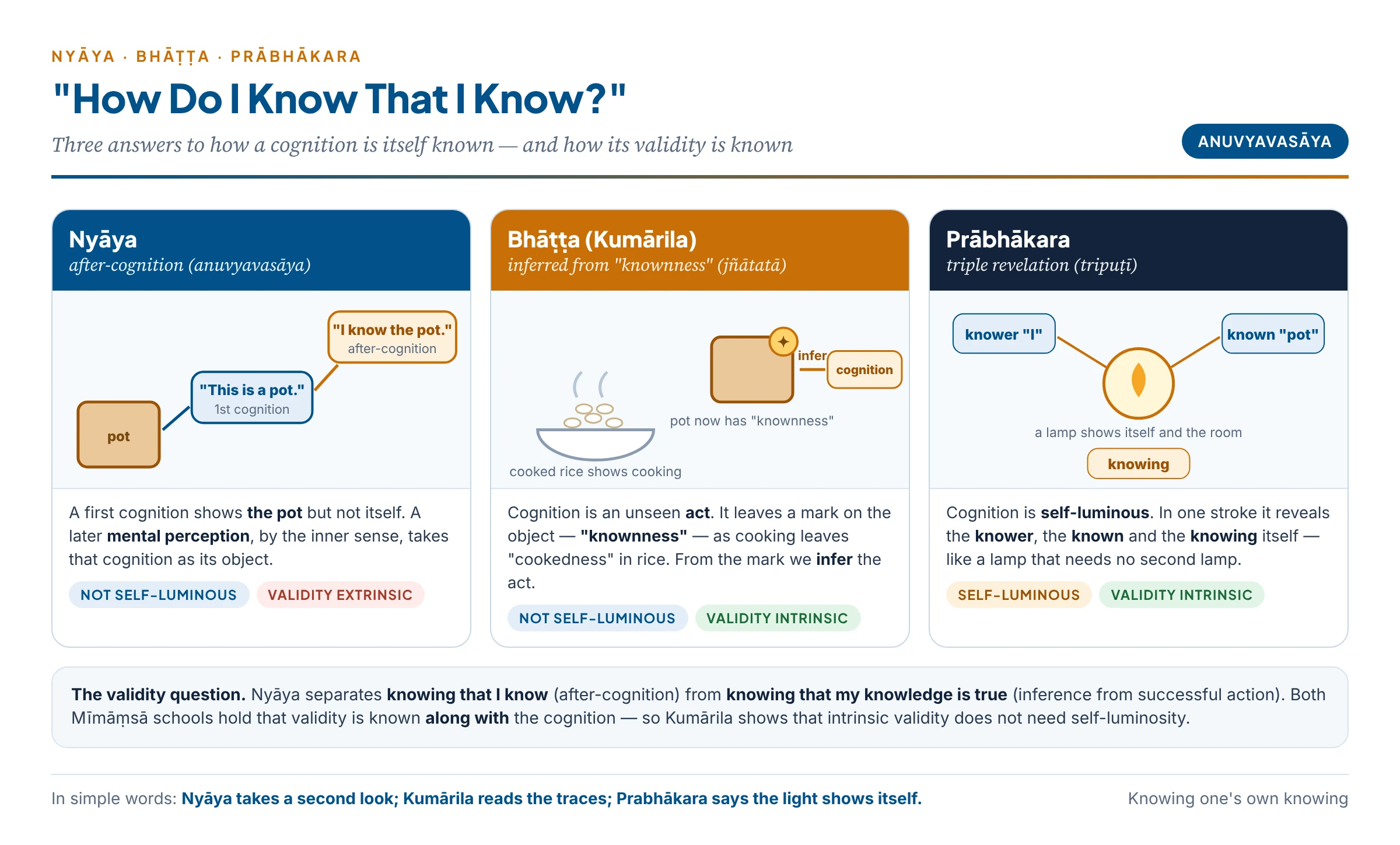
The 2024 paper asked how a cognition is itself known, comparing the Naiyāyikas, the Bhāṭṭas and the Prābhākaras.
- Nyāya — after-cognition (anuvyavasāya).
- First-order cognition (vyavasāya): “This is a pot.” It reveals the pot — but not itself.
- Second-order cognition (anuvyavasāya): “I know the pot.” A later mental perception, produced by the inner sense (manas), which has the first cognition as its object.
- Not self-luminous. A cognition does not reveal itself, just as the eye does not see itself. It is known by another cognition — introspection.
- No regress. The after-cognition need not itself be known by a third cognition for the first to be known; it is enough that it occurs. We are not obliged to be aware of our awareness of our awareness.
- Validity is still extrinsic. The after-cognition tells us that we know a pot — not that our knowledge is true. Truth is known by inference from successful activity (Section 9).
- Bhāṭṭa (Kumārila) — inferred from “knownness” (jñātatā).
- A cognition is an act of the self that cannot be perceived.
- When this act falls on an object, it produces in the object a new property — “knownness” or “manifestedness” (jñātatā, prākaṭya) — as cooking produces “cookedness” in rice.
- We perceive the knownness in the object and infer the cognition that produced it.
- Prābhākara — triple revelation (tripuṭī-pratyakṣa).
- Cognition is self-luminous (svayaṃ-prakāśa), like a lamp that shows itself while showing other things.
- In every cognition three things are revealed at once: the knower (“I”), the known (“this pot”), and the knowing itself.
- Murāri Miśra (a third Mīmāṃsā line) agreed with Nyāya that a cognition is known by after-cognition, but held that its validity is grasped by that same after-cognition — intrinsically.
| Nyāya | Bhāṭṭa | Prābhākara | |
|---|---|---|---|
| How a cognition is known | By a later mental perception (anuvyavasāya) | By inference from the “knownness” it produces in the object | Self-revealed — knower, known and knowing shown together |
| Is cognition self-luminous? | No | No | Yes |
| How its validity is known | Extrinsically — inference from successful activity | Intrinsically | Intrinsically |
| Analogy | A second look at what one has seen | Inferring cooking from cooked rice | A lamp showing itself and the room |
11. The Great Debate: Svataḥ versus Parataḥ Prāmāṇya
- Mīmāṃsā’s svataḥ prāmāṇyavāda. Validity is intrinsic — produced by the same conditions that produce the cognition, and known by the same means that know the cognition. Invalidity is extrinsic — due to a defect in the causes, and known through a later cancelling cognition (bādhaka-jñāna) or the discovery of the defect.
- Mīmāṃsā’s arguments.
- Universal trust. In daily life we act on our cognitions at once. I see water and drink; I see fire and step back. “Belief is normal; disbelief is exceptional.“
- Error is discovered later. We first accept “this is a snake” and only later learn it was a rope. Truth comes first; falsity is discovered afterwards.
- Infinite regress. If cognition A needs cognition B to prove its validity, B needs C, and so on without end — nothing could ever be known.
- The Veda. If validity required external proof, the Veda too would need outside confirmation. Since the Veda is authorless (apauruṣeya), it is free from the defects of a speaker, and so it is self-valid.
- Nyāya’s replies.
- The regress does not arise. Verification is needed only when doubt arises. In familiar cases validity is inferred at once. And the chain of verification ends in the experience of the fruit — the quenching of thirst — about which no doubt arises in the ordinary way; where there is no doubt, no further test is demanded.
- Error refutes intrinsic validity. If every cognition were valid in itself, an erroneous cognition — which arises from the same kind of conditions — would also have been valid at birth. That is absurd.
- Trust is not truth. That we act on cognitions at once shows our psychological readiness to believe, not that validity is self-evident.
- Same conditions, same status. It is inconsistent to treat the conditions of knowledge as intrinsic when the cognition is true and extrinsic when it is false.
- The Veda is valid because of its author. The Veda is valid not because it has no author but because its author, God, is the most reliable speaker (āpta) — Article 5.
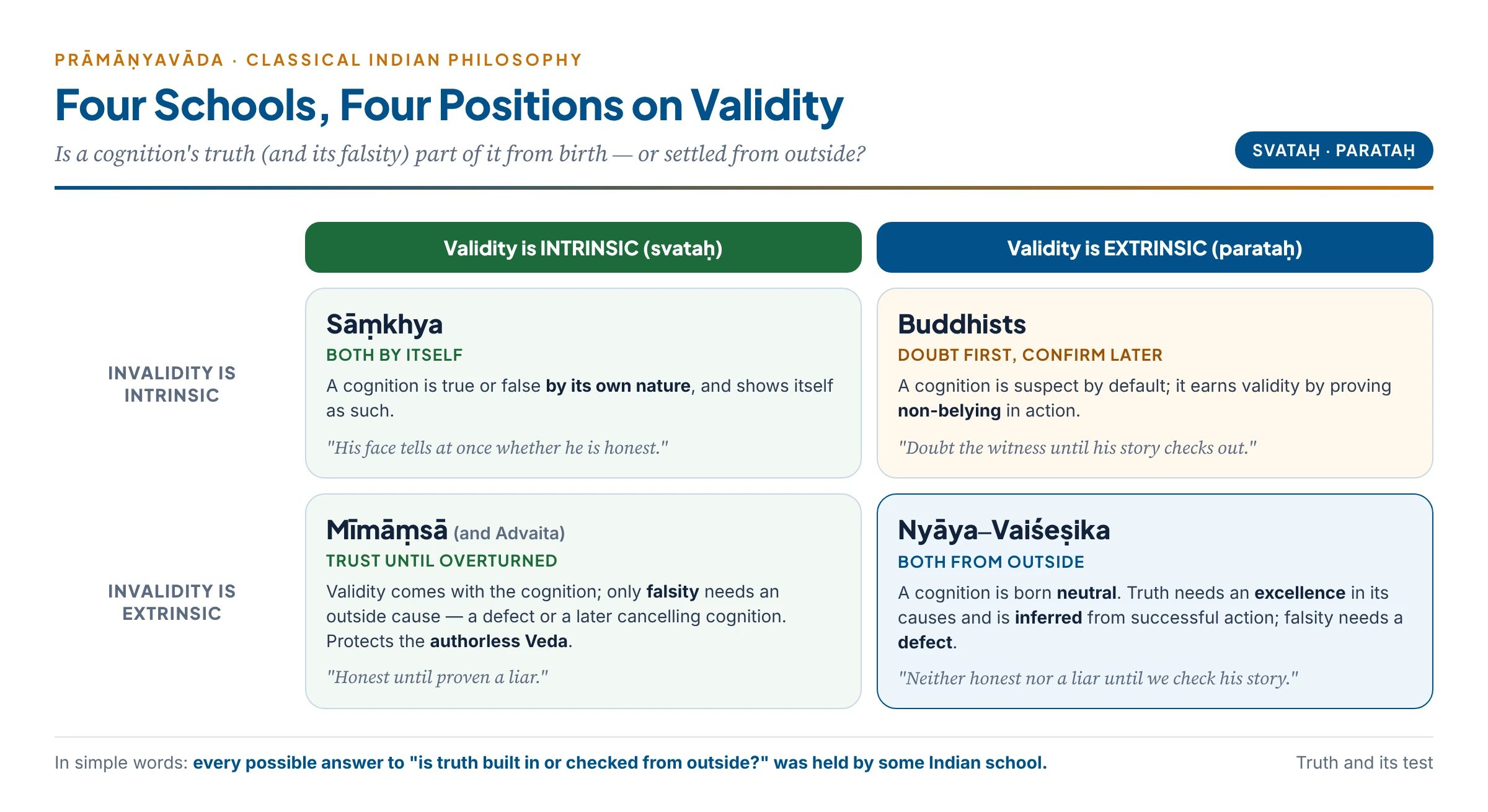
- The four possible positions. Indian thinkers occupied every combination:
| School | Validity (prāmāṇya) | Invalidity (aprāmāṇya) |
|---|---|---|
| Sāṃkhya | Intrinsic | Intrinsic |
| Nyāya–Vaiśeṣika | Extrinsic | Extrinsic |
| Mīmāṃsā (and Advaita) | Intrinsic | Extrinsic |
| Buddhism | Extrinsic | Intrinsic |
- The other two positions.
- Sāṃkhya — both validity and invalidity are intrinsic: a cognition is true or false by its own nature, and is known as such by itself.
- Buddhists (as usually reported) — invalidity is intrinsic and validity extrinsic: a cognition should be doubted until it proves itself non-belying (avisaṃvādin) in successful action.
- Advaita — sides with Mīmāṃsā: validity is intrinsic, because the self-luminous witness (sākṣin) that reveals a cognition also reveals its validity.
In simple words
Two jurors judge a witness. The Mīmāṃsā juror says: “A witness is honest until proven a liar.” The Nyāya juror says: “A witness is neither honest nor a liar until we check his story against the facts.” The Buddhist juror says: “Doubt him until his story is confirmed.” The Sāṃkhya juror says: “His face shows at once whether he is honest or lying.”
12. Does Self-luminosity Entail Intrinsic Validity?
The 2018 paper asked whether accepting the self-luminosity of knowledge (svayaṃprakāśavāda) necessarily leads to accepting intrinsic validity (svataḥ prāmāṇyavāda), with reference to the Naiyāyikas, the Mīmāṃsakas and the Advaitins.
- Prābhākara — yes, and consistently. A self-revealing cognition reveals itself as it is; and since for Prabhākara all apprehension is valid, it reveals itself as valid.
- Bhāṭṭa — intrinsic validity without self-luminosity. Kumārila denies that cognition is self-luminous (it is inferred from knownness) and still holds that its validity is intrinsic — because the same inference that makes a cognition known makes its validity known. So intrinsic validity does not require self-luminosity.
- Advaita — both. The witness-consciousness (sākṣin) is self-luminous, and it reveals both a cognition and its validity at once. Error is exposed only by a later sublating cognition.
- Nyāya — neither. A cognition is not self-luminous (it is known by after-cognition), and its validity is extrinsic. Even if a cognition did reveal itself, it would reveal only that it exists, not that it corresponds to its object — since correspondence is a relation to something outside.
- Conclusion. The two doctrines are logically independent: Bhāṭṭa shows intrinsic validity without self-luminosity, and Nyāya argues that self-revelation of a cognition would not yet reveal its truth.
Critical Evaluation
Objections of Rival Schools (Pūrva-pakṣa)
- Cārvāka. Only perception is a pramāṇa. Inference, testimony and comparison all go beyond what is perceived (Unit 12). Nyāya’s reply: the Cārvāka’s own denial of inference is an inference (from observed failures to all cases); and without inference, he could not even know other minds or the past.
- Buddhist. There are only two pramāṇas for two kinds of object — perception for unique particulars and inference for constructed universals; comparison and testimony are inference. Means and result of knowledge are one (Section 6). Validity must be earned — doubt first.
- Mīmāṃsā. Extrinsic validity leads to regress and paralyses action; the Veda would lose its authority.
- Advaita. Every pramāṇa is valid only at the empirical level (vyavahāra); ultimately only self-luminous consciousness is real, and Nyāya’s realism mistakes the empirical for the ultimate.
- Sceptical worry. If truth is known only by the success of action, what of truths that lead to no action — mathematics, history, metaphysics? And can success not follow from a false belief by luck?
Defences and Strengths
- Correspondence secures realism. By making truth a relation to an independent object, Nyāya keeps knowledge answerable to the world.
- Fallibilism without scepticism. We may err, but errors are caught by further experience; this is the method of science.
- Success as evidence, not definition. Nyāya does not say “true means useful”; it says success is the mark from which truth is inferred. A lucky success is possible, but repeated, varied success is good evidence.
- Regress answered. Verification is triggered only by doubt; most cognitions are trusted by familiar inference.
- A rich epistemology. The tetrad of knower, known, knowledge and means; the instrument–result distinction; the after-cognition theory — these give Indian philosophy one of its most careful analyses of knowledge.
Critics and Defenders
Criticism — Critics
- Mīmāṃsā (Kumārila): extrinsic validity means infinite regress and endless hesitation; “belief is normal”.
- Buddhists (Dignāga, Dharmakīrti): means and result of knowledge are one cognition; testimony and comparison are only inference.
- Cārvāka: nothing beyond perception is a reliable source.
- Advaita: pramāṇas hold only at the empirical level; consciousness is self-luminous.
- Modern critics: the pragmatic test cannot reach truths that prompt no action; success can be lucky.
Defence — Defenders and strengths
- Verification is needed only where doubt arises; in familiar cases validity is inferred at once — no regress.
- If truth were intrinsic, error would be impossible; the very existence of error favours Nyāya.
- Instrument and result are as different as axe and cutting; their fusion leads toward idealism.
- Truth is correspondence; success is only its test — a sound combination of realism and pragmatism.
- After-cognition explains self-knowledge without making cognition mysteriously self-luminous.
Cross-Tradition Comparison
Nyāya and Western Theories of Truth
| Issue | Nyāya | Western parallel |
|---|---|---|
| What truth is | Agreement of cognition with object (tadvati tat-prakāraka) | Correspondence theory — Aristotle (“to say of what is that it is”), Russell, early Wittgenstein |
| How truth is tested | Inference from successful activity (pravṛtti-sāmarthya) | Pragmatism — William James (“truth’s cash-value”), Peirce; but James made usefulness the meaning of truth, Nyāya only its test |
| Default attitude to a cognition | Neutral until checked (extrinsic validity) | Descartes’ method of doubt goes further — doubt everything until certain |
| Mīmāṃsā’s rival view | Trust until defeated (intrinsic validity) | Thomas Reid and G. E. Moore: common-sense beliefs are innocent until proven guilty |
| Regress of justification | Ends where no doubt arises | Wittgenstein’s On Certainty: doubt itself needs grounds; justification ends somewhere |
| Knowing one’s own cognition | After-cognition (anuvyavasāya) by the inner sense | Locke’s reflection; modern higher-order theories of consciousness |
| Self-luminosity of cognition | Rejected | Descartes’ transparent mind; Brentano’s inner awareness (closer to Prābhākara) |
| Number of sources | Four pramāṇas incl. testimony | Hume and the empiricists reduce testimony to induction; modern social epistemology treats testimony as basic |
Indian Connect — Key takeaways
- Nyāya’s definition of truth is realist (correspondence); its test of truth is pragmatic (successful action) — a combination the West reached only with Peirce.
- The svataḥ–parataḥ debate is India’s version of the Western quarrel between foundationalism (some beliefs carry their own warrant) and fallibilism (every belief answers to experience).
- The question “How do I know that I know?” was asked in India a thousand years before higher-order theories of consciousness; Nyāya, Kumārila and Prabhākara cover the main modern answers.
- Nyāya’s acceptance of testimony as an independent source anticipates contemporary epistemology of testimony: most of what we know, we know because others told us.
Synthesis (Siddhānta)
- The allied system. Nyāya and Vaiśeṣika divide the labour of a single logical realism: Vaiśeṣika says what there is; Nyāya says how it is known — and both aim at liberation through right knowledge.
- Knowledge. Cognition is a quality of the self that reveals objects like a lamp. Valid presentative cognition is pramā, produced by four pramāṇas. Doubt, error and hypothetical reasoning are non-valid; memory, though it can be true, is not pramā because it is not presentative.
- Means and result. The pramāṇa is the decisive instrument; the pramā is its result — distinct, as the axe is distinct from the cutting.
- Truth and its test. Truth is correspondence; its test is successful activity. Validity and invalidity are both extrinsic — produced by excellences or defects in the causes, and known by later inference. A cognition is itself known by after-cognition.
- Contemporary relevance.
- Science. Peer review, replication and field testing embody the parataḥ attitude — a result is not accepted because it “looks right” but because it survives checking.
- Law and evidence. Courts rely on witnesses (testimony) yet test their reliability — the Nyāya demand that testimony come from an āpta. India’s Bharatiya Sakshya Adhiniyam, 2023, like the Evidence Act before it, distinguishes oral and documentary evidence and their tests of reliability.
- Fact-checking and misinformation. In an age of viral claims and AI-generated content, the Nyāya rule — a cognition is neutral until verified — is a practical civic virtue.
- Debate ethics. Nyāya’s distinction between vāda (honest discussion), jalpa (wrangling) and vitaṇḍā (mere destruction) is a ready guide to the quality of public debate.
“Valid knowledge is that which corresponds to reality.” — a Nyāya maxim (yathārthānubhavaḥ pramā)
Previous Year Questions
- 2025Delineate the main points of difference between the theory of intrinsic validation (svataḥ prāmāṇyavāda) and theory of extrinsic validation (parataḥ prāmāṇyavāda) in classical Indian philosophy.
- 2025Present an exposition of the debate between Naiyāyikas and Buddhists with reference to the notion of Pramāṇa and Pramāṇaphala.
- 2024How do I know that I know? Answer this question with reference to the Naiyayikas, the Bhatta Mīmāṃsakas and the Prābhākaras.
- 2024On what grounds do the Prabhakaras and the Naiyayikas reject memory as a source of knowledge? Discuss.
- 2024“A candidate who is never seen to be studying during the day-time secures a high position in a competitive exam.” How would the Bhatta Mimāṃsakas and the Naiyayikas explain the success of this candidate? Discuss.
- 2022How do Mimansakas refute the Nyaya view that Implication (arthapatti) is reducible to Inference (anumana) and establish Implication as an independent means of valid knowledge (pramana)? Critically discuss.
- 2020Why is memory not a valid knowledge according to Mimansa?
- 2018Does the admission of Svayamprakashavada necessarily lead to the admission of Svatahpramanyavada? Discuss after the Naiyayikas, the Mimamsakas and the Advaita Vedantins.
- 2017Explain the theory of validity of knowledge (pramanyavada) according to mimamsa. How do they criticize the Nyaya theory of validity?
- 2015Elaborate Nyaya-Mimamsa debate on Pramanyavada.
- 2013How is the pramanya (validity/truth) of a statement determined? Examine in this context the theory paratah pramanyavada.
- 2012Discuss the views of Mimamsa and Nyaya on the theory of Pramanyavada. Which of them do you find adequate? Give reasons for your answer.
- 2011How do Mimamsakas defend Svatah Pramanyavada against the Naiyayika criticism? Discuss.
- 2006Explain Nyaya theory of Pramanas.
- 1999What is self-validity of knowledge? Examine the Purva-Mimamsaka arguments against the theory of extrinsic validity of Knowledge.
- 1997Svatah-pramanya and paratah-pramanya.
- 1996Examine the Nyaya theory of Pramana in the light of the Buddhist criticism of it.