

Schools of Buddhism: Pratītyasamutpāda; Kṣaṇikavāda, Nairātmyavāda
Official Syllabus: Paper I, Section B, Unit 14
Kṣaṇikavāda — the doctrine of momentariness — holds that everything that exists lasts for only one moment (kṣaṇa). There are no enduring things — no lasting tables, rivers, bodies or souls — only streams of momentary events, each arising and perishing at once and giving rise to the next. What we call “the same thing” is a series (santāna) of similar moments following so fast that we mistake similarity for identity. The Buddha taught that all conditioned things are impermanent (anitya); his later followers, above all the logicians Dharmakīrti, Śāntarakṣita and Ratnakīrti, sharpened this into the claim that things are not merely short-lived but momentary, and defended it with powerful arguments from causal efficiency (arthakriyākāritva) and the causelessness of destruction.
In simple words
A film shows a man walking across the screen. In fact there is no moving man — only 24 separate still pictures every second, each slightly different from the last, flashed so quickly that the eye joins them into one smooth movement. Kṣaṇikavāda says the world is like that film: what looks like one lasting thing is a rapid series of momentary frames. The “same” man is a run of similar pictures.
Context & Problem
From Anitya to Kṣaṇika
- The Buddha’s teaching: impermanence (anityatā). “All conditioned things are impermanent” (sabbe saṅkhārā aniccā). “Whatever has a beginning has an end.” “Know that whatever exists arises from causes and conditions and is in every respect impermanent.” This says that things do not last for ever.
- The later doctrine: momentariness. His followers developed this into the theory that things last “not even for short periods of time” but “exist for one partless moment only“. Momentariness is impermanence pushed to its limit.
- Other names.
- Kṣaṇabhaṅgavāda — the theory of momentary destruction (bhaṅga = breaking).
- Santānavāda — the theory of the flux or ceaseless flow (series).
- Saṅghātavāda — the theory of aggregates: the soul is an aggregate of fleeting skandhas, matter an aggregate of momentary atoms.
- The slogan. The Buddha’s “lion’s roar” (saugata-siṃhanāda): “everything is sorrow; everything is without self; everything is momentary” (sarvaṃ duḥkham, sarvam anātmam, sarvaṃ kṣaṇikam).
Why Momentariness Mattered
- Against the self. If everything is momentary, a permanent soul is impossible — the strongest support for no-self (Article 5).
- Against God and Prakṛti. “The theory of momentariness repudiates at one stroke all metaphysical permanent entities like Primordial Matter, Self, God.”
- Against attachment. If nothing lasts even for two moments, clinging to anything is folly; seeing momentariness weakens craving.
- The debate. Momentariness became the central battle-line between Buddhists and the Nyāya, Mīmāṃsā, Jaina and Vedānta schools, which all defended enduring substances and an enduring self.
Core Doctrine
1. What the Doctrine Says
- Everything is momentary. “Everything is momentary. Nothing is permanent. Change is the rule of the universe.” Body, sensation, perception, disposition, consciousness — all are impermanent and changing.
- Becoming, not being. “There is neither being nor not-being, but only becoming. Reality is a stream of becoming.” “There is no ‘thing’ which changes; only ceaseless change goes on.”
- Links in a chain. “Everything is merely a link in a chain, a spoke in a wheel, a transitory phase in a series.”
- Mind and matter alike. It applies “to mind and matter alike, for both are momentary”. The so-called soul is a series of fleeting ideas; so-called matter is a series of momentary atoms of earth, water, fire and air.
- Arising, enduring, perishing — at once. Abhidharma thinkers analysed each moment into arising (utpāda), staying (sthiti) and perishing (bhaṅga) (the Sarvāstivādins added decay); the later logicians insisted that a thing perishes the very moment it arises — a moment has no room for staying.
2. What a “Moment” Is
- Not a tiny unit of clock-time. For Śāntarakṣita, “kṣaṇa is not a time-moment. It is the character of being destroyed immediately after being produced.” The very nature of a thing to disappear after existing for one moment only is called kṣaṇa; the thing that has this nature is kṣaṇika.
- No gap between thing and momentariness. “There is absolutely no difference between the momentary character and the thing which is supposed to possess it. The momentary character itself is the momentary thing.” The distinction is a creation of language.
- The unique particular. The ultimately real is the momentary particular (svalakṣaṇa) — “the this, the here, the now, the present moment of efficiency” — indescribable in words, which grasp only general features.
Common confusion
Does “momentary” mean “lasting for a very short time”, like a millisecond? No. That reading makes momentariness a claim about duration, which physics could measure. The Buddhist logicians meant something stronger: a momentary thing has no duration at all — it perishes in the act of arising. “Kṣaṇa” names this nature of instant perishing, not a small stretch of time. That is why the doctrine cannot be refuted simply by pointing to a stone that “lasts” for years: the “lasting stone” is a series of perishing moments.
3. The Classical Similes
- The stream of a river. “You cannot bathe twice in the same river.” The water in which you took your dip has flowed away and been replaced by other water. “A river is only a continuous flow of different waters.” (The Greek Heraclitus said exactly this.)
- The flame of a lamp (dīpa-śikhā). A lamp seems to burn with one flame all night; in fact “a flame is a series of different flames“, each lasting a moment, each conditioned by its own oil and wick. “The rapidity of succession gives rise to the illusion of unity.”
- The hurricane-lantern test. When a faulty hurricane lantern makes the succession break, “one flame succeeds another after a slight interval” — and we see that the “one flame” was always many.
- The rolling wheel. “Just as a chariot wheel in rolling rolls only at one point of the tyre, and in resting rests only at one point, in exactly the same way the life of a living being lasts only for the period of one thought. As soon as that thought has ceased, the living being is said to have ceased.”
- Seed to tree, child to old man. “The seed becomes the tree through different stages; the child becomes the old man through different stages.” No stage is the same as another; “identity is nothing but continuity of becoming“.
- The key point. “Similarity is mistaken as identity.” The “same flame” is “only a succession of so many similar flames”.

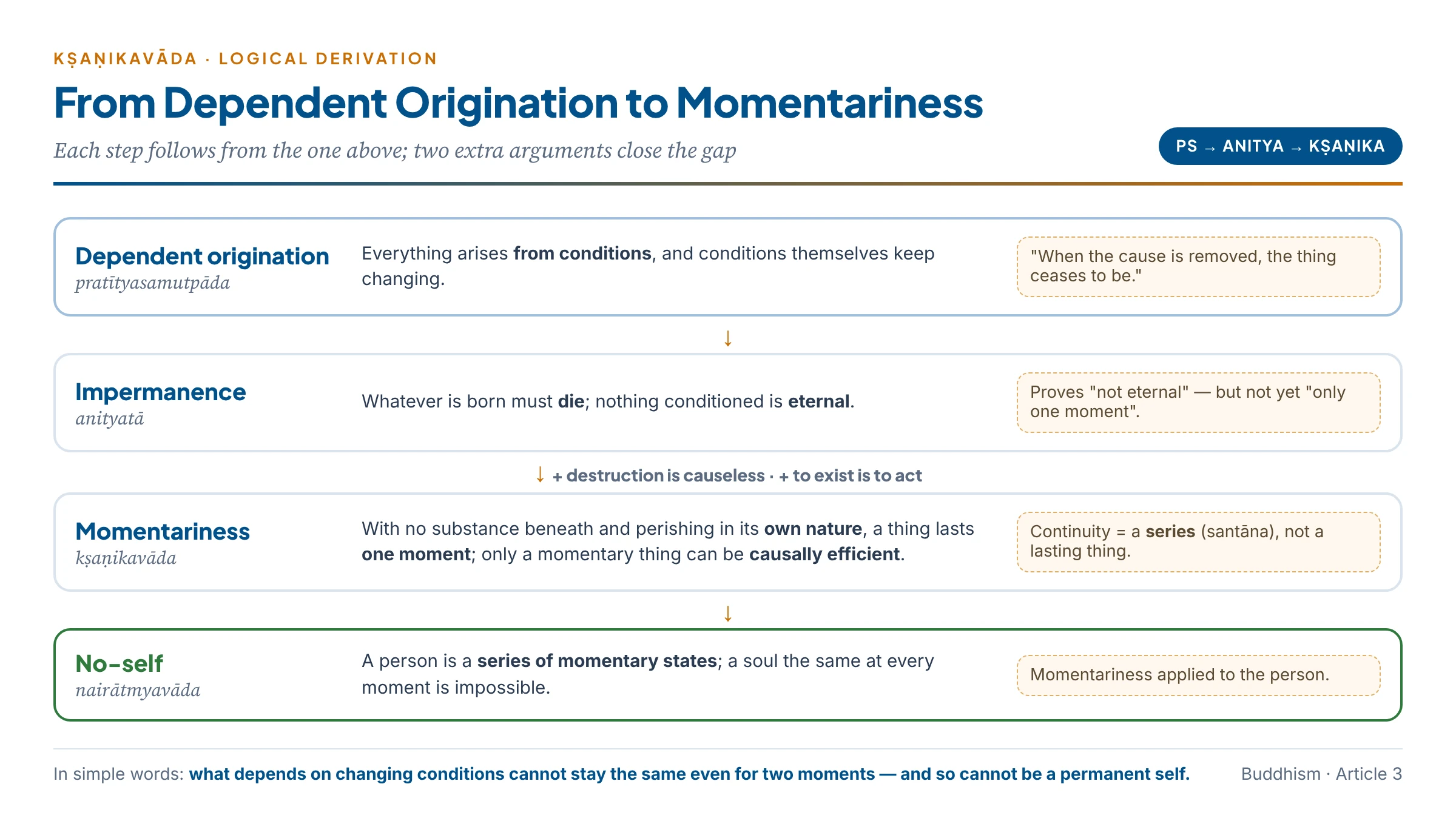
4. Kṣaṇikavāda as a Derivative of Pratītyasamutpāda
How does momentariness follow from dependent origination?
- Whatever arises depends on conditions. “If we say that a thing arises depending on its cause, we admit that it is momentary, for when the cause is removed the thing will cease to be.”
- Conditions themselves are dependent and changing. The oil burns, the wick chars, the air moves; no condition stays fixed.
- So the thing cannot stay the same. What depends on changing conditions must change as they change. “Things are relative, dependent, conditional and finite; so they must be momentary.”
- Whatever is born must die. “That which arises, that which is born, that which is produced must necessarily be subject to death and destruction. That which is subject to destruction is not permanent, and that which is not permanent is momentary.”
- No permanent ground. Since there is no uncaused, unconditioned substance underneath (that would contradict dependent origination), nothing holds a thing steady between moments.
- Conclusion. Dependent origination yields impermanence; impermanence, with nothing permanent beneath it, becomes momentariness.
Is the Derivation Strictly Logical?
- Yes, in spirit. Momentariness is the natural conclusion of a world in which everything is conditioned and nothing is a substance.
- Not quite, in strict logic. From “everything arises and ceases” it follows that nothing is eternal, but not yet that everything lasts only one moment. A pot could be conditioned and still last a hundred years. To bridge this gap, the later Buddhists needed two further arguments — that destruction needs no cause, and that to exist is to be causally efficient. Dependent origination supplies the framework; these arguments supply the proof.
5. The Argument from the Causelessness of Destruction (Vināśitvānumāna)
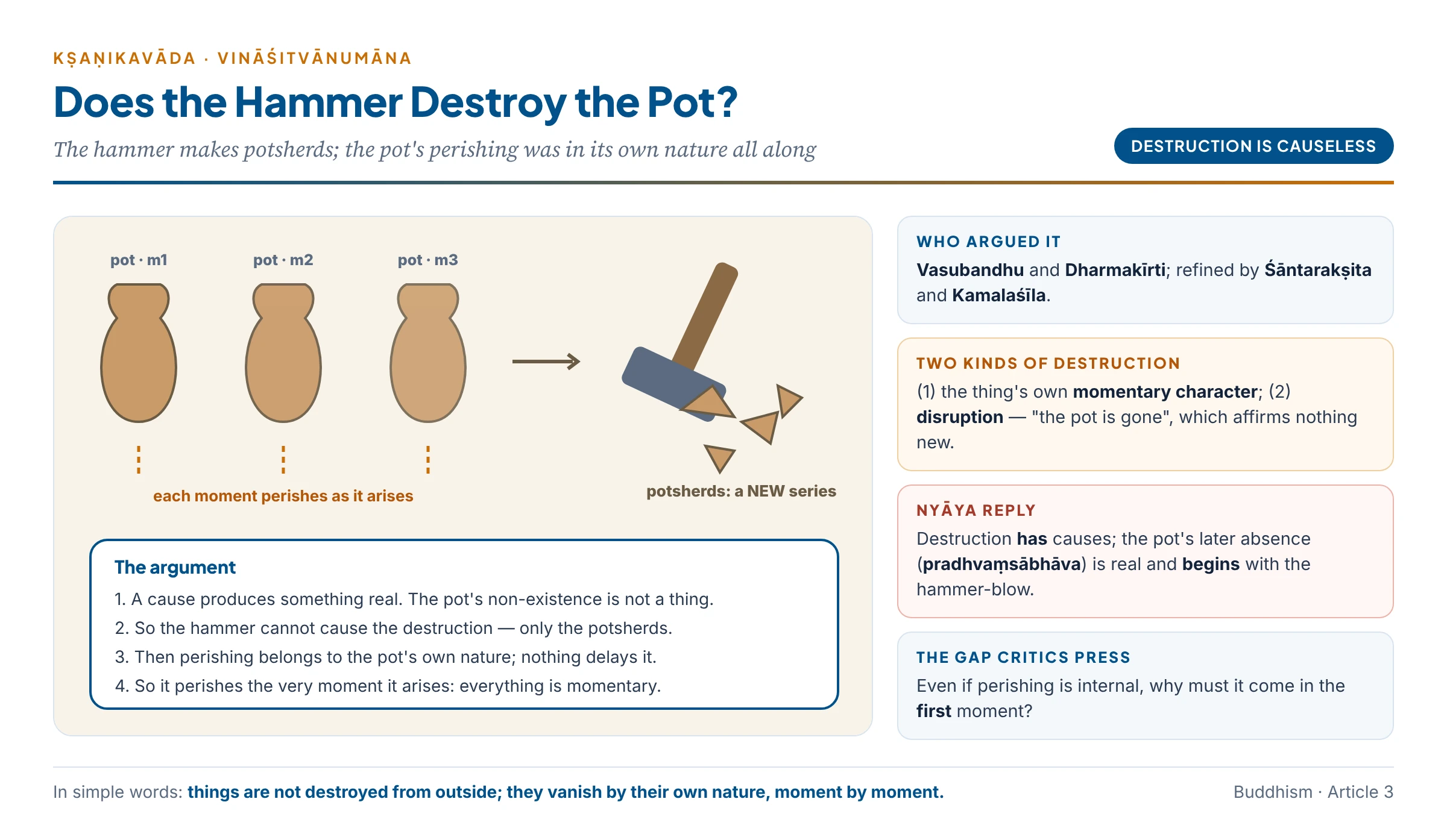
This argument, given by Vasubandhu and Dharmakīrti, shows that perishing belongs to the very nature of things.
- What does a hammer do to a pot? We think the hammer causes the destruction of the pot. But what the hammer produces is potsherds — a new positive thing. The non-existence of the pot is not a “thing” that a hammer could make.
- Destruction is not an effect. A cause produces a real effect; destruction is a non-entity (abhāva); a non-entity cannot be produced. So destruction has no cause (vināśa ahetuka).
- Then perishing is in the thing’s own nature. If nothing outside makes a thing perish, it must perish of itself.
- And it perishes at once. If perishing is its nature, there is nothing to delay it; a thing that perished “later” would need some cause for the delay, and there is none. So it perishes as soon as it arises.
- Conclusion. “Because annihilation is uncaused, it automatically follows everything.” “All produced things are necessarily momentary because they do not depend for their destruction on any cause.”
- Two senses of destruction (Śāntarakṣita and Kamalaśīla).
- Momentary character — the thing’s own nature of lasting one moment; its only “cause” is the thing’s own production (“the very fact that a momentary entity is produced implies that it is destroyed”).
- Disruption — empirical annihilation, when we say “the pot is gone”. This “does not convey the affirmation of anything”; it simply means the thing is no longer there.
In simple words
Watch a soap bubble. Nobody needs to burst it; leave it alone and it vanishes on its own, because vanishing is in its nature. A pin only decides where the bubble goes, not whether. The Buddhist says everything is a bubble of this kind — the hammer that “breaks” a pot only starts a new series of potsherds; the pot was perishing at every moment anyway.
6. The Argument from Existence (Sattvānumāna): Arthakriyākāritva
This is the most famous proof, given by Dharmakīrti and set out in full by Ratnakīrti.
“Whatever exists is momentary, like a pot; and the things in dispute exist.” — Ratnakīrti (yat sat tat kṣaṇikam, yathā ghaṭaḥ)
Step 1: What Is It to Exist?
- Existence = causal efficiency. “The criterion of the existence (sattā) of a thing is its capacity to produce some effect” — arthakriyākāritva-lakṣaṇaṃ sat. Dharmakīrti: “whatever is capable of effective action is ultimately real” (arthakriyā-sāmarthya-lakṣaṇaṃ paramārthasat).
- Examples. A real fire is one that burns, cooks and sheds light; a fire that does none of these is a painted fire. Things that produce nothing — a hare’s horn, a sky-flower, a barren woman’s son — are unreal.
- Dharmakīrti’s jibe. The inefficient “is the unreal and we have nothing to do with its existence or non-existence, just as a prospective bride has nothing to do with the beauty or ugliness of a eunuch.”
- Pragmatic flavour. “Right knowledge is successful or efficacious knowledge.” Reality is what works.
Step 2: The Dilemma for a Permanent Thing
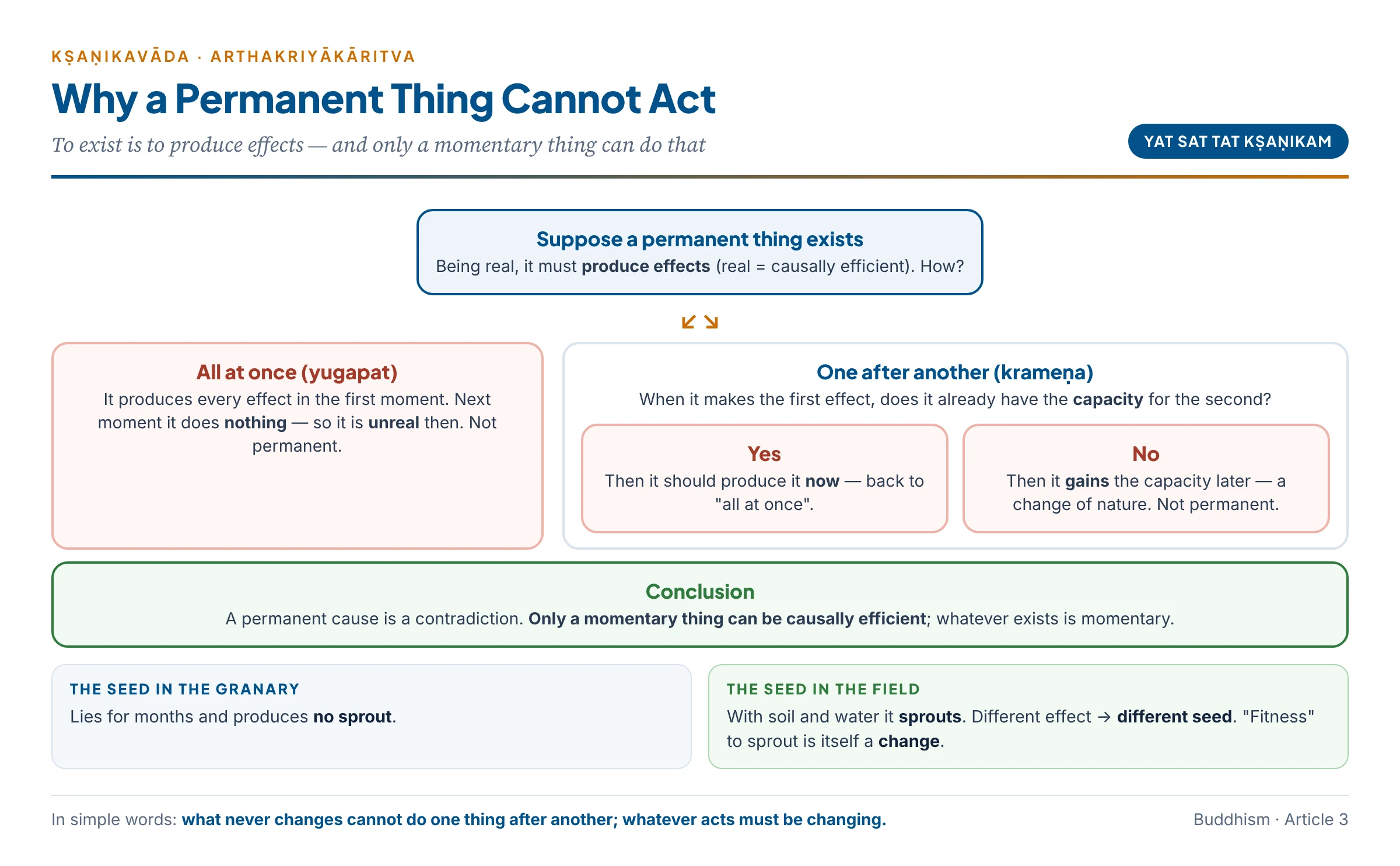
Suppose something permanent existed (a permanent seed, soul, God). Being real, it must produce effects. It can do so in only two ways:
- All at once (yugapat). Then, in the first moment, it produces all its effects. In the next moment it has nothing left to do — so it is inefficient, and therefore unreal. A thing that is real at one moment and unreal at the next is not permanent.
- One after another (krameṇa). Then ask: at the moment it produces the first effect, does it have the capacity for the second?
- If yes, it should produce the second right away (a cause with full capacity does not wait) — and we are back to “all at once”.
- If no, its capacity must change later. But a change of capacity is a change of nature — it is a different thing. So it is not permanent.
- Conclusion. “A permanent entity is a contradiction in terms. Only that which is momentary can possess causal efficiency.” Since everything real is causally efficient, everything real is momentary.
In simple words
Think of a bowler who must bowl six different deliveries. If he truly had the power for all six right now and never changed, nothing would stop him bowling all six at once. If instead he gains the power for the next ball only later, then he is not the same bowler he was a moment ago. Either way, a never-changing cause cannot produce a sequence of different effects — that is the whole force of the dilemma.
Step 3: The Seed in the Granary and the Seed in the Field
- The example. If a seed lasted for more than one moment, it would be the same seed throughout, and should produce the same effect at every moment. But “the seed in the house does not produce the seedling which is generated by a seed sown in the field. The seed in the house cannot then be the same as that in the field.”
- The objection: potentiality and auxiliaries. “The seed always has the potentiality to produce the sprout; this becomes active only in the presence of auxiliary conditions (sahakārin) — earth, water, warmth.”
- The reply.
- Then “the seed of the first moment is not the cause of the seedling”, but “the seed modified by the other conditions” — so the seed has changed.
- Do the auxiliaries produce a special modification (atiśaya) in the permanent seed? If that modification is identical with the seed, the seed itself has changed; if it is different, it — not the seed — is the real cause, and its relation to the seed is a mystery.
- If the seed with auxiliaries is the same as without them, the auxiliaries are useless; if it is different, the seed is not permanent.
- Ratnakīrti’s formulation. If the seed-at-the-first-moment and the seed-at-the-later-moment were identical, they would have to produce the same effect at both times; since they do not, no two phases of a thing are identical — each exists only for the shortest possible duration.
7. Causation Between Moments
If things last only a moment, how can one thing cause another?
- Cause and effect in successive moments. “The cause comes into existence in the first moment and produces the effect in the second moment, and immediately after producing it the cause ceases to exist.” (Some Vaibhāṣikas placed the effect in the third moment.)
- Not simultaneous. “The cause does not produce the effect holding it, as it were, in a pair of tongs, nor does the effect arise clinging to the cause like a lover clinging to his beloved.”
- No separate “activity”. “There is no causal operation separate from the cause.” “Existence itself is causal efficiency” (sattaiva vyāpṛtiḥ). The mere existence of the cause is its causing.
- Causality = invariable antecedence. “Causality means invariable antecedence” (ānantarya-niyama): “the cause merely precedes the effect and the effect merely follows the cause”. Causality is functional interdependence, not production of one substance by another.
- Motion as a series of stills. “We are told that reality is motion and we are also told that motion is impossible.” Both are true: things are too brief to move; “motion is only a series of immobilities” — “flashes of energy follow one another”, as in a stream or a lamp.
8. Santāna: Continuity Without Identity
- What santāna is. A series or stream of momentary events, each conditioned by the one before and conditioning the one after. “The continuity of the life-series is based on a causal connection running through the different states.”
- Why things seem to last. “The rapidity of succession preserves continuity, which is not broken. Similarity is mistaken as identity.”
- Transmission of content. “The preceding link does not perish before transmitting its content to the succeeding link”; “the successor bears all the burden of the predecessor.” Habits, memories and karmic tendencies pass on as conditions, not as a carried substance.
- Unity of the series is conventional. “The notion of the ‘doer’ or ‘enjoyer’ becomes possible in reference to the supposed unity of the chain. This unity is only a creation of the intellect.” (Whether this answers the critics is the subject of Article 4.)
In simple words
In a cricket stadium, a “Mexican wave” runs all the way round the stands. Yet no spectator travels: each one only stands up and sits down when the neighbour does. The wave is real as a pattern of passing-on, not as a thing that moves. A santāna is like that wave — continuity without any traveller.
9. How Momentariness Strengthens No-Self
- A permanent self is ruled out. A soul would have to be the same at every moment; momentariness says nothing is the same for two moments.
- The person is a series. “All individuals are series of momentary states of consciousness“; “the soul is reduced to a series of fleeting ideas.”
- Arguments for a soul are undercut. The usual reasons for a soul — memory, recognition, the unity of experience — are re-explained as features of a causal series.
- Experience confirms it. We find only passing perceptions, feelings and thoughts, never a fixed observer (compare Hume: “I never can catch myself… without a perception”).
- Hence Kṣaṇikavāda is the “metaphysical engine” of Nairātmyavāda: no-self is momentariness applied to the person. (Full treatment in Article 5.)
10. Momentariness in the Schools
| School | View of momentariness |
|---|---|
| Early Buddhism | All conditioned things impermanent; momentariness not yet a formal doctrine |
| Theravāda Abhidhamma | Mental moments with three phases — arising, standing, dissolving; matter lasts somewhat longer |
| Vaibhāṣika (Sarvāstivāda) | Dharmas are momentary in their activity, yet exist in past, present and future; the moment has four marks — arising, duration, decay, destruction |
| Sautrāntika | Strict momentariness: only the present moment exists; past and future dharmas are unreal; continuity by seeds (bīja) |
| Yogācāra (Vasubandhu) | Momentariness of phenomena; the deeper consciousness is a changing stream, not a substance |
| Svatantra-vijñānavāda (Dignāga, Dharmakīrti, Śāntarakṣita, Ratnakīrti) | Universal momentariness, even of consciousness; the systematic proofs above |
| Mādhyamika | Momentariness, like permanence, is a view about things with own-nature; both are empty — momentariness “loses its importance” |
Does Momentariness Apply to Everything?
- The strict view. For the logicians, everything real is momentary — even consciousness. “Reality is annihilation.”
- The restricted view. Some interpreters hold that momentariness applies only to the phenomenal world (saṃsāra), not to nirvāṇa: “a theory of momentariness logically implies that there is a reality which is unborn, uncreated and imperishable — Bodhi or Prajñā”. The Pāli canon itself speaks of “an unborn, unbecome, unmade, unconditioned“, without which there would be no escape from the born and conditioned. On this reading, momentariness describes what we must escape from, not ultimate reality.
- Assessment. The restricted view fits Mahāyāna and the positive descriptions of nirvāṇa; the strict view fits the logicians. Both agree that everything conditioned is momentary.
Indian Connect
- Yoga also speaks of the moment (kṣaṇa): the commentator Vyāsa holds that only the present moment is real and that the sequence of moments is a construction of the mind — very close to the Buddhist view, though Yoga keeps a permanent Puruṣa behind the changing citta.
- Sāṃkhya agrees that Prakṛti changes every moment (pariṇāma), but insists that change needs a changing substance.
- Jainism splits the difference: every real is origination, destruction and permanence together (utpāda-vyaya-dhrauvya) — momentary in its modes (paryāya), permanent as substance (dravya).
Critical Evaluation
(The objections from memory, recognition, karma and responsibility are treated fully in Article 4. Here we examine the arguments for momentariness.)
A. Against the Argument from Existence
- Nyāya: the definition is question-begging. To define existence as “causal efficiency at every moment” already assumes that what does not act at a moment does not exist at that moment. But a seed in the granary exists; it simply lacks accessories. Existence is not the same as acting.
- Nyāya (Udayana, Vācaspati): capacity is not activity. A permanent thing has a fitness (yogyatā) that becomes active when accessories gather (sahakāri-sannidhāna). The seed does not change its nature by meeting water any more than a key changes by meeting its lock.
- Jaina: half-truth. Things are momentary as modes but permanent as substance; the gold that becomes a bracelet and then a necklace persists. Kṣaṇikavāda “oversimplifies” reality and is “only partially true“.
- The reasoner must last. To compare two moments, find them different, and draw the conclusion “therefore momentary”, the thinker must span both moments. The argument presupposes a lasting mind.
B. Against the Argument from Causeless Destruction
- Destruction does have causes. Fire burns the wood, water dissolves the salt, the hammer breaks the pot; practice treats them as causes. To call destruction “non-being” and so uncaused is a verbal manoeuvre.
- The jump from “uncaused” to “immediate”. Even if a thing’s perishing is internal to it, why must it come in the first moment? A clock may “contain” its running down yet run for years.
- Non-being is real in its own way. Nyāya and Vaiśeṣika admit absence (abhāva) as a real category, which can be produced — the posterior absence of a pot (pradhvaṃsābhāva) begins when the pot is broken.
C. Against Momentariness Itself
- Śaṅkara: permanence underlies change. Even though the empirical world changes, change can be known only against something unchanging — ultimately Brahman, and empirically the knowing self.
- Nyāya: stable relations collapse. If nothing persists, causal connections, logical inference and concepts — all of which relate one moment to another — become impossible.
- Sāṃkhya: consciousness is constant. Pure consciousness (Puruṣa) is the unchanging witness of change; making consciousness momentary destroys the witness.
- Yoga: liberation needs a steady mind. The practice of stilling the mind (citta-vṛtti-nirodha) is hard to square with a mind that is a new mind every moment.
- Śaṅkara: a momentary cause has no time to act. The Buddhist says “being itself is the activity” (bhāva eva vyāpāraḥ). But a cause that perishes the moment it is born cannot work on anything. Either it lasts into the next moment to produce its effect — and then it is not momentary — or the effect arises when the cause no longer exists, that is, from non-being, which the Buddhist himself rejects.
- Experience. We feel ourselves as the same person yesterday and today; recognition (“this is the same Devadatta”) seems direct, not inferred from similarity.
D. Buddhist Replies
- Fitness is change. A seed that has become fit to sprout is not the seed that was not fit; “fitness” is a polite name for change.
- Substance is never perceived. What we perceive are qualities and events; the “persisting substance” is an inference or a construction from similarity.
- Experience is constructed. The feeling of sameness is produced by rapid, similar succession — as the film-viewer “sees” one moving man.
- Relations are functional. Inference and causation need only regular succession of moments, not persisting relata.
Critics and Defenders
Criticism — Critics
- Nyāya: existence is not acting; a permanent seed with fitness acts when accessories arrive.
- Nyāya, Vaiśeṣika: destruction has causes; absence is a real category.
- Jaina: momentary in modes, permanent in substance — only half the truth.
- Śaṅkara, Sāṃkhya: change presupposes an unchanging witness or ground.
- All rivals: the arguer who compares moments must himself last.
Defence — Defenders and strengths
- Dharmakīrti: to exist is to act; a permanent cause is idle, hence unreal.
- Vasubandhu: destruction cannot be produced, so perishing is in the thing’s nature — and immediate.
- Ratnakīrti: different effects at different times prove different things.
- A single principle explains change, causation, no-self and the folly of attachment.
- Anticipates process philosophy and the event-based picture of modern physics.
Cross-Tradition Comparison
| Thinker | View of change and permanence | Compared with Kṣaṇikavāda |
|---|---|---|
| Heraclitus | “You cannot step into the same river twice”; all flows | The same simile; but Heraclitus keeps a rational order (logos) that does not flow |
| Hume | The self is “a bundle or collection of different perceptions, which succeed each other with an inconceivable rapidity” | Very close; Hume reaches it by introspection, the Buddhists by logic as well |
| William James | “The passing thought itself is the thinker”; consciousness is a stream | Like santāna; but James’s stream is continuous, not a string of separate moments |
| Bergson | Reality is duration — continuous, flowing time | Agrees that reality is becoming; disagrees that it is made of separate instants — Bergson would call that the “cinematographic” error |
| Whitehead | Reality is made of actual occasions that “perish as they arise”, passing their character to successors | The closest Western parallel: momentary events, continuity by inheritance |
| Russell | Physical objects as series of events (“logical constructions”) | A modern logical version of the series view |
| Descartes | God must re-create the world at every moment (continuous creation) | Agrees that nothing lasts by itself; but needs God where Buddhism needs only conditions |
Indian Connect — Key takeaways
- Nyāya-Vaiśeṣika (enduring substances and atoms) and Advaita (the unchanging Brahman) are the two opposite poles to Kṣaṇikavāda; Jainism and Sāṃkhya stand between, admitting change in a permanent substance.
- Yoga’s treatment of the moment shows that momentariness was a shared Indian problem, not a Buddhist oddity.
- The Buddhist arthakriyā test of reality foreshadows pragmatism: the real is what makes a difference.
Synthesis (Siddhānta)
- The doctrine. Everything conditioned — mind and matter — exists for one moment, perishing as it arises; what we call a lasting thing is a series (santāna) of similar moments, each conditioning the next.
- Its grounds. (1) Dependent origination: what depends on changing conditions cannot stay the same; (2) causeless destruction: perishing is in a thing’s nature, so it comes at once; (3) causal efficiency: to exist is to act, and only a momentary thing can act.
- Its achievement. It gives Buddhism a metaphysics without substance, supports no-self, removes God and Prakṛti, and explains causation as regular succession of events.
- Its burden. It must explain memory, recognition, personal identity, karma and responsibility without anything that lasts — the test faced in Article 4.
- Contemporary relevance.
- Physics. Modern physics describes the world in terms of events and fields rather than lasting little lumps of matter; “things” are relatively stable patterns of process.
- Neuroscience. The brain’s states change continuously; the sense of a stable self is increasingly studied as a constructed model — a picture close to santāna.
- Psychology of change. Accepting impermanence is a core skill in grief counselling and mindfulness practice: suffering decreases when we stop demanding permanence.
- Ecology and economics. Seeing institutions, ecosystems and markets as processes rather than fixed objects improves how we plan for change and resilience.
“Whatever exists is momentary.” — Dharmakīrti
Previous Year Questions
- 2026How does the Buddhist theory of momentariness problematize the issue of human action and responsibility? Critically discuss.
- 2020How is Kshanikavada a logical derivative of Pratityasamutpada in Buddhism? Explain.
- 2019What is Pratityasamutpāda? How do the Buddhists apply this concept to prove that everything is momentary?
- 2017What are the arguments of the Buddhists to establish Kshanikvada? Do they necessarily lead to krtanasa and akrtabhyupagam?
- 2016How does Ksanikavada strengthen the arguments for ‘Nairatmyavada’? Explain.
- 2013Explain the Buddhist notion of ‘Impermanence’ and show how the idea of Impermanence leads to theory of momentariness of reality.
- 2004State and discuss the Buddhist notion of momentariness.
- 2003Ksanikavada of Buddhism. Short Notes.