

Schools of Buddhism: Pratītyasamutpāda; Kṣaṇikavāda, Nairātmyavāda
Official Syllabus: Paper I, Section B, Unit 14
Buddhism begins not with a theory of the universe but with a diagnosis of human life. Siddhārtha Gautama, the Buddha (“the Awakened One”), refused to discuss whether the world is eternal or whether the soul survives death, and taught instead four truths about suffering (duḥkha): that it exists, that it has a cause, that it can cease, and that there is a path to its cessation. From this practical core his followers later drew a whole metaphysics — dependent origination (Pratītyasamutpāda), momentariness (Kṣaṇikavāda) and no-self (Nairātmyavāda) — and four rival schools. This article sets out the foundation on which all of them stand.
In simple words
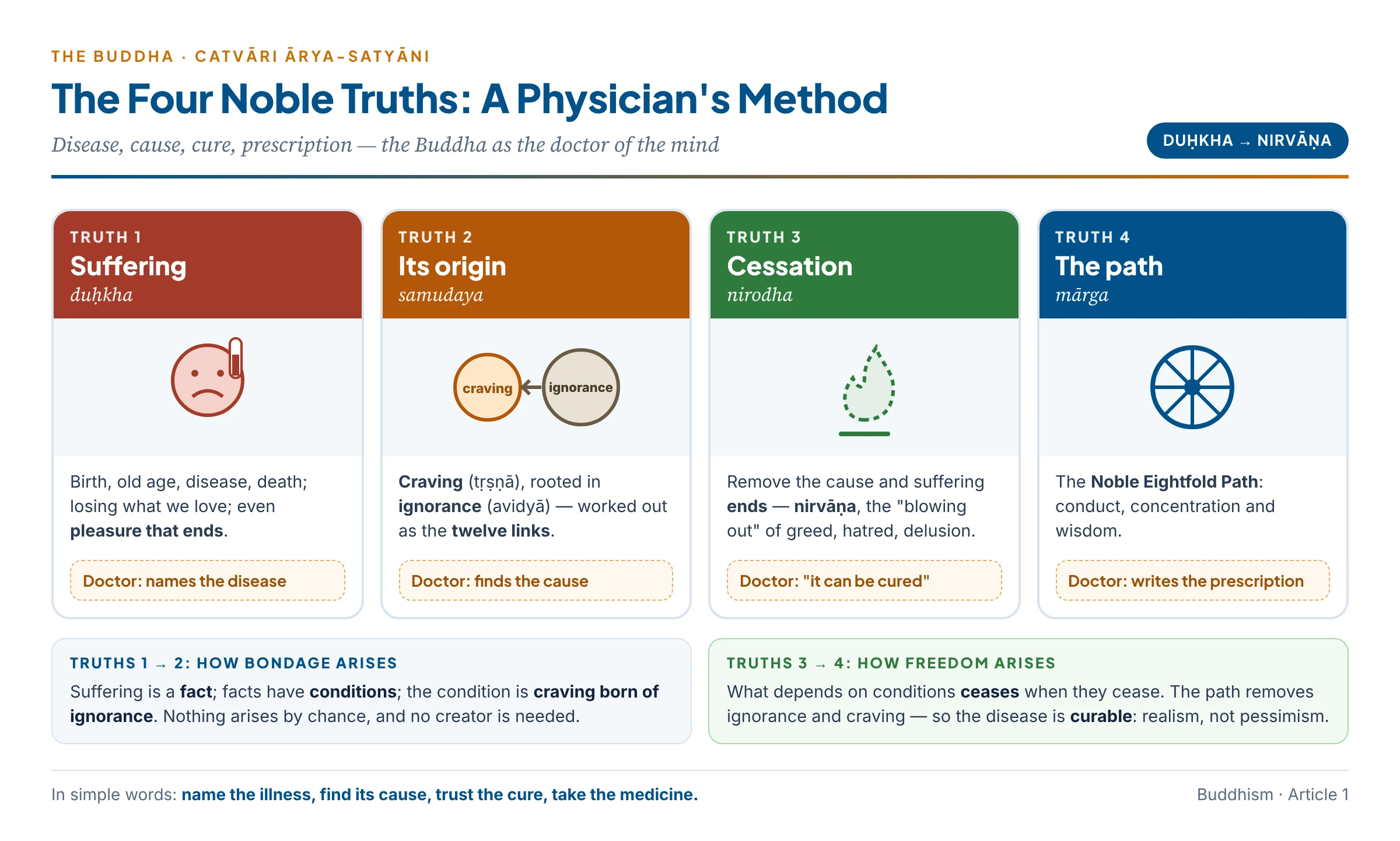
A patient with a high fever does not need a lecture on the history of medicine. A good doctor does four things: names the disease, finds its cause, assures the patient it can be cured, and writes the prescription. The Buddha described himself in just this way — as a physician of the mind. The Four Noble Truths are his diagnosis, cause, prognosis and prescription.
Context & Problem
The Life Behind the Teaching
- Birth and renunciation. Siddhārtha was born (traditionally 563 BCE) into the royal Śākya family of Kapilavastu, at Lumbinī, in the Himalayan foothills. Shielded from hardship, he was shaken by four sights — an old man, a sick man, a corpse and a wandering ascetic. The first three showed him that life is bound up with old age, disease and death; the fourth suggested a possible way out.
- The search. He left the palace, studied under the meditation teachers of his day and practised severe austerities for about six years. None of this gave him the answer.
- Enlightenment. Turning to a middle course between luxury and self-torture, he meditated under the Bodhi tree at Bodh Gayā and attained enlightenment (bodhi), at about 35. He became the Buddha.
- The first sermon. At Sārnāth he preached to his five former companions the Four Noble Truths and the Middle Path — “setting in motion the wheel of the Dhamma” (Dhammacakkappavattana).
- Teaching and passing. He taught for forty-five years, travelling, preaching and founding the Saṅgha (the monastic order), and passed away at 80 at Kuśinagara — his parinirvāṇa.
Common confusion
Did the Buddha attain enlightenment at the age of 80? No. Some popular notes confuse two events. Enlightenment (bodhi) came at about 35, under the Bodhi tree; the next forty-five years were spent actively teaching. Parinirvāṇa (final nirvāṇa) came with his death at 80. The difference matters philosophically: a Buddha who was liberated yet active for forty-five years shows that nirvāṇa is not inactivity or annihilation.
The Sources
- The Tripiṭaka (“three baskets”), in Pāli, preserves the teaching as remembered by his disciples:
- Vinaya Piṭaka — rules of discipline for the Saṅgha.
- Sutta Piṭaka — the Buddha’s sermons and dialogues.
- Abhidhamma Piṭaka — systematic philosophical analysis of the teaching.
- Councils. Tradition says the first two baskets were recited at the First Council at Rājagṛha soon after the Buddha’s death (Upāli recited the Vinaya, Ānanda the Suttas); the Abhidhamma was added at the Third Council at Pāṭaliputra under Aśoka; a later council in Kashmir under Kaniṣka produced the great commentary, the Vibhāṣā, which gave the Vaibhāṣika school its name.
What the Buddha Was Reacting Against
- Vedic ritualism. Buddhism is a nāstika (heterodox) school: it rejects the authority of the Vedas (Veda-prāmāṇya) and the sacrificial religion of the priests.
- Two metaphysical extremes.
- Eternalism (śāśvatavāda) — the view, found in the Upaniṣadic teachers, that there is an eternal, unchanging self (ātman) behind experience.
- Annihilationism (ucchedavāda) — the materialist view (as in the Cārvāka) that the person is destroyed at death and nothing carries over.
- Two practical extremes.
- Sensual indulgence (kāma-sukha) — the pleasure-seeking life of the palace.
- Self-mortification (attakilamatha) — the starvation and pain of the ascetics.
- The Middle Path (Majjhimā Paṭipadā) avoids both pairs: ethically it is moderation; metaphysically it is dependent origination — things are neither eternally real nor simply annihilated.
In simple words
Think of tuning a veena. If the string is too tight it snaps; if it is too loose it gives no sound. Only a string that is neither too tight nor too loose makes music. The Buddha gave this very image to a monk who had wounded himself with over-strict practice. The Middle Path is not lukewarm compromise; it is the right tension.
Core Doctrine
1. The Anti-Speculative Attitude
- Primarily an ethical teacher. “Buddha was primarily an ethical teacher and reformer, not a metaphysician.” His aim was to show the way of life that leads beyond suffering.
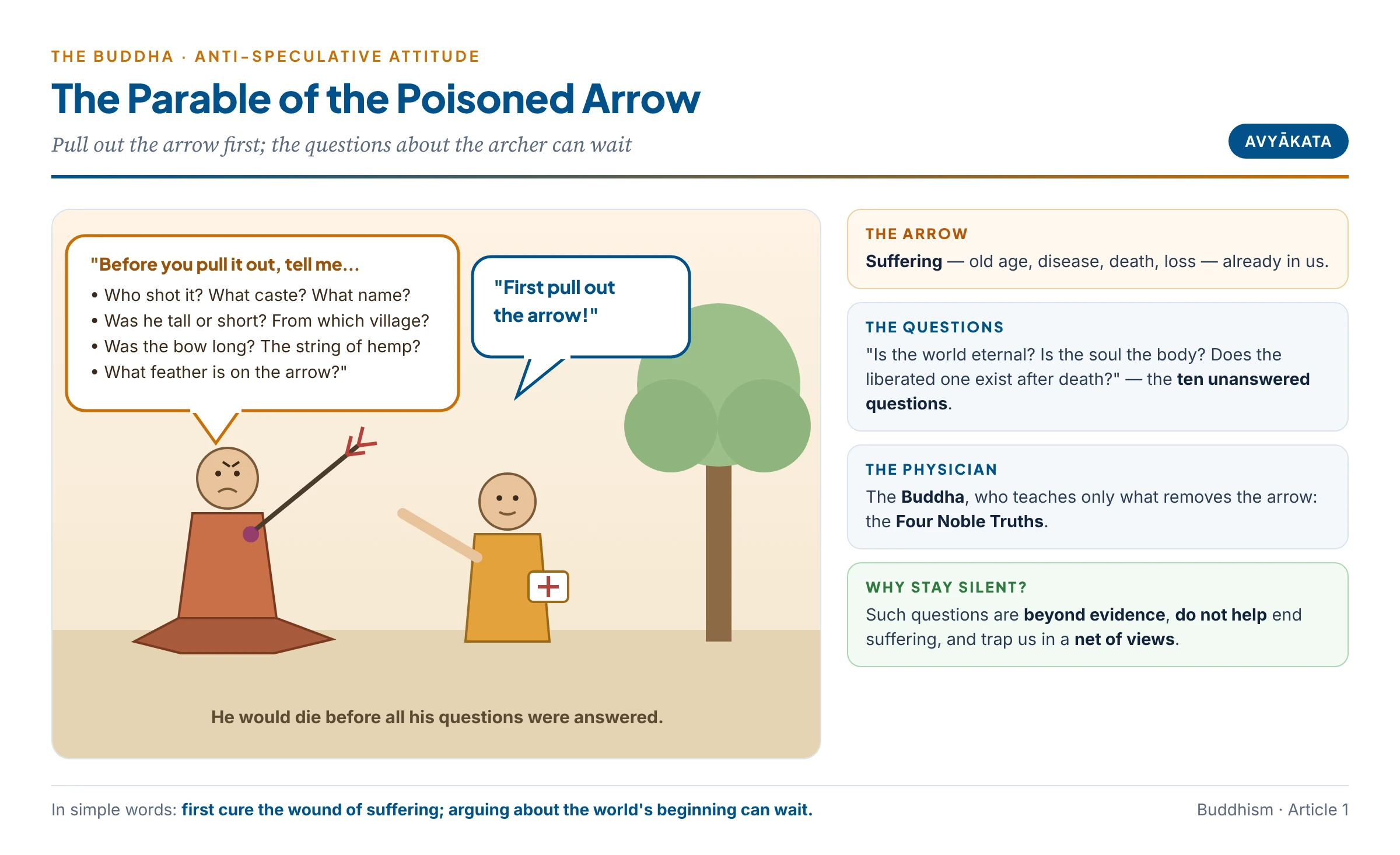
- Why speculation is avoided. When asked whether the soul is the same as the body, whether the world is eternal, and similar questions, the Buddha declined to answer. Three reasons are given:
- Insufficient evidence. Such questions go beyond experience; arguing about them produces partial, one-sided views — like the blind men and the elephant, each describing only the part he touched.
- Ethically unprofitable. They do not lead to “aversion, absence of passion, cessation, quiescence, knowledge, supreme wisdom and nirvāṇa“.
- A net of views. A person who indulges in speculation becomes “all the more entangled in the net of theories he himself has woven”.
- The parable of the poisoned arrow. A man is struck by a poisoned arrow. If he refuses treatment until he learns who shot it, his caste, his name, whether the bow was long or short, and what the arrow was made of, he will die before he knows. The urgent task is to pull out the arrow. Speculating about the soul and the world while life is full of suffering is exactly this folly.
- The handful of leaves. Holding a handful of siṃsapā leaves, the Buddha asked his monks which were more — the leaves in his hand or those in the forest. “Those in the forest.” “So too, what I know but have not taught is far more than what I have taught. I have taught only what is useful for ending suffering.”
2. The Ten Unanswered Questions (Avyākata)
- The list. When the wandering ascetic Poṭṭhapāda (and, in another dialogue, the monk Māluṅkyāputta) pressed him, the Buddha left ten questions unanswered (avyākata, “undeclared“; often written daśa-avyākṛtāni):
- Is the world eternal?
- Is the world not eternal?
- Is the world finite?
- Is the world infinite?
- Is the soul the same as the body?
- Is the soul different from the body?
- Does the Tathāgata (the liberated one) exist after death?
- Does he not exist after death?
- Does he both exist and not exist after death?
- Does he neither exist nor not exist after death?
- The grouping. Four questions concern the world (time and space), two the soul–body relation, and four the fate of the liberated — the last set already using the four-cornered form (catuṣkoṭi) that Nāgārjuna later made famous. (Some texts expand them to fourteen or sixteen by giving every problem four alternatives.)
- Silence is not ignorance. When the wandering monk Vacchagotta asked “Is there a self?“, the Buddha stayed silent. He later explained to Ānanda: had he said “there is a self“, he would have sided with the eternalists; had he said “there is no self“, he would have sided with the annihilationists — and confused Vacchagotta further.
In simple words
Ask “Where does the flame go when a lamp is blown out — north, south, east or west?” Every answer is wrong, not because the answer is secret but because the question does not fit the case: the flame did not go anywhere. The Buddha used this very example. “Does the liberated one exist after death?” is a question of the same kind; “yes” and “no” both mislead.
How the Silence Was Interpreted
- As empiricism or agnosticism. Some followers read it as frank admission that the mind cannot decide questions beyond experience — a kind of scepticism or agnosticism.
- As practical wisdom. Others read it as purely pragmatic: the questions are irrelevant to liberation.
- As a sign of the indescribable. The Mahāyāna schools read it as a sign that ultimate reality and the state of the liberated transcend all concepts: the Buddha had realised something “far beyond“, “comprehended only by the wise“, “not grasped by mere logic“. Nāgārjuna’s Śūnyavāda and the two truths grew from this reading.
- “The nemesis of neglected metaphysics.” Buddhism, though primarily an ethical movement, soon gave birth to about thirty schools, some of which entered “the deep waters of metaphysical speculation, heedless of the founder’s warning“. Every reasoned attempt to avoid philosophy lands a thinker in a new philosophy.
Indian Connect
- The Upaniṣads had asked exactly the questions the Buddha set aside — the nature of the self and of Brahman. His silence is a deliberate turn from what is ultimately real to what ends suffering.
- Śaṅkara later borrowed the Mādhyamika device of two levels of truth; the Buddha’s own refusal to answer “is” or “is not” about the liberated person is the seed of that idea.
- Jaina thinkers met the same problem differently: instead of silence, they offered seven qualified answers (saptabhaṅgī) to every such question.
3. The Four Noble Truths (Catvāri Ārya-satyāni)
The Buddha’s enlightenment is summed up in four truths “for the spiritually worthy” (ārya):
| # | Truth | Pāli / Sanskrit | Medical parallel | In one line |
|---|---|---|---|---|
| 1 | Suffering | dukkha / duḥkha | The disease | Life as we live it is marked by suffering |
| 2 | Origin of suffering | samudaya | The cause | Suffering arises from craving, rooted in ignorance |
| 3 | Cessation of suffering | nirodha | The cure is possible | Remove the cause and suffering ends — nirvāṇa |
| 4 | Path to cessation | mārga / magga | The prescription | The Noble Eightfold Path |
The First Truth: Suffering (Duḥkha)
- What it includes. “Birth is suffering, old age is suffering, disease is suffering, death is suffering; union with the unpleasant, separation from the pleasant, not getting what one wants — in short, the five aggregates of clinging are suffering.”
- Three kinds of duḥkha (a standard Buddhist classification):
- Plain pain (dukkha-dukkhatā) — a toothache, grief.
- Suffering of change (vipariṇāma-dukkhatā) — pleasure that hurts because it ends.
- Suffering of conditioned existence (saṅkhāra-dukkhatā) — the subtle unsatisfactoriness of anything that depends on conditions and so can never be secure.
- Even pleasure is duḥkha. Worldly pleasures look pleasant only to the short-sighted: their transitoriness, the pain of their loss and the fear of losing them make them sources of anxiety.
- Pessimism or realism?
- The charge. The Cārvāka would object that life holds pleasures as well as pains; condemning all of life is pessimism.
- The reply. The first truth is only the diagnosis. The third truth declares the disease curable, and the Buddha speaks of the highest happiness as well as suffering. His attitude is better called realism — “there is a problem, but there is also a solution”. Buddhism begins with pessimism and ends in optimism.
- Shared with others. This kind of “pessimism” is common to almost all Indian schools; the Buddha only states it most sharply.
In simple words
A child cries when a soap bubble bursts. Its beauty was real, but it was always going to burst — and the child’s grief comes from expecting it to last. The Buddha does not deny that the bubble is beautiful. He says that expecting permanence from what is impermanent is the root of our pain.
The Second Truth: The Origin of Suffering (Samudaya)
- The immediate cause: craving (tṛṣṇā, Pāli taṇhā, literally “thirst”). It takes three forms:
- Craving for sense-pleasure (kāma-taṇhā).
- Craving for existence (bhava-taṇhā) — to become, to continue.
- Craving for non-existence (vibhava-taṇhā) — to be rid of what we dislike, even of life.
- The root cause: ignorance (avidyā). Craving itself arises from not knowing things as they are — not knowing the Four Noble Truths, the impermanence of things and the absence of a permanent self. Ignorance makes us cling to the fleeting as if it were lasting and to the self as if it were real.
- Causation, not chance. The second truth rests on the Buddha’s law of causation: “nothing is unconditional; the existence of everything depends on some conditions.” Suffering, being a fact, must have conditions. The Buddha works these out as the twelve links of dependent origination (dvādaśa-nidāna) — covered in detail in the next article.
- Past, present, future. The causes of the present life lie in the past life, and the future life depends on the present.
The Metaphysical Implications of the Second Truth
Though the Buddha avoided metaphysics, the second truth implies a view of reality. Four doctrines follow from it:
- Dependent origination (Pratītyasamutpāda) — everything arises in dependence on conditions; there is no uncaused first cause and no self-caused reality.
- The law of karma — a special case of causation: the present existence is the effect of the past, the future of the present.
- Universal change (anityatā) — what arises from conditions perishes when they cease; later developed into momentariness (Kṣaṇikavāda).
- No-soul (anātmavāda) — since everything is conditioned and changing, there is no permanent, unconditioned self.
- And two denials. The second truth leaves no room for a creator God (suffering is explained by natural conditions, not by a divine will) and no room for chance (nothing arises fortuitously).
The Third Truth: The Cessation of Suffering (Nirodha)
- Follows from the second. “If these conditions are removed, misery would cease.” Since suffering depends on conditions, it is not eternal; remove ignorance and craving, and suffering stops.
- Nirvāṇa. This cessation is called nirvāṇa (Pāli nibbāna), literally “blowing out” — of the three fires of greed (rāga), hatred (dveṣa) and delusion (moha).
- Attainable in this life. One who has broken the fetters of attachment is an Arhat (“worthy one”), liberated here and now.
- Not inactivity. The Buddha’s forty-five years of teaching show that nirvāṇa is compatible with action — but action without greed, hatred and delusion, which “does not create karma producing rebirth”, like fried seeds that cannot sprout.
- Double gain. Nirvāṇa negatively guarantees no rebirth; positively it is perfect peace even in this life. (The nature and kinds of nirvāṇa are treated fully in Article 6.)
The Fourth Truth: The Path (Mārga)
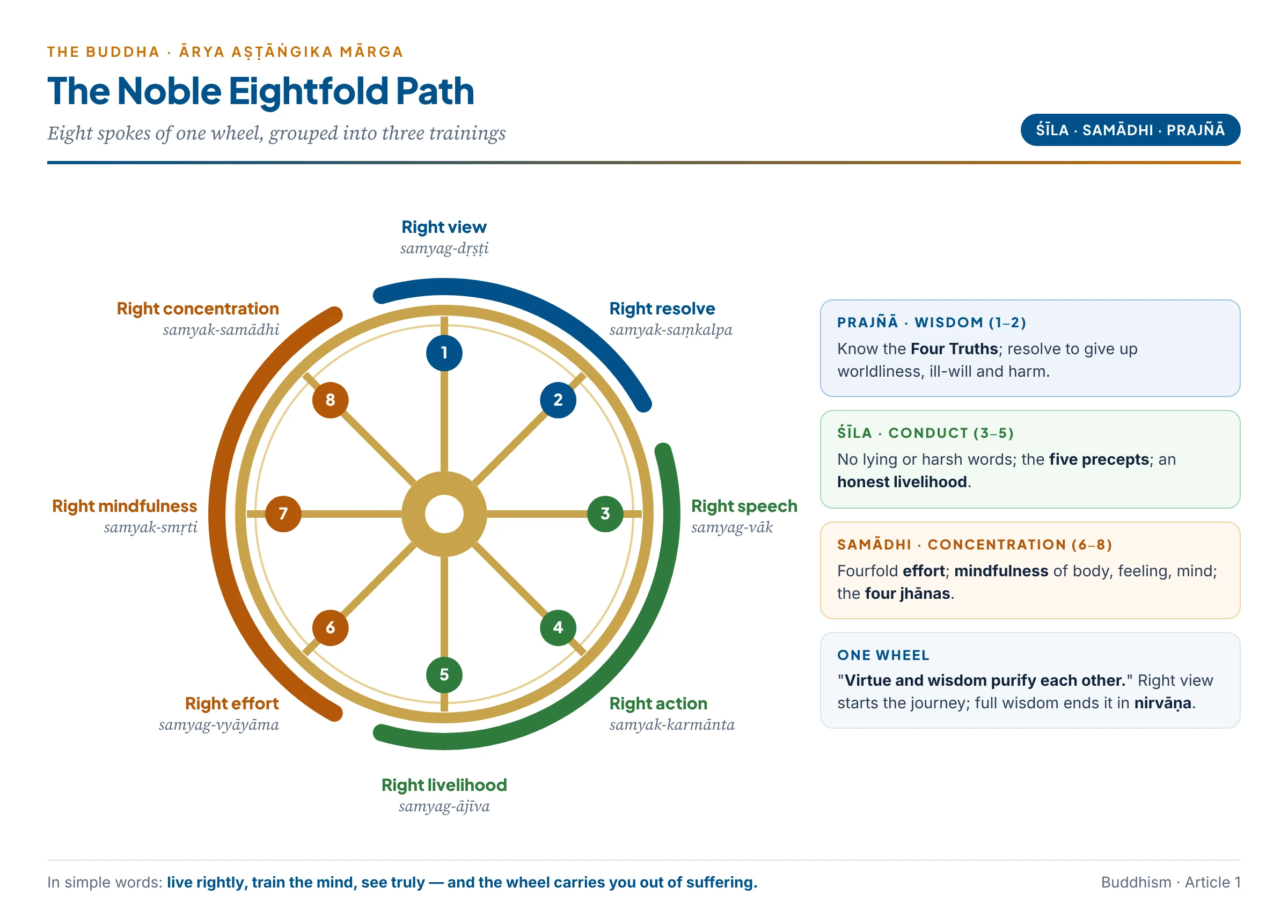
- The Noble Eightfold Path (Ārya Aṣṭāṅgika Mārga) is the “prescription”. It is open to all — monks and lay people alike — and gives “in a nutshell the essentials of Buddhist ethics”.
4. The Noble Eightfold Path
| # | Step | Pāli | Sanskrit | What it means | Training |
|---|---|---|---|---|---|
| 1 | Right view | sammā-diṭṭhi | samyag-dṛṣṭi | Correct knowledge of the Four Noble Truths — not speculation about self and world | Prajñā |
| 2 | Right resolve | sammā-saṅkappa | samyak-saṃkalpa | Resolve to renounce worldliness, give up ill-will, and harm no one | Prajñā |
| 3 | Right speech | sammā-vācā | samyag-vāk | Abstain from lying, slander, harsh words, frivolous talk | Śīla |
| 4 | Right action | sammā-kammanta | samyak-karmānta | The five precepts (pañca-śīla): no killing, stealing, sexual misconduct, lying, intoxication | Śīla |
| 5 | Right livelihood | sammā-ājīva | samyag-ājīva | Earn a living by honest means, harming none | Śīla |
| 6 | Right effort | sammā-vāyāma | samyag-vyāyāma | Root out old evil thoughts, prevent new ones, cultivate and retain good ones | Samādhi |
| 7 | Right mindfulness | sammā-sati | samyak-smṛti | Constant awareness of body, feelings, mind and mental states as they really are — “not this is I, not this is mine“ | Samādhi |
| 8 | Right concentration | sammā-samādhi | samyak-samādhi | Passing through the four meditative absorptions (jhāna) to perfect equanimity | Samādhi |
A Closer Look at the Last Three Steps
- Right effort is fourfold. It is negative and positive: (1) root out evil thoughts already present, (2) prevent new ones from arising, (3) develop good thoughts, (4) retain them. “Even one high up on the path cannot afford to take a moral holiday.”
- Right mindfulness sounds trivial — “think of a spade as a spade” — but it is hard. We habitually treat the body, feelings and mind as if they were permanent and ours. The Mahāsatipaṭṭhāna Sutta advises contemplating the body as a mere combination of the four elements, filled with flesh, bone, bile, phlegm and blood, and, at the cemetery, watching how a corpse decays — so that “he gives up all false affection for the body, his own and others”.
- Right concentration: the four jhānas.
- First — the pure mind dwells on the truths with reasoning (vitarka) and investigation (vicāra), and feels joy and ease born of detachment.
- Second — doubts dissolve, reasoning becomes unnecessary; there remain joy, peace and inner tranquillity.
- Third — the meditator lets go even of joy; there remain equanimity and bodily ease.
- Fourth — even ease is dropped; a state of perfect equanimity, “without pain, without ease”. This leads to arhatship or nirvāṇa.
The Threefold Training (Triśikṣā)
- Śīla (moral conduct) — right speech, action, livelihood.
- Samādhi (concentration) — right effort, mindfulness, concentration.
- Prajñā (wisdom) — right view and right resolve.
- Their unity. “Virtue and wisdom purify each other.” In Indian philosophy, knowledge and morality are inseparable: one starts with right view as a mere intellectual grasp, but old habits continue and create a divided personality; the remaining steps reform the will and emotions until the personality becomes harmonious, and perfect wisdom becomes possible. Knowledge, goodness and equanimity are attained together in nirvāṇa.
- Four stages of the noble person. On the path the practitioner becomes in turn a stream-enterer (srotāpanna), a once-returner (sakṛdāgāmin), a non-returner (anāgāmin), and finally an Arhat, liberated in this life.
5. The Three Marks of Existence (Tilakkhaṇa)
“All conditioned things are impermanent; all conditioned things are suffering; all phenomena are without self.” — Dhammapada (Sabbe saṅkhārā aniccā, sabbe saṅkhārā dukkhā, sabbe dhammā anattā)
- Anicca (impermanence). Everything that arises from conditions changes and passes away — from the smallest particle to our emotions; birth, ageing and death are part of the process. “Whatever has a beginning has an end“; “where meeting is, parting will be; where birth is, death will come”.
- Dukkha (unsatisfactoriness). Because conditioned things change, clinging to them brings dissatisfaction — including the subtle unease of existence itself, even without acute pain.
- Anattā (no-self). Neither the five aggregates nor anything else is a permanent, independent self; the “ego” is a mental construction.
- How they are linked. What is impermanent cannot give lasting satisfaction; what is impermanent and unsatisfying cannot be my true self. Seeing this weakens clinging; the “lion’s roar” of the Buddha sums it up: “everything is sorrow, everything is without self, everything is momentary” (sarvaṃ duḥkham, sarvam anātmam, sarvaṃ kṣaṇikam).
- Note the difference of scope. The verse says “all conditioned things (saṅkhārā) are impermanent and suffering”, but “all phenomena (dhammā) are without self” — the wider word includes even the unconditioned (nirvāṇa): nirvāṇa is not suffering, but it is not a self either.
6. The Three Jewels (Triratna)
- The refuge formula (tisaraṇa): “I take refuge in the Buddha; I take refuge in the Dhamma; I take refuge in the Saṅgha.”
- Buddha — the teacher, the example that liberation is possible for a human being.
- Dhamma — the teaching, above all dependent origination and the Four Truths; also the law that governs the world.
- Saṅgha — the community of practitioners that supports the aspirant.
- Their internal relation. The Buddha discovered the Dhamma; the Dhamma is what the Buddha taught; the Saṅgha preserves and practises it. The Buddha declared that after him “the Dhamma will be your teacher” — the jewel that unites the other two. (How the Triratna fits with no-self is discussed in Article 6.)
7. Buddhism as a Religion Without God
- No creator. The world is explained by natural causation (dependent origination) and the moral law of karma, “without maker, without beginning”. A creator God is unnecessary and the Buddha discouraged speculation about one.
- Arguments used by later Buddhist thinkers against a creator:
- The argument from suffering. If an all-powerful, good God made the world, why is it full of suffering and injustice?
- The argument from change. A permanent God could produce nothing in time; whatever produces effects must itself change — so a permanent creator is causally inert.
- The argument from karma. If God rewards and punishes according to karma, it is karma that does the work; God is superfluous. If he does not follow karma, he is arbitrary.
- The argument from purpose. If God created out of need, he is not perfect; if without a purpose, he acts like a child at play.
- What takes God’s place. The law of karma and dharma “governs the universe in such a way that no fruit of action is lost”. The Buddha’s life gives the ideal and the promise of liberation; the Saṅgha strengthens the aspirant.
- A religion of self-help. “Be a light unto yourselves” (attadīpā viharatha); “decay is inherent in all composite things — work out your salvation with diligence” (the Buddha’s last words).
- Is it still a religion? By a theistic definition (religare, binding man to God), early Buddhism is not a religion. By a wider definition — a way of salvation with an ideal of the holy, practices, a community and a vision of ultimate value — it is. Later Mahāyāna even raised the Buddha to a divine status (the Dharmakāya, the Buddha Amitābha), showing how the human need for grace reasserted itself.
Indian Connect
- Jainism is the other great Indian religion without a creator God: both put a moral law (karma) and a perfected teacher (Tīrthaṅkara, Buddha) in God’s place.
- Sāṃkhya and Pūrva Mīmāṃsā also explain the world without a creator — the first by Prakṛti, the second by apūrva and the eternal Veda.
- Nyāya answered all these schools with its proofs for Īśvara as the intelligent distributor of karmic fruit — the strongest Indian reply to the Buddhist argument from karma.
Critical Evaluation
A. Was the Buddha Really Anti-Metaphysical?
- For the claim. He refused the ten questions; he called views a “net”; he compared speculation to arguing about an arrow instead of removing it. Positivism (“confine thought to this world”), phenomenalism (“we are sure only of the phenomena we experience”) and empiricism in method are fair labels for his attitude.
- Against the claim.
- His ethics presupposes a metaphysics: causation, karma, impermanence, no-self.
- He spoke of a non-sensuous experience in nirvāṇa — something ordinary empiricists deny.
- His silence was selective: he did answer questions about causation and the self as aggregates; he refused only those whose answer would mislead.
- Balanced view. The Buddha rejected speculative metaphysics (claims beyond experience, held as dogma), not all reasoning about reality. He gave a practical metaphysics — just enough theory to support the path.
B. Did Early Buddhism Value the Four Truths More Than Metaphysics?
- Yes, in emphasis. “Both in the past and even now do I set forth just this: suffering and the cessation of suffering.” The Four Truths and the Eightfold Path give “the whole of early Buddhism in a nutshell”. Metaphysics enters only as the content of right view.
- But the truths themselves carry metaphysics. The second truth is a theory of causation; the third assumes that conditioned states can cease; the fourth assumes the mind can be transformed. The four truths are not instead of metaphysics but metaphysics put to practical use.
- The later turn. The Abhidharma and the four schools show that the questions the Buddha set aside could not be avoided once Buddhism had to defend itself against rival systems.
C. Is the First Truth Pessimistic?
- Charge. It condemns life wholesale; the Cārvāka and many modern readers see it as world-negating.
- Reply. The first truth is followed by the third — cessation is possible, here and now. The Buddha teaches realism about suffering and optimism about its cure; his own life after enlightenment was one of compassion and activity.
D. Is a Religion Without God Coherent?
- Theistic objection. Without God there is no grace, no guarantee that the moral order is just, and no object of worship; Buddhism’s own later history (the Buddha as saviour) seems to concede this.
- Buddhist reply. The law of karma guarantees justice impersonally; refuge in the Buddha, Dhamma and Saṅgha gives the devotional and communal side; nirvāṇa gives the ultimate value. Religion is a way of transformation, not necessarily belief in a creator.
Critics and Defenders
Criticism — Critics
- Cārvāka: the first truth is pessimism; life has pleasures too.
- Theists (Nyāya): without an intelligent Īśvara, karma cannot distribute its fruits; a religion without God lacks grace.
- Vedāntins: silence on the self is evasion; the path presupposes a self that is freed.
- Rationalist critics: an ethics with hidden metaphysics cannot call itself anti-metaphysical.
- Later Buddhists themselves: the “nemesis of neglected metaphysics” — some thirty schools disputed what the silence meant.
Defence — Defenders and strengths
- Realism, not pessimism: disease and cure; the third truth is optimistic.
- Karma works as an impersonal law, as natural causation does — no distributor needed.
- Silence avoids two errors (eternalism and annihilationism) rather than evading the question.
- A practical metaphysics, held for the sake of the path, is not speculative metaphysics.
- The ethics is rational, universal and open to all — no caste, no priest, no revelation.
Cross-Tradition Comparison
| Theme | Buddha | Western parallel | Point of comparison |
|---|---|---|---|
| Refusing unanswerable questions | Avyākata | Kant — reason falls into antinomies when it asks whether the world has a beginning in time or limits in space | Both reject questions that go beyond possible experience; three of Kant’s four antinomies echo the Buddha’s world questions |
| Meaningless metaphysics | Speculation “does not profit” | Logical positivists — metaphysical statements are unverifiable | The Buddha calls them unprofitable, not meaningless |
| Philosophy as cure | Buddha as physician | Epicurus and the Stoics; Wittgenstein — philosophy as therapy | Philosophy is judged by whether it relieves suffering or confusion |
| Suffering and desire | Craving is the cause of suffering | Schopenhauer — the will to live is the root of suffering; he admired Buddhism | Schopenhauer’s cure (denial of the will) is close to nirvāṇa, but he is a pessimist; the Buddha is not |
| The Middle | Majjhimā paṭipadā | Aristotle — virtue as the mean between excess and deficiency | Aristotle’s mean is a mean of feeling and action; the Buddha’s is also a mean between metaphysical extremes |
| Pragmatism | Only what ends suffering is taught | William James — truth as what works | The Buddha’s “handful of leaves” is a pragmatic criterion of what is worth teaching |
Indian Connect — Key takeaways
- The Buddha’s silence stands between the Upaniṣadic “the Self is” and the Cārvāka “nothing survives” — the first form of the Middle Path.
- His method — diagnosis, cause, cure, path — was taken over by Yoga (heya, hetu, hāna, hānopāya: what is to be avoided, its cause, its removal and the means) and by Āyurveda.
- The Mahāyāna reading of the silence as a sign of the indescribable links the Buddha to Nāgārjuna and, through the two truths, to Śaṅkara.
Synthesis (Siddhānta)
- The teaching in one sentence. Life is marked by suffering; suffering has conditions, chiefly craving rooted in ignorance; when the conditions are removed suffering ceases (nirvāṇa); the Eightfold Path of conduct, concentration and wisdom removes them.
- The method. Practical, experiential, rational: test the teaching “as gold is tested by fire”; avoid questions whose answers cannot be verified and do not help.
- The hidden metaphysics. The second truth already contains dependent origination, karma, impermanence and no-self — the three doctrines of the syllabus — and the avyākata contain the seeds of the Mādhyamika dialectic.
- Contemporary relevance.
- Mental health. Mindfulness-based therapies (stress reduction, cognitive therapy) build directly on right mindfulness; craving and clinging are now studied as drivers of anxiety and addiction.
- Ethics without dogma. The five precepts and right livelihood offer a secular, universal ethic — relevant to debates on consumerism and responsible business.
- Social reform. Dr B. R. Ambedkar turned to Buddhism (1956) as a rational, egalitarian religion without caste or priestly authority — the Buddha’s rejection of Vedic hierarchy given new political life.
- Middle Path in public life. Avoiding the extremes of indulgence and austerity, and of dogmatic certainty and cynical scepticism, remains a sound rule for personal and public reasoning.
“Both in the past and now, I set forth just this: suffering and the cessation of suffering.” — The Buddha
Previous Year Questions
- 2024State and evaluate Buddhism as a religion without God.
- 2017Critically evaluate the Buddhistic arguments against Is God necessary for religion? Justify your answer.
- 2015What is the role of Pratityasamutpada in explaining dukkha? Elucidate means to overcome it.
- 2012Do you agree with the view that in early Buddhism more importance was given to Four Noble Truths than to systematic metaphysics? Give reasons for your agreement or disagreement?
- 2011Can Buddhism, because of its doctrine of ‘anatta‘, be regarded as a religion or not? Discuss.
- 2010Bring out the metaphysical implication of the second noble truth of the Buddhism.
- 2007Four Arya Satya (Noble Truths) according to Buddhism. Short Notes.