

Cārvāka: Theory of Knowledge; Rejection of Transcendent Entities.
Official Syllabus: Paper I, Section B, Unit 12
The Cārvāka says that perception is the only valid means of knowledge and that inference (anumāna) is never a pramāṇa, because the universal rule on which it rests (vyāpti) can never be established. Every other school of Indian philosophy — orthodox and heterodox alike — rejected this view, and almost all of them used the same weapon against it: the Cārvāka cannot state, defend or even understand its own position without using inference. Its refutation of inference is itself an inference. This article examines that charge of self-contradiction (svavacana-virodha), the detailed replies of Nyāya, Buddhism, Jainism, Mīmāṃsā and Vedānta, the defences open to the Cārvāka — including the distinction between crude (dhūrta) and refined (suśikṣita) Cārvākas and the sceptic Jayarāśi — and two famous comparisons: the Cārvāka as a positivist, and the Cārvāka as the Hume of India who saved Indian philosophy from dogmatism.
In simple words
A teacher announces to the class: “Never trust a generalisation!” A sharp student asks: “Sir, isn’t that itself a generalisation?” The teacher is stuck: if the rule is true, we should not trust it; if we should not trust it, why follow it? The Cārvāka faces the same trap. “No inference is valid” is a statement about all inferences — and nobody has perceived all inferences. The claim can only be reached by inferring.
Context & Problem
The Position under Attack
- Thesis 1. Perception (pratyakṣa) is the only pramāṇa.
- Thesis 2. Inference is invalid because vyāpti cannot be known: not by perception (only particulars), not by perceived universals (there are none), not by inference (regress or circle), not by testimony (itself inference), not by causation (itself a vyāpti), not by repeated observation (hidden conditions — upādhi — can never be ruled out).
- Thesis 3. Whatever is not perceived — God, soul, karma, the other world — does not exist.
- Why everyone attacked it. Every other school depended on inference: Nyāya proved God and the soul by it; Sāṃkhya knew prakṛti and puruṣa only by it; Buddhists and Jainas built their logic on it. So the Cārvāka became the standard opponent (pūrvapakṣa) whom every system had to answer — the “touchstone” on which each tested its theory of knowledge.
Two Kinds of Self-Refutation
- Logical self-refutation: a statement that, if true, makes itself false (“all statements are false”).
- Performative self-refutation: a statement that is contradicted by the act of asserting it (“I am not speaking now”; arguing at length that arguments prove nothing).
- The charge against the Cārvāka is mainly performative: whatever the truth of “inference is invalid”, the Cārvāka cannot assert, argue for or communicate it without inferring.
Core Doctrine
1. The Charge of Self-Contradiction (Svavacana-virodha)
Critics point to at least eight places where the Cārvāka uses the inference it rejects.
- The refutation is a syllogism. “A pramāṇa gives certain knowledge; inference does not give certain knowledge; therefore inference is not a pramāṇa.” This is a deductive inference — used to prove that deduction proves nothing.
- “Perception alone is valid” is a generalisation. The Cārvāka has found some perceptions reliable in the past and concludes that all perceptions — including future ones — are reliable. That is exactly the illicit generalisation it condemns in others.
- It concedes a vyāpti. To say “perception is always a source of valid knowledge” is to assert an invariable relation between perception (the reason) and validity (what is proved). That is a vyāpti — the very thing the Cārvāka says can never be established.
- “Not perceived, therefore not real” is an inference. The rejection of transcendent entities runs:
- Something can be accepted as real only if it is perceived;
- God, soul and rebirth are not perceived;
- Therefore God, soul and rebirth are not real.
This is a syllogism. Moreover, the step from non-perception to non-existence goes beyond perception: we may fail to perceive something that exists. If the existence of a soul after death cannot be perceived, its non-existence cannot be perceived either.
- Inferring from some failures to all. The Cārvāka notices that some inferences mislead and concludes that all inference is invalid — an inference from some cases to all.
- Understanding opponents requires inference. Thoughts and ideas are not material objects; they cannot be perceived, only inferred from words and gestures. To understand the Naiyāyika, and to make the Naiyāyika understand him, the Cārvāka must infer.
- Even the Cārvāka’s proof that knowledge lies in the senses is inductive. One argument reported for the school — sight is present when the eye is present and absent when the eye is absent, so knowledge is located in the sense organs — is a textbook use of agreement in presence and absence (anvaya-vyatireka), the very method Nyāya uses to establish vyāpti.
- The invalidity of inference cannot be proved at all. The Viśiṣṭādvaita thinker Veṅkaṭanātha (Vedānta Deśika) puts it sharply: the invalidity of inference is not a perceptible object, so it cannot be known by perception; if it is known by inference, inference has been accepted. So the Cārvāka thesis can never be established by its own standard.
- The verdict of the critics. “To refuse the validity of inference is to refuse to think and discuss. All thoughts, discussions, doctrines, affirmations and denials, all proofs and disproofs are made possible by inference.” A position that cannot be stated without contradiction was called “sheer nonsense and no system of philosophy“.
2. The Jaina Dilemma: Silence or Speech
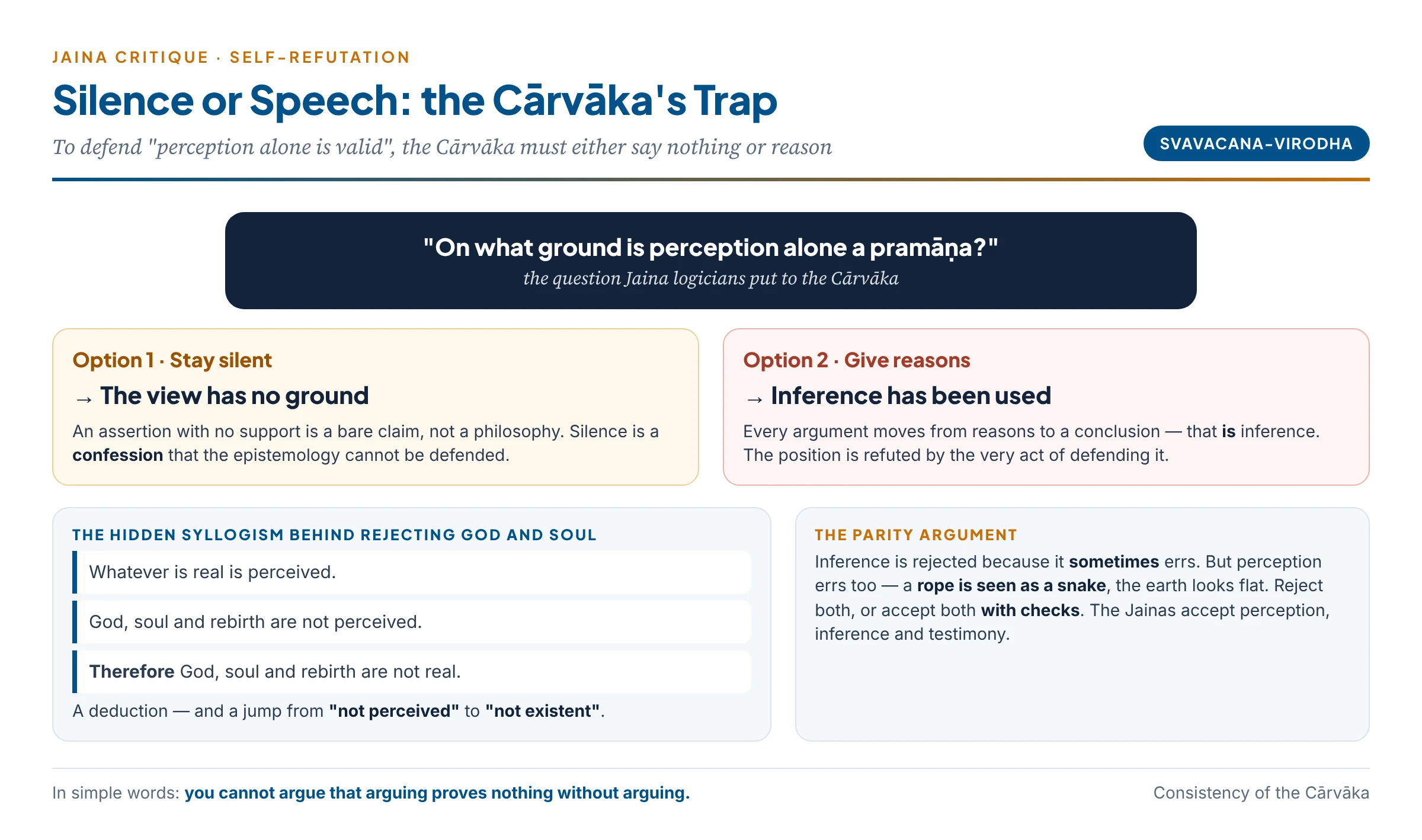
- The challenge. Jaina logicians ask the Cārvāka: on what ground do you hold that perception alone is a pramāṇa?
- If you stay silent, you admit that your position has no ground — it is a mere assertion, and an ungrounded assertion is no philosophy.
- If you give reasons, you argue — and argument is impossible without inference. Your position is then refuted by your own act.
- The parity argument. If inference is rejected because it sometimes goes wrong, perception must be rejected too, because it also goes wrong — a rope is seen as a snake, a mirage as water. Either both are rejected (and the Cārvāka has no pramāṇa left) or both are accepted with checks.
- The Jaina alternative. Jainas accept three pramāṇas — perception, inference and testimony. Inference is valid when it obeys the rules of correct reasoning; testimony is valid when it is the report of a reliable authority — above all the omniscient Tīrthaṅkaras. Jainas also note that even “perception” in the ordinary sense is mediate knowledge (mati), since bare sense-contact must be ordered by thought before it becomes knowledge.
3. The Buddhist Reply
- External objects are themselves inferred. The Sautrāntika Buddhists hold that the mind knows only a representation (ākāra) of an object, never the object directly; the existence of the external object is inferred from the representation. So if the Cārvāka accepts external material objects — as a materialist must — he has already accepted inference.
- Other minds. To understand an opponent’s statement, one must infer the concepts in his mind, which no sense perceives.
- A stronger ground for vyāpti. The Buddhist logician Dharmakīrti answers the upādhi objection by grounding vyāpti not in mere repeated observation but in two necessary relations:
- Tādātmya (identity of nature): “This is a tree, because it is a śiṃśapā (a kind of tree).” Being a śiṃśapā is being a tree; no hidden condition can separate them.
- Tadutpatti (causal origin): “There is fire, because there is smoke.” Smoke arises from fire; an effect cannot exist without its cause.
Because these relations are essential, not merely observed, the worry about unseen exceptions does not arise. This is close to Kant’s reply to Hume — treating causality as a necessary presupposition of experience rather than a habit.
- Inference is one of two Buddhist pramāṇas. Buddhists reject testimony and comparison as independent sources, but perception and inference are both indispensable: perception grasps the unique particular, inference the general.
4. The Nyāya Defence of Vyāpti
Nyāya, the school of logic, gave the fullest reply. It accepted the Cārvāka’s warning that vyāpti must be unconditional, and built a method designed to meet every Cārvāka objection.
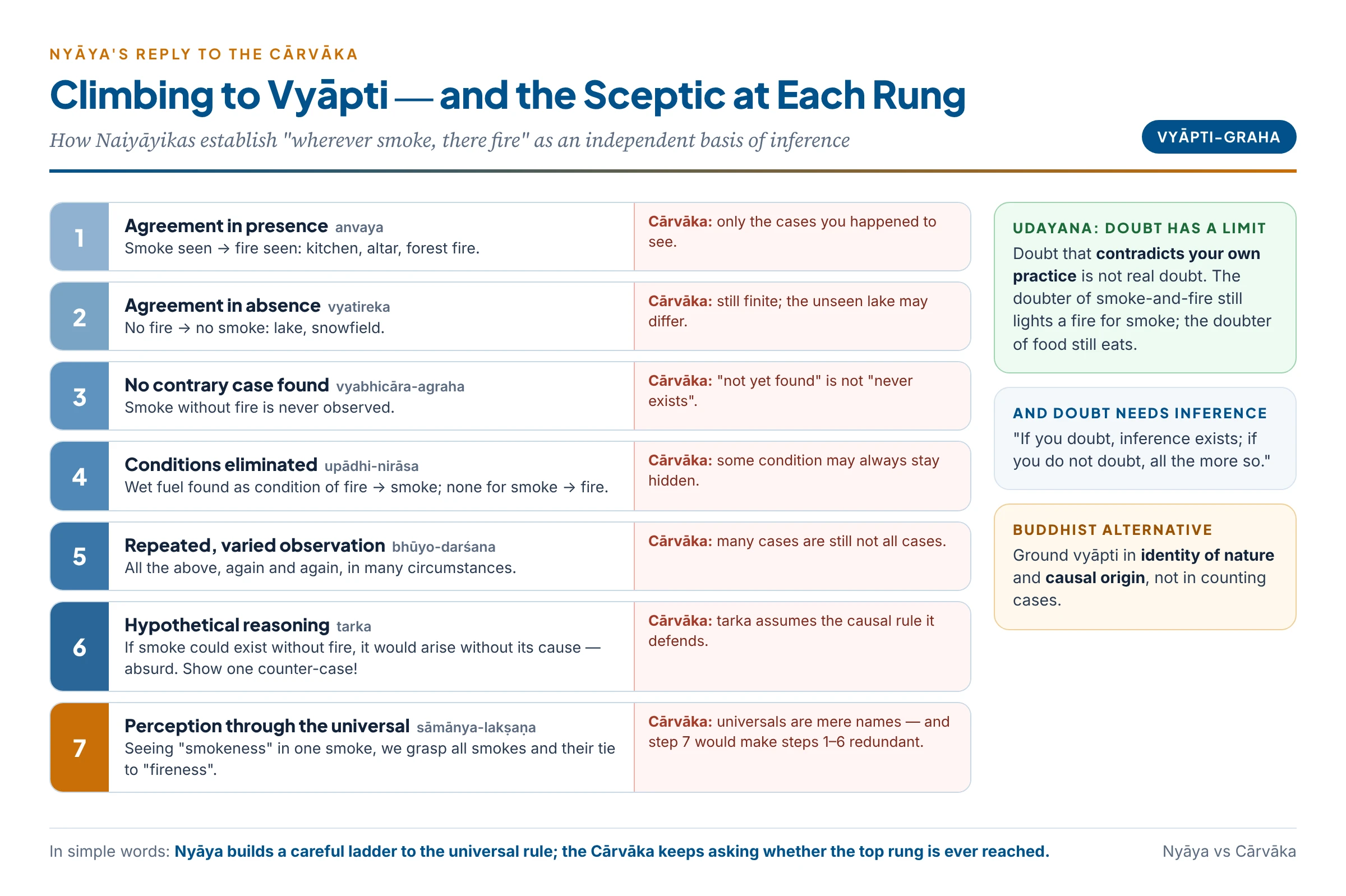
Steps for establishing vyāpti:
- Anvaya — agreement in presence. Wherever smoke is observed, fire is observed (in the kitchen, at the altar, in the forest fire).
- Vyatireka — agreement in absence. Wherever fire is absent, smoke is absent (in a lake, in a snowfield).
- Vyabhicāra-agraha — non-observation of any contrary case. We never find smoke without fire.
- Upādhi-nirāsa — elimination of conditions. We examine suspected conditions. Repeated observation shows that wet fuel is a condition for fire producing smoke — so “wherever fire, there smoke” is not a vyāpti. But no condition is found for smoke indicating fire: smoke never occurs without fire, whatever the fuel, weather or place. So “wherever smoke, there fire” is unconditional.
- Bhūyo-darśana — repeated observation of all the above under varied circumstances.
- Tarka — hypothetical reasoning (indirect proof). Suppose someone still doubts. Tarka asks: if there could be smoke without fire, smoke would arise without its cause — which contradicts all experience. Tarka also challenges the sceptic: produce one real case of smoke without fire, and Nyāya will withdraw the rule; if none can be produced, denying the rule is groundless.
- Sāmānya-lakṣaṇa pratyakṣa — perception through the universal. In perceiving this smoke we perceive the universal smokeness, and through it all smokes; likewise for fire. So the relation between all smokes and all fires is grasped. In the same way, “all men are mortal” rests on perceiving the universal manhood related to mortality.
Udayana’s limit to doubt. The Nyāya logician Udayana adds a decisive point: doubt itself has a limit. Doubt that contradicts one’s own practice is not allowed (vyāghātāvadhir āśaṅkā). A man who doubts that smoke comes from fire still lights a fire when he wants smoke to drive away mosquitoes; a man who doubts that food removes hunger still eats when hungry. And if anyone doubts an inference, the doubt itself rests on inference — so “if you doubt, inference exists; if you do not doubt, all the more so”.
In simple words
A boy tells his mother: “You can’t prove that eating will stop my hunger — maybe today it won’t.” Then he goes to the kitchen and eats. His doubt is in his words; his certainty is in his actions. Udayana says such doubt is not real doubt at all — it is contradicted by the doubter’s own behaviour. The Cārvāka who says “no inference is valid” still walks away from a fire when he sees smoke pouring out of a room.
The Nyāya–Cārvāka debate at a glance:
| Cārvāka challenge | Nyāya reply |
|---|---|
| “How can you know vyāpti without perceiving every case?” | Repeated observation, absence of contrary cases and perception through the universal establish it. |
| “Future cases may not conform to past ones.” | Tarka: denying the rule leads to absurdity; doubt that contradicts practice is not legitimate. |
| “Your ‘absence of conditions’ is itself inferred — circular!” | Conditions are eliminated by cumulative perception and reasoning, not by one inference. |
| “Inferences to God or soul are imagination.” | The same method that proves fire from smoke proves unseen realities from their effects. |
| “These are unverifiable fictions.” | Without inference, nothing beyond the present moment — history, science, other minds — can be known. |
Cārvāka rejoinders and the limits of the Nyāya method:
- Repeated observation is still finite. However many times we look, we cannot be sure that every hidden condition has been found; claiming so from limited observation (bhūyo-darśana) is illicit generalisation again.
- Tarka is not a pramāṇa. Nyāya itself admits that tarka only supports a pramāṇa; and the absurdity it points to (“smoke without its cause”) assumes the very causal rule in question.
- Universals are unreal. For the Cārvāka there is no “smokeness” to be perceived; and if the universal could be seen in a single instance, all the earlier steps of observation would be redundant — a point even friendly critics raise.
- Vedāntins establish vyāpti by the inductive steps alone — observed co-presence and non-observation of exceptions — without sāmānya-lakṣaṇa. That shows the extraordinary perception is not needed, but it also leaves the inductive gap open.
5. Replies from Sāṃkhya, Mīmāṃsā and Vedānta
| School | Main reply to the Cārvāka |
|---|---|
| Nyāya | Practical life, science and expertise rest on inference; ether, mind, space and soul are unperceived yet necessary; vyāpti is established by method and tarka |
| Jaina | Silence-or-speech dilemma; perception errs too; inference valid when it follows rules; sensation needs thought |
| Buddhist | External objects and other minds are known by inference; vyāpti rests on identity and causal origin |
| Sāṃkhya–Yoga | Prakṛti and puruṣa are known only by inference; daily expectations (clouds → rain) are inferences; yogic perception cannot be dismissed without argument |
| Mīmāṃsā | Testimony is the source of history, of knowledge of distant lands and of language itself; knowledge is valid by itself (svataḥ-prāmāṇya) unless contradicted |
| Vedānta | Abstract truths — numbers, universals, causal laws — are not perceptible yet real in cognition; the invalidity of inference cannot itself be proved (Veṅkaṭanātha) |
- Memory and recognition. Nyāya adds that memory (smṛti) and recognition (pratyabhijñā: “this is the same Devadatta I met yesterday”) cannot be explained by present perception alone.
- Yogic perception. Sāṃkhya, Yoga and Buddhism claim a yogic perception reported by sages. The Cārvāka dismisses it simply because it is rare, without argument.
Common confusion
Advaita and Mādhyamika Buddhism also attacked inference. Are they “Cārvākas” on this point? No. Nāgārjuna (Mādhyamika) and the Advaitin Śrīharṣa — in his long controversy with the logician Udayana — denied the ultimate validity of inference. But they denied the ultimate validity of all pramāṇas, perception included, while accepting all of them, inference included, at the empirical level (vyavahāra). The Cārvāka keeps perception and rejects inference from one and the same standpoint; it knows no distinction between ultimate and empirical truth. Critics therefore called its position a “thoughtless self-contradiction”, while they treated Śrīharṣa’s and Nāgārjuna’s critiques as consistent dialectic.
6. What Can the Cārvāka Say in Reply?
The Cārvāka is not without answers. Four lines of defence are available — and the history of the school shows that its abler members used them.
- Reasoning used only to destroy (vitaṇḍā, prasaṅga). The Cārvāka may say: “I do not use inference to establish any truth. I use your rules of reasoning only to show that your conclusions do not follow.” This is negative dialectic (vitaṇḍā, refutation without a counter-thesis; prasaṅga, drawing out the absurd consequences of an opponent’s view). Like a ladder kicked away after climbing, the argument cancels itself once it has done its work.
- Expectation is habit, not inference. When the Cārvāka avoids a smoky room, he is not inferring; he is acting on a psychological habit formed by repeated experience. Animals do the same. Habit guides action without claiming knowledge — so acting on expectations does not commit the Cārvāka to inference as a pramāṇa.
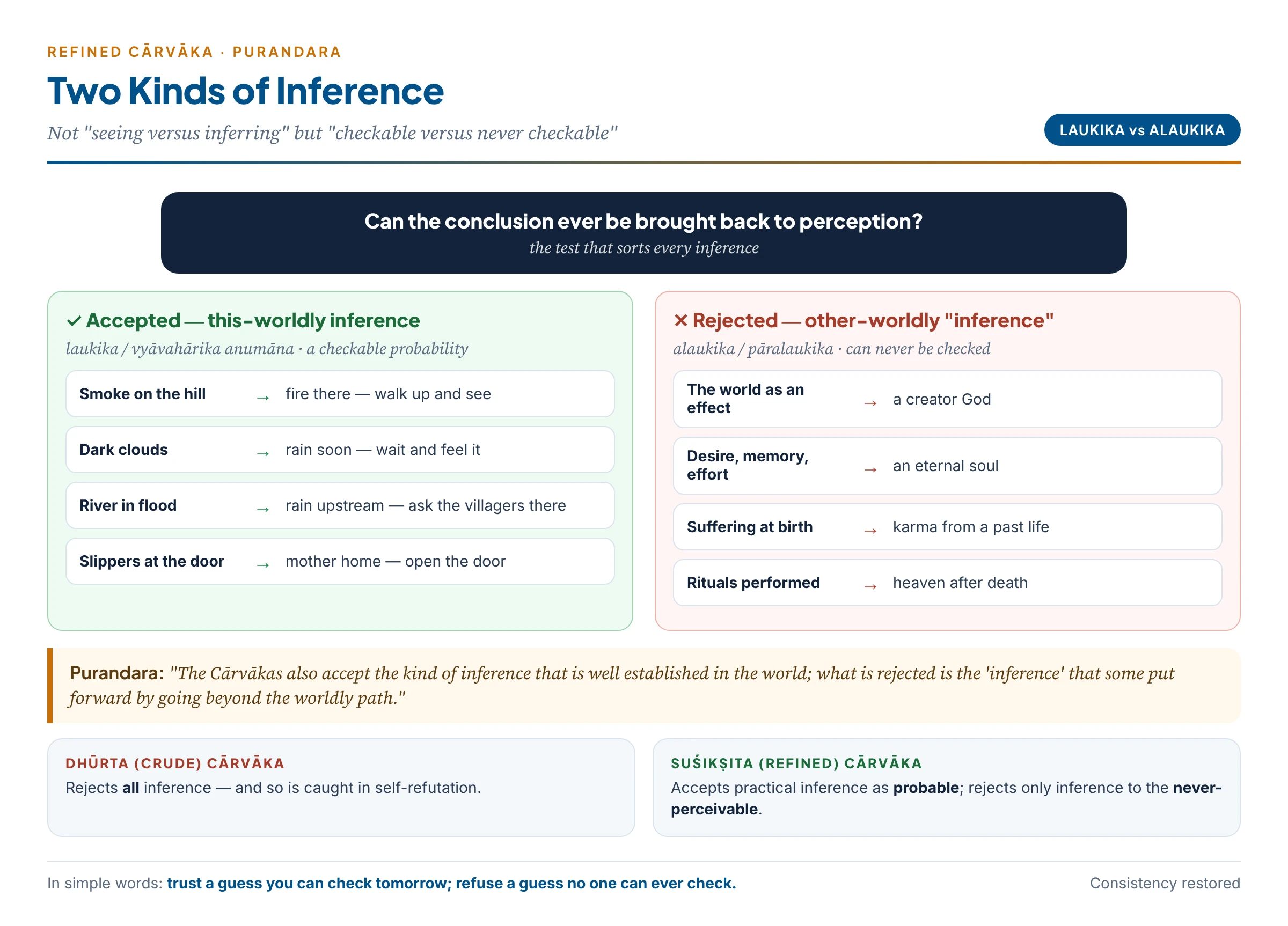
- Accept this-worldly inference; reject other-worldly inference. This is the most important defence, stated by Purandara (7th century CE), the only early Cārvāka whose words survive (quoted by the Buddhist Kamalaśīla): “The Cārvākas also accept the kind of inference that is well established in the world; what is rejected is the ‘inference’ that some put forward by going beyond the worldly path.”
- Laukika / vyāvahārika anumāna — inference about things that can in principle be perceived: smoke → fire, clouds → rain, a river’s rising → rain upstream. Such inferences can be checked by later perception, and they are accepted as probable guides.
- Alaukika / pāralaukika anumāna — “inference” to things that can never be perceived: God, soul, karma, heaven, the other world. Such conclusions can never be checked, so they are rejected.
- Probability, not certainty. Inference may be treated as a hypothesis or probability (sambhāvanā), useful for life but never giving pramā (certain, valid knowledge). This is close to modern fallibilism: scientific laws are well-confirmed hypotheses, never proven certainties.
In simple words
The weather office says: “Heavy rain tomorrow.” An astrologer says: “In your next birth you will be a king.” Both are predictions — both are inferences. But tomorrow you can look out of the window and check the first; nobody can ever check the second. Purandara’s Cārvāka trusts the first kind (with caution, as a probability) and refuses the second kind altogether. The line is not between seeing and inferring, but between what can and what can never be brought back to perception.
- Jayarāśi: the consistent sceptic. Jayarāśi Bhaṭṭa (8th century), the author of the only surviving work of the school, took a different route. In his Tattvopaplavasiṃha he examines the definitions of every pramāṇa given by the other schools — perception included — and shows, by the opponents’ own criteria, that none can be established. He thus avoids the charge of keeping perception while rejecting inference. His conclusion is that ordinary life proceeds perfectly well without any theory of pramāṇa: “all everyday practices are delightful as long as they are not examined.” This is radical scepticism — which is why some historians doubt that he was a materialist at all, though he presents himself in the line of Bṛhaspati.
Indian Connect — Three Cārvāka positions on inference
- Crude rejection — no inference at all: self-refuting, as the critics say.
- Purandara’s line — inference about the perceivable is accepted as checkable probability; inference to the imperceptible is rejected: consistent, and close to modern empiricism and verificationism.
- Jayarāśi’s scepticism — no pramāṇa, not even perception, can be theoretically justified; life goes on without theory: consistent, but no longer materialism.
7. Dhūrta and Suśikṣita Cārvākas
Later opponents themselves admitted that the Cārvākas were not all alike. The Nyāya writer Jayanta Bhaṭṭa speaks of the “better-educated” Cārvākas, distinct from the crude ones.
- Dhūrta (cunning, crude) Cārvākas.
- Reject all inference, outright.
- Hold the crudest dehātmavāda: the gross body is the self.
- Preach unrestrained sensual pleasure: “eat, drink and be merry, even on borrowed money”.
- Suśikṣita (well-educated, refined) Cārvākas.
- Accept practical inference (vyāvahārika anumāna) about perceivable things, as Purandara does, while rejecting inference to the transcendent.
- Some, according to reports, allowed a conscious self that lasts as long as the body — not eternal, but more than a heap of matter.
- Pursue refined pleasures — the sixty-four arts (music, painting, literature), friendship, a cultured urban life — and accept the need for social order, law and the state.
- Some accept dharma (social and moral order) as a value alongside artha and kāma, while still rejecting mokṣa.
Common confusion
Some notes use “dhūrta vs suśikṣita” for inference, some for pleasure, some for dharma. Which is right? All three — they describe the same split seen from different angles. The labels come from opponents’ reports, not from two schools with separate texts. The crude Cārvāka rejects all inference, identifies the self with the gross body and seeks gross pleasure; the refined Cārvāka accepts practical inference, recognises social and cultural values, and seeks refined pleasure. Use the distinction for the theory of knowledge (this article), and again for ethics (the article on rejection of transcendent entities).
8. Is Cārvāka Philosophy Positivistic?
- What positivism means. The word was coined by Auguste Comte (19th century): genuine knowledge is positive knowledge — of observable facts and the regularities among them, obtained by scientific observation; theology and metaphysics are earlier, outgrown stages of thought. In the 20th century the logical positivists (Schlick, Carnap, Ayer) added the verification principle: a statement is meaningful only if it is empirically verifiable or true by definition; metaphysics and theology are literally meaningless.
Reasons for calling the Cārvāka positivistic:
- Only observation counts. Perception is the sole pramāṇa — like positivism’s insistence on observable facts.
- Metaphysics is rejected. God, soul, heaven, hell, karma and rebirth are dismissed as beyond experience — as positivism dismisses theological and metaphysical entities.
- Critique of religious authority. Rituals and sacrifices are tools of priestly exploitation — paralleling the positivist critique of religious dogma and its emphasis on social, practical utility.
- Causation as regularity. Causal necessity is only observed succession plus mental habit — the positivist (and Humean) view of causal laws as regularities.
- Naturalism. The world is explained by the nature of matter (svabhāva), not by divine design — as positivists favour natural, mechanical explanation.
- Here and now. Both focus on this world and immediate empirical reality, rejecting unseen future worlds.
- Physicalism. Consciousness is a product of matter — matching scientific materialism.
Limits of the comparison:
- No scientific method. The Cārvāka develops no theory of experiment, hypothesis-testing or systematic observation, central to positivism.
- Induction. Positivism accepts inductive generalisation as the basis of scientific laws (as probable); the crude Cārvāka rejects even that. The Cārvāka is more restrictive than Western positivism.
- “False” versus “meaningless”. For logical positivists, “God exists” is neither true nor false — it is meaningless. The Cārvāka says it is false: there is no God. The Cārvāka makes a metaphysical denial that a strict positivist would also call meaningless.
- Logic and mathematics. Positivists accept the necessary truths of logic and mathematics as analytic; the Cārvāka has no comparable theory and treats deduction as circular.
- No law of stages. Comte’s law of three stages (theological → metaphysical → positive) has no counterpart.
- Ethics. Comte preached altruism (“live for others”) and a “religion of humanity”; the Cārvāka (at least the crude one) preaches personal enjoyment.
In simple words
Someone says: “There is an elephant in the next room.” You open the door and find no elephant — the statement was false. Now he says: “There is an elephant in the next room, but it is invisible, silent, weightless and leaves no trace.” No possible look can ever check this. A logical positivist says the sentence says nothing at all — it is meaningless. The Cārvāka says something stronger: there is no such elephant. “God”, “soul” and “heaven” are, for the Cārvāka, invisible elephants — and they do not exist.
- Verdict. The Cārvāka is positivistic in spirit — empirical, anti-metaphysical, anti-clerical, naturalistic. It is best described as an early, naïve empiricist positivism: radical in what it denies, but without the scientific method and logical theory of modern positivism. The refined Cārvāka of Purandara, who accepts checkable inference and rejects only the uncheckable, comes closest to the verification principle.
Indian Connect — The same self-refutation charge
The logical positivists met the same objection as the Cārvāka. Their verification principle — “only empirically verifiable statements are meaningful” — is not itself empirically verifiable, so by its own standard it seems meaningless. Positivists answered that the principle is a proposal or a rule of method, not a factual claim — much as the Cārvāka answered that its anti-inference arguments are only negative dialectic against opponents.
9. The Hume of India: Saving Indian Philosophy from Dogmatism
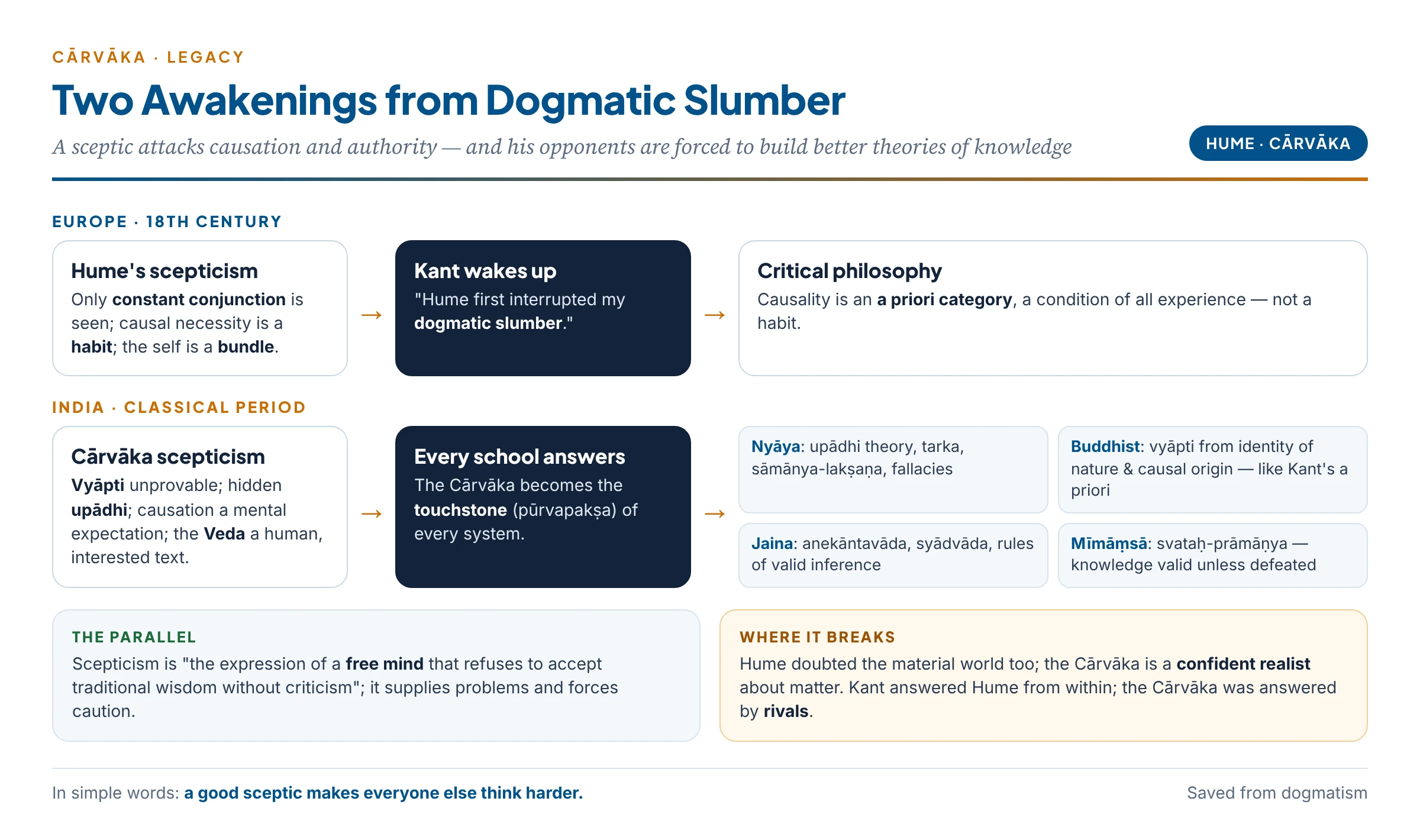
- The Western story. David Hume argued that we never observe necessary connection between cause and effect — only constant conjunction — so causal necessity is a habit of the mind; the self is a bundle of perceptions. This scepticism threatened science and metaphysics alike. Kant confessed: “I openly confess that the remembrance of David Hume was the very thing which many years ago first interrupted my dogmatic slumber.” Kant’s answer was his critical philosophy: causality is an a priori category of the understanding, a precondition of experience itself.
- The Indian parallel. The Cārvāka challenged three possible dogmatisms of Indian thought:
- Scriptural dogmatism — the uncritical acceptance of the Veda’s authority (śabda); the Cārvāka exposed contradictions in scripture and the interests behind it.
- Logical dogmatism — the unexamined assumption that vyāpti and causal laws are simply given; the Cārvāka showed that observation cannot exclude hidden conditions, and that causal necessity is a psychological expectation — exactly Hume’s point.
- Metaphysical dogmatism — the unproved assertion of an eternal soul, a creator God, unseen merit (adṛṣṭa) and liberation after death.
- How the other schools woke up. Just as Kant answered Hume by building a critical philosophy, the Indian schools answered the Cārvāka by building rigorous theories of knowledge (pramāṇa-śāstra):
- Nyāya — the theory of upādhi, the method of establishing vyāpti, tarka, sāmānya-lakṣaṇa perception and the theory of fallacies (hetvābhāsa);
- Buddhism — vyāpti grounded in identity of nature and causal origin, a position analogous to Kant’s a priori categories;
- Jainism — anekāntavāda (many-sidedness of reality) and syādvāda (conditional predication), reconciling partial truths without falling into total scepticism, and rules for valid inference;
- Mīmāṃsā — svataḥ-prāmāṇya-vāda, the theory that knowledge is valid by itself unless defeated, as a defence against sceptical doubt.
- The value of scepticism. “Scepticism or agnosticism is only the expression of a free mind that refuses to accept traditional wisdom without a thorough criticism.” Philosophy lives on free thought; the more it can satisfy the sceptic, the sounder it is. The Cārvāka’s value lies directly in supplying fresh problems and indirectly in compelling other thinkers to give up dogmatism and become critical and cautious in speculation and statement.
- Where the parallel breaks.
- Hume was a sceptic even about the material world and the self; the Cārvāka is a confident realist about the perceived material world and identifies the self with the body.
- Kant answered Hume from within one mind; the Cārvāka was answered by rival schools, and never produced its own Kant — its own texts were lost.
- Hume’s scepticism was epistemological; the Cārvāka’s was put to work for a metaphysics (materialism) and an ethics (hedonism).
Critical Evaluation
Is the Cārvāka Consistent? A Balanced Answer
- The crude Cārvāka is not consistent. A thinker who says “no inference is valid” and then argues for it, generalises from past perceptions, infers non-existence from non-perception and understands opponents’ words, uses inference at every step. The charge “the refutation of anumāna is itself anumāna” is decisive against him.
- The refined Cārvāka can be consistent. A thinker who says, with Purandara, that inference about the perceivable is a checkable probability, while inference to the imperceptible is groundless, uses inference only of the kind he accepts. His arguments against Nyāya are inferences about perceivable matters (how people reason) and are offered as probable, not certain.
- The sceptical Cārvāka can be consistent. Jayarāśi, who rejects the theoretical justification of all pramāṇas and uses only the opponent’s own definitions, avoids the double standard — at the cost of materialism itself.
- The remaining weak point for all forms is the step from “not perceived” to “does not exist“. A refined Cārvāka can at most say: “There is no good reason to believe in God or soul” — an agnostic conclusion — not “There is no God or soul” — an atheist one.
Critics and Defenders
Criticism — Critics
- The refutation of inference is itself an inference — a syllogism and a generalisation.
- “Perception alone is valid” is an unperceived universal rule.
- Non-perception does not prove non-existence; non-existence after death is equally unperceived.
- Jaina dilemma: silence leaves the view groundless; argument concedes inference.
- Veṅkaṭanātha: the invalidity of inference cannot be known by any means.
- Udayana: doubt that contradicts one’s own practice is not real doubt.
Defence — Defenders and strengths
- Negative dialectic (vitaṇḍā): opponents’ rules used only to expose them.
- Purandara: worldly, checkable inference accepted; only inference to the unseen rejected.
- Habit, not inference, guides daily action — as Hume later argued.
- Jayarāśi consistently attacks all pramāṇas, perception included.
- The upādhi problem and the problem of induction were never fully solved; Nyāya’s method grew out of answering them.
Cross-Tradition Comparison
Critics of Inference and Metaphysics, East and West
| Issue | Crude Cārvāka | Refined Cārvāka (Purandara) | Hume | Logical positivism | Popper |
|---|---|---|---|---|---|
| Induction | Invalid | Probable, if checkable | No rational ground; custom | Probable | Never proves; theories are only corroborated |
| Metaphysics | False | Groundless | “Commit it to the flames” | Meaningless | Unfalsifiable, but may inspire science |
| Self-refutation charge | Fatal | Avoided | Faced (the fork is not itself a matter of fact or a relation of ideas) | Faced (verification principle is unverifiable) | Avoided (falsifiability is a proposal) |
| Positive doctrine | Materialism, hedonism | Materialism, refined ethics | Naturalism of habit and sentiment | Unified science | Critical rationalism |
Indian Connect — Key takeaways
- The Cārvāka critique produced the best of Indian logic: Nyāya’s theory of vyāpti, upādhi and tarka, Dharmakīrti’s identity and causal origin, and Udayana’s principle that doubt has a limit.
- Purandara’s distinction between checkable and uncheckable inference anticipates the verification principle — and is more careful than the crude Cārvāka its critics usually attacked.
- Jayarāśi shows that Indian materialism also had a sceptical wing, closer to Nāgārjuna’s dialectic than to physics.
Synthesis (Siddhānta)
- The charge. The Cārvāka refutation of inference is itself an inference: a syllogism, a generalisation from past perceptions, an unproved vyāpti between perception and validity, and an inference from non-perception to non-existence.
- The replies of other schools. Jainas: silence or speech — both fatal; perception errs too. Buddhists: external objects and other minds are inferred; vyāpti rests on identity and causal origin. Nyāya: vyāpti is established by agreement in presence and absence, absence of contrary cases, elimination of conditions, tarka and perception through the universal; doubt contradicted by practice is illegitimate. Mīmāṃsā and Vedānta: testimony and abstract truths are indispensable; the invalidity of inference cannot be proved.
- The defences. Negative dialectic; habit instead of inference; Purandara’s acceptance of worldly, checkable inference; Jayarāśi’s universal scepticism. The dhūrta–suśikṣita distinction shows that the “Cārvāka” of the textbooks is often the crude Cārvāka.
- Positivism and Hume. The Cārvāka is positivistic in spirit but without scientific method; it played in India the role Hume played in Europe — the sceptic who woke the dogmatists.
- Balanced verdict. The crude rejection of inference is self-refuting; the refined position is consistent and remarkably modern, but it can support only agnosticism about the transcendent, not its outright denial.
- Contemporary relevance. The distinction between checkable and uncheckable claims is the core of the scientific method and of evidence law; Udayana’s “doubt has a limit” is the working principle of practical reasoning — courts convict “beyond reasonable doubt“, not beyond all conceivable doubt; and the Cārvāka’s challenge reminds every institution — religious, political or scientific — that authority must earn belief by evidence.
“Doubt is limited by contradiction with one’s own practice.” — Udayana
Previous Year Questions
- 2024Do you think Cārvāka’s philosophy is positivistic in nature? Give reasons and justifications for your answer.
- 2022How do Naiyayikas respond to Carvaka’s objections against inference (anumana) and establish inference as an independent means of knowledge? Critically discuss.
- 2019Are the Carvakas consistent when they hold that inference is not a source of knowledge? Discuss.
- 2018Is Carvakas rejection of inference acceptable to the other systems of Indian philosophy? If not, why? Do you think the views of other systems to be justified? Give reasons for your answer.
- 2016What would be Carvaka’s view on Vyapti? Can this view be acceptable to the Naiyayikas? Give reasons for your answer.
- 2010“Just as the skepticism of Hume helped Kant to come out of his dogmatic slumber, so also the Carvaka philosophy saved Indian philosophy from dogmatism.” Discuss.
- 2003Charvak’s refutation of anumana is itself a process of anumana. Discuss.