

Quine and Strawson: Critique of Empiricism; Theory of Basic Particulars and Persons.
Official Syllabus: Paper I, Section A, Unit 11
We say of the same human being that she weighs 55 kilos and that she is thinking about her exam; that he is standing in the corridor and that he is in pain. Why are states of consciousness ascribed to anything at all — and why to the very same thing to which we ascribe physical characteristics? In Chapter 3 of Individuals (1959), P. F. Strawson answers that our concept of a person is primitive: it is not built by joining a mind to a body, but is the concept of one type of entity to which both kinds of predicates — M-predicates (material) and P-predicates (personal, implying consciousness) — apply equally. Strawson reaches this conclusion by refuting the two classical answers: Cartesian dualism (the “ownership” theory), which makes it impossible to identify other minds and therefore to ascribe experiences even to oneself; and the no-ownership theory of Hume, Lichtenberg and Schlick, which cannot even be stated without using the idea of ownership it denies. Persons, like material bodies, are basic particulars of our conceptual scheme.
In simple words
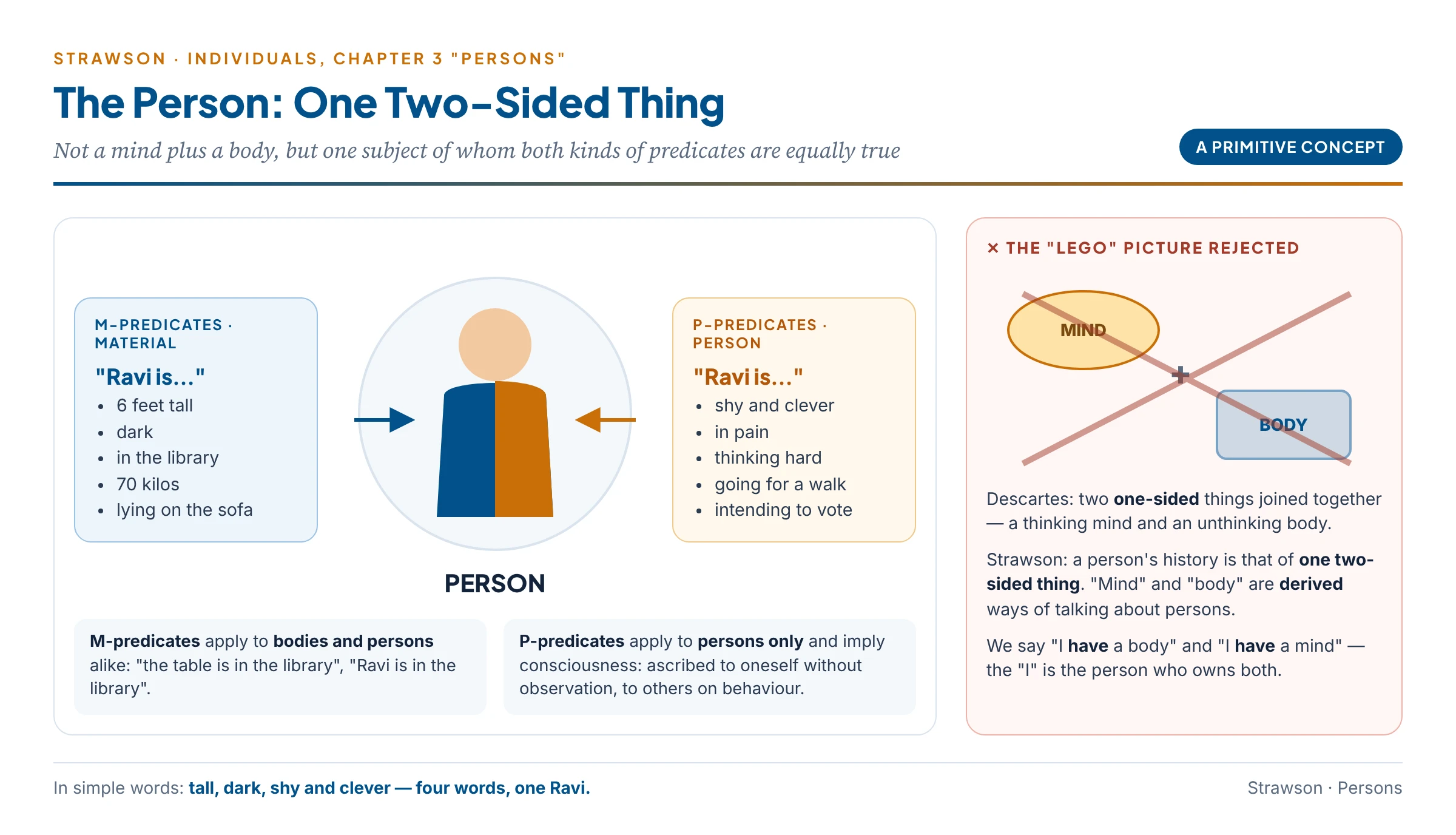
Your classmate Ravi is tall and dark, and also shy and clever. A Cartesian would say the first two words describe his body and the last two describe his mind — two different things living together. But when you talk about Ravi you never mean two things. You mean one Ravi, of whom all four words are true. Strawson says this ordinary way of speaking is right: the person comes first, and “his mind” and “his body” are only two ways of talking about him.
Context & Problem
Strawson’s Two Questions
Strawson opens his chapter on persons with two questions — the very questions UPSC set in 2026:
- Why are one’s states of consciousness ascribed to anything at all? Why do we say “I am in pain”, “she remembers”, rather than simply “there is pain”, “there is a memory”?
- Why are they ascribed to the very same thing as certain corporeal characteristics, a certain physical situation, etc.? Why is the thing that thinks the same thing that is six feet tall and sitting in this room?
- What is at stake. These questions underlie the whole mind–body problem. How the two kinds of attributes — physical (height, colour, shape, weight, location) and mental (thinking, remembering, seeing, deciding, feeling emotions) — are related, and why they belong to one subject, had remained unsolved for centuries.
A Tempting but Inadequate Answer: the Special Position of One’s Body
- The suggestion. Each of us has a body that occupies a unique position in our experience. Whether I see depends on whether these eyes are open; what I see depends on where this body is and which way its head is turned; I feel pain when this body is hurt.
- Strawson’s reply. These facts explain why my experiences are causally linked to one particular body. They do not explain why I ascribe experiences to anything at all, or why I ascribe them to the same thing to which I ascribe weight and height. A causal link between experiences and a body is not yet a single subject that has both.
- Two classical answers. Philosophers have answered the two questions in two ways, which Strawson examines and rejects: Cartesianism and the no-ownership doctrine.
Core Doctrine
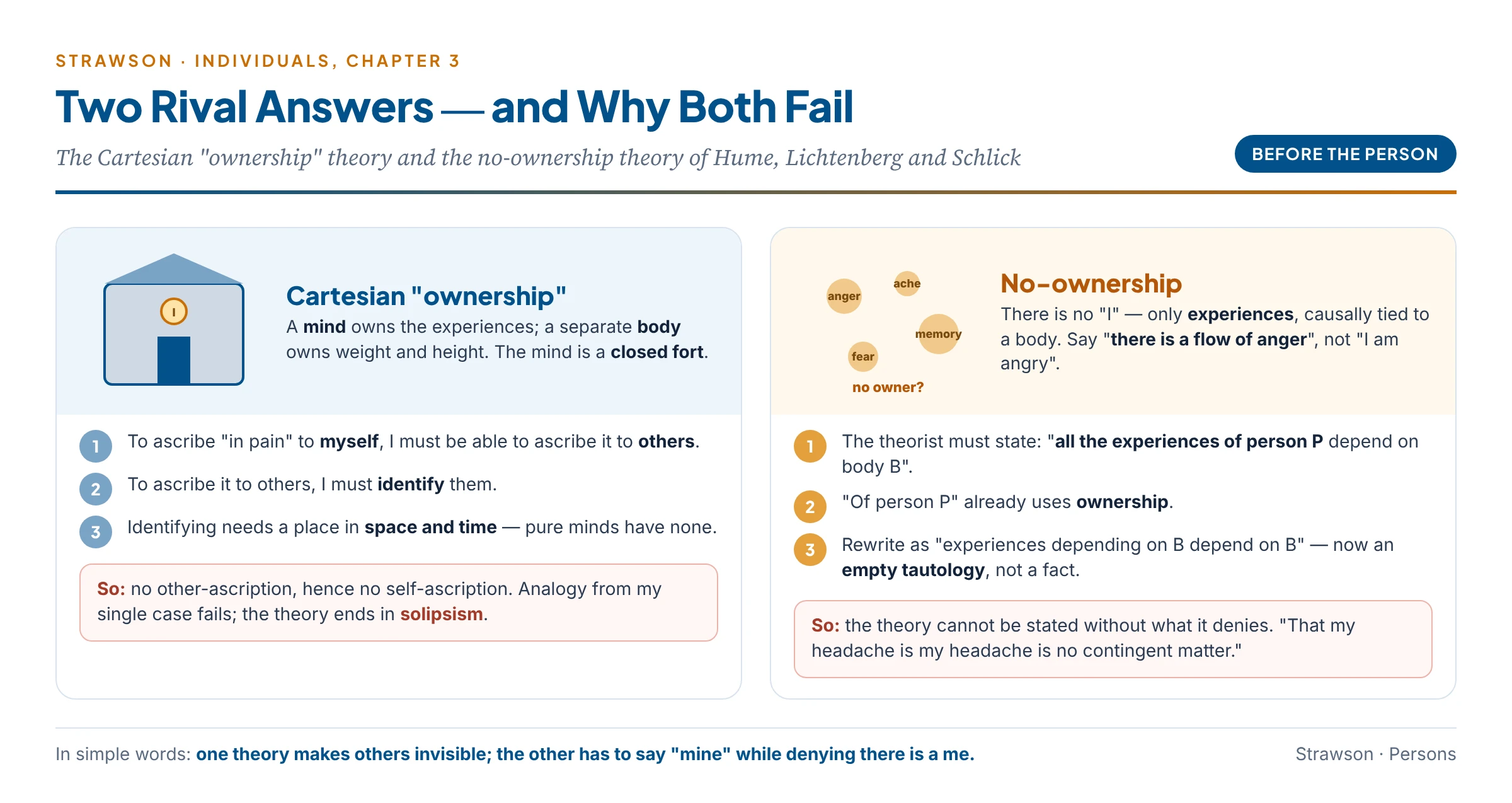
1. The Cartesian Answer: the “Ownership” Theory
- The view. When we speak of a person we are really referring to two distinct substances of different types — a mind (thinking, unextended) and a body (extended, unthinking) — each with its own kind of states. States of consciousness belong to the mind; physical characteristics belong to the body.
- Answer to the questions. To question 1: experiences are ascribed to something because they belong to a mind, the thinking substance. To question 2: they are not really ascribed to the same thing as physical characteristics — the “person” is a union of two things, so the second question rests on a confusion.
- The mind as a closed fort. For Descartes the mind is the exclusive owner of its thoughts (the cogito); it is like a closed fort that nobody else can enter. I know my own thoughts directly and certainly; other minds are hidden from me.
- The religious background. Descartes’ “I” in “I think, therefore I am” mirrors the traditional picture of the soul — immortal, joined to a body for a time and separated at death. The soul has the psychological qualities (happiness, pain, desire); the body is unconscious extension with weight and height.
- The interaction problem. Once mind and body are made independent substances, their relation becomes a mystery. Descartes’ interactionism (through the pineal gland), Spinoza’s parallelism and Leibniz’s pre-established harmony are all attempts to explain it — and none succeeds.
2. Strawson’s Refutation of Cartesian Dualism
The central argument — no self-ascription without other-ascription:
“It is a necessary condition of one’s ascribing states of consciousness, experiences, to oneself, in the way one does, that one should also ascribe them, or be prepared to ascribe them, to others who are not oneself.” — Strawson
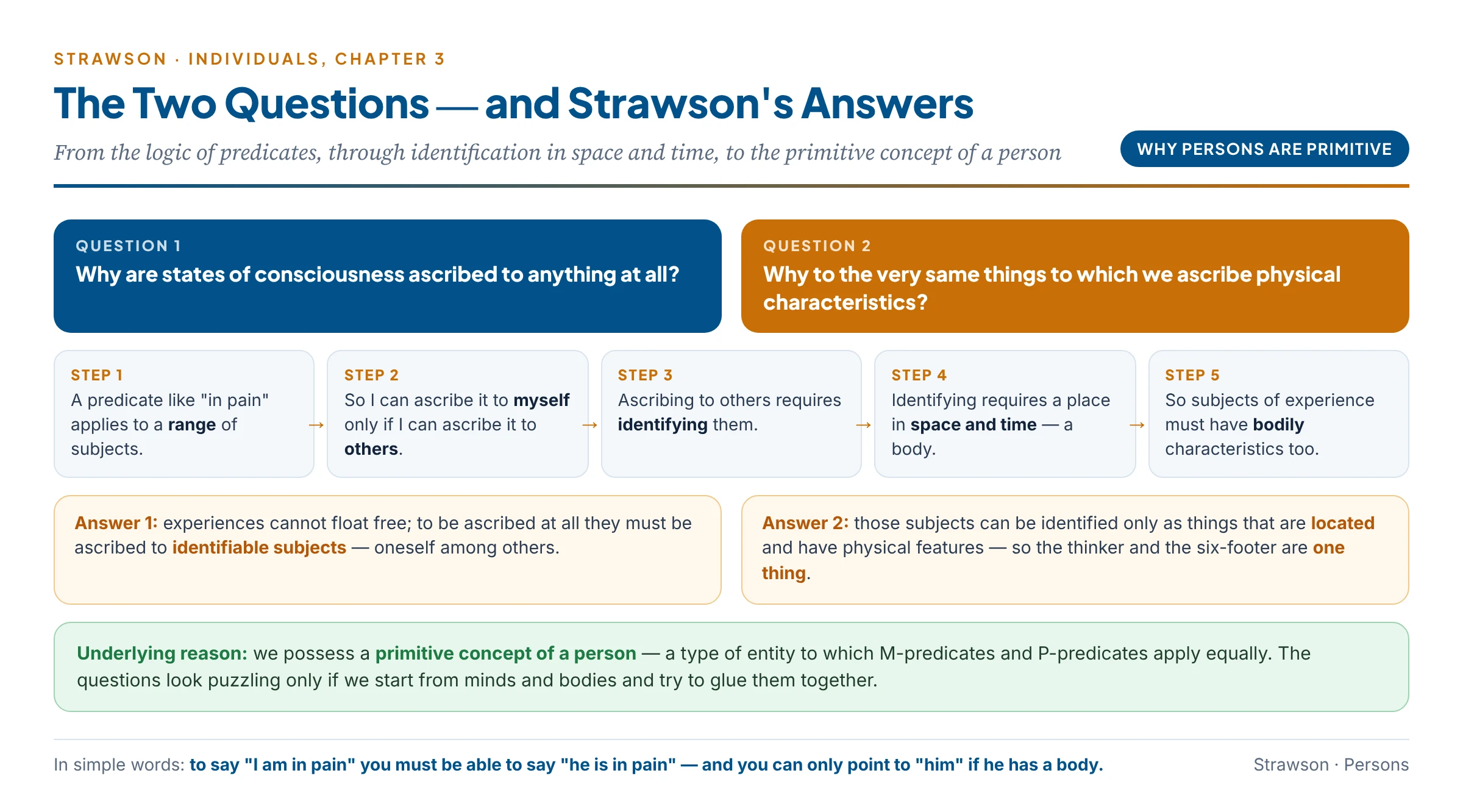
- Predicates need a range of subjects. To understand a predicate like “is in pain” is to understand that it can be significantly (though not necessarily truly) applied to a range of different individuals. “The idea of a predicate is correlative with that of a range of distinguishable individuals of which the predicate can be significantly … affirmed.”
- So I must be able to apply it to others. I could not understand “I am in pain” if I could not also understand “he is in pain”, “she is in pain”. A predicate that could only ever apply to me would not be a predicate at all.
- Others must be identifiable. To ascribe a state to another subject, I must be able to identify that subject — pick it out from others.
- Identification needs location. As the theory of basic particulars shows, identifying a particular requires locating it in the public spatio-temporal framework.
- Cartesian egos cannot be located. A pure mind has no position in space; it cannot be seen, pointed to or re-identified. So, if subjects of experience were Cartesian egos, I could never identify other subjects.
- Therefore I could not ascribe experiences even to myself. If I cannot ascribe states of consciousness to others, then by step 1–2 I cannot ascribe them to myself either. The Cartesian theory makes self-ascription — the starting point of Descartes’ own philosophy — impossible.
- Conclusion. The subjects to which we ascribe states of consciousness must be identifiable in the way bodies are — they must have bodily characteristics. That is, they must be persons.
Supporting points:
- The analogy argument fails. Cartesians say: I observe that my inner states go with certain behaviour; seeing similar behaviour in others, I infer by analogy that they have similar inner states. But (i) this generalises from a single case — my own — which is no inductive basis at all; and (ii) it presupposes that I already understand what it would be for another to have pain, which is the very thing in question. It leads not to knowledge of other minds but to philosophical scepticism: an adult can suppress pain and an actor can pretend it, so behaviour would never be more than a fallible sign.
- The pure ego cannot be primary. “The concept of the pure individual consciousness — the pure ego — is a concept that cannot exist; or, at least, cannot exist as a primary concept in terms of which the concept of a person can be explained or analysed. It can exist only, if at all, as a secondary, non-primitive concept, which itself is to be explained, analysed, in terms of the concept of a person.“
- No criteria for the soul. We have no criteria for saying that a soul exists, or that this soul is the same as that one yesterday. The soul cannot be identified or re-identified, is not in space and time, and is not open to ordinary experience such as touch — so it cannot be the primary subject of our talk about people.
- Contrary to ordinary practice. On the Cartesian view, if I am angry nobody else could know it. Yet in practical life we understand each other all the time through interaction — we see a friend’s anger in her face and words.
- Solipsism. If mental states belong to private, immaterial minds accessible only to their owners, then only my own mind can be known with certainty; Cartesian dualism slides into solipsism.
In simple words
Imagine a classroom where every student is invisible and silent — no bodies, no voices — and the teacher must take attendance. She cannot say “Priya is present” or “Arjun is absent”, because she cannot pick out anyone. Now suppose the teacher herself were the same. She could not even say “I am present”, because “present” only makes sense as something that can be true of this student or that one. Cartesian minds are like invisible students: you cannot identify them, so you cannot ascribe anything to them — not even to yourself.
3. The No-Ownership Theory
- The view. Experiences are not owned by anything — there is no “I”, ego or self. There are only experiences, flowing one after another. Instead of “I am angry” or “he is angry”, we should say “there is a flow of anger“. The word “I” is only a grammatical subject that refers to nothing.
- Its historical champions. Lichtenberg, the eighteenth-century German thinker who said we should say “it thinks” as we say “it rains”, rather than “I think”; Hume in all contexts (the self is “nothing but a bundle or collection of different perceptions“); Wittgenstein at one period (in his lectures of the early 1930s) and Schlick in a particular context. Some writers also compare certain interpretations of the Buddhist doctrine of no-self (anātman).
- The theory’s explanation of “ownership”. Our talk of ownership arises because experiences happen to be causally dependent on the states of one particular body. “My experiences” just means “the experiences causally dependent on this body”. This is the only sense in which experiences have an “owner” — and it is a “dubious” sense.
- “Real” ownership would have to be transferable. Something is genuinely owned only if it could logically have belonged to someone else — like a book. But my pain could not have been yours; the knower cannot feel the pain of others. Since experiences are not transferable, the theorist concludes, they are not really owned by anybody. At most they are contingently related to a body.
4. Strawson’s Refutation of the No-Ownership Theory
The theory, Strawson argues, is incoherent: the theorist denies the sense of possession but is forced to use it in stating his denial.
- What the theorist must say. He must state the contingent fact on which his theory rests: “All my experiences are causally dependent on the state of body B.” To avoid the forbidden “my”, he must rephrase it: “All the experiences of person P are causally dependent on body B.“
- The trap. The phrase “of person P” picks out a class of experiences precisely as someone’s — it uses the very notion of ownership he says is an illusion.
- The alternative fails. If he tries instead “all experiences causally dependent on body B are causally dependent on body B“, the statement becomes analytic — a tautology, true by its own words — not the contingent fact his theory needs.
- Ownership is necessary, not contingent. “That my headache is my headache is — for the headache — no contingent matter.” A pain is identified as someone’s pain; its belonging to that person is part of what it is, not an accident that could have been otherwise. So the no-ownership theorist has got things the wrong way round.
- Sensations would float. If experiences belonged to no one, they would be “floating” in space and time. Neither Hume nor anyone else explains how such free-floating sensations come to be grouped with one individual rather than another person in the same room.
- Ordinary life becomes absurd. “There is a flow of anger” is meaningless unless someone is angry. Without owners, our intentions, promises and linguistic behaviour would make no sense.
- Self-refutation in practice. No-ownership theorists themselves need sentences like “I am in pain“, “it is my experience”, “it is her experience” — and so are inconsistent with their own theory.
- Memory and responsibility. When I remember an event of yesterday, I assume that the one who remembers is the one who experienced it. Without a persisting person, memory, responsibility and intention become incoherent.
Common confusion
Is Strawson’s “ownership theory” his own theory? No — a frequent mix-up. In Strawson’s discussion, the “ownership” theory is the Cartesian view he rejects: experiences are owned by a mind (an ego), not by the whole person. The “no-ownership” theory (Hume, Lichtenberg, Schlick) is the other view he rejects. Strawson’s own position is that experiences are owned by persons. Some notes call this “Strawson’s ownership theory of the person” — acceptable only if it is clear that the owner is the person, not a Cartesian soul.
5. The Solution: the Concept of a Person Is Primitive
“What I mean by the concept of a person is the concept of a type of entity such that both predicates ascribing states of consciousness and predicates ascribing corporeal characteristics, a physical situation &c. are equally applicable to a single individual of that single type.” — Strawson
What “primitive” means:
- Not further analysable. The concept of a person cannot be broken down into, or built up from, more basic concepts — such as “mind” + “body“, an “animated body” or an “embodied soul”.
- Logically prior. “The concept of a person is logically prior to that of an individual consciousness.” States of consciousness could not be ascribed at all unless they were ascribed to persons. It is to the person, not to a pure ego, that the pronoun “I” refers.
- Not about people being simple. Strawson does not say that people are primitive or simple beings; he says that our concept of a person — as the unitary bearer of both kinds of predicates — is logically basic, more basic than the concept of a human mind or a human body considered on its own.
- One two-sided thing. In a later essay (“Self, Mind and Body”) Strawson put it vividly: my history is not the history of “two one-sided things” — a Cartesian mind and a Cartesian body — but of “one two-sided thing“: a person.
How ordinary language shows it:
- Shy, clever, tall, dark. If I describe someone as shy and clever, tall and dark, a dualist would say the first two predicates belong strictly to the mind and the last two to the body. Strawson replies that all four belong to the same subject — a person — and none belongs more or less properly than another.
- Ravi walks; Ravi believes. “Ravi is walking to the market” and “Ravi believes the shop is open” are about one individual, not two substances.
- “I have a body”, “I have a mind”. We never say “I am a body” or “I am a mind”; we say “I have a strong body and a strong mind”. The “I” is the person who owns both — prior to and over and above mind and body.
- We do not say “a mind thinks, a body moves”. We say “a person thinks” and “a person acts”.
What follows:
- Mind and body are derived notions. “Mind” and “human body” indicate secondary ways in which we sometimes talk about persons; the distinction between mental and physical predicates arises within the concept of a person, not the other way round.
- Not a composite. A person is not the union of body and mind, nor a composite of them; it is a unique, identifiable reality to which both kinds of predicates are ascribed.
- Failed, not just revisionary, metaphysics. Strawson’s modest label “descriptive” should not deceive us. Backed by his transcendental argument, he claims that any concept of a person must have these features. Then the “Lego-like” picture of an immaterial mind plus an unthinking body, snapped together to make a person, is not merely revisionary metaphysics but failed metaphysics — it does not even make sense.
6. M-Predicates and P-Predicates
| M-predicates (material) | P-predicates (personal) | |
|---|---|---|
| What they ascribe | Corporeal characteristics, physical situation | Characteristics that imply consciousness in their bearer |
| Examples | “weighs 70 kilos”, “is 6 feet tall”, “is in the drawing room”, “is lying on the sofa”, “has a broken arm”, “is dark” | “is in pain”, “is thinking hard”, “believes in God”, “is smiling”, “is going for a walk”, “is depressed”, “intends to vote”, “is shy” |
| Applicable to | Material bodies and persons (“the table is in the drawing room”, “Ravi is in the drawing room”) | Persons only |
| How ascribed | By observation, to oneself and others alike | To oneself without observation of behaviour; to others on the basis of behaviour |
- Not all P-predicates are states of consciousness. “Is smiling”, “is going for a walk”, “is writing a letter” describe actions and bodily doings; but they all imply that their bearer is conscious. “Is in pain”, “believes in God” ascribe states of consciousness directly.
- Not two substances. The division into M- and P-predicates is a division among predicates — kinds of things we say — not a division of reality into two substances.
Common confusion
Does “P” stand for “physical” and “M” for “mental”? No — exactly the reverse, and many notes get it wrong. In Strawson, M-predicates are material predicates (weight, height, location), which apply to bodies as well as persons. P-predicates are person predicates (thinking, feeling pain, smiling, intending), which imply consciousness and apply only to persons. Remember: M = material, P = person.
7. The Logic of P-Predicates: Self-Ascription and Other-Ascription
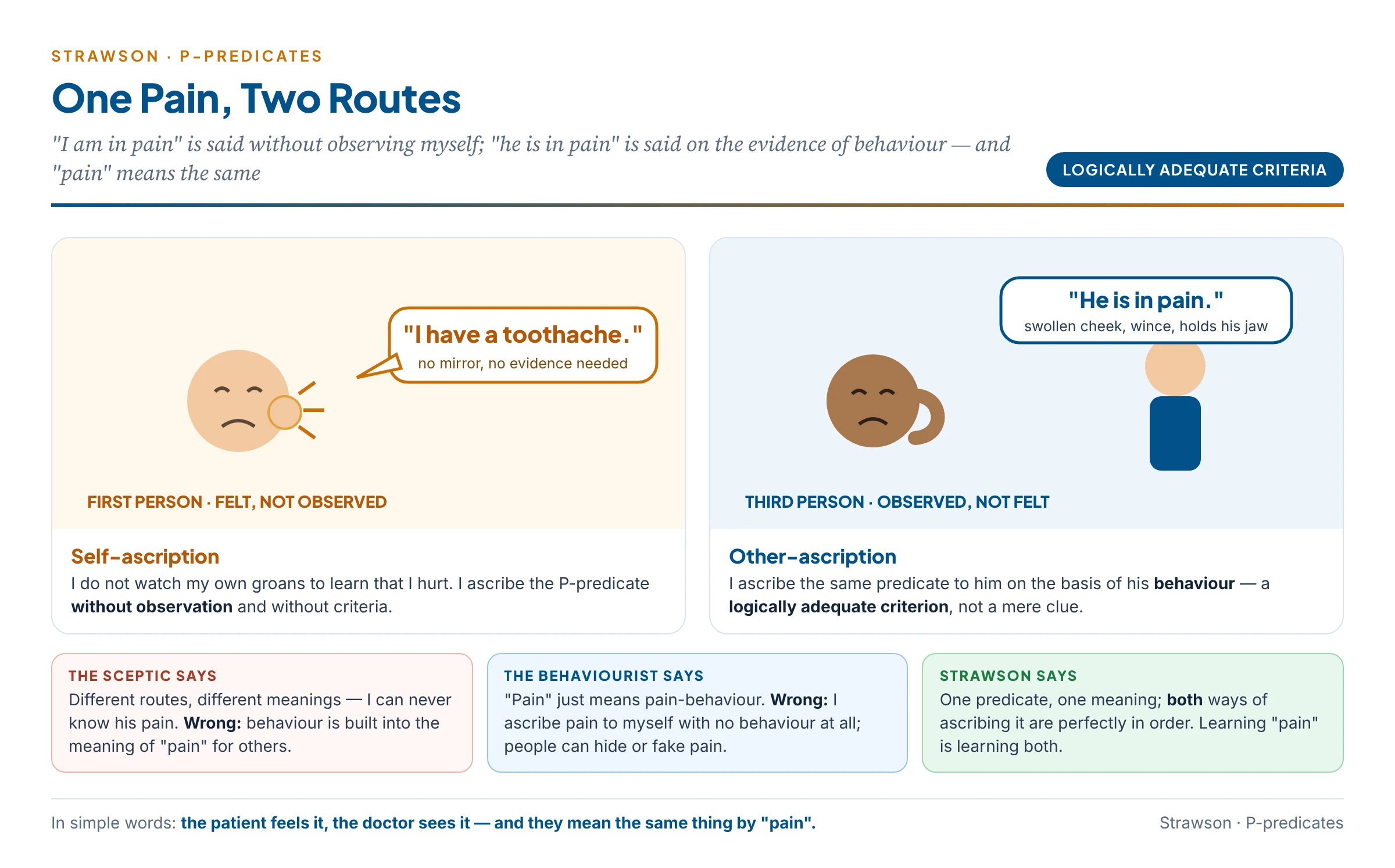
- Two ways of ascribing, one meaning. P-predicates are essentially both self-ascribable and other-ascribable:
- To myself, I ascribe “is in pain” without observing my behaviour — I do not watch myself groan to find out that I hurt. Pain is felt, not observed.
- To others, I ascribe it on the strength of observing their behaviour — he is groaning, holding his jaw, refusing food.
- The same predicate. “It is not that these predicates have two kinds of meaning. Rather, it is essential to the single kind of meaning that they do have, that both ways of ascribing them should be perfectly in order.”
- Depression as the example. We speak of “behaving in a depressed way” and of “feeling depressed“. Feelings can only be felt, not observed; behaviour can only be observed, not felt. But “X’s depression” is “something, one and the same thing, which is felt but not observed by X, and observed but not felt by others than X“.
- Learning the concept. To learn to use a P-predicate is to learn both aspects of its use together. A child learning “pain” learns both to say “I’m hurt” when it hurts and to recognise when mother is hurt.
- Logically adequate criteria. Behaviour is not a mere sign or symptom of an inner state from which we infer it by analogy; it is a logically adequate criterion for ascribing the P-predicate to another. That is part of what the predicate means.
Steering between scepticism and behaviourism:
- The sceptic says: I ascribe pain to myself on one basis (feeling) and to others on another (behaviour); where the criteria differ, the meanings must differ; so I can never really know that others are in pain. Strawson replies that the sceptic forgets that behaviour is a logically adequate criterion for other-ascription — built into the meaning of the predicate. So there is no genuine problem of other minds.
- The behaviourist says: “pain” just means pain-behaviour. Strawson replies that this forgets the first-person side: I ascribe pain to myself without any behavioural criteria. Behaviour is a logically adequate criterion for others, not the whole meaning of the predicate — a person can suppress pain or pretend it.
- The result. Both extremes are avoided. The meaning of “pain” is the same in all cases; it is the meaning of a predicate that applies to persons.
In simple words
At a clinic, the doctor asks, “Where does it hurt?” The patient does not look in a mirror to find out — he just says, “Here, in my tooth.” The doctor, for her part, watches: the swollen cheek, the wince when she taps. Two very different routes — feeling and observing — yet both are talking about the same pain, with the same word. Neither the patient nor the doctor thinks “pain” has two meanings. That is Strawson’s point about P-predicates.
Common confusion
Does Strawson say that I know my own pain by “logically adequate criteria”? No. Some notes put it that way, but it reverses his point. I ascribe pain to myself without criteria — I do not observe my behaviour. The “logically adequate criteria” are the behavioural grounds on which I ascribe pain to others. His point is that these criteria are not mere symptoms (as the sceptic thinks) nor the whole meaning (as the behaviourist thinks), but are built into the one meaning of the predicate.
8. Action Predicates: the Bridge between Inner and Outer
- Predicates of action. “Is going for a walk”, “is coiling a rope”, “is playing cricket”, “is writing a letter”. These are P-predicates (they imply intention and consciousness), yet they involve bodily movement.
- Why they matter. I ascribe them to others on the basis of observation, but to myself I usually ascribe them without observation — I know I am going for a walk without watching my legs. And they point not to a definite inner sensation but to a pattern of bodily movement carried out with an intention.
- The bridge. Such predicates show most clearly that the mental and the bodily are two aspects of one subject’s doings. When we see others act we see them as persons, not as bodies from which we infer hidden minds. This makes the idea of a common human nature, and our understanding of each other, intelligible.
In simple words
When Dhoni takes a quick single, you do not see a body moving and then guess that a mind somewhere decided to run. You see Dhoni running for a single — intention and movement in one act. Action words like “running”, “writing a letter”, “waving goodbye” show most plainly that what we meet in daily life is persons, not bodies with hidden minds attached.
9. Disembodied Survival and the “Pure Ego”
Does Strawson’s view rule out life after death? Not strictly.
- A secondary possibility. It is logically possible to think of oneself as surviving the death of the body — retaining memory and consciousness, even perceiving things — but not able to initiate any physical movement, having no body to act through.
- Only as a former person. Such a being could conceive of itself only by drawing on its earlier embodied life: its identity would be derived from the person it was. It would be “a former person” — the concept of a pure ego is possible only in this secondary sense, parasitic on the concept of a person.
- Strictly solitary and fading. The disembodied individual would be strictly solitary: unable to act on others or be identified by them. Its sense of itself would depend on its memories of embodied life; as those faded, so would its personal existence. “He has, as it were, no personal life of his own to lead.”
- The parallel. After death we talk of the pure body (the corpse); similarly we can talk of a pure ego — but in both cases the concept is derived from that of the person who was.
10. Strawson’s Answers to the Two Questions
Pulling the threads together:
- Why are states of consciousness ascribed to anything at all? Because a predicate like “is in pain” is meaningful only as applicable to a range of distinguishable subjects — oneself and others. Experiences cannot simply float; to be ascribed at all they must be ascribed to identifiable subjects.
- Why to the same things as physical characteristics? Because subjects can be identified only if they are located in the public world of space and time — that is, only if they also have corporeal characteristics. The subjects of experience must therefore be the very same things that weigh so much and stand here — persons.
- The underlying reason. We have a primitive concept of a type of entity to which both kinds of predicates apply equally. The two questions arise only for a philosopher who starts with minds and bodies and then wonders how to connect them. Start instead with persons, and the “problem” of their connection does not arise in that form.
11. Implications for Mind–Body Dualism
UPSC has asked what implication the primitiveness of the person has for mind–body dualism (2023), and about Strawson’s argument against the Cartesian view (2002, 2009).
- Dualism is incoherent, not merely false. If self-ascription requires other-ascription, and other-ascription requires embodied, locatable subjects, then a world of pure minds could not even contain the concept of experience. Cartesian dualism undermines itself.
- The “interaction problem” is a pseudo-problem. It arises only because mind and body were first separated into independent substances. If the person is primitive, there are not two things that need connecting.
- No problem of other minds. Since behaviour is a logically adequate criterion of others’ states, solipsism and radical scepticism about other minds are avoided.
- Neither materialism nor idealism. The person is not reducible to the body (materialism) nor to the mind (idealism); Strawson rejects both, along with interactionism, parallelism and pre-established harmony.
- A conceptual, not a scientific, solution. Strawson resolves the dualism of concepts: how we must think and speak of persons. He does not offer a scientific account of how brains produce consciousness — which is why critics say he dissolves rather than solves the problem.
12. Is Strawson’s Person a Refutation of Hume’s Self?
UPSC asked this in 2010. A balanced answer needs both sides.
Hume’s view:
- “I never can catch myself at any time without a perception, and never can observe anything but the perception.” When we introspect we find only fleeting perceptions — no enduring self. The self is “nothing but a bundle or collection of different perceptions” linked by resemblance and causation; personal identity is a fiction of the imagination.
- In the Appendix to the Treatise, Hume himself confessed dissatisfaction: he could not explain the principles that unite our successive perceptions.
How far Strawson refutes Hume:
- Yes — as an account of ascription. Hume’s bundle theory is a version of the no-ownership doctrine. Strawson shows that perceptions are identified only as someone’s perceptions, so “the bundle” presupposes the person whose bundle it is. The very description “my perceptions” smuggles in an owner.
- Yes — on the unity problem Hume could not solve. What unites a bundle is that its perceptions belong to one person, identifiable through a body in space and time. Hume looked for the self inside, among perceptions; Strawson finds the subject outside, in the public world.
- Yes — on memory and identity. Hume made personal identity a fiction of memory and habit; Strawson shows that memory, responsibility and intention presuppose a persisting person.
- No — on the empirical point. Strawson does not show that introspection reveals a self-object; on that, Hume is right. The person is not something found in experience but the subject identified through body and behaviour.
- No — against a substantial soul. Strawson agrees with Hume in rejecting a Cartesian soul. His person is not a hidden spiritual substance; in that respect he refines Hume rather than refuting him.
Verdict. Strawson’s theory is a refutation of Hume’s no-ownership account of the self — the claim that experiences need no owner — but not a return to the substantial self Hume rejected. It replaces Hume’s “bundle without an owner” with an embodied person who owns the bundle.
| Question | Descartes | Hume | Strawson |
|---|---|---|---|
| What is the self? | An immaterial thinking substance | A bundle of perceptions | A person: one entity with M- and P-predicates |
| Who owns experiences? | The mind (ego) | No one | The person |
| How are other minds known? | By inference from behaviour (doubtful) | Not addressed directly | Through logically adequate behavioural criteria |
| Personal identity | Identity of the soul | A fiction of memory and imagination | Identity of an embodied, re-identifiable person |
| Relation to body | Two substances, interacting | Body is a bundle too | Bodily and mental are aspects of one subject |
Critical Evaluation
Objections to Strawson’s Theory of Persons
- Explaining away, not solving. His theory, critics say, suggests that if we consider the person in a non-Cartesian and non-physicalist way, the problem vanishes. That is escaping the mind–body problem, not solving the ontological question of how mind and body are related.
- A conceptual answer to a real problem. Strawson offers a solution about concepts, but the real problems — studied today with the help of neuroscience — remain, for example mental causation: how do thoughts and intentions make the body move? A Strawsonian analysis does not say.
- Analysing the unanalysable. If the concept of person is primitive and unanalysable, how can we distinguish M-predicates and P-predicates within it? Ascribing two kinds of predicates looks like analysing the person conceptually — a contradiction in his own position.
- Substratum or bundle? To “ascribe” predicates is to treat them as belonging to something. This can be taken in two ways:
- In an Aristotelian sense, the person is an underlying subject (substratum) of the predicates — but then the person must exist, at least conceptually, before any predicates are ascribed, which is hard to square with its being defined by them.
- In a Russellian sense, the person is made up of M- and P-predicates — a sum or bundle of properties — but then the person is analysable after all.
Either way, critics argue, Strawson’s theory is violated.
- Animals, plants and machines. Many P-predicates (“feels pain”, “is frightened”, “wants food”) apply to animals; even plant behaviour can be described in P-predicate vocabulary. Does Strawson make animals persons? And AI researchers ask whether it is a kind of “racism” to exclude computers and robots from personhood on conceptual grounds.
- Person or human being? It is hard to distinguish Strawson’s concept of a person from that of a human being — a member of a biological species — which can also be described by M- and P-predicates. If they coincide, Strawson inherits all the old problems about who counts as a person.
- The pure ego let back in. By admitting a disembodied pure ego as a logical possibility, critics say (including some positivists), Strawson violates his own thesis that persons are primitive.
- Primitiveness not proved. Logical positivists like Ayer objected that Strawson does not prove that the concept of person is primitive; he only shows that we use it.
- Rejected from both sides. Materialists reject the theory because it denies the primacy of matter; idealists reject it because it denies the primacy of mind.
- Back-door dualism. By accepting two kinds of basic particulars — bodies and persons — and two kinds of predicates, Strawson may let a version of dualism back in.
Replies on Strawson’s Behalf
- On dissolving. Many philosophical problems are created by bad concepts; showing that the dualist’s starting point is incoherent is a genuine result, not an evasion.
- On analysis. Distinguishing two kinds of predicates that apply to persons is not analysing the concept of person into simpler components; the person is not built from the predicates.
- On animals. Strawson can accept that many animals have P-predicates; the core concept is of a being with both kinds of predicates, and degrees of personhood can be recognised. What he denies is that any subject of experience could be a pure, bodiless ego.
- On science. Neuroscience studies how persons think; Strawson clarifies what we are talking about when we speak of persons thinking — the two inquiries are complementary.
Critics and Defenders
Criticism — Critics
- Mind–body theorists: he explains the problem away; only a conceptual solution.
- Neuroscience-minded critics: says nothing about mental causation or the brain.
- Logical critics: distinguishing M- and P-predicates analyses the “unanalysable” person; substratum-or-bundle dilemma.
- Ayer and the positivists: primitiveness asserted, not proved; admitting a pure ego is inconsistent.
- Animal and AI ethics: P-predicates fit animals and perhaps machines; person vs human being unclear.
- Materialists and idealists: each object to losing the primacy of matter or mind.
Defence — Defenders and strengths
- Refutes Cartesian dualism from within: self-ascription needs other-ascription, which needs embodied subjects.
- Refutes the no-ownership theory: it cannot be stated without “ownership”.
- Ends the problem of other minds: behaviour as logically adequate criterion.
- Avoids both scepticism and behaviourism about P-predicates.
- Fits ordinary language and life: we speak of one Ravi who is tall and shy.
- Widely regarded as having brought the classical body–mind debate largely to rest at the conceptual level.
Cross-Tradition Comparison
The Self, the Body and Ownership in Indian Thought
| Indian view | Its account of the self | Relation to Strawson |
|---|---|---|
| Nyāya–Vaiśeṣika | The self (ātman) is a distinct substance, the substratum of cognition, desire, effort, pleasure and pain; the body (śarīra) is “the locus of effort, senses and their objects” | An owner of experiences, like Strawson — but an Aristotelian substratum separate from the body, nearer the Cartesian side |
| Buddhism (anātmavāda) | No permanent self; the “person” is a stream of five aggregates (skandhas); “I” is a convenient designation | Comparable to the no-ownership theory Strawson rejects |
| Pudgalavāda (Vātsīputrīya Buddhists) | The person (pudgala) is real, neither identical with nor different from the aggregates — it cannot be reduced to them | Strikingly close to Strawson’s primitive, irreducible person |
| Advaita (Śaṅkara’s adhyāsa) | “I am fat“, “I am thin“, “I am in pain” — the ordinary “I” mixes bodily and mental predicates through superimposition of self and not-self | Śaṅkara treats the mixing of predicates as an error; Strawson treats it as the truth about persons |
| Jaina | The soul (jīva) is conscious and coextensive with the body it occupies (dehaparimāṇa) | An embodied subject, though still a distinct substance |
| Sāṃkhya | Puruṣa (pure consciousness) and prakṛti (matter, including mind) are two independent realities | A dualism like Descartes’ |
| Cārvāka | The self is the body qualified by consciousness (caitanya-viśiṣṭa-deha) | A single subject of physical and conscious predicates — but reduced to matter, which Strawson rejects |
Indian Connect — Key takeaways
- Pudgalavāda — the Buddhist school that held the “person” to be inexpressible as either the same as or different from the aggregates — is the closest Indian parallel to Strawson’s primitive person; it was attacked by other Buddhists exactly as Strawson’s theory is attacked by reductionists.
- Śaṅkara’s adhyāsa describes the same linguistic fact Strawson starts from — we say “I am fat” and “I am thinking” of one “I” — but draws the opposite conclusion: the unity is a superimposition, and the true self is pure consciousness.
- The Buddhist no-self and Hume’s bundle face Strawson’s objection that experiences are identified only as someone’s; Buddhist thinkers answer with the conventional “person” (prajñapti), which Strawson would say is no mere convenience but a primitive concept.
- Cārvāka’s “conscious body” shares Strawson’s rejection of a separate soul but, unlike him, reduces the person to matter.
Synthesis (Siddhānta)
- The two questions. Why are states of consciousness ascribed to anything, and why to the same things as physical characteristics?
- Two failed answers. Cartesianism makes subjects unidentifiable, so it cannot allow ascription to others — and therefore not even to oneself; the no-ownership theory must speak of experiences “of person P” to state its own view.
- The answer. The concept of a person — one entity to which both M-predicates and P-predicates apply equally — is primitive: logically prior to the concepts of a pure mind and a mere body. P-predicates are self-ascribed without observation and other-ascribed on logically adequate behavioural criteria, with one meaning; action predicates show the unity most clearly.
- What follows. Mind–body dualism is incoherent; the problem of other minds dissolves; a disembodied ego is at most a secondary, “former person” concept; Hume’s ownerless bundle gives way to an embodied owner.
- Balanced verdict. Strawson resolves the conceptual side of the mind–body problem — how we must think of persons — while leaving open scientific questions about brain and consciousness, and philosophical questions about animals, machines and the boundaries of personhood. His concept of the person nonetheless remains the most influential non-Cartesian, non-materialist account in analytic philosophy, and the debate on body and mind has been largely brought to rest at this level.
- Contemporary relevance. Indian mental-health law treats a patient as one person whose bodily and mental states are both assessed by observable criteria and by self-report; the Puttaswamy privacy judgment (2017) protects the person’s bodily integrity and mental autonomy together; and debates on AI personhood ask exactly Strawson’s question — whether a being to which P-predicates seem to apply must also be an identifiable, embodied subject.
“The concept of a person is logically prior to that of an individual consciousness.” — Strawson
Previous Year Questions
- 2026Why are states of consciousness ascribed to anything at all and why are they ascribed to the same things to which we also ascribe physical properties? How does Strawson answer these questions in his work Individuals?
- 2023Why does Strawson consider person to be a primitive concept? What implication does it have for the mind-body dualism? Discuss.
- 2018How does Strawson explain the concept of person in his philosophy? Discuss.
- 2015Strawson’s distinction between ‘M’ and ‘P’ predicates.
- 2013Explain and evaluate Strawson’s arguments for his conception of the nature of Person.
- 2010Is Strawson’s concept of person a refutation of Hume’s concept of self? Discuss.
- 2009Descartes’ mind-body dualism and Strawson’s response to it.
- 2007State and discuss Strawson’s theory of Person.
- 2003Strawson’s notion of person as primitive.
- 2002Explain Strawson’s argument against the Cartesian mind-body dualism.