

Logical Positivism: Verification Theory of Meaning; Rejection of Metaphysics; Linguistic Theory of Necessary Propositions.
Official Syllabus: Paper I, Section A, Unit 7
The logical positivists did not argue that metaphysics is false. They argued something far more radical: that metaphysical sentences — “The Absolute is perfect“, “Reality is spiritual“, “The soul is immortal“, “God exists beyond space and time” — are literally meaningless. They are pseudo-statements (Scheinsätze): strings of words that have the grammar of factual claims but assert nothing, because they are neither true by definition nor checkable by any possible experience. This is elimination, not refutation: “God exists” and “God does not exist” are, for the positivist, equally empty. Moritz Schlick applied the verification principle to dissolve “pseudo-problems”; Rudolf Carnap, in his famous 1932 essay “The Elimination of Metaphysics through Logical Analysis of Language“, showed how metaphysics misuses words and logical syntax; and A. J. Ayer extended the attack to theology and ethics, leading to the emotive theory of moral language.
In simple words
Ask, “What colour is the number seven?” or “Is Thursday heavier than Tuesday?” Nobody answers “red” or “yes” — we sense at once that the question is confused, not difficult. The grammar is perfect, but nothing could ever count as an answer. The positivists claim that the great questions of metaphysics — “Is reality one or many?“, “Is the Absolute beyond change?” — are of the same kind: they look deep, but no answer could ever be checked, so they are not real questions at all.
Context & Problem
What the Positivists Meant by “Metaphysics”
- Definition. For the positivists, metaphysics is any claim to knowledge of a reality beyond all possible experience — a “super-phenomenal” or “trans-empirical” reality: God, the soul, heaven, the Absolute, the thing-in-itself, Brahman, Being as such.
- The name. “Metaphysics” comes from the Greek meta ta physika — the books placed “after the physics” in Aristotle’s collected works. Later it came to mean the study of what lies beyond physical nature; some notes loosely render it “beyond experience“.
- “Meaningless” is a technical word. It does not mean foolish or silly. It means “without cognitive content” — non-experiential, not open to checking. Metaphysical sentences may still carry emotional, poetic or practical significance.
- The positivist verdict in one line. A statement is cognitively meaningful only if it is analytic or empirically verifiable (Article 1). Metaphysical sentences are neither, so they are literal nonsense.
Older Attacks on Metaphysics
Attacks on metaphysics are much older than Vienna. What was new was the method.
| Who | Method | Verdict on metaphysics |
|---|---|---|
| Sophists (age of Socrates) | Practical humanism: “Man is the measure of all things” (homo mensura) | Gods and souls are beyond human knowing; concentrate on human affairs |
| David Hume | Psychological: every idea must be traced to an impression | No impression of God, soul or necessary connection — “commit it to the flames“ |
| Immanuel Kant | Epistemological: categories apply only to phenomena | Noumena (God, soul, world-whole) unknowable; reason falls into illusion; metaphysics of experience survives |
| G. E. Moore | Common sense and the ordinary use of words | Idealist metaphysics contradicts what we all know |
| Russell and early Wittgenstein | Logical analysis; language must picture facts | Metaphysical sentences picture no possible fact — nonsense (Wittgenstein: what matters most can only be shown) |
| Logical positivists | Logico-linguistic analysis + verification principle | Literally meaningless pseudo-statements; neither true nor false |
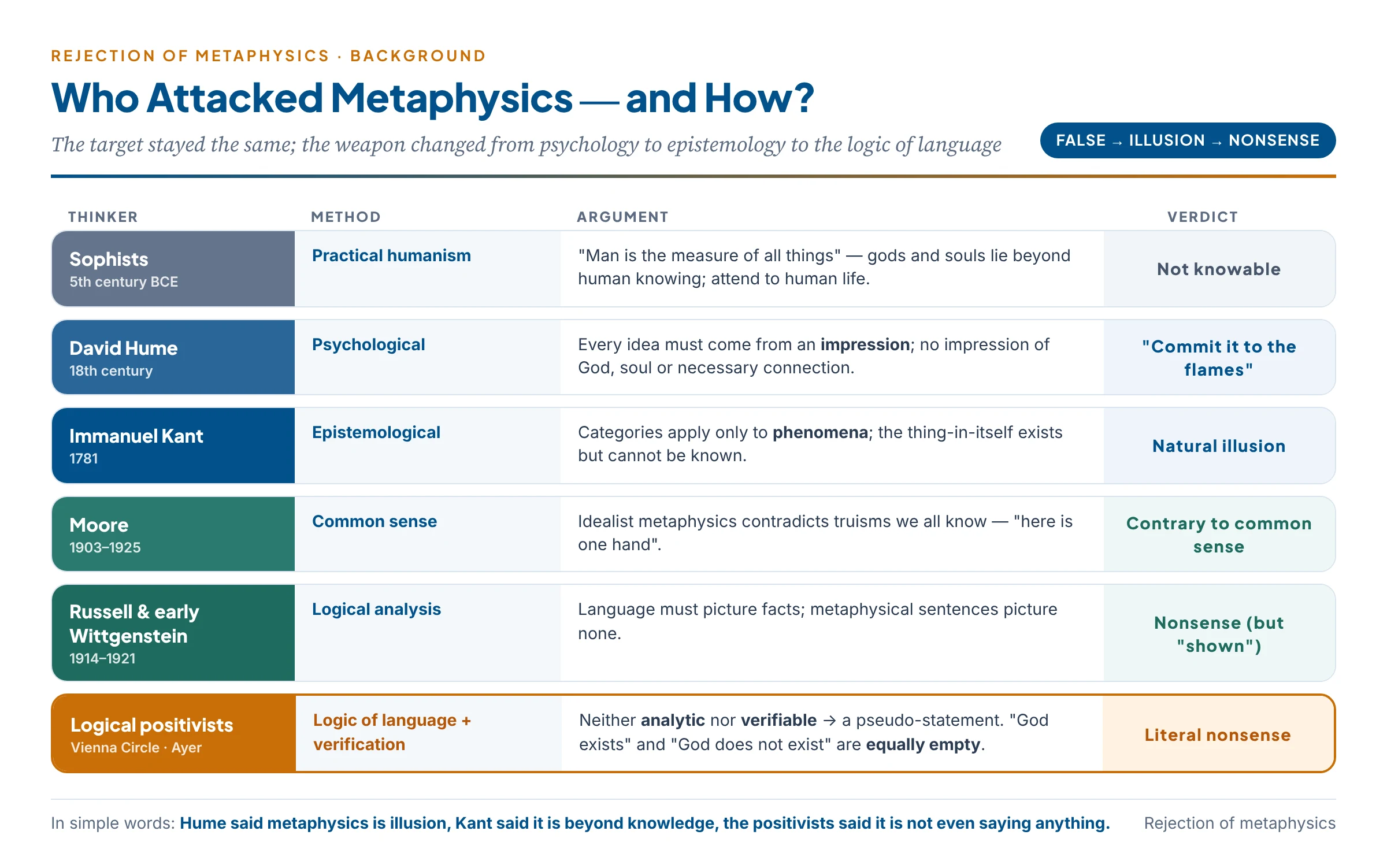
- Hume called it false sophistry; Kant called it a natural illusion; the positivists called it nonsense. Kant still thought metaphysical questions were genuine questions that reason cannot help asking; the positivists said they are not questions at all.
- Aim of the Vienna Circle. To make philosophy as certain as mathematics and science — accept logic, accept experience, and eliminate whatever is neither.
Core Doctrine
1. Elimination, Not Refutation
- Refutation would mean proving a metaphysical claim false — showing, say, that God does not exist. That would itself be a metaphysical claim.
- Elimination means showing that the claim never succeeded in saying anything. The positivist does not take sides in the metaphysical debate; he shows that both sides are talking nonsense.
- “God exists” and “God does not exist” are equally meaningless. So the atheist’s denial and the agnostic’s doubt are as empty as the believer’s assertion. Ayer insisted that his view must not be confused with atheism or agnosticism: the agnostic thinks the question is real but unanswerable; the positivist thinks there is no question.
- “Meaningless” vs “false”. “There is a tiger in this room” may be false — we look and see. “There is an invisible, undetectable tiger in this room that leaves no trace” is not false; it fails to say anything that could be true or false.
- Why this is more devastating. A refuted theory can be repaired; a theory shown to be empty has nothing to repair. Metaphysics is not defeated in argument — it is dissolved.
2. Moritz Schlick: Pseudo-Problems and the “Turning Point” in Philosophy
- Meaningful vs meaningless. Using the verification principle, Schlick drew a sharp line: meaningful propositions have specifiable verification conditions; meaningless ones have none.
- What counts as meaningful. Empirical statements and scientific hypotheses (even false ones) are meaningful. Logical and mathematical propositions are meaningful too, not because experience verifies them, but because they are formal (analytic) truths.
- Metaphysics fails at the level of meaning. A statement like “Reality as such is spiritual” is grammatically correct but asserts no testable fact. Metaphysical statements fail “not because they are false, but because they are unverifiable“.
- Pseudo-problems. Unanswerable disputes — whether reality is one or many, material or spiritual, finite or infinite — persist precisely because they are not anchored in experience. Once the verification test is applied, “these debates lose their footing“; they dissolve rather than get solved.
- Not useless in every sense. Schlick admitted that such sentences may express emotions, attitudes or ways of responding to life. “The world is fundamentally meaningful” may express a moral or existential outlook — but it states no fact. Philosophy must separate expressions of attitude from statements of knowledge.
- Philosophy as activity. In “The Turning Point in Philosophy” (1930) Schlick declared that the age of philosophical systems was over: philosophy is the activity that makes meanings clear; science makes statements true or false.
3. Wittgenstein’s Legacy: No Objective Referent
The positivists read the Tractatus as an anti-metaphysical manifesto.
- Language mirrors facts. Language is a symbolic expression of the facts of experience. Complex sentences are analysed into simple ones, and simple sentences picture facts. “Ripe mango is sweet” is true because it corresponds to a fact; “The King of Nepal is a Muslim” is false because it does not — but both connect with possible facts.
- Pseudo-propositions. A sentence that cannot even possibly connect with any fact is a pseudo-proposition. “God exists” is, on this reading, neither true nor false.
- The “inner experience” defence fails. Metaphysicians reply that their claims rest not on outer but on inner experience. The answer: an experience cannot be known unless it is expressed, and once expressed it must connect with some objective reality that others can check — which metaphysical statements, by their own admission, do not.
- A caution. Wittgenstein himself did not hold the verification principle as a theory and thought the most important things — ethics, the mystical — show themselves even though they cannot be said. The positivists kept his “nonsense” verdict but dropped his reverence for what lies beyond language.
4. Rudolf Carnap: The Logical Analysis of Language
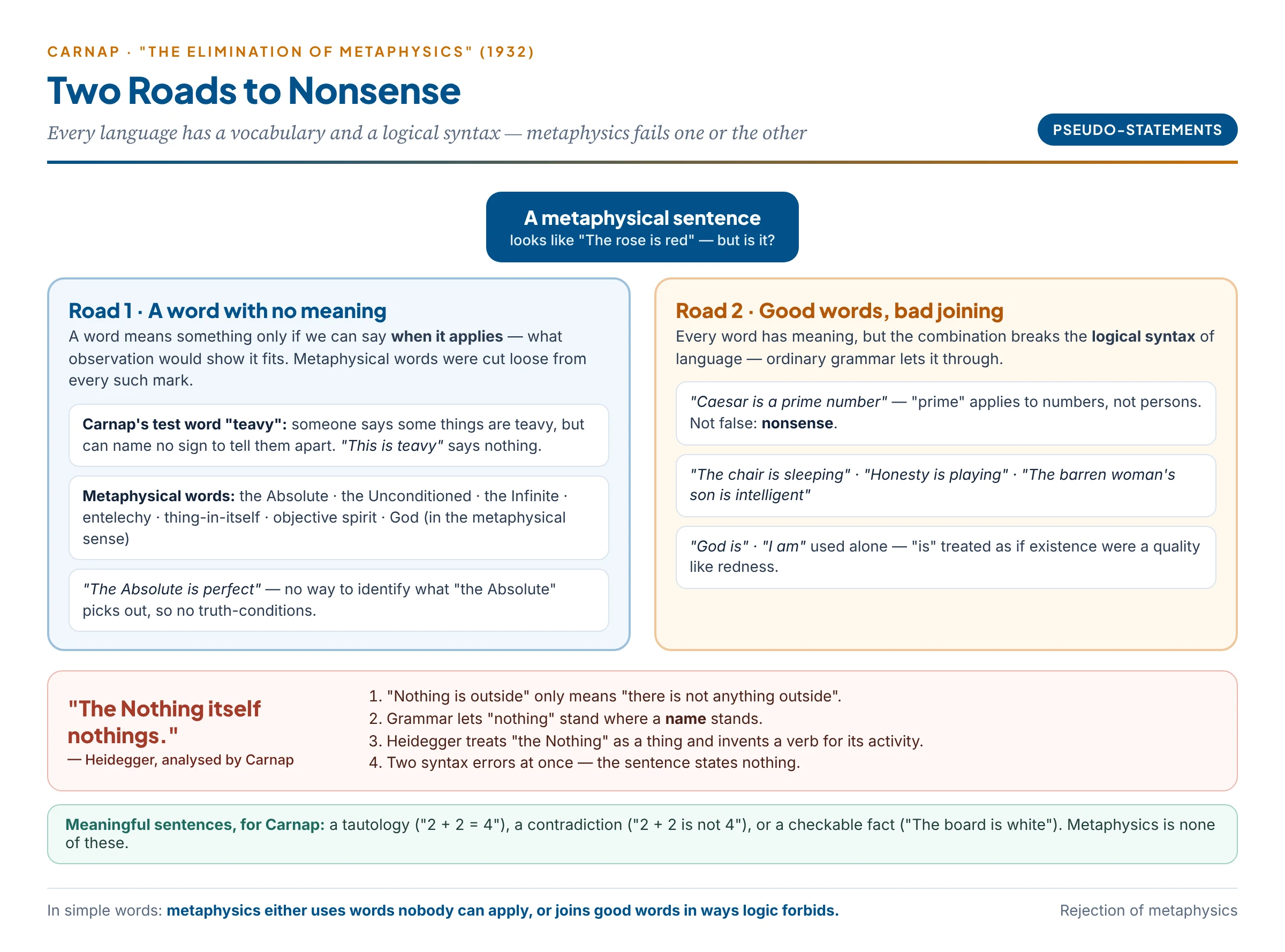
In “The Elimination of Metaphysics through Logical Analysis of Language” (1932), Carnap gave the most precise version of the attack. He did not argue against metaphysics polemically; he analysed its sentences and showed that they collapse under analysis.
- Two parts of every language.
- Vocabulary — the stock of words that have meaning: “chair”, “table”, “beauty”, “justice”.
- Logical syntax — the rules for combining words into meaningful sentences: “Ram is playing“, “The wall is green“.
- If either part fails, the sentence fails. A sentence can be meaningless because it uses a word without meaning, or because it combines meaningful words wrongly. Metaphysics, says Carnap, commits both errors.
- Meaningful sentences come in three kinds only. A sentence is meaningful if it is a tautology (“2 + 2 = 4“), a contradiction (“2 + 2 is not 4” — meaningful but necessarily false), or a contingent empirical statement (“The board is white“). Metaphysical sentences fit none of the three.
5. First Road to Nonsense: Words Without Meaning
- What gives a word meaning. A word is meaningful only if we can say when it applies: the simple sentences in which it occurs must have truth-conditions in experience. That is what Carnap’s four questions test (from which sentences can it be derived, under what conditions is it true, how can it be verified, what is its meaning — Article 1).
- Carnap’s invented word. Suppose someone invents the word “teavy” and says some things are teavy and others are not, but can give no observable mark by which to tell them apart. He may say he “feels” what teavy means — but the word has no meaning, and “This thing is teavy” says nothing.
- Metaphysical words are like “teavy”. “The Absolute“, “the Unconditioned“, “the Infinite“, “the thing-in-itself“, “entelechy“, “objective spirit“, “the Being of beings“, “omnipotent“, “Brahman” (as the metaphysician uses it), and “God” in its metaphysical sense. Each once had an ordinary meaning — “principle” meant “beginning”, “God” once meant a bodily being on Mount Olympus — but the metaphysician cut the word loose from every observable criterion and kept only the feeling it arouses.
- Examples analysed.
- “The Absolute is perfect” has a familiar subject–predicate form, but there is no method for identifying what “the Absolute” refers to, so the sentence has no truth-conditions.
- “God is absolute“, “God is infinite” — the words seem meaningful, yet nothing in experience shows when they apply.
- “All reality is mental” — we can experience this or that, but there is no experience of “all” reality at once, so the claim can never be checked.
- Contradictory descriptions. Metaphysicians describe God in opposite ways — personal for some and impersonal for others, outside the world for some and within it for others, beyond experience for some and within reach for others. Carnap took this as a sign that the word is fixed to no content at all.
- The intuition defence and the blind man. Metaphysicians say their claims rest on the experience of spiritually advanced persons with powers of intuition; to reject them is like a blind man rejecting colour reports. Carnap answered that a blind man can still understand colour statements and check them through others (by instruments, by consistent reports); but no one can say what observation would confirm the mystic’s claim. No statement earns the title “meaningful” unless experience could validate or invalidate it.
- Ayer on intuition. There is no criterion to distinguish a genuine intuition of God from a hallucination. An intuition that cannot be checked yields no knowledge.
6. Second Road to Nonsense: Violating Logical Syntax
- Meaningful words, meaningless whole. Sometimes every word has meaning, but the way they are joined breaks the logic of language.
- “Caesar is a prime number” — grammatical in English, but “prime number” applies to numbers, not to persons. It is not false; it is nonsense. (Contrast “Caesar is a general” — meaningful.)
- “The chair is sleeping“, “Honesty is playing” — every word is fine, the combination says nothing.
- “The barren woman’s son is intelligent” — the phrase “barren woman’s son” describes nothing that could exist.
- Ordinary grammar is a poor guide. Natural languages allow such combinations because their grammar does not track logical form. A logically correct language would make them impossible to construct — and then metaphysics could not even be formulated.
- Carnap on Heidegger. Carnap’s most famous target was a passage from Heidegger’s lecture “What is Metaphysics?“: “What about this Nothing? … The Nothing itself nothings.” Carnap analysed it step by step:
- In everyday speech, “What is outside?” — “Nothing is outside” simply means “There is not anything that is outside“.
- Ordinary grammar lets “nothing” stand where a noun stands, as if it named a thing.
- Heidegger treats “the Nothing” as an object with its own activity — it “nothings” — and even makes up a verb for it.
- The result breaks logical syntax twice: “nothing” is used as a name, and a meaningless verb is invented. Heidegger’s sentences say nothing at all, however profound they sound.
- Misuse of “is” and “exists”. The little word “is” has several jobs: it links a quality to a thing (“The rose is red“), it states identity (“Gandhi is the Father of the Nation“) and, misleadingly, it is used to assert existence (“God is“).
- Saying “God is” treats existence as if it were a quality like redness. But existence is not a quality that things may have or lack — an existing rose and an imagined rose have the same list of qualities.
- Descartes’ “I think, therefore I am” also misuses “am”. From “I think” what follows is only “there is something that thinks“; “I am” used alone, with no quality after it (“I am tall”, “I am a boy”), is a syntactic slip that makes existence look like a property of a mysterious “I”.
- “A dog exists” and “A dog barks” have the same grammar but different logic. Metaphysicians who miss this treat “existence” or “Being” as a special attribute and start asking about “Being as such“.
- Copulas and imaginary things. “The rose is red” requires that the rose exist for the sentence to be true. But “Mermaids are imaginary” does not require mermaids to exist — and “The barren woman’s son is intelligent” cannot presuppose such a son. Merely using the words “God” or “soul” in sentences proves nothing about their existence; metaphysics is often “dramatic language” mistaken for description.
In simple words
A dictionary tells you what words mean; grammar tells you how to join them. “Glorp is heavy” fails the dictionary (no one can say what a glorp is). “Heavy is glorpily the” fails grammar. “The Nothing nothings” passes ordinary grammar but fails the deeper logical grammar, like “Caesar is a prime number“. Carnap says metaphysics hides in these two blind spots.
7. Why Does Metaphysics Exist at All? An Attitude Towards Life
If metaphysics says nothing, why have so many brilliant minds devoted themselves to it?
- Expression of a feeling about life. Carnap answered that metaphysics expresses a general attitude towards life (Lebensgefühl) — a sense of the world as harmonious or hostile, ordered or tragic. This is a real and important human need.
- Art does it honestly. The proper medium for expressing an attitude towards life is art — poetry, music, painting. The musician expresses his feeling in sounds without pretending to state a theory.
- “Musicians without musical ability.” Metaphysicians, said Carnap, are musicians without musical ability: they feel the urge to express an attitude, lack the artistic gift, and so pour it into the form of theory — arguments, definitions, proofs. Of all metaphysicians, he thought Nietzsche came closest to art, choosing a poetic form in Thus Spoke Zarathustra.
- The real danger. The non-theoretical character of metaphysics would not be a defect in itself — all art is non-theoretical and highly valuable. The danger lies in its deceptive character: “it gives the illusion of knowledge without actually giving any knowledge“.
- Seduction of grammar. Ayer added a second cause: philosophers are misled by grammatical forms. Because we say “Martians exist” in the same form as “Martians attack“, we take existence for an attribute; because every sentence has a subject, we invent a “substance” behind the qualities.
8. Is Metaphysics Then a Kind of Poetry?
Even in the movement’s early days, some suggested that metaphysics might simply be poetry. The positivists’ answers differed.
- Carnap: no. Pages of metaphysics are full of arguments and polemics — “proofs” that claim to compel agreement. Poetry never argues in this way. Metaphysics pretends to be theory.
- Ayer: no. A poet consciously uses words to express and arouse emotion and knows that what he writes is not literally true. The metaphysician does not know this: he unknowingly falls into linguistic confusion while trying to know the world by non-scientific means.
- Richard von Mises: partly. Even poetry conveys some cognitive meaning; metaphysics may be science in its infancy — early, vague guesses that later become testable.
- Other verdicts. Wittgenstein spoke of “significant nonsense“; some later positivists (Waismann among them) allowed that metaphysics can help us “see the world in a fresh and interesting way“; Freud, close to the positivist outlook though never in the Circle, dismissed it as a kind of disordered verbalism.
9. A. J. Ayer: The Elimination of Metaphysics
Chapter 1 of Language, Truth and Logic is titled “The Elimination of Metaphysics“. It opens: “The traditional disputes of philosophers are, for the most part, as unwarranted as they are unfruitful.“
- The metaphysical thesis. The metaphysician claims that philosophy gives knowledge of a reality transcending the world of science and common sense.
- Ayer’s challenge — ask for the premises. From what premises could such knowledge be derived? If from experience, then nothing beyond experience can be validly inferred from it. If from pure reason, then reason alone yields only tautologies (Article 3), which say nothing about any reality. Either way, no transcendent knowledge is possible.
- The sharper point. Ayer goes further than Kant. Kant said we cannot know the transcendent; Ayer says we cannot even meaningfully speak of it. Sentences that claim to describe it are senseless.
- Philosophy and metaphysics are mutually exclusive. Philosophy, rightly understood, is analysis and is closely related to science; metaphysics concerns realms unconnected with observable fact. They are not just distinct — they exclude each other.
- Two kinds of “existence”. People speak of empirical existence (what can be experienced through the senses and so verified) and transcendental existence (beyond experience and so unverifiable). Only the first can figure in meaningful statements.
- Examples. “God is in heaven“, “The Absolute is perfect“, “Reality is fundamentally spiritual“, “Being transcends experience“, “God exists beyond space and time” — no possible observation bears on any of them, so they are not false but cognitively meaningless. In Ayer’s words they are pseudo-propositions: they may evoke emotions or attitudes but state no facts.
- Ayer does not deny value. He grants that religious and metaphysical utterances may have emotional or symbolic value; he insists only that they do not belong to knowledge.
- Two famous targets.
- Substance. Because we use one word for a thing and several words for its qualities, we wrongly suppose there must be a “substance” in which the qualities inhere. Analysis shows a thing is nothing over and above its sense-contents (a phenomenalist view Ayer held).
- Being. Because “is” and “exists” look like predicates, philosophers ask what “Being” is — a question that arises only from a grammatical illusion.
Common confusion
Did the positivists say metaphysical statements are false? No. Many answers write “positivists proved metaphysics false”. The positivists insisted that metaphysical sentences are neither true nor false: they lack the meaning needed to be either. To call “God exists” false would be to make a meaningful claim — atheism — which Ayer explicitly rejected. Their move is elimination (showing emptiness), not refutation (showing falsity).
10. Ayer on Theology
Ayer applied the same test to religious claims in a separate chapter, “Critique of Ethics and Theology“.
- “God exists” cannot be demonstrated. No proof from premises that are certain can establish it, since only tautologies are certain, and tautologies cannot yield existence.
- It cannot even be made probable. If “God” means a transcendent being, then no observable regularity in nature could make “God exists” probable. If “God” just means the regularities of nature, then “God exists” says no more than “nature is regular” — which is not what believers mean.
- The notion is unintelligible. “The notion of a person whose essential attributes are non-empirical is not an intelligible notion at all.” “God” in the transcendent sense is a metaphysical term.
- Atheism and agnosticism are equally ruled out. If “God exists” is nonsensical, so is “God does not exist“, and the agnostic’s “we cannot know whether God exists” assumes there is a genuine question to be unsure about.
- The mystic’s claim. If the mystic says he has intuited God but cannot describe the object of his intuition, he admits it is ineffable — and then he is “bound to talk nonsense when he describes it“. Religious experience is interesting to the psychologist, but it gives no knowledge of a transcendent being.
- Even religious people agree in part. Believers themselves say God is beyond experience, not verifiable in practice or in theory, strongly or weakly, directly or indirectly. And they would never accept “God exists” as an analytic truth, since analytic truths are empty of information.
11. Ayer on Ethics: The Emotive Theory
- Ethical words are not factual. “Stealing is wrong” is neither analytic (its denial is not self-contradictory) nor empirically verifiable (no observation shows “wrongness”). So it has no factual meaning.
- What moral sentences do. They express the speaker’s feelings and try to arouse similar feelings in others or direct their actions.
- Ayer’s example. “If I say to someone, ‘You acted wrongly in stealing that money’, I am not stating anything more than if I had simply said, ‘You stole that money.’” Adding “wrong” is like saying “You stole that money” in a peculiar tone of horror, or writing it with special exclamation marks.
- “Boo–hurrah” theory. Critics nicknamed it the boo–hurrah theory: “Stealing is wrong” ≈ “Stealing — boo!“; “Charity is good” ≈ “Charity — hurrah!“
- No real moral disagreement. Since moral sentences are not true or false, there is nothing to contradict. Apparent moral disputes are really disputes about facts (what happened, what the consequences will be) or clashes of feeling.
- C. L. Stevenson’s version. The American philosopher Charles Stevenson developed a subtler emotivism: moral terms have emotive meaning that expresses attitudes and persuades others to share them.
- Criticism. Emotivism makes rational moral argument impossible. We could never show that slavery, untouchability or genocide is objectively unjust — only that we dislike it. It ignores the reasons we give in moral debate and the normative pull of moral claims. Many saw this as the most damaging consequence of strict verificationism.
In simple words
A child points at a broken vase and says to his brother, “You broke it!” — a fact, checkable. If he says, “You broke it, and that was wicked!“, Ayer thinks the second part adds no new fact — it is like saying “You broke it” with an angry face. The anger is real, and it may change his brother’s behaviour, but it is not something you could verify like the broken vase.
12. Metaphysics, Theology and Ethics Side by Side
| Domain | Example | Positivist verdict | What the sentence really does |
|---|---|---|---|
| Metaphysics | “The Absolute enters into, but is incapable of, evolution” | Literally meaningless | Expresses an attitude to life; misuses words and syntax |
| Theology | “God exists beyond space and time” | Literally meaningless (so are atheism and agnosticism) | Expresses religious feeling and commitment |
| Ethics | “Stealing is wrong” | No factual meaning (emotivism) | Expresses disapproval; tries to influence others |
| Aesthetics | “This painting is beautiful” | No factual meaning | Expresses approval of a work |
| Science | “Water boils at 100 °C at standard pressure” | Meaningful (verifiable) | States a checkable fact |
| Logic and maths | “2 + 2 = 4” | Meaningful (analytic) | Records rules for using symbols |
13. Is the Rejection about Meaning, Knowledge or the Nature of Things?
UPSC asked whether the rejection of metaphysics concerns the problem of meaning, the problem of knowledge, the nature of things, or all of them together. The best answer is: primarily meaning, but resting on a theory of knowledge and carrying consequences for what we can say about the nature of things.
- Primarily a problem of meaning (semantic). The positivists’ distinctive claim is that metaphysical sentences fail to mean anything. Hume and Kant asked whether we can know the transcendent; the positivists asked whether we can even say anything about it. Example: “The soul is immortal” is rejected not because the evidence is weak but because no evidence could ever bear on it.
- Grounded in a problem of knowledge (epistemological). The verification principle presupposes empiricism: the only source of factual knowledge is experience, and reason alone gives only tautologies. Without this theory of knowledge the meaning-test would have no basis. Example: “God is known by intuition” fails because intuition is not a public, checkable source of knowledge.
- Implications for the nature of things (ontological) — but only negatively. The positivist cannot say “there is no transcendent reality” — that would itself be metaphysics. He says only that nothing meaningful can be said about it. Yet in practice his picture of the world is limited to what science can describe; critics say this is a hidden metaphysics (phenomenalism or physicalism).
- So: all three, in an order. Meaning is the weapon, knowledge is its foundation, and the nature of things is its target, approached only by silence. Example: Kant’s thing-in-itself — Kant says it exists but is unknowable (knowledge); the positivist says the phrase has no meaning (meaning), so even Kant’s claim that it exists is ruled out (nature of things).
14. Pseudo-Statements: How to Identify Them
Gathering the tests used by Schlick, Carnap and Ayer, a sentence is a pseudo-statement if:
- It is not analytic. Its denial is not self-contradictory — “God does not exist” contains no contradiction.
- No possible observation bears on it. Neither in practice nor in principle, strongly nor weakly, directly nor indirectly. Ask: “What would the world look like if it were false?” If the answer is “exactly the same”, it is empty.
- It contains a word with no criterion of application. “The Absolute“, “entelechy“, “the thing-in-itself” — no observable mark tells us when they apply.
- It breaks logical syntax. “The Nothing nothings“, “Caesar is a prime number“, “The chair is sleeping“.
- It and its denial are equally compatible with every experience. “Reality is ultimately spiritual” and “Reality is ultimately material” fit every observation equally well — the dispute can never make progress.
- It mimics the grammar of fact. It has the subject–predicate form of “The rose is red“, which gives an illusion of meaning.
In simple words
A counterfeit ₹500 note has the right size, colour and printed number — it looks exactly like money. But try to spend it at a bank and it is worth nothing, because nothing stands behind it. A pseudo-statement is a counterfeit sentence: it has the shape of “The rose is red“, but when you try to “cash” it in experience — “What would I see if it were true?” — nothing stands behind it.
- Contrast with genuine but false statements. “Ostriches are green“, “There are 300 planets in the solar system“, “The Earth is flat” are false but meaningful — we know how to check.
- Critical points. The tests are harder to apply than they look. “Every event has a cause“, “There are other minds” and “The past existed” are hard to verify directly, yet seem meaningful; and the criterion itself is not easily classified (Article 4).
15. “The Soul of Superman Is Good”
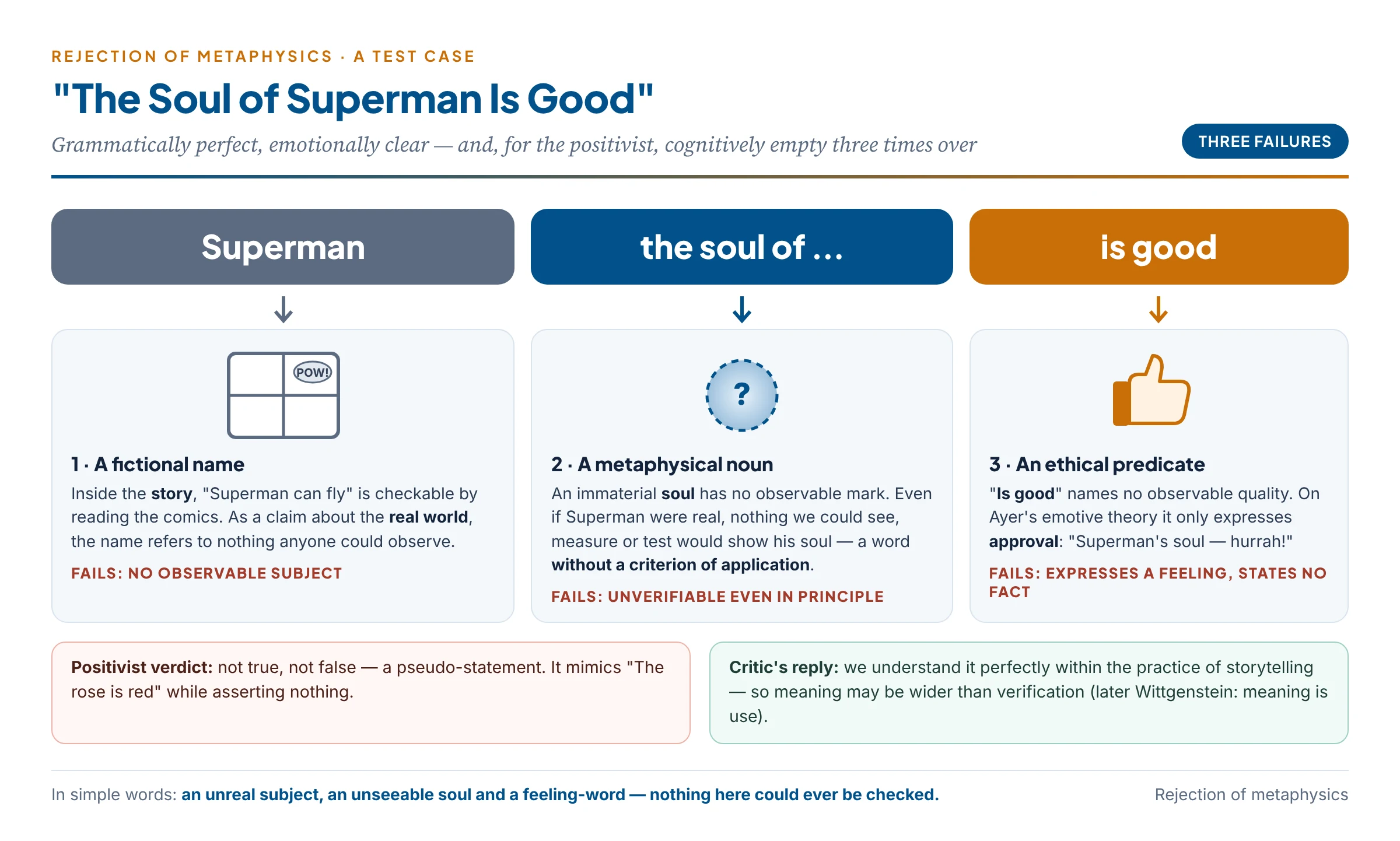
This sentence, asked by UPSC, packs three problems into one line — fiction, metaphysics and ethics.
- “Superman” — a fictional name. Superman does not exist in the world. Within the comic-book story, “Superman can fly” is checkable by reading the comics; but as a claim about the real world the name refers to nothing. Taken literally as a factual claim, the sentence is about nothing that could be observed.
- “The soul” — a metaphysical term. Even if Superman existed, his soul, understood as an immaterial, non-observable substance, could not be checked by any observation. It is a word without a criterion of application — a pseudo-concept.
- “Is good” — an ethical predicate. Even if Superman and his soul could be observed, “is good” expresses approval, not a fact (emotivism). At best it says “Superman’s soul — hurrah!“
- Verdict. The sentence is grammatically perfect and emotionally clear, but cognitively empty three times over: it fails the verification test at every level.
- Contrast. “Clark Kent works at the Daily Planet” (inside the story, checkable by reading); “Superman’s costume is red and blue” (inside the story, checkable); “Superman is more popular than Batman in India” (a meaningful factual claim about readers, checkable by survey).
- Critical note. A critic might reply that we understand the sentence perfectly — we know what it would be for a fictional hero to have a good character — which suggests that meaning is broader than verification (later Wittgenstein: meaning lies in use within a practice such as storytelling).
16. Verification and Religious Language
The positivist challenge set off a long debate in philosophy of religion about whether religious language can be meaningful.
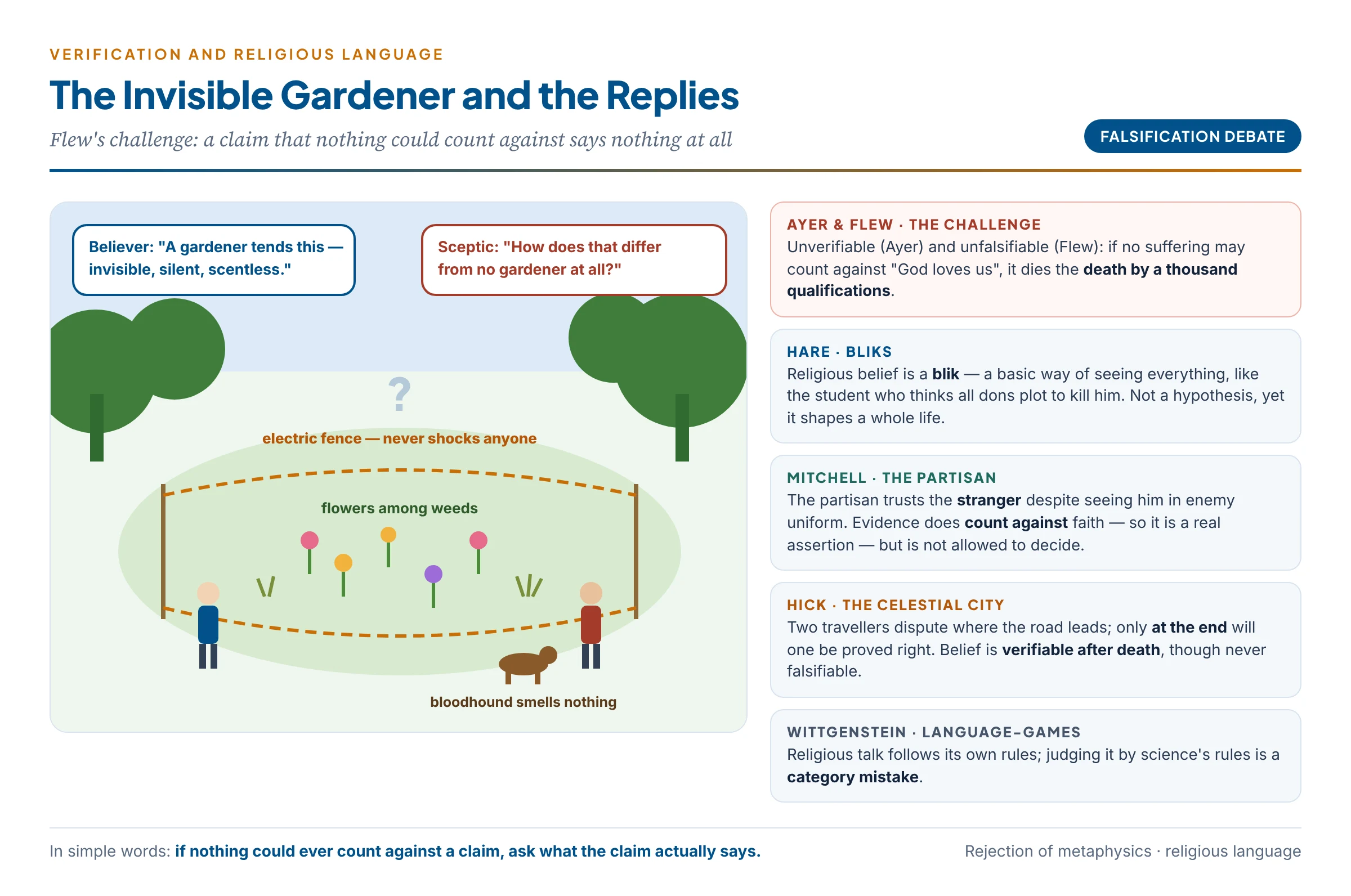
- Ayer’s challenge. Religious statements such as “God loves us as a father loves his children” cannot be verified, so they are literally meaningless. A sentence like “Ostriches are green” is false but meaningful; “God loves us” is not even false.
- Antony Flew’s falsification challenge (1950). Flew borrowed John Wisdom’s parable of the invisible gardener. Two explorers find a clearing with flowers and weeds. One says a gardener tends it. They watch, set up an electric fence, patrol with bloodhounds — no sign of any gardener. The believer insists he is invisible, intangible, silent and scentless. The sceptic asks: “What is the difference between an invisible, intangible, eternally elusive gardener and no gardener at all?” A claim that allows nothing to count against it dies “the death by a thousand qualifications“. Religious believers let no suffering, not even a child’s death from cancer, count against “God loves us” — so the claim seems to assert nothing.
- R. M. Hare’s “bliks”. Hare agreed that religious beliefs are not falsifiable assertions, but said they are bliks — basic, unshakeable ways of seeing the world that shape all our interpretations. His example: a student convinced that all the university dons want to murder him; however kind they are, he says “that is just their cunning“. His blik is insane; a believer’s blik can be sane. A blik is not meaningless — everything in a person’s life depends on which blik he has.
- Basil Mitchell’s partisan and stranger. In an occupied country, a partisan meets a stranger who says, “Trust me, I am on your side.” Later the stranger is seen sometimes helping the resistance and sometimes in enemy uniform. The partisan keeps trusting him, though he feels the force of the contrary evidence. Religious belief, says Mitchell, is like this: evidence counts against it (so it is a genuine assertion), but faith does not let it decisively count.
- John Hick’s eschatological verification. Hick replied directly to the verificationist: religious claims are verifiable in principle — after death. Two travellers walk a road; one believes it leads to the Celestial City, the other believes it leads nowhere. On the journey nothing settles the dispute, but at the end of the road one of them will be proved right. “God exists” is thus verifiable (if true, it will be confirmed after death) though not falsifiable (if false, no one will be there to find out). Hick also held: “In order to say something which may possibly be true, we must say something which may possibly be false.“
- R. B. Braithwaite’s non-cognitivism. Braithwaite accepted the verification challenge and reinterpreted religious statements as declarations of a moral intention — to live a life of love — supported by stories that need not be literally true.
- Later Wittgenstein’s language-games. Religious language has its own rules within a form of life. To demand that it pass the test of the scientific language-game is a category mistake. When a believer says “I believe in a Last Judgement” and the other says “I’m not so sure“, they are not disagreeing as two people do about whether “there is a German aeroplane overhead“; they have different pictures of life.
- Life after death. It is unverifiable this side of death; is it then meaningless or even self-contradictory (“we are either alive or dead”)? Hick’s answer is that it would be verified in the afterlife; Wittgenstein’s that it expresses a picture that guides life.
17. What the Positivists Did to Classical Metaphysics: Examples
- Aristotle’s teleology. “Everything strives towards its natural end” and “the Unmoved Mover moves the world as an object of love” are, for the positivist, beyond verification; only mechanical causation between observable events belongs to science.
- Leibniz’s monads. “The world consists of windowless monads in pre-established harmony” cannot be verified even by Leibniz’s own lights: no monad can step outside itself to perceive the others.
- Spinoza’s Substance, Hegel’s Absolute Spirit, Bradley’s Absolute, Kant’s thing-in-itself, Śaṅkara’s nirguṇa Brahman — all share the same fate: not refuted, but declared cognitively empty.
- Even Hume was too metaphysical. Hume looked for an impression of causal necessity and, not finding it, concluded that causation is a habit. Schlick said the search itself was confused: “the word cause, as used in everyday life, implies nothing but regularity of sequence“; the criterion of causality is simply successful prediction.
Critical Evaluation
Objections (Pūrva-pakṣa)
- Self-refuting. “Metaphysics is nonsense” is itself a philosophical thesis that is neither analytic nor verifiable — as critics put it, to say that metaphysics is nonsense is itself nonsense. The verification principle cannot pass its own test.
- Science goes with it. A remark often quoted in this debate (associated with John Passmore): “Throw metaphysics into the fire and science goes with it; try to retain science, and metaphysics enters through the back door.” Universal laws, theoretical entities and historical claims cannot be verified strongly; weak or indirect verification readmits metaphysics.
- Hidden metaphysics. The positivists’ own views — phenomenalism (things are constructions of sense-data) or physicalism (everything can be described in physical language) — are themselves metaphysical theses.
- Popper: metaphysics is not nonsense. Karl Popper argued that the line between science and non-science is not the line between sense and nonsense. Metaphysical ideas — Greek atomism, heliocentrism, field theory — were untestable when proposed but later inspired testable science. Metaphysics can be meaningful and fruitful.
- Descriptive metaphysics. P. F. Strawson later revived metaphysics as the description of the basic structure of our thought about the world (persons, material bodies, space and time) — a kind of metaphysics no verificationist could easily dismiss.
- Quine: metaphysics continuous with science. For Quine, metaphysics is “science generalised”: our most general theories about what exists are tested, as a whole, along with physics.
- Language has many uses. Later Wittgenstein: religious, moral and poetic language is meaningful within its own practice; meaning depends on context. The demand that every meaningful sentence describe facts is a prejudice.
- Human needs. Concepts like God, soul and another world have great pragmatic value: they give consolation, purpose and moral orientation. Dismissing metaphysical questions ignores the human need for a comprehensive framework of meaning.
- Emotivism’s cost. If moral judgements are mere expressions of feeling, moral reasoning, human rights and justice lose their rational basis.
Replies and Strengths
- A healthy discipline. The attack forced philosophers to state clearly what their claims mean and what difference they make. Much vague, speculative system-building lost credibility, and “imaginary theories” became harder to sell as knowledge.
- Separating feeling from fact. The positivists rightly distinguished expressing an attitude from stating a fact. Even critics of emotivism accept that moral language has an important expressive and persuasive side.
- Respect for science and human effort. The movement affirmed the power of human inquiry to solve problems without appeal to the supernatural — part of the Enlightenment spirit the Circle defended against irrational political movements of the 1930s.
- A permanent question. “What would count against your claim?” — the question behind Flew’s gardener — remains a powerful test for religious, political and pseudo-scientific claims.
Critics and Defenders
Criticism — Critics
- Self-refutation: “metaphysics is nonsense” is itself nonsense by the positivists’ own test.
- Passmore’s warning: science and metaphysics stand or fall together.
- Popper: metaphysics is non-scientific, not meaningless; it often gives birth to science.
- Strawson and Quine: metaphysics returns as descriptive metaphysics or as generalised science.
- Later Wittgenstein: religious and moral language have their own grammar.
- Ethical critics: emotivism destroys moral argument.
Defence — Defenders and strengths
- Schlick: dissolve pseudo-problems instead of fighting endless battles.
- Carnap: precise logical analysis exposes misuse of words and syntax.
- Ayer: elimination, not refutation — no need to win metaphysical debates.
- Flew: a claim compatible with every possible event asserts nothing.
- Legacy: clarity, testability and suspicion of empty profundity.
Cross-Tradition Comparison
Indian Attitudes to Unanswerable Questions
| Point | Logical positivism | The Buddha | Cārvāka | Navya-Nyāya | Nāgārjuna |
|---|---|---|---|---|---|
| Attitude to metaphysics | Meaningless | Set aside the questions (avyākṛta) | Rejected: only the perceived is real | Analyses empty terms | Dissolves every metaphysical view |
| Key idea | Verification principle | Unanswered questions; poisoned arrow | Pratyakṣa alone is valid | Alīka (non-existent) terms | Prasaṅga (reduction to absurdity); śūnyatā |
| Example | “The Absolute is perfect” | “Is the world eternal? Does the Tathāgata exist after death?” | “There is a soul / heaven / rebirth” | “Hare’s horn“, “barren woman’s son“, “sky-flower“ | “Things arise from themselves / from others” |
| Goal | Clarity for science | Liberation from suffering | Worldly happiness | Precise logic | Freedom from all views |
Indian Connect — Key takeaways
- The Buddha’s unanswered questions (avyākṛta). Asked whether the world is eternal, whether the soul is the same as the body, whether the enlightened one exists after death, the Buddha stayed silent. In the parable of the poisoned arrow, a wounded man who refuses treatment until he knows who shot the arrow and of what wood the bow was made will die first. Like the positivists, the Buddha judged such questions unprofitable; unlike them, his reason was practical (liberation), not semantic.
- Empty terms. Indian logicians used “hare’s horn” (śaśaśṛṅga), “barren woman’s son” (vandhyāputra) and “sky-flower” (ākāśakusuma) as stock examples of words that refer to nothing — close to Carnap’s “words without meaning”.
- Nāgārjuna dissolves metaphysical theses by showing that each leads to absurdity — a “therapy” resembling Schlick’s dissolving of pseudo-problems, but aimed at emptiness (śūnyatā) and freedom, not at science.
- Cārvāka denies God, soul, heaven and rebirth as unperceived — but, unlike the positivist, it says they are false (non-existent), which a positivist would call another metaphysical claim.
Positivist Rejection Compared with Hume and Kant
| Point | Hume | Kant | Logical positivists |
|---|---|---|---|
| Ground | Ideas must come from impressions | Categories valid only for phenomena | Sentences must be analytic or verifiable |
| Metaphysics is | Sophistry and illusion | A natural illusion of reason | Literal nonsense |
| Transcendent reality | Unknowable; belief from habit | Exists (thing-in-itself) but unknowable | Talk of it is meaningless |
| What survives | Maths and experimental reasoning | Metaphysics of experience; regulative ideas; moral faith | Logic, maths and science |
| Method | Psychological | Epistemological (critical) | Logical analysis of language |
Synthesis (Siddhānta)
- What the rejection achieved. The positivists made it impossible to assume that grand metaphysical sentences mean something. They showed how easily grammar creates the illusion of profundity (“The Nothing nothings“) and how often philosophical disputes are disputes about words.
- Where it went too far. Their criterion could not justify itself, could not protect science without readmitting metaphysics, and reduced ethics to emotion. Metaphysics returned — chastened — as Strawson’s descriptive metaphysics, Quine’s naturalised ontology, and contemporary analytic metaphysics.
- The lasting lesson. Not every question that sounds deep is a real question. Before arguing whether a claim is true, ask what it means and what difference it would make. This lesson serves equally against empty metaphysics, pseudo-science, propaganda and slogans.
- Indian perspective. Indian thought had its own critics of speculation — the Buddha’s silence, Nāgārjuna’s dialectic, the Cārvāka’s empiricism — but most Indian schools held that direct spiritual experience (anubhava, sākṣātkāra) is a genuine source of knowledge. For them, the positivist has not refuted the transcendent; he has only shown the limits of sense-language, a point Advaita itself accepts when it says Brahman is that “from which words turn back“.
“The traditional disputes of philosophers are, for the most part, as unwarranted as they are unfruitful.” — A. J. Ayer
Previous Year Questions
- 2026Analyse R. M. Hare’s concept of ‘blik’ and assess whether it successfully defends the meaningfulness of religious language.
- 2023Does the rejection of metaphysics as proposed by Logical Positivists relate to problem of meaning or problem of knowledge or nature of things or all of them together? Discuss with suitable examples.
- 2021What according to Logical Positivists are “pseudo-statements”? How does one identify “pseudo-statements”? Critically discuss with examples.
- 2020“The Soul of Superman is Good.” Critically examine the above statement in the light of logical positivism.
- 2018How do the logical positivists show that metaphysical sentences are meaningless? Can their verification theory of meaning account for the meaningfulness of all scientific sentences? Discuss.
- 2016Explain verification theory. Does it lead to elimination of metaphysics?
- 2015How can religious language be verified? Is it correct to say that religious language is verified because it cannot be falsified? Discuss.
- 2013Can religious language be said to be verifiable?
- 2013Do cognitivists provide cogent answer to the objection based on falsifiability?
- 2012Logical Positivism broadly claims that metaphysics and theology are meaningless because they are neither matters of logic nor verifiable empirically! Critically examine.
- 2011Are religious doctrines and debates verifiable? Discuss.
- 2009Examine how Ayer eliminates metaphysics.
- 2007Elimination of metaphysics at the hands of Logical Positivists. Short Notes.
- 2005State and discuss the logical positivists’ attempts to eliminate metaphysics.
- 2001Evaluate the logical positivists’ arguments for the elimination of metaphysics.
- 2000Explain the verification theory and show whether it leads to the elimination of metaphysics.
- 1998Critically discuss Ayer’s view on metaphysics.