

Logical Positivism: Verification Theory of Meaning; Rejection of Metaphysics; Linguistic Theory of Necessary Propositions.
Official Syllabus: Paper I, Section A, Unit 7
Logical positivism (also called logical empiricism, scientific empiricism or neo-positivism) was the movement of the Vienna Circle in the 1920s and 1930s, made famous in the English-speaking world by A. J. Ayer’s Language, Truth and Logic (1936). Its central weapon was the verification theory of meaning (the verifiability criterion of meaning): a sentence that claims to state a fact has meaning only if we can say what experience would show it to be true or false. Everything else is either a truth of logic and mathematics (true by the meaning of words) or literal nonsense. The theory was meant to do two jobs at once — give science a firm footing and show that metaphysics says nothing at all. This article explains how the principle was born with Moritz Schlick, refined by Rudolf Carnap, and systematised by Ayer through three pairs of distinctions: in practice vs in principle, strong vs weak, and direct vs indirect verification.
In simple words
Your friend says, “There is a ₹500 note under your pillow.” You know exactly what to do: lift the pillow and look. The sentence may turn out false, but it clearly means something, because you know what would settle it. Now your friend says, “The Absolute is beyond all change.” Ask, “How can I check?” — and nothing can be done, not even in principle. The logical positivists say: the first sentence is a genuine claim; the second only sounds like one. If you cannot say how to check it, it says nothing.
Context & Problem
Why a “Philosophical Revolution” in Vienna?
- Endless quarrels. Philosophers had argued for 2,000 years about whether reality is one or many, matter or mind, finite or infinite — with no progress. Science, meanwhile, was racing ahead: relativity and quantum physics had overturned old certainties.
- Schlick’s diagnosis. Moritz Schlick felt that traditional metaphysics produced endless disputes without cumulative progress. If science settles questions and philosophy never does, perhaps philosophy is asking the wrong kind of questions — questions that cannot, even in principle, be answered by experience.
- The proposal. Make philosophy as clear and rigorous as science and mathematics. Use the new mathematical logic of Frege, Russell and Whitehead to analyse language, and use experience as the final test of every factual claim.
- Popular motto. “If science may be said to be blind without philosophy, it is true also that philosophy is virtually empty without science.“
The Vienna Circle: People and Events
- Origin. A discussion group formed around Moritz Schlick, who in 1922 took over the chair of philosophy of the inductive sciences at the University of Vienna (the chair once held by the physicist Ernst Mach). It met regularly from about 1924 to 1936.
- Members. Rudolf Carnap (logician), Otto Neurath (social scientist), Herbert Feigl, Friedrich Waismann, Philipp Frank (physicist), Hans Hahn (mathematician) and the young Kurt Gödel. A sister group in Berlin was led by Hans Reichenbach.
- Visitors. The young Oxford philosopher A. J. Ayer attended in 1933, went home and wrote Language, Truth and Logic (1936; second edition with a new Introduction, 1946) — the book that spread the doctrine through the English-speaking world.
- Going public. In 1929 the Circle published its manifesto, “The Scientific Conception of the World: The Vienna Circle”, and from 1930 ran the journal Erkenntnis (“knowledge”). It organised congresses for the Unity of Science.
- The end. The rise of Nazism scattered the members (most were liberal, socialist or Jewish). Schlick was shot dead by a former student on the university steps in 1936. Carnap, Feigl, Frank, Gödel and Reichenbach went to the USA, where they shaped philosophy of science for decades.
Common confusion
Were Wittgenstein and Russell members of the Vienna Circle? No. Many notes list “Russell, Wittgenstein, Schlick, Carnap and Ayer” as the Circle. Wittgenstein’s Tractatus was the Circle’s favourite book and Schlick and Waismann met him privately, but he never joined and kept aloof — to the members’ annoyance. Russell was an inspiration, not a member. Ayer was a visitor. Karl Popper studied in Vienna and debated the Circle but was never a member — he became its sharpest critic.
Roots: What the Positivists Inherited
- David Hume. Hume’s fork: every genuine piece of knowledge is either about relations of ideas (maths, logic) or about matters of fact (experience). Anything else — “commit it then to the flames: for it can contain nothing but sophistry and illusion“. The positivists kept the fork but moved it from the origin of ideas (Hume’s psychology) to the logic of language.
- Ernst Mach and Comte. The older positivism of Auguste Comte and Ernst Mach had said science should deal only with what is positively given in observation. The new movement added the word “logical” because it used modern logic.
- Russell and Whitehead. Principia Mathematica gave a precise logic for analysing sentences — the tool for “logical analysis of language“.
- Early Wittgenstein. From the Tractatus they took three ideas: “Philosophy is not a body of doctrine but an activity“; “most of the propositions and questions of philosophers are not false but nonsensical“; and that the truths of logic are tautologies that say nothing about the world. Wittgenstein’s picture theory linked meaning to possible facts; the positivists turned this into a working test of experience.
- Einstein. Einstein showed that “simultaneity” must be defined by a method of measurement (clocks and light signals). The positivists generalised: the meaning of a concept is fixed by how we check it.
Two Aims of the Movement
- Positive (constructive) aim. To provide a secure logical foundation for science — to analyse scientific statements, show how they connect to observation, and build one unified language of science.
- Negative (destructive) aim. To eliminate metaphysics (and, with it, theology and normative ethics) by showing that its sentences are meaningless — not false, but empty.
- Philosophy redefined. Philosophy is not a super-science that discovers new facts. It is an activity of clarification: it analyses the statements of science and of everyday life, and dissolves pseudo-problems created by misuse of language.
- Feigl’s quip. Traditional philosophy “is the disease of which it should be the cure“.
- A grammar for science. “Philosophy is to science what grammar is to language”: as grammar gives rules for correct speech, philosophy gives rules for deciding whether a scientific assertion is meaningful and well-formed.
Core Doctrine
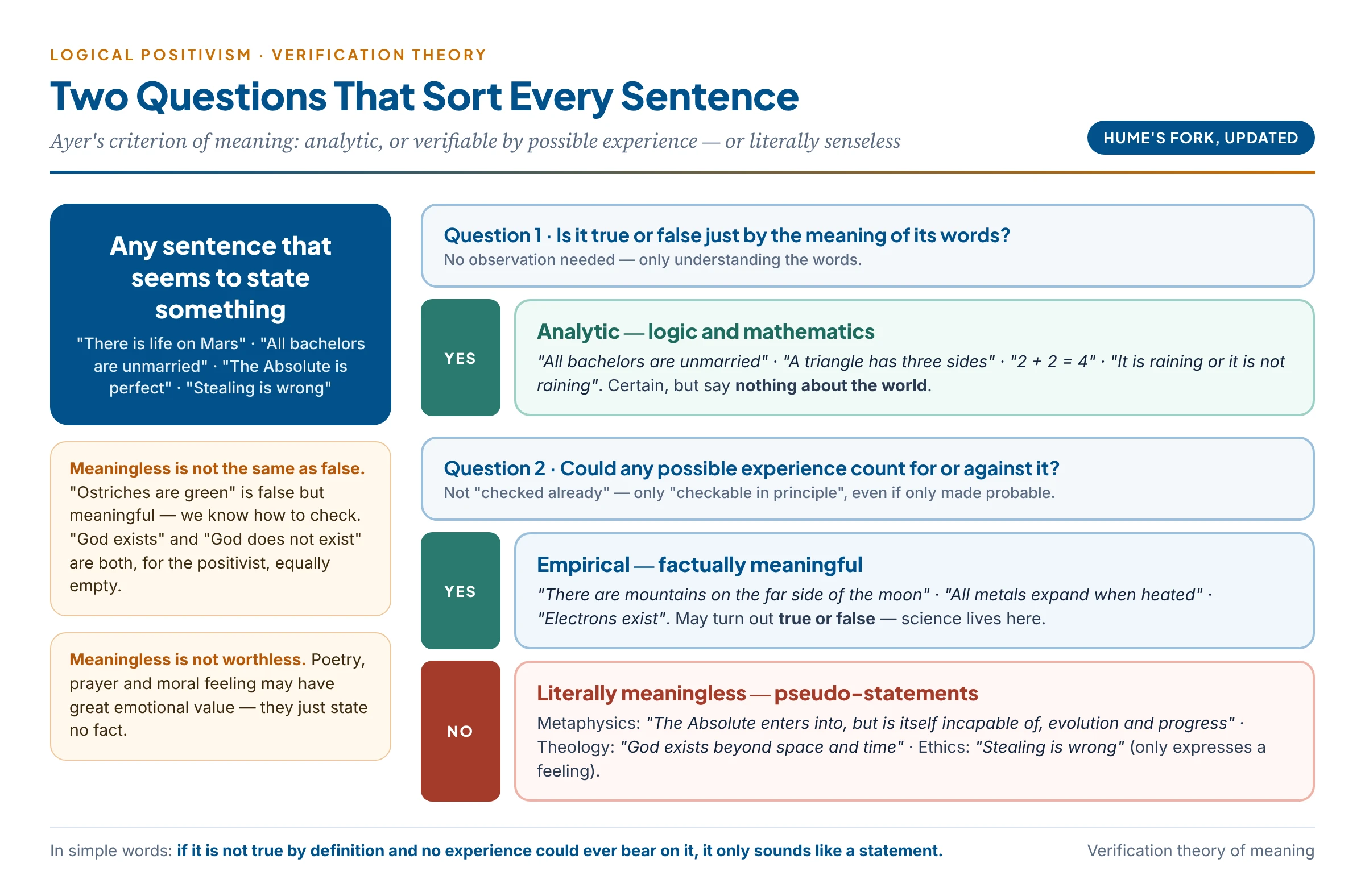
1. Only Two Kinds of Meaningful Statement
The verification theory rests on a sharp division between two kinds of statement.
- Analytic statements — true or false by the meaning of the words alone. “All husbands are married“, “All bachelors are unmarried“, “A triangle has three sides“, “A red rose is red“. To check them you need only understand the words; no survey of husbands is needed.
- Synthetic statements — their truth depends on how the world is. “All husbands have heads“, “This desk is brown“, “The rose is red“, “The wall is white“. To check them you must look.
In simple words
“All husbands are married” and “All husbands have heads” are both true. But you can imagine a husband born without a head (fed through tubes, still married) — strange, but not a contradiction. You cannot imagine an unmarried husband: the word “husband” already means “married man”. The first truth is checked by meaning; the second by looking at the world.
- Trivial vs informative. Analytic statements are “trivial“: they make no claim about the world. From “All giants are giants” you cannot infer that any giant exists. Synthetic statements are “informative“: if “This desk is brown” is true, the world contains at least one desk.
- Only two boxes. Every meaningful statement is either analytic or synthetic, never both. All analytic statements are a priori (known without experience) and all synthetic statements are a posteriori (known through experience). There is no synthetic a priori — Kant’s third box is abolished. (Article 3 of this unit explains how logic and maths fit into the analytic box.)
- The test is for synthetic statements. Telling whether a statement is analytic is easy with modern logic. The real question is: when is a statement that claims to be about the world genuinely meaningful? Is “God exists in a heavenly place” a claim about the world? The verification principle was designed to answer exactly this.
2. Two Kinds of “Meaning”: Cognitive and Emotive
- Cognitive (literal, factual) meaning. A sentence has cognitive meaning if it states something that can be true or false. Only such sentences give information — they are the business of science and philosophy.
- Emotive (non-cognitive) meaning. Exclamations (“Ouch!“), commands (“Shut the door“), poetry, prayers and value judgements (“Murder is wrong“) may express feelings, arouse attitudes or direct action, but they state no fact.
- Not a sneer. Calling a sentence “meaningless” means only that it has no cognitive meaning. It may still have great emotive, poetic or practical value. A poem is not a failure because it cannot be verified; it was never trying to state facts.
- The trouble with metaphysics is that it pretends to give cognitive information (“The soul is immortal”, “Reality is spiritual”) while offering nothing that experience could check.
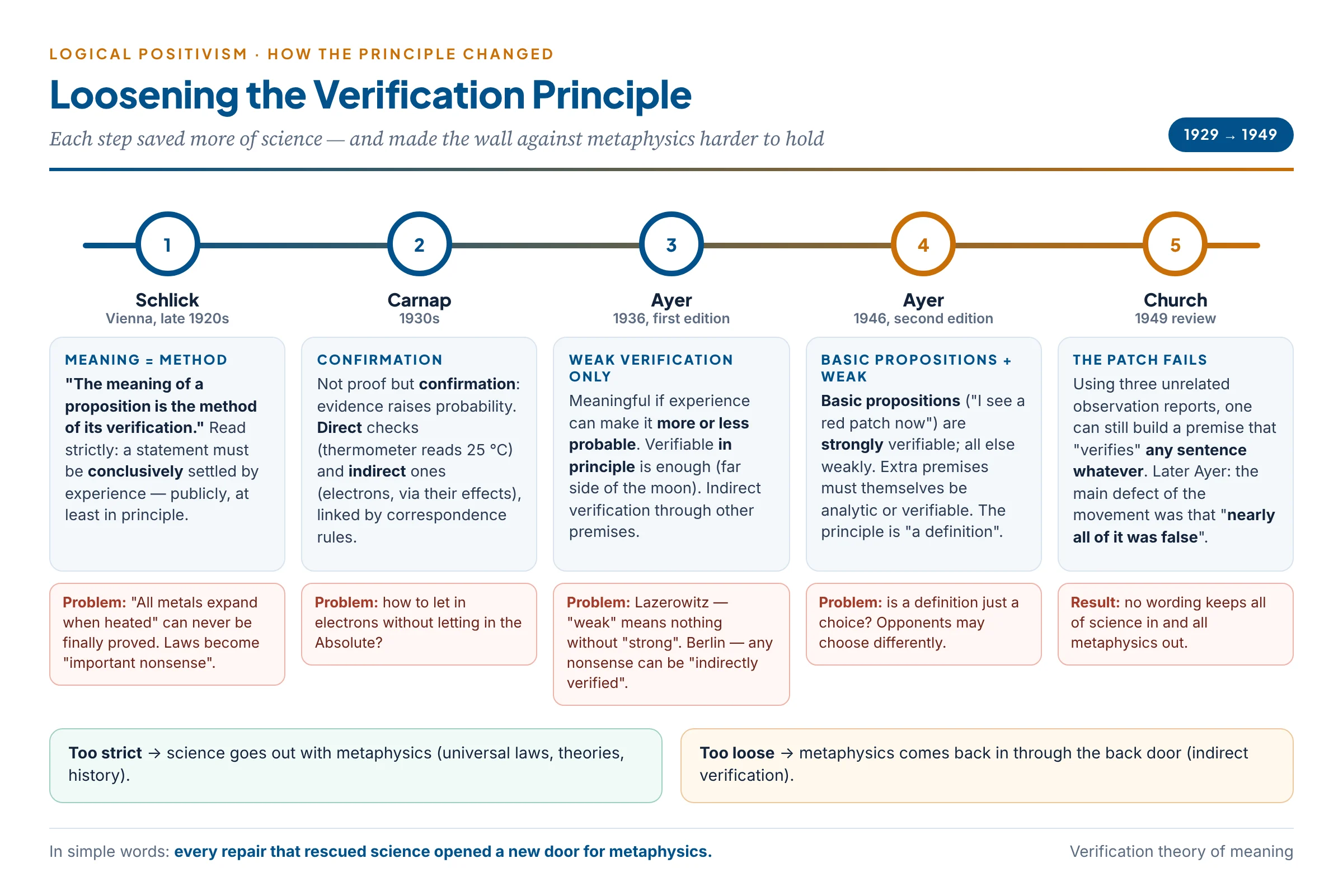
3. Moritz Schlick: “The Meaning of a Proposition Is the Method of Its Verification”
“The meaning of a proposition is the method of its verification.” — Moritz Schlick
- The founding formula. To understand a statement is to know what would count as verifying it in experience. If no experience could ever count for or against it, it asserts nothing.
- Meaning is practical, not mysterious. For Schlick, meaning is “not something hidden behind words“, nor a mysterious link between language and transcendent entities; it is a practical matter of use and testability.
- Examples.
- “This rod is one metre long” or “This table is brown” — meaningful, because we know how to check (a measuring tape, a look).
- “There is life on Mars” — meaningful even before anyone checks, because we know what evidence would settle it.
- “The Absolute is infinite” — specifies no method of checking at all, so it has no cognitive meaning.
- The shrinking universe. Schlick’s famous example: suppose someone says “The universe is shrinking uniformly” — everything, including every measuring rod and every human body, shrinks at exactly the same rate. Then no observation could ever detect the shrinking, because there is nothing outside the universe to measure it against. The sentence sounds like science, but since no possible experience distinguishes “shrinking” from “not shrinking”, it says nothing.
4. Schlick’s Refinements: Experience, Public Checking and “In Principle”
- Experience is the ultimate ground of meaning. Every meaningful factual statement must connect, directly or indirectly, with experience. This does not mean every statement describes a sensation: “Electrons exist” is meaningful because electrons explain and predict observable results — meter readings, tracks in a cloud chamber.
- Experience must be public (intersubjective). Meaning cannot rest on a private intuition or inner feeling that nobody else can check. “The thermometer reads 30 °C” is objective because anyone can look at the same thermometer. This makes science shared and cumulative — a cooperative enterprise — rather than a set of private convictions.
- Verifiability, not actual verification. A statement need not be checked here and now. It only has to be possible in principle to say what experiences would settle it. Statements about distant galaxies, unobserved particles and prehistoric events are meaningful, because we know what evidence would count.
- Meaning is prior to truth. Verification is a test of meaningfulness, not of truth. “There is life on Mars” may be false, yet it is perfectly meaningful. “Ostriches are green” is false — but we know at once how to check it, so it is meaningful. A metaphysical statement such as “The world is grounded in pure Being” is neither true nor false, because it lacks meaning altogether. Only what is meaningful can be true or false.
- Scientific objectivity. For Schlick, objectivity comes from common methods and shared observation, not from metaphysical insight or “inner certainty”.
In simple words
A referee in cricket can only give a decision if there is some way to check — a replay, a ball-tracker, an umpire’s view. If a player appeals, “The ball was out in some invisible way that no camera or eye could ever detect“, the referee cannot even begin. The appeal is not wrong; it is not a real appeal at all. The verification principle works like that referee: it does not decide true or false — it decides whether there is anything to decide.
5. One Statement, Many Methods? An Early Objection
- The objection. If meaning is the method of verification, then a statement that can be checked in two different ways would have two different meanings. “It is raining” can be checked by looking out of the window, by feeling the drops, or by a rain gauge. Does it then have three meanings? That would make language ambiguous and useless for science.
- The positivist reply. Later positivists softened the formula: meaning is given not by one particular procedure but by the whole set of possible observations relevant to a statement’s truth. The slogan became “meaning is verifiability“, not “meaning is one method”.
6. The Crack in Strict Verification: Universal Laws
- Strict (conclusive) verification. Schlick’s early view was read as demanding that a meaningful statement be conclusively settled by a finite set of observations.
- The problem. Science is made of universal laws: “All metals expand when heated“, “Water freezes at 0 °C“, “Water is H2O“, “All ravens are black“. Each covers an unlimited number of cases — past, present and future. No finite set of observations can conclusively prove an unlimited generalisation. Strict verification would turn the whole of natural science into nonsense along with metaphysics.
- Theoretical entities. Electrons, magnetic fields and genes cannot be observed directly. If meaning required direct observation, much of physics would be meaningless.
- Schlick’s bold answer. Schlick bit the bullet. Following a hint from Wittgenstein and Frank Ramsey, he said that laws of nature are not genuine statements at all but rules or instructions for forming statements — “inference tickets” that let us move from one observation to a prediction. Critics mocked this as calling science “important nonsense“.
- Why this mattered. The tension showed that strict verificationism could not stay. Later positivists kept Schlick’s insight — meaning is tied to possible experience — but loosened it to fit real science.
7. Rudolf Carnap: Confirmation, Not Proof
- Reformer, not rebel. Rudolf Carnap supplied the movement’s logical precision. He accepted Schlick’s insight but saw that strict verification excluded large parts of science.
- Three kinds of hard case he had to save:
- Universal laws — “All metals expand when heated” cannot be tested in every instance.
- Theoretical entities — electrons are inferred from effects, never seen.
- Historical claims — “Dinosaurs existed millions of years ago” cannot be directly observed today, though fossils support it.
- Direct and indirect verification.
- Direct — simple observation statements checked immediately: “The thermometer reads 25 °C.“
- Indirect — theoretical statements confirmed through their observable consequences: “Electrons exist” is confirmed by experimental results in physics.
- Effect to cause. If we can directly verify the effect, we can indirectly verify the cause: from a patient’s malaria we can indirectly verify the Anopheles mosquito; from a glowing bulb we can indirectly verify the electric current.
- Correspondence rules. Theoretical terms (“electron”, “field”) are meaningful because correspondence rules connect them to observation terms — like a bridge between the language of theory and the language of the laboratory.
- From verification to confirmation. Carnap replaced the demand for conclusive proof with confirmation — evidence that raises the probability of a statement. Repeated experiments make “All metals expand when heated” more and more rationally acceptable, though never certain. He later worked on degrees of confirmation using probability.
- Testability. In Testability and Meaning (1936–37) he said a statement is meaningful if it is testable or confirmable — connected by “reduction sentences” to things we could observe.
- Result. Meaning depends not on final proof but on a statement’s place in a network of scientific testing. This shift marks the move from rigid logical positivism to the more flexible logical empiricism.
8. Carnap’s Four Questions for Any Basic Sentence
To decide whether a word or sentence has meaning, Carnap asked of every elementary sentence in which it occurs:
- From which sentences can it be derived, and which sentences can be derived from it?
- Under what conditions is it true, and under what conditions false?
- How can it be verified?
- What is its meaning?
- For Carnap these four questions come to the same thing: knowing a sentence’s meaning is knowing its logical connections and its truth-conditions in experience.
- Applied to metaphysics. Metaphysical sentences cannot answer any of the four. (Article 2 of this unit shows how Carnap used this to unmask “pseudo-statements“.)
9. A. J. Ayer: The Criterion of Factual Significance
- The systematiser. A. J. Ayer did not invent new doctrines; he sharpened, simplified and applied them with great force. Language, Truth and Logic became the manifesto of logical positivism in Britain.
- His formulation. A sentence is factually significant to a person if, and only if, he knows what observations would lead him, under certain conditions, to accept the proposition as true or reject it as false.
- The full criterion. A statement is literally meaningful if and only if it is either analytic or empirically verifiable. If it is neither, it is literally senseless — however grand it sounds.
“A proposition is meaningful only if it is possible in principle or in practice to have sense perception which can directly or indirectly show that it is true or false or at least more or less probable.” — the verification principle as usually summarised from Ayer
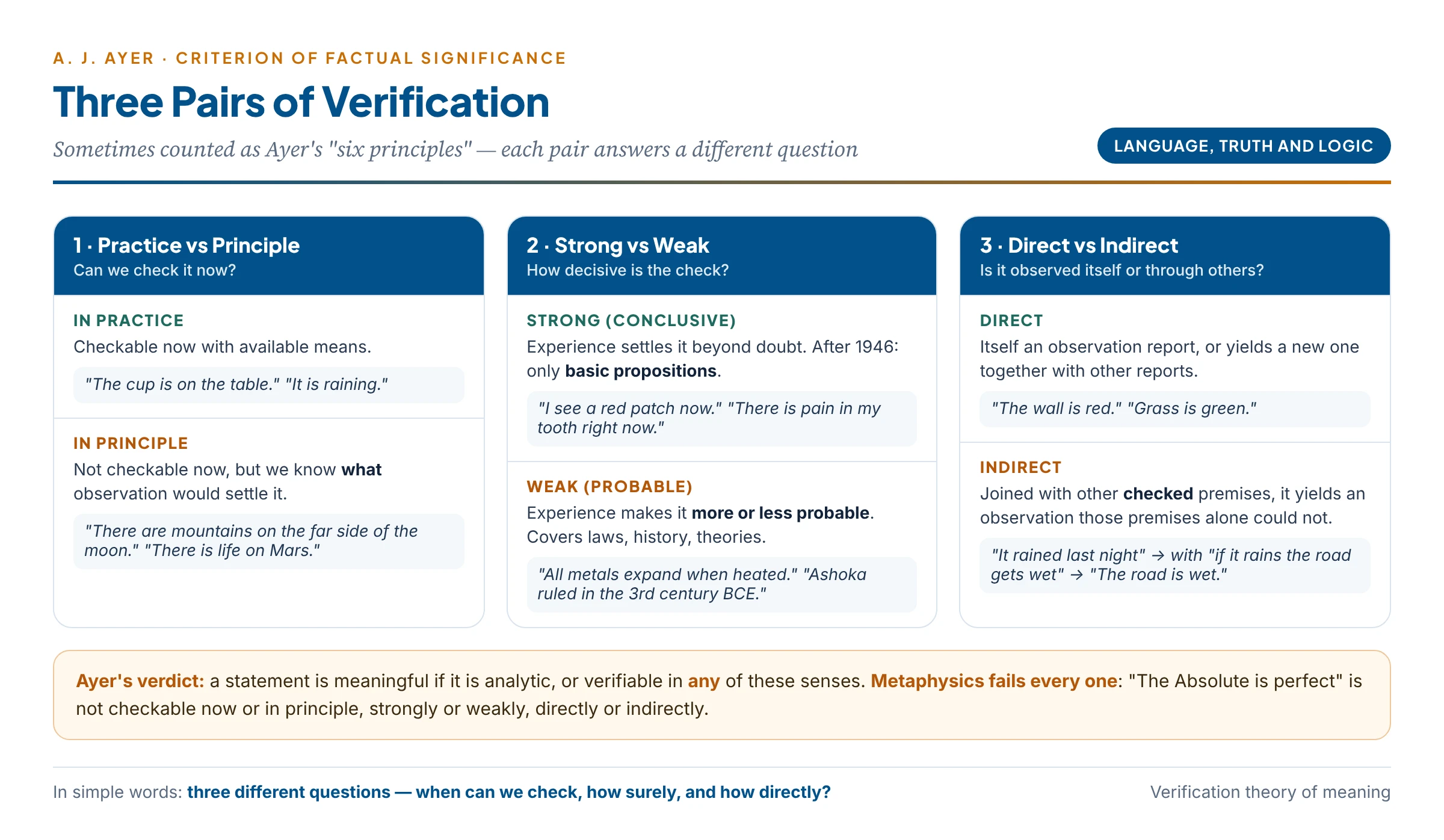
- Three pairs of distinctions. Packed into this summary are three pairs — sometimes counted as Ayer’s “six principles of verification“:
- Practical verification vs verification in principle (theoretical).
- Strong (conclusive) vs weak (probable) verification.
- Direct vs indirect verification.
10. First Pair: Verifiable in Practice vs Verifiable in Principle
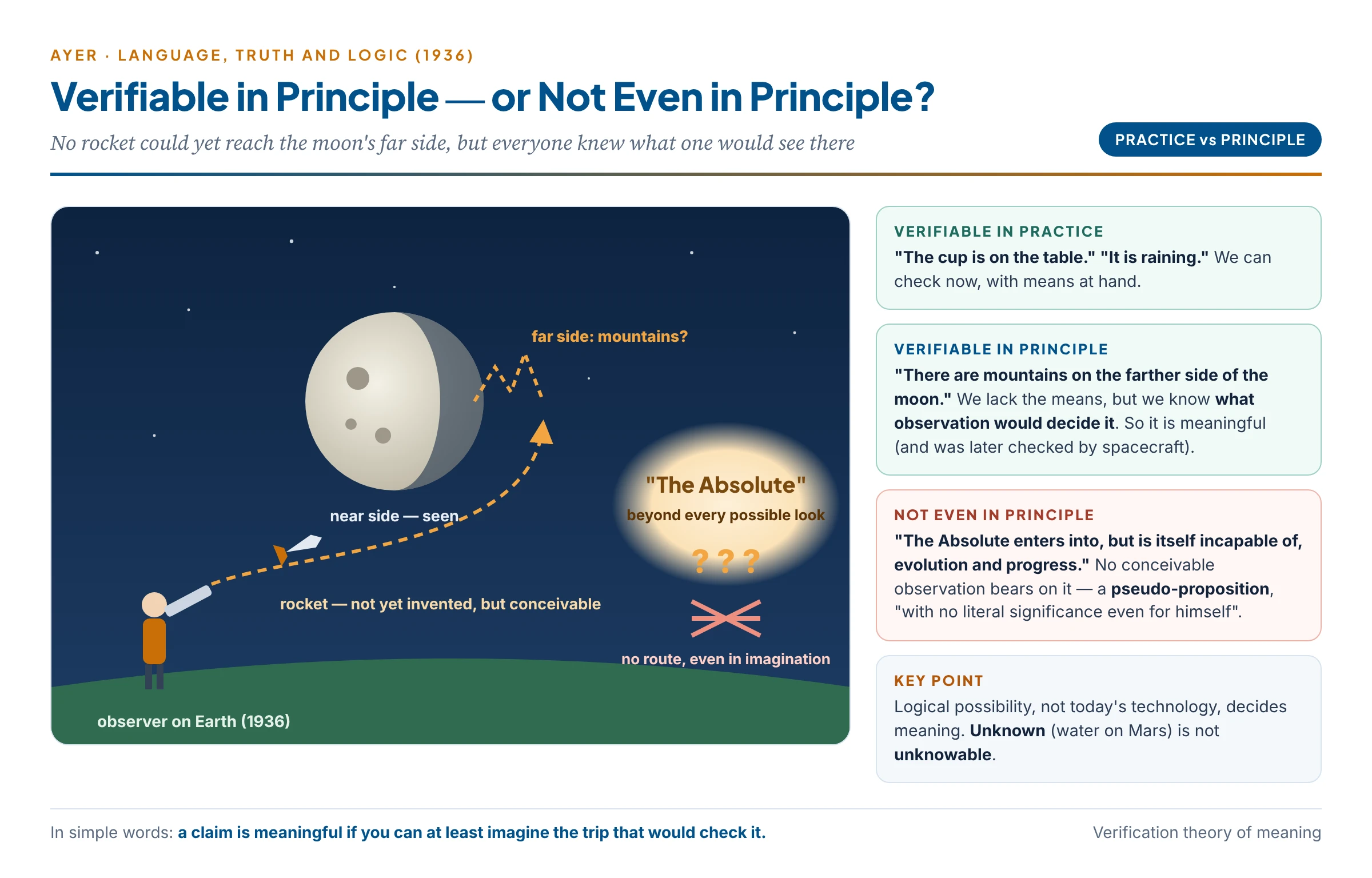
- Practical (actual) verifiability. Statements we can check now with means at hand: “The cup is on the table“, “It is raining“, “The water is hot“.
- Verifiability in principle (theoretical). Statements we cannot check now because we lack the practical means, but for which we know exactly what observations would settle them. Ayer’s classic example, written long before space travel: “There are mountains on the farther side of the moon.” No rocket then existed to go and look — but everyone knew what one would see if one went.
- Other examples. “There is life on Mars“, “There is water on Mars“, “There is extraterrestrial life” — meaningful because we can describe the steps: travel there and look.
- Not even in principle. Ayer’s contrast is a sentence taken from the idealist F. H. Bradley: “The Absolute enters into, but is itself incapable of, evolution and progress.” One cannot conceive of any observation that would show whether the Absolute did or did not enter into evolution. So it is a pseudo-proposition: it has “no literal significance even for himself” — that is, even for the person who says it.
- “God exists in a heavenly place.” What observation would show this true or false? To reply “we shall find out when we die” only confirms that no observation, in the ordinary sense, is relevant now. So the sentence expresses no proposition.
- Ayer’s three groups. Statements fall into three groups: (1) those verifiable now; (2) those not yet verifiable but verifiable with suitable apparatus; (3) those impossible to verify in any conceivable way. Only the third group is meaningless.
- Why the distinction matters. It protects scientific hypotheses and future research: scientists work on many theories that are not verifiable today but may become verifiable as technology develops. Logical possibility, not practical convenience, decides meaning.
- Religious believers agree on one point. Believers themselves say that God is beyond all experience — not checkable in practice or in theory. That is exactly why, for the positivist, such claims fail the test.
Indian Connect — Unknown is not unknowable
- Water on Mars was once unknown — not yet checked — but never unknowable: we knew what evidence would decide it. The positivists sharply separate the not-yet-known from the in-principle-unknowable.
- Kant’s thing-in-itself (noumenon), the Upaniṣadic nirguṇa Brahman “from which words turn back, along with the mind, not reaching it” (yato vāco nivartante), and the Advaitin’s Brahman beyond the senses are unknowable by definition. The believer counts this as depth; the positivist counts it as the very mark of cognitive emptiness.
11. Second Pair: Strong (Conclusive) vs Weak (Probable) Verification
- Definitions (Ayer).
- A proposition is verifiable in the strong sense if and only if its truth could be conclusively established in experience.
- It is verifiable in the weak sense if it is possible for experience to render it probable.
- Schlick’s demand was strong. Schlick (as usually read) required that a statement’s truth or falsity be conclusively determined by sense experience.
- Why strong verification “proves too much”. Ayer argued that if conclusive verifiability were the test, the argument would prove too much:
- General laws — “All metals expand when heated“, “Arsenic is poisonous“, “All men are mortal” — can never be conclusively established by any finite series of observations. Schlick’s way out — calling them “important nonsense” — Ayer found unacceptable.
- Statements about the past — “Julius Caesar crossed the Rubicon“, “Ashoka ruled in the 3rd century BCE“, “Napoleon was defeated at Waterloo” — cannot be conclusively observed today.
- Even simple particular statements about physical objects — “This object is red” — may be overturned by later experience (the light was coloured; it was a reflection). So almost nothing is conclusively verifiable.
- Strongly verifiable cases (the ideal extreme). Ayer used strong verification mainly to show the logical extreme. The cases that come closest are reports of immediate experience:
- “This patch is red (here and now)” — seen under normal light, it is settled at once.
- “The thermometer reads 30 °C at this moment” — once seen, no further test can overturn it at that time.
- “There is a table in front of me” — seen and touched in standard conditions (an ideal case).
- “This light is on now” — visibly glowing; no inference or probability involved.
- “I am in pain“, “There is pain in my tooth right now” — reports of current experience.
- Weak verification — the working test. In the first edition (1936), Ayer rejected strong verification as a test of meaning and adopted only weak verification: a statement is meaningful if some possible sense-experience is relevant to its truth — if experience can make it more or less probable. Weak verification follows the method of induction.
- Examples of weak verification.
- “All metals expand when heated” — repeated experiments on different metals keep supporting it, raising its probability.
- “The Earth’s core is extremely hot” — nobody can look at the core; seismic data, volcanoes and geological models make it probable.
- “This medicine is effective against the disease” — supported by clinical trials, repeated patient outcomes and statistics, yet never certain in every case.
- “Electrons exist” — supported by the predictive success of physics and effects such as cloud-chamber tracks.
- “There is water on Mars” — once only probable, supported by spectral analysis, satellite images and chemical traces of past water.
- Metaphysics fails even the weak test. No experience can make “The Absolute is perfect” even slightly more or less probable. So the weakening that saves science does not save metaphysics — or so Ayer hoped.
- Ayer’s lasting point. Weak verification preserves the meaningfulness of science while admitting its fallible, probable character. This is one of Ayer’s most important contributions.
Common confusion
Is “strong verification” the same as “verifiable now”, and “weak verification” the same as “verifiable in future”? No. Some notes say strong verifiability means “practically verifiable” and weak verifiability means “possible in future, e.g. life on Mars”. That mixes up two different pairs. Practical vs in principle is about whether we can check now or only in theory. Strong vs weak is about how decisive the check would be — conclusive proof or only probability. “All metals expand when heated” can be tested in practice today, yet it is only weakly verifiable; “There are mountains on the far side of the moon” was verifiable only in principle, yet one good look would settle it conclusively.
12. Lazerowitz’s Objection and the 1946 Revision
- Morris Lazerowitz’s point. “Strong” and “weak” are correlative (paired) terms, like “tall” and “short”. If no statement can ever be strongly verified, then talk of “weakly” verified loses its contrast — what is “probable” being compared with? If we accept a weak sense, we are bound to accept that some statements are verifiable in the strong sense too. Moreover, statements like “I am in pain” plainly are conclusively verified.
- Ayer’s revision (second edition, 1946). Ayer conceded that there is a special class of propositions verifiable in the strong sense: basic propositions (also called protocol or observation reports). A basic proposition describes nothing beyond the experience of the moment; it simply records a present sense-experience: “I am now seeing a red patch“, “There is pain in my tooth right now“. Since it claims nothing further, nothing further can refute it.
- The final position. A statement is significant if it is verifiable in the strong sense (basic propositions) or in the weak sense (everything else: physical objects, scientific laws, history). The great majority of meaningful statements remain only weakly verifiable.
- Popper’s alternative for universal laws. Karl Popper proposed that universal statements be treated as scientific so long as they could be falsified — refuted by a single counter-case — and be accepted until an exception turns up. Ayer did not adopt this in the first edition; he kept weak verification. (Popper’s view is examined in Article 4.)
13. Third Pair: Direct vs Indirect Verification
- Direct verification. A statement is directly verifiable if it is itself an observation statement — “It is raining“, “The wall is red“, “Grass is green” — or if, together with other observation statements, it lets us predict a new observation that those others alone would not give us. Example: “There is a cat under the chair” together with “I look under the chair” leads to “I see a furry shape there“.
- Why indirect verification is needed. Much of science is not directly observable. Carnap stressed that science must accept indirect verification or its theories would become nonsensical.
- Indirect verification (Ayer, 1936). A statement is indirectly verifiable if, combined with other premises, it lets us derive some directly verifiable statement which could not be derived from those other premises alone. Two conditions:
- The derived statement must be directly verifiable (an observation).
- It must follow only with the help of the statement being tested — not from the other premises alone.
- Everyday examples.
- “If it has rained, the road is wet.” “It has rained.” So “The road is wet” — directly checkable by looking. Hence “It has rained” (say, during the night while we slept) is indirectly verifiable.
- “When it rains, the pot gets filled with water.” “It rained.” So “The pot is filled with water.” The statement “It rained” is linked by a meaningful premise to an observable conclusion, so it is indirectly verifiable.
- The hidden danger. As stated, this formula put no restriction on the “other premises”. Article 4 shows how Isaiah Berlin and Alonzo Church used this gap to “verify” any nonsense at all — and how Ayer’s repairs failed.
14. Ayer’s Revised Definitions (1946)
In the 1946 Introduction, Ayer stated the test more carefully:
- Directly verifiable: a statement that is either itself an observation statement, or that together with one or more observation statements entails at least one new observation statement not derivable from those others alone.
- Indirectly verifiable: a statement that, together with certain other premises, entails one or more directly verifiable statements not derivable from those premises alone — provided the other premises are themselves analytic, directly verifiable, or independently shown to be indirectly verifiable.
- Purpose of the proviso. It stops someone from smuggling nonsense in through a made-up premise. (“If the Absolute is lazy, this paper is white” is not analytic, not directly verifiable, and not independently verifiable — so it cannot be used.)
- Final summary of Ayer’s position. A statement is literally meaningful if it is analytic, or verifiable — strongly or weakly, directly or indirectly, in practice or in principle. Everything else is literal nonsense.
- Status of the principle itself. In 1946 Ayer said he wished the principle to be taken not as an empirical hypothesis but as a definition — a proposal about how to use the word “meaningful” for factual statements. (Whether this saves it is discussed in Article 4.)
In simple words
Think of a detective. Some facts she sees directly (the broken window). Others she proves indirectly (the thief came at night), by combining them with reliable background rules (“thieves who break glass leave glass on the floor”). But a clever lawyer could invent a silly rule — “If the moon is jealous, the window is broken” — and “prove” that the moon is jealous. Ayer’s 1946 proviso is the judge saying: only rules that are themselves checked may be used as evidence.
15. How the Positivists Explain General Statements
UPSC has asked how the positivists give meaning to general statements (“All metals expand when heated”, “All men are mortal”) and whether the same account works for metaphysical general statements. The answers within the school differ.
- Schlick — rules, not statements. Universal laws are not genuine propositions but rules for deriving singular, checkable predictions. “All metals expand when heated” is an instruction: “If you heat this piece of iron, expect it to expand.” Its meaning lies in the particular predictions it licenses.
- Ayer — weak verification. A general statement is meaningful because observations can make it probable. Each heated metal that expands is a confirming instance; the statement is never conclusively proved, but its probability rises.
- Carnap — degree of confirmation. The law is meaningful because it belongs to a testable system; we can calculate how far the evidence confirms it.
- Popper’s contrast — falsifiability. A universal statement can never be verified, but one counter-example can refute it: a single metal that shrinks on heating would falsify the law. Its meaning as science lies in what it forbids.
- Can the same account apply to metaphysical general statements? No — and this is the positivist’s point.
- “All is Brahman“, “Everything is a mode of one Substance“, “All reality is spiritual” have no observable instances that could confirm them, no predictions that follow from them, and nothing they forbid: whatever happens is “consistent” with them.
- “All metals expand” makes a difference in experience — heat the metal and watch. “All is spiritual” makes no difference anywhere: a spiritual world and a material world would look exactly alike.
- So scientific generality is open-ended but checkable; metaphysical generality is unlimited and uncheckable.
- A critic’s reply. Critics answer that some metaphysical generalisations (e.g. “Every event has a cause“) play a guiding role in science even though no single observation verifies them — a point Popper and Kant both made in different ways.
16. Can the Theory Account for All Scientific Sentences?
The theory’s critics — and some of its own members — doubted whether it could protect every part of science.
- Universal laws. Not conclusively verifiable — rescued only by weak verification or confirmation.
- Existential statements. “There is a unicorn somewhere” or “There exists a particle with this mass” can be verified (find one) but never falsified (you cannot search everywhere). Statements mixing “all” and “some” — “For every substance there is a solvent” — can be neither conclusively verified nor falsified.
- Theoretical terms. “Electron”, “gene”, “field” — rescued by indirect verification and correspondence rules, but no one could give a clean rule that let these in while keeping metaphysics out.
- Statements about the past and remote future. “If a big hydrogen bomb explodes, humanity will be wiped out” — Russell’s example of a meaningful scientific statement that nobody could verify, because no one would be left to observe the result.
- Counterfactuals. “This sugar would have dissolved if it had been put in water” — about what did not happen, so not directly observable.
- Verdict. Each patch for science tended to let metaphysics back in; each tightening to exclude metaphysics excluded parts of science. Article 4 traces how this dilemma ended the programme.
17. Philosophy’s Proper Function after Verification
- Analysis, not explanation. For Ayer, philosophy produces no theories about reality. Its proper function is analysis: clarifying meanings, exposing confusions and removing pseudo-problems.
- An auxiliary to science. Science investigates facts; philosophy examines language — especially the language of science. Philosophy becomes an auxiliary discipline that keeps science conceptually clear.
- Questions dissolve. Once the verification principle is applied, many traditional questions — “Is reality one or many?“, “Is the world matter or spirit?” — are not answered but dissolved: they were never genuine questions.
- Schlick’s “turning point”. In “The Turning Point in Philosophy” (1930) Schlick wrote that science is the pursuit of truth, philosophy the pursuit of meaning — philosophy makes statements clear, science makes them true or false.
Critical Evaluation
Objections (Pūrva-pakṣa)
- Self-refutation. The principle itself — “Only analytic or empirically verifiable statements are meaningful” — is neither analytic nor empirically verifiable. By its own test it is meaningless. (This is the most famous objection; see Article 4.)
- Science suffers. Universal laws, theoretical entities, historical and counterfactual statements cannot be conclusively verified. Strong verification destroys science; weak verification is hard to define without letting metaphysics in.
- The indirect-verification loophole. Isaiah Berlin and Alonzo Church showed that the definitions of indirect verification could be used to “verify” any sentence whatever, including nonsense.
- What is verified — sentence or proposition? A proposition is, by definition, something that can be true or false, so it is always meaningful; only a sentence can be meaningful or meaningless. The positivists talk as if they test propositions for meaningfulness, which is confused.
- Too narrow a notion of experience. If “experience” means only sense experience, the theory ignores moral, aesthetic, religious and intuitive experience — which many people take to be genuine sources of insight.
- Language does more than describe. Later Wittgenstein: language has many functions — asking, promising, praying, joking, commanding. To make factual description the only model of meaning is a prejudice. Meaning lies in use.
- Solipsism. If basic propositions report my present experience, verification seems to rest on what is private to each knower — threatening to lock each person in his own experience (solipsism), the very opposite of Schlick’s demand for public checking.
Replies and Strengths
- A rule, not a report. Ayer replied that the principle is a definition or methodological proposal about how to use “factually meaningful” — so it need not pass its own test. It earns its keep by its usefulness in sorting claims.
- Clarity as a lasting virtue. Even critics accept the core lesson: a claim that makes no difference to any possible experience deserves suspicion. Scientists still ask “What would count as evidence?“
- Separating meaning from truth. The theory rightly insisted that we must know what a claim means before arguing whether it is true; many philosophical quarrels dissolve under this question.
- Public checking. Schlick’s stress on intersubjective testing is the backbone of modern scientific method — peer review, replication and shared measurement.
- A flexible research programme. Its own members revised it openly (Schlick → Carnap → Ayer). The move from verification to confirmation became the foundation of philosophy of science.
Critics and Defenders
Criticism — Critics
- Self-refuting: the principle fails its own test.
- Lazerowitz: “strong” and “weak” are paired terms; rejecting strong verification empties weak verification.
- Berlin and Church: indirect verification lets any nonsense in.
- Russell: meaningful scientific statements (the hydrogen bomb example) cannot be verified.
- Popper: universal laws cannot be verified, only falsified.
- Later Wittgenstein: meaning is use, not verification.
Defence — Defenders and strengths
- Ayer: the principle is a definition, not a factual claim.
- Ayer 1946: admitted basic propositions as strongly verifiable; weak verification for the rest.
- Carnap: confirmation and correspondence rules save laws and theoretical terms.
- Schlick: public, intersubjective checking secures objectivity.
- Lasting method: “What would count as evidence?” remains the first question of science and of clear thinking.
Cross-Tradition Comparison
Verification in Indian Epistemology
Indian theories of knowledge (pramāṇa-śāstra) debated a question close to the positivist one: how do we know that a cognition is valid?
| Question | Logical positivism | Nyāya | Mīmāṃsā | Cārvāka |
|---|---|---|---|---|
| Test of a claim | Possible sense-experience (verification) | Later verification by successful action | Valid by itself unless contradicted | Perception alone |
| Name of view | Verification theory of meaning | Parataḥ prāmāṇya (validity from outside) | Svataḥ prāmāṇya (self-validity) | Pratyakṣam evaikam pramāṇam |
| Example | “There is water on Mars” — check by probes | “This is water” — confirmed when it quenches thirst (saṃvādī pravṛtti) | “This is water” — accepted at once unless later sublated (bādha) | Only what is seen is real |
| Inference & logic | Logic analytic; induction gives probability | Inference (anumāna) a valid source | Inference and śabda (Veda) valid | Rejects inference beyond perception |
| Verdict on God / soul / afterlife | Meaningless (unverifiable) | God and self proved by inference | Self proved; Veda authorless | Non-existent |
Indian Connect — Key takeaways
- Nyāya’s parataḥ prāmāṇya is the closest Indian parallel to verification: the truth of “this is water” is confirmed from outside — when drinking it actually quenches thirst. Like Schlick, Nyāya ties validity to a public, practical test.
- But Nyāya is a theory of truth, not of meaning: an unverified cognition is still meaningful. And Nyāya uses inference to prove God and the self — exactly what positivism forbids.
- Cārvāka is often called India’s positivism (UPSC 2024 asked this): both trust perception and reject God, soul, heaven and rebirth. But Cārvāka rejects inference itself, while positivists accept logic and probable induction (Article 4 compares them fully).
Verification Compared with Other Western Theories of Meaning
| Point | Logical positivism | Early Wittgenstein | Later Wittgenstein | Popper |
|---|---|---|---|---|
| What gives meaning | Method of verification | Picturing a possible fact | Use in a language-game | (Not a theory of meaning) |
| Test for science | Verifiability (later: confirmation) | Picture of facts | — | Falsifiability (demarcation) |
| Metaphysics | Literal nonsense | Nonsense, but points to the mystical | Grammar gone astray | Not science, but meaningful and often fruitful |
| Ethics | Emotivism: expresses feelings | Cannot be said; shows itself | A form of life | Field of rational criticism |
| Logic & mathematics | Tautologies; true by convention | Tautologies that show the world’s form | Rules of a technique | Deductive systems |
Synthesis (Siddhānta)
- What the theory achieved. The verification theory forced philosophy to ask of every claim: “What would it be like for this to be true — and how could anyone tell?” It separated meaning from truth, gave science a clear model of evidence, and made public testability a philosophical virtue.
- How it changed. Its history is a story of honest retreat: from Schlick’s conclusive verification, to Carnap’s confirmation, to Ayer’s weak and indirect verification and his 1946 basic propositions. Each step saved more of science — and made the line against metaphysics harder to draw.
- Where it failed. No formulation could include all of science while excluding all of metaphysics, and the principle could not justify itself. These failures (Article 4) ended logical positivism as a school by the 1950s.
- What survives. The spirit survives in philosophy of science (theories of confirmation and testing), in the scientist’s demand for evidence, and in everyday clear thinking: a political promise, an advertisement or a horoscope that no possible event could disprove tells us nothing.
- Indian perspective. Indian epistemology shared the demand for valid means of knowledge (pramāṇa) and, in Nyāya, for practical confirmation — but never reduced meaning to sense-verification. Most Indian schools would say the positivist has mistaken one pramāṇa for the whole of knowledge.
“The meaning of a proposition is the method of its verification.” — Moritz Schlick
Previous Year Questions
- 2025Present an exposition of the verification theory of meaning as propounded by the logical positivists. In this context also differentiate between the “strong” and the “weak” sense of the word “verifiable”.
- 2019How do the logical positivists account for the meaning of general statements? Can the same account be applied to metaphysical statements? Discuss.
- 2018How do the logical positivists show that metaphysical sentences are meaningless? Can their verification theory of meaning account for the meaningfulness of all scientific sentences? Discuss.
- 2016Explain verification theory. Does it lead to elimination of metaphysics?
- 2014Are empirical statements conclusively verifiable? Discuss the limitations of ‘verification theory of meaning’.
- 2011Discuss the limitations of verification theory.
- 2000Explain the verification theory and show whether it leads to the elimination of metaphysics.