

Hegel: Dialectical Method; Absolute Idealism.
Official Syllabus: Paper I, Section A, Unit 5
Absolute Idealism is the central doctrine of Hegel’s philosophy. It holds that ultimate reality is one, rational and spiritual — not a heap of material things and not a hidden “thing in itself”, but a living, self-developing whole that Hegel calls the Absolute, the Idea or Spirit (Geist). Thought and being are not two separate worlds: the structure of reason is the structure of reality, so that “what is rational is real, and what is real is rational“. Hegel reached this position by removing the last wall in Kant’s system — the unknowable noumenon — and by showing, through the dialectic, how the Absolute goes out of itself into Nature and returns to itself as Spirit, finally knowing itself in art, religion and philosophy. Absolute Idealism answers the question Kant left open: can reason know reality as it truly is? Hegel’s answer is an emphatic yes.
In simple words
Think of a great novel. Every character, scene and dialogue is real within the story, yet each gets its meaning only from the plot as a whole. The plot is not a separate thing sitting outside the pages; it lives in the characters and events and is gradually revealed as you read. Hegel says the universe is like this. The Absolute is the “plot” of reality — rational, all-including, and present in every part. The difference is that in Hegel’s universe the story is also reading itself: in human minds, the Absolute comes to understand its own plot.
Context & Problem
What “Absolute Idealism” Means
- Idealism. Reality in its ultimate nature is spiritual and mental, not material. “Idea is everything and everything is idea.” All that exists is a manifestation of reason.
- “Spiritual” does not mean supernatural. By “spirit”, Hegel means self-conscious, thinking reality — reality that can know and determine itself — not ghosts, angels or a God beyond the clouds.
- Absolute. Reality is one, all-inclusive and unconditioned: there is nothing outside it to limit it. If there were more than one reality, each would be limited by the rest; a limited reality cannot be eternal and self-dependent.
- Objective idealism. Unlike Berkeley’s subjective idealism, which makes things depend on individual minds, Hegel’s ideas are objective — thoughts, but “not your thoughts or my thoughts or the thoughts of any particular mind”. Hence his philosophy is also called objective idealism.
- Concrete monism. Reality is one, but not a blank unity. It is a unity in diversity — “many in one and one in many” — like a living organism. This is concrete monism, in contrast with Spinoza’s abstract monism.
- Rational idealism. The whole is a coherent system of thought, like mathematics, in which every part is logically connected with every other.
The Road from Kant: Fichte, Schelling, Hegel
- Kant’s legacy. Kant showed the primacy of mind in knowledge: “the understanding makes nature” — that is, the mind’s categories give phenomenal nature its laws. But he left the thing in itself outside the mind, unknowable.
- Fichte removed the thing in itself and made the active “I” (the self that posits itself and its “not-I”) the source of everything.
- Schelling made the Absolute the identity of subject and object, nature and spirit — but as a featureless identity reached by intellectual intuition.
- Hegel kept Schelling’s unity but insisted that the Absolute must be articulated, developing and knowable by concepts. The Absolute is not the starting point grasped in a flash; it is the result of a long dialectical development.
- Two transformations of Kant:
- “Understanding makes nature” becomes “nature is a system of thoughts“. If the mind gives nature its form and the thing in itself is empty, then nothing in nature is alien to thought.
- Kant’s transcendental unity of apperception (the “I think” that must accompany all my representations) was only a logical condition of knowledge. Hegel turns it into an ontological reality: the Absolute Mind, of which each human mind is a finite reproduction. Man’s thought of God is God’s own thought expressed through a human vehicle.
Core Doctrine
1. Hegel’s Critique of the Thing in Itself
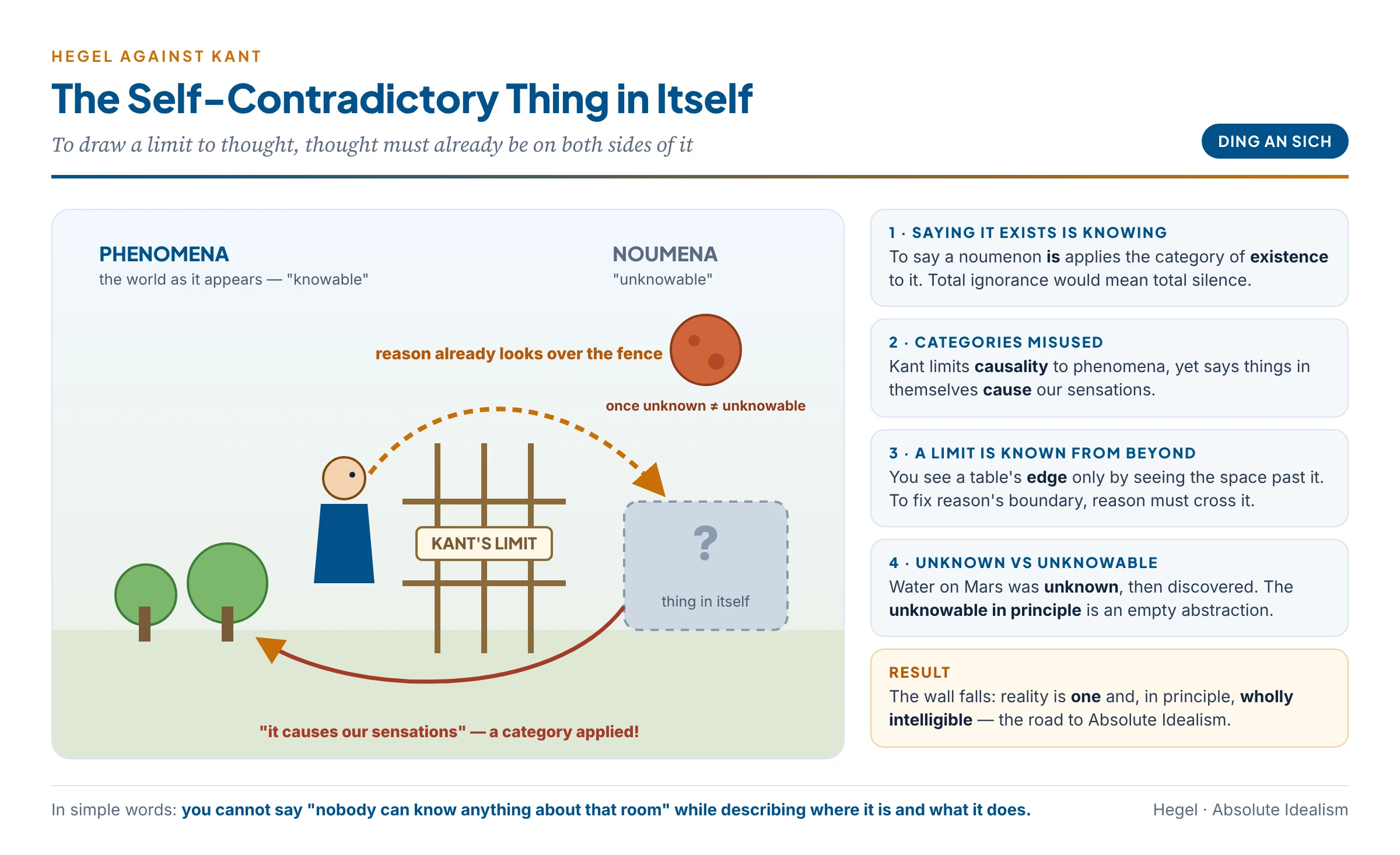
Kant said that we know that things in themselves exist (as the source of our sensations) but can never know what they are. Hegel finds this position self-contradictory.
Hegel’s objections:
- To say it exists is already to know something. If Kant says a noumenal world is, he applies the concept of existence to it — and so claims knowledge of it. Our knowledge may be scanty, but it is not zero. Total ignorance would mean total unawareness: we could not even say that the noumenon exists.
- Illegitimate use of the categories. Kant insists that causality and existence apply only to phenomena. Yet he says things in themselves affect our senses and cause our sensations — applying the category of cause to the noumenon and breaking his own rule.
- To know a limit is to be beyond it. “No one can know, or even feel, that anything is a limit or defect unless he is at the same time above and beyond it.” You cannot see the edge of a table without also seeing the empty space beyond it. To declare that knowledge stops at phenomena, reason must already have looked over the fence.
- The unknowable is an empty abstraction. A “something” stripped of all qualities, relations and knowability is pure nothing — the emptiest product of thought, not the deepest reality.
- Unknown is not unknowable. Hegel distinguishes the unknown (not known yet) from the unknowable (in principle never knowable). Water on Mars was once unknown; it could be — and was — discovered. But an absolutely unknowable reality is a meaningless notion.
- Criticism of knowledge before knowing is impossible. Kant wanted to test the instrument of knowledge before using it. Hegel replies that this is like wanting to learn to swim before going into the water: reason can examine itself only by knowing.
The result. The wall between phenomena and noumena collapses. There is no reality outside reason; reality is unified, transparent and, in principle, completely intelligible.
In simple words
Imagine someone saying: “There is a room in this house that nobody can ever know anything about — but I know it is there, I know it is behind this door, and I know it is what makes the noise we hear.” He has already told you three things about it! Hegel says Kant’s thing in itself is like that room. The moment you say it exists and causes our sensations, you have stopped treating it as unknowable.
Common confusion
Does Hegel say that Kant’s noumenon is “unknown”? No — the point is the opposite. Hegel accepts that much is still unknown and will be discovered; what he rejects is the idea of something unknowable in principle. Also note Kant’s possible reply: he distinguished thinking from knowing. The thing in itself can be thought (without contradiction) but not known (since nothing corresponding to it is given in sense). It may also have practical and moral meaning — as an object of faith. So Hegel’s critique is powerful, but Kant is not as simply self-contradictory as is often said.
2. The Identity of Thought and Being
- What it does not mean. It does not mean that everything is merely an idea in my head, or that a mountain is a fantasy.
- What it means. The structures of thought and the structures of reality ultimately correspond. Reality is not irrational or unknowable; it is shaped so that it can be grasped by reason.
- Categories belong to reality. Concepts such as cause, necessity, substance and freedom are not tools that the human mind imposes on a foreign world (as Kant held). They express how reality itself is organised. When we think rationally, we are not distorting reality — we are participating in its structure.
- Reason is at home in the world. Philosophy does not stand outside reality looking in; it is reality becoming conscious of itself.
- Hegel’s challenge to Hume. Hume held that nothing beyond sense experience can be known. Hegel insists that there are realities beyond the senses that are known by reason — 2 + 2 = 4 is true, though no one has ever seen the abstract number “two”; and without such abstract measures we could not even compare concrete quantities.
- Cause and reason. Hume showed that we cannot find a cause (a force producing an effect in time) for the world. Hegel replies that we can at least find a reason — a logical necessity, which has nothing to do with time. The reason for the world is logically prior to the world, as a mathematical problem is logically (not temporally) prior to its solution. The logical exists as truly as the physical.
3. “The Rational Is Real and the Real Is Rational”
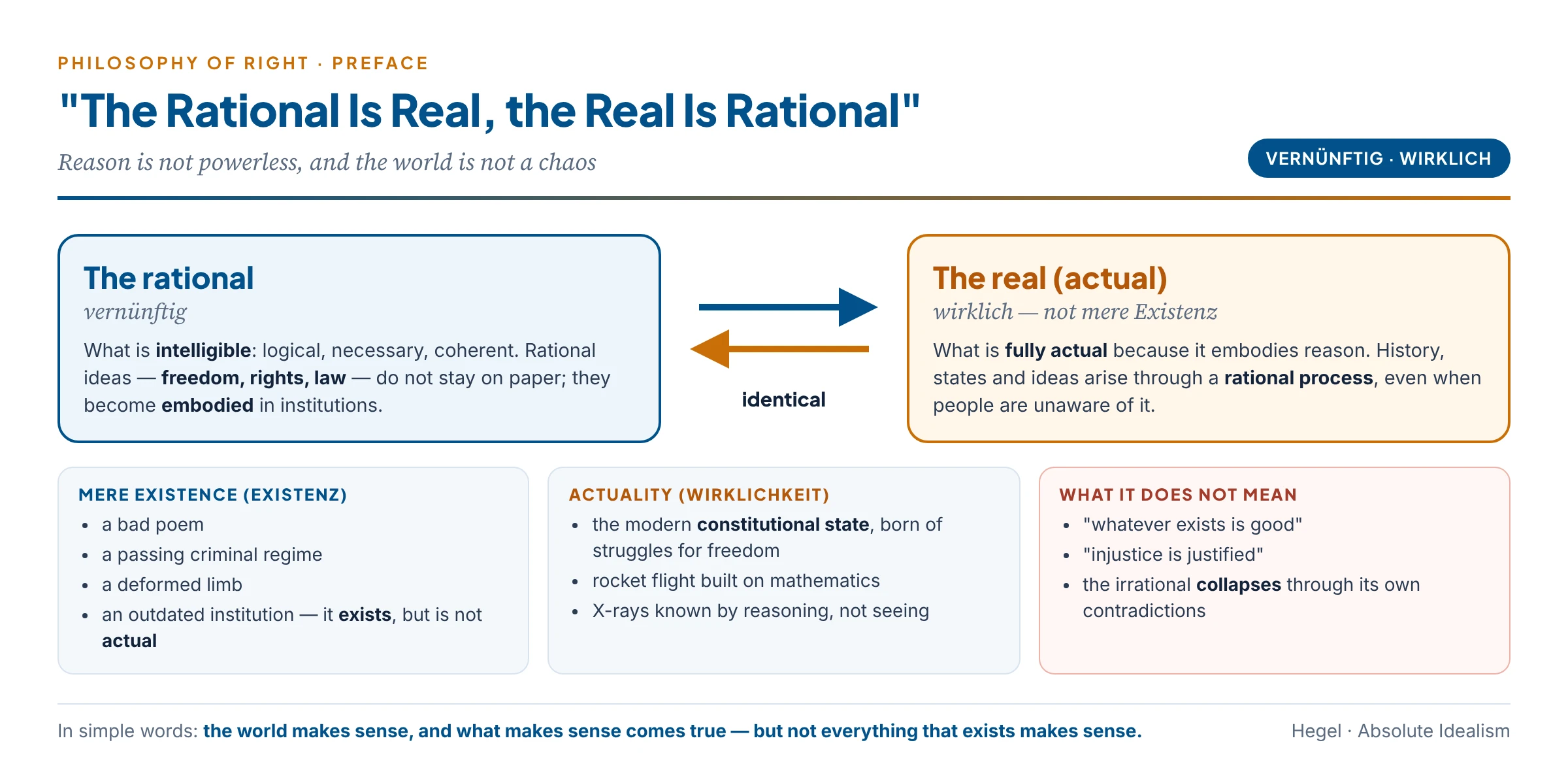
Hegel’s most famous sentence, from the preface to the Philosophy of Right (1820): Was vernünftig ist, das ist wirklich; und was wirklich ist, das ist vernünftig — “What is rational is actual, and what is actual is rational.”
- “Rational” means intelligible through reason — logical, necessary, coherent.
- “Real” (wirklich) means actual — what is fully developed and necessary — not merely whatever happens to exist (Existenz).
- Hegel distinguishes mere, accidental existence — a bad poem, a passing criminal regime, a deformed limb — from true actuality.
- Only what embodies the developing purpose of reason is fully actual.
- “The real is rational.” The world is not a chaotic heap ruled by chance. Social institutions, historical events and ideas do not arise by accident; they emerge through a rational process, even when the individuals involved are unaware of it. Modern constitutional states, for example, grew through struggles that expressed a growing awareness of freedom.
- “The rational is real.” Reason is not powerless or merely abstract. Rational ideas — freedom, rights, law — tend to become embodied in institutions and practices.
- What it does not mean. It does not say that everything that exists is good or reasonable, and it does not justify injustice: what is irrational or outdated will collapse through its own contradictions.
- Two sides of one coin. Hegel’s epistemology demonstrates “the rational is real” (reason alone gives knowledge of reality); his metaphysics demonstrates “the real is rational” (reality has a rational structure, so the logic of the dialectic applies to reality itself). The aim and business of philosophy is “to reconcile thought with reality“.
- Everyday illustrations:
- Space flight was possible only because rocket engineers grasped the mathematical and logical pattern of motion in space; reality “obeyed” their calculations because reality is rational.
- X-rays cannot be seen; they are known through reasoning — yet they are real, because reality behaves according to the laws of reason.
- “Reason rules the world.” In history this becomes Hegel’s watchword: things have happened reasonably in world history.
Common confusion
Does “the real is rational” mean Hegel justified every existing government? Many readers took it that way. Right Hegelians used the dictum to defend the Prussian state; Left Hegelians (including the young Marx) read it the other way — whatever is rational will become real, so irrational institutions are doomed. Hegel himself distinguished existence from actuality: a corrupt or outdated institution may exist, but it is not actual in his sense. The dictum is a claim about the rational structure of reality, not a blessing on the status quo.
4. The Absolute as Subject, Not Merely Substance
- Hegel’s programme. “Everything turns on grasping and expressing the True, not only as Substance, but equally as Subject.”
- Against Spinoza. Spinoza conceived ultimate reality as a single, static substance governed by necessity. Hegel admires Spinoza’s unity but finds his substance lifeless and inactive — it lacks self-awareness, development and freedom.
- What “subject” means. Subjectivity is the ability to relate to oneself, to negate, and to develop — to become other and return to oneself. The Absolute is therefore a process, not a finished thing: it becomes what it truly is through a logical and historical development.
- Why it matters. By calling the Absolute subject, Hegel brings movement, freedom and consciousness into metaphysics. Reality is not just something that exists; it is something that comes to know itself. Spirit is “both the subject and the substance of reality”.
5. Logic as Metaphysics
- Not formal logic. For Hegel, logic is not just the rules of correct reasoning. His Science of Logic studies the basic categories of reality — being, essence, cause, necessity, freedom.
- Logic = ontology. The movement of pure concepts is at the same time the movement of being. The passage from Being to Becoming is not only a change in our thinking; it reveals that reality is dynamic and processual. “Things and the thinking of them are one and the same content.”
- Metaphysics restored and transformed. Kant had ruled out metaphysics as knowledge of the supersensible. Hegel brings it back — not as speculation about hidden substances, but as the study of the self-development of rational categories.
- Not “empty ratiocination”. Logical connections must be found in the actual, not spun out in the air. Logic is the process by which, from our experience of the actual, we draw out the categories that describe the Absolute. Thought must follow the inner logic of reality itself.
- Logic is the foundation. Nature and Spirit emerge from the logical structure of the Absolute; logic is their inner core.
6. The Absolute Idea
- The summit of the Logic. The Absolute Idea is the highest category, where the opposition between concept and object, subject and substance, thought and reality is fully overcome.
- Self-moving reason. It is not a static conclusion but reason that knows itself as both form and content. It integrates all earlier, partial categories into a coherent whole. Like Aristotle’s God, it is “thought thinking itself” — the unity of the subjective and the objective Idea.
- “Idea” with a capital I. Hegel’s Idea is not the subjective creation of a particular mind, nor a faded copy of a sensation. Nothing is so real as the Idea. Like Plato’s Ideas, it is discovered, not created, by the human mind.
- An expressive power. The Idea is not static and self-enclosed; it contains a force that makes its expression not only possible but necessary. Through all dialectical development — progress and even regress — it keeps its organic and purposive character.
- Truth as totality. The Absolute Idea is truth as the whole system of relations; when philosophy reaches it, reality becomes fully intelligible to itself.
- Free self-release. The Absolute Idea does not remain locked inside logic: it freely externalises itself as Nature and returns to itself as Spirit.
How the Absolute appears in Hegel’s descriptions:
- One and all-inclusive — infinite, indivisible, with no limitation, no condition and no dependency; absolute monism with no ultimate plurality.
- Unity in diversity — nothing exists when separated from the whole; all substances and objects, even the states, societies, polities and economies of this world, are manifestations of the Absolute Idea.
- Overcoming of all dualisms — the distinctions of knower, known and knowledge, soul and nature, phenomena and noumena, knowledge and existence, idea and object, all come to an end, since all are moments of one absolute reason.
- Dynamic yet perfect — all change takes place within the Absolute, while the Absolute itself is complete. It is “living and dynamic, comprehending all motion within itself, although it is without motion itself”; it “contains many histories but has no history of its own”.
- Self-luminous — it illumines every object in the universe and needs no external light, being “in the nature of light”.
- A storehouse of possibilities — the Absolute holds infinite possibilities that are progressively realised in history and the events of the world.
7. The Journey of the Absolute: Idea, Nature, Spirit
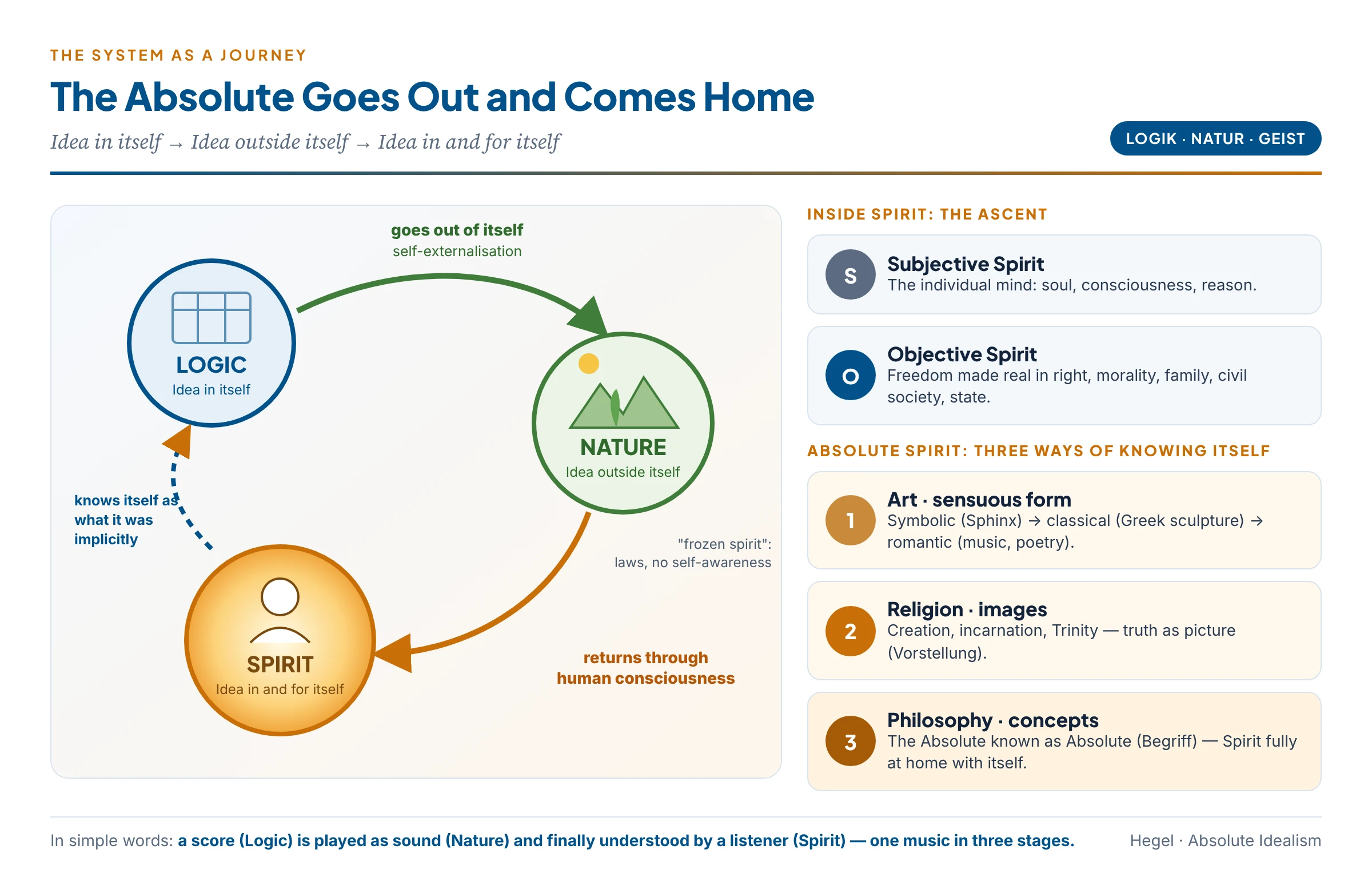
- Logic — the Idea in itself (an sich). The timeless system of pure categories: the “blueprint” of reality, first as abstract, undifferentiated idea.
- Nature — the Idea outside itself (Anderssein, otherness). The Idea externalises or “alienates” itself as space, time, matter, plants and animals. Nature is “petrified” or “frozen” spirit.
- Spirit — the Idea in and for itself (an und für sich). The Idea returns to itself through human consciousness, society and culture, and becomes self-conscious.
- Why must the Absolute go out of itself? Because consciousness needs an object. Consciousness-in-itself is abstract; it becomes concrete only in relation to objects of nature and life which at first appear as its “other”. Spirit realises itself only by meeting something opposed to it and overcoming that otherness — the “seriousness, the suffering, the patience and the labour of the negative“.
8. Nature as the Self-Externalisation of Spirit
- Not independent of Spirit. Nature is Spirit expressing itself outwardly as material reality. It appears as something other than Spirit — governed by necessity and external relations.
- Rational but unconscious. Nature follows laws derived from the Absolute Idea; physical and biological processes show order and regularity. But nature does not reflect on itself; it lacks self-consciousness.
- Science makes the implicit explicit. The laws of nature are thoughts already at work in nature. Scientists, through toil and struggle with material things, make these implicit thoughts explicit. Knowing nature, Spirit finds itself in it.
- Necessary but incomplete stage. Nature provides the material condition for Spirit to realise itself; it is not rejected but sublated within Spirit. Man is organic to nature: nature and life “conspired for billions of years” to give birth to him.
In simple words
A music score is pure, silent structure — that is like Logic. When an orchestra plays it, the music goes out into the air as sound waves — that is like Nature: the same structure, now outside itself, but the vibrating air does not know it is music. When a listener hears and understands the symphony, the music returns to a mind and becomes conscious — that is like Spirit. The score, the sound and the understanding are three stages of one work.
9. Spirit (Geist) and Its Three Stages
For Hegel, Spirit is the ultimate reality — not separate from the world, but the world understood as self-conscious and rational.
- Subjective Spirit — the individual mind: soul, consciousness, self-consciousness, reason. Spirit exists here as personal awareness.
- Objective Spirit — Spirit made objective in institutions: abstract right (property, contract, punishment), morality (conscience), and ethical life (Sittlichkeit) — family, civil society and the state. Here freedom becomes real in the world (treated fully in the article on history and the state).
- Absolute Spirit — the highest stage, where Spirit attains full self-knowledge:
- Art presents the Absolute in sensuous form — beauty in stone, colour and sound.
- Religion presents it in pictorial thought (Vorstellung) — images and stories such as creation, incarnation and salvation.
- Philosophy presents it in pure concepts (Begriff) — the Absolute known as Absolute.
The stages of art:
- Symbolic art — the sensuous matter overwhelms the idea; the meaning is vague and mysterious. Architecture is its typical form; the Egyptian Sphinx is its symbol.
- Classical art — perfect harmony of matter and spirit; Greek sculpture, where the human body embodies form completely.
- Romantic art — spirit overflows the sensuous; painting, music and poetry. Poetry, using words, finds even imagery inadequate and points beyond art to religion.
The stages of religion:
- Nature-religion — the divine is conceived as less than spirit: magic, the “religion of substance” (Hegel’s label for Hinduism and Buddhism) and Zoroastrianism (God as light).
- Religion of spiritual individuality — worship of a personal God (Judaism, Greek and Roman religion).
- Absolute or consummate religion — Christianity, where the Absolute appears as God-man (incarnation) and as the Trinity, which Hegel read as a picture of the dialectic.
Philosophy is the culmination. Only thought is an adequate witness of Spirit. The history of philosophy is the gradual unfolding of one truth from Thales to Hegel — the earliest systems the poorest and most abstract, the latest “the most concrete and the deepest”, containing all earlier ones. Man’s knowledge of God is God’s knowledge of himself in man.
10. Freedom as the Essence of the Absolute
- Freedom is not doing as one likes. True freedom is self-determination through reason: a free will acts on rational principles that it recognises as its own.
- The Absolute is free because it determines itself completely; nothing outside limits it.
- Freedom and necessity united. Freedom is not opposed to necessity; it emerges through rational necessity, as when we understand and accept the laws that govern us. (The social and historical side of freedom — laws, institutions and the state — is treated in the article on history and the state.)
11. The Organic Theory of Truth and Reality
- The basic conception. The relation of the Absolute to its parts is like that of an organism to its organs — “the basic conception of Hegel’s philosophy”, extended to all truth and reality.
- The whole is prior to the parts. Each part gets its meaning only within the total system. Every fact depends on and in turn helps to determine every other fact. Relations are internal (they make a thing what it is) — against Locke’s doctrine of the externality of relations.
- The work of art. We cannot understand a painting by analysing the chemistry of the canvas, though it cannot exist without it, nor by studying each patch of colour separately. Its meaning belongs to the whole, which is more than the sum of its parts; the whole determines each part, and each part contributes to the whole.
- The human person. A man’s personality is shaped not only by what he is now but by the traits inherited from his parents, by relatives, teachers, playmates and associates, by the human race — and even by the planet he lives on, conditioned by other heavenly bodies. Life as a whole is conditioned by society, which is related to the entire universe. So the universe becomes conscious of itself in the individual.
- Abstract and concrete.
- Looking at a leaf under a microscope, cut off from the tree, or treating a person’s experiences as isolated instances, is abstract.
- Understanding the leaf’s function in the tree, or the person as a member of society, is concrete.
- To view anything apart from its relations is to view it abstractly; to view it in its organic relations is to view it concretely.
- The Absolute is in space and time. Hegel’s Absolute is not beyond space and time but in them, as their all-embracing thought; yet it is also timeless and complete as the whole.
- “The True is the whole.” There is no truth except the whole truth. This is a coherence theory of truth: a system in which everything is explained clearly, consistently and without ambiguity must be true.
- Two aims of the system. To show man’s unity with nature, and man’s unity with himself and with other selves. Hegel’s metaphysics seeks the unity of opposites — one and many, nature and culture, individual and society. Fragmentation and isolation are alien to its spirit.
12. The Concrete Universal
This doctrine is the key to Hegel’s idealism.
Three kinds of universal:
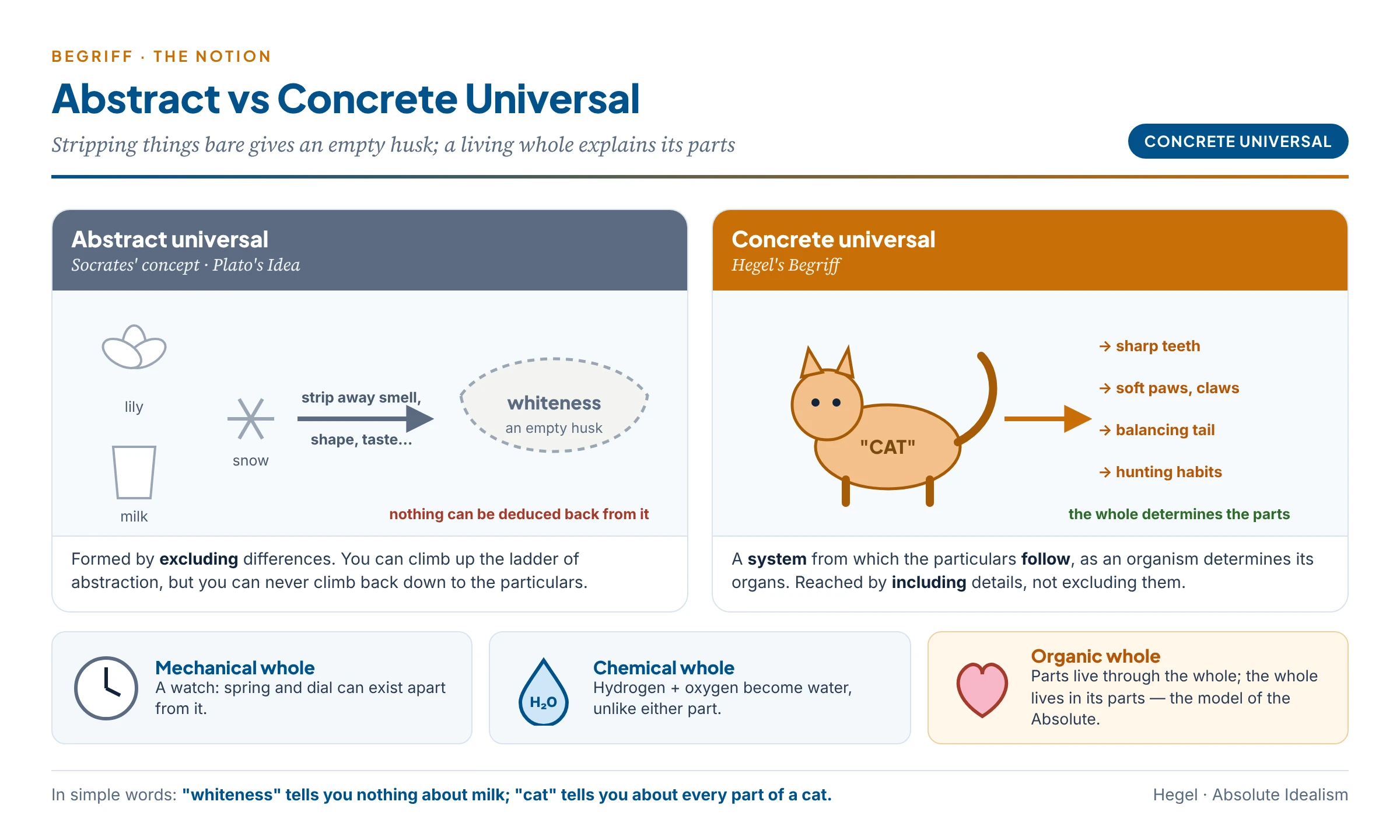
- Socrates’ concept — formed by the human mind from many perceptions: from many cows we abstract “cowness“, leaving out size and colour. It depends on the thinker’s mind.
- Plato’s Idea — the concept turned into an objective essence existing independently of human thought. But Plato’s Ideas are still abstract: “whiteness” is reached by stripping away everything else from white lilies, white roses, milk and snow — their smell, softness and leaves. What remains is an empty husk, from which no white thing can be deduced.
- Hegel’s concrete universal (Begriff, the “notion”) — not reached by stripping away differences. It is a whole or system from which the particulars follow. Say “cat” and you know at once the kind of teeth, paws and tail it must have: the idea of the organism determines its parts.
Three kinds of whole:
- Mechanical whole — a watch or a bicycle: the parts (spring, dial; spokes, rims, chain) can exist apart from the whole. A concrete idea, like a bicycle, is reached by including the parts, not excluding them.
- Chemical whole — hydrogen and oxygen combine and are transformed into water, quite unlike its parts.
- Organic whole — the parts live through the whole, and the whole is sustained by the parts, joined by an inner purpose. This is the model for the Absolute.
Consequences:
- The Absolute Idea is the system of all ideas — the indwelling spirit of the universe “from the dust up to the distant stars”, working itself out in matter, life and mind.
- An isolated individual is a myth. A person becomes human by learning a language, practising morality and carrying a cultural heritage. The family comes before the individual: “the universal is the prius of the particular”.
- Hegel’s universals are close to Kant’s a priori concepts, but valid not only for human thought — independent of any mind whatsoever.
In simple words
Ask someone to describe “a Kathakali dancer“. If you strip away the costume, the make-up, the music, the stories from the epics and the temple tradition, you are left with “a person moving” — an abstract universal that tells you nothing. The concrete universal is the living art form itself: once you understand it, the costume, gestures and music follow from it. Hegel says reality must be understood this way — through wholes that explain their parts, not through empty labels.
13. Absolute Idealism and the Reality of the Phenomenal World
Is the everyday world — tables, trees, mountains, planets — real or unreal for Hegel?
- Reality in the full sense is that which is eternal, unchangeable and a systematic whole. Anything short of this is appearance.
- Things of daily life exist. A thing exists if it can be sensed and located in space and time. We can certainly see a table and say where it is.
- But existing things are not fully real:
- They are shot through with illusion — a rope appears as a snake; a plane or a kite looks like a tiny speck in the sky.
- There are ordinary, abnormal and dream delusions — we hear voices when there are none.
- Things too far or too small are beyond the senses.
- They are impermanent — they begin and end.
- Yet they are not unreal. Actual things have “punch and sting“: fire burns and too much cold kills; we must adjust to them. They are not as unreal as a barren woman’s son, a square circle, a sky-flower or the horn of a hare. “Every puff of existence, however ephemeral, has some reality about it.”
- A thing is an aggregate of universals. A table is a congeries of solidity, heaviness, hardness, brownness, extension and so on. Analyse any object and it “is converted into ideas”. Over and above these universals there is no unknowable “matter”.
- The paradox. A universal (heaviness, hardness) cannot itself be sensed or located; so by the definition of existence it does not “exist”. Hence: “That which exists is not real, and the Real does not exist.“
- Identity-in-difference resolves it. Existence and reality are opposed (existence is passing, reality eternal) yet identical in that both have Being. Even a centaur has some being in the world of fiction. But they have being differently: reality has independent being; existence has dependent being.
- From implicit to explicit. Things follow from thoughts as a conclusion follows from premises. As Aristotle’s forms are the inner moulding principle of things, Hegel’s Ideas pass from bare possibility to actuality in the things of the world.
- The verdict. The phenomenal world is neither illusion nor ultimate reality. It is real as a moment — a necessary stage — in the self-unfolding of Spirit. Appearance is not a veil hiding reality; it is reality appearing. Matter is not denied (as in Berkeley) but sublated into Spirit.
Indian Connect
- Sad-asad-vilakṣaṇa — Advaita calls the world “neither real nor unreal“, much as Hegel treats everyday things — which is why the stock Indian examples (the rope-snake, the barren woman’s son, the hare’s horn) explain his point so well.
- The difference. For Śaṅkara, the world is mithyā — an appearance superimposed (adhyāsa) on Brahman, which vanishes in knowledge. For Hegel, the world is a necessary moment of the Absolute and is preserved in it. Advaita’s Brahman would lose nothing if the world disappeared; Hegel’s Absolute needs the world to become self-conscious.
- Rāmānuja’s Viśiṣṭādvaita is closer to Hegel: the world and souls are the body of Brahman (śarīra–śarīrī), real and inseparable from it (apṛthaksiddhi), as organs from an organism.
14. Hegel’s God
- God is the Absolute Spirit, not a transcendent creator standing outside the world. The Absolute is the world in its organic unity, not its maker.
- Pantheism or panentheism? Hegel is often called a rationalistic pantheist. But God is not simply identical with nature (as “God or Nature” in Spinoza): God is the fullest reality, achieved through self-determination, and is not reducible to the world or to nature. The world is in God, but God is more than the world — a view often called panentheism.
- God becomes self-conscious in man. “Man knows about God only in so far as God knows about himself in man.” God’s knowledge of himself and the philosopher’s knowledge of God are two aspects of one reality.
- God is a process. God is not a finished being but a dialectical process that includes the world and history.
- Religion and philosophy. Religion grasps God through images (creation, incarnation, Trinity); philosophy grasps the same content in concepts. Christianity is the “absolute religion” because its images (God becoming man, dying and rising) picture the dialectic of Spirit.
- The ontological argument. Unlike Kant, Hegel defended the ontological argument: the hundred thalers are a finite thing whose concept and existence can come apart, but God is precisely the being whose concept includes existence.
- God in history. Because God realises himself in world history, Hegel sees history as a theodicy — the justification of God’s ways. (The question whether this view lent support to colonial and imperial designs is examined in the article on history and the state.)
Critical Evaluation
Objections to Absolute Idealism
- Moore and Russell — the realist revolt. Both began as Hegelians and then rejected Absolute Idealism:
- Reality is plural, not one system; things exist independently of minds and of each other.
- Relations are external: a thing does not change its nature by being related to others. If all relations were internal, we could know nothing until we knew everything.
- Analysis does not falsify. Hegelians held that analysing an object destroys it; Russell replied that analysis is the very method of knowledge, and monism makes mathematics impossible.
- Hegel denies the objective reality of space and time; Moore’s defence of common sense insists that these beliefs cannot be given up.
- Kant’s possible reply. Hegel ignores the difference between thinking and knowing; the unknowable can be thought, and may be the object of faith.
- Unverifiable and obscure. The Absolute Idea cannot be tested by any experience; the system is over-systematic, speculative and hard to understand. Bradley, himself an idealist, mocked the system as an “unearthly ballet of bloodless categories”.
- Logical positivists. Statements about the Absolute are neither analytic nor empirically verifiable, hence meaningless.
- Existentialists. Kierkegaard protested that the system has no room for the existing individual, his choices and his anguish; Sartre found no place for human freedom in a necessary Absolute.
- Marx. Hegel mystifies reality: real history is made by material conditions, not by the self-development of an Idea.
- The problem of evil and waste. If the real is rational, then famines, wars and genocides seem to be “rational” moments — a conclusion many find morally intolerable.
- Husserl. Hegel assumed, without ground, that his dialectic could disclose everything.
In simple words
Russell’s objection to “internal relations” can be put simply. If a teacup’s nature depended on its relation to everything in the universe — the table, the room, the moon, a star — then you could not know the teacup until you knew the whole universe. Since we obviously do know teacups, Russell concluded that most relations are external: the teacup stays the same teacup whether or not the moon is full.
Replies and Strengths
- No unknowable remainder. Hegel’s critique of the thing in itself removes a genuine tension in Kant: one cannot consistently claim that something exists, causes our sensations and is utterly unknowable.
- Not subjective idealism. Hegel does not deny the external world; he denies only that it is alien to reason. Matter is sublated, not abolished.
- Holism has modern support. Science increasingly studies systems — ecosystems, the climate, the brain, the economy — where parts make sense only in the whole, as the organic theory claims.
- History and society taken seriously. Unlike earlier idealisms, Hegel’s makes history, institutions and culture part of reality, opening the way for the social sciences.
- The real is rational is not quietism. Properly understood, the dictum is a confidence in intelligibility, compatible with criticism of what merely exists.
Critics and Defenders
Criticism — Critics
- Moore and Russell: realism, pluralism, external relations; monism ruins mathematics and common sense.
- Kant (in reply): thinking is not knowing; the noumenon can be thought and believed.
- Bradley and others: over-systematic, obscure — a “ballet of bloodless categories”.
- Positivists: the Absolute is unverifiable and meaningless.
- Kierkegaard, Sartre: the individual and his freedom disappear.
- Marx: idealism mystifies material history.
Defence — Defenders and strengths
- Coherence: no contradictory unknowable thing in itself.
- Objective, not subjective: the world is real as a moment of Spirit.
- Holism: systems thinking in science echoes the organic theory.
- History and culture brought into metaphysics.
- Freedom made the essence of reality.
- British idealists (Green, Bradley, Caird) built ethics and politics on it.
Cross-Tradition Comparison
Hegel, Spinoza and Advaita Vedānta
| Dimension | Spinoza | Hegel | Advaita Vedānta (Śaṅkara) |
|---|---|---|---|
| Ultimate reality | One infinite Substance (God or Nature) | Self-developing Spirit (Geist) | Pure non-dual consciousness (Brahman) |
| Nature of the Absolute | Substance without subject | Substance as subject | Nirguṇa, beyond all relations |
| Change and history | Unreal from the standpoint of eternity | Real and essential; history realises freedom | Empirical (vyāvahārika); sublated in realisation |
| Status of the many | Modes of one substance | Moments of the self-alienating, self-returning Idea | Superimposition (adhyāsa) through māyā |
| Method | Geometrical deduction | Dialectic | Adhyāropa–apavāda (superimpose, then negate) |
| Highest knowledge | Intuitive knowledge (scientia intuitiva) | Philosophy: the concept of the Absolute | Jñāna: realisation “I am Brahman” |
Indian Connect — Key takeaways
- Both Hegel and Śaṅkara are absolutists for whom the highest truth is reached by knowledge, not by ritual or mere belief.
- The crucial difference is the status of the world: for Śaṅkara the many is sublated and cancelled in Brahman; for Hegel the many is preserved as the Absolute’s own self-expression.
- Hegel himself misread Vedānta as a “religion of substance” in which the individual is lost — the same charge he brought against Spinoza.
- Sri Aurobindo later combined both: like Śaṅkara, Brahman (Saccidānanda) is the one reality; like Hegel, the world is a real evolution of Spirit.
Kant and Hegel on Reality and Our Thinking about It
| Point | Kant | Hegel |
|---|---|---|
| Relation of thought and reality | Thought shapes appearances; reality in itself lies beyond thought | Thought and being are identical; reality is thought objectified |
| Status of categories | Forms of the human understanding | Structures of reality itself |
| Thing in itself | Thinkable, unknowable | Empty abstraction; nothing is unknowable in principle |
| Unity of apperception | Logical condition of experience | Absolute Mind, of which human minds are finite expressions |
| Philosophy’s task | Critique — fix the limits of knowledge | System — comprehend the whole |
| Type of idealism | Transcendental (critical) idealism | Absolute (objective) idealism |
- Is Hegel’s Absolutism the culmination of Kant’s dualism? In one sense yes: Hegel starts from Kant’s own problems — the gap between phenomena and noumena, the antinomies, the active role of mind — and closes the gap by making mind itself absolute. “Understanding makes nature” becomes “nature is thought”. In another sense no: Kant would see this as precisely the dogmatic metaphysics his critique forbade, since it ignores the line between thinking and knowing.
Synthesis (Siddhānta)
Hegel’s Absolute Idealism grows out of one bold refusal: the refusal to accept that reality could be in principle closed to reason. Once the unknowable thing in itself is shown to be self-contradictory, thought and being are no longer separated; the categories of the mind are the categories of the world; and “the rational is real, and the real is rational“. Reality is then not a static substance but a subject — the Absolute Idea that goes out of itself as Nature and returns to itself as Spirit, rising from individual minds through social institutions to art, religion and philosophy, where it finally knows itself. The world of everyday things is neither illusion nor final reality but a necessary moment of this self-development, and truth is the whole, understood as an organic system of concrete universals.
The system’s weaknesses are real: it is speculative and unverifiable, it seems to swallow the individual, and it can be read as sanctifying whatever exists. Yet it changed philosophy permanently by insisting that reality is intelligible, that parts are understood only in wholes, and that history, society and culture belong to the very fabric of what is real.
- Systems thinking: ecology, climate science and network theory study wholes in which the parts are defined by their relations — Hegel’s organic theory in scientific form.
- Social ontology: modern thinkers who say that money, law and nations exist through shared understanding echo the idea that Spirit is real in institutions.
- Education and identity: the view that a person becomes a self only through language, culture and recognition is now common in psychology and sociology.
- Faith in reason: Hegel’s confidence that no reality is in principle unknowable remains the working assumption of science.
Reason does not look at the world from outside; in our thinking, the world comes to understand itself.
Previous Year Questions
- 2026Analyze and discuss the different ways in which Kant and Hegel conceived the relationship between reality and our thinking about reality.
- 2026Explain Hegel’s idea that the concept of the Absolute as being is the concept of the Absolute as becoming as a process of self-development.
- 2025How does Hegel challenge Kant’s distinction between Phenomena and Noumena? Discuss.
- 2024Is rejection of Locke’s notion of primary qualities instrumental in Berkeley’s leaning towards idealism? In this context, also discuss how Berkeley’s subjective idealism is different from the absolute idealism proposed by Hegel.
- 2021Discuss Hegel’s Dialectical method. Explain how his dialectical method leads him to the Absolute Idealism.
- 2020Examine the reality of the phenomenal world in the light of Hegel’s Absolute Idealism.
- 2018Explain the significance of the Kantian dictum, ‘Understanding makes Nature’. How far do you agree that Hegel’s Absolutism is the culmination of the Kantian Dualism? Discuss. Give reasons in favour of your answer.
- 2016What is Hegel’s view on God? Do you think that his interpretation of God was contributive to the colonial and imperial expansionist designs? Explain.
- 2009“The rational is real and the real is rational.” Short Notes.