

Kant: Possibility of Synthetic a priori Judgments; Space and Time; Categories; Ideas of Reason; Antinomies; Critique of Proofs for the Existence of God.
Official Syllabus: Paper I, Section A, Unit 4
Kant’s whole Critique of Pure Reason turns on one question: “How are synthetic a priori judgments possible?” A synthetic judgment tells us something new — its predicate is not already contained in its subject. An a priori judgment is known independently of experience and holds with universality and necessity. Hume and Leibniz both assumed that these two features never come together: whatever is informative is learnt from experience and therefore uncertain; whatever is certain is merely a matter of definitions. Kant argues that mathematics and the basic principles of physics are both informative and necessary — they are synthetic a priori — and that explaining how this is possible is the key to the powers and limits of human reason. His answer: such judgments are possible because they express the forms of our own sensibility and understanding, which every object of experience must fit. The same answer shows why metaphysics of God, soul and world cannot be synthetic a priori knowledge.
In simple words
Suppose you are told, “Every rectangle has four sides.” You did not need to measure any rectangles — and you also learnt nothing new, because “four-sided” is part of what “rectangle” means. Now suppose you are told, “Your friend’s new phone is blue.” That is new information, but you could only know it by looking, and it could have been otherwise. Kant asks: is there a third kind of statement — one that gives new information, yet is known without looking and cannot be false? He says yes: “7 + 5 = 12” and “every event has a cause” are like that. Explaining how such statements are possible is the central task of his philosophy.
Context & Problem
The Real Problem: Saving Science after Hume
- Knowledge proper for Kant must be universal, necessary and new (informative about the world). Such knowledge visibly exists in mathematics and natural science (Newton’s physics).
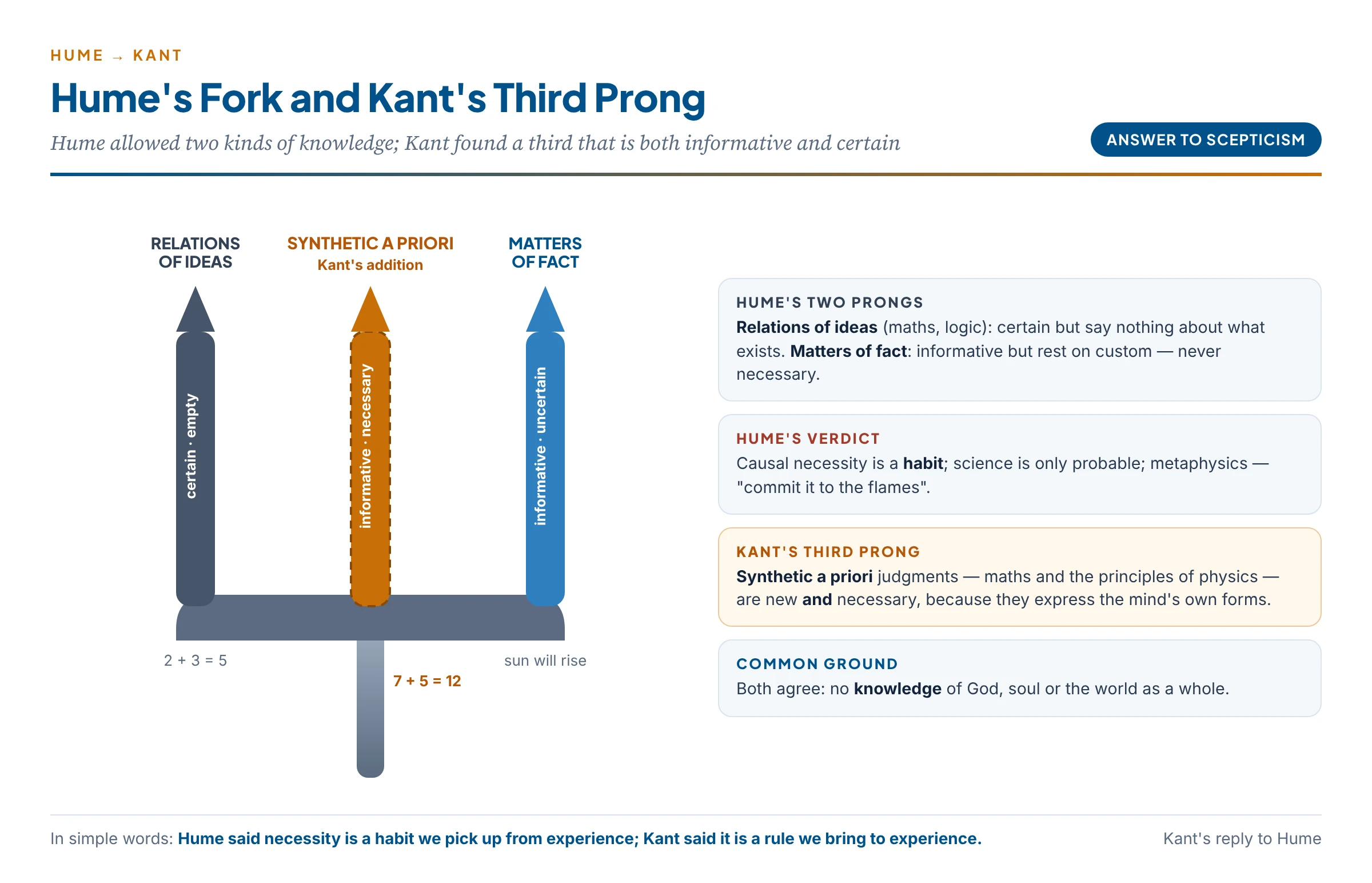
- Hume’s challenge. Hume divided all objects of reason into two kinds (Hume’s fork):
- Relations of ideas — mathematics and logic; known by thought alone; certain, but they tell us nothing about what exists (“2 + 3 = 5“).
- Matters of fact — knowledge of the world; informative, but resting on experience and custom, so never necessary (“the sun will rise tomorrow”).
- Hume’s conclusion. There is no third kind that is both certain and factual. Causal necessity is a habit; the laws of science are only probable; metaphysics is neither demonstration nor fact — “commit it to the flames.”
- Leibniz’s parallel division. Truths of reason (necessary; their opposite is a contradiction) and truths of fact (contingent). Rationalists and empiricists agreed that only analytic propositions are a priori and that all synthetic propositions are a posteriori.
- Kant’s task. To save the necessity of science from Hume’s scepticism without returning to rationalist dogmatism, Kant must show that a third kind of judgment exists — and explain how it is possible.
What a “Judgment” Is
- For Kant, knowledge is expressed in judgments — statements that relate a subject concept to a predicate concept and can be true or false (“The table is round”).
- Judgments can be classified by two different questions:
- How is the predicate related to the subject? → analytic or synthetic (a question about the content of concepts).
- How is the judgment known to be true? → a priori or a posteriori (a question about the source of validity).
- Earlier philosophers ran the two distinctions together. Kant’s first step is to separate them.
Core Doctrine
1. Analytic and Synthetic Judgments
- Analytic judgments. The predicate is already contained (secretly) in the concept of the subject.
- Examples: “All bodies are extended” — extension is part of what “body” means. “All bachelors are unmarried.” “A triangle has three sides.”
- They are explicative (clarifying): they unpack what we already think in the subject, and add nothing new.
- Their test: denying them produces a contradiction (“an unextended body”).
- Because they are tautologies, they cannot by themselves give knowledge of the world.
- Synthetic judgments. The predicate is not contained in the subject; it adds something to it.
- Examples: “All bodies are heavy” — weight is not part of the mere concept of body. “Some bodies are heavy.” “All bachelors are smart.”
- They are ampliative (augmentative): they extend our knowledge.
- Denying them involves no contradiction.
- They provide novelty.
2. A Priori and A Posteriori Judgments
- A priori knowledge is knowledge independent of experience for its validity.
- Its marks are strict universality (no exception is possible) and necessity (it could not be otherwise). Experience can show only what is, never what must be, so wherever we find universality and necessity we have an a priori element.
- Example: 2 + 2 = 4. We may have learnt numbers through experience, but once understood, the equation needs no further proof from experience.
- A posteriori knowledge depends on experience for its validity — on observation and perception. It is contingent and particular: true or false depending on what experience shows (“There is a cup on the table”; “This rose is fragrant”).
Common confusion
Does “a priori” mean “before experience” in time? No. Kant opens the Critique by saying that all our knowledge begins with experience — a child learns to count with fingers and pebbles. “A priori” does not describe when we learn something, but how its truth is justified: an a priori judgment is one whose validity does not depend on experience. “Knowledge begins with experience, but it does not all arise from experience.”
3. Four Possible Combinations
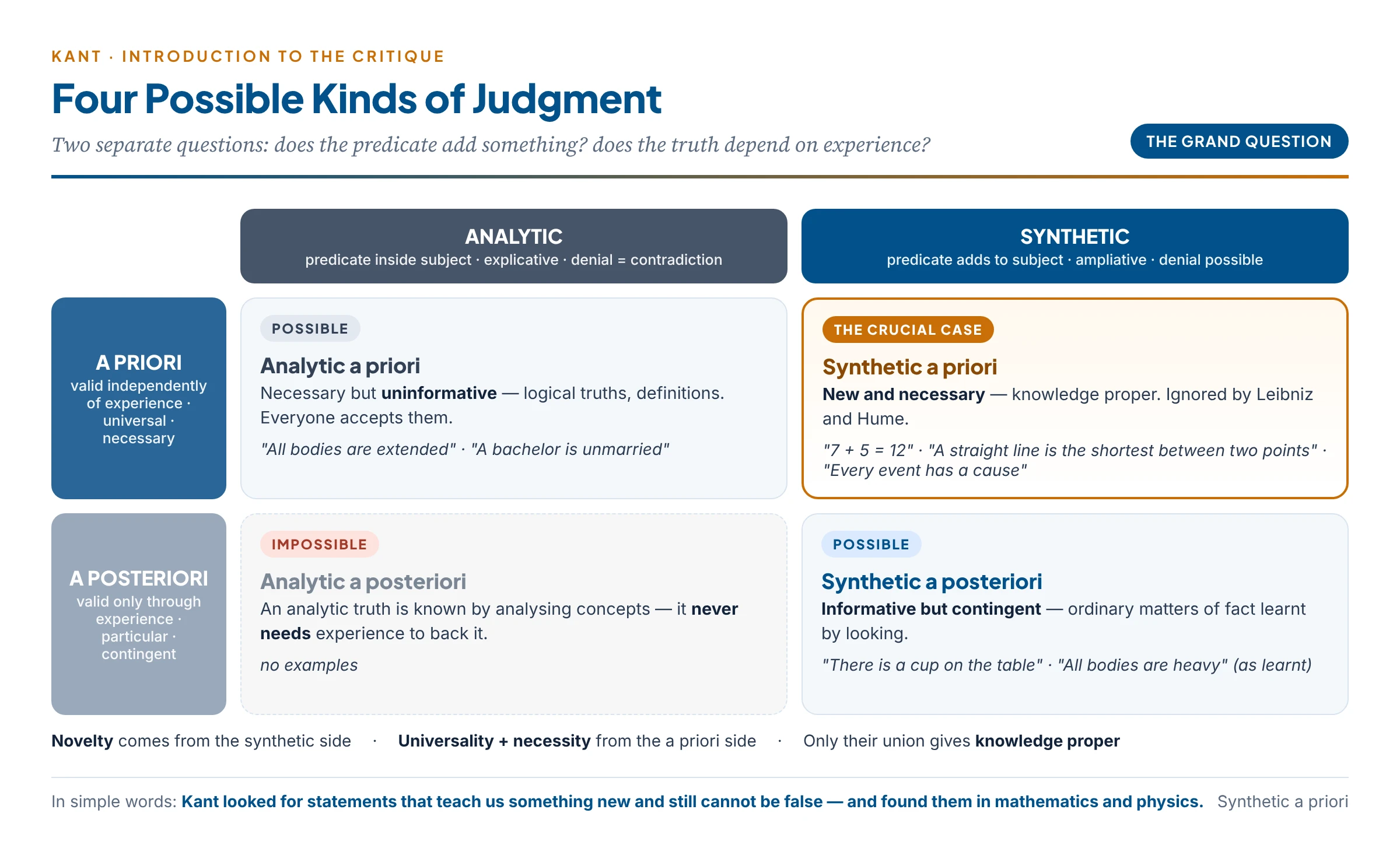
Because the two distinctions answer different questions, Kant considers all four logically possible combinations:
| Combination | Possible? | Character | Examples |
|---|---|---|---|
| Analytic a priori | Yes | Necessary and universal, but uninformative; logical truths and matters of definition — everyone agrees | “All bodies are extended”; “A triangle has three sides” |
| Analytic a posteriori | No | Impossible: an analytic judgment is known by analysing concepts, so it never needs experience to support it | — |
| Synthetic a posteriori | Yes | Informative but contingent; ordinary matters of fact known through the senses | “There is a cup on the table”; “All swans are white” |
| Synthetic a priori | Yes — the crucial case | Informative and necessary — the only kind that can give new knowledge that must be true; neither Leibniz nor Hume considered it | “7 + 5 = 12”; “The straight line is the shortest between two points”; “Every event has a cause” |
- Knowledge proper is synthetic a priori. Novelty comes from the synthetic element; universality and necessity from the a priori element. Kant thus defines knowledge in a way that does justice to both rationalism and empiricism.
- The real question. Rationalists assumed synthetic a priori knowledge (of God, soul, substance) without asking how it is possible; empiricists denied it altogether. Kant asks the critical question: how are synthetic a priori judgments possible — and where are they possible?
4. Synthetic a priori Judgments in Mathematics
- Kant rejects two views of mathematics: that it is merely analytic (Leibniz, and later logicists), and that it is learnt from observation (empiricists).
- Arithmetic: “7 + 5 = 12.”
- Synthetic: analyse the concept of “the sum of 7 and 5” as long as you like — it contains only the union of two numbers in one, not the particular number 12. To reach 12 we must go beyond the concepts and count — adding 5 units one by one to 7, for instance on our fingers. The judgment extends our knowledge. The point is clearer with larger numbers: no one sees “3,465” merely by thinking “1,789 + 1,676.”
- A priori: the connection is universal and necessary. Experience gives only particular and uncertain information; no one checks 7 + 5 = 12 by repeated trials.
- Geometry: “The straight line is the shortest distance between two points.”
- Synthetic: the concept “straight” is a concept of quality (direction); “shortest” is a concept of quantity (magnitude). Shortness is not contained in straightness; it must be added by constructing the line in intuition.
- A priori: it holds for every line, necessarily, without measuring.
- How such judgments are possible. Through pure intuition:
- Arithmetic rests on the a priori form of time — counting is the successive addition of units.
- Geometry rests on the a priori form of space — we construct a triangle in pure space and read off its properties without consulting physical objects.
- Because space and time are forms of our sensibility, mathematics is valid for all possible experience — but only for the world as it appears to us, not for things in themselves (see the article on space and time).
In simple words
Ask a child, “What is 7 + 5?” She does not find “12” by staring at the word “seven” or the word “five.” She counts on: eight, nine, ten, eleven, twelve. Something new is produced by an activity in time — that is why Kant calls the judgment synthetic. Yet once she has done it, she knows that no pair of seven and five things anywhere could ever make thirteen — that is why it is a priori.
5. Synthetic a priori Judgments in Physics
- Physics contains a pure part. Its basic principles — “every event has a cause,” “in all changes the quantity of substance remains the same” (conservation), “action and reaction are equal” — are not mere generalisations from observation.
- “Every event has a cause.”
- Synthetic: the concept of an event (something that happens) does not contain the concept of a cause. Hume was right about this.
- A priori: it is held as universal and necessary. Repeated observation shows only that events have so far been regularly connected, not that they must be; yet physics presupposes this necessity in every experiment.
- How such judgments are possible. Through the categories of the understanding — especially causality, substance and quantity. These are a priori concepts the mind must apply to sensory data to have a coherent experience at all; without them nature would be a chaotic flow of impressions. So the basic principles of physics are synthetic (they extend our knowledge of nature) and a priori (they arise from the mind’s own structure).
- Their limit. They are valid only for the phenomenal world — nature as it appears to us.
Common confusion
Is “every event has a cause” analytic? Many people say “every effect has a cause” is obviously true by definition. Both statements look alike but are different.
- “Every effect has a cause” is analytic: “effect” means something produced by a cause, so denying it is a contradiction.
- “Every event has a cause” is synthetic: “event” means only something that happens (a change in time); nothing in that concept mentions a cause. Its necessity is not logical but comes from the category of causality — so it is synthetic a priori.
6. Synthetic a priori Judgments in Metaphysics
- Metaphysics claims to be synthetic a priori. Traditional metaphysics claimed necessary truths (a priori) that extend knowledge (synthetic) about God, the soul and the world as a whole — “the soul is a simple substance,” “the world has a beginning,” “God exists.”
- But it lacks intuition. In mathematics the concepts are applied to pure intuitions of space and time; in physics the categories are applied to empirical intuitions. In metaphysics there is no intuition at all of God, soul or world-whole. The categories are valid only when they organise sensory data; used beyond experience, they produce illusions.
- The result. Rational metaphysics produces:
- Paralogisms — fallacious inferences about the soul (rational psychology).
- Antinomies — equally provable contradictions about the world as a whole (rational cosmology).
- Invalid proofs of God’s existence (rational theology).
- So metaphysics as a science is not possible. Synthetic a priori knowledge in traditional metaphysics cannot be had.
- But metaphysics is not destroyed. As a natural disposition of reason it remains; a critical metaphysics maps the a priori structure of experience; and the Ideas of God, freedom and immortality keep a regulative role in inquiry and a practical role in morality.
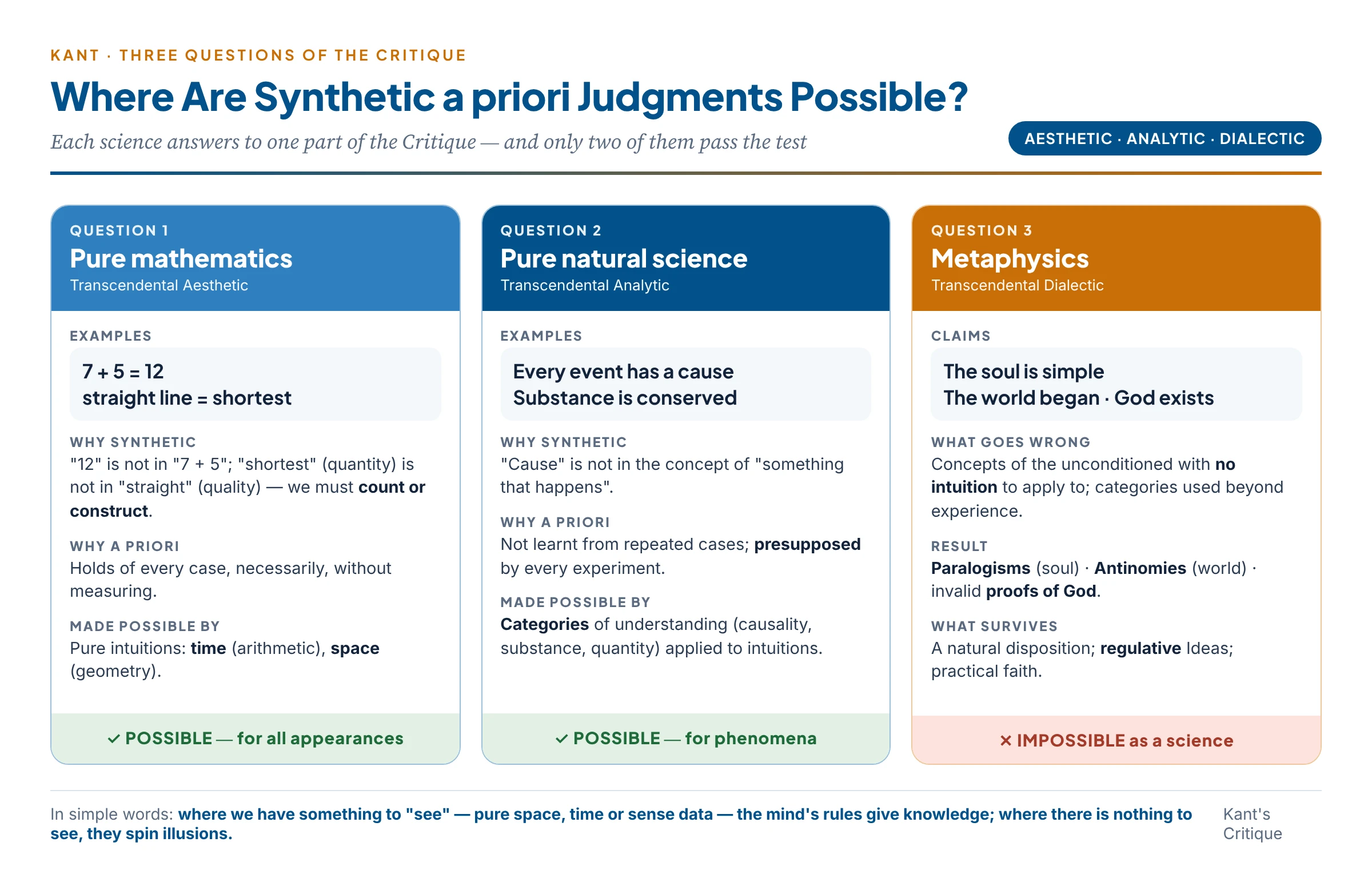
The three questions of the Critique and their answers:
| Question | Answered in | Source of the synthetic a priori | Verdict |
|---|---|---|---|
| How is pure mathematics possible? | Transcendental Aesthetic | Pure intuitions of space (geometry) and time (arithmetic) | Possible — valid for all appearances |
| How is pure natural science possible? | Transcendental Analytic | Categories of the understanding (causality, substance…) applied to intuitions | Possible — valid for phenomena |
| How is metaphysics possible? | Transcendental Dialectic | Ideas of reason (soul, world, God) with no intuition | Impossible as a science; possible only as a natural disposition and as practical faith |
7. How Synthetic a priori Judgments Are Justified
- The transcendental method. Kant does not prove these judgments by logic (that would make them analytic) or by observation (that would make them a posteriori). He shows that they are conditions of the possibility of experience: without them, no experience of objects could occur at all.
- The Copernican key. If knowledge had to conform to independent objects, a priori knowledge of them would be impossible — how could I know in advance what an external thing must be like? But if objects must conform to the forms of our sensibility and understanding, then I can know a priori whatever follows from those forms — for every object of experience must fit them.
- Universality explained. These forms are the same in every human mind, so the judgments based on them hold for every knower.
- Necessity explained. The mind cannot experience except through these forms, so whatever expresses them must hold of all experience.
- The cost. Synthetic a priori judgments hold only of phenomena. That is exactly why they cannot extend to God, soul or the world-whole.
8. Kant’s Response to Hume’s Scepticism about A Priori Judgments
- What Kant accepts from Hume.
- Causal judgments are synthetic: the effect is not contained in the concept of the cause.
- Their necessity is not a logical necessity, and it is not observed in experience.
- Where Hume went wrong. Hume took mathematics to be analytic (relations of ideas). Had he seen that mathematics is synthetic and yet certain, he would have realised that his fork was incomplete — for his own argument would then have destroyed mathematics too, which he never doubted.
- The general form of Hume’s problem. Kant generalised Hume’s doubt about causality to all concepts by which reason connects things a priori — substance, community, necessity. Hume’s question becomes Kant’s: how are synthetic a priori judgments possible?
- Kant’s answer.
- Necessity in causal judgments is real, but it comes from the understanding, not from the objects as things in themselves nor from habit.
- Without the category of causality, we could not even distinguish an objective sequence of events (a ship floating downstream: first upstream, then downstream — the order is fixed) from a merely subjective sequence of perceptions (looking over a house: roof first or door first — any order will do). So causality is a presupposition of experience, not a product of it.
In simple words
Stand by a river and watch a boat drift downstream: you see it first near the bridge, then near the temple. You cannot see it in the other order — the order belongs to the event. Now look over a house: you may see the roof first and the door next, or the door first and the roof next — the order is up to you. How do you tell these two cases apart? Only by thinking the boat’s positions as connected by a rule (a cause fixes which comes first). So the idea of necessary order is not a habit picked up after experience; it is what lets us experience an objective event at all.
- Kant’s reply in one line. Hume showed that necessity cannot be found in experience; Kant showed that it is brought to experience by the mind as the condition of there being any experience at all.
9. Hume’s Account of the “Ideas of Reason” and Kant’s Response
- Hume on reason.
- Reason proper concerns only relations of ideas (demonstration) and matters of fact (probable reasoning); all reasoning about matters of fact rests on cause and effect, and that rests on custom, not reason.
- The large “ideas” that metaphysics claims to know by reason — necessary connection, substance, the enduring self, the external world, God as first cause — are traced back to impressions. Where no impression is found, the idea is explained as a product of imagination working by association (resemblance, contiguity, causation) and of habit: necessity is “in the mind, not in objects”; substance is a “collection of simple ideas” united by imagination; the self is a “bundle of perceptions.”
- Reason is “the slave of the passions“; belief in the external world and in causal order is natural, not rationally proved.
- Kant’s response.
- Separates understanding and reason. The concepts Hume called fictions — causality and substance — are not products of imagination but categories of the understanding, objectively valid for all phenomena. Hume treated a priori concepts as empirical habits because he had only two boxes (relations of ideas, matters of fact).
- The synthetic a priori. Mathematics and the principles of physics are a third kind of knowledge, both necessary and informative.
- The true “Ideas of reason.” For Kant, Ideas of reason in the strict sense are soul, world and God — concepts of the unconditioned formed by reason’s search for completeness. Here Kant agrees with Hume that they give no knowledge; but he explains them not as fictions of association but as necessary, natural products of reason, valuable as regulative guides to inquiry and as postulates of morality.
- Self. Against Hume’s bundle, the transcendental unity of apperception (“I think”) is a necessary condition of any experience — though not a knowable soul-substance.
- Critical evaluation. Kant gives an account of the objectivity of science that Hume lacked. But critics say he does not refute Hume so much as re-locate necessity in the mind; if the mind’s forms might have been otherwise, the necessity is still, in a sense, human and conditional. Some call the move from “we cannot think otherwise” to “it must be so for all experience” an escape by transcendental argument rather than a proof.
Critical Evaluation
Objections to the Synthetic a priori
- The empiricist dilemma. A judgment is either synthetic a posteriori or analytic a priori; never synthetic a priori. If it is synthetic, it is based on facts and so contingent; if it is a priori, it cannot be about facts. Kant’s middle category is a contradiction.
- Ayer and the logical positivists. All synthetic judgments are a posteriori and all analytic judgments are a priori, and vice versa. Necessary truths are necessary only because they are true by definition — conventions of language.
- “7 + 5 = 12” is analytic. Given the definitions of 7, 5, + and 12 (as Leibniz tried and as Frege and Russell later did in logic), “12” follows from “7 + 5” by logic alone; nothing new is added. If one thinks logically rather than psychologically, 12 is “contained” in 7 + 5.
- Mixing psychological and logical criteria. Ayer argues that Kant uses two different tests for analyticity:
- A psychological test — whether the predicate is thought in the subject (“I do not think 12 when I think 7 + 5”).
- A logical test — whether the denial is a contradiction.
- In “7 + 5 = 12,” Kant uses the psychological test to call it synthetic, yet its denial is a contradiction by the logical test. So his analysis is confused.
- Only for subject–predicate judgments. The containment criterion fits “S is P” forms only. Many judgments are relational — “If a > b and b > c, then a > c” — and fall outside Kant’s scheme.
- Kant’s own postulations. The a priori forms (space, time, twelve categories) that make the synthetic a priori possible are themselves assumed, not proved.
- Non-Euclidean geometry and relativity. Kant took Euclidean geometry as necessarily true of all experienced space. Non-Euclidean geometries are consistent, and Einstein’s relativity shows physical space is not Euclidean. So geometry is either pure (analytic, about axioms) or applied (empirical) — not synthetic a priori.
- Quine. In “Two Dogmas of Empiricism,” Quine attacks the analytic–synthetic distinction itself: “analyticity” cannot be defined without circularity (through synonymy, definition, necessity). If there is no sharp distinction, Kant’s question collapses; any statement can be held true “come what may,” and any can be revised. In this sense, Kant’s notion of a priori synthetic knowledge is, for Quine, a metaphysical article of faith.
In simple words
Quine’s point can be pictured as a spider’s web of beliefs. Logic and mathematics sit near the centre; observations sit at the edge. When an experiment goes wrong, we usually adjust something near the edge — but nothing is immune: in a crisis even a “necessary” truth near the centre can be changed (as Euclid’s geometry was in physics). So there is no special class of truths that are certain in advance — no analytic truths, and no synthetic a priori truths either.
Replies and Defences
- Against “7 + 5 = 12 is analytic.” Reducing arithmetic to logic needs set-theoretic axioms that are not plainly logical truths, and Gödel showed arithmetic cannot be captured completely by any formal system. Many hold that Kant’s insight — that mathematics involves construction and is not a mere unpacking of definitions — survives.
- Against the psychological charge. Kant’s containment criterion concerns the content of concepts, not anyone’s private thoughts; and he also uses the contradiction test for analytic judgments. The tests agree once “containment” is understood as conceptual.
- Strawson and Grice defended the analytic–synthetic distinction against Quine: ordinary speakers apply it with broad agreement; a distinction can be real even if hard to define.
- Moore’s claim that no synthetic proposition is ever necessarily true is directly denied by Kant’s theory; the debate between them is precisely about whether such propositions exist.
- Later analytic philosophy separated a priori (a matter of knowledge) from necessary (a matter of truth) and found that the two need not coincide — showing that Kant was right to keep these questions apart even if his examples are disputed.
- Practical value. Even if contested in logic, the theory of synthetic a priori judgment saved philosophy from scepticism at a decisive moment and explained the success of science.
Critics and Defenders
Criticism — Critics
- Empiricists: synthetic a priori is a contradiction in terms.
- Ayer and the logical positivists: all necessary truths are analytic, true by convention; Kant confuses psychological and logical criteria.
- Frege, Russell (logicism): arithmetic is analytic, derivable from logic and definitions.
- Non-Euclidean geometry and Einstein: geometry of physical space is empirical.
- Quine: no analytic–synthetic distinction at all; a priori knowledge is an article of faith.
- Relational judgments (“a > b, b > c, so a > c”) escape the subject–predicate scheme.
Defence — Defenders and lasting value
- Mathematical construction: arithmetic and geometry are not mere definitions; Gödel’s results weaken the reduction of mathematics to logic.
- Strawson and Grice: the analytic–synthetic distinction is real and usable.
- Transcendental arguments remain a living method: some concepts are needed for any experience at all.
- Separation of questions: Kant rightly kept “how do we know it?” apart from “what does it say?” — a distinction modern philosophy still uses.
- Historical value: the synthetic a priori answered Hume and gave science a rational foundation.
Cross-Tradition Comparison
Universality and Necessity in Indian Epistemology
| Point | Kant | Nyāya | Cārvāka | Buddhist logic (Dharmakīrti) |
|---|---|---|---|---|
| Central problem | How are universal and necessary judgments possible? | How is vyāpti (invariable concomitance) known, e.g. “wherever smoke, there fire”? | Is any universal connection knowable? | What grounds necessary connection in inference? |
| Answer | A priori forms of mind (space, time, categories) | Repeated observation plus a special extraordinary perception of the universal (sāmānyalakṣaṇa pratyakṣa) and the removal of doubt (tarka) | No — vyāpti can never be established; perception shows only particulars; inference is only probable | Necessary connection rests on identity (svabhāva) or causality (tadutpatti) between terms |
| Attitude to scepticism | Answers Hume | Answers sceptical doubt by tarka and extraordinary perception | Sceptic — the Indian “Hume” | Grounds necessity in real relations |
Indian Connect — Key takeaways
- The Cārvāka critique of vyāpti reaches Hume’s conclusion: since we cannot perceive all cases of smoke and fire, past, present and future, no universal rule is ever proved — inference gives only probability.
- Nyāya’s answer resembles Kant’s in insisting that universality cannot come from counting instances; but Nyāya places the universal in reality (as jāti, grasped by an extraordinary perception), whereas Kant places it in the forms of the knowing mind.
- Buddhist logic grounds necessary inference in identity (tādātmya) and causal origin (tadutpatti) — a realist answer close to the rationalists, without Kant’s turn to the subject.
Synthesis (Siddhānta)
Kant separated two questions that earlier philosophy had merged: whether a judgment adds to its subject (analytic or synthetic), and whether its truth depends on experience (a priori or a posteriori). The four combinations reveal a gap in both rationalism and empiricism: a class of synthetic a priori judgments — “7 + 5 = 12,” “the straight line is the shortest,” “every event has a cause” — that are informative and necessary. Kant explains them by the Copernican turn: they express the pure intuitions of space and time and the categories of the understanding, so they hold for every possible object of experience. The same explanation draws the boundary of knowledge: where there is no intuition — God, soul, the world as a whole — synthetic a priori claims become illusion, and metaphysics as a science is impossible.
The theory has been attacked from every side — by the logicists for arithmetic, by non-Euclidean geometry and relativity for space, by Ayer for confusion of criteria, and by Quine for the distinction itself. Yet its central question remains alive: is there anything we know about the world, with necessity, before we observe it? Every modern debate about mathematics, the laws of nature and the limits of science still begins from the map Kant drew.
- Philosophy of mathematics: whether mathematics is discovered, constructed or a system of logic still turns on Kant’s “construction in intuition.”
- Philosophy of science: the role of fixed frameworks (conservation, causality) in organising experiment echoes Kant’s pure physics; their revision in modern physics echoes Quine.
- Cognitive science: research on built-in expectations in infants (objects persist, causes precede effects) gives an empirical twist to Kant’s a priori forms.
- Limits of knowledge: the boundary Kant drew for metaphysics informs the modern separation of scientific claims from claims of faith and value.
Hume showed that necessity cannot be found in experience; Kant showed that it is brought to experience by the mind that has the experience.
Previous Year Questions
- 2026How does Hume account for ideas of reason? How does Kant respond to Hume’s views in this regard? Critically discuss.
- 2024How does Kant respond to Hume’s scepticism with regard to a priori judgments? Discuss.
- 2023What are the main arguments offered by Kant to prove that a priori synthetic judgements are possible? Discuss with examples.
- 2018How does Quine show that the notion of synthetic a priori judgement as discussed by Kant is a metaphysical article of faith? Give reasons for your answer.
- 2017How is ‘all bodies are extended’ an analytic judgement but ‘all bodies are heavy’ a synthetic judgement? Is ‘every event has a cause’ an analytic or a synthetic judgement? Explain.
- 2017Elaborate Kant’s theory of space and time. How does this theory enable him to explain how mathematical propositions can be both synthetic and a priori?
- 2014How are synthetic a priori judgements justifiable according to Kant? Explain.
- 2007Nature of synthetic a priori judgment according to Kant. Short Notes.
- 2005How does Kant respond to Hume’s scepticism?
- 2003How is synthetic a priori judgment possible? Short Notes.
- 1994Can synthetic truths be known a priori? If so, must such knowledge be knowledge of universal and necessary truths? In this context critically consider Kant’s view.