

Empiricism (Locke, Berkeley, Hume): Theory of Knowledge; Substance and Qualities; Self and God; Scepticism.
Official Syllabus: Paper I, Section A, Unit 3
David Hume (1711–1776) is the third and most radical of the British empiricists. He accepted Locke’s starting point — all knowledge comes from experience — and followed it to the end without stopping where Locke and Berkeley stopped. Everything in the mind, he said, is a perception: either a lively impression or a faint idea copied from it. From this simple map he drew three famous results: every meaningful idea must be traced to an impression (the copy principle); all knowledge is either relations of ideas or matters of fact (Hume’s Fork); and our inferences from the past to the future rest on custom, not on reason (the problem of induction). The result is a theory of knowledge that is honest, modest and deeply unsettling — the theory that woke Kant from his “dogmatic slumber.”
In simple words
Think of the difference between touching a hot stove and remembering that you once touched it. The touch is sharp, loud, unmistakable; the memory is a pale photocopy of it. Hume says the whole mind is made of these two things — originals (impressions) and photocopies (ideas) — and that you can never have a photocopy of something that was never an original. A person born blind can talk about “red,” but he has no photocopy of red, because he never had the original.
Context & Problem
Hume’s Life, Works and Aim
- Scottish philosopher and historian (Edinburgh). His History of England made him famous in his lifetime; his philosophy made him immortal.
- Main philosophical works:
- A Treatise of Human Nature (1739–40) — written in his twenties. Book I on understanding, Book II on the passions, Book III on morals. Hume complained that it “fell dead-born from the press.”
- An Enquiry Concerning Human Understanding (1748) — a shorter, clearer recasting of Book I. Hume himself regarded the Enquiry as his authoritative statement, though later scholars rank the Treatise higher.
- An Enquiry Concerning the Principles of Morals (1751), The Natural History of Religion (1757) and Dialogues Concerning Natural Religion (published after his death, 1779).
- A “science of man.” Newton had explained the physical world with a few laws. Hume wanted to do the same for the mind — to find the few principles by which ideas arise and combine. His method is experimental and introspective: observe the contents of the mind without prejudice and report what is actually found there.
- Hume on his own character: “a man of mild dispositions, of command of temper, of an open, social and cheerful humour.” His love of literary fame, he said, was his ruling passion, yet it never soured his temper.
From Locke to Berkeley to Hume
- Common ground. Like Locke and Berkeley, Hume holds that knowledge results from experience and is neither innate nor received from God. This kind of empiricism lies behind the modern scientific method: knowledge should rest on observation rather than on intuition or faith.
- The march of empiricism:
| Point | Locke | Berkeley | Hume |
|---|---|---|---|
| Substances accepted | Three: matter, soul, God | Two: soul (spirits) and God; matter denied | None — “I cannot establish any substance at all” |
| Epistemology and metaphysics | Epistemology given priority over metaphysics | Epistemology and metaphysics coordinated: idealist epistemology leads to idealist metaphysics | No metaphysics; only a psychological account of experience |
| Status of knowledge | Certain in intuition and demonstration; sensitive knowledge real | Ideas are things; God guarantees order | Certain only in relations of ideas; everything about the world probable |
- “Halfway empiricism” completed. Locke kept a substance he never experienced (“something, I know not what”); Berkeley rejected material substance but kept spiritual substance and God. Hume uses Berkeley’s own weapon against Berkeley’s spirits and takes empiricism to its logical conclusion. He is often called the only consistent empiricist of the three.
- The question. If all we have are perceptions, how far can knowledge reach? Can experience give us necessity, causal power, substance, a self, an external world, God? Hume’s theory of knowledge sets up the test that each of these will have to pass.
Core Doctrine
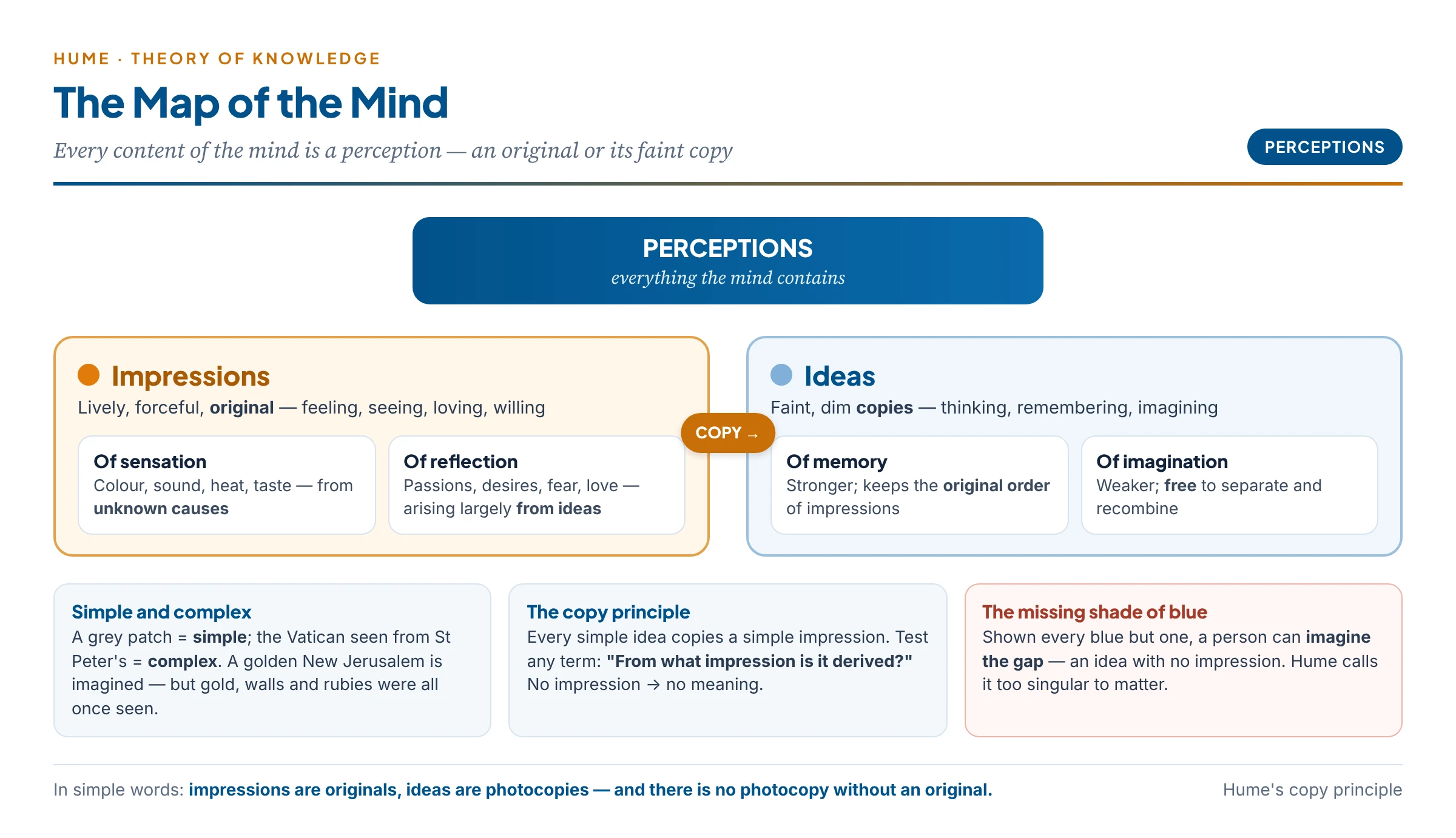
1. Perceptions: Impressions and Ideas
“All the perceptions of the human mind resolve themselves into two distinct kinds, which I shall call impressions and ideas.” — David Hume
- Perception is Hume’s word for every content of the mind — seeing, hearing, loving, hating, willing, remembering, imagining.
- Impressions are our “more lively perceptions” when we hear, see, feel, love, hate, desire or will. They are the direct, vivid, forceful products of immediate experience.
- Ideas are the “less lively perceptions” we are conscious of when we reflect on impressions — thoughts, memories, imaginings. They are faint copies of impressions.
- The difference is one of degree — of force and vivacity (liveliness), not of kind:
- It is one thing to feel a pain of excessive heat, another to recall it in memory or anticipate it in imagination.
- When I look through a window I receive the lovely landscape (impression); when I close my eyes and think of it, I have its image (idea).
- The colour of the screen I am looking at now is an impression; my memory of the colour of my mother’s hair is an idea.
- Even “the liveliest thought is still inferior to the dullest sensation.” Memory is like a faithful mirror or a portrait: it represents the original but never matches its vivacity.
| Impressions | Ideas |
|---|---|
| Primary and original | Secondary, copies of impressions |
| Vivid, forceful, lively | Faint and dim |
| Come through the senses, emotions and other mental activity | Formed from impressions by memory and imagination |
| Direct products of immediate experience | Thoughts, beliefs, memories connected to impressions |
| Looking at the wall, listening to music, feeling anger | Remembering the wall, recalling the song, thinking about anger |
Two kinds of impressions:
- Impressions of sensation — received through the sense organs: colour, sound, taste, smell, heat, cold. They “arise in the soul originally, from unknown causes.”
- Impressions of reflection — passions, desires, emotions, love, hate, will. They arise “in a great measure from our ideas”: the idea of a past pain may produce a new impression of fear. So reflection is secondary in order to sensation, yet its impressions are still original facts of mind, not copies.
Two kinds of ideas:
- Ideas of memory — fairly strong and lively; tied to the original order and position of the impressions.
- Ideas of imagination — weaker and fainter; free to separate, mix and rearrange the materials of memory.
2. Simple and Complex Perceptions
- Simple perceptions admit of no division or distinction: the sensation of red, of cold, a particular smell.
- Complex perceptions are made of simple parts: an apple is a complex of colour, taste, smell and shape.
- Correspondence: “The perception of a grey area on the wall is a simple impression, and the very thought of it brings about the simple idea. But when I go to the top of St Peter’s Basilica I get the complex impression of the entire Vatican City; if I think of it later I have a complex idea.” Here the complex idea corresponds to the complex impression.
- Complex ideas need not copy complex impressions. I can imagine the New Jerusalem, whose pavements are gold and whose walls are rubies, though I have never seen such a city; I can imagine a golden mountain or a virtuous horse. But every part — gold, ruby, wall, mountain, horse, virtue — came from an earlier impression. The creative power of the mind is only the power of “compounding, transposing, augmenting or diminishing” the materials given by the senses.
- So all ideas, simple or complex, can be traced back to simple impressions.
3. The Copy Principle and the Test of Meaning
“All our simple ideas in their first appearance are derived from simple impressions, which are correspondent to them, and which they exactly represent.” — David Hume
- The principle. Every simple idea is a copy of a prior simple impression. Impressions come first — in time and in authority. No idea can arise independently of experience.
- Hume’s evidence:
- Constant correspondence. Examine any idea, however sublime; you will find it resolves into simple ideas copied from impressions. Even the idea of God — an infinitely intelligent, wise and good being — “arises from reflecting on the operations of our own mind, and augmenting, without limit, those qualities of goodness and wisdom.”
- Missing organs, missing ideas. A man blind from birth has no idea of colours; a man deaf from birth has no idea of sounds. Restore the sense and the ideas follow. A person who has never tasted wine has no idea of its relish.
- The test of meaning. When we suspect a philosophical term is used “without any meaning or idea,” we need only ask: “From what impression is that supposed idea derived?” If none can be found, the term is empty. This single question becomes Hume’s razor against substance, the self, necessary connection and much of theology.
- Against innate ideas. The copy principle denies the rationalists’ innate ideas of God, self or substance. Hume adds a sharp clarification: if “innate” means “contemporary with birth,” the dispute is frivolous; if it means “not copied from any prior perception,” then all our impressions are innate and none of our ideas are.
- Beyond perceptions, nothing can be known. “Let us chase our imagination to the heavens, or to the utmost limits of the universe; we never really advance a step beyond ourselves.” If anything exists beyond our impressions and ideas, it is totally unknown, and it makes no sense to argue about it.
In simple words
The copy principle works like a customs check at an airport. Every idea that wants to enter the country of knowledge must show its passport — the impression it was copied from. “Red” shows the passport of seeing red. “Golden mountain” shows two passports, gold and mountain. But “substance,” “necessary connection” and “immortal soul” arrive with no passport at all. Hume does not let them in as genuine ideas; he asks where they really came from.
4. The Missing Shade of Blue
- Hume’s own exception. Imagine a person who has seen every shade of blue except one. Lay the shades before him from darkest to lightest; he will notice a gap. Hume admits he can supply the missing shade by imagination — an idea without a corresponding impression.
- Hume’s response. The instance is “so singular, that it is scarce worth our observing, and does not merit that for it alone we should alter our general maxim.”
- Why critics make much of it. A principle claimed to be without exception has, by its author’s own admission, an exception. If the mind can produce one new simple idea, why not others? The case shows that the mind is more active than Hume’s copy-model allows.
5. Atomism: Whatever Is Distinguishable Is Separable
- The dogma. Whatever we can distinguish in thought, we can separate; whatever is different is distinguishable; so every perception is a distinct existence.
- Humean atomism. Impressions are separate and independent, atomic and unanalysable. The colour, taste and smell of an apple come as separate impressions; there is no logical connection between them. Impressions are neither linked to one another, nor to an object behind them, nor to a mind that owns them.
- The problem this creates. Knowledge is a connected system, but the raw materials are loose atoms. Something must bind them. Hume’s answer is not reason but a “gentle force” of attraction among ideas — association.
6. The Association of Ideas
“Here is a kind of attraction, which in the mental world will be found to have as extraordinary effects as in the natural.” — David Hume
- Ideas do not wander at random. Even in dreams and day-dreams one idea “naturally introduces another.” There is a “bond of union,” an “associating quality,” by which ideas follow each other with some regularity and method; anything that breaks the chain is felt as odd.
- Not a faculty but a pattern. What brings ideas together is not a special power of the mind but qualities in the ideas themselves and the habitual way the mind groups them.
- Three principles (laws) of association:
- Resemblance (similarity) — one idea leads to another like it. A portrait leads our thought to the person painted; this animal makes us think of that animal.
- Contiguity in time or place — ideas experienced together are recalled together. Mention of one room in a building leads to talk of the others; the cup suggests the table it stands on; day suggests night.
- Cause and effect (causation) — the strongest of the three. Think of a wound and you can hardly avoid thinking of the pain that follows; the switch suggests the light; fire suggests heat; dark clouds suggest rain.
- What association explains. Complex ideas, memory, imagination, belief and even metaphysical notions are explained as products of associative habits, not of rational insight. Experience gives us both the ideas and our awareness of their association; all human beliefs, including those we call knowledge, result from repeated application of these simple associations.
- The law of association plays in the mental world the role that the law of gravitation plays in the physical world. This is Hume’s “Newtonian” ambition.
- Strength and limit. Association gives psychological connection — we cannot help passing from one idea to the next — but not logical necessity. An idea is “true” if its original impression can be traced; if not, it is “false.” Thus association explains both the power and the limits of human knowledge.
7. Abstract (General) Ideas
- Hume sides with Berkeley. He calls Berkeley’s denial of abstract ideas “one of the greatest and most valuable discoveries” of recent times. The traditional view (Locke’s) said the mind can form an idea of “triangle” that is neither equilateral, isosceles nor scalene; Hume finds this psychologically impossible.
- All ideas are particular, because they are copied from particular impressions, and an impression has a determinate size, shape and colour.
- Generality lies in use, not in the idea. When we think “triangle,” we picture one particular triangle and let it stand for all others. A general word becomes linked by custom with many resembling particular ideas; when the word is used, it calls up any one of them as the context requires — and, if we try to reason wrongly about all triangles from one, custom brings another to mind that corrects us.
- Why it matters. Rejecting abstract ideas removes unnecessary mental entities and supports Hume’s attack on metaphysics, which trades heavily in abstract terms — “substance,” “essence,” “pure being” — with no impressions behind them. Hume even denies a separate idea of existence: to think of a thing, and to think of it as existing, are the same.
8. Relations: Seven Kinds, Natural and Philosophical
- Relations are made by the mind’s act of comparison; they are not extra impressions found in things.
- Seven philosophical relations, in two groups:
| Depend entirely on the ideas compared — known by intuition or demonstration | Can change without any change in the ideas — known through experience |
|---|---|
| 1. Resemblance | 5. Identity |
| 2. Contrariety | 6. Relations of time and place |
| 3. Degrees in quality (brighter, heavier) | 7. Cause and effect |
| 4. Proportions in quantity or number |
- The first group gives the sciences of arithmetic, algebra and (with qualifications) geometry. The second group concerns real existence; of its three relations, only causation carries us beyond what is present to the senses. Hence the whole weight of factual knowledge falls on causation (the next article).
- Natural vs philosophical relations:
- A natural relation is one by which ideas are automatically associated in the imagination — resemblance, contiguity and causation working on us without effort.
- A philosophical relation is any ground of deliberate comparison used in reasoning and judgment.
- Causation is both: a natural relation that drives belief and a philosophical relation that reflection analyses. Even “objective-looking” relations like identity and causation are finally rooted in mental habit, not in a metaphysical structure of things.
9. Hume’s Fork: Relations of Ideas and Matters of Fact
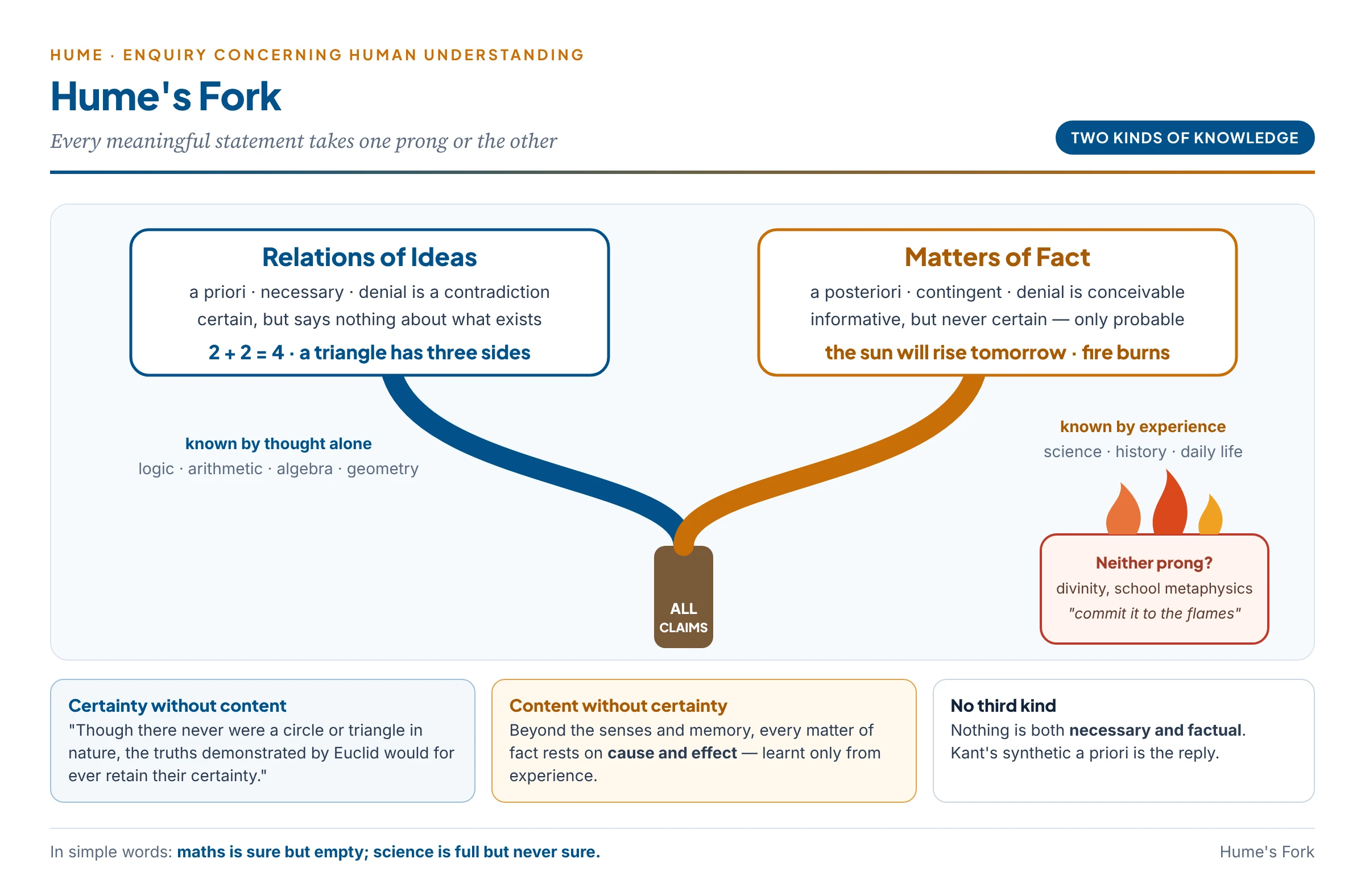
“All the objects of human reason or enquiry may naturally be divided into two kinds, to wit, Relations of Ideas, and Matters of Fact.” — David Hume
- Relations of Ideas — propositions of geometry, algebra, arithmetic and logic; “every affirmation which is either intuitively or demonstratively certain.”
- “That three times five is equal to the half of thirty” or “3 + 4 = 7” expresses a relation between numbers.
- Such propositions are “discoverable by the mere operation of thought, without dependence on what is anywhere existent in the universe. Though there never were a circle or triangle in nature, the truths demonstrated by Euclid would for ever retain their certainty and evidence.”
- Some are known intuitively (“a triangle has three sides”), some demonstratively (“the angles of a triangle equal two right angles”).
- Matters of Fact — propositions about what exists and happens.
- “The sun will not rise tomorrow” is “no less intelligible, and implies no more contradiction” than “the sun will rise tomorrow.”
- Their truth depends on observation, memory and causal reasoning; their contrary is always possible.
| Relations of Ideas | Matters of Fact |
|---|---|
| Known a priori, independent of experience | Known a posteriori, dependent on experience |
| Based on relations between ideas | Based on observation of the world |
| Truth necessary and universal | Truth contingent and particular |
| Denial is a contradiction | Denial involves no contradiction |
| Established by demonstration or intuition | Established by perception and experiment |
| Give no new information about reality | Inform us about how the world is |
| Analytic in nature (in later terms) | Synthetic in nature (in later terms) |
| Certain and indubitable | Probable, never absolutely certain |
| Logic and mathematics | Physical objects, events, history, natural science |
| Independent of time and place | Dependent on time, place and circumstances |
| “2 + 2 = 4”; “a triangle has three sides” | “The sun will rise tomorrow”; “fire causes heat” |
| No role for causation | Heavily dependent on cause–effect |
- The price of each prong. Relations of ideas give certainty without content; matters of fact give content without certainty. Mathematical knowledge is uncontroversial but uninformative; the interesting propositions of science are problematic. Abstract metaphysics tries, fruitlessly, to have the certainty of the first with the content of the second.
- No third kind. If “knowledge proper” means what is certain, universal and factual at once, Hume finds none: there is no class of propositions that tells us about the world and is also necessary. This is the gap Kant later tried to fill with the synthetic a priori. Hume’s fork is in effect his version of the a priori / a posteriori distinction that Kant made central.
10. The Criterion of Meaning: “Commit It Then to the Flames”
“If we take in our hand any volume; of divinity or school metaphysics, for instance; let us ask, Does it contain any abstract reasoning concerning quantity or number? No. Does it contain any experimental reasoning concerning matter of fact and existence? No. Commit it then to the flames: for it can contain nothing but sophistry and illusion.” — David Hume
- Only two kinds of meaningful propositions. A statement that is neither a relation of ideas nor a matter of fact is a pseudo-proposition — it looks like a claim but says nothing.
- Consequences:
- Genuine knowledge is restricted to mathematics, logic and empirical science.
- Speculative metaphysics and rational theology (proofs of God’s nature, the soul’s substance, the world’s first cause) are excluded.
- Two centuries later the logical positivists turned this fork into the verification principle: a sentence is meaningful only if it is analytic or empirically verifiable. Hume is their acknowledged ancestor.
- Geometry and arithmetic. Hume rated arithmetic and algebra as perfectly exact. In the Treatise he doubted the exactness of geometry, because it rests on the idea of infinite divisibility of extension, which he thought absurd: our ideas of space are made of indivisible minimal points. In the Enquiry he treats geometry as demonstrative.
- Even demonstration is fallible in practice. The rules of demonstrative science are “certain and infallible,” but our application of them is not: we make mistakes in long calculations. So even our mathematical knowledge, as actually possessed, carries a small doubt — a theme for the article on Hume’s scepticism.
11. Necessity in Knowledge
- Necessity belongs only to relations of ideas. The contrary of every matter of fact is conceivable, so no factual statement is necessary. It is necessary that two plus two equals four; it is never necessary that the sun rise tomorrow.
- Yet we feel necessity in nature. In causal reasoning and induction we assume necessary connections. Hume shows that experience reveals only constant conjunction, never necessity; repeated observation produces expectation, not logical compulsion.
- Psychological, not logical, necessity. The “necessity” we ascribe to nature is a subjective feeling of determination produced by habit. Hume replaces metaphysical necessity with natural necessity rooted in human psychology.
- Not a denial of practice. Science and daily life depend on stable expectations, and Hume does not ask us to give them up. His point is epistemological: such necessity cannot be rationally justified.
“The Sun Will Rise Tomorrow” and “2 + 2 = 4”: The Same Necessity?
- No — they belong to different prongs of the fork.
| “2 + 2 = 4” | “The sun will rise tomorrow” | |
|---|---|---|
| Kind | Relation of ideas | Matter of fact |
| Known by | Thought alone (demonstration) | Experience and causal inference |
| Denial | Self-contradictory — “2 + 2 = 5” cannot even be clearly conceived | Perfectly conceivable — a sunless tomorrow is imaginable |
| Necessity | Logical — in the ideas themselves | Psychological — felt expectation from habit |
| Certainty | Demonstrative | Probable (very high, but never demonstrative) |
| Informative about the world? | No | Yes |
- Why we feel them equally sure. Our belief that the sun will rise is so strong — backed by uniform experience without exception — that it feels as firm as arithmetic. Hume grants this practical certainty (he calls such inferences “proofs,” as distinct from mere probabilities) but insists it is a different kind of assurance: its strength is the strength of custom, not of logic.
12. Knowledge of Matters of Fact
- Beyond the senses and memory, causation does all the work. “All reasonings concerning matter of fact seem to be founded on the relation of cause and effect.”
- A man finding a watch on a desert island concludes that men were once there.
- A letter from a friend tells us the friend is in France.
- Hearing a voice in the dark, we infer a person is present.
- Causal knowledge comes from experience, never from reason alone. “Adam, though his rational faculties be supposed, at the very first, entirely perfect, could not have inferred from the fluidity and transparency of water that it would suffocate him, or from the light and warmth of fire that it would consume him.” No one could know a priori that bread nourishes or that gunpowder explodes.
- Hence matters of fact are never certain. Their truth depends on observation, testimony and causal reasoning; scientific laws describe regularities observed so far, not inevitable truths of nature.
- Not destroyed, but humbled. Hume’s analysis does not abolish empirical knowledge; it reveals its psychological foundations. Matters of fact guide action and inquiry effectively, yet remain epistemologically insecure.
13. The Problem of Induction
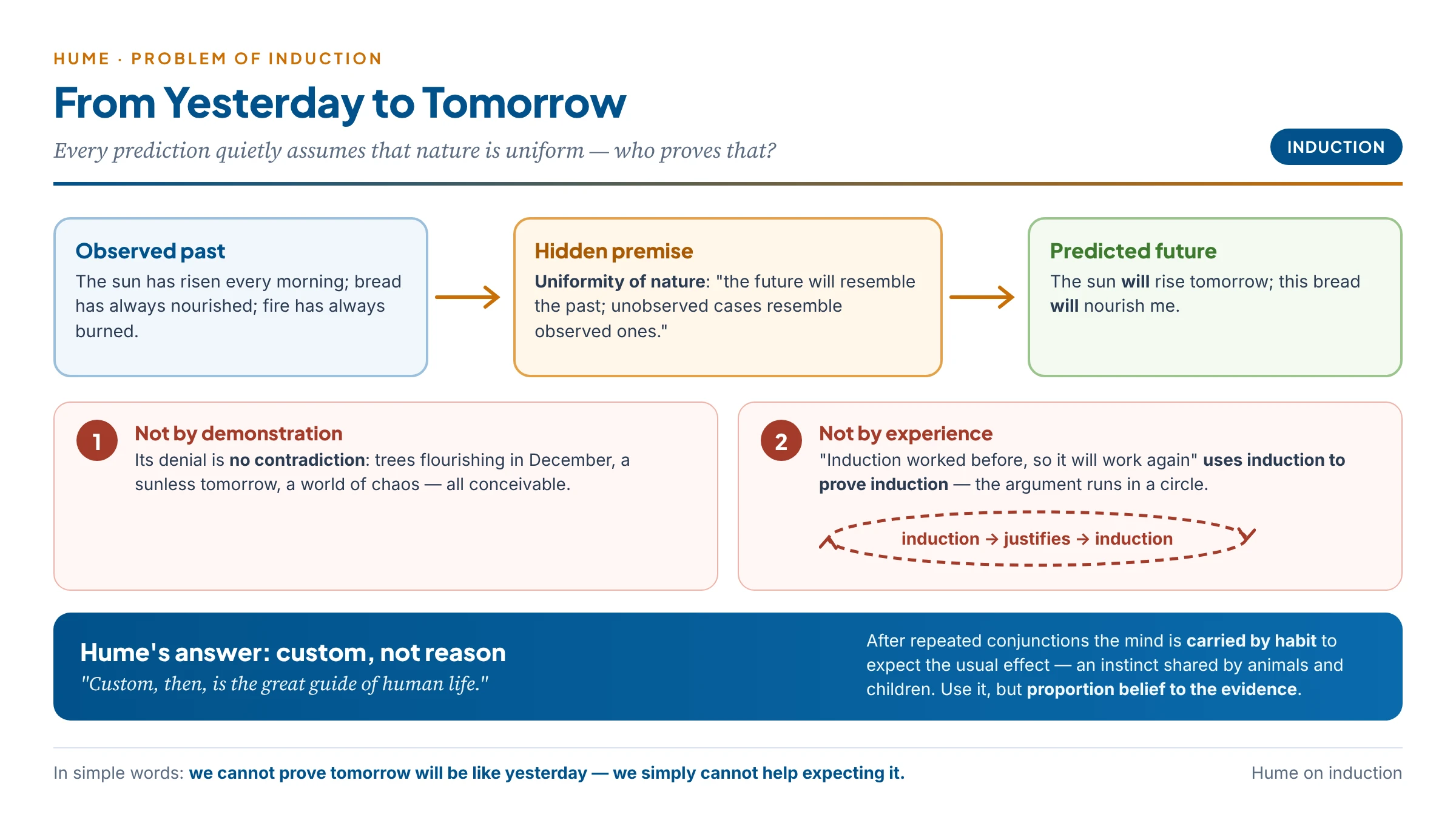
- Induction is reasoning from observed cases to unobserved ones — from particular experiences to a general rule or to a prediction. “The sun has risen every morning, so it will rise tomorrow.” “Bread has nourished me before, so this bread will nourish me.” All natural science and all daily expectation rest on it.
- The hidden premise. Every such inference assumes the uniformity of nature: “instances of which we have had no experience must resemble those of which we have had experience, and the course of nature continues always uniformly the same.”
- Hume asks: what justifies this premise? Only two kinds of reasoning exist — demonstrative (relations of ideas) and probable (matters of fact). Both fail:
- Not demonstrative. The contrary of uniformity is conceivable without contradiction. “Is there any more intelligible proposition than to affirm that all the trees will flourish in December and January, and decay in May and June?” We can easily imagine a world of chaos, so logic cannot guarantee our inductions.
- Not probable (experiential). Any argument from experience — “induction has worked in the past, so it will work in the future” — already assumes that the future will resemble the past. It is circular: it uses induction to justify induction.
- Conclusion. “It is impossible, therefore, that any arguments from experience can prove this resemblance of the past to the future; since all these arguments are founded on the supposition of that resemblance.”
- What actually moves us is custom. After repeated conjunctions, the mind is carried by habit to expect the usual attendant. “Custom, then, is the great guide of human life.” It is an instinct: animals and infants expect fire to burn long before they could reason about it. Nature has not left such an important operation to “the uncertain deductions of our reason.”
- Hume does not tell us to stop. We cannot shake this instinctive belief, and we should not try; we may use induction every day as long as we recognise its limits. “A wise man proportions his belief to the evidence.” Hume distinguishes proofs (arguments from uniform experience, leaving no room for doubt in practice) from probabilities (where experience is mixed).
- The problem after Hume:
- J. S. Mill made the uniformity of nature the “ultimate major premise” of induction — but his own justification of it was inductive, and so circular.
- Kant answered that causality is an a priori category the mind brings to experience.
- Russell put the point vividly: the chicken fed every morning by the farmer expects food again — and one morning has its neck wrung. More refined views of uniformity “would have been useful to the chicken.”
- Popper accepted that induction cannot be justified and rebuilt science on falsification instead: theories are bold conjectures tested and rejected, never proved.
- P. F. Strawson argued that asking whether induction is “rational” is confused, since being guided by inductive evidence is part of what we mean by being reasonable.
Common confusion
Did Hume say we should stop trusting induction, or that predictions are mere guesses? Many notes say Hume “rejected induction.” That overstates him. Hume showed that induction cannot be justified by reason — neither by demonstration nor by experience without circularity. He did not say inductive beliefs are worthless or should be abandoned. He held they are unavoidable (nature compels them), reliable enough to live by, and should be proportioned to the evidence. His target is the claim that induction gives rational certainty, not the practice of induction itself.
14. The Theory of Belief
- What is the difference between believing and merely imagining? I can imagine a golden mountain, or that the sun will not rise tomorrow, but I do not believe it. The content of the two ideas can be the same; so belief is not an extra idea added to the content.
- Hume’s answer. Belief is a manner of conceiving an idea: a lively idea related to or associated with a present impression. It differs from fiction in force, vivacity, firmness and steadiness — “a more vivid, lively, forcible, firm, steady conception.”
- Reading the same events in a history book and in a romance, the reader of history believes them; the ideas strike him with more force and enter more deeply into his thinking and conduct.
- Belief comes from custom. When two objects have been constantly conjoined, the present impression of one transfers its vivacity to the idea of the other. The transition is not governed by reason but by a natural necessity of the mind.
- Belief is more a feeling than a judgment — “more properly an act of the sensitive than of the cogitative part of our natures.” Its strength is proportional to the regularity and uniformity of past experience.
- Uses of the theory. Hume applies it to belief in causation, induction, the external world and personal identity: in each case belief exceeds what reason can justify but is unavoidable in practice. This completes his project of replacing rationalist epistemology with a naturalistic science of human understanding.
In simple words
Read a news report that your city will get heavy rain tomorrow, and then read a story in which your city is flooded by a magic river. The pictures in your head may be equally detailed — but only the first one makes you pack an umbrella. Hume says that difference is belief: not a new picture, but the same kind of picture held with more force and grip, because it is tied to what you have seen happen before.
15. Hume’s Phenomenalism
- Confined to perceptions. For Hume the only direct objects of knowledge are perceptions. We “never really advance a step beyond ourselves.”
- The cause of impressions is unknown. Whether impressions arise immediately from the object, are produced by the creative power of the mind, or come from the Author of our being, “will always be impossible to decide.” Hume declines Locke’s material substance and Berkeley’s God as explanations.
- Neither mental nor physical. Unlike Berkeley, Hume does not say perceptions are states of a mind-substance; unlike Locke, he does not say they are copies of external things. Impressions are simply what is given — a kind of neutral stuff, the contents and “what” of knowledge. This avoids the epistemological dualism of Descartes and Locke, which could never explain how ideas are compared with outside objects. The view comes very near to the sense-data theory of Russell and to later neutral monism.
- Things and minds as constructions. “Objects” are bundles of perceptions held together by constancy and coherence; “minds” are bundles held together by resemblance and causation (both developed in the article on substance and self). This is why Hume’s position is called phenomenalism: what we call reality is built out of appearances (phenomena), with nothing knowable behind them. Mill later defined matter as “the permanent possibility of sensation.”
- Not a denial of bodies. Hume does not deny that bodies exist; he says we can neither prove nor disprove their independent existence, though nature compels us to believe in it.
16. Hume’s Account of the “Ideas of Reason” and Kant’s Response
- The question. Rationalists held that reason possesses ideas that experience cannot give — necessary connection, substance, the self, existence, infinity, God — and that these ground certain knowledge of reality. How does Hume account for such ideas?
- Hume’s strategy: trace or explain away. Each supposed idea of pure reason is either:
- A relation of ideas — a truth of logic or mathematics, certain but saying nothing about existence; or
- Copied from impressions and then enlarged, combined or projected by imagination and custom.
- Applied to each “idea of reason”:
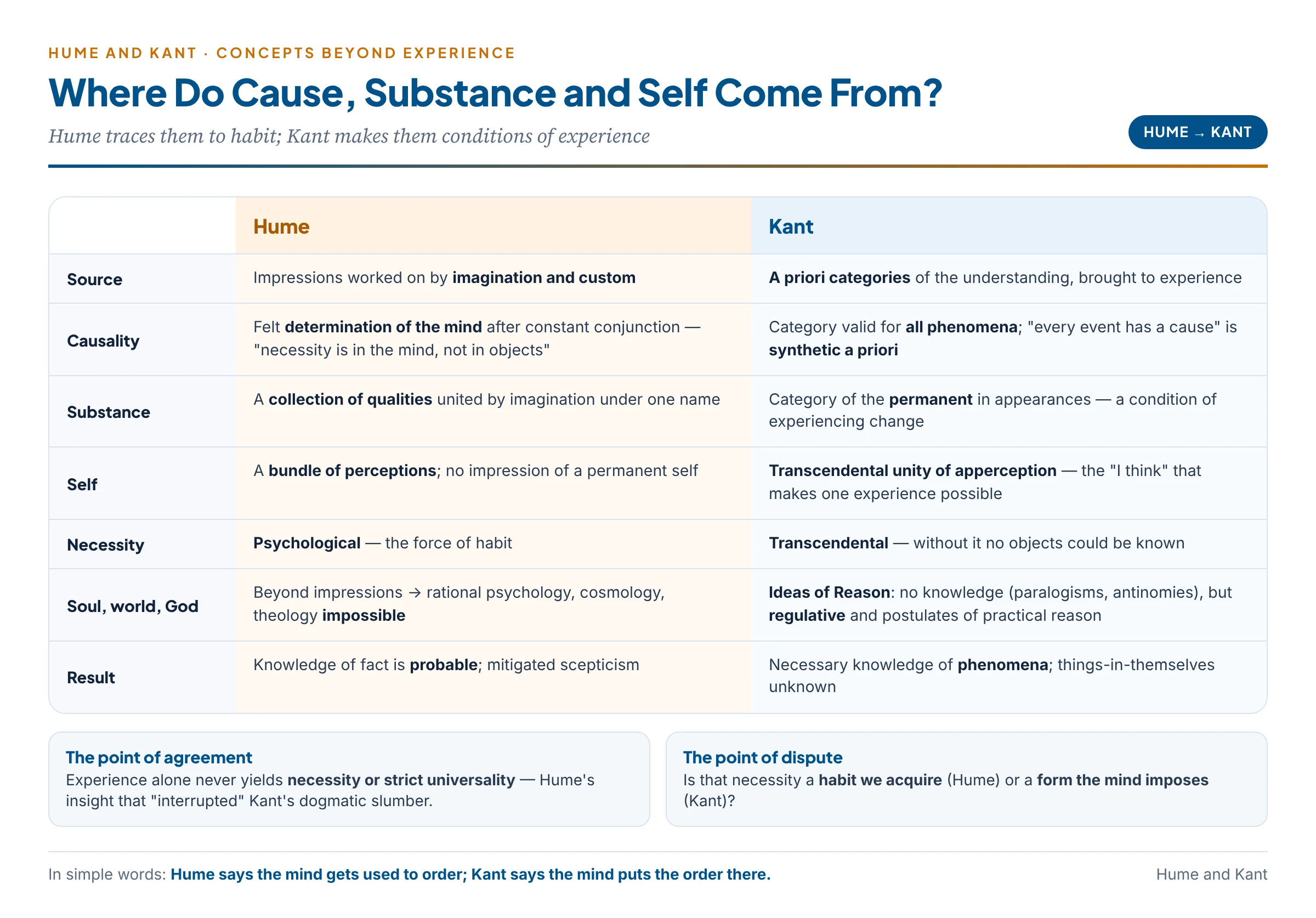
- Necessary connection — no impression in the objects; the idea is copied from an impression of reflection: the felt determination of the mind to pass from cause to effect after repeated conjunction. “Necessity is something that exists in the mind, not in objects.”
- Substance — no impression of a substratum; only a collection of simple ideas united by imagination and given a common name.
- Self — no impression of a permanent self; only a bundle of perceptions, unified by memory and imagination.
- Existence — no separate idea; to conceive a thing and to conceive it as existing are the same.
- Infinity — we have no idea of infinite divisibility; our ideas of extension end in minimal points.
- God — formed by augmenting without limit our ideas of human wisdom and goodness; no demonstrative or experiential proof reaches His existence.
- Reason itself is naturalised. Reason, says Hume, is “nothing but a wonderful and unintelligible instinct in our souls, which carries us along a certain train of ideas.” In conduct, “reason is, and ought only to be, the slave of the passions“: it shows facts and relations but cannot move us to act.
- Verdict. Ideas that claim to give knowledge beyond experience are either empty or are fictions of imagination; rational psychology (of the soul), rational cosmology (of the world as a whole) and rational theology (of God) are impossible.
Kant’s response:
- Agreement with Hume’s negative point. Kant accepted that concepts like causality and substance cannot be derived from experience: experience never shows necessity or strict universality. “The remembrance of David Hume was the very thing which first interrupted my dogmatic slumber.”
- Disagreement on their source. Hume concluded these concepts are “bastards of the imagination” bred by custom. Kant argued they are a priori categories of the understanding — pure concepts the mind brings to experience, and without which there could be no experience of objects at all. Their necessity is transcendental, not psychological.
- Hume’s fork widened. Hume admitted only analytic a priori (relations of ideas) and synthetic a posteriori (matters of fact). Kant showed a third class — synthetic a priori judgments — in mathematics (“7 + 5 = 12,” which Hume wrongly took to be merely analytic) and in the principles of physics (“every event has a cause“). Kant remarks that had Hume seen mathematics to be synthetic, he would not have so easily denied a priori knowledge of matters of fact.
- The Copernican revolution. Instead of the mind conforming to objects, objects conform to the mind’s forms (space and time) and categories. Causality is valid of all phenomena precisely because it is a condition of their being experienced.
- Kant’s own “Ideas of Reason” — soul, world, God. Here Kant largely agrees with Hume: when reason tries to know these, it falls into paralogisms (fallacies about the soul), antinomies (contradictions about the world) and failed proofs of God. But Kant does not “commit them to the flames”: they have a regulative use, guiding inquiry toward system and unity, and practical reason postulates God, freedom and immortality as conditions of morality.
- The self. Against Hume’s bundle, Kant argued that the “I think” must be able to accompany all my representations — the transcendental unity of apperception — or the bundle could never be known as one experience.
- Evaluation.
- Kant turned Hume’s psychological “habit” into epistemological necessity, saving the universality of science and mathematics.
- Critics reply that Kant did not refute Hume so much as change the question: his categories hold only for phenomena, and things-in-themselves stay unknown — a sceptical result in its own way. Some call the transcendental argument a form of escapism.
- Hume’s naturalism, meanwhile, revives in modern cognitive science, which studies how habits of expectation are actually formed.
Common confusion
Did Hume think mathematics is synthetic, or that maths is “derived from experience”? Two opposite errors appear in notes. Hume did not derive mathematical truths from observation: relations of ideas are known by thought alone and hold even if no triangle ever existed. And he did not think mathematics gives information about existence: it is certain because it is about the relations of our ideas. Kant’s objection is precisely that Hume treated arithmetic as analytic, whereas Kant held it to be synthetic a priori. (Hume’s ideas of number and figure are still copied from impressions — the copy principle covers the ideas, not the truth of the relations between them.)
Critical Evaluation
Criticisms of Hume’s Theory of Knowledge
- Perception is more than an impression. Perception by its very nature refers to an object. Hume’s “impression” is a bare sensory datum; but when Hume says “I have seen Paris,” the seeing is a highly complex, interpreted act, not a simple impression.
- The missing shade of blue. By Hume’s own admission the copy principle has an exception; one exception shows the mind can produce ideas not given in impressions.
- Ideas are not exact copies. Call up the image of a shade of red: the same image fits several closely similar shades, and we cannot point to the one impression it copies. “Exactly represent” is psychologically false.
- Vivacity is not a reliable criterion. In fever, madness or violent emotion, ideas become as lively as impressions; some impressions are weak and faint. So force and vivacity cannot sort perceptions into the two kinds.
- Priority cannot be checked. To know that an idea copies an earlier impression, we would have to compare them; but the past impression cannot be recalled except as an idea. Hume himself says “it is impossible to recall the past impressions in order to compare them with our present ideas.”
- The mind is active, not passive. Locke’s error repeats in Hume: in compounding, the simple perception of red is altered within the many-qualitied rose, so the mind creates as well as copies; and seeing the difference between yellow and blue is not a visual act but an intellectual one.
- Atomism is false to experience. Psychologists reject the picture of impressions arriving one by one to a passive mind; we perceive organised wholes (the Gestalt point). “Whatever is distinguishable is separable” does not follow: we can distinguish the colour and shape of a patch, but we cannot have one without the other.
- Memory. Hume assumes memory directly corresponds to past impressions, but memory reconstructs and errs.
- Association cannot do the work of synthesis. Kant: knowledge needs rules of synthesis and concepts — categories — which cannot be reduced to laws of association. And association itself presupposes one consciousness in which ideas are associated.
- The fork is too tidy. If Kant is right about synthetic a priori truths, the fork is not exhaustive. Later philosophers (Quine) questioned the sharp analytic/synthetic line itself.
- Self-refutation charge. The principle “every meaningful idea comes from an impression” is neither a relation of ideas nor an observed matter of fact. By its own test, critics say, Hume’s principle should be committed to the flames.
In simple words
Hume’s theory is like a camera model of the mind: light comes in, a picture is stored, and pictures are later pasted together. Critics say the mind is more like an editor: it chooses, compares, frames and interprets what comes in. Hume describes the camera beautifully, but much of knowledge happens in the editing room.
What Can Be Said for Hume
- Honest limits. Hume showed precisely where reason’s certainty ends: within relations of ideas. Every later theory of knowledge has had to start from his division.
- Meaning and verification. The copy principle and the fork anticipate the verification principle of the logical positivists and the modern demand that theories make testable claims.
- Induction remains open. No universally accepted non-circular justification of induction has been found; probability theory and falsificationism are attempts to live with Hume’s result rather than refute it.
- Belief as natural. Hume’s view that belief is shaped by habit and expectation has strong support in modern psychology and in the study of learning, including machine learning, which generalises from past data exactly as Hume described.
- A weapon against dogmatism. “Commit it to the flames” is a standing challenge to any claim — religious, metaphysical, political — that cannot say what experience would count for or against it.
Critics and Defenders
Criticism — Critics
- Kant: experience requires a priori categories; synthetic a priori judgments exist; association needs a unifying “I think.”
- Critics of the copy theory: the copy principle is neither exceptionless nor verifiable; vivacity fails as a test; perception refers to objects.
- Psychologists (Gestalt): perceptions come as organised wholes, not as separate atoms.
- Rationalists: necessity in mathematics and logic shows reason’s independent power.
- Self-refutation objection: Hume’s own principles fall outside both prongs of his fork.
Defence — Defenders and lasting value
- Hume’s reply: he describes how the mind actually works; nature, not argument, secures our beliefs.
- Logical positivists (Ayer, Carnap): the fork is the basis of a clear theory of meaning.
- Popper: Hume’s problem of induction is real; science should rely on falsification, not on proof.
- Naturalists and cognitive scientists: belief formation by habit and association is an empirical fact.
- Strawson: induction needs no further justification; it is part of what reasonableness means.
Cross-Tradition Comparison
Hume and Indian Theories of Knowledge
| Point | Hume | Cārvāka | Buddhist logicians (Dignāga, Dharmakīrti) | Nyāya |
|---|---|---|---|---|
| Valid sources | Impressions (perception); demonstration only for relations of ideas | Perception alone (pratyakṣa) | Perception and inference | Perception, inference, comparison, testimony |
| What perception gives | Atomic impressions | Sense contact with objects | The bare particular (svalakṣaṇa), free of concepts | Objects with their universals |
| General ideas | Particular ideas used generally by custom | — | Constructed (sāmānya-lakṣaṇa, kalpanā); words work by exclusion (apoha) | Real universals (jāti) |
| Inference about the unobserved | Rests on custom; not rationally justified | Rejected: the universal concomitance (vyāpti) can never be established | Valid, grounded in identity (tādātmya) and causality (tadutpatti) | Valid; vyāpti known through repeated observation, tarka and perception of universals |
| Status of causal necessity | In the mind, not in objects | Things act by their own nature (svabhāva) | Real causal efficiency (arthakriyā) | Real invariable antecedence |
Indian Connect — Key takeaways
- The Cārvāka critique of inference is the closest Indian parallel to Hume’s problem of induction. Inference needs vyāpti, the universal rule “wherever there is smoke there is fire.” But perception reaches only present cases, not all past and future ones; inference cannot prove vyāpti without circularity (it would need another vyāpti); testimony and comparison depend on inference. So, says the Cārvāka, inference gives at best probability, never certainty — Hume’s conclusion two thousand years earlier.
- Nyāya’s reply resembles Kant’s in spirit. Nyāya says we grasp the universal “smokeness” in a single perception (sāmānya-lakṣaṇa pratyakṣa), so the rule covers all smoke; and hypothetical reasoning (tarka) shows that denying the rule leads to absurdity. Like Kant, Nyāya finds a source of necessity that is not mere repetition.
- Buddhist epistemology parallels Hume’s impressions and ideas. The bare, momentary particular (svalakṣaṇa) given in perception is like Hume’s impression; the general concepts we build on it (sāmānya-lakṣaṇa) are like Hume’s ideas used generally — mental constructions, not features of reality.
- A difference. Indian schools debated these questions as a theory of valid means of knowledge (pramāṇa) aimed at liberation; Hume’s aim was a naturalistic science of the mind with no soteriological goal.
Synthesis (Siddhānta)
Hume’s theory of knowledge begins with a simple picture — impressions and their faint copies — and a simple test — “from what impression?” From these he derives the whole shape of human knowledge. There are relations of ideas, certain because they say nothing about existence, and matters of fact, informative because they are never certain. Between the two there is no bridge built by reason: every step from the observed to the unobserved rests on causation, every causal inference on the uniformity of nature, and that uniformity on nothing but custom. Belief, which carries us across the gap, is a lively feeling, not a proof.
The theory has real weaknesses: it treats the mind as more passive than it is, its key distinctions (vivacity, copying) are psychologically shaky, and its own principles fall outside its fork. Kant answered that the mind supplies the necessity Hume could not find in experience. Yet Hume’s central results still stand at the centre of philosophy: mathematics and logic do not tell us what exists; no non-circular proof of induction has been found; and our everyday certainty that the future will resemble the past is, in the end, a fact about human nature rather than a truth of reason.
- Philosophy of science: induction, falsification, confirmation and probability theory all begin from Hume’s problem.
- Logical positivism and analytic philosophy: the verification principle and the analytic/synthetic distinction descend from the fork.
- Cognitive science and machine learning: learning by association and generalisation from past data is Hume’s “custom” made precise.
- Public reasoning: “a wise man proportions his belief to the evidence” remains the best short rule for weighing claims in science, law and the media.
Reason tells us what must be true of our ideas; only experience — and the habits it breeds — tells us what is true of the world.
Previous Year Questions
- 2026How does Hume account for ideas of reason? How does Kant respond to Hume’s views in this regard? Critically discuss.
- 2024How does Kant respond to Hume’s scepticism with regard to a priori judgments? Discuss.
- 2018Are the two truths “The Sun will rise tomorrow” and “2+2=4” of the same necessity for Hume? Give reasons in favour of your answer.
- 2010Does Hume deny the possibility of knowledge? Discuss.
- 2004Hume’s views on Induction. Short notes.
- 2002Hume’s Phenomenalism. Short notes.
- 1995Hume’s arguments against induction. Notes.
- 1990No empirical proposition is ever certain. Comment.