337,362+ aspirants visit every month


Unlock Elite Access: Level Up Your Preparation with Exclusive Content
Sociology Optional PYQ Solutions · Model answer
Write short answer of the following in about 150 words: In what way biographies could be used to study social life?
- UPSC 2014
- Research Methods and Analysis
Unlock the full answer · ₹1,499 ↓
W.I. Thomas, working with Florian Znaniecki, gave sociology its founding demonstration that a single individual's personal account — letters, diaries, an autobiographical statement — could be treated as legitimate sociological data, not merely as anecdotal colour.
You are reading the opening of the model answer. The full answer is part of Sociology Optional PYQ Solutions.
What the full answer covers
- What Biography Uniquely Reveals
- The Method's Limitation
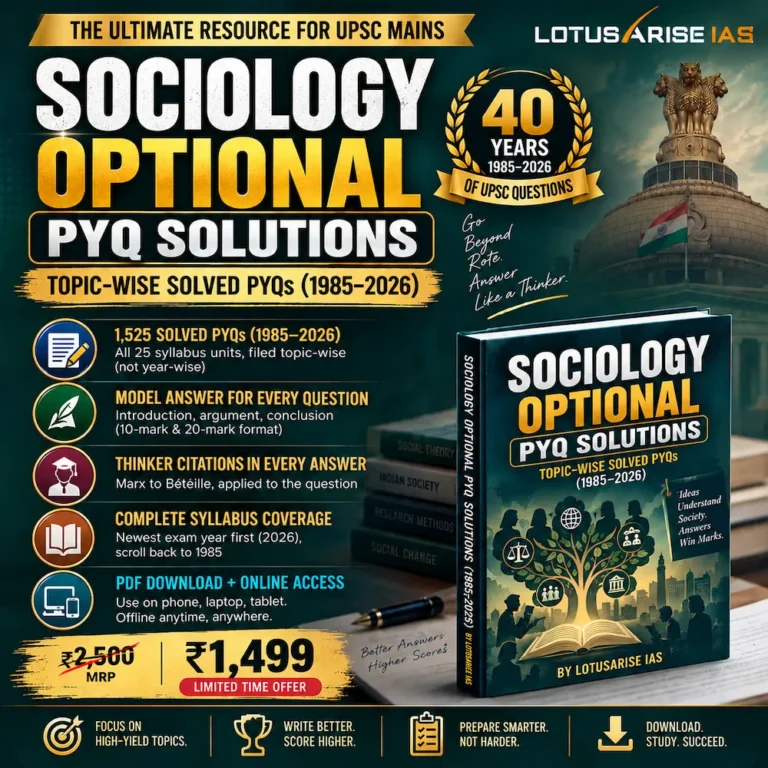
Sociology Optional PYQ Solutions
Unlock this answer and 1,500+ more
- 1,500+ solved UPSC Sociology PYQs from 1985 to 2026, Paper-1 and Paper-2
- Topic-wise across all 25 syllabus units, newest exam year first
- A full model answer for every question, shaped to 10 or 20 marks, with thinkers and Indian examples
- Read online on lotusarise.com, plus PDF download
₹1,499₹2,50040% off
One-time payment · 12 months of access · Instant access · UPI, cards, RuPay
See every Research Methods and Analysis question (63 solved) →Already enrolled? Log in
Sociology Optional · Kits & packs
Score more in Sociology Optional.
Sociology PYQ Solutions give you a full model answer to 1,500+ Sociology PYQs, topic by topic. The Mains Master Kit gives you the complete notes, thinkers and premium articles for the whole syllabus.
- 1,500+ solved PYQs from 1985 to 2026, across all 25 units
- Notes and thinkers for Paper 1 and Paper 2
- One-time payment · instant access · no subscription
Trusted by 3,00,000+ aspirants every month · Secure checkout · UPI, cards, RuPay
Most enrolled in Sociology Optional
Sociology Optional · PDF bundle
Sociology Optional Master Blueprint (Notes + PYQs)
₹500 ₹765 35% off