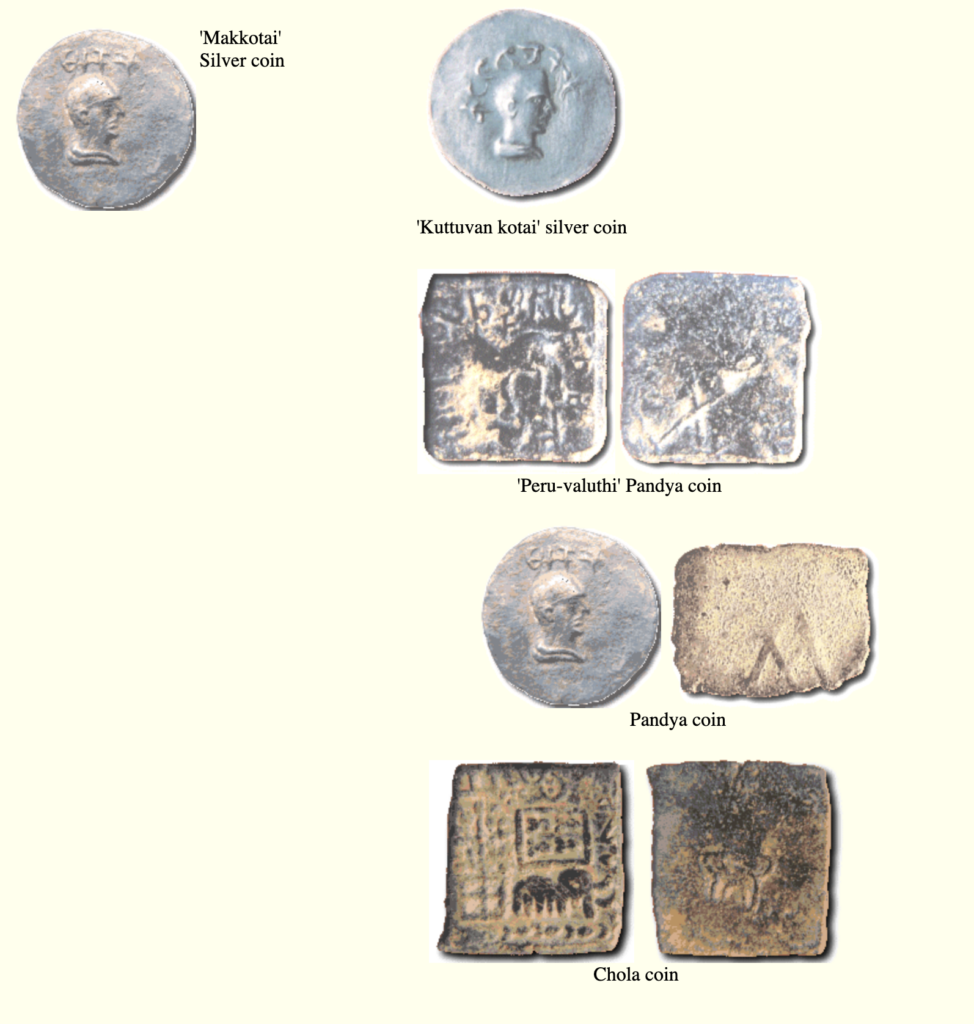
Sangam Age: Coinage

- The introduction of coins, like the Tamil-Brahmi script, was another important innovation of this period. People used coins, at least in some contexts, and the discovery of coin hoards — comprising both local and foreign issues — attests to the trade relations that existed between the ancient Tamil country and other regions.
- According to Monica Smith, the distribution of coins with different weight standards across different regions suggests their use both as a standard of value and as a medium of exchange.
- A fully developed money economy had not yet emerged, but the use of copper coins indicates a degree of monetisation; the use of coinage may have been limited to urban centres or to certain groups of traders.
- It could be argued that these coins functioned as a kind of bullion — their value fixed largely by the weight of the metal, rather than a standardised currency system.
- Roman coins are similarly argued to have been used for their bullion value. Coins from the time of Augustus Caesar are found more frequently, possibly because they were retained and circulated later on account of their high-quality metal content.
- These Roman coins are concentrated in the Coimbatore region of Kongu, suggesting the importance of this area in trade activities.
- Later Roman coins are found more commonly in the southern parts of India and in Sri Lanka; they were probably also used as ornaments during this period, as indicated by indirect references in Tamil literature.
- Trade based on coinage was also prevalent, since traders travelling from distant regions needed to amass their wealth in metal form.
- Although people traded in all kinds of materials, they ultimately converted their profits into metal wealth.
- The use of coins can be understood in the context of people travelling long distances, who needed to acquire wealth in the form of metal bullion that could be easily transported.
- This suggests a kind of pyramidal mode of exchange, where coins were used mainly at the top — for major transactions carried out by a limited number of people — and perhaps functioned as fixed-value units.
- It was likely the traders and the kings who used coins predominantly.
Local Coinage of Sangam
- Local coins also carried value, likely based on their metal content, and may have been minted by kings through the smelting of copper; some such coins might also have been issued as donations.
- Punch-marked coins, along with Chera, Chola, Pandya, and Malayaman coins, are found across Tamil Nadu.
- Sangam literature refers to kasu, pon, and kanam as different types of coins. Kasu was used as an ornament, and perhaps not in commercial transactions.
- The chief Kalankaikkanni Narmuticcheral is recorded as having given 40,00,000 gold coins to Kappiyarry Kappiyanar, while another chief, Atukotpattu Cherlathan, gave Kakkaippatiniyar 100,000 kanam of coins.
- These coins likely had standard shapes and weights, which helped legitimise the king’s authority.