Alauddin Khalji: Introduction

Alauddin Khalji (1296–1316) stands out as one of the most consequential rulers of the Delhi Sultanate — a monarch who combined ruthless centralisation of power with an ambitious programme of territorial conquest, and who undertook the most far-reaching agrarian and market reforms attempted by any Sultan before him. Coming to the throne through the treacherous murder of his uncle and father-in-law, Jalaluddin Khalji, Alauddin rejected his predecessor’s liberal precepts in favour of a theory of fear as the basis of good government, while simultaneously widening the social base of the nobility to include non-Turks, Indian Muslims, and Hindus. His reign witnessed the expansion of Delhi’s authority across Gujarat, Rajasthan, Malwa, and deep into the Deccan and the far south, a sustained and largely successful defence against repeated Mongol invasions, and a set of agrarian and market reforms — from the fixing of land revenue at half the produce to the strict price controls of Delhi’s three markets — that remain unparalleled in the agrarian history of medieval India. This article examines Alauddin’s approach to the state and his administrative and military reforms, the phases and geography of his territorial expansion, and finally his agrarian and market reforms in detail, along with their economic and social impact.
Alauddin Khalji (1296–1316)
- Alauddin Khalji came to the throne by treacherously murdering his uncle and father-in-law, Jalaluddin Khalji.
His Approach to the State
- He established a highly centralised government.
- The Sultan began to consider himself a representative of God, or the “Shadow of God.”
- He did not accept Jalaluddin’s theory of benevolence and humanitarianism, considering it unsuitable to the times and a sign of weak government.
- He instead adhered more closely to Balban’s theory that fear was the basis of good government — a theory he applied to the nobles as well as to ordinary people.
- After the outbreak of a couple of rebellions early in his reign — including one by his nephew, Aqat Khan — he decided to take harsh measures to keep the nobles under control.
- When some Mongol soldiers who had participated in the Gujarat campaign rebelled against the state’s policy of claiming 4/5th of the war spoils, Alauddin imprisoned their wives and children living at Delhi — a practice Barani notes was novel at the time.
- By the time Alauddin came to the throne, the position of the Delhi Sultanate was fairly well consolidated. This emboldened him to undertake a series of internal reforms and experiments, aimed at improving the administration, strengthening the army, strengthening the land revenue system, and providing for the welfare of citizens.
- However, Alauddin accepted Jalaluddin’s contention that a truly Islamic state could not be set up under the specific conditions prevailing in India.
- In his discussions with Qazi Mughis of Delhi, as reported by Barani, he asserted that splendour and show, along with the award of punishments not sanctioned by sharia (Holy Law), were inescapable in India. He went so far as to declare: “I do not know what is lawful or unlawful according to shara. Whatever I consider necessary for the state or for its welfare, I decree.”
- Barani sadly concludes that Alauddin was convinced that matters concerning the state and administration were independent of the rules and orders of the sharia — while state matters pertained to kings alone, the latter (the sharia) had been assigned to qazis and muftis, i.e., those concerned with justice in the courts.
- During Alauddin’s reign, the non-Turks were no longer kept back, and forged ahead.
- This was the reason Alauddin was able to choose and promote to the top many non-Turks, such as Zafar Khan and Nusrat Khan, and later Malik Kafur, a non-Turk slave who had been captured in Gujarat.
- Malik Nayak, a Hindu who had been governor of Samana and Sunam, was given command of an army — with Muslim officers serving under him — which inflicted a crushing defeat on the Mongols.
Alauddin’s Administrative Reforms/Regulations
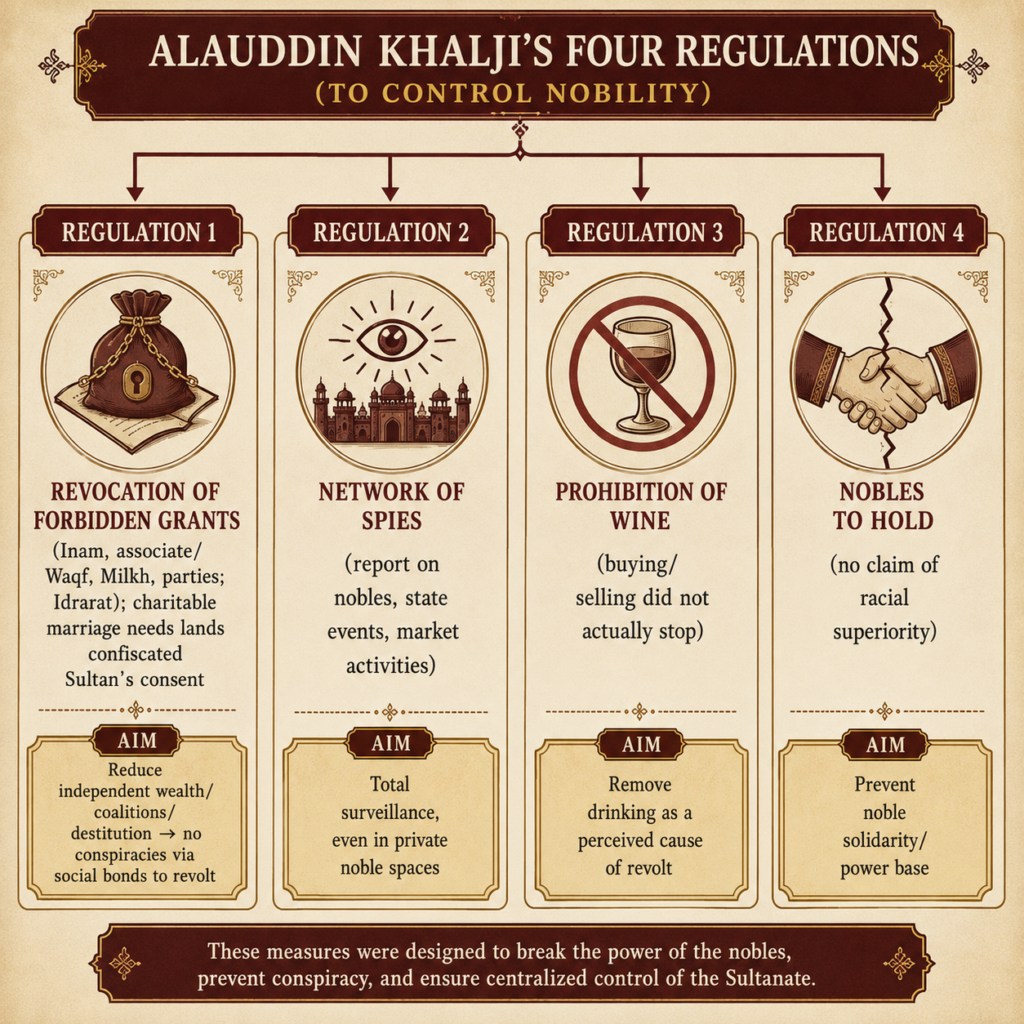
- Regulation 1: Revocation of all grants — such as Inams, Waqf, Milkh, and Idrarat pension.
- Instructions were issued to officials to extort money from nobles and people.
- Almost all the nobles of Jalaluddin’s time, whom Alauddin had won over by the lure of gold and positions, were uprooted, and their accumulated wealth confiscated.
- Alauddin hearkened back to Balban’s belief — one shared by the historian Barani — that the people should not be left enough means to harbour thoughts of rebellion. As part of this policy, he ordered that all charitable lands — i.e., lands assigned in waqf or inam — be confiscated.
- The idea was to force people to work for their livelihood, keeping them too occupied to think of revolt.
- Barani points out that Alauddin’s agrarian reforms were also part of this same policy — reducing the people, i.e., the Hindus, to a position of destitution in order to avoid rebellion.
- Instructions were issued to officials to extort money from nobles and people.
- Regulation 2: Creation of a network of spies.
- He revived Balban’s system of spies, who kept him informed of all developments — even those occurring in the privacy of the homes of nobles.
- The functions of these spies were to:
- Provide information about the activities of nobles.
- Provide information about state events.
- Provide information about people’s activities in marketplaces.
- Regulation 3: Prohibition of wine drinking.
- However, Alauddin himself admitted to the Chief Qazi that the buying and selling of wine did not actually stop.
- The reasoning behind this regulation was that he considered drinking a cause of revolts.
- Regulation 4: Nobles forbidden to associate with each other.
- Nobles were forbidden from holding convivial parties with one another; even for forming marriage alliances, they had to seek the Sultan’s permission.
Military Reform
- Alauddin Khalji maintained a strong and huge standing army to safeguard his empire.
- He introduced the system of branding of horses (dagh) and the maintenance of a descriptive register of soldiers (huliya), to prevent false musters and corrupt practices.
- Alauddin abolished the Jagir system and paid salaries in cash.
- He fixed the pay of soldiers at 234 tankas a year, with an additional 78 tankas for a soldier maintaining two horses.
- The Ariz-i-Mumalik was in charge of the appointment of soldiers.
Alauddin’s Conquests and Territorial Expansion
- After the death of Iltutmish in 1235, the process of expansion of the boundaries of the Delhi Sultanate came to a halt.
- For nearly half a century thereafter, the efforts of the Sultans of Delhi were geared towards consolidating early territorial gains, strengthening the fiscal and administrative base of the Sultanate.
- The next phase of territorial expansion, therefore, began only with the opening of the 14th century, under the Khaljis.
- Alauddin’s administrative and economic measures had helped consolidate as well as widen the base of the Sultanate.
- The greater openness on the part of the Khaljis in recruiting officials, administrators, and soldiers from elements beyond the Turks — i.e., Indian Muslims and Hindus — along with the internal restructuring of the administration, created the conditions for the rapid territorial expansion of the Sultanate.
Phases of Expansion
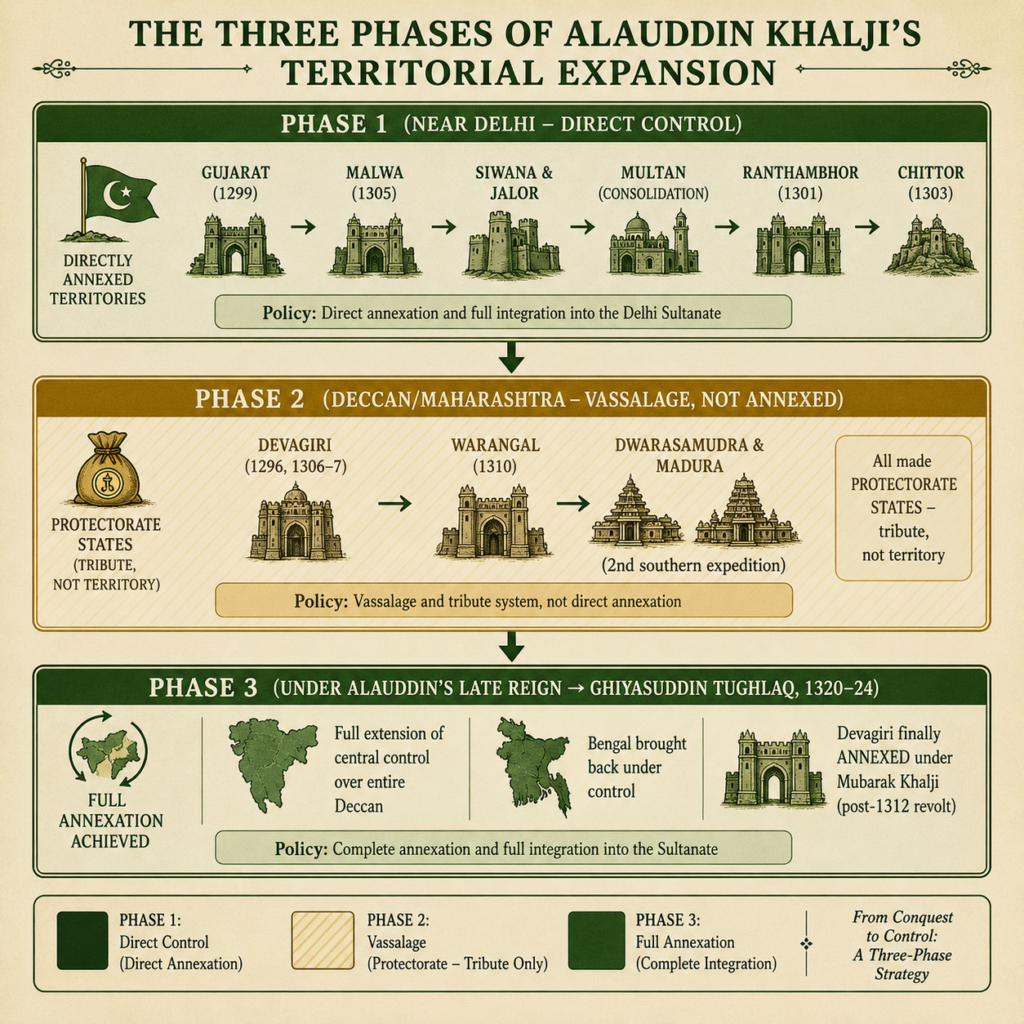
- First phase: Areas not far from Delhi, such as Gujarat, Rajasthan, and Malwa, were brought under Delhi’s control.
- Second phase: Principalities in modern Maharashtra and the Deccan were raided and compelled to accept Delhi’s vassalage.
- No attempt, however, was made during this phase to bring them under the direct control of the Delhi Sultans.
- Third phase: Beginning in the last years of Alauddin’s reign, and climaxing during the reign of Ghiyasuddin Tughlaq (1320–24), this phase saw the extension of central control over the entire Deccan; Bengal was also brought under control once again.
West and Central India
- Gujarat (1299): This was the first project of territorial expansion under Alauddin, who was attracted by the wealth of Gujarat, whose flourishing trade had always lured invaders.
- The army was jointly commanded by two of Alauddin’s best generals, Ulugh Khan and Nusrat Khan. Gujarat proved easy prey — it was plundered, its capital Anhilwara sacked, and Alp Khan made governor.
- Malwa (1305): The fort of Mandu was captured; Ain-ul-Mulk was appointed governor, bringing Ujjain, Dhar, and Chanderi under his control.
- Siwana and Jalor were also annexed.
North-West and North India
- Multan:
- The Multan expedition was not an act of territorial expansion but part of the policy of consolidation — a surviving member of Jalaluddin’s family had fled to Multan.
- Arkali Khan was made prisoner, and Multan once again came under the control of Delhi.
- Ranthambhor:
- In 1300, Alauddin sent Ulugh Khan to march against Ranthambhor, ruled by Rai Hamir. Alauddin had to personally take command of the campaign; the siege lasted over six months.
- Ultimately, the women inside the fort performed jauhar, and Hamir Dev died fighting.
- Chittor:
- In pursuance of the same policy, Alauddin attacked the kingdom of Chittor in 1303. After several assaults, the ruler of Chittor suddenly sent an offer of surrender to the Sultan on his own accord.
- The fort was later bestowed upon Maldeo, a son of the sister of Chittor’s earlier ruler, who remained loyal to Delhi till the end of Alauddin’s reign.
Deccan and Southward Expansion
- Devagiri:
- In 1296, during his governorship of Kara, Alauddin had already plundered Devagiri.
- In 1306–7, due to the immediate cause of non-payment of tribute, Alauddin sent Malik Kafur against Rai Ram Chandra Dev of Devagiri, with Ainul Mulk Multani and Alp Khan providing assistance.
- Rai Ram Chandra Dev surrendered and was made a protectorate — Alauddin’s policy was not to annex but to amass as much wealth as possible.
- Ram Chandra Dev was accorded great honour by the Sultan and restored to the throne of Devagiri, in return for the assurance of regular and prompt payment of an annual tribute.
- Further south:
- Malik Kafur’s careful handling of the Devagiri affair enhanced the Sultan’s confidence in his abilities as a military general, and he was entrusted with the responsibility of making forays into the peninsular region of the South.
- The acquisition of wealth from southern kingdoms — rather than actual territorial annexation — appears to have been the prime motive behind these expeditions.
- Sirpur and Warangal were also attacked and looted.
- From Warangal (1310), an enormous amount of wealth was accumulated, but the kingdom was not annexed, instead becoming a protectorate state.
- In a second expedition to the south, Dwarasamudra and Madura (capital of the Pandyas) were targeted — in both cases, wealth was accumulated and the kingdoms made protectorate states.
- Malik Kafur’s careful handling of the Devagiri affair enhanced the Sultan’s confidence in his abilities as a military general, and he was entrusted with the responsibility of making forays into the peninsular region of the South.
- The Deccan and southward campaigns had two basic aims:
- A formal recognition of the authority of the Delhi Sultan over these regions.
- The amassing of maximum wealth at the minimal loss of life.
- The policy of not annexing the conquered territories, while accepting acknowledgement of the Sultan’s suzerainty, speaks to Alauddin’s political sagacity.
- Amir Khusrau has given detailed accounts of the campaigns against the southward kingdoms in his Khazain-ul Fatuh.
- Within a year of Malik Kafur’s return from Ma’bar, developments in the Deccan called for a review of the policy of non-annexation. After Ram Dev (ruler of Devagiri) died in 1312, his son declared independence. As a result, under Mubarak Khalji (Alauddin’s successor), Devagiri was annexed.
Alauddin’s Effort to Deal with the Mongol Challenge
- The Mongol invasions of 1297–98 and 1299 were successfully repelled — these first two Mongol incursions were defeated.
- These successes made Alauddin relaxed.
- By the end of 1299, however, the Mongols appeared again and reached straight up to Delhi. Alauddin was taken aback, but showed a brave front and prevented the Mongols from entering the capital city.
- Delhi was saved, but this event was a great shock for Alauddin — the able general Zafar Khan was killed during this fight.
- Alauddin now paid serious attention to this issue:
- A strong rampart was created around Delhi for defence; all forts were repaired; strong military forces were deployed at Samana and Dipalpur.
- A large standing army was recruited.
- In 1303, the Mongols appeared again and reached Delhi, but Alauddin had created a strong defence line outside Siri, so the Mongols retreated without a fight.
- In 1305, the Mongols appeared again and reached the Doab region, bypassing Delhi; Alauddin’s forces, under Malik Nayak, defeated the Mongols badly.
Agrarian and Economic Measures
- Alauddin Khalji’s agrarian and market reforms should be seen both in the context of efforts at the internal restructuring of the Sultanate, as well as the need to create a large army to meet the recurrent threat of Mongol invasions.
- Barani’s account gives detailed information about the revenue system of Khalji’s time; Alauddin took stern measures in this field.
Agrarian Reform
- Bringing Land Under Khalisa:
- The area extending from Dipalpur and Lahore to Kara, near modern Allahabad, was brought under khalisa — i.e., not assigned to any noble as iqta.
- The magnitude of the state demand was set at half the produce of the land.
- The land was to be measured (masahat), and land revenue fixed on the yield of each unit of area. The term used was wafa-i-biswa (wafa = yield; biswa = 1/20th of a bigha) — most probably levied separately on the holding of each individual cultivator.
- Alauddin also levied Kharaj, Jazia, and Karai-Ghari-Charai on peasants.
Curbing Privileges of Intermediaries
- The privileges of intermediaries (Khots, Muqaddams, Choudharys, etc.) were abolished, and they were brought under the new system.
- Intermediaries and peasants alike were now to pay the same standard demand (50%), without any distinction between intermediary or ordinary peasant (balahar).
- In the language of Barani, the intermediaries were reduced to the level of the balahar — the lowest of the low in village society — with their menial labour and even their women’s work being forced into service in the houses of Muslims for wages.
- The perquisites of intermediaries were disallowed; the grazing tax and house tax (Ghari) were also to be taken from the intermediaries.
Reform in Revenue Administration
- The state’s direct relations with the peasants resulted in an expansion of revenue officials. Alauddin tried to ensure the efficient and honest working of the machinery of revenue administration.
- Large numbers of accountants (mutsarrif), collectors (amils), and agents (gumashtas) had to be appointed. That this was accomplished in a comparatively short period shows how effectively the new rulers were able to reach even the small towns.
- Local officials charged with collecting land revenue were instructed to be so strict that cultivators were made to sell their food-grains for payment of land revenue to merchants at cheap prices without even taking them to their own storage pits.
- Alauddin desired that the accounts of all these officials be strictly audited by the naib wazir, Sharaf Qais — and if, on the basis of the account-books of the village patwaris (something we hear of for the first time), even a single jital was found outstanding against an official, they were to be severely punished.
- Alauddin was prepared to give officials sufficient wages to lead a decent life, but took a serious view of bribe-taking and corruption.
- Barani notes, in his characteristic manner, that none of the amils and mutsarrifs could take bribes — they had been reduced to such a position by hardships, imprisonment, or torture for even small outstanding dues, that people considered these posts too degrading, and were unwilling to marry their daughters to those who held them.
Mode of Payment: Collection in Kind
- Ordinarily, payment in cash was the general practice during the 13th century, and became quite widely prevalent by the 14th century.
- However, Alauddin himself preferred collection in grain. He decreed that the whole revenue due from the khalisa in the Doab should be realised in kind, and only half the revenue due from Delhi (and its suburbs) in cash.
- Reason for his preference:
- To maintain a large reserve of grain stored at Delhi and other areas, for contingencies such as scarcity owing to drought or other factors.
- To use this storage as a lever for his price-fixation measures in the grain market.
- Reason for his preference:
- Barani indicates the extent of the area where these measures operated — covering the heart of Alauddin’s empire. However, Bihar, Awadh, Gujarat, and parts of Malwa and Rajputana are not mentioned; these measures were largely meant for the khalisa (“crown” or “reserve” land).
Objective of the Agrarian Reforms
- To free peasants from the illegal exactions of the intermediaries.
- As Barani mentions, there were two reasons:
- The Sultan’s policy was that the “burden” (bar) of the “strong” (aqwiya) should not fall on the “weak” (zuaja), and also to check the intermediaries, since they had become intractable.
- It was directed against the Hindus, since most local chiefs were Hindus.
- These measures, however, can hardly be considered socialistic. In fact, all of Alauddin’s reform measures were basically designed to meet an emergency situation posed by the danger of the Mongols.
Impact of Land Revenue Reform
- The 50% demand was the highest in the entire agrarian history of India.
- Though peasants were now protected from the economic oppression of the intermediaries, they had to pay a higher rate of taxation than before.
- We do not know precisely to what extent Alauddin’s demand of half the produce marked an actual rise, since we have no information about the actual incidence of land revenue earlier — but the 50% demand was, nonetheless, the highest in India’s agrarian history.
- Since the rate was uniform, it constituted, in a sense, a form of regressive taxation.
- Thus, the state gained at the cost of the intermediaries, leaving the peasants in the lurch.
- It is true that intermediaries were eliminated from direct revenue collection, but they were still expected to maintain law and order in the countryside and assist revenue officials, without any remuneration or perquisites.
- Large-scale corruption and embezzlement surfaced among revenue officials, for which they were ruthlessly punished by the naib wazir — about 8 to 10 thousand officials were imprisoned.
Market Reforms
Alauddin Khalji was more or less the first ruler who looked at the problem of price control in a systematic manner, and was able to maintain stable prices for a considerable period.
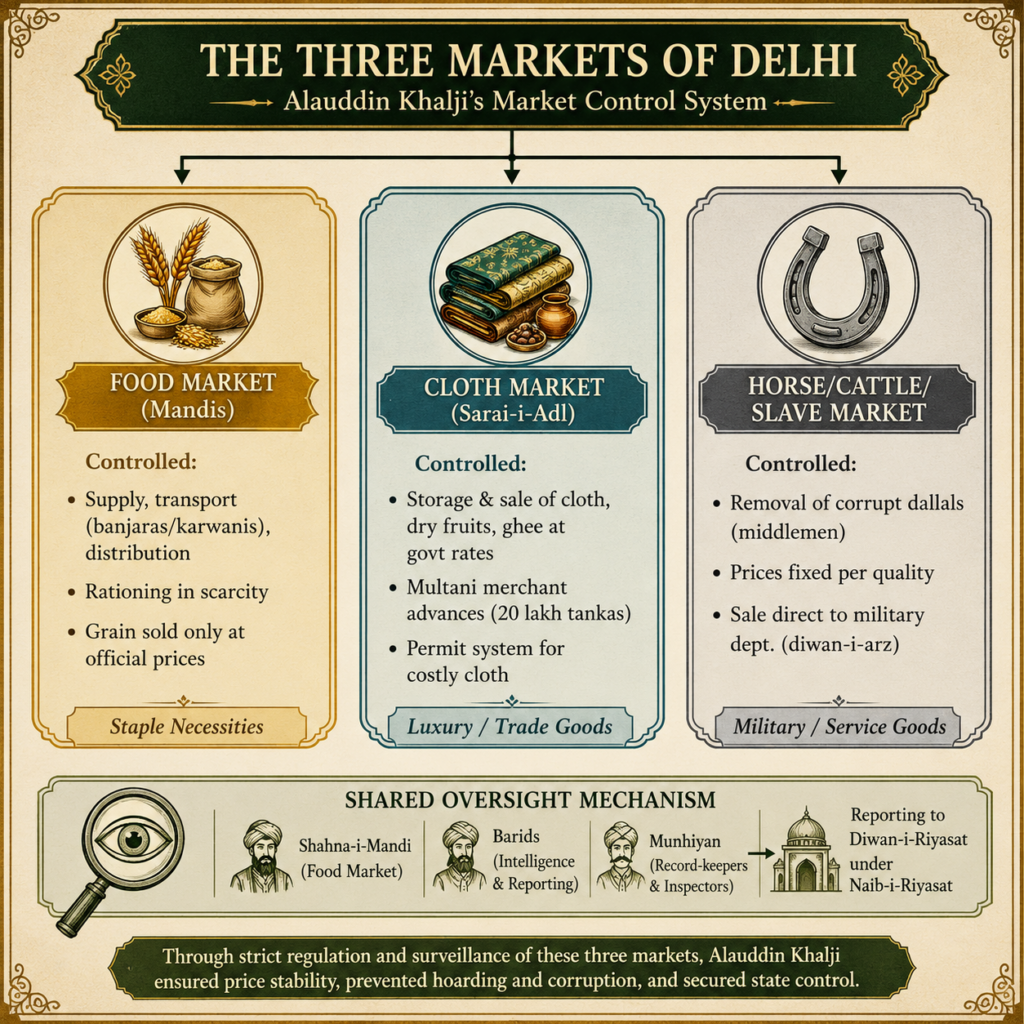
- According to Barani, Alauddin set up three markets at Delhi.
The Food Market
- Alauddin tried to control not only the supply of food-grains from the villages, and their transportation to the city by grain-merchants (karwanis or banjaras), but also their proper distribution to the citizens — these were the three most important aspects in controlling food prices.
- His first effort was to ensure sufficient government stocks of food-grains, so that traders would not hike prices by creating an artificial scarcity. For this purpose, royal stores were set up at Delhi and nearby areas.
- The transportation of food-grains from the countryside was generally carried out by the karwaniyan or banjaras. An official (shuhna) was appointed to oversee them; in normal times, the banjaras brought in so much grain that it was not necessary to touch the royal stores.
- To ensure a regular supply of food-grains to the banjaras, a number of regulations were made — e.g., increasing khalisa land, fixing land revenue at half, and enforcing strict collection of revenue.
- Barani tells us that cultivators were not allowed to keep more than 10 man of grain for themselves — all food-grains were to be brought to the market (mandis) for granaries set up by Alauddin, and sold only at official prices.
- An officer, the shahna-i-mandi, was in charge of the market, with strict instructions to punish anyone who violated the orders.
- Barani says that, as a consequence, the price of grains fell: wheat sold for 7½ jital per man, barley for 4 jital, and superior-quality rice for 5 jital.
- Alauddin also instituted a system of rationing during times of scarcity — each grocer was issued an amount of grain from government stores, and if an individual had no villages or lands of their own, they were issued grains according to the number of their dependants.
- Barani records that, as a consequence of these measures, even during times of famine, there was no shortage of food-grains at Delhi, and the price of food-grains did not increase even by a dam or a dirham. This is supported by Isami, a contemporary of Barani.
The Cloth Market (Sarai-i-Adl)
- This market also sold dry fruits, herbs, ghee, oil, and other commodities that could be kept for a long time.
- Alauddin ordered that all cloth brought by merchants from different parts of the country, including foreign lands, be stored and sold only in this market, at government rates. If any commodity was sold even a single jital higher than the official price, it would be confiscated, and the seller punished.
- To ensure adequate supply of all commodities, all merchants were registered, and a deed taken from them, committing to bring the same quantities of commodities to the sarai-adl every year, to be sold at government rates.
- These steps were not entirely new, but two measures reflected fresh thinking:
- First, the rich Multani merchants — those who brought commodities from long distances, including foreign countries — were given an advance of 20 lakh tankas from the treasury, on condition that they not sell to intermediaries, but sell directly at the sarai-adl at official rates.
- Second, the power and responsibility for enforcing these orders was given to a body of merchants themselves.
- To ensure that costly cloth was not purchased by ordinary people and passed on to others, who might take it out of Delhi and sell it in neighbouring towns at four to five times the price, an officer was appointed to issue permits to amirs, maliks, etc., for the purchase of such costly commodities, in accordance with their income.
- Control of the price of cloth, perfumes, etc., was not vital to the Sultan, but was nonetheless fixed, because:
- Prices in this sector would affect prices in general.
- It may have been done to please the nobility.
The Market for Horses, Cattle, and Slaves
- The supply of good-quality horses at fair prices was important both for the military department and the ordinary soldier. The horse trade was more or less a monopolistic trade, overland trade being monopolised by Multanis and Afghans, but sold in the market by middlemen or dallals.
- According to Barani, the rich dallals were as powerful as the officials of the market, resorting to bribery and other corrupt practices; horse-merchants were in league with the dallals to raise horse prices.
- Alauddin took harsh measures against such dallals — they were banished from the town, and some imprisoned. Then, with the help of other dallals, the quality and price of horses were fixed as per quality.
- Alauddin wanted that rich men and dallals should not go to the horse market at all, and that horse-merchants should sell directly to the military department (diwan-i-arz).
- His efforts to eliminate middlemen were not entirely successful, though Barani tells us that the prices of horses fixed by Alauddin remained stable throughout his reign.
- Similarly, the price of slave boys and girls, and of cattle, were also fixed.
- These prices were apparently fixed to make life a little easier for the nobles, the richer sections (including government servants), and soldiers, who had become accustomed to buying slaves for domestic and personal service.
- Likewise, animals were needed for meat, transport, and milk and milk products.
Officers and Regulations for the Markets
- To implement these reforms, three types of officers were appointed:
- A controller of market (shahna-i-mandi): each market was under the control of this officer, who maintained a register of all merchants.
- Intelligence officers (barids).
- Secret spies (munhiyan), who sent reports to the Sultan regarding the functioning of these markets.
- A separate department, called the Diwan-i-Riyasat, was created under an officer titled the Naib-i-Riyasat.
- Detailed regulations (Zawabit) were framed to control and administer the three markets:
- Regulation 1: The Sultan fixed the price of all commodities.
- Regulation 2: Three types of officers were appointed — shahna-i-mandi, barids, and munhiyan.
- Regulation 3: Granaries were established in Delhi and in Chhain in Rajasthan; land revenue from khalisa land was realised in kind, to be stored in these granaries.
- Regulation 4: Grain merchants were placed under the supervision of the shahna-i-mandi, with sureties taken from them.
- Regulation 5: Hoarding was prohibited.
- Regulation 6: The Sultan ordered such vigour in land revenue collection that peasants would be forced to sell their produce right by the side of their fields.
- Regulation 7: The Sultan himself received daily reports from these three sources — shahna-i-mandi, barids, and munhiyan.
Objective of the Market Reforms
- Barani gives two reasons for the market reforms:
- First, Alauddin instituted the reforms because, after the Mongol siege of Delhi, he wanted to recruit a large army — but all his treasury would have soon been exhausted if he had to pay soldiers their normal salaries. As a result of price control and the resulting fall in prices, he was able to recruit more soldiers at the same cost.
- Second, Barani offers another reason: that it was part of Alauddin’s general policy to impoverish the Hindus, so that they would cease to harbour thoughts of rebellion — since most traders were Hindus.
- Amir Khusrau, by contrast, says it was for public welfare — i.e., ensuring cheap food grains and combating famine.
- On balance, Alauddin’s market reforms were oriented more towards administrative and military necessities than towards genuine internal restructuring.
- It is not entirely clear whether Alauddin’s market regulations applied only to Delhi, or also to other towns in the empire.
- Barani tells us that regulations concerning Delhi tended to be followed in other towns as well; in any case, the army was stationed not only in Delhi but in other towns too.
- However, we do not have sufficient information to be certain on this matter.
Impact of the Market Reforms
Impact on the Economy
- Positive impacts:
- During Alauddin’s reign, prices of goods were low; foodstuffs and other necessities were easily available; hoarding, black-marketing, cheating by the business community, and exploitation by middlemen were checked.
- The regulations provided for rationing of grain in times of drought or famine.
- We do not hear of any large-scale famine or death from starvation during Alauddin’s reign.
- A significant and lasting impact of these reforms was the furthering of a market economy in the villages, bringing about a more integral relationship between town and country, and furthering the process of internal restructuring of the Sultanate.
- Delhi became the biggest market for fine cloth, whose price was fixed, drawing traders from all places to buy it and resell it elsewhere at higher prices.
- Negative impacts:
Impact on Society
- Since goods were sold at cheap rates in Delhi, many people migrated to the city, including learned men and excellent craftsmen — paving the way for cultural intercourse among the people of the Sultanate and helping the development of a composite culture in society.
- The task of transporting food-grains from the countryside, generally carried out by karwans and banjaras, required them to form themselves into one corporate body, providing sureties for one another — in this process, they became, though unconsciously, carriers of the exchange of ideas, further enriching the evolving socio-cultural life of Delhi.
- Alauddin oppressed the higher-ups, but provided great relief to the common man — this can be seen as a form of social justice.
- The removal of middlemen lessened their power and socially degraded them.
- Alauddin’s military strength increased on account of the price-control system, which not only provided strength and stability to the administration but also provided employment to the people.
- Through employment, he checked social unrest on the one hand, while on the other, he saved the people from the Mongol menace, controlled the revolts of local chiefs, and led a successful expedition to South India.
- Due to tough regulations, aided by officers and spies, the level of crime decreased and the rule of law prevailed — roads were made safe for travel, allowing traders to bring goods to market easily.
- Though criminal acts were controlled, the heavy-handed approach of Alauddin Khalji nonetheless created resentment in society.
How Far the Aims Were Achieved
- During Alauddin’s reign, prices of goods remained low, and foodstuffs and other necessities were easily available; hoarding, black-marketing, cheating, and exploitation by middlemen were checked.
- We do not hear of any large-scale famine, death, or starvation during Alauddin’s reign.
- Alauddin was able to raise a large army and successfully oppose the Mongol invasions.
Why the Market Control System Did Not Survive
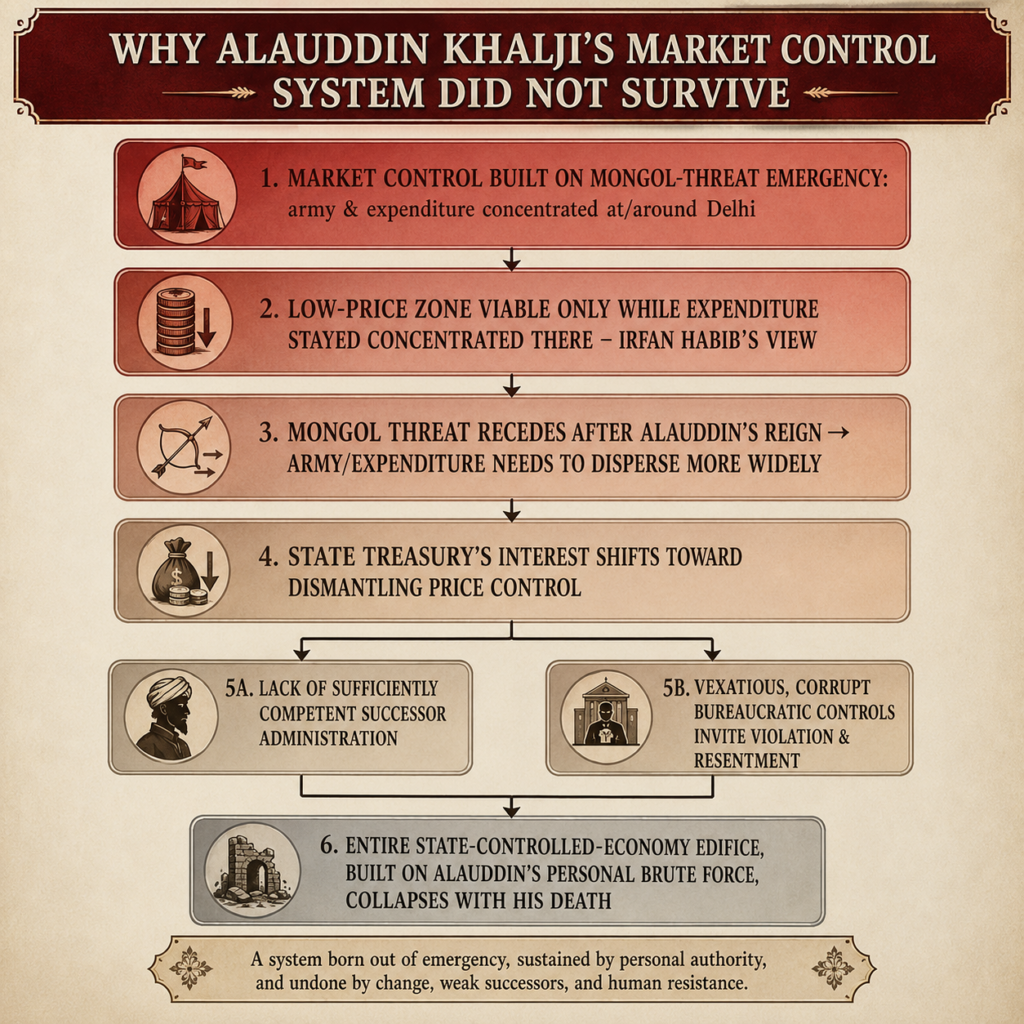
- The market control measures did not survive — we do not hear of them after Alauddin Khalji’s time.
- A very efficient and alert administration was imperative for the success of price control; therefore, one possible reason for its non-survival could be the lack of sufficiently competent administration among his successors.
- Irfan Habib, however, offers a different explanation for the abandonment of price control:
- Since the prevalence of low prices implied lower revenues from the low-price zone, price control was viable only as long as the zone of low prices remained restricted, and most expenditure remained concentrated there.
- With the Mongol threat receding, the army and expenditure had to be dispersed more widely, no longer concentrated at and around Delhi alone — and the interests of the state treasury now lay in dismantling price control.
- The regulations of Alauddin had also resulted in considerable vexatious, bureaucratic control and corruption. Perhaps Alauddin would have been more successful had he controlled the prices of essential commodities only, or those meant for direct military use. But by attempting to control the price of everything, such widespread, centralised controls were bound to be violated, inviting punishments that led to resentment.
- Thus, by their very nature, Alauddin Khalji’s market reforms were temporary, largely meant to tide over an emergency or a particular situation. The entire edifice of state-controlled economy, built on the brute force of Alauddin Khalji, ultimately died with him.
Conclusion
Alauddin Khalji’s reign (1296–1316) represents the high-water mark of early Delhi Sultanate statecraft — a ruler who fused ruthless centralisation, a broadened and more meritocratic nobility, sustained territorial expansion from Gujarat to Madura, and an unprecedented experiment in agrarian and market regulation, all bound together by the overriding imperative of withstanding the Mongol threat. His policy of non-annexation in the Deccan and South, extracting wealth and formal suzerainty rather than direct control, reflected genuine political sagacity, while his agrarian reforms — curbing intermediaries but imposing the highest land-revenue demand in India’s medieval history — and his market controls, which achieved remarkably stable prices at the cost of pervasive bureaucratic coercion, together reveal a state apparatus built almost entirely on the personal will and force of the Sultan himself. It is telling, then, that this entire edifice of state-controlled economy and centralised authority proved unsustainable beyond Alauddin’s own lifetime — a reminder that even the most effective personalised despotism in medieval India could not, by itself, create durable institutions capable of outliving its founder.