Trade and Commerce in the Thirteenth and Fourteenth Centuries

- During the Sultanate period, as in earlier centuries, India remained the manufacturing workshop for much of the Asian world and adjacent regions of East Africa, sustained by brisk and well-established domestic trade.
- India’s commercial position rested on highly productive agriculture, skilled craftsmen, strong manufacturing traditions, and a highly specialised and experienced class of traders and financiers.
- The growth of towns and a genuine money nexus in north India, following Turkish centralisation, brought improved communications, a sound currency system built around the silver tanka and the copper dirham, and the reactivation of Indian trade — particularly overland trade with Central and West Asia.
- This article examines trade and commerce in the thirteenth and fourteenth centuries through the concept of “induced trade,” the structure of both inland (domestic) and foreign trade, the key commercial classes who sustained this economy, and the transport systems that connected it all.
The Concept of “Induced Trade”
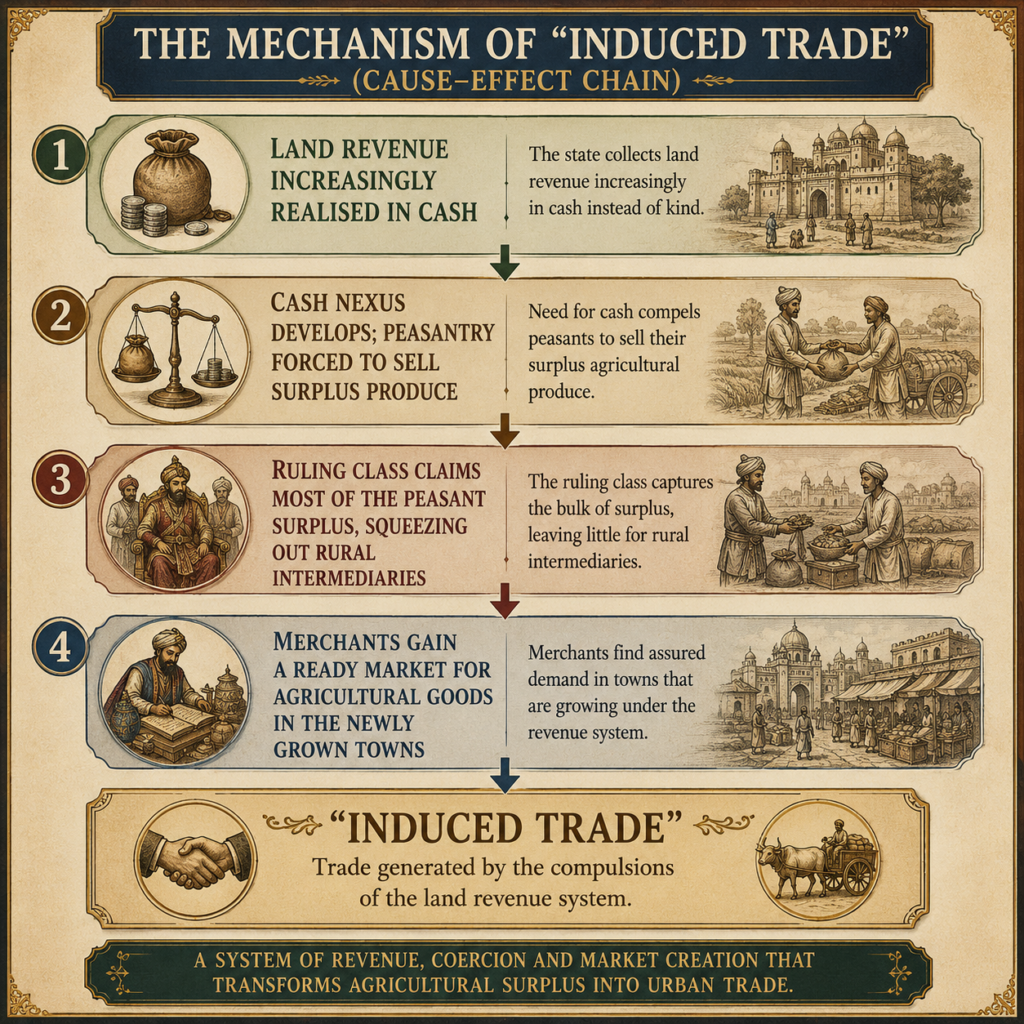
- “Induced trade” refers to trade generated directly by the compulsions of the land revenue system.
- Several factors proved conducive to the development of this inland trade:
- The growing practice of realising land revenue in cash, and the corresponding development of a cash nexus.
- The peasantry, as a result, was forced to sell its surplus produce.
- Merchants, in turn, found a ready market for agricultural products in the newly emerged towns.
- The ruling class also tended to claim almost the entire peasant surplus, in a deliberate effort to reduce the share otherwise captured by rural intermediaries.
Inland Trade (Domestic Trade)
- Inland trade can be divided into two broad categories:
- Local trade, between villages and with mandis and district towns.
- Long-distance trade, between metropolitan towns and wider regions.
Village–Town Trade (Local Trade)
- This short-distance trade in bulk commodities was a natural consequence of two developments: the emergence of towns (which needed food and raw material) and the realisation of land revenue in cash (meaning villages, too, needed cash).
- The turnover of this trade was high in volume but low in value.
- The commodities involved were chiefly foodgrains — wheat, rice, gram, sugarcane — and raw materials such as cotton, destined for urban manufacture.
- A distinctive feature of this trade was its essentially one-way flow of commodities, since villages remained, by and large, largely self-sufficient.
- The sale of crops was primarily the responsibility of the village bania, who in turn supplied peasants with essentials such as salt and spices, and raw iron for the village blacksmith.
- On occasion, wealthier cultivators carried their own surplus produce directly to local mandis — a practice Alauddin Khalji actively encouraged, specifically to discourage hoarding at the village level.
- These mandis were further supplemented by local fairs, where animals — essential for field operations, local transport, and milk — were also traded, playing a genuinely vital role in the country’s economic life.
- Local trade, however, did not generate enough wealth to make its traders genuinely prosperous — the much-maligned village bania likely enjoyed a standard of living no higher than that of a reasonably well-off peasant.
Inter-Town Trade (Long-Distance Trade)
- Long-distance trade centred on high-value goods — primarily luxury articles, though bulk commodities featured as well, with the manufactures of one town regularly carried to another.
- The trading activities of wealthy merchants and financiers — the sahs, modis, and sarrafs — were geared both to moving bulk commodities within the country and to meeting the luxury demands of the nobility residing in major cities.
- Bulk commodities included foodgrains, oil, ghee, and pulses, moving from surplus regions to deficit ones:
- Rice and sugar, surplus in Bengal and Bihar, were shipped to Malabar and Gujarat.
- Wheat, surplus in modern eastern UP (Awadh, Kara/Allahabad), was transported to the Delhi region.
- Overland transport of bulk goods was expensive, and was carried out mainly by the banjaras, who travelled with their families alongside thousands of bullocks — their operations likely financed by wealthy sahs and modis.
- Expensive but bulky commodities, such as fine-quality textiles, travelled on the backs of horses or in bullock carts, moving in caravans or tandas, protected by hired soldiers, since roads remained genuinely unsafe from both wild animals and dacoits.
- Bulk commodities included foodgrains, oil, ghee, and pulses, moving from surplus regions to deficit ones:
- The construction of the road from Delhi to Deogir under Muhammad bin Tughluq illustrates concrete efforts made to improve road communication.
- Trees were planted along both sides of the road, and a halting station (sarai) was built every two miles (karoh), offering food and drink along the way.
- In Bengal, an embankment was constructed so that a stretch of the road to Lakhnauti, previously submerged during the rains, could remain passable.
Commodities of Long-Distance Trade
- Beyond bulk commodities, textiles formed the main item of long-distance trade.
- Barani records that Delhi received distilled wines from Kol (Aligarh) and Meerut, muslin (fine cloth) from Devagiri, and striped cloth from Lakhnauti (Bengal); wine was also imported from abroad, in addition to being produced domestically at Meerut and Aligarh.
- Ibn Battuta notes that ordinary cloth came from Awadh, and betel leaf from Malwa (a twenty-four-day journey from Delhi); candy sugar was supplied to Multan from Delhi and Lahore, and ghi from Sirsa (Haryana).
- Horses, both foreign and domestic, formed another important item of trade, alongside indigo, spices, unguents, drugs, and leather goods. Shawls and carpets from Kashmir were in strong demand at Delhi, as were dry fruits.
- This long-distance inter-town trade also carried goods arriving from other countries — moving from entry-point towns to other urban centres, and carrying export goods back out to exit points.
- Multan was likely the great entrepôt for overland foreign trade, serving as a centre of re-export.
- Gujarat’s port towns — Broach and Cambay — functioned as exchange centres for overseas trade.
Finance
- The hundi system of credit must have continued through this period, with modis and sarrafs serving as its principal operators and financiers.
- Although no formal system of banking existed as such, the village bania at the local level, and modis and sarrafs at the national level, provided the main means of financing agricultural operations and trade.
- Interest rates on loans stood at roughly 10% per annum for large loans, and 20% on small or petty sums.
Foreign Trade
- Both overland and overseas trade were in a genuinely flourishing state during this period.
- India possessed an old tradition of trade with West Asia, extending through it to the Mediterranean world, as well as to Central Asia, Southeast Asia, and China, via both overseas and overland routes.
Seaborne Trade
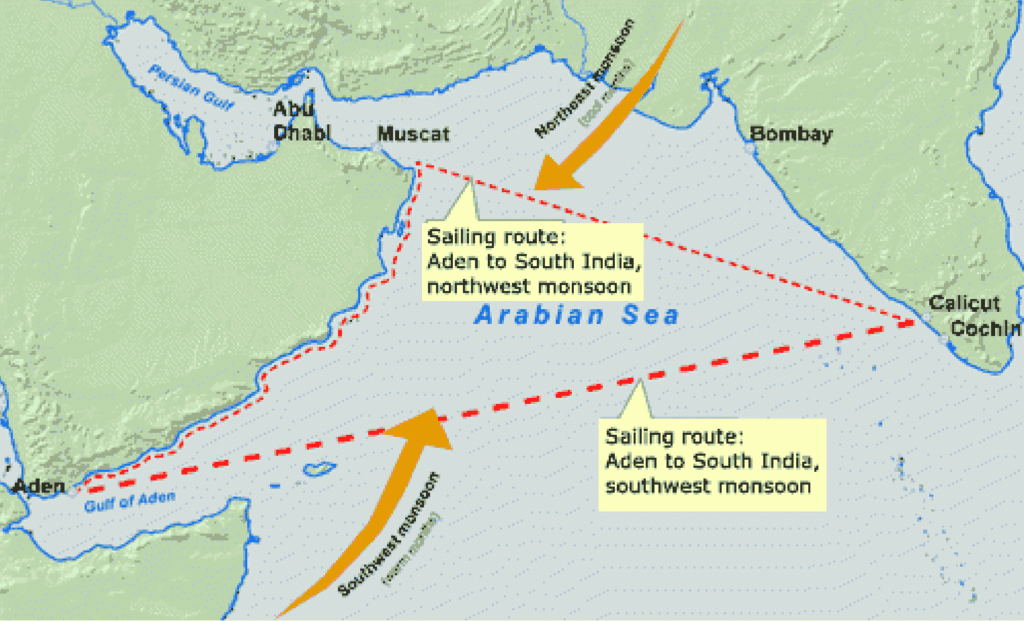
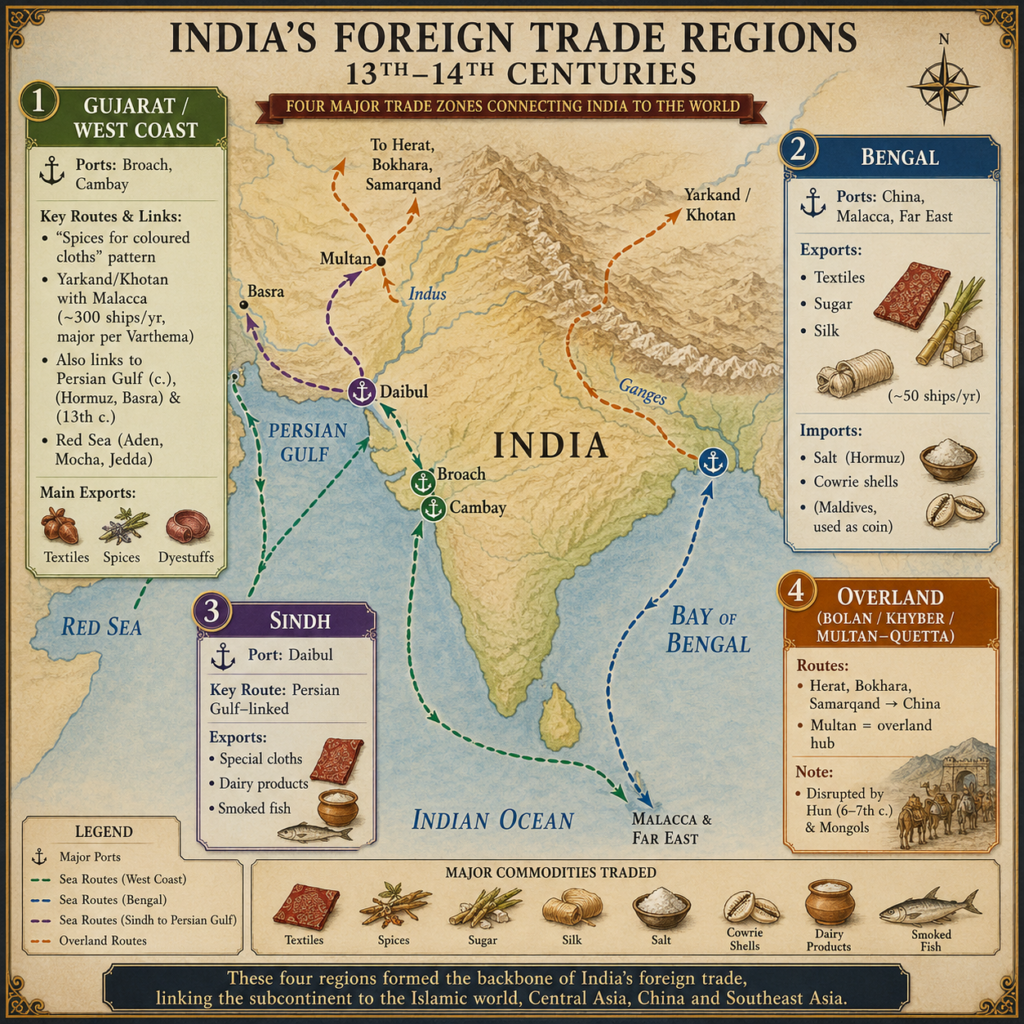
- The Khalji annexation of Gujarat almost certainly enlarged trade relations between the Delhi Sultanate and both the Persian Gulf and the Red Sea.
- Hormuz and Basra served as the chief ports for ships passing through the Persian Gulf, while Aden, Mocha, and Jedda, along the Red Sea, were similarly important for Gujarat.
- Gujarati merchandise was also carried eastward — to the port of Malacca on the Malacca Straits, and to Bantam (Java) and Achin/Aceh in the Indonesian archipelago.
- This followed a distinctive “spices for coloured cloths” pattern: the main export from Gujarat to Malacca was coloured cloth manufactured in Cambay and other Gujarati towns, in strong demand there; in return, Gujarati merchants brought back locally grown spices. This trading pattern persisted even after the Portuguese advent in Asian waters.
- Foreign merchants, especially the Arabs, were particularly active in overseas trade through Gujarat and Malabar.
- Indian traders — both Hindus (Agrawal and Maheshwari communities) as well as Jains and Bohras — were similarly active in this trade, maintaining colonies of Indian traders across West and Southeast Asia.
- Several contemporary accounts corroborate the scale of this trade:
- The European traveller Tome Pires (in India during the first decade of the 16th century) observed: “Cambay chiefly stretches out two arms: with her right arm she reaches out towards Aden, with the other towards Malacca,” adding that *“Malacca cannot live without Cambay, nor Cambay without Malacca, if they are to be very rich and very prosperous.”
- The Italian traveller Varthema (also in India during this period) records that around 300 ships from different countries regularly called at Cambay, and that roughly 400 “Turkish” merchants resided at Diu.
- The Ilkhanid court historian Wassaf reports that 10,000 horses were annually exported to Ma’bar and Cambay from Persia.
- The Broach coin-hoards, containing coins of the Delhi Sultans alongside gold and silver coins from Egypt, Syria, Yemen, Persia, Genoa, Armenia, and Venice, further testify to the genuinely large scale of overseas trade.
- The ports of Bengal maintained trading relations with China, Malacca, the Far East, and Southeast Asia.
- Textiles, sugar, and silk fabrics were Bengal’s most important exports — Varthema notes that around fifty ships annually carried these commodities to numerous destinations, including Persia.
- Bengal, in turn, imported salt from Hormuz and sea-shells from the Maldive Islands — these shells were themselves used as currency in Bengal, Orissa, and Bihar. Bengal also imported silks and spices.
- Ma Huan, who visited Bengal in the early 15th century, remarked that “wealthy individuals who built ships and go to foreign countries to trade are quite numerous.”
- Sindh was another significant region for seaborne trade, its most notable port being Daibul.
- This region maintained closer commercial ties with the Persian Gulf ports than with the Red Sea zone, exporting special cloths, dairy products, and smoked fish.
Coastal Trade
- Coastal trade naturally flourished along the entire stretch from Sindh to Bengal, touching Gujarat, Malabar, and the Coromandel coast along the way — offering an important avenue for the exchange of regional products distinct from inland inter-regional trade.
Overland Trade
- The principal overland trade routes ran through the Bolan Pass to Herat, and through the Khyber Pass to Bokhara and Samarqand, with additional Kashmir routes leading to Yarkand and Khotan for onward transmission to China.
- These routes were periodically disrupted by nomadic incursions from Central Asia — such as the Hun eruption of the 6th–7th centuries, and the Mongol onslaught of the 13th century.
- India was also connected to Central Asia, Afghanistan, and Persia via the Multan–Quetta route, though repeated Mongol turmoil in Central Asia and Persia made this route less favoured by merchants.
- The rise and fall of empires naturally affected the safety of these overland routes, though traders proved consistently hardy and skilful in overcoming such obstacles.
- The nomads themselves quickly recognised the value of allowing trade to flow — and, crucially, of taxing it for their own benefit.
- The Mongols, accordingly, not only permitted trade but, when not actively at war, traded themselves in camels, horses, arms, falcons, furs, and musk.
- Although Balban faced difficulties obtaining horses from Central Asia due to the Mongols, this problem must have been temporary, since Alauddin Khalji faced no comparable difficulty.
- With the establishment of stable Mongol empires, and greater road security, trade with China and West Asia became considerably easier — a trend that improved further during the 14th century, as the Mongols themselves gradually assimilated into Islam.
- Multan functioned as the major trading centre for overland commerce.
- Lahore, ruined by the Mongols in 1241, was unable to fully recover until the reign of Muhammad Tughluq.
- Multan also served as the principal entry point for foreign traders, collectively known as Khurasanis, who were generally considered somewhat less wealthy than native Multanis.
- Given the high cost of overland transport, this trade naturally concentrated on commodities that were lightweight but high in value.
Imports and Exports
- Imports: the two principal categories of import were:
- Horses: the single most important commodity imported overland into India.
- There was steady demand for Arabi, Iraqi, and Central Asian horses, needed for the army — since cavalry remained the principal instrument of warfare, and superior horses were neither bred in India nor well-suited to the Indian climate.
- Horses were imported chiefly from Zofar (Yemen), Kis, Hormuz, Aden, and Persia, and were valued not only militarily but for show and status.
- Precious metals — gold and silver, particularly silver, which was not mined in India at all, yet was in high demand both for metallic currency and for fashioning luxury items.
- Brocade and silk were imported from Alexandria, Iraq, and China; tea and silk likewise came from China, though silk was also sourced from Persia, where the mulberry tree and silk cocoons had themselves been introduced during the 13th–14th centuries by the Mongols.
- Gujarat served as the principal centre through which European luxury articles entered India.
- Other imported commodities included camels, furs, slaves, velvet, dried fruits, and wines.
- Horses: the single most important commodity imported overland into India.
- Exports: Sultanate India mainly exported grain and textiles.
- Some Persian Gulf regions depended entirely on India for foodstuffs such as rice, sugar, and spices.
- Slaves were exported to Central Asia, and indigo to Persia, alongside numerous other commodities; precious stones such as agates were exported specifically from Cambay.
The Portuguese Advent
- Despite brisk trading activity, Indian merchants’ share of overseas trade remained genuinely negligible — only a small section of Gujarati Banias, southern Chettis, and domiciled Indian Muslims participated in large-scale overseas trade, which remained largely in the hands of Arab merchants.
- With the arrival of the Portuguese, a genuinely new dimension entered Indian seaborne trade — the “element of force.”
- Equipped with superior, cannon-armed ships, the Portuguese swiftly imposed a commercial hegemony over much of Asia’s trading world, including Indian waters, particularly along the western coast.
- This directly curtailed the Arabs’ share of Indian trade, though Arab merchants survived in the eastern trade, particularly at Malacca, alongside Indian traders.
- The Portuguese captured Goa in 1510, which became their headquarters; Malacca fell to them in 1511, Hormuz in 1515, and Bassein and Diu in 1534 and 1537 respectively.
- Goa, under Portuguese patronage, quickly developed into a major centre for import and export — the Portuguese themselves clearly understood Goa’s strategic importance to maintaining their overall position in India.
- Effect on other Western Indian ports: Portuguese possession of Goa proved genuinely unfavourable to other western Indian ports.
- Tome Pires remarked that the Muslim rulers of the Deccan and Gujarat had “a bad neighbour in Goa.”
- Many west-coast ports fell into decay during the century of Portuguese dominance in Indian waters, a direct result of aggressive Portuguese policy:
- They controlled the key sea routes.
- They controlled the type and volume of cargo carried by other merchants.
- They introduced the cartaz system (from the Persian qirta, “paper sheet”) — a mandatory permit for ships operating in Asian waters, without which vessels were liable to confiscation and their cargo plundered.
- A fee was charged for issuing each cartaz — policies that adversely affected the seaborne carrying trade of both Indians and Arabs alike.
Commercial Classes
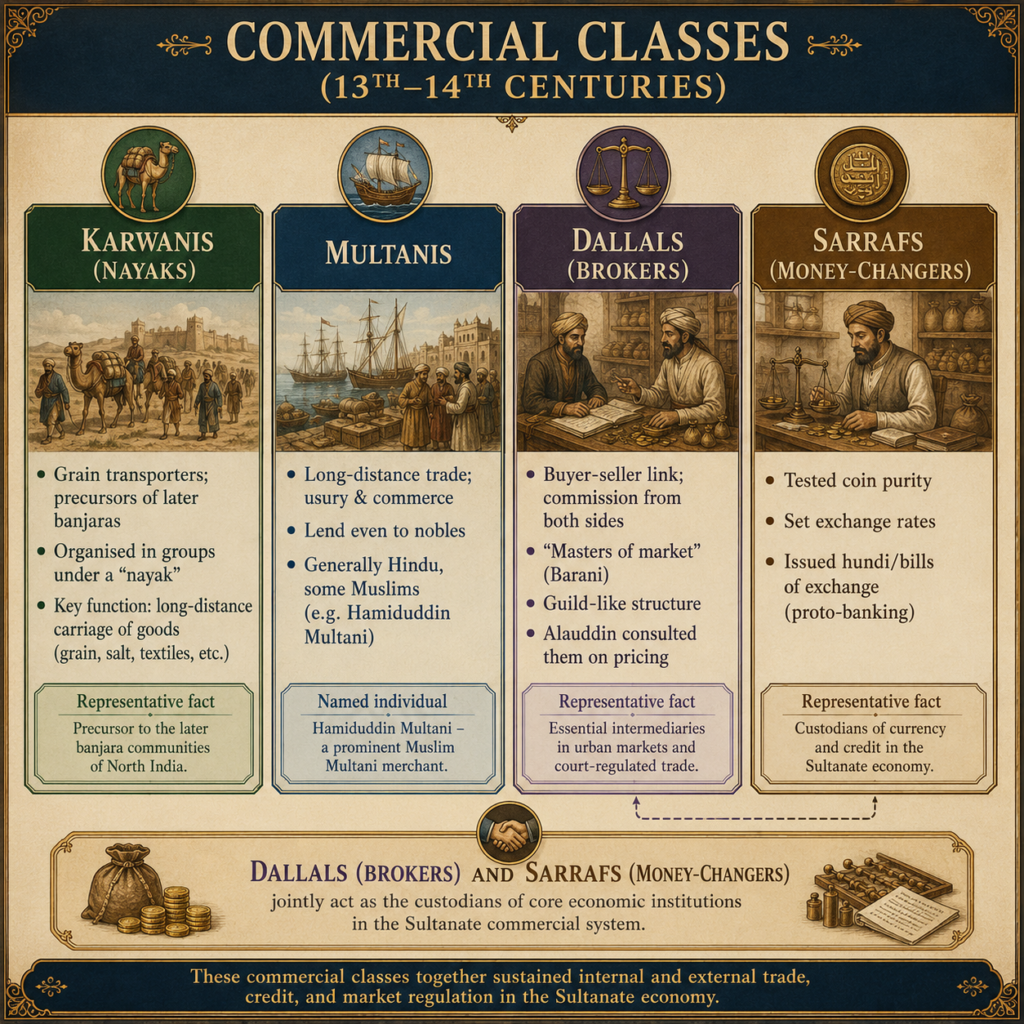
- Two principal types of merchants are documented in contemporary sources.
Karwanis (Nayaks)
- Merchants who specialised in carrying grain were termed Karwani by Barani — a Persian term meaning “those who moved together in large numbers.”
- The contemporary mystic Nasiruddin (Chiragh-i-Delhi) calls them nayaks, describing them as those “who bring foodgrains from different parts to the city [Delhi].”
- It can be said with a fair degree of certainty that these karwanis were the direct predecessors of the later banjaras. As is clear from Mughal-era sources, they were organised into groups, each with a headman called nayak.
Multanis
- Barani notes that long-distance trade was largely in the hands of these merchants.
- They were engaged in both usury and commerce (sud o sauda) — the sahas and Multanis were apparently wealthy enough to extend loans even to nobles, who, according to Barani, were frequently in need of cash.
- The sahas and Multanis were generally Hindu, though at least some Muslims were also counted among Multani merchants — for instance, Hamiduddin Multani, whom Barani styles “malik-ut-tujjar” (“the great merchant”).
- Beyond these well-defined merchant groups, others who chose to could equally take up trade — a Sufi mystic from Bihar, for instance, became a slave-merchant trading between Delhi and Ghazni, while a number of pious men from Central Asia came to Delhi and became merchants in their own right.
Dallals (Brokers)
- Dallals, or brokers, formed another important commercial class, working as a link between buyer and seller, and taking a commission from both parties.
- Barani describes them as the “masters of the market” (hakiman-i-bazar), instrumental in raising prices — his reference to “chief brokers” (mihtran-i-dallalan) similarly suggests a reasonably well-established broker’s guild, though further details are lacking.
- Alauddin Khalji regularly consulted brokers regarding the cost of production of goods in the market as part of his price-fixing policy — though during his reign, “chief brokers” were also dealt with quite severely.
- Under Feroz Tughluq’s reign, brokers appear to have regained their standing.
- Feroz Tughluq abolished the dallalat-i-bazarha (a tax levied on brokers’ licences) — and further ruled that even if a deal between buyer and seller ultimately fell through, brokers were not required to return their commission.
- This confirms that “brokerage” had become a fairly well-established institution by the Tughluq period.
Sarrafs
- Sarrafs, functioning as money-changers, were especially sought after by merchants — particularly foreign traders arriving in India with their own native coinage.
- Sarrafs tested the metallic purity of coins, both indigenous and foreign, and established the appropriate exchange rate.
- They also issued bills of exchange (Hindi: hundi; Persian: suftaja), or letters of credit — effectively functioning as “bankers.” The introduction of paper into India by the Turks likely accelerated the development of this bill-of-exchange institution.
- For these services, the sarraf naturally charged a commission.
- Both brokers and sarrafs, in sum, occupied a genuinely pivotal position in the commercial world of their period, serving as custodians of several core economic institutions — no merchant of the era could realistically have dispensed with their services.
Transport
- Goods were transported both by pack animals and on bullock carts — with pack animals likely accounting for the larger share of overall transport.
- Ibn Battuta mentions 30,000 mans of grain being transported on the backs of 3,000 bullocks from Amroha to Delhi, and notes that highways ran throughout the empire, marked at set intervals by minarets.
- Afif records that bullock carts were also used for carrying passengers, on payment.
- Pack-oxen offered a comparatively cheap mode of transport — travelling slowly, grazing as they moved, and journeying in large herds, which helped reduce transport costs, particularly along desert routes.
- The account of Shahabuddin al-Umari (author of the Masalik-ul Absar) suggests that deliberate efforts were made to create conditions conducive to trade:
- Inns were built at each stage (manzil) of major routes.
- In Bengal, Iwaz Khalji built long embankments to safeguard roads from flooding.
- Boats were employed along riverine routes to carry bulk goods, while large ships were used for seaborne trade.
Conclusion
- Trade and commerce in the thirteenth and fourteenth centuries reveal an economy in genuine transformation — the compulsions of a cash-based land revenue system generated a powerful engine of “induced trade,” connecting village, town, and metropolitan economies through a well-organised hierarchy of karwanis, Multanis, dallals, and sarrafs.
- This inland trade network was, in turn, plugged into a genuinely flourishing foreign trade — overland routes linking India to Central Asia, Persia, and China, and seaborne routes connecting Gujarat, Bengal, and Sindh to the Persian Gulf, the Red Sea, and Southeast Asia — until the Portuguese advent introduced an entirely new, coercive “element of force” into what had previously been a largely open, competitive commercial world.
- Taken together, these developments confirm India’s continued role, throughout this period, as a genuine manufacturing and trading hub for much of medieval Asia.