The Maurya Empire: Foundation, Administration, Ashoka’s Dhamma, and Decline

The Maurya Empire (322–185 BCE) stands as ancient India’s first great pan-Indian empire — a geographically extensive Iron Age power that, at its height, stretched from the Himalayas to the Deccan and from Afghanistan to Assam. Founded by Chandragupta Maurya with the guidance of Kautilya (Chanakya), consolidated by Bindusara, and transformed by Ashoka’s turn towards Dhamma after the Kalinga war, the Maurya Empire left behind an unmatched administrative legacy, documented in both the Arthashastra and Megasthenes’s Indika, as well as a vast corpus of rock and pillar edicts. Understanding the empire’s founding, its sophisticated administrative machinery, the ideology of Ashoka’s Dhamma, and the causes of its eventual disintegration is central to UPSC History Optional, forming one of the most heavily examined topics in ancient Indian history.
Overview of the Maurya Empire
- The Maurya Empire was a geographically extensive Iron Age power in ancient India, ruled by the Maurya dynasty from 322–185 BCE. Originating from the kingdom of Magadha in the Indo-Gangetic Plain (modern Bihar and eastern Uttar Pradesh), the empire had its capital at Pataliputra (modern Patna).
- The empire was founded in 322 BCE by Chandragupta Maurya, who overthrew the Nanda dynasty and rapidly expanded his power westward across central and western India, taking advantage of the disruptions caused by the westward withdrawal of Alexander the Great’s Hellenic armies.
- By 316 BCE, the empire had fully occupied north-western India, defeating and conquering the satraps left behind by Alexander. Chandragupta then defeated the invasion led by Seleucus I, a Macedonian general from Alexander’s army, gaining additional territory west of the Indus River.
- The Maurya Empire was one of the largest empires in the world at the time, and the largest ever seen in the Indian subcontinent. At its greatest extent, it stretched north along the natural boundaries of the Himalayas, east into Assam, and west into Balochistan and the Hindu Kush mountains of Afghanistan.
- The empire was expanded into India’s central and southern regions by emperors Chandragupta and Bindusara, but it excluded a small portion of unexplored tribal and forested regions near Kalinga (modern Odisha), until this too was conquered by Ashoka.
- The empire declined for about fifty years after the end of Ashoka’s rule, and dissolved in 185 BCE with the foundation of the Sunga dynasty in Magadha.
- The population of the empire has been estimated at about 50–60 million, making the Mauryan Empire one of the most populous empires of antiquity. Archaeologically, the period of Mauryan rule in South Asia falls within the era of the Northern Black Polished Ware (NBPW).
Rulers of the Maurya Dynasty
| Ruler | Life span | Reign start | Reign end |
|---|---|---|---|
| Chandragupta | 345–298 BCE | 320 BCE | 298 BCE |
| Bindusara | 320–272 BCE | 298 BCE | 272 BCE |
| Ashoka | 304–232 BCE | 269 BCE | 232 BCE |
| Dasaratha | 252–224 BCE | 232 BCE | 224 BCE |
| Samprati | — | 224 BCE | 215 BCE |
| Salisuka | — | 215 BCE | 202 BCE |
| Devavarman | — | 202 BCE | 195 BCE |
| Satadhanvan | — | 195 BCE | 187 BCE |
| Brihadratha | — | 187 BCE | 185 BCE |
Expansion of the Mauryan State
- The Magadha state existed in the fifth century BCE, and the Nanda Empire reached its greatest extent under Dhana Nanda by 323 BCE.
- The Maurya Empire was first founded by Chandragupta Maurya in 320 BCE, after conquering the Nandas; he then extended its borders towards Seleucid Persia after defeating Seleucus in 305 BCE.
- Bindusara extended the empire’s borders southward into the Deccan Plateau by 300 BCE, and Ashoka extended the empire into Kalinga during the Kalinga War of 265 BCE, establishing superiority over the southern kingdoms.
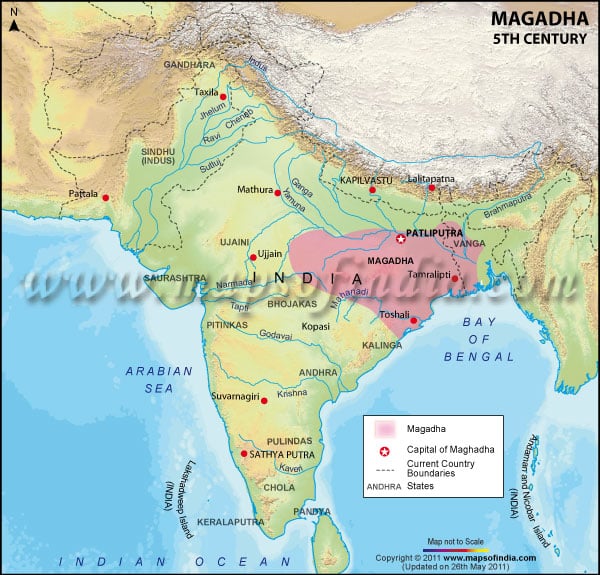 u003cbru003eMagadha state in the 5th century BCE
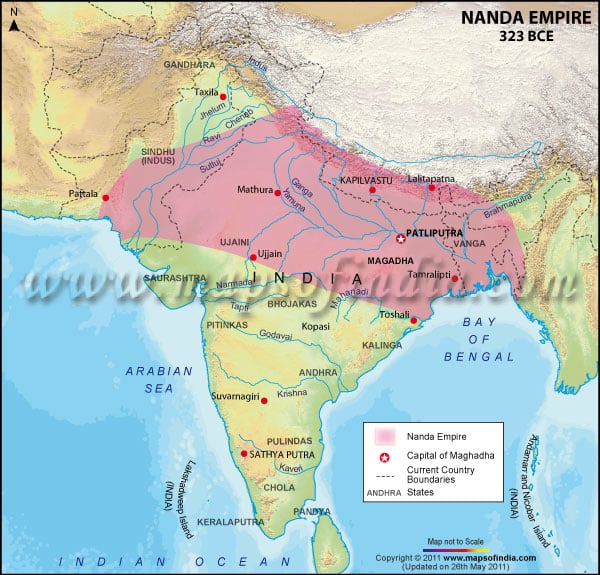 u003cbru003eThe Nanda Empire at its greatestu003cbru003eextent under Dhana Nanda 323 BCE
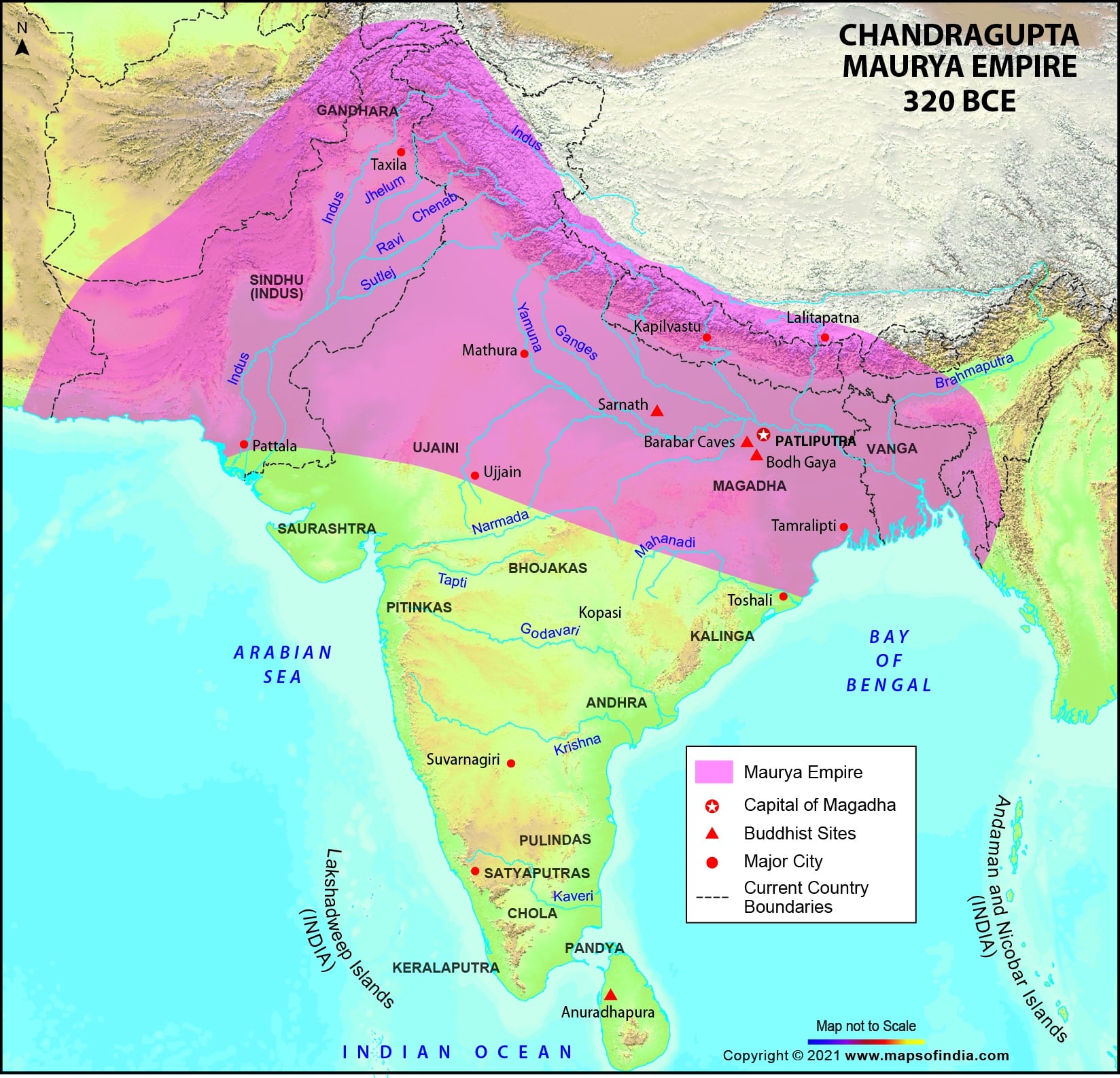 u003cbru003eThe Maurya Empire when it was first founded by Chandraguptau003cbru003eMaurya 320 BCE, after conquering the Nanda
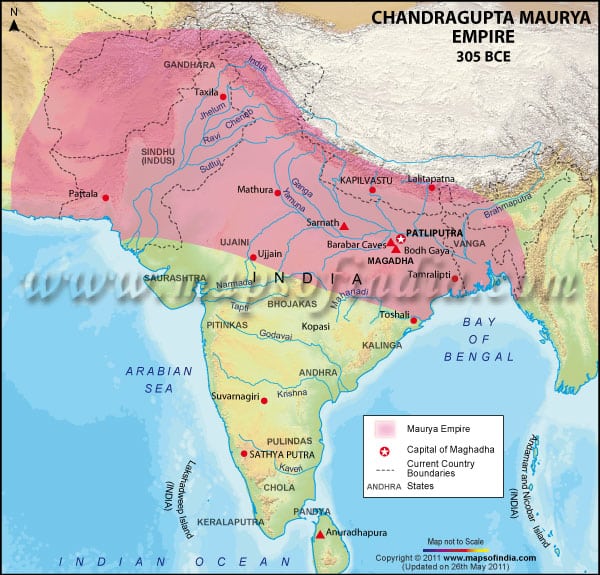 u003cbru003eChandragupta extended the borders of the Mauryau003cbru003eEmpire towards Seleucid Persia after defeating Seleucus 305 BCE
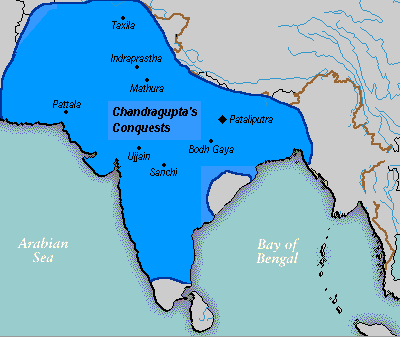 u003cbru003eBindusara extended the bordersu003cbru003eof the empire southward into the Deccan Plateau 300 BCE
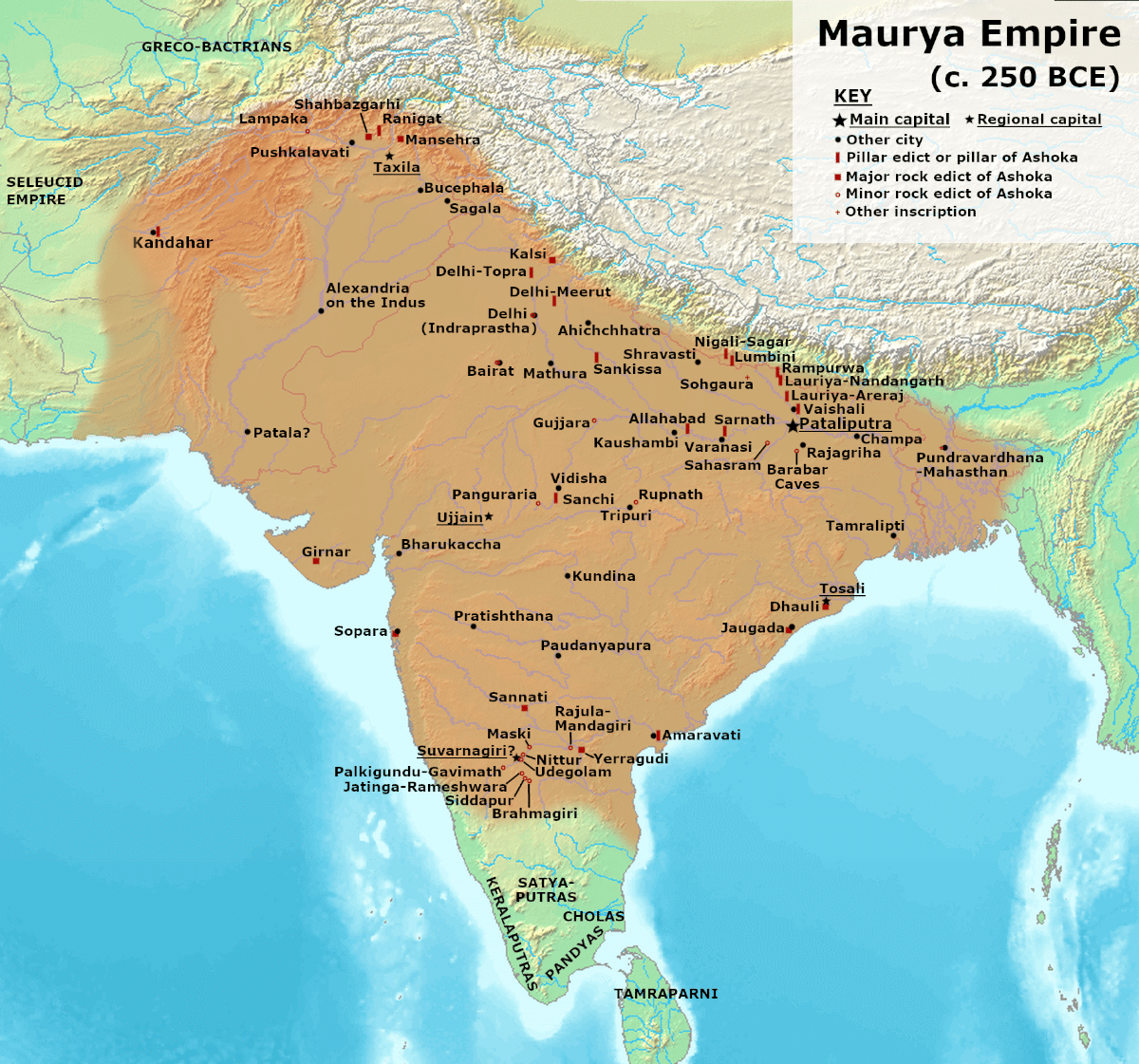 u003cbru003eAshoka extended into Kalinga during theu003cbru003eKalinga War 265 BCE, and established superiority over the southern kingdoms.
Chandragupta Maurya (320–298 BCE)
His Background
- Very little is known with certainty about Chandragupta’s ancestry; what is known is gathered from later classical Sanskrit literature, Buddhist sources, and classical Greek and Latin sources.
Classical Greek and Latin Sources
- Classical Greek and Latin sources refer to Chandragupta by the names “Sandracottos” or “Andracottus.”Plutarch, in his Parallel Lives, reports that Androcottus (Chandragupta) met Alexander around Takshashila in the north-west, and that he viewed the ruling Nanda Empire in a negative light; Chandragupta is also said to have met the Nanda king, angered him, and made a narrow escape.
- According to this account, the encounter would have occurred around 326 BCE, suggesting a birth date for Chandragupta around 340 BCE.
- Plutarch and other Greco-Roman historians appreciated the gravity of Chandragupta’s conquests. Justin, a second-century CE Latin historian who lived under the Roman Empire, describes Chandragupta’s humble origins and explains how he later led a popular uprising against the Nanda king.
Classical Sanskrit Sources
- Chandragupta’s rise to power is shrouded in mystery and controversy. The Sanskrit drama Mudrarakshasa (“The Signet of the Minister”) by Vishakhadatta describes his royal ancestry and even links him with the Nanda family, calling him a “Nandanvaya” — a descendant of Nanda — while also using terms such as kula-hina and Vrishala for his lineage, suggesting a humble origin.
- The Mudrarakshasa is a historical Sanskrit play narrating Chandragupta’s ascent to power, variously dated to the late fourth century.
- Both the Mudrarakshasa and the Jaina work Parisishtaparvan speak of Chandragupta’s alliance with the Himalayan king Parvataka, sometimes identified with Porus.
Buddhist Sources
- The Buddhist text Mahavamsa calls Chandragupta a member of a division of the Kshatriya clan called the Moriya (the Mor clan, or gotra, of the Jat people); the Mahaparinibbana Sutta likewise states that the Moriyas (Mauryas) belonged to the Kshatriya community, while the Mahavamshatika connects him with the Shakya clan of the Buddha.
- A medieval inscription represents the Maurya clan as belonging to the solar race of Kshatriyas.
Rise of Chandragupta and Foundation of the Maurya Dynasty
(According to the Mudrarakshasa and Greek and Roman sources)
- The Maurya Empire was founded by Chandragupta Maurya, with the help of Chanakya, a Brahmin teacher at Takshashila. According to several legends, Chanakya travelled to Magadha — a kingdom large and militarily powerful, feared by its neighbours — but was insulted by its king, Dhana Nanda, of the Nanda dynasty; Chanakya swore revenge and vowed to destroy the Nanda Empire.
- Chanakya encouraged Chandragupta and his army to seize the throne of Magadha, initially intending to train a guerrilla army under Chandragupta’s command. Using his intelligence network, Chandragupta gathered young men from across Magadha and other provinces — men aggrieved by the corrupt and oppressive rule of Dhana Nanda — along with the resources necessary to fight a long series of battles.
- Preparing to invade Pataliputra, Maurya devised a strategy: a battle was announced, drawing the Magadhan army out of the city to a distant battlefield to engage his forces, while his general and spies bribed the corrupt general of Nanda. He also managed to create an atmosphere of civil war within the kingdom, culminating in the death of the heir to the throne.
- Chanakya succeeded in winning over popular sentiment, and ultimately, Nanda resigned, handing power to Chandragupta and going into exile.
- Chanakya then approached the prime minister, Rakshasa, convincing him that his loyalty was owed to Magadha rather than to the Nanda dynasty, and insisting he continue in office. Rakshasa accepted this reasoning, and Chandragupta Maurya was legitimately installed as the new king of Magadha; Rakshasa became Chandragupta’s chief advisor, while Chanakya assumed the role of an elder statesman.
- Meanwhile, the conquering armies of Alexander the Great refused to cross the Beas River and advance further eastward, deterred by the prospect of battling Magadha; Alexander returned to Babylon, redeploying most of his troops west of the Indus. Soon after Alexander’s death in Babylon in 323 BCE, his empire fragmented, and local kings declared independence, leaving behind several smaller, disunited satraps.
- The Roman historian Justin describes how Sandrocottus (the Greek rendering of Chandragupta’s name) conquered the north-west: after Alexander’s death, Chandragupta turned his attention to north-western South Asia (modern Pakistan), defeating the satrapies left in place by Alexander, and may have assassinated two of his governors, Nicanor and Philip. The satrapies he fought may have included Eudemus, ruler of western Punjab until his departure in 317 BCE, and Peithon, ruler of the Greek colonies along the Indus until his departure for Babylon in 316 BCE.
- Chandragupta had defeated the Macedonian satrapies in the north-west of the Indian subcontinent by 317 BCE.

Expansion by Chandragupta Maurya
- Megasthenes recorded the size of Chandragupta’s army as 400,000 soldiers. According to Strabo, Megasthenes was stationed in the camp of Sandrocottus (Chandragupta), which consisted of 400,000 men; Pliny, who also drew on Megasthenes’s work, gives even larger figures — 600,000 infantry, 30,000 cavalry, and 9,000 war elephants.
- The Mauryas’ military strength was almost three times that of the Nandas, apparently owing to a much larger empire and correspondingly greater resources.
Conquest of Seleucus’s Eastern Territories
- Justin, a Greek writer, claims that Chandragupta overran the whole of India with an army of 600,000 — a figure that may or may not be accurate, but Chandragupta did liberate north-western India from the hold of Seleucus.
- Seleucus I Nicator, a Macedonian satrap of Alexander, reconquered most of Alexander’s former empire and brought under his own authority the eastern territories as far as Bactria and the Indus (according to Appian’sHistory of Rome), until in 305 BCE he came into conflict with Chandragupta.
- Seleucus appears to have fared poorly, ceding large territories west of the Indus to Chandragupta as a result of his defeat — including the Hindu Kush, modern-day Afghanistan, Arachosia (modern Kandahar), Gedrosia (modern Balochistan), and Gandhara.
- Archaeologically, concrete evidence of Mauryan rule — such as the inscriptions of the Edicts of Ashoka — is found as far as Kandahar in southern Afghanistan.

Treaty with Seleucus and Indo-Mauryan Relations
- Classical sources record that, following a treaty between the two rulers — probably the first treaty of ancient India with a foreign power — Chandragupta and Seleucus exchanged presents. Chandragupta married Seleucus’s daughter to formalise the alliance, and in return sent 500 war elephants, a military asset that would later play a decisive role in battle.
- In addition to this treaty, Seleucus dispatched an ambassador, Megasthenes, to Chandragupta’s court, and later Deimachus to his son Bindusara, at Pataliputra. Later still, Ptolemy II Philadelphus, ruler of Ptolemaic Egypt and a contemporary of Ashoka, is recorded by Pliny as having sent an ambassador named Dionysius to the Mauryan court.
- Presents continued to be exchanged between the Mauryan and Greek rulers; the intensity of these contacts is testified by the existence of a dedicated Mauryan state department for Greek (Yavana) and Persian foreigners, and by the remains of Hellenistic pottery found throughout northern India.
- Greek populations apparently remained in the north-west of the Indian subcontinent under Mauryan rule. Ashoka installed several Edicts written in Greek; in his edicts, he mentions having sent Buddhist emissaries to Greek rulers as far as the Mediterranean (Edict No. 13), and that he developed herbal medicine within their territories for the welfare of humans and animals (Edict No. 2).
- The Greeks in India even seem to have played an active role in propagating Buddhism — some of Ashoka’s emissaries, such as Dharmaraksita, or the teacher Mahadharmaraksita, are described in Pali sources as leading Greek (“Yona,” i.e., Ionian) Buddhist monks active in Buddhist proselytism, as mentioned in the Mahavamsa.
- It is also thought that Greeks contributed to the sculptural work of the Pillars of Ashoka, and more generally to the flourishing of Mauryan art.
Jainism and Death of Chandragupta
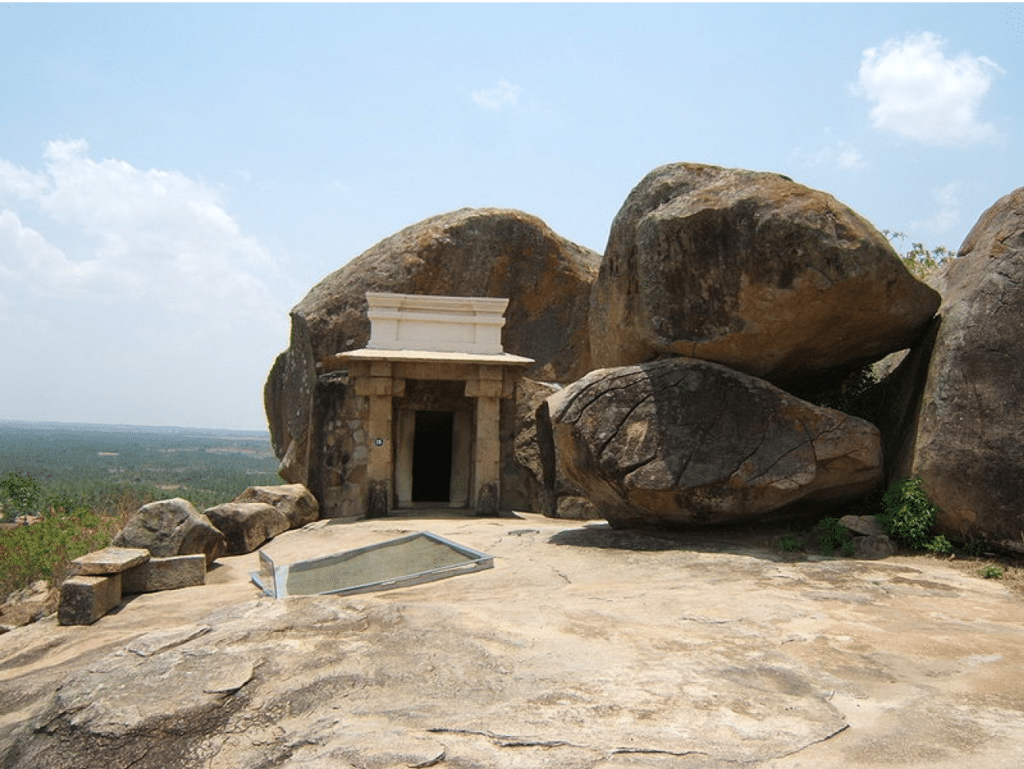
- According to Jain tradition, Chandragupta gave up his throne at the beginning of the third century BCE, when he was forty-two years old, and became an ascetic under the last Shrutakevali, Bhadrabahu, migrating south with him and ending his days in sallekhana (death by fasting), in keeping with Jain spiritual tradition, at Sravana Belgola in present-day Karnataka — though fifth-century inscriptions from the region support the idea of a larger southern migration around that time.
- Chandragupta was the first ruler to take the titles Devampriya and Priyadarshi.
State under the Mauryas
- The Mauryas organised a very elaborate system of administration, known to us chiefly from the account of Megasthenes and the Arthashastra of Kautilya.
Megasthenes’s Indika
- Megasthenes, a Greek ethnographer and explorer of the Hellenistic period, was the Greek ambassador sent by Seleucus to the court of Chandragupta Maurya. He lived in the Mauryan capital of Pataliputra and wrote an account not only of the city’s administration but of the Mauryan empire as a whole.
- Megasthenes’s account does not survive in full, but quotations from it occur in the works of several later Greek writers; these fragments have been collected and published as a book entitled Indika, which sheds valuable light on the administration, society, and economy of Mauryan times. His Indica served as an important source for later writers such as Strabo and Arrian.
- At the beginning of his Indica, Megasthenes refers to older Indian traditions concerning the prehistoric arrival of Dionysus and Hercules (divine Greek heroes) in India — a story popular among the Greeks of the Alexandrian period.
- His comments on Indian religion are particularly important: he mentions the devotees of Heracles and Dionysus, but does not mention the Buddhists — a silence that supports the theory that Buddhism was not yet widely known before Ashoka’s reign.
About Pataliputra
- Megasthenes describes features such as the Himalayas and the island of Sri Lanka, and states that numerous cities existed in India, though he considered Pataliputra — which he calls Palibothra (a Greek term meaning “a city with gates”) — the most important.
- According to him, Pataliputra was bounded by a deep ditch and a wooden wall crowned with 570 towers, with 64 gates, rivalling the splendour of contemporary Persian sites such as Susa; the ditch, timber palisades, and wooden houses have all been found in excavations.
- Megasthenes further states that Pataliputra was 9.33 miles long and 1.75 miles broad — a size that tallies with that of modern Patna, since Patna, too, is a city of considerable length but little breadth. Given this conformity, it becomes possible to trust Megasthenes’s other statements as well.
About the King
- Megasthenes gives a detailed description of the personal life of Chandragupta Maurya: he led a very splendid life, and his palace was unique in its beauty. The king did not sleep in the same room for two consecutive days, and he did not favour meeting people too frequently.
About Administration
- Megasthenes writes extensively about the civil administration of Chandragupta Maurya, describing the king as an autocrat and the master of unlimited power, who kept himself fully informed of the main events of his empire through his network of spies.
- He refers to the administration of Pataliputra, the Mauryan capital, as being carried out by six committees, each consisting of five members, entrusted respectively with sanitation, care of foreigners, registration of births and deaths, regulation of weights and measures, and other similar functions.
- The administration of the armed forces, likewise, was carried on by a board of thirty officers, divided into six committees of five members each — with each of the six wings of the armed forces (the army, cavalry, elephants, chariots, navy, and transport) assigned to the care of a separate committee.
About Indian Society
- Megasthenes describes a disciplined multitude of people under Chandragupta, who lived simply and honestly and did not know writing: “The Indians all live frugally, especially when in camp. They dislike a great undisciplined multitude, and consequently they observe good order. Theft is of very rare occurrence. People have no written laws, and are ignorant of writing, and must therefore in all the business of life trust to memory. They live, nevertheless, happily enough, being simple in their manners and frugal. They never drink wine except at sacrifices. Their beverage is a liquor composed from rice instead of barley, and their food is principally a rice-pottage.”
- Megasthenes also found that the institution of slavery was unknown to ancient Indian society, declaring all Indians to be free.
- However, since he did not travel across the whole of India, his observations may not apply to the entire country — it is possible that, slavery being absent in north-western India specifically, this impression shaped his sweeping declaration.
- Megasthenes’s claim regarding the non-existence of slavery is not supported by other available evidence: the Smritis, or Hindu law-books, make clear that slavery was a recognised institution in India as early as the Vedic age.
- Some scholars have tried to reconcile this discrepancy by suggesting that the slavery system in India was very mild, with most slaves being domestic slaves treated as members of the family; slave trade was prohibited in the Shastras, which laid down various injunctions for the liberation of slaves. Megasthenes, impressed by the prevailing intellectual mood of the time, may have been influenced accordingly — the liberal rules of the Arthashastra regarding slaves likewise testify to society’s relatively liberal attitude towards the institution.
- Megasthenes describes Indians as divided into seven classes — a caste system rather different from the one that exists today, suggesting that the caste system may have been, to some extent, fluid and evolving (though it is equally possible that, as a foreigner, he was simply not adequately informed about the actual caste system). The seven classes were:
- Philosophers (sophists) — fewest in number of all the classes, but pre-eminent in dignity above all others.
- Husbandmen — far more numerous than the others, devoting the whole of their time to tillage; regarded as public benefactors, they were protected from all injury.
- Shepherds (herdsmen) — who neither settled in towns nor villages but lived in tents, paying taxes from their animals.
- Artisans and shopkeepers — who likewise performed public duties and paid tax on the receipts from their work, except for those who made weapons of war, who instead received a wage from the community.
- Military — next to the farmers in number, enjoying the greatest freedom and the most agreeable life, devoted solely to military activities and maintained entirely at the king’s expense.
- Overseers — who supervised everything occurring in the country and cities and reported it to the king (where the Indians were governed by kings) or to the authorities (where they were self-governing).
- Councillors and assessors — who deliberated on public affairs; the smallest class in number, but the most respected on account of the high character and wisdom of its members, from whose ranks the king’s advisers, the state’s treasurers, arbiters who settled disputes, generals of the army, chief magistrates, and supervisors of agricultural works were usually drawn.
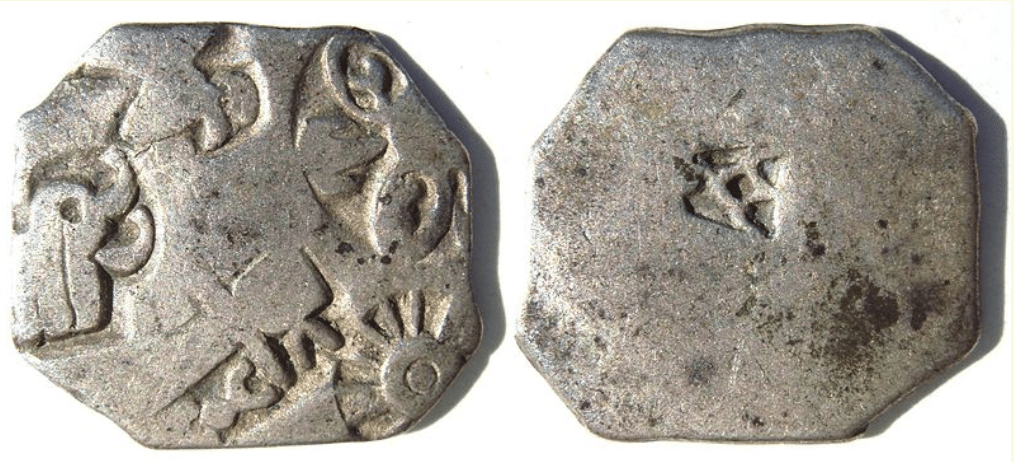
A silver punch-marked coin of the Maurya Empire, bearing the symbols of the wheel and the elephant, dates to the third century BCE.
Kautilya (Chanakya) and the Arthashastra
- The Arthashastra is an ancient Indian treatise on statecraft, public administration, economic policy, and military strategy, written in Sanskrit. It identifies its author by the names “Kautilya” and “Vishnugupta,” both traditionally identified with Chanakya (350–283 BCE), a scholar at Takshashila and the teacher and guardian of Emperor Chandragupta Maurya — though many authors appear to have contributed to the text over the centuries.
- Megasthenes’s account can be usefully supplemented by the Arthashastra, although it was finally compiled a few centuries after Mauryan rule. It is divided into fifteen adhikaranas (sections) and 180 prakaranas (subdivisions), comprising about 6,000 slokas.
- It was rediscovered in 1904 by R. Shamasastry, who published it in 1909; the first English translation appeared in 1915.
- Despite the controversy over its date and authorship, its importance lies in offering a clear and methodical analysis of the economic and political conditions of the Mauryan period; the similarities between the administrative terms used in the Arthashastra and in the Ashokan edicts strongly suggest that the Mauryan rulers were acquainted with the work, which provides useful and reliable information on Mauryan society, politics, and administration.
The King
- Kautilya suggests that the king should be an autocrat who concentrates all power in his own hands, enjoying unrestricted authority over his realm — while at the same time honouring the Brahmanas and seeking the advice of his ministers. Thus, though autocratic, the king was expected to exercise his authority wisely.
- The king should be cultured, wise, and well-read enough to understand every detail of his administration. Kautilya states that the chief cause of a king’s downfall is his inclination towards evil, listing six vices that lead to a king’s decline: haughtiness, lust, anger, greed, vanity, and love of pleasure. The king should live in comfort, Kautilya says, but should not indulge in these pleasures.
Ideals of Kingship
- The central ideal of kingship, according to Kautilya, is that the king’s own well-being lies in the well-being of his people — only happy subjects can ensure the happiness of their sovereign. He also states that the king should be a “Chakravarti,” the conqueror of different realms, winning glory by conquering other lands.
- The king should protect his people from external dangers and ensure internal peace; Kautilya maintained that soldiers should be imbued with the spirit of a “holy war” before marching to the battlefield, holding that all is fair in a war waged in the interest of the country.
Internal Strife
- Quarrels among the people can be resolved by winning over their leaders or removing the cause of the quarrel — indeed, people fighting among themselves can even help the king through their mutual rivalry.
- Conflicts for power within the royal family, on the other hand, bring harassment and destruction to the people and double the effort required to end them; hence, internal strife within the royal family is more damaging than quarrels among ordinary subjects.
Training of a Future King
- Self-discipline is of two kinds — inborn and acquired. Learning imparts discipline only to those who possess the necessary mental faculties: obedience to a teacher, the desire and ability to learn, the capacity to retain what is learnt, understanding of what is learnt, reflection upon it, and the ability to draw inferences by deliberating on acquired knowledge. A future king should acquire discipline and follow it strictly in life, learning the sciences from authoritative teachers.
- In training a prince, alongside improving his self-discipline, he should always associate with learned elders, in whom alone discipline has firm roots — only a king who is wise, disciplined, devoted to the just governance of his subjects, and conscious of the welfare of all beings will enjoy the earth unopposed.
About the Ministers
- Kautilya maintains that the king should appoint ministers, since a king without ministers is like a one-wheeled chariot; the king’s ministers should be wise and intelligent, though the king should not become a puppet in their hands, and should discard improper advice when necessary.
- The ministers should work together as a team and hold their meetings in privacy; Kautilya adds that a king who cannot keep his secrets cannot last long.
Provincial Administration
- Kautilya tells us that the kingdom was divided into several provinces, governed by members of the royal family; some smaller provinces, such as Saurashtra and Kamboja, were administered instead by officers called “Rashtriyas.”
- The provinces were further divided into districts, which were themselves sub-divided into villages; the chief administrator of a district was called the “Sthanika,” while the village headman was called the “Gopa.”
Civic Administration
- The administration of large cities, as well as the capital city of Pataliputra, was carried on very efficiently. Pataliputra was divided into four sectors, each under the charge of an officer called the “Sthanika,” assisted by junior officers called “Gopas,” who looked after the welfare of ten to forty families each.
- The whole city was under the charge of another officer called the “Nagarika,” and a system of regular census was maintained.
Spy Organisation
- Kautilya states that the king should maintain a network of spies to keep him well informed about the minute details and happenings within the country, its provinces, districts, and towns; spies were also expected to keep watch on other officials, and to ensure peace within the land.
- According to Kautilya, women spies were considered more efficient than men and should, in particular, be recruited for the purpose; above all, the king was advised to send agents into neighbouring countries to gather politically significant information.
Maintenance of Law and Order
- A conducive atmosphere is necessary for a state’s economy to thrive, requiring that law and order be strictly maintained; the Arthashastra specifies fines and punishments to support this enforcement — a science of law enforcement also known as Dandaniti.
Seven Ways to Deal with Neighbouring Countries
- Kautilya outlines seven strategies (the Sadgunya) for dealing with neighbouring states:
- Sama — appeasement, or a non-aggression pact;
- Dana — gift-giving, or bribery;
- Bheda — division, or separating the opposition;
- Danda — strength, or punishment;
- Maya — illusion, or deceit;
- Upeksha — ignoring the enemy; and
- Indrajala — feigning military strength.
Shipping
- Kautilya also provides significant information about shipping under the Mauryas: each port was supervised by an officer who kept watch over ships and ferries, tolls were levied on traders, passengers, and fishermen, and almost all ships and boats were owned by the king.
Economic Condition
- According to Kautilya, the central government maintained about two dozen departments of state, controlling social and economic activities, at least in areas near the capital.
- Kautilya considered poverty a major cause of rebellion, and therefore advised that there should be no shortage of food or the money to buy it, since such shortages create discontent and destabilise the king — the king was accordingly advised to take active steps to improve the economic condition of his people.
- The chief source of state income was land revenue in the villages, while the tax on the sale of goods was the chief source of revenue in the cities.
- How did Chandragupta Maurya manage to meet the expenses of a huge army? If the Arthashastra is to be relied upon, the state controlled almost all economic activity within the realm.
- The state brought new land under cultivation with the help of cultivators and shudra labourers; virgin land opened to cultivation yielded handsome income to the state through revenue collected from newly settled peasants, with taxes from peasants varying from one-fourth to one-sixth of the produce. Those provided with irrigation facilities by the state had to pay separately for it.
- In times of emergency, peasants were compelled to raise additional crops, and tolls were levied on commodities brought to town for sale, collected at the gate. The state also enjoyed a monopoly in mining, the sale of liquor, and the manufacture of arms, among other activities — bringing vast resources to the royal exchequer, and giving Chandragupta’s well-organised administrative system a sound financial base.
Comments on Vices
- Kautilya considered vices to be corruptions arising from ignorance and indiscipline, since an unlearned man fails to perceive their injurious consequences. He summarised that, subject to the qualification that gambling is most dangerous where power is shared, the vice with the most serious consequences is addiction to drink, followed by lusting after women, gambling, and finally, hunting.
Bindusara (298–272 BCE)
- Bindusara was the son of the first Mauryan emperor, Chandragupta Maurya, and his queen Durdhara. According to the Rajavalikatha, a Jain work, his original name was Simhasena.
- Bindusara, at just twenty-two years of age, inherited a large empire comprising what is now northern, central, and eastern India, along with parts of Afghanistan and Baluchistan.
- Bindusara’s life has not been documented as thoroughly as that of his father, Chandragupta, or his son, Ashoka. Chanakya continued to serve as prime minister during his reign, and according to the medieval Tibetan scholar Taranatha, who visited India, Chanakya helped Bindusara “to destroy the nobles and kings of the sixteen kingdoms and thus to become absolute master of the territory between the eastern and western oceans.”
- Bindusara extended the empire into the southern part of India, as far as modern-day Karnataka, bringing sixteen states under Mauryan rule and thereby conquering almost all of the Indian peninsula — he is said to have conquered the “land between the two seas,” the peninsular region between the Bay of Bengal and the Arabian Sea.
- Bindusara did not conquer the friendly Tamil regions — Pandya, Chera, Chola, and Satyaputra. Apart from these southern states, Kalinga (modern Odisha) was the only kingdom in India that remained outside Bindusara’s empire; it was later conquered by his son Ashoka, who served as viceroy of Ujjaini during his father’s reign.
- The famous Tamil poet Mamulanar of the Sangam literature likewise described how the Deccan plateau was invaded by the Maurya army.
- Bindusara had a Greek ambassador at his court named Deimachus. Ambassadors from the Seleucid Empire (such as Deimachus) and Egypt visited his court, and he maintained good relations with the Hellenic world.
- He was a man of wide interests and tastes — tradition holds that he asked Antiochus I (a king of the Hellenistic Seleucid Empire) to send him sweet wine, dried figs, and a sophist; Antiochus wrote back in reply, “The dry figs and the sweet wine we will send you; but it is not lawful for a sophist to be sold in Greece.”
- Unlike his father, Chandragupta (who later converted to Jainism), Bindusara believed in the Ajivika sect; his guru, Pingalavatsa (also known as Janasana), was a Brahmin of the Ajivika sect.
- During his rule, the citizens of Taxila revolted twice — the first revolt owing to the maladministration of his eldest son, Susima, and the cause of the second remaining unknown, though Bindusara could not suppress it during his lifetime; it was ultimately crushed by Ashoka after Bindusara’s death.
- Bindusara died in 272 BCE and was succeeded by his son, Ashoka the Great.
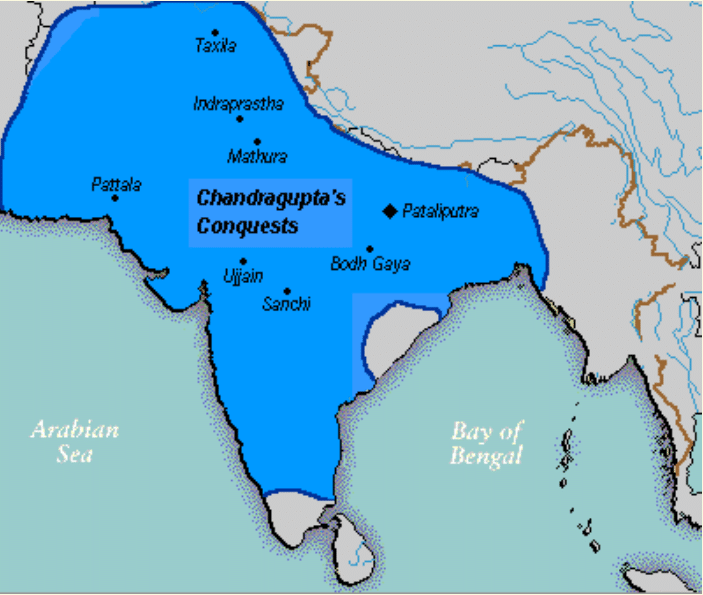
Ashoka (272–232 BCE)
Accession and Early Reign
- Ashoka Maurya was an Indian emperor of the Maurya dynasty who ruled almost the entire Indian subcontinent, with his capital at Pataliputra. He is said to have received his name from his mother’s exclamation upon his birth — “I am now without sorrow” — since Bindusara’s wife bore him a son.
- The Buddhist text Divyavadana describes Ashoka putting down a revolt caused by the activities of wicked ministers in Ujjain and Taxila — an incident that may have occurred during Bindusara’s own reign.
- Bindusara’s death in 272 BCE led to a war of succession: the Dipavamsa and Mahavamsa record Ashoka killing ninety-nine of his brothers, sparing only one, named Vitashoka or Tissa; he came to power with the support of the minister Radhagupta.
- Buddhist legends describe Ashoka as bad-tempered and of a wicked nature in his early reign, and claim that he built “Ashoka’s Hell,” an elaborate torture chamber.
- Ascending the throne, Ashoka expanded his empire over the following eight years — from present-day Assam in the east to Iran in the west, and from the Pamir Knot in the north to peninsular southern India, excluding present-day Tamil Nadu and Kerala, which remained ruled by the three ancient Tamil kingdoms.
- As monarch, he was ambitious and aggressive, re-asserting the empire’s superiority in southern and western India; but it was his conquest of Kalinga (262–261 BCE) that proved the pivotal event of his life.
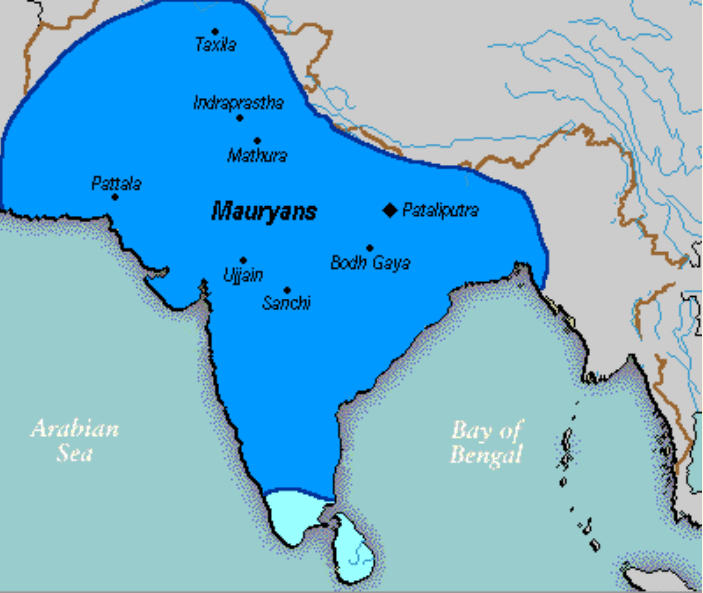
The Kalinga War
- The Kalinga War was fought between Ashoka and the ruler of the state of Kalinga, a feudal republic located on the coast of present-day Odisha and the northern parts of Andhra Pradesh — the only major war Ashoka fought after his accession to the throne.
Causes of the Kalinga War
- The reasons for invading Kalinga were both political and economic. Since the time of Ashoka’s father, Bindusara, the Mauryan Empire, based in Magadha, had pursued a policy of territorial expansion; Kalinga had been under Magadhan control during Nanda rule but regained its independence with the onset of Mauryan rule — a development considered a great setback to the traditional Magadhan policy of expansion, and a loss of political prestige for the Mauryas.
- Since its independence, moreover, Kalinga had become an arch-enemy of Magadha, allying itself with the Chola and Pandya countries of the south against it — prompting Ashoka’s invasion.
- Kalinga also possessed a vast army that could threaten the security of the Maurya Empire, and had achieved considerable material prosperity through its commercial relations with Malaya, Java, and Ceylon — a prosperity that may also have provoked Ashoka’s invasion.
Aftermath of the Kalinga War
- Ashoka’s response to the Kalinga War is recorded in the Edicts of Ashoka. The war prompted him to devote the rest of his life to ahimsa (non-violence) and to Dharma-vijaya (victory through Dharma); following the conquest of Kalinga, Ashoka ended the empire’s military expansion, leading it through more than forty years of relative peace, harmony, and prosperity.
- Rock Edict No. 13 (Dhauli/Tosali) records: “Beloved-of-the-Gods, King Priyadarsi, conquered the Kalingas eight years after his coronation. One hundred and fifty thousand were deported, one hundred thousand were killed and many more died (from other causes). After the Kalingas had been conquered, Beloved-of-the-Gods came to feel a strong inclination towards the Dharma, a love for the Dharma and for instruction in Dharma. Now Beloved-of-the-Gods feels deep remorse for having conquered the Kalingas.”
- About two-and-a-half years after the Kalinga war, Ashoka became an enthusiastic supporter of the Buddha’s religion; under its influence, he eventually forswore conquest by war (Bherighosha) and replaced it with conquest by Dharma (Dhammaghosha). He refrained from engraving his confession of remorse at any location within Kalinga itself, replacing it instead with separate Rock Edicts addressed to his officers, emphasising the need for good governance.
- Nigrodha, a five-year-old Buddhist monk, is said to have been responsible for the change in Ashoka; it is said that Ashoka himself was converted to Buddhism by Upagupta.
The Concept of Ashoka’s Dhamma
- The word Dhamma is the Prakrit form of the Sanskrit word Dharma. Various attempts have been made to define it or find equivalent English terms — such as “piety,” “moral life,” or “righteousness” — but scholars have struggled to translate it precisely, since it was coined and used in a very specific context.
- The best way to understand what Ashoka meant by Dhamma is to read his edicts, written to explain its principles to the people of his empire.
- Dhamma was not a particular religious faith or practice, nor an arbitrarily formulated royal policy — it was primarily an ethic of social conduct, relating to generalised norms of social behaviour, through which Ashoka tried to synthesise the various social norms current in his time.
- Dhamma was not the policy of a heretic, but a system of belief drawn from different religious faiths, and it also included other welfare measures.
The Need for Dhamma
- Around 600 BCE, considerable intellectual ferment was apparent, with healthy rivalry among numerous sects — the Charvakas, Jains, Buddhists, Ajivikas, and others — whose doctrines ranged from bare materialism to determinism. This intellectual liveliness was reflected in the eclectic interests of the Mauryan rulers themselves: it is claimed that Chandragupta was a supporter of the Jainas, and there is evidence that Bindusara favoured the Ajivikas.
- Ashoka’s empire was thus inhabited by peoples of many cultures and levels of development, with a vast range of customs, beliefs, affinities, antagonisms, tensions, and harmonies. The north was in close contact with the Hellenised culture of Afghanistan and Iran, while the far south stood on the threshold of a creative flowering of Tamil culture.
- Ruling such an empire required a broad set of ideas addressed to the public at large — and it is in his inscriptions that the king expounds his thinking on Dhamma.
- Ashoka aimed at creating an attitude of mind among his subjects in which social conduct was accorded the highest place; the ideology of Dhamma can be viewed as a focus of loyalty and a point of convergence for the bewildering diversity of the empire.
- A centralised monarchy demands a certain oneness of feeling among its people, and the ethics of Dhamma were intended to generate precisely this feeling. Mauryan society, with its heterogeneous elements and its competing economic, social, and religious forces, posed a real threat of disruption — Ashoka therefore needed some binding factor to allow economic activity to proceed smoothly and to secure the stability of his state.
- As the commercial classes gained economic importance, they increasingly resented their inferior social status under Brahmanical sanction and turned instead towards Buddhism, which preached social equality; their support was vital to the peace and prosperity of the empire, and Ashoka hoped to attract them through the propagation of Dhamma — weaning them away from too close an identification with Buddhism specifically.
- Ashoka clearly felt that these contrary social pulls threatened the peace of the realm; his Dhamma was, therefore, intended to serve a distinctly practical purpose.
Interpretations of Dhamma
- The Ashokan policy of Dhamma has long been the subject of scholarly controversy and debate. Some have argued that Ashoka was a partisan Buddhist, effectively equating Dhamma with Buddhism, and suggesting that it was originally Buddhist thought being preached as Dhamma, to which certain theological additions were made only later — a view based largely on Buddhist chronicles, which hold that the Kalinga war was the dramatic turning point at which Ashoka, out of remorse for the death and destruction of war, decided to become a Buddhist; Buddhist records credit him with propagating Buddhism both within India and abroad.
- Historians have also debated the actual results of Ashoka’s propagation of Dhamma. Some believe that Ashoka’s ban on sacrifices and his favour towards Buddhism provoked a Brahmanical reaction, contributing to the decline of the Mauryan Empire; others believe that the cessation of wars and the emphasis on non-violence crippled the empire’s military strength, leading to its collapse after Ashoka’s death.
- Ashoka’s Dhamma is best understood as a superb document of his essential humanity, and an answer to the socio-political needs of his time — it was not anti-Brahmanical, since respect for Brahmanas and Sramanas formed an integral part of it, and his emphasis on non-violence did not blind him to the practical needs of the state (he warned forest tribes that, although he disliked using coercion, he might be compelled to resort to force should they continue to cause trouble).
- By the time Ashoka renounced war, the entire Indian subcontinent lay under his control; in the south, he remained on friendly terms with the Cholas and Pandyas, while Sri Lanka was an admiring ally. Thus, Ashoka’s turn away from war came only once his empire had reached its natural boundaries.
- His plea for tolerance was a wise course of action in a society that was ethnically diverse, religiously varied, and class-divided — a conglomerate of farmers, pastoral nomads, hunter-gatherers, Greeks, Kambojas, Bhojas, and hundreds of other groups with differing traditions. In this situation, a plea for tolerance was clearly needed, and Ashoka sought to transcend narrow, parochial cultural traditions with a broad set of ethical principles.
Ashoka’s Moral Code (Dhamma) as Formulated in the Rock Edicts
- Ashoka’s moral code, or Dhamma, is chiefly formulated across his fourteen Major Rock Edicts:
- Edict I: prohibits animal sacrifice and bans festive gatherings involving the killing of animals — Ashoka notes that only two peacocks and one deer were still being killed for his own kitchen, and expresses his wish to discontinue even this practice.
- Edict II: relates to measures of social welfare, mentioning medical treatment for both men and animals, the construction of roads and wells, and tree-planting; it also describes the neighbouring kingdoms of Chola, Pandya, Satyaputra, and Keralaputra in South India.
- Edict III: declares liberality towards Brahmanas and Sramanas, and respect for one’s parents, to be virtues. Issued twelve years after Ashoka’s coronation, it instructs that the Yuktas (subordinate officers), Pradesikas (district heads), and Rajukas (rural officers) should tour all areas of the kingdom every five years to spread the policy of Dhamma.
- Edict IV: comments that, owing to the policy of Dhamma, the lack of morality and disrespect towards Sramanas and Brahmanas, along with violence and unseemly behaviour towards friends, relatives, and others, had been checked, and that the killing of animals had also been curtailed to a large extent; it declares Dhammaghosha (the drum of Dhamma) to be the ideal for mankind, rather than Bherighosha (the drum of war).
- Edict V: refers to the appointment of Dhamma-mahamattas for the first time, in the twelfth year of Ashoka’s reign — special officers appointed to look after the interests of all sects and religions and to spread the message of Dhamma; it also touches on policy towards slaves, with Ashoka declaring, “Every human is my child.”
- Edict VI: instructs the Dhamma-mahamattas that they may bring their reports to the king at any time, describes the king’s desire to remain constantly informed of his people’s condition, and deals with speedy administration and the smooth transaction of business.
- Edict VII: is a plea for tolerance among all sects — the edict suggests that tensions among the sects were intense, perhaps verging on open antagonism, and the plea forms part of Ashoka’s overall strategy to maintain unity.
- Edict VIII: records that Ashoka undertook Dhammayatras (tours), including his first Dhamma-yatra to Bodh Gaya and the Bodhi Tree — replacing the earlier royal practice of going on hunting expeditions, and allowing the emperor to come into contact with various sections of his people.
- Edict IX: attacks popular ceremonies performed after birth, illness, marriage, and before setting out on a journey, censuring in particular the ceremonies observed by wives and mothers, and instead stresses the practice of Dhamma over the futility of such ceremonies.
- Edict X: denounces the desire for fame and glory, and reasserts the merits of following the policy of Dhamma.
- Edict XI: elaborates further on the policy of Dhamma, emphasising respect for elders, abstention from killing animals, and liberality towards friends.
- Edict XII: renews the appeal for tolerance among sects, reflecting the king’s anxiety over conflict between them and his continued plea for harmony.
- Edict XIII: is of paramount importance for understanding Ashoka’s policy of Dhamma — the largest of all the edicts, it describes his victory over Kalinga and pleads for conquest by Dhamma rather than by war, describing the victory of his Dhamma over the Greek kings Antiochus, Ptolemy, Antigonus, Magas, and Alexander, as well as the Cholas and Pandyas; it also mentions the Kambojas, Nabhakas, Bhojas, and Andhras. This edict represents the logical culmination of the thought developed across the preceding edicts — by “conquest,” Ashoka appears to mean the adoption of the policy of Dhamma by a country, rather than its territorial control.
- Edict XIV: describes the engraving of these inscriptions in different parts of the country; in it, Ashoka states, “My dominions are wide, and much has been written, and I shall cause still more to be written. And some of this has been stated again and again because of the charm of certain topics, and in order that men should act accordingly.”
- In a minor edict, Ashoka states: “Father and mother must be obeyed; similarly respect for living creatures must be enforced, truth must be spoken. These are the virtues of the law of Duty (or ‘Piety,’ Dhamma) which must be practiced. Similarly, the teacher must be reverenced by the pupil, and proper courtesy must be shown to relations. This is the ancient standard of duty (or ‘Piety’) — leads to length of days, and according to this men must act.”
- The three obligations — showing reverence, respecting animal life, and telling the truth — are inculcated repeatedly across the edicts, and were meant for all: Buddhists, Brahmins, Jains, and Ajivikas alike, representing, in effect, the essence of the good principles of every religion; Ashoka passionately appealed for tolerance towards all religions, and reverence for one another.
- Had this Dhamma been fundamentally tied to Buddhist doctrine, Ashoka would likely have said so openly in his edicts; instead, he did not incorporate any of the core tenets of Buddhist faith — the Four Noble Truths, the chain of causation, the Eightfold Path, or Nirvana. These omissions, together with his repeated reference to the concept of svarga (heaven, a Hindu belief), show that his Dhamma cannot simply be identified with Buddhism.
- Since Ashoka’s Dhamma was not intended solely for the cause of Buddhism, during his dharma-yatras he not only visited various Buddhist sites of importance but also gave gifts to Sramanas and Brahmins alike. Notably, even after entrusting the propagation of Dhamma to the Dhamma-mahamattas, Ashoka continued to style himself as the “beloved of the devas” — a Hindu concept, since Buddhism at that time had no gods of its own.
Success of Ashoka’s Dhamma?
- Ashoka claims that his missions were sent to various places — including Ceylon and various Western countries — and maintains that they were all successful; this claim, however, is difficult to accept, since there is no authentic proof of the missions’ success.
- His policy of Dhamma ultimately failed to achieve its desired goal, and social tension continued. Taxila, which had revolted once already during his father’s reign, was goaded into rebellion once more, this time by ministerial oppression.
- The power of the official Dhamma-mahamattas to intervene in people’s lives grew over time, generating resentment against them. None of Ashoka’s successors continued the propagation of Dhamma, and his policy left no lasting impact — many vassals declared their independence after Ashoka’s retirement around 232 BCE.
- Ashoka’s “Dhamma”, in this sense, could not survive him, and was therefore, in a narrow sense, a failure — though it should be remembered that he was never attempting to establish a new religion, but only to impress upon society the need for ethical and moral principles.
- His policy of consolidating the empire through Dhamma did bear some fruit: the Kandahar inscription speaks of the success of this policy among hunters and fishermen, who gave up the killing of animals and took to settled agricultural life.
Was Ashoka a Complete Pacifist?
- There is good reason to believe that Ashoka was not, in fact, as pacifistic or unmilitaristic as is often believed — Buddhist literature seems to exaggerate his pacifism considerably.
- Various Ashokan inscriptions, along with some stray Hindu texts, indicate that the Mauryans under Ashoka maintained a fairly strong army, even using it to quell uprisings among tribal societies and other groups; some inscriptions warn against further revolts, framed within the context of Piyadasi’s benevolence.
- Ashoka did not give up his imperial ambitions, but rather modified them in accordance with the humanitarian ethics of Buddhism.
- Within the empire, he appointed a class of officers known as Rajukas, vested with the authority to reward as well as punish people whenever necessary. He also maintained the death penalty, merely granting condemned men a stay of execution of three days so that they could prepare their minds for the next world.
- Though Buddhist tradition credits him with abolishing judicial torture, this claim is not, in fact, stated anywhere in his own edicts.
The Edicts of Ashoka

- The Edicts of Ashoka are a collection of 33 inscriptions on the Pillars of Ashoka, as well as on boulders (rocks) and cave walls, created by Emperor Ashoka during his reign. These inscriptions are dispersed across modern-day Bangladesh, India, Nepal, and Pakistan, and represent the first tangible evidence of Buddhism.
- The edicts focus on social and moral precepts rather than on specific religious practices or the philosophical dimensions of Buddhism, and also mention Ashoka’s social and animal welfare programmes.
- According to the edicts, the extent of Buddhist proselytism during this period reached as far as the Mediterranean, and many Buddhist monuments were created; Ashoka names the Greek rulers of his time, inheritors of Alexander’s conquests, from Bactria as far as Greece and North Africa — displaying a clear grasp of the contemporary political situation.
- The inscriptions found in eastern India were written in the Magadhi language, using the Brahmi script; in the western part of India, the language used is closer to Sanskrit, employing the Kharoshthi script, with one extract of Edict 13 in Greek, and one bilingual edict in Greek and Aramaic.
- These edicts were decoded by the British archaeologist and historian James Prinsep in 1837. In these inscriptions, Ashoka refers to himself as “Beloved of the Gods” (Devanampiyadasi); the identification of Devanampiyadasi with Ashoka was confirmed by an inscription (a Minor Rock Edict) discovered in 1915 by C. Beadon, at Maski, a village in Raichur district, Karnataka.
- Another minor rock edict, found at the village of Gujarra (Girjara) in Datia district, Madhya Pradesh, likewise bears the name “Ashoka” alongside the usual “Devanampiyadasi.”
- The edicts are divided into: Pillar Edicts (major and minor); Major Rock Edicts — fourteen edicts (numbered first to fourteenth), plus two separate ones found in Odisha; and Minor Rock Inscriptions, comprising the Minor Rock Edicts, the Queen’s Edict, the Barabar Caves inscriptions, and the Kandahar bilingual inscription.
Pillar (Stambha) Edicts (Set of Seven)
- The Pillar Edicts form a set of seven:
- Pillar Edict I: Ashoka’s principle of protecting his people.
- Pillar Edict II: defines Dhamma as the minimisation of sins, along with many virtues — compassion, liberality, truthfulness, and purity.
- Pillar Edict III: abolishes the sins of harshness, cruelty, anger, pride, and similar vices.
- Pillar Edict IV: deals with the duties of the Rajuka, his officer.
- Pillar Edict V: lists animals and birds that should not be killed on certain days, along with another list of animals never to be killed at all; it also describes Ashoka’s release of twenty-five prisoners.
- Pillar Edict VI: sets out the Dhamma policy.
- Pillar Edict VII: describes the works undertaken by Ashoka for his Dhamma policy, stating that all sects desire both self-control and purity of mind.
Why a Pillar Edict?
- All the pillars were placed at Buddhist monasteries, important sites from the life of the Buddha, and places of pilgrimage; some columns carry inscriptions addressed to monks and nuns, while others were erected to commemorate Ashoka’s own visits.
- It is possible that Persian artists came to Ashoka’s empire seeking work, bringing with them the pillar form common in Persian art; but it is equally likely that Ashoka chose the pillar because it was already an established Indian art form — in both Buddhism and Hinduism, the pillar symbolised the axis mundi, the axis on which the world spins.
- The pillars and edicts represent the first physical evidence of the Buddhist faith, asserting Ashoka’s Buddhism and his desire to spread the Dharma throughout his kingdom. Since the edicts say nothing about the philosophical aspects of Buddhism, some scholars have suggested that this reflects a simple and rather naïve understanding of the Dharma on Ashoka’s part.
- Ashoka’s goal may not have been to expound the truths of Buddhism at all, but to inform his people of his reforms and encourage them towards a moral life; through their strategic placement, and their grounding in Buddhist Dharma, the edicts served to underscore Ashoka’s administrative role and his character as a tolerant leader.
The Pillars (Stambha)
- The Pillars of Ashoka are a series of columns dispersed throughout the northern Indian subcontinent, erected — or at least inscribed with edicts — by the Mauryan king Ashoka during the third century BCE. Originally, there must have been many more pillars, but only nineteen survive with inscriptions, and only six retain their animal capitals.
- Averaging 40 to 50 feet in height and weighing up to 50 tons each, the pillars were dragged or carried, sometimes across rivers and for hundreds of miles, to the sites where they were erected; they are generally polished.
- The columns appear to have been carved from two types of stone: some from spotted red and white sandstone quarried near Mathura, others from buff-coloured, fine-grained hard sandstone, usually with small black spots, quarried at Chunar, near Varanasi. The uniformity of style across the pillar capitals suggests that they were all sculpted by craftsmen from the same region.
Architecture of the Pillars
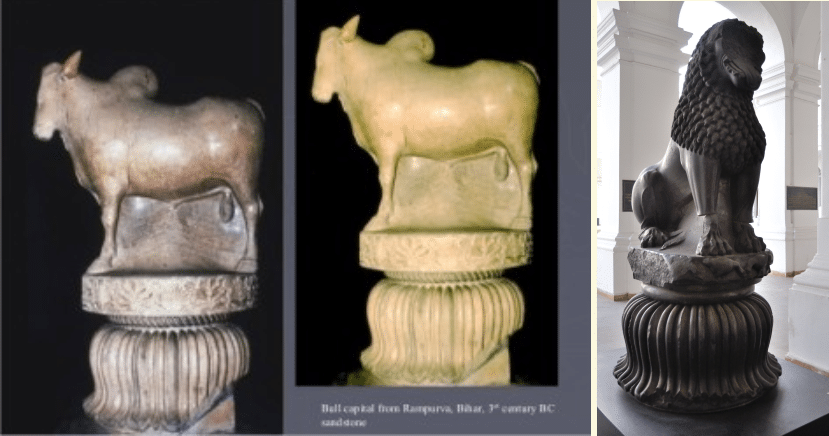
- The pillars comprise four component parts, made in two pieces: the shaft; and the capital, itself composed of the bell (the lower part of the capital) and the abacus (the upper part). The three sections of the capital are made in a single piece, often of a different stone from the monolithic shaft to which they are attached by a large metal dowel.
- The shafts are always plain and smooth, circular in cross-section, tapering slightly upwards, and always chiselled from a single, monolithic piece of stone. The capital forms the topmost member of the column, its lower portion shaped and arched gently like a bell formed of lotus petals.
- The abacus is a flat slab forming the uppermost member of the capital, above the bell; its chief function is to provide a broad supporting surface — typically wider than the capital itself — to receive the weight of the crowning animal sculpture (such as the four Asiatic lions of the Sarnath pillar). Abaci are of two types: square and plain, or circular and decorated.
- The crowning animal sculptures are masterpieces of Mauryan art, shown seated or standing, always fully in the round, and chiselled as a single piece together with the abacus; presumably, all or most of the other surviving columns, which now lack capitals or animals, once possessed them too.
The Pillars as Stone Sculpture and Their Influences
- The six surviving animal sculptures from the Ashokan pillars form “the first important group of Indian stone sculpture,” though they are thought to derive from an earlier tradition of wooden columns topped with animal sculptures in copper, none of which have survived; it is also possible that some of the stone pillars predate Ashoka’s own reign.
- There has been much discussion of the extent of influence from Achaemenid Persia — the column capitals supporting the roofs at Persepolis show certain similarities, and the “rather cold, hieratic style” of the Sarnath Lion Capital in particular shows “obvious Achaemenid and Sargonid influence.”
- Five of the pillars — two at Rampurva, and one each at Vaishali, Lauriya-Areraj, and Lauriya Nandangarh — possibly marked the course of the ancient royal highway from Pataliputra to the Nepal valley. Several pillars were later relocated by rulers of the Mughal Empire, with their animal capitals removed in the process.
List of the Pillars (With or Without Inscriptions)
- Two medieval Chinese pilgrim accounts record sightings of several columns that have since vanished — Faxian records six, and Xuanzang, fifteen, of which at most five can now be identified with surviving pillars. The main surviving pillars, along with any crowning animal sculptures and inscribed edicts, are as follows:
- Sarnath, near Varanasi, Uttar Pradesh — four lions, Pillar Inscription, Schism Edict. The capital, carved from a single block of polished sandstone, was always a separate piece from the column; it features four Asiatic lions standing back to back, mounted on an abacus whose frieze carries high-relief sculptures of an elephant, a galloping horse, a bull, and a lion, separated by spoked chariot wheels.
- The capital was originally probably crowned by a Wheel of Dharma (Dharmachakra, popularly known in India as the Ashoka Chakra) with 24 spokes, fragments of which were found on-site. This capital — minus its inverted, bell-shaped lotus flower — has been adopted as the National Emblem of India, showing the horse on the left and the bull on the right of the Ashoka Chakra on the circular base on which the four lions sit back to back, with an elephant and a lion on the far side; the wheel itself, the “Ashoka Chakra,” has been placed at the centre of the National Flag of India. The original pillar, sometimes called the Ashoka Column, remains in its original location, though the Lion Capital itself is now housed in the Sarnath Museum.
- Sarnath, near Varanasi, Uttar Pradesh — four lions, Pillar Inscription, Schism Edict. The capital, carved from a single block of polished sandstone, was always a separate piece from the column; it features four Asiatic lions standing back to back, mounted on an abacus whose frieze carries high-relief sculptures of an elephant, a galloping horse, a bull, and a lion, separated by spoked chariot wheels.
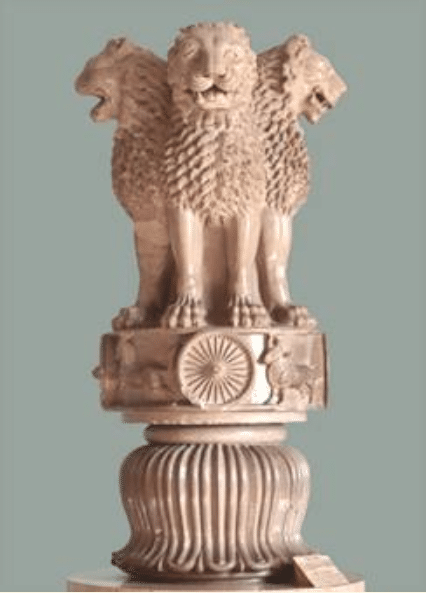
but this Lion Capital is now in the Sarnath Museum,
- Sanchi, near Bhopal, Madhya Pradesh — four lions, Schism Edict. The capital from Sanchi’s Ashokan column is now in the Sanchi Museum; the stone is not the local sandstone used for most of the work at Sanchi, but came instead from Chunar.
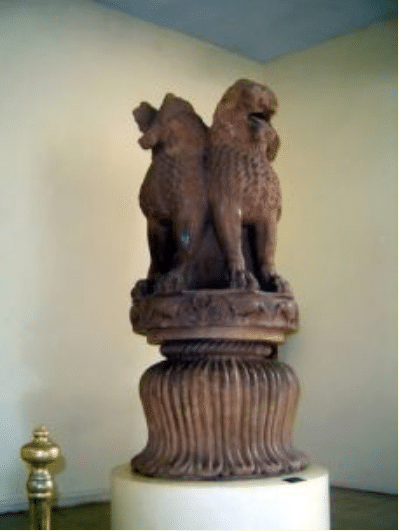
used for most of the work at Sanchi. Instead, it came from Chunar
- Rampurva, Champaran, Bihar — two columns: one with a bull capital and Pillar Edicts I–VI, the other with a single lion capital and no edicts.
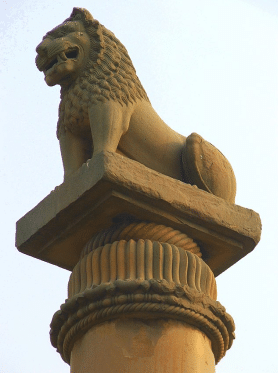
- Vaishali, Bihar — a single lion, with no inscription. The pillar’s location is contiguous with the site of a Buddhist monastery and a sacred coronation tank; the lion faces north, the direction the Buddha took on his final journey.
- Sankissa, Uttar Pradesh — an elephant capital only, mainly unpolished, though the abacus is at least partly polished.
- Lauriya-Nandangarh, Champaran, Bihar — a single lion, with Pillar Edicts I–VI.
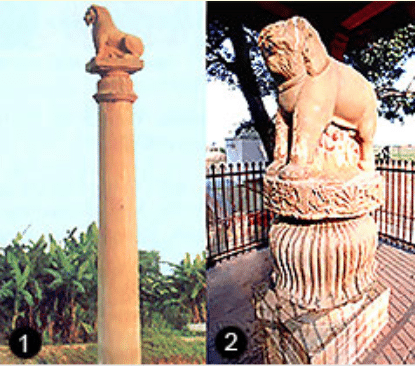
- Kandahar, Afghanistan — fragments of Pillar Edict VII.
- Ranigat, Khyber Pakhtunkhwa, Pakistan.
- Delhi-Meerut, Delhi ridge — Pillar Edicts I–VI, moved from Meerut to Delhi by Firuz Shah Tughluq in 1356.
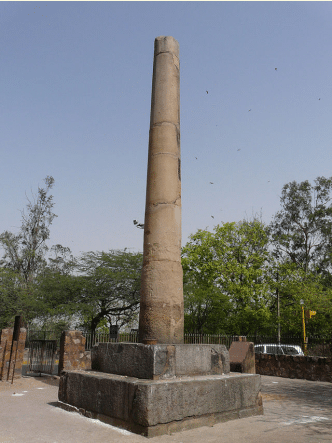
- Delhi-Topra, Feroz Shah Kotla, Delhi — Pillar Edicts I–VII, moved from Topra to Delhi by Firuz Shah Tughluq; the Brahmi inscription conveys the same message of “the code of Dharma: virtue, social cohesion, and piety” found on the other pillars, but with the added distinction of also referring to matters of taxation.
- Lauriya-Araraj, Champaran, Bihar — Pillar Edicts I–VI.
- Allahabad, Uttar Pradesh — originally located at Kausambi and probably moved to Allahabad by Jahangir; Pillar Edicts I–VI, the Queen’s Edict, and the Schism Edict.
- Amaravati, Andhra Pradesh.
- Minor pillar inscriptions, containing records of their own dedication, include:
- Lumbini (Rummindei), Rupandehi district, Nepal — the upper part of the pillar broke off when struck by lightning, and the original horse capital mentioned by Hsuan Tsang is now missing. The inscription describes how King Priyadarsi (Ashoka), Beloved of the Gods, personally visited and worshipped at this spot, because the Sage of the Sakyans — Lord Buddha — was born here; Ashoka exempted Lumbini from taxation.
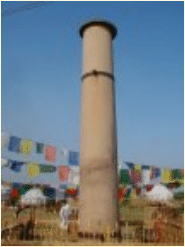
- Nigali-Sagar (or Nigliva), near Lumbini, Rupandehi district, Nepal — originally near the Buddha Konakamana stupa. The inscriptions here refer to repairs and expansions made to the size of this earlier stupa in 254 BCE, and to Ashoka’s personal visit and offerings of prayer in 249 BCE; the pillar recording the enlargement of the stupa is admittedly no longer in its original location (in situ).

- The Allahabad Pillar (or Allahabad Ashoka Stambha) bears inscriptions from Ashoka as well as later inscriptions attributed to Samudragupta and Jahangir. The pillar was first erected at Kaushambi, an ancient town some 30 kilometres west of Allahabad and once the capital of the Koshala kingdom, before being moved to Allahabad — presumably under Muslim rule; it now stands within the Allahabad Fort, also a royal palace built in the sixteenth century by Akbar. The Ashokan inscription, in Brahmi script, is dated to 232 BCE, and contains the same six edicts found on the other pillars.
Major Rock Edicts (Set of Fourteen): Sites
- Beyond their content (discussed above under Ashoka’s Dhamma), the Major Rock Edicts are found inscribed at the following sites:
- Kandahar, Afghanistan — portions of Rock Edicts 12 and 13, in bilingual Greek-Aramaic.
- Shahbazgarhi, Khyber Pakhtunkhwa, Pakistan — in Kharoshthi script.
- Mansehra Rock Edicts, Mansehra, Khyber Pakhtunkhwa, Pakistan — in Kharoshthi script, describing the expansion of Buddhism and the Law of Piety (Dharma); the site lies near the Karakoram Highway, on the ancient Silk Route.
- Kalsi, near Chakrata, Dehradun district, Uttarakhand.
- Girnar, near Junagadh, Gujarat — in Brahmi script, inscribed high on a large, domed mass of black granite.

- Sopara, Thane district, Maharashtra — fragments of Rock Edicts 8 and 9.
- Dhauli, near Bhubaneswar, Odisha — containing Rock Edicts I–X and XIV, plus two separate Kalinga Edicts not among the standard set of fourteen (Separate Edict I declares that all people are Ashoka’s children; Separate Edict II proclaims the edicts even to a single person). The rock-cut elephant above the edicts at Dhauli is the earliest Buddhist sculpture of Odisha, depicting only the animal’s foreparts.
- Jaugada, Ganjam district, Odisha — includes the Kalinga Edict but excludes Rock Edicts 1–10 and 14; Jaugada served as a provincial Mauryan fortified capital for the newly conquered province of Kalinga.
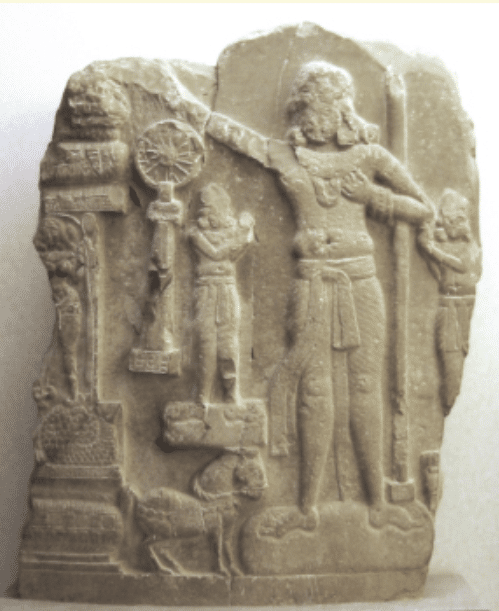
- Sannati, Gulbarga district, Karnataka — separate Rock Edicts 1 and 2, along with fragments of Rock Edicts 13 and 14, written in Prakrit and Brahmi script. One of the stones here — the only known example of its type — depicts Ashoka (274–232 BCE) seated on his throne, probably the only surviving image of the emperor himself.
- Yerragudi, near Gooty, Kurnool district, Andhra Pradesh — both Major and Minor Rock Edicts are found here; the edict discusses the welfare of wildlife, making the Ashokan edicts probably the first law for wildlife welfare anywhere in the world.
Minor Rock Edicts: Sites
- The Minor Rock Edicts are found at the following locations: Kandahar (Afghanistan); Lampaka (Afghanistan); Bahapur (Delhi); Bairat, near Jaipur (Rajasthan); Bhabru, a second hill at Bairat (Rajasthan); Gujarra, near Jhansi, Datia district (Madhya Pradesh); Rupnath, on the Kaimur Hills near Jabalpur (Madhya Pradesh); Panguraria, Sehore district (Madhya Pradesh); Sohgaura, Gorakhpur district (Uttar Pradesh); Sahasram, Rohtas district (Bihar); the Barabar Caves, Bihar (bearing donatory inscriptions to the Ajivika sect by the Mauryan king Dasaratha, in 232 BCE); Mahasthan, Bogra district (Bangladesh); Rajula-Mandagiri, Kurnool district (Andhra Pradesh); Palkigundu and Gavimath, Koppal district (Karnataka); Suvarnagiri (Kanakagiri), Koppal district (Karnataka); Brahmagiri, Chitradurga district (Karnataka); Jatinga-Rameshwara, near Brahmagiri (Karnataka); Siddapur, near Brahmagiri (Karnataka); Maski, Raichur district (Karnataka); Nittur, Bellary district (Karnataka); and Udegolam, Bellary district (Karnataka).
Disintegration of the Maurya Empire
- Towards the end of his reign, Ashoka’s grip over the imperial organisation weakened, and the Maurya Empire began to decline with his death in 232 BCE, breaking up soon after. Evidence for the later Mauryas is meagre.
- The Puranas, alongside Buddhist and Jaina literature, provide some information on the later Mauryas, though there is little agreement among them — even among the Puranas themselves, there is considerable variance from one text to another. The one point on which all the Puranas agree is that the dynasty lasted 137 years.
- Ashoka’s death was followed by the division of the empire into western and eastern halves.
- The western part, including the north-western province, Gandhara, and Kashmir, was governed by Kunala (one of Ashoka’s sons) and then, for a while, by Samprati (according to Jaina tradition, a grandson of Ashoka and a patron of Jainism). It was later threatened from the north-west by the Bactrian Greeks, to whom it was practically lost by 180 BCE, and from the south by the Andhras or Satavahanas, who later rose to power in the Deccan.
- The eastern part, with its capital at Pataliputra, came to be ruled by Dasaratha (probably one of Ashoka’s grandsons); besides being mentioned in the Matsya Purana, Dasaratha is also known to us from caves in the Nagarjuni Hills, which he dedicated to the Ajivikas.
- According to the Puranas, Dasaratha reigned for eight years, and the same sources record Kunala ruling for eight years in the west; both may have died around the same time, allowing Samprati, now ruling in the west, to have successfully regained the throne at Pataliputra, reuniting the empire in around 223 BCE.
- However, the empire had probably already begun to disintegrate by this point; Jaina sources record that Samprati ruled from both Ujjain and Pataliputra.
- After Dasaratha and Samprati came Salisuka, mentioned in the astronomical work the Gargi Samhita as a wicked and quarrelsome king. According to the Puranas, Salisuka’s successors were Devavarman, Satadhanvan (Satamdhanus), and finally Brihadratha — the last of whom was overthrown by his commander-in-chief, Pushyamitra, who founded the new Sunga dynasty.
Important Causes of the Fall of the Maurya Empire
- The Magadhan empire, built up through successive wars culminating in the conquest of Kalinga, began to disintegrate after Ashoka’s departure in 232 BCE. Several causes appear to have brought about the decline and fall of the Maurya Empire.
Brahmanical Reaction
- Scholars have suggested that the pro-Buddhist policies of Ashoka, and the pro-Jaina policies of his successors, alienated the Brahmins and led to the revolt of Pushyamitra, founder of the Shunga dynasty.
- This Brahmanical reaction is said to have begun as a result of Ashoka’s own policies: though he adopted a tolerant stance and asked people to respect even the Brahmanas, he issued his edicts in Prakrit rather than Sanskrit, prohibited the killing of birds and animals, and derided superfluous rituals performed by women — an anti-sacrifice attitude, rooted in Buddhism, that adversely affected Brahmana incomes.
- Further, Ashoka appointed Rajukas to govern the countryside and introduce vyavaharasamata and dandasamata — the same civil and criminal law for all varnas — whereas the Dharmashastras compiled by the Brahmanas prescribed varna-based discrimination; this policy, naturally, infuriated the Brahmanas.
- Some of the new kingdoms that arose on the ruins of the Maurya Empire were, in fact, ruled by Brahmanas — the Shungas and Kanvas, who ruled in Madhya Pradesh and further east on the remnants of the Maurya Empire, were Brahmanas, as were the Satavahanas, who founded a kingdom in the western Deccan and Andhra; these Brahmana dynasties revived the very Vedic sacrifices that Ashoka had discarded.
- The view that Brahmanical reaction was responsible for Mauryan decline rests on three main points: the Buddhist text Divyavadana refers to the persecution of Buddhists by Pushyamitra Sunga; Ashoka’s claim of having exposed the Bhudevas (Brahmins) as false gods suggests he was ill-disposed towards Brahmins; and the very capture of power by Pushyamitra Sunga shows the triumph of the Brahmins.
- Each of these three points, however, can be challenged: the Divyavadana cannot be entirely relied upon, since it was during Pushyamitra Sunga’s own reign that the Sanchi and Barhut stupas were completed — the impression of persecution was probably instead created by Menander’s invasion, since Menander himself was a Buddhist.
- The word “bhudeva” may also have been misinterpreted, since it must be read in the context of the surrounding phrase; while it normally means “brahmana” or “brahmin” in classical Sanskrit, the specific context may require a different reading.
- The victory of Pushyamitra Sunga, moreover, clearly shows that the last of the Mauryas was simply an incompetent ruler, since he was overthrown in the very presence of his own army — a fact that had nothing to do with Brahmanical reaction against Ashoka’s patronage of Buddhism. Indeed, the very fact that a Brahmin served as commander-in-chief of the Mauryan ruler suggests that the Mauryas and the Brahmins were, in fact, cooperating with one another.
Financial Crisis
- The enormous expenditure on the army and on payments to the bureaucracy created a financial crisis for the Maurya Empire. The Mauryas maintained, in ancient terms, the largest army and the largest regiment of officers, and despite the wide range of taxes imposed upon the people, it proved difficult to sustain this huge administrative superstructure.
- Ashoka’s large donations to Buddhist monks further emptied the royal treasury, and towards the end, the Mauryas were reportedly obliged to melt down gold images to meet expenses.
- These factors, however, are somewhat one-sided and are not fully corroborated by archaeological evidence — excavations at sites such as Hastinapura and Sisupalgarh have, in fact, shown improvements in material culture during this period.
Oppressive Rule
- Oppressive rule in the provinces was an important cause of the empire’s break-up. During the reign of Bindusara, the citizens of Taxila bitterly complained against the misrule of wicked bureaucrats (dushtamatyas); their grievance was redressed by the appointment of Ashoka, yet a similar complaint was raised by the same city once Ashoka himself became emperor.
- The Kalinga edicts show that Ashoka was deeply concerned about oppression in the provinces, instructing his mahamatras not to tyrannise the townsmen without due cause; for this purpose, he introduced a rotation of officers in Tosali (in Kalinga), Ujjain, and Taxila, and himself spent 256 nights on pilgrimage — which may have aided administrative supervision.
- All of this, however, failed to stop oppression in the outlying provinces, and after Ashoka’s retirement, Taxila took the earliest opportunity to throw off the imperial yoke.
Vastness of the Empire
- The Maurya Empire was simply too vast in extent — while stretching to the farthest corners of the Indian subcontinent, it also included territories beyond India’s natural frontiers. This vastness proved a source of weakness rather than strength, given the limitations of communication; distances were so great that the empire could not remain a closely integrated political unit for very long.
- Though Chandragupta and Ashoka had left behind an elaborate system of administration, the entire machinery operated under central direction, and this highly centralised character of government suffered from a grave defect — it depended entirely on the king for all major policy, making the success of administration hostage to his personal ability.
- If the king was strong, the centre remained strong; if he was weak, the centre weakened, and once the centre weakened, the administration of distant provinces weakened in turn. This is precisely what happened under the later Mauryas — a weak centre, under a weak king, could no longer govern such a vast empire, and as a result, Mauryan administration collapsed and the empire began to disintegrate.
New Knowledge in the Outlying Areas
- Magadha had owed its original expansion to certain basic material advantages. Once knowledge of these cultural elements spread to central India, the Deccan, and Kalinga — as a result of the Magadhan empire’s own expansion — the Gangetic basin, the heart of the empire, lost its special advantage; the regular use of iron tools and weapons in the peripheral provinces coincided directly with the decline and fall of the Maurya Empire.
- On the basis of the material culture acquired from Magadha, new kingdoms could now be founded and developed independently — explaining the rise of the Shungas and Kanvas in central India, the Chetis in Kalinga, and the Satavahanas in the Deccan.
Neglect of the North-West Frontier and the Great Wall of China
- Since Ashoka was primarily preoccupied with missionary activities at home and abroad, he was unable to give sufficient attention to safeguarding the passes of the north-western frontier — a growing necessity in light of the movement of tribes in Central Asia during the third century BCE. The Scythians, a nomadic people reliant chiefly on the horse, were in a state of constant flux, posing a serious danger to the settled empires of both China and India.
- The Chinese ruler Shih Huang Ti (247–210 BCE) constructed the Great Wall of China, around 220 BCE, specifically to shield his empire against Scythian attacks — but Ashoka took no comparable measures.
- When the Scythians eventually pushed towards India, they forced the Parthians, Shakas, and Greeks to move into the subcontinent in turn. The Greeks, who had established a kingdom in north Afghanistan known as Bactria, were the first to invade India, in 206 BCE, followed by a series of further invasions continuing up to the beginning of the Christian era.
Internal Revolt
- A further, more immediate cause was the partition of the empire into two — the eastern part under Dasaratha, and the western part under Kunala. Had this partition not occurred, the Greek invasions of the north-west might have been held back for a while longer, giving the Mauryas a chance to re-establish some measure of their former power; the partition also disrupted the various administrative services.
- As Mauryan rule weakened and the empire began breaking up within half a century of Ashoka’s death, a final death-blow came in the form of an internal revolt — led by the chief of the Maurya army, General Pushyamitra, around 185 BCE, when the Maurya king Brihadratha ruled in Magadha.
- This was, in essence, a military coup d’état. Pushyamitra, himself a Brahmin, is described in the Puranas in the words: “Pushyamitra the Senapati will rule the kingdom by assassinating his own master.” Bana, the celebrated author of the Harsha-Charita, describes the incident, recounting how Pushyamitra held a parade of the army to which he invited the king to preside — thereby creating the occasion to kill him on the spot, with the army’s support.
- The Shungas subsequently ruled at Pataliputra and in central India, performing several Vedic sacrifices to mark the revival of the Brahmanical way of life, and are said to have persecuted the Buddhists; they were succeeded, in turn, by the Kanvas, who were likewise Brahmanas.
Ashoka’s Pacifist Policy
- Ashoka’s pacifist policies have also been held responsible for undermining the strength of the empire, his emphasis on non-violence weakening its military strength over time — though it should be noted that nothing in the Ashokan inscriptions actually suggests any demobilisation of the army, and capital punishment, too, continued throughout his reign.
Most Fundamental Reasons
- The decline of the Mauryan Empire cannot be satisfactorily explained solely by reference to military inactivity, Brahmin resentment, popular uprising, or economic pressure — the underlying causes were, in fact, more fundamental, rooted in the very organisation of Mauryan administration and its conception of the state.
- Mauryan administration was of an extremely centralised character, necessitating a king of considerable personal ability; in such a system, the weakening of central control automatically weakened the entire administration. With Ashoka’s death, and the uneven quality of his successors, a weakening at the centre set in — particularly following the division of the empire.
- It should also be remembered that all officials owed their loyalty to the king personally, rather than to the state as an institution; a change of king could therefore result in a change of officials, demoralising the bureaucracy, since the Mauryas had no system for ensuring the continuity of a well-planned administrative service.
- Given the Mauryan state’s extreme centralisation and the king’s virtual monopoly of all power, there existed a total absence of any advisory institution representing public opinion — which is why the Mauryas relied so heavily on their system of espionage. Compounding this lack of representative institutions was the absence of any distinction between the executive and judicial functions of government; an incapable king could thus use his officers either for purposes of oppression, or simply fail to use them for any good purpose at all.
- The Mauryan state derived its revenues from taxing a variety of resources that would themselves need to grow and expand in order to sustain the state’s administrative apparatus — yet the Mauryas made no serious attempt to expand this revenue potential, or to restructure and reorganise their resource base. This inherent weakness in the Mauryan economy, combined with the other factors above, contributed directly to the empire’s collapse.
- Other significant factors contributing to the decline, and to the lack of national unity, included the pattern of land ownership and the inequality of economic development across regions — land could frequently change hands, and the fertile Ganges region was considerably more prosperous than the northern Deccan. Mauryan administration was never fully attuned to addressing these disparities in economic activity; had the southern region been more developed, the empire might have enjoyed greater economic homogeneity.
- It is also true that the peoples of the subcontinent were not of a uniform cultural level — the sophisticated cities and trade centres stood in sharp contrast to isolated village communities, and even the languages spoken varied considerably across regions. All these differences naturally produced economic and political structures that differed markedly from region to region.
- Ultimately, then, the causes of the Mauryan Empire’s decline must be attributed, in large part, to a top-heavy administration in which authority rested entirely in the hands of a very few individuals, while any real sense of national consciousness remained wholly unknown.
Conclusion
The Maurya Empire represents both the pinnacle and the cautionary lesson of ancient India’s first experiment in pan-Indian imperial rule. From Chandragupta’s founding conquests and Kautilya’s meticulous statecraft, through Ashoka’s transformative turn towards Dhamma after the horrors of Kalinga, to the empire’s eventual fragmentation under weak successors and an over-centralised administration, the Mauryan experience illustrates both the extraordinary reach and the inherent fragility of a state built around the personal capability of a single ruler. For UPSC History Optional aspirants, the Maurya Empire remains indispensable — not only for its administrative innovations and Ashoka’s unique ideology of governance, but as a template for understanding the recurring cycles of centralisation and disintegration that mark the political history of ancient India.