

Every statutory power a Sub-Divisional Magistrate exercises — mapped to its current BNSS section, its limits, and the landmark judgments (Madhu Limaye, Ratlam, Ram Sumer Puri Mahant, Anuradha Bhasin) that define how far that power can actually go.
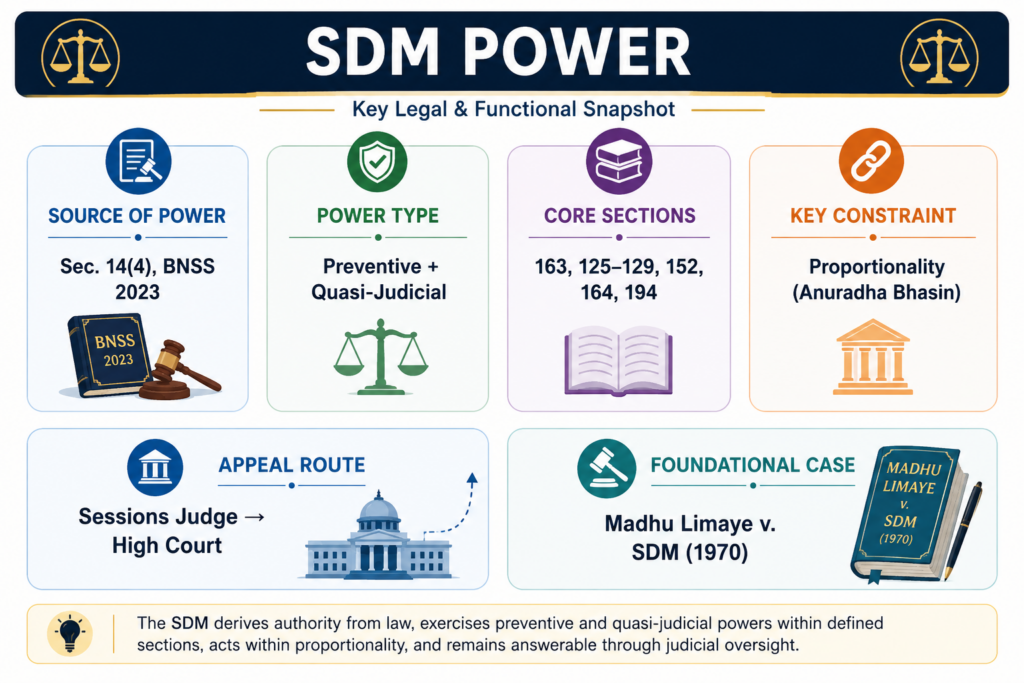
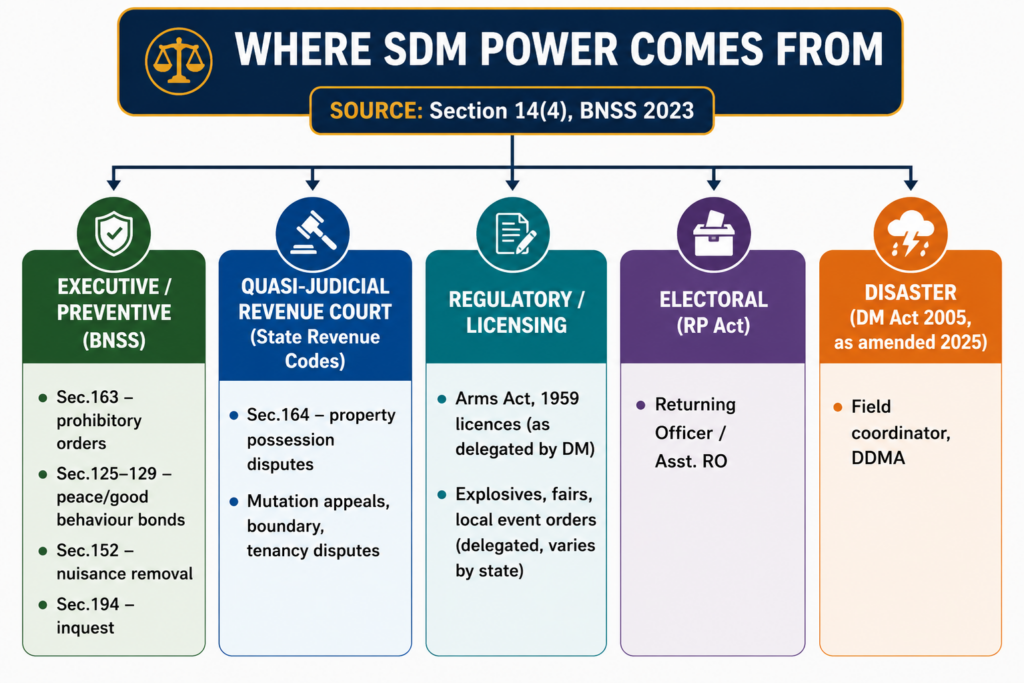
An SDM’s power comes from being an Executive Magistrate placed in charge of a sub-division under Section 14(4) of the BNSS, 2023, and splits into four categories: executive/preventive powers (prohibitory orders under Section 163, peace/good-behaviour bonds under Sections 125-129, public-nuisance removal under Section 152, and inquest into unnatural death under Section 194); quasi-judicial revenue powers (possession disputes under Section 164, mutation appeals, and tenancy matters under state revenue codes); regulatory powers delegated by the District Magistrate under special laws such as the Arms Act, 1959; and electoral powers as Returning Officer. None of these powers is unlimited — every one of them has been shaped, and constrained, by Supreme Court rulings from Madhu Limaye (1970) to Anuradha Bhasin (2020).
Quick Answer
The Framework: Where SDM Power Comes From
Every power an SDM exercises traces back to one line: Section 14(4) of the Bharatiya Nagarik Suraksha Sanhita, 2023, under which a State Government places an Executive Magistrate in charge of a sub-division. From that single appointment flow four distinct baskets of power — and UPSC increasingly expects an aspirant to keep them separate rather than treat “SDM powers” as one undifferentiated list.
Power 1: Prohibitory Orders — Section 163 BNSS (erstwhile Section 144 CrPC)
This is the SDM’s best-known power: where immediate prevention is necessary against obstruction, annoyance, injury to any person, danger to human life/health/safety, a riot, or an affray, the SDM (or DM, or a specially empowered Executive Magistrate) can issue a written order — directing a person to abstain from an act, or to take certain action regarding property in their possession or management. In genuinely urgent cases the order can be made ex-parte, without hearing the affected party first.
- Duration: not more than two months from the date of the order; the State Government may extend it, by notification, up to six months in total, if necessary to prevent danger to human life, health or safety, or a riot or affray.
- Safeguard: any person affected can apply to have the order rescinded or altered; the Magistrate must give them a hearing on that application “with all reasonable despatch.”
📚 Landmark Case — Madhu Limaye v. Sub-Divisional Magistrate, Monghyr (1970)
A seven-judge Constitution Bench of the Supreme Court upheld the constitutional validity of Section 144 CrPC (now Section 163 BNSS) against a challenge that it violated Article 19. The Court’s reasoning is exactly what makes this power constitutionally sound: it is not an ordinary administrative power but must be exercised judicially, with the Magistrate recording the material facts that justify the order, and remains open to being rescinded by the Magistrate or set aside by a superior court. The Court’s central point was that the possibility of misuse is not, by itself, a ground to strike down a law — the safeguards built into the section are what save it.
📚 Landmark Case — Anuradha Bhasin v. Union of India (2020)
Arising from the internet shutdown in Jammu & Kashmir after August 2019, the Supreme Court held that any Section 144-type order restricting fundamental rights must satisfy the test of proportionality — it must be necessary, suitable, and the least restrictive option available. Orders cannot be indefinite, must be based on specific material facts rather than a blanket rationale, cannot simply be renewed on repeat to sidestep the two-month cap, and must be published so that an affected person can actually challenge them. This case is now the standard citation for testing whether any modern Section 163 BNSS order — communal-tension curfews included — has been properly exercised.
⏱ Also Worth Knowing
In In Re: Ramlila Maidan Incident (2012), the Supreme Court criticised the use of Section 144 against a sleeping crowd of protestors, holding that such a sweeping preventive power is meant only for genuinely grave situations — a useful counter-example to cite alongside Madhu Limaye to show the power is not a blank cheque.
Power 2: Security for Keeping the Peace & Good Behaviour — Sections 125-129 BNSS (erstwhile Sections 106-111 CrPC)
Where an Executive Magistrate receives credible information that a person is likely to commit a breach of the peace, disturb public tranquillity, or is a habitual offender likely to commit a cognisable offence, the Magistrate can require that person to execute a bond — with or without sureties — undertaking to keep the peace or maintain good behaviour, for a period not exceeding one year (longer periods apply to certain good-behaviour bonds and to security ordered by a court upon conviction).
📚 Case Law Snapshot
Courts have consistently held (Rameshwar Dayal v. State of Punjab; more recently Syed Ali Akbar Khan v. State of Kerala, 2024) that this is a preventive, not punitive proceeding, governed by a “sufficient reason to believe” standard rather than proof beyond reasonable doubt — but that standard still requires concrete, credible material. Mere involvement in one or two isolated, especially private, incidents is not enough to justify a security proceeding; the Magistrate must show a genuine, forward-looking risk to public peace.
Power 3: Removal of Public Nuisance — Section 152 BNSS (erstwhile Section 133 CrPC)
On a police report or other information, an SDM (or DM, or specially empowered Executive Magistrate) can pass a conditional order requiring the removal of an unlawful obstruction or nuisance from a public place, way, river or channel; the prohibition or regulation of a trade or occupation injurious to public health; or the removal of a dangerous or hazardous structure. The order is conditional — the person affected can either comply or appear to show cause against it.
📚 Landmark Case — Municipal Council, Ratlam v. Vardhichand (1980)
The Supreme Court, in a judgment still cited in every discussion of this power, held that Section 133 CrPC (now Section 152 BNSS) imposes a mandatory public duty, not a discretionary favour — an authority cannot decline to act merely by pleading a shortage of funds. The ruling remains the operative principle for how a Section 152 BNSS order must be approached today, and is a strong citation for any Mains answer on administrative accountability, municipal sanitation, or environmental nuisance.
Power 4: Property-Possession Disputes — Section 164 BNSS (erstwhile Section 145 CrPC)
Where a dispute over land, water, or the boundaries of either is likely to cause a breach of the peace, the SDM can inquire into the matter and pass an order determining which party was in actual possession on the date of the order (or within the preceding two months, in a case of force), until a competent civil court decides otherwise. This is the power UPSC most frequently tests for a single reason: it is deliberately, narrowly limited to possession — never to title or ownership.
📚 Landmark Case — Ram Sumer Puri Mahant v. State of U.P. (1985)
The Supreme Court held that where a civil court is already seized of, or has already decided, a question of possession over the same property, a parallel Section 145 (now Section 164) proceeding before the SDM is generally not justified — parties should instead seek interim protection (injunction, receiver) from the civil court itself. The civil court’s decree binds the Magistrate, not the other way around. This is a real, recurring fact pattern: several reported cases (including proceedings before SDMs in Guna, Madhya Pradesh, and Kaithal, Punjab) have been set aside on exactly this ground.
⚠ Common Confusion, Corrected
An SDM’s Section 164 order never confers ownership. It answers one narrow question — who was in possession, to prevent violence — and is expressly provisional, subject to whatever a civil court later decides on title. Treating this as a “land dispute settlement” power is the single most common misstatement of this section in student answers.
Power 5: Inquest into Unnatural Death — Section 194 BNSS (erstwhile Section 174 CrPC)
When a police officer receives information of a suicide, a death caused by an animal, machinery or accident, a death raising suspicion of an offence, or a death in police custody, the officer investigates and prepares a report on the apparent cause of death, forwarded to the nearest Executive Magistrate. In cases involving custodial death, disappearance, rape-related death, or dowry-related death, the law requires a Magistrate — not just the police — to hold or supervise the inquiry, precisely because these are the categories most vulnerable to institutional cover-up. The SDM’s role here sits at the intersection of executive magistracy and basic due-process protection for the most vulnerable complainants.
Power 6: Revenue Court Powers
Outside the BNSS entirely, each state’s own land revenue legislation — the UP Revenue Code, 2006; the Rajasthan Land Revenue Act, 1956; the MP Land Revenue Code, 1959; the Bihar Tenancy Act, among others — designates the SDM as a revenue court for a defined set of matters: mutation appeals against Tehsildar orders, partition suits, boundary disputes following patwari demarcation, tenancy allotment and resumption disputes, and encroachment removal on government or Gram Sabha land. The procedure mimics a civil court (pleadings, evidence, reasoned written orders, a right of appeal), but the SDM remains an administrative/quasi-judicial officer, not a civil judge — appeals from an SDM’s revenue-court order typically go to the District Collector, then the Divisional Commissioner or the state’s Board of Revenue.
Power 7: Regulatory & Licensing Powers
A number of licensing powers that field administration relies on daily are, strictly speaking, District Magistrate-level powers under their parent statutes — for example, arms licences under the Arms Act, 1959, and cinema-hall or public-assembly licences under the Cinematograph Act and related local laws. In practice, many states delegate specific categories of this work — renewals, rural sub-divisions, lower-risk licence classes — down to the SDM or Additional District Magistrate under the DM’s own delegation order. This makes SDM-level licensing power real but derivative: it exists only where and to the extent the DM (or the relevant Act’s licensing authority) has chosen to delegate it, and the exact scope varies by state and by district practice.
Power 8: Electoral and Disaster-Management Powers
Under the Representation of the People Act, 1950 and 1951, the Election Commission of India routinely appoints SDMs as Returning Officers or Assistant Returning Officers for constituencies within their sub-division, covering nomination scrutiny, Model Code of Conduct enforcement, polling logistics, and counting-day command — all coordinated through the District Election Officer (the DM).
Under the Disaster Management Act, 2005, as amended by the Disaster Management (Amendment) Act, 2025 (in force from 9 April 2025), the SDM functions as the field-level coordinator for the District Disaster Management Authority, chaired by the DM — running first situation reports, coordinating NDRF/SDRF deployment, and managing relief camps within the sub-division.
SDM Power vs. DM, Tehsildar & SP
| Power | Tehsildar | SDM | DM | SP |
|---|---|---|---|---|
| Mutation, land records | First-instance authority | First appellate authority | Second appeal (via Commissioner in most states) | — |
| Sec.163 BNSS (prohibitory orders) | No | Yes, within sub-division | Yes, original holder for the district | No independent power; enforces on ground |
| Sec.164 BNSS (possession disputes) | No | Yes | Yes (rarely exercised personally) | No |
| Chairs DDMA | No | Field coordinator/member | Yes, chairs the DDMA | Member |
| Direct command of the police force | No | No — coordinates only | No — coordinates only | Yes, operational control |
| District Election Officer | No | RO/ARO at constituency level | Yes, district level | No (law-and-order support role) |
Limits & Checks on SDM Power
Every power above is deliberately hedged by procedural and constitutional checks — this is the section examiners most reward, because it shows an aspirant understands power as a bounded legal concept rather than a blank grant of authority.
- Written, reasoned orders: orders under Sections 163, 152 and 164 BNSS must record the material facts relied upon — an unreasoned or template order is vulnerable to being quashed.
- Time limits: Section 163 orders cap at two months (extendable to six by the State Government); good-behaviour/peace bonds under Sections 125-129 cap at one to three years depending on the sub-section.
- Proportionality: per Anuradha Bhasin, any rights-restricting order must be the least restrictive option reasonably available, not a blanket measure.
- No adjudication of title: Section 164 orders are strictly provisional on possession and yield entirely to a civil court’s decision, per Ram Sumer Puri Mahant.
- Internal review: an affected person can apply to the same Magistrate to rescind or alter an order under Section 163.
- External review: orders remain open to revision before the Sessions Judge and to writ or revisional jurisdiction of the High Court.
- Transparency: orders restricting rights must be published and are subject to RTI disclosure, reinforcing the accountability the SDM is separately responsible for administering as a Public Information Officer.
Landmark Judgments at a Glance
| Case | Power Tested | Holding, in Brief |
|---|---|---|
| Madhu Limaye v. SDM, Monghyr (1970) | Sec.163 BNSS (ex-144) | Constitutionally valid; must be exercised judicially, with recorded reasons, and remains open to review. |
| In Re: Ramlila Maidan Incident (2012) | Sec.163 BNSS (ex-144) | Reserved for genuinely grave situations, not routine crowd management. |
| Anuradha Bhasin v. UOI (2020) | Sec.163 BNSS (ex-144) | Must satisfy proportionality; cannot be indefinite, unpublished, or repeatedly renewed. |
| Syed Ali Akbar Khan v. State of Kerala (2024) | Sec.126 BNSS (ex-107) | Requires clear evidence of an imminent threat, not isolated/private incidents. |
| Municipal Council, Ratlam v. Vardhichand (1980) | Sec.152 BNSS (ex-133) | A mandatory public duty; cannot be declined for want of funds. |
| Ram Sumer Puri Mahant v. State of U.P. (1985) | Sec.164 BNSS (ex-145) | No parallel proceeding once a civil court is seized of possession/title; decides possession only, never title. |
Critical Evaluation: Power Without Overreach?
The SDM’s power is a case study in a deliberate design trade-off: concentrating preventive, quasi-judicial and regulatory authority in one generalist officer is administratively efficient in an emergency, but it also means an officer without formal judicial training is routinely making decisions that touch on fundamental rights. The consistent judicial response — from Madhu Limaye‘s insistence on recorded reasons through Anuradha Bhasin‘s proportionality test — has been not to strip the power away, but to keep tightening the procedural leash around it: written orders, time limits, publication, and appeal. A well-rounded Mains answer should resist the temptation to argue either that these powers are colonial-era relics to be abolished, or that they are unproblematic administrative necessities — the more defensible position is that the power is functionally necessary for field governance, and that its legitimacy depends entirely on the safeguards being actively enforced rather than treated as a formality.