

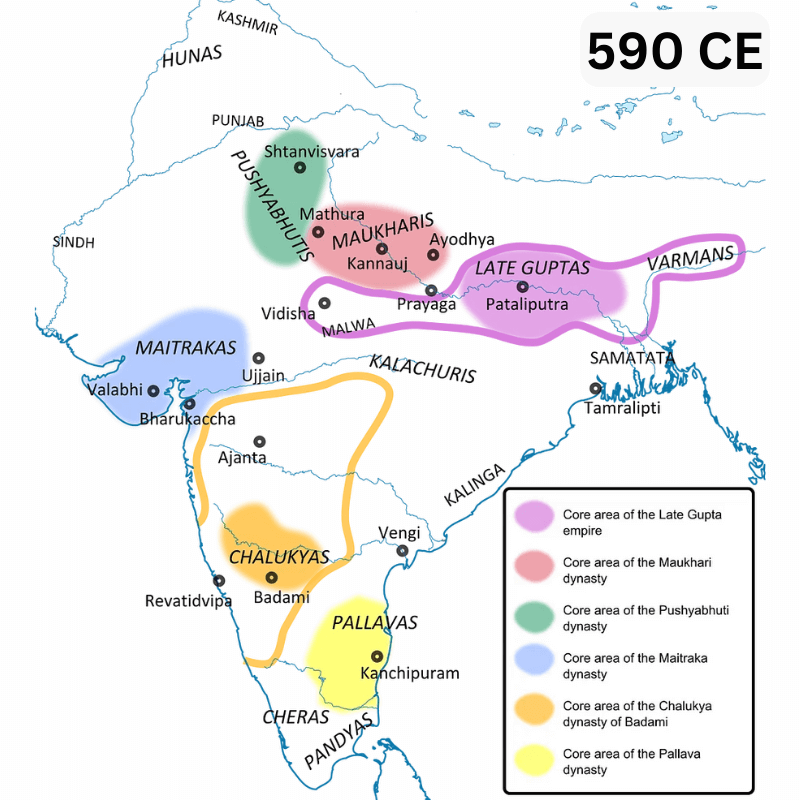
- The political scenario in post-Gupta north India was characterised by the emergence of numerous ruling families like the Maukharis of Kanyakubja, later Guptas of Magadha, Gaudas of West Bengal (Murshidabad Dist.), Maitrakas of Valabhi (Saurashtra peninsula), Pushyabhutis of Thaneswar, etc. Many of them were originally subordinates of the Guptas. But, with the decline of the political authority of the Guptas, they assumed independence.
- North India in the 6th century was, thus, an arena where multiple ruling powers, all rooted in their respective regional contexts, were constantly fighting with each other. In such a political scenario, the samantas (subordinates) emerged powerful. They kept control over outlying areas or fought battles in areas far away from the political centres of their overlords. The rise of local and regional powers has been regarded as the hallmark of this period.
Pushyabhuti Dynasty
- The Pushyabhuti dynasty, also known as the Vardhana dynasty, was the ruling dynasty of the Kingdom of Thanesar and later the Kingdom of Kannauj in northern India during the 6th and 7th centuries.
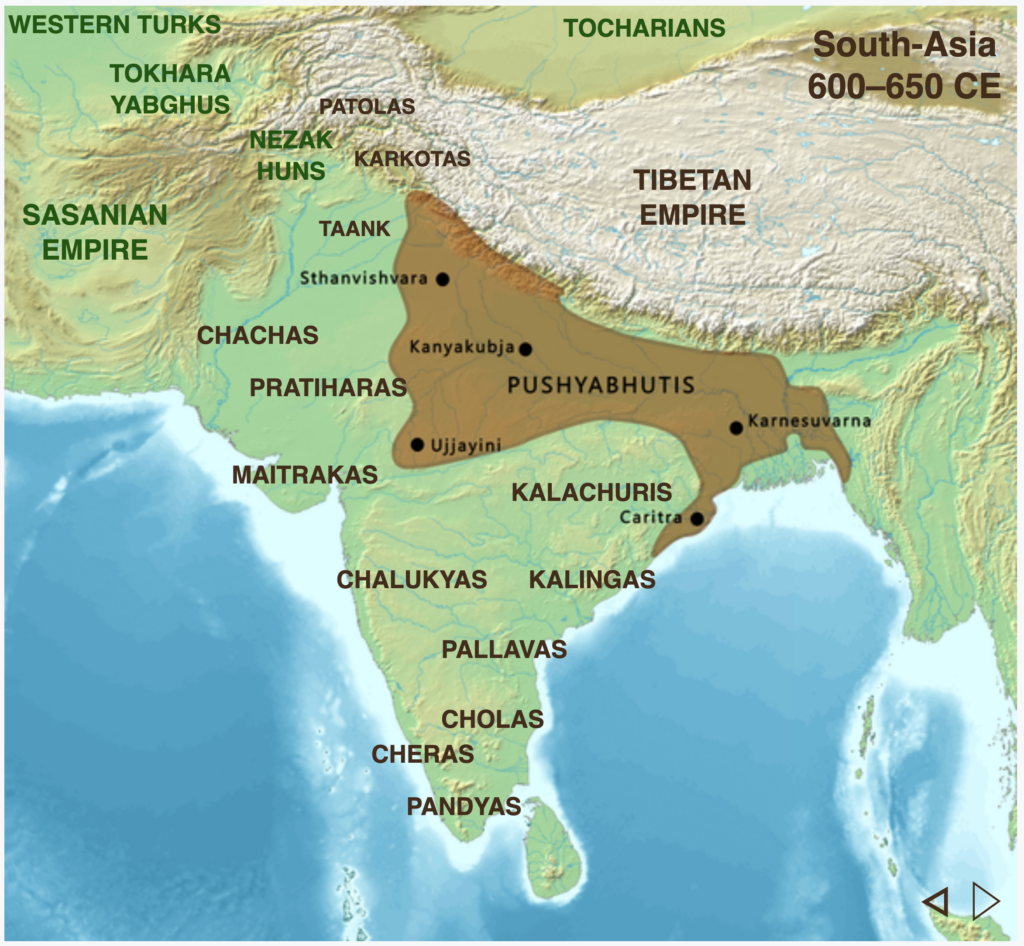
- The dynasty reached its zenith under its last ruler Harsha Vardhana (c. 590 – c. 647 CE), whose empire covered much of north and north-western India, extending till Kamarupa in the east and Narmada River in the south.
- The dynasty initially ruled from Sthanveshvara (modern-day Thanesar, Haryana), but Harsha eventually made Kanyakubja (modern-day Kannauj, Uttar Pradesh) his capital, from where he ruled until 647 CE.
- According to Harshacharita by Banabhatta, the dynasty was founded by Pushyabhuti, a devotee of Lord Shiva.
- Historians assume that, like the Maukharis, their neighbours in the east, the Pushyabhutis took advantage of the fall of the Gupta Empire to assert independence and found a new kingdom and dynasty.
- The details of the dynasty are available from the reign of Prabhakarvadhana, the fourth ruler.
- He assumed the title of Maharajadhiraja. He feuded with the Huna invaders from North-Western India.
- He had two sons, Rajyavardhana and Harshavardhana, and one daughter, Rajyashri, who was married to Grihavarman of the Maukhari dynasty.
- After the death of Prabhakarvardhana, Rajyavardhana assumed the throne.
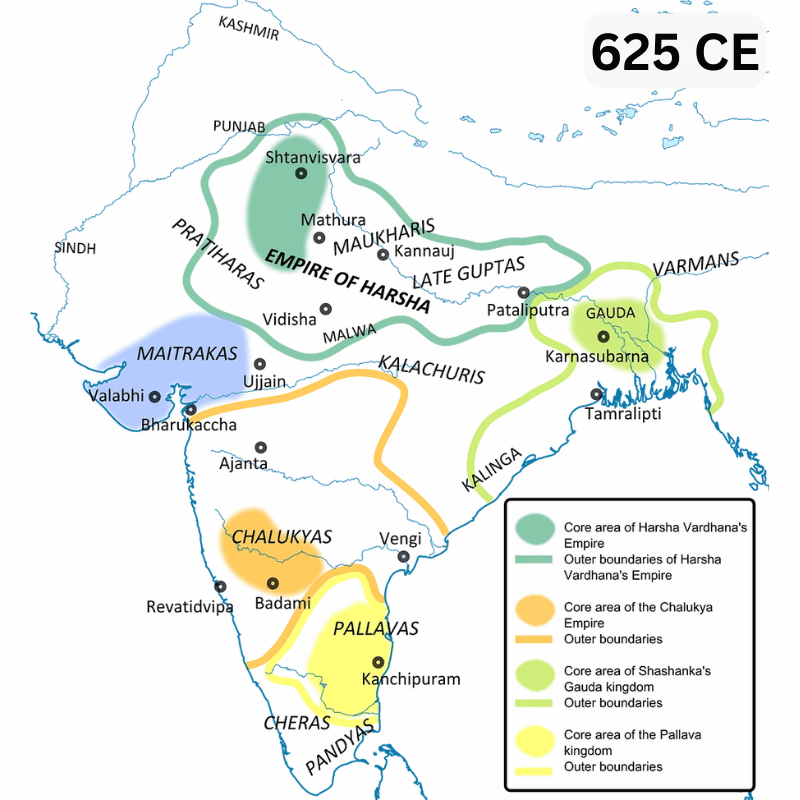
- Grihavarman was killed by a later Gupta king of Malwa, who also abducted his wife Rajyashri. Resultantly, Rajyavardhana marched against the Malwa king and defeated him. But while returning to Thanesar, he was killed by ‘Shashanka’, the Gauda King.
- Harsha formed an alliance with Bhaskar Varman, the king of Kamarupa, and forced Shashanka to retreat. This resulted in the coronation of King Harshavardhana as the Pushyabhuti King, who turned out to be the most outstanding ruler of India in the 6th-7th century AD.
Rulers of Pushyabhuti dynasty
- Pushyabhuti:
- According to Harshacharita by Banabhatta, founder king of this dynasty at Thaneshwar was Pushyabhuti and that the family was known as Pushyabhuti vamsha.
- The Banskhera and Madhuvan plates and royal seals mention five earlier rulers among whom the first three are given the title of Maharaja. This may indicate that they were not sovereign monarchs. The fourth king Prabhakarvardhana has been described as a Maharajadhiraja which makes us infer that he was an independent monarch.
- Naravardhana
- First Rajyavardhana 1
- Adityavardhana (Adityavardhana or Adityasena):
- He was the third ruler of the Pushyabhuti dynasty, and father of Prabhakaravardhana.
- Prabhakaravardhana (6th century CE):
- Prabhakaravardhana was one of the earliest known rulers of the dynasty, but the fourth ruler from the family.
- He is credited with expanding his kingdom’s territory and establishing strong diplomatic relations with neighboring states.
- Rajyavardhana:
- Rajyavardhana, the elder son of Prabhakaravardhana, succeeded his father as the ruler of the Pushyabhuti dynasty.
- He is known for his support of scholars and poets and his patronage of the arts and culture.
- Harsha (Harsha Vardhana, 590-647 CE):
- Harsha, the younger son of Prabhakaravardhana, is the most famous ruler of the Pushyabhuti dynasty.
- He is often referred to as Emperor Harsha. His reign is considered a golden period in ancient Indian history.
- Harsha was a great patron of literature and culture, and his court attracted many scholars, poets, and artists.
- Rajashekhara:
- After the death of Harsha, Rajashekhara, a minister succeeded him as the ruler of the Pushyabhuti dynasty.
- However, his reign was relatively short, and he faced challenges in maintaining the vast empire.
- Prabhakarvardhana II:
- Following Rajashekhara’s reign, Prabhakarvardhana II briefly ruled over the remnants of the dynasty’s territories.
Decline of the Pushyabhuti Dynasty
- After Harsha died in 647 CE, the Pushyabhuti dynasty faced internal strife and external invasions. The empire gradually fragmented, and regional powers rose to prominence. The decline of the dynasty marked the end of the Vardhana era.
- Kanyakubja remained as a kingdom and once more came into the limelight under King Yashovarman (r. 725-753 CE), while most of Harsha’s feudatories like Bhaskaravarman bifurcated the empire and added the conquered bits to their kingdoms.
- Yashovarman maintained Kanyakubja as a center of power, and between 750 and 1000 CE, its significance increased to the point that conquering it became a sign of imperial power in India, even for politically remote states like the Rashtrakutas of southern India, the Pratiharas of northwestern India, and Palas of eastern India.

Fantastic