337,362+ aspirants visit every month


Unlock Elite Access: Level Up Your Preparation with Exclusive Content
PSIR Optional PYQ Solutions · Model answer
Bring out linkages between environmental degradation and neo -corporatism in the globalised era. (200 words)
- UPSC 2012
- 15 marks
- Contemporary Global Concerns
Unlock the full answer · ₹1,770 ↓
Neo-corporatism, as defined by Philippe C. Schmitter ("Still the Century of Corporatism?", 1974) and Gerhard Lehmbruch, is a mode of interest intermediation. A few non-competing peak associations receive a state-recognised representational monopoly in return for restraint, so the state governs with organised interests rather than merely being lobbied by them. The classic form was tripartite:…
You are reading the opening of the model answer. The full answer is part of the PSIR Optional PYQ Solutions.
What the full answer covers
- From tripartism to business incorporation
- How the linkage produces degradation
- The Indian dimension
- The counter-view
- Conclusion
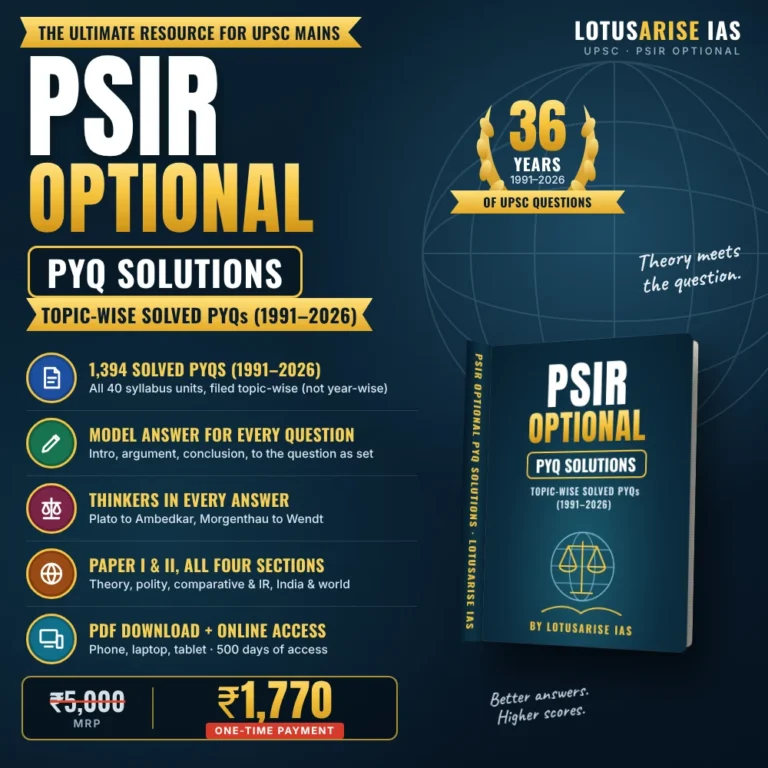
PSIR Optional PYQ Solutions
Unlock this answer and 1,393 more
- 1,394 solved UPSC PSIR PYQs from 1991 to 2026, Paper-1 and Paper-2
- Topic-wise across all 40 syllabus units
- A full model answer for every question
- Read online on lotusarise.com, plus PDF download
- 500 days of access from the day you enrol
₹1,770₹5,00064% off
One-time payment · No subscription · Instant access · UPI, cards, RuPay
See every Contemporary Global Concerns question (64 solved) →Already enrolled? Log in
PSIR Optional · Kits & packs
Score more in PSIR Optional.
PSIR PYQ Solutions give you a full model answer to all 1,394 PSIR PYQs, topic by topic. The Mains Master Kit gives you the complete self-study system for Paper 1 and Paper 2.
- 1,394 solved PYQs from 1991 to 2026, across all 40 units
- Notes for all four sections, updated with current developments
- One-time payment · instant access · no subscription
Trusted by 3,00,000+ aspirants every month · Secure checkout · UPI, cards, RuPay
Most enrolled in PSIR Optional