

Musi River
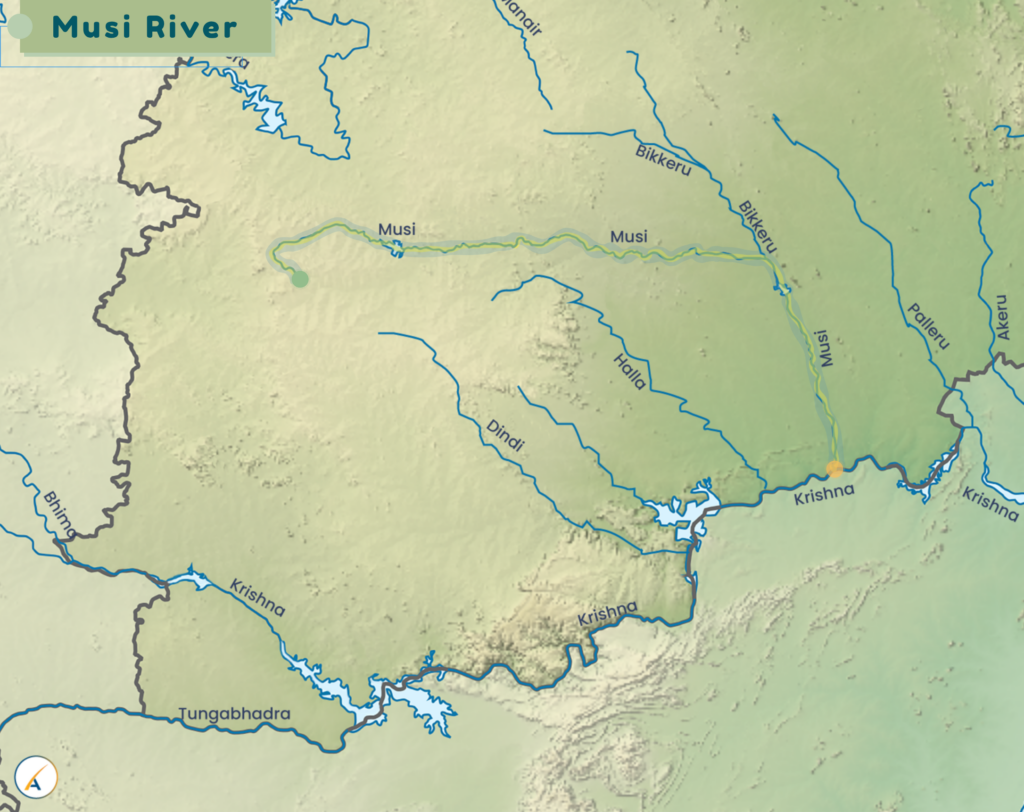
- The Musi River, also known as the Muchukunda or Musunuru River, is a 240-km major tributary of the Krishna River in the Deccan Plateau, flowing through Telangana.
- The river gained prominence in the late 16th century when Muhammad Quli Qutb Shah, the founder of Hyderabad, established the city along its banks.
- Course:
- It originates from Anantagiri Hills near Vikarabad District (about 90 km west of Hyderabad).
- The river is formed by the merging of two small rivulets: Esi (8 km) and Musa (13 km).
- After originating, the Musi River flows in an eastward direction, cutting through the heart of Hyderabad city, where it historically divided the Old City from the New City.
- The river then continues its journey through the southern Telangana plains.
- It ultimately joins the Krishna River near Wazirabad in Nalgonda district.
- Dams: Himayat Sagar and Osman Sagar are the two dams that are constructed over the river.
- Hussain Sagar Lake was built on a tributary of the River Musi. It was a lake of 24 kilometres, built to meet the water and irrigation needs of the city.
- Several historic bridges and mosques line its banks, reflecting Qutb Shahi and Nizam-era architecture.
- The Musi River has 24 diversion weirs for irrigation, locally known as kathwas.
- Now due to random urbanization and lack of planning the river has become a holder of all the unprocessed domestic and industrial waste drained out of Hyderabad.
| Also Known As | Muchukunda River / Musunuru River / Moosa River |
| Type | Major Tributary of the Krishna River |
| State | Telangana, India |
| Origin | Anantagiri Hills, Vikarabad District |
| Altitude at Origin | 4,660 metres above sea level |
| Total Length | Approximately 240–250 kilometres |
| Flow Direction | Eastward (turning southward at Chittaloor) |
| Joins | Krishna River near Wazirabad, Nalgonda District |
| Major Dams | Osman Sagar (1920) & Himayat Sagar (1927) |
| Irrigation Weirs | 24 diversion weirs (locally called Kathwas) |
| Passes Through | Hyderabad city (55 km stretch within city limits) |
Drainage Basin
- The Musi forms part of the Krishna River basin, which is one of the major river systems of Peninsular India.
- The river’s drainage basin covers parts of Vikarabad, Rangareddy, Hyderabad, Medchal-Malkajgiri, and Nalgonda districts.
- The basin is critical for both urban water supply and agricultural irrigation across the southern Telangana plains.
Course of the Musi River
Upper Course — Anantagiri to the Reservoirs
- From its source in the Anantagiri Hills, the river flows in a broadly eastward direction through the rocky and undulating terrain of Rangareddy district. In its upper course, the Musi receives rainfall-fed seasonal streams and passes through forested zones, maintaining relatively good water quality. The river soon enters the catchment areas of the two major reservoirs constructed during the Nizam era:
- Osman Sagar (1920) — Built by Nizam Mir Osman Ali Khan as a flood mitigation and drinking water measure after the catastrophic 1908 floods. The reservoir supplies water to Hyderabad and Secunderabad.
- Himayat Sagar (1927) — Built during the reign of the last Nizam (Nizam VII) and named after his youngest son Himayat Ali Khan. This reservoir also provides water to the twin cities and supports flood control.
Middle Course — Through Hyderabad City
- The Musi’s most celebrated and historically significant stretch is its passage through the heart of Hyderabad city. The river cuts through approximately 55 kilometres of the urban landscape, making it the defining geographical axis of the metropolitan area.
- Historically, the Musi served as a natural boundary dividing the Old City (to the south) from the New City (to the north). The southern bank hosted the medieval Qutb Shahi and later Nizam-era structures — including the iconic Charminar, Mecca Masjid, Lad Bazaar, and numerous mosques — while the northern bank saw modern administrative and commercial development over the centuries.
- Several historic bridges span the Musi within the city, most notably Purana Pul (Old Bridge), built during the reign of Ibrahim Quli Qutb Shah in 1578, and Naya Pul (New Bridge) at Afzal Gunj, constructed during the post-1908 reconstruction era. These bridges — along with mosques and palaces on the riverbanks — reflect centuries of Qutb Shahi and Nizam-era architecture.
Lower Course — Southern Telangana Plains
- After passing through Hyderabad, the Musi enters the southern Telangana plains, flowing through parts of Nalgonda district. In this lower course, the river turns slightly southward near Chittaloor and traverses relatively flat terrain, where it has historically supported agricultural activities through its 24 diversion weirs (kathwas) used for irrigation.
Confluence with the Krishna River
- The Musi River concludes its 240 km journey by joining the Krishna River near Wazirabad in Nalgonda district (also cited at Vadapally, near Miryalaguda) at an altitude of approximately +61 metres. Here, the Musi merges into one of the largest rivers of Peninsular India, completing its role as one of the Krishna’s major Deccan tributaries.
Ecological & Environmental Challenges
- Historically a lifeline for the Deccan Plateau, the Musi has unfortunately become one of the most polluted rivers in Telangana.
- Urbanisation, lack of planned sewage treatment, and dumping of untreated domestic and industrial waste have severely degraded the water quality.
The Musi Riverfront Development Project
- To transform the river into an urban corridor rather than a polluted drain, the Telangana government is executing the massive Musi Riverfront Development Project.
- Funding & Scope: Phase-I of the project spans a 5-km stretch out of an initial 21-km focus area. It involves an estimated ₹7,055 crore and is being funded by the Asian Development Bank.
- Timeline & Goals: The government has set a December 2027 deadline to complete the initial phases. The broader vision seeks to establish commercial spaces, tourism attractions, and public areas, while strictly addressing pollution and improving the livelihoods of existing riverbank communities.
Heritage Tourism Corridor
- A 55-kilometre Musi River rejuvenation project has identified several historic landmarks along the river’s urban stretch with plans to connect them through a heritage tourism and cultural corridor.
- This initiative aims to revive the river not just ecologically but also as a living thread of Hyderabad’s layered cultural memory.