

- This is the place list of India’s islands, set out coast by coast, so that each can be marked on the map with its State and its significance. The origin, relief and geopolitics of the two main groups belong to the account of the islands of India.
- India has about 1,382 identified offshore islands in the 2016 official list. The Andaman and Nicobar chain lies in the Bay of Bengal and Lakshadweep in the Arabian Sea.
- The rest are delta, barrier, estuarine, lagoon and river islands, many of them low, shifting and exposed to erosion.
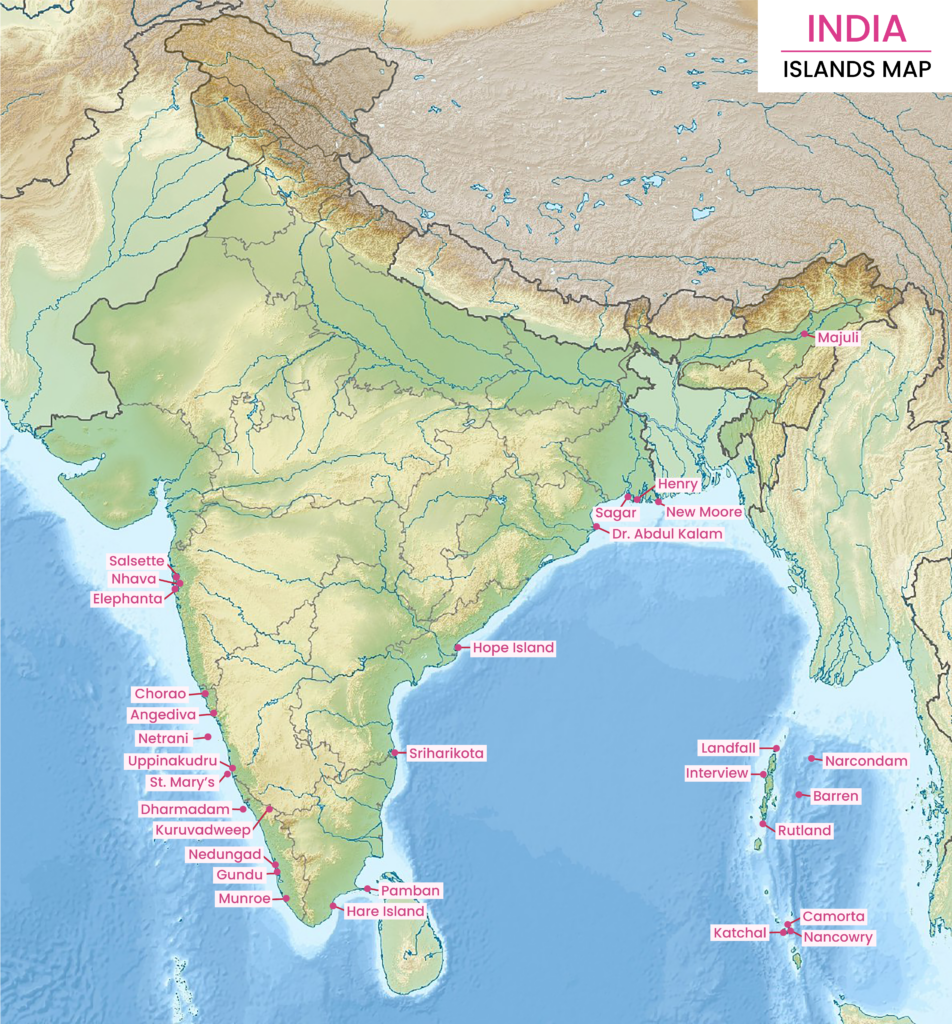
| Coast or region | State or Union Territory | Islands |
|---|---|---|
| Ganga delta | West Bengal | New Moore, Sagar, Ghoramara, Henry, Lohachara, Nayachar |
| Mahanadi–Brahmani coast, Chilika | Odisha | Abdul Kalam, Shortt’s, Parikud, Ekakula |
| Godavari to Pulicat, Krishna | Andhra Pradesh | Hope, Sriharikota, Bhavani |
| Andaman group | Andaman and Nicobar Islands | Landfall, North, Middle and South Andaman, Interview, Rutland, Little Andaman, Swaraj, Shaheed, Netaji Subhas Chandra Bose, Narcondam, Barren |
| Nicobar group | Andaman and Nicobar Islands | Car Nicobar, Chowra, Kamorta, Nancowry, Katchal, Little and Great Nicobar |
| Palk Bay, Gulf of Mannar, rivers | Tamil Nadu | Pamban, Hare, Van Tivu, Abunda, Nallathanni, Quibble, Srirangam |
| Malabar backwaters | Keralam (Kerala) | Dharmadam, Gundu, Ezhumanthuruthu, Kuruvadweep, Munroe, Nedungad, Pulincunnoo, Ramanthuruth, Valiyaparamba, Vallarpadam, Venduruthy, Willingdon, Vypin |
| Kanara coast, Kaveri | Karnataka | Netrani, Kaveri Nisargadhama, St Mary’s, Uppinakudru, Pigeon-Cock, Srirangapatna |
| Mandovi–Zuari | Goa | Anjediva, Caculo, Chorao, Tiswadi, Divar |
| Konkan, Mumbai Harbour | Maharashtra | Salsette, Seven Islands, Trombay, Ambu, Butcher, Elephanta, Cross, Hog, Middle Ground, Oyster Rock, Panju, Khanderi |
| Kachchh, Kathiawar, Khambhat | Gujarat; Dadra and Nagar Haveli and Daman and Diu | Pirotan, Aaliya Bet, Khaliabet, Pachham, Khadir Bet, Bela; Diu |
| Arabian Sea | Lakshadweep | Agatti, Andrott, Bangaram, Bitra, Chetlat, Kadmat, Kalpeni, Maliku Atoll, Minicoy, Aminidivi, Laccadive |
| Rivers and lakes | Assam; Jammu and Kashmir | Majuli; Teen Chinar |
Bay of Bengal Islands
West Bengal and the Ganga Delta
- New Moore Island:
- Also called Purbasha and South Talpatti.
- It was a small uninhabited offshore sandbar in the Bay of Bengal, off the Ganga–Brahmaputra delta.
- It emerged after the Bhola cyclone of 1970 and was reported gone by about March 2010. Sea level rise, altered monsoon rain and river flows, and land subsidence are the causes offered.
- India and Bangladesh both claimed it, spurred by talk of oil and natural gas in the area.
- The arbitral award of 7 July 2014, under the Permanent Court of Arbitration’s registry, drew the sea boundary so that its former site falls on India’s side, though the site is now under water.
- It had mangrove vegetation and a fragile ecosystem.
- Sagar Island:
- Also known as Gangasagar or Sagardwip, about 100 km south of Kolkata.
- An island of the Ganga delta on the continental shelf of the Bay of Bengal, and among the largest in the Sundarban delta, at the mouth of the Hugli River. It is West Bengal’s largest island.
- It falls in South 24 Parganas district of West Bengal.
- A place of Hindu pilgrimage. Each Makar Sankranti, hundreds of thousands gather for a holy dip where the river meets the sea and offer prayers at the Kapil Muni Temple.
- Halliday Island:
- In the Sundarbans of West Bengal, on the River Matla, and designated a wildlife sanctuary.
- Ghoramara Island:
- About 150 km south of Kolkata, in the Sundarban delta complex.
- A small island of roughly five sq km, shrunk from about 8.5 sq km in 1975.
- It is fast disappearing through erosion and sea level rise.
- Henry Island:
- Near Bakkhali in South 24 Parganas, West Bengal.
- It is home to millions of red crabs, with dense mangrove forest parted by numerous canals.
- Wildlife includes tiger, deer, wild pig, crocodile and snake.
- Lohachara Island:
- A former islet in the Hugli River, part of the Sundarban delta, close to the Sundarban National Park.
- Older accounts say it was permanently flooded in the 1980s. Its loss was reported by researchers in December 2006, from satellite images, and local newspapers in April 2009 spoke of it rising from the water again.
- It was once inhabited by more than 6,000 people. Thousands of them became refugees and moved to the mainland.
- Nayachar Island:
- A newly emerged island with a mangrove ecosystem, in the middle estuary of the Hugli in West Bengal.
- River silt built it up, and it long stayed largely submerged, rising above the water only now and then.
- Till 1990 it was completely barren. 151 animal species were later recorded on it, a rare case of quick colonisation.
- Natural succession was helped by tidal flooding and by soil that fishermen brought from elsewhere.
- The West Bengal Government proposed a major chemical hub here, after an earlier proposal for Nandigram.
Odisha
- Dr. A. P. J. Abdul Kalam Island (Wheeler Island):
- Formerly Wheeler Island, named after an English commandant, Lieutenant Hugh Wheeler. It was renamed on 4 September 2015.
- It lies in the Bay of Bengal off the Odisha coast, about 10 km from the shore, about 70 km south of Chandipur in Balasore district and about 150 km east of Bhubaneswar.
- The missile test facility for most Indian missiles.
- Its nearest port is Dhamra.
- Shortt’s Island:
- Off the coast of Odisha near Abdul Kalam Island.
- It lies in the Bay of Bengal, off the north-eastern side of the Mahanadi delta.
- Parikud Island:
- An island within Chilika Lake, with the lake on one side and the Bay of Bengal on the other.
- Jahnikuda, at its eastern end near the lake, acts as a gateway to Puri, the seat of Lord Jagannath.
- Ekakula Island:
- Within the Gahirmatha Marine Sanctuary of Odisha.
- A leading nesting site of Olive Ridley sea turtles.
- Its quiet Ekakula beach draws many tourists.
Andhra Pradesh
- Hope Island:
- A small tadpole-shaped island off Kakinada in the Bay of Bengal.
- It is young, formed in the last 200 years from sand carried by the Godavari.
- It shields Kakinada port from strong cyclones, tidal waves and tsunamis, and so makes that port one of the safest on the east coast.
- It stands about 10 km from the Coringa Wildlife Sanctuary and the Sri Kukkuteswara Swamy Temple.
- Sriharikota:
- A barrier island off the Bay of Bengal coast, in the Shar Project settlement. It was in Nellore district and is now in Tirupati district of Andhra Pradesh.
- It lies at the sea margin of Pulicat Lake.
- It holds the rocket launching station of the Indian Space Research Organisation, the Satish Dhawan Space Centre (SHAR).
- It is linked with Chennai by road. A second spaceport at Kulasekarapattinam in Tamil Nadu is targeted for commissioning in 2026–27.
- Bhavani Island:
- A river island on the Krishna, about 4 km upstream from Vijayawada and above the Prakasam Barrage.
- It is considered one of the largest river islands in India, at 133 acres.
- A tourist attraction, with a robotic dinosaur park, garden and mirror mazes, golf and badminton simulators, and cycling.
Andaman Islands
- The Union Territory as a whole: the current official count is 836 islands, islets and rocks, of which 31 are permanently inhabited, over about 8,249 sq km. Older accounts give about 265 islands, 203 of them Andaman and 62 Nicobar.
- Sri Vijaya Puram (Port Blair), the capital, took its present name by an announcement of 13 September 2024.
- On 23 January 2023, 21 unnamed islands of the group were named after recipients of the Param Vir Chakra.
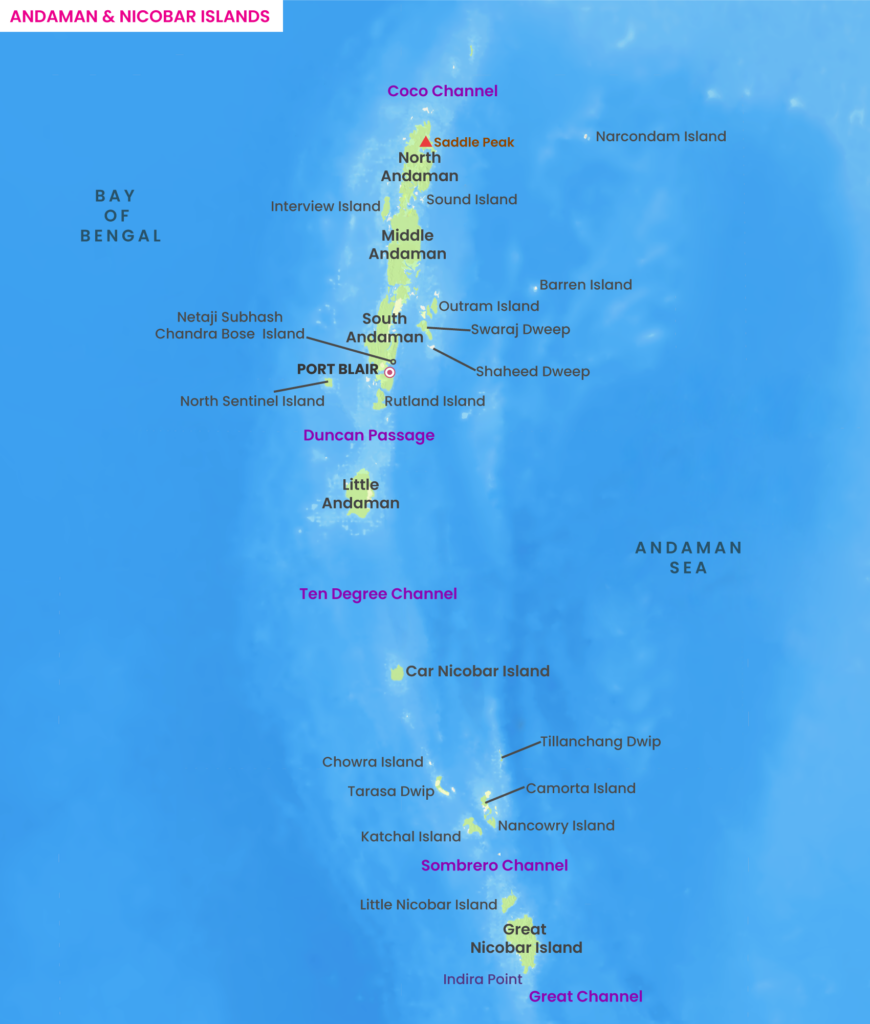
- Port Blair on this map is now Sri Vijaya Puram.
- Narcondam Island:
- India’s easternmost island, small and volcanic, in the northern Andaman Sea.
- A dormant volcano of conical shape with no crater left at the top. At 710 m it is the second tallest point of the islands after Saddle Peak.
- Its nearness to Myanmar gives it great strategic and geopolitical significance.
- It is the easternmost point of the Andaman and Nicobar Islands.
- Barren Island:
- In the Andaman Sea, south of Narcondam.
- The only confirmed active volcano of the Indian subcontinent, and the only active one along the chain of volcanoes from Sumatra to Myanmar.
- Eruptions: one in 2020 was followed by mild eruptions on 13 and 20 September 2025, and by lava flows on the north flank from mid-November to December 2025.
- It lies on the volcanic arc formed at the margin of the tectonic plates.
- True to its name, it has no human population.
- It carries a caldera about 2 km wide at the top.
- Landfall Island:
- The northernmost island of the Union Territory of Andaman and Nicobar Islands.
- The Coco Channel separates it from Myanmar’s Coco Islands, and the Cleugh Passage from North Andaman.
- Tourism exists here, but public access is limited.
- North Andaman Island:
- The northern island of Great Andaman.
- It holds the highest point of the archipelago, Saddle Peak, at 732 m (731 m in some accounts).
- Its northern tip is called Cape Price.
- It is geologically part of the Arakan Yoma.
- Diglipur is the main town, and rice and oranges are the main activities.
- Middle Andaman Island:
- The largest island of the group, at about 1,536 sq km, and usually named as the largest island of India.
- It lies between North Andaman and South Andaman.
- The Jarawa people live here.
- It is geologically part of the Arakan Yoma.
- Fishing and agriculture are the main activities.
- Towns: Rangat, Billiground and Mayabunder.
- South Andaman Island:
- The southernmost of the Great Andaman group, and third largest after Middle and North.
- Sri Vijaya Puram (Port Blair) stands in its south-eastern part, which is less mountainous than the rest.
- It holds the majority of the population of the islands.
- The 2004 Indian Ocean earthquake struck it, with many deaths.
- Rutland Island:
- Between South Andaman and Little Andaman, north of the Duncan Passage.
- Rich in marine life, with a good range of fish and corals.
- Formerly home to the Jangil (Rutland Jarawa), one of the indigenous Andamanese groups.
- It has no permanent indigenous settlement now.
- Little Andaman:
- The fourth largest of the Andaman group.
- It heads the Little Andaman group, the counterpart of the Great Andaman group, and lies between the Duncan Passage and the Ten Degree Channel. The Duncan Passage parts it from Rutland Island.
- It is home to the Onge people.
- Scenic, with saltwater crocodiles, widespread rainforest and several rare species of marine turtle.
- Interview Island:
- An island of the Andaman group, west of the Austen Strait, which divides North Andaman from Middle Andaman.
- It has only one village, in its eastern part.
- Swaraj Dweep (Havelock Island):
- One of the largest islands of Ritchie’s Archipelago, between Peel Island and Shaheed Dweep (Neil Island), east of Great Andaman.
- The old name honoured Henry Havelock, a British general.
- Renamed on 30 December 2018 by Prime Minister Narendra Modi, as a tribute to Subhas Chandra Bose.
- Most settlers are Bengalis (5,354 people).
- Its Radhanagar Beach was named “Best Beach in Asia” by Time magazine in 2004.
- Netaji Subhas Chandra Bose Dweep (Ross Island):
- Known as Ross Island until 30 December 2018.
- It belongs to the South Andaman administrative district, about 3 km east of central Sri Vijaya Puram.
- It is controlled by the Indian Navy.
- It served as the administrative headquarters of the islands. The earthquake of 1941 damaged it, and it was given up by about 1946, after the Japanese occupation.
- With its ruins, it has become a major tourist spot.
- Other islands on the map:
- Shaheed Dweep (Neil Island), renamed with Swaraj Dweep on 30 December 2018.
- Outram Island and Sound Island, off the east side of the Great Andaman chain.
- North Sentinel Island, west of South Andaman, home of the Sentinelese.
Nicobar Islands
- The group as a whole: in older counts, 7 big and 12 small islands with several tiny ones, scattered over 262 km with a greatest width of 58 km. The Ten Degree Channel parts it from the Andamans.
- Car Nicobar:
- The northernmost of the Nicobars, south of the Ten Degree Channel.
- A flat, fertile island with clusters of coconut palms and fine beaches, ringed by a roaring sea.
- Major crops are coconut and arecanut.
- It holds more than half of the Nicobar population.
- Chowra Island:
- Also known as Choura, Tatat or Sanenyo.
- It lies north of Teressa (Tarasa Dwip) and south of Battimalv Island, in the Indian Ocean.
- Kamorta Island:
- An island in the Nicobar chain, also written Camorta.
- INS Kardip is a naval forward operating base of the joint-services Andaman and Nicobar Command here.
- The Indian Navy’s Kamorta-class corvette is named after it.
- Kalatapu is the main village.
- It was hit by the tsunami of December 2004.
- Nancowry Island:
- The name covers both a single island and the group of adjoining islands, at the centre of the Nicobars.
- Part of the Tribal Reserve Area.
- Its land-locked Nancowry Harbour is described as one of the safest natural harbours in the world.
- Katchal Island:
- Part of the Nicobars, in the central group, west of Nancowry, as the map shows.
- It is home to Nicobari tribes and settlers from Tamil Nadu.
- The 2004 tsunami devastated it, with at least 1,500 deaths.
- Little Nicobar:
- Part of the Nicobar Islands, separated from Great Nicobar by St George’s Channel.
- It has suffered from tsunami and earthquake.
- Great Nicobar Island:
- The largest of the Nicobar group.
- Its southernmost tip is Indira Point (Pygmalion Point).
- The Great Channel separates it from Sumatra.
- Mount Thuillier (642 m) is the highest point of the Nicobars.
- It holds the Great Nicobar Biosphere Reserve.
- It lies only about 147 km from Sumatra.
- Great Nicobar Project: a government plan, restated on 1 May 2026, for a transshipment terminal at Galathea Bay, an international airport, a power plant and a township. Environmental groups and some tribal bodies object, and the matter is before the Calcutta High Court.
- Other islands on the map:
- Tillanchang Dwip and Tarasa Dwip (Teressa), in the northern part of the central group.
Southern and Arabian Sea Islands
Tamil Nadu and the Gulf of Mannar
- Pamban Island:
- Also known as Rameswaram Island, in Ramanathapuram district, and about 30 km from Pamban town to Dhanushkodi.
- The Pamban Channel separates it from mainland India. The New Pamban Bridge, opened on 6 April 2025, is the country’s first vertical-lift railway sea bridge.
- Most of the island is covered with white sand, with coconut and palm in abundance.
- Its main towns are Rameswaram and Dhanushkodi.
- Adam’s Bridge:
- Also known as Ram’s Bridge or Rama Setu, between Palk Bay and the Gulf of Mannar.
- A chain of limestone shoals between Pamban and Mannar Island of Sri Lanka, about 30 km long. They form a geological link between India and Sri Lanka.
- Sethusamudram Ship Channel Project: it would have cut a channel through the shoals, and Hindu groups who revere them opposed it strongly.
- The Supreme Court suspended dredging there by an interim order of 14 September 2007. In 2019 the Centre told the court it would look for another alignment that spares the shoals.
- Hare Island:
- It adjoins V. O. Chidambaranar Port at Thoothukudi and forms part of the Gulf of Mannar Marine National Park.
- With an area of 1.29 sq km, it is listed as the largest island in that park.
- A picnic spot for holiday seekers and domestic tourists, with many visitors during Pongal.
- Van Tivu Island:
- In Tamil Nadu, also known as Church Island.
- One of the 21 islands of the Gulf of Mannar, near 8°50′N and 78°E. These islands lie on average about 8 km from the coast.
- Abunda (Adunda) Island:
- A coral island in the Gulf of Mannar, inhabited by Tamil fishermen.
- Its thin soil supports coconut and vegetables.
- The petro-refinery of Thoothukudi pollutes it.
- Nallathanni Theevu:
- In the Gulf of Mannar, about 4 km from the coast, in Ramanathapuram district.
- It is listed with Krusadai and Musal as one of three inhabited islands of the gulf.
- Kachchatheevu:
- An uninhabited island of about 285 acres on the Sri Lankan side of the sea boundary, north-east of Adam’s Bridge, with a Catholic shrine of St Anthony.
- 1974: an India–Sri Lanka agreement fixed the sea boundary and placed it on the Sri Lankan side, leaving Indian fishermen the use of it to dry nets and visit the shrine.
- 1976: a further agreement ended fishing by either side in the other’s waters.
- 6 October 2026: the Attorney General told the Supreme Court the Centre does not wish to reopen the treaties.
- Quibble Island:
- A river island in Chennai, Tamil Nadu, formed by the Adyar River and one of its tributaries.
- A European cemetery was laid out here in British times.
- Srirangam:
- A river island in Tiruchirappalli city, formed between the Kaveri and the Kollidam.
- The Grand Anicut stands to the east of the island.
- An important Hindu Vaishnavite pilgrimage centre.
Keralam
- Dharmadam Island (Green Island):
- A small 2-hectare private island at Thalassery, Kannur district of Keralam (Kerala), about 4 km from the town.
- It is covered with coconut palms and dense bush, a fine sight from Muzhappilangad Beach, and at low tide one can walk out to it.
- Earlier known as Dharmapattanam, it was a Buddhist stronghold.
- Gundu Island:
- The smallest of the islands that together make up the city of Kochi, spread over 5 acres.
- It can be reached only by boat from Vypin.
- It first housed a coir factory and is now a resort owned by the Taj Malabar Hotel.
- Ezhumanthuruthu:
- About 8 km west of Kaduthuruthy town, Kottayam district. Its area is about 2 sq km.
- Densely peopled (about 3,500), and a twin of the small island of Pulithuruthu.
- Kuruvadweep:
- Also Kuruva Island, a protected river delta of 950 acres (3.8 sq km) on the tributaries of the Kabini, in Wayanad district.
- It has three densely wooded uninhabited islands and a few submergible satellite islands.
- Home to rare birds, orchids and herbal plants.
- Munroe Island:
- Also Mundrothuruthu, an inland group of eight small islets, about 13.4 sq km, where Ashtamudi Lake meets the Kallada River, in Kollam district.
- It is named after Colonel John Munro, Resident of the former princely State of Travancore.
- Nedungad:
- A small island in Ernakulam district, on the east side of Nayarambalam.
- Pulincunnoo:
- An island village in Alappuzha district near the Pampa River, part of the backwaters.
- The Rajiv Gandhi Trophy boat race is held here in October–November each year.
- Ramanthuruth:
- One of the smallest islands that make up Kochi.
- It was the smallest polling booth in central Kerala in the 2006 State elections.
- Its terrain is hard to cross, and it is sparsely peopled.
- Valiyaparamba:
- A coastal island in Hosdurg taluk, Kasaragod district, separated from the mainland by the Kavvayi Backwater.
- Perhaps the most scenic backwater stretch in the State. Four rivers feed it, and many small islands dot it.
- Green coconut groves and emerald backwaters make the tour a treat, about 50 km from Mangaluru.
- Vallarpadam:
- A small island in Vembanad Lake, 1 km north of mainland Kochi, about 3.9 km long and 1.5 km wide.
- It lies between Mulavukad Island on its east and Vypin on its west.
- Its International Container Transshipment Terminal, a proposal in older accounts, opened in 2011 as India’s first transshipment terminal.
- With Willingdon Island, it is one of the two islands around which the Port of Kochi is set.
- A major pilgrim centre at Christmas, with the Church of Our Lady of Ransom.
- Venduruthy:
- A small island in Kochi, now part of greater Willingdon Island, approached only from the Ernakulam backwater channel.
- It had the Roman Catholic Church of Saint Peter and Saint Paul.
- INS Venduruthy is named after it, and it has two defence schools, the Gunnery School and the Navigation and Direction School.
- Willingdon Island:
- Named after Lord Willingdon, then Viceroy of India. It is also known as Wellington Island.
- An artificial island, built from material dredged from Vembanad Lake while the Kochi port was being deepened, and in place by 1936.
- Home of the modern port of Kochi.
- It has an airfield, a shipbuilding yard, the Southern Naval Command headquarters and a custom house.
- Vypin (Vypeen):
- One of the group of islands forming part of Kochi. It is a barrier island between the Arabian Sea on the west and the Kochi backwaters, formed by distributaries of the Periyar, on the east.
- About 27 km long, it emerged after a heavy flood in 1341.
- One of the most densely peopled islands in the world.
- A bridge from Kalamukku connects it to Kochi, and the Goshree bridges also link Mulavukad and Vallarpadam.
- Njarakkal is its business centre.
- Kavvayi Backwaters:
- In the north of the State, in Kannur district, among the largest lakes of the Malabar region and listed as the third largest in the State.
Karnataka
- Netrani Island:
- Also known as Bajrangi, Murudeshwar and Pigeon Island, a small coral island in the Arabian Sea.
- About 10 nautical miles from the temple town of Murudeshwara, in Uttara Kannada (North Kanara) district, near Karwar.
- It offers some of the best scuba-diving sites, and suits snorkelling.
- The Indian Navy uses it for target practice.
- Kaveri Nisargadhama:
- An island in the Kaveri in Kodagu district, and a famous picnic spot about 30 km from Madikeri.
- This 25-acre island has thick bamboo groves, sandalwood and teak.
- St Mary’s Islands:
- Also Coconut Island and Thonsepar, a set of four small uninhabited islands in the Arabian Sea off Malpe, Udupi district.
- They are formed of columnar basaltic lava, dating to the time when Madagascar was attached to India (about 88 million years ago).
- By legend, Vasco da Gama first saw them on his way to Kozhikode.
- Uppinakudru Island:
- Known as Salt Island, about 6 km north of Kundapura in Udupi district.
- A small island village once famous for trading salt (uppu) and sea food.
- It has 3 temples and 8 mutts: the Lord Gopalakrishna, Lord Vasudeva and Siddi Vinayak temples.
- Agriculture (paddy, pulses) is the base of its economy.
- Pigeon-Cock:
- An elongated island, west of the Mangaluru seaport, running north to south.
- It helped the development of the port, though the surrounding water is polluted.
- Srirangapatna Island:
- A river island just 19 km from Mysuru, but in Mandya district.
- The main Kaveri flows along its eastern side.
- The de facto capital of Hyder Ali and Tipu Sultan, and the site of the last Mysore War, the fourth, in 1799.
Goa
- Anjediva Island:
- Off South Goa district. It is legally part of Goa, though a common belief places it in Karnataka, off whose coast it lies.
- About 1.5 km long and 0.3 km wide.
- Known for its annual Feast of Our Lady of Springs on 2 February and the Feast of the Chapel of St Francis of Assisi on 4 October.
- It is now part of the Karwar naval base, INS Kadamba.
- Caculo Island:
- A river island in the St Inez Creek, Panaji.
- Chorao Island:
- Also Choddnnem or Chodan, on the Mandovi near Ilhas.
- Home of the Salim Ali Bird Sanctuary, with both Hindu and Christian communities.
- One of six major islands between the Mandovi and the Zuari. The others are Ilha de Goa, Divar, Cumbarjua, St Estevam and Vanxim, besides smaller mangrove islands and sandbanks.
- Tiswadi (Ilhas de Goa):
- The Mandovi forms its northern boundary, and Panaji stands on it.
- Old Goa was founded here, with the magnificent Basilica of Bom Jesus.
- Divar:
- An island on the Mandovi, about 10 km upstream from Panaji, to which it is connected.
- The Konkan Railway passes through it.
- It is known for scenery, paddy, birds and barren land.
Maharashtra and Mumbai Harbour
- Salsette Island:
- In the Konkan division, on the west coast, and one of the most densely peopled islands in the world.
- Its highest point is Kanheri Peak, in the Borivali National Park, also known as Sanjay Gandhi National Park, long described as the world’s biggest park within city limits.
- Vasai Creek bounds it on the north and Thane Creek on the east. Mahim Creek separated it from the island city of Bombay.
- Seven Islands of Bombay:
- Isle of Bombay, Colaba, Mazagaon, Parel, Old Woman’s Island (Little Colaba), Mahim and Worli.
- Several smaller islands lay to the east of the main seven: Elephanta, Butcher, Middle Ground, Oyster Rock, East Ground and Cross Island.
- Trombay:
- A north-eastern suburb of Mumbai, west of Thane Creek and north of the Elephanta and Butcher islands.
- Site of the Bhabha Atomic Research Centre.
- With the Seven Islands and Salsette, it forms Greater Mumbai.
- Ambu Island:
- An islet off Mumbai near Madh Island, in the Arabian Sea, reached at low tide across a rocky isthmus.
- A mosque stands on it, and Malad, 15 km away, is the closest railhead.
- Butcher Island (Jawahar Dweep):
- Off Mumbai, west of Elephanta.
- Its oil terminal stores crude that is later piped to Wadala for refining.
- A restricted area, mostly under dense vegetation.
- Elephanta Island:
- Also called Gharapuri (“place of caves”) or Pory Island, one of a number of islands in Mumbai Harbour.
- A popular tourist destination for its rock-cut cave temples.
- Its area is about 10 sq km, and it falls in Raigad (Raigarh) district.
- Cross Island:
- An uninhabited island in Mumbai Harbour, between the coast at Dockyard Road and Elephanta.
- It hosts oil installations and several large gas holders, and has the ruins of an old fort.
- Locally known as Chinal Tekdi.
- Hog Island (Nhave):
- In Bombay Harbour, about ten miles east of the Apollo pier.
- The English name comes from the hogging of ships here, a method of cleaning their hulls.
- Middle Ground Coastal Battery:
- A heritage site of an old coastal gun battery, managed by the Indian Navy.
- It stands on Middle Ground islet in Mumbai Harbour, a few hundred metres from the Gateway of India, in Thane Creek.
- Oyster Rock:
- An island in Mumbai Harbour, fortified and owned by the Indian Navy, and briefly used as a naval museum.
- The Maharashtra Government once thought of anchoring the decommissioned INS Vikrant here. That carrier was instead scrapped from November 2014.
- Panju Island:
- An estuarine island in Vasai Creek, just north of Mumbai, with a maximum elevation of 1 m.
- The Western Railway uses it to connect Salsette with the mainland at Vasai.
- Khanderi Island:
- An island fort south of Mumbai on the Maharashtra coast, also named Kanhoji Angre Island.
- Shivaji’s forces took and fortified it in 1679, and the fort is intact. Its most prominent structure is a lighthouse of 1866–67.
- It is reached only with the permission of the port authority at Mumbai.
- It is one of the forts of the Maratha Military Landscapes World Heritage site, inscribed in 2025.
Gujarat and Diu
- Pirotan Island:
- In the Marine National Park of the Gulf of Kachchh, about 12 nautical miles (22 km) off Bedi Port, Jamnagar district.
- It has mangroves and low-tide beaches, over an area of 3 sq km. Rozi Island lies about 10 km to the south-east.
- Of the park’s 42 islands, it is the most popular, and one of two that visitors are normally allowed to enter.
- Diu Island:
- Off the southern coast of the Kathiawar peninsula, across a tidal creek.
- Area 40 sq km, with a population of 44,110 in an older count, in Diu district and about 5 km east of Diu Head.
- Part of the Union Territory of Dadra and Nagar Haveli and Daman and Diu. Daman and Diu share one Member of Parliament.
- The town of Diu, Diu Fort and Diu Airport are on the island.
- Site of the Battle of Diu in 1509 between Portugal and the forces of the Sultan of Gujarat, Mahmud Begada, and his allies.
- Aaliya Bet:
- An island at the mouth of the Narmada in the Gulf of Khambhat, with a tourism interest.
- Its mangroves need rehabilitation, because industries pollute them.
- Khaliabet:
- An island in the Gulf of Khambhat, with mangroves and corals.
- Affected by industrial pollution, in a region of tidal energy potential.
- Pachham Island:
- The westernmost of the islands of marshy land in the Kachchh region, with Khavda as its main town.
- Two parallel, structurally controlled ranges, Kaladungar and Goradungar, stand on it, parted by a synclinal central valley.
- Khadir Bet:
- The central island of the region, in the Great Rann of Kachchh, among marshy landforms. The Luni drains here.
- The Harappan site of Dholavira, a World Heritage site since 2021, stands on it.
- Bela Island:
- The easternmost of the Kachchh islands, also in the Great Rann, with marshy landforms and the same Luni drainage.
Lakshadweep
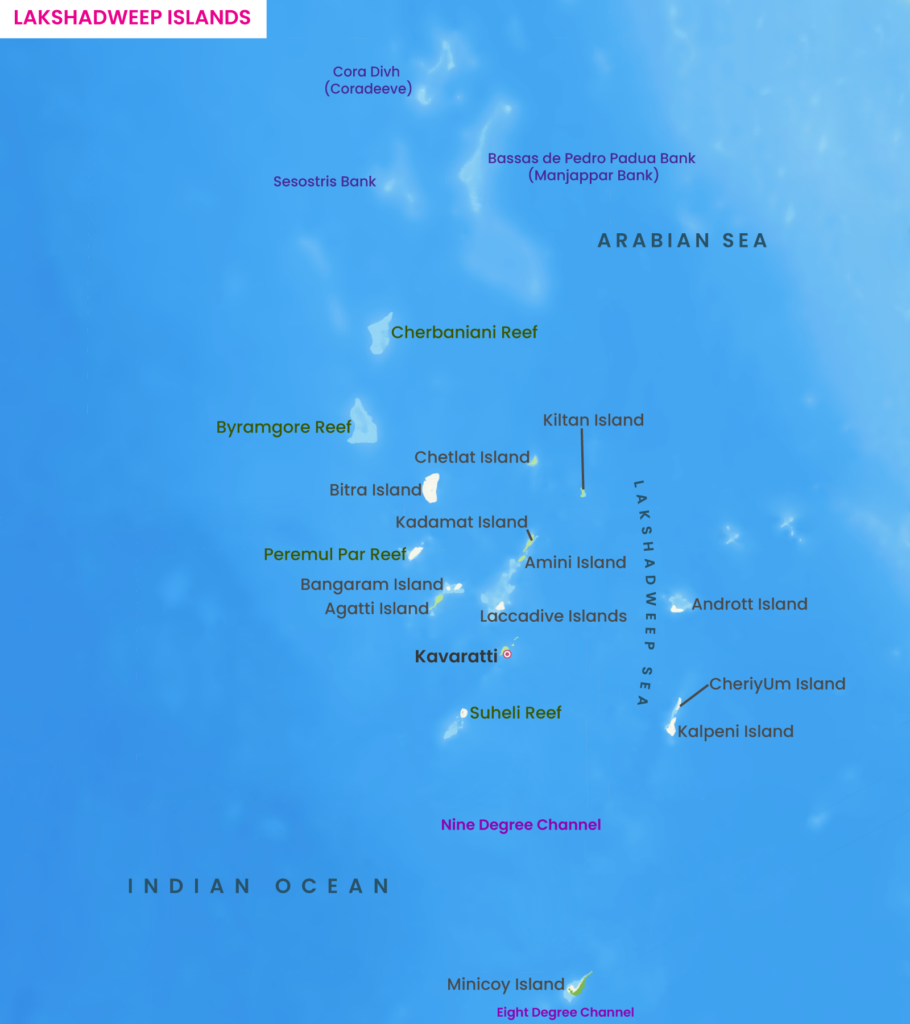
- The group as a whole: 36 islands over 32 sq km between about 8°N and 12°N, with 10 inhabited islands, 12 atolls, 3 reefs and 5 submerged banks. Kavaratti is the capital. Older accounts give 25 small islands and 108.78 sq km.
- All are of coral origin, flat and mostly under 5 m, with shallow lagoons on the western side and steeper slopes on the east.
- Agatti Island:
- A 7.6 km long island on the Agatti atoll.
- Agatti Aerodrome is the only operational airport of Lakshadweep. A new airfield at Minicoy has been proposed since January 2024.
- Entry needs a confirmed place to stay. Older accounts mention one hotel, the Agatti Island Beach Resort.
- Andrott (Androth):
- A small inhabited island in this group of 36 coral islands.
- The first island of Lakshadweep to embrace Islam, and the largest, at about 4.90 sq km.
- It is known for old monuments and a lighthouse, and fishing is the backbone of its economy.
- Bangaram Atoll:
- A tiny teardrop-shaped island close to Agatti and Kavaratti.
- A popular tourist resort, with a population of only about 60, mostly tourists.
- Bitra Island:
- Also Bitra Par, a coral atoll of the Amindivi subgroup, the smallest inhabited island of the group.
- A small shrine to an old Arab saint, Malik Mulla, buried on the island, draws pilgrims.
- About 300 people live here.
- A Revenue Department notice of 11 July 2025 proposed acquiring the whole island for defence and strategic agencies. Residents and the local Member of Parliament opposed it.
- Chetlat Island:
- A coral island of the Amindivi subgroup, 37 km north-west of Kiltan.
- It draws tourists with its scenery and rich aquatic life.
- Kadmat Island:
- Also Cardamom Island, a coral island of the Amindivi subgroup.
- A lagoon surrounds it on the eastern and western sides, with corals.
- Its best attractions are long sandy beaches, and it is an ideal place for solitude.
- The Ministry of Environment and Forests has notified it as a marine protected area, to conserve its plants, animals and other resources.
- Kalpeni Island:
- An inhabited atoll, with coral debris thrown up by a violent storm in 1847.
- The first island in Lakshadweep where women were allowed to go to school.
- Maliku Atoll (Viringili Island):
- It has only two islands, Minicoy and Viringili.
- Viringili (Villingili) is an uninhabited islet at the south-western end of Minicoy’s reef.
- Minicoy Island:
- Locally Maliku, the only inhabited island of its atoll, the southernmost atoll of the archipelago.
- The second largest island of the group, about 10 km long and covered with coconut palms, with a tall lighthouse.
- The Nine Degree Channel separates it from the rest of Lakshadweep, and the Eight Degree Channel from the Maldives.
- Aminidivi:
- The northernmost of the subgroups, with 5 islands: Amini, Kiltan, Chetlat, Kadmat and Bitra.
- Each is very scenic, and Kadmat is especially popular.
- Laccadive Islands:
- Also the Cannanore Islands, one of the three island subgroups of the Union Territory.
- The central subgroup, parted from Amindivi roughly by the 11th parallel north and from Minicoy, far to the south, by the Nine Degree Channel.
- Islands: Suheli Par, Pitti, Kalpeni, Andrott, Agatti and Kavaratti.
- A blend of traditional culture, nature and modern life.
- Other names on the map:
- Kavaratti, the capital; Cheriyam beside Kalpeni.
- Reefs: Cherbaniani, Byramgore, Perumal Par and Suheli. Submerged banks: Cora Divh, Sesostris and Bassas de Pedro Padua.
Inland River and Lake Islands
- Majuli:
- Between the Brahmaputra and the Subansiri in Assam, recognised by Guinness World Records in September 2016 as the largest river island in the world.
- It formed through course changes by the rivers. Erosion cut it from 733.79 sq km in 1914 to 524.29 sq km in 2016 on current official work. Older reports give about 1,250 sq km falling to about 880 sq km.
- The abode of Assamese neo-Vaishnavite culture, and India’s first island district, from 2016.
- It has been on UNESCO’s Tentative List since 2004, without inscription, and it faces ecological problems.
- Phumdis (floating islands):
- Masses of vegetation and soil on Loktak Lake, Manipur. The Keibul Lamjao National Park stands on them, the home of the Sangai deer.
- Teen Chinar:
- An islet in Dal Lake, Srinagar, Jammu and Kashmir, better known as Char Chinar or Rupa Lank, after the chinar trees on its corners.
- Damaged by the 2014 floods, it received two transplanted chinars in February 2022.
Other Coastal Features
Channels and Straits
- Coco Channel:
- Between Landfall Island and Coco Island of Myanmar, linking the Bay of Bengal with the Andaman Sea.
- It marks the maritime boundary between India and Myanmar.
- Austen Strait:
- Between North Andaman and Middle Andaman, east of Interview Island, linking the Bay of Bengal with the Andaman Sea.
- Duncan Passage:
- A strait of about 50 km that parts Rutland Island on the north from Little Andaman on the south, linking the Bay of Bengal and the Andaman Sea.
- Several islands lie in the passage.
- Ten Degree Channel:
- It separates the Andaman and Nicobar groups, about 150 km wide, on 10°N latitude, and links the Bay of Bengal with the Andaman Sea.
- Sombrero Channel:
- Between Katchal Island and Little Nicobar, linking the Andaman Sea with the Indian Ocean.
- It is the waterway for Port Nancowry.
- St George’s Channel:
- Between Little Nicobar and Great Nicobar.
- Great Channel:
- Between Great Nicobar and Sumatra, south of Indira Point, and the maritime boundary between India and Indonesia.
- An important international waterway passes through it.
- Nine Degree Channel (Mamala Channel) and Eight Degree Channel:
- The first parts Minicoy from the main Lakshadweep group, and the second parts Minicoy from the Maldives.
Bays and Gulfs
- Palk Bay:
- Between India and Sri Lanka, north-east of Adam’s Bridge and south-west of the Palk Strait, which links it with the Bay of Bengal.
- It holds many small islands, and is a fishing ground of strategic importance.
- Gulf of Mannar:
- Between India and Sri Lanka, south-west of Adam’s Bridge, dotted with many islands.
- A marine biosphere reserve, with coral reefs, a fishing ground, a sea route and strategic value.
- Kakinada Bay:
- A shallow bar-built water body, 3–8 m deep at high tide, north-east of the Godavari delta.
- Kakinada Port lies on its western coast, and Hope Island protects the port from storms, waves and cyclones.
- Mahim Bay:
- Between Worli on the south and Bandra on the north, to the west of Mumbai, and named after the island of Mahim.
- The Mithi River drains into Mahim Creek, and the Bandra–Worli Sea Link joins the two ends.
- Gulf of Khambhat:
- Between the Kathiawar Peninsula and the Gujarat Plain, fed by the Sabarmati, Mahi, Narmada and Tapi.
- It is shallow, with shoals and sandbanks including the Mal Bank and Malacca Banks.
- It has oil and gas, tidal energy and corals.
- Gulf of Kachchh (Kutch):
- Between Kachchh and Kathiawar, with the Rukmavati draining into it.
- Mandvi, Mundra, Kandla, Jamnagar, Salaya and Okha stand on it, with the Marine National Park near Jamnagar.
- It has corals, tidal power and a sea route, and many small islands.
Points and Headlands
- Indira Point:
- At the southern tip of Great Nicobar, touching the Great Channel. It is the southernmost point of India, also called Pygmalion Point.
- Cape Comorin (Kanniyakumari):
- “The Virgin Princess”, the southernmost point of mainland India, in Tamil Nadu.
- The meeting point of the Arabian Sea, the Gulf of Mannar and the Indian Ocean, at an average elevation of about 0 m.
- A favourite tourist place, and Nagercoil is the closest major city.
- Point Calimere:
- A low headland on the Coromandel Coast, at the apex of the Kaveri delta, where the Peninsula’s coast makes a right-angled turn.
- It holds the Point Calimere Wildlife Sanctuary.
Creeks, Banks and the Delta Forest
- Thane Creek:
- Part of the estuary of the Ulhas, opening into Bombay Harbour, from Mumbra Ritibunder to the Mankhurd–Vashi Bridge, with Thane city at its head.
- An important bird nesting area, with the Thane Creek Flamingo Sanctuary, a Ramsar site since 13 April 2022.
- Sir Creek:
- A 96 km tidal strip in the Rann of Kachchh marshlands, in dispute between India and Pakistan, locally called Baan Ganga.
- Pakistan claims the entire creek under paragraphs 9 and 10 of the Bombay Government Resolution of 1914. India seeks a boundary along the mid-channel.
- The area is rich in oil and gas.
- Kori Creek:
- A large creek east of Sir Creek, in the marshlands of Kachchh, wholly on the Gujarat side and close to the disputed strip.
- The region is rich in oil and gas.
- Mal Bank:
- At the head of the Gulf of Khambhat, where the Sabarmati and Mahi drain, with Khambhat city to the north-east.
- It has oil and gas, coral and tidal power potential.
- Malacca Banks:
- Sandbanks below the sea surface, or shoals, at the southern entrance of the Gulf of Khambhat, west and south-west of Surat.
- A system of four irregular ridges running roughly north to south. Malacca Bank proper is the second ridge from the west.
- Sundarbans:
- The largest single block of tidal halophytic mangrove forest in the world, named after the Sundari tree.
- It spreads over the seaward fringe of the Ganga delta in West Bengal and Bangladesh.
- A UNESCO World Heritage Site, famous for its Royal Bengal Tigers.
Further Names by Coast
- Kathiawar: Piram and Bhaisala.
- Kachchh: Vaida, Nora and Karumbhar (Karunbhar), besides Pirotan.
- Near Mumbai: Karanja, besides Butcher, Elephanta and Cross.
- Mangaluru coast: Bhatkal, besides Pigeon and St Mary’s.
- Gulf of Mannar: Crocodile, besides Pamban and Adunda.
- Many of these are uninhabited and are administered by the adjacent States.
Previous Year Questions
2026Critically examine the strategic, economic and ecological impacts of the proposed ‘Great Nicobar Project’.2026Map item: Bitra Island2025With reference to typical examples, assess why regional planning in India is important for island territories for their sustainable development.2025Map item: Sri Vijayapuram2023Examine the geostrategic significance of Indian islands.2023Assess the ecotourism potential of Andaman and Nicobar, Lakshadweep islands and highlight the challenges associated with the sustainable development of island territories.2023Map item: Ross Island2022Map item: Maliku Atoll2022Map item: Gangasagar2021Map item: Pamban Island2021Map item: Sir Creek2019Map item: Barren Island2018Discuss the strategies of integrated development of island territories in India.2018Map item: Kori Creek2017Map item: Nayachar Island2017Map item: Havelock Island2015Indian island territories are vulnerable to the sea level rise. Explain.2015Map item: Narcondam2014Map item: Ganga Sagar


Pls check Barren Island recent eruption may be 2018
Yeah, the Most recent eruption one being in 2020.
does the the information written in bold are the most important
Thank you so very much for this compilation, Sir/Madam!
thank you