

- India’s important cities and towns, grouped by zone and State, are each known for an industry, a historical event, a river, a railway or a national institute.
- Many of these towns have a clear function: they grew around one industry, one railway junction or one military station.
- “Million-plus” means a city with one million people or more on the 2011 Census. India had 53 such cities then, against 12 in 1981.
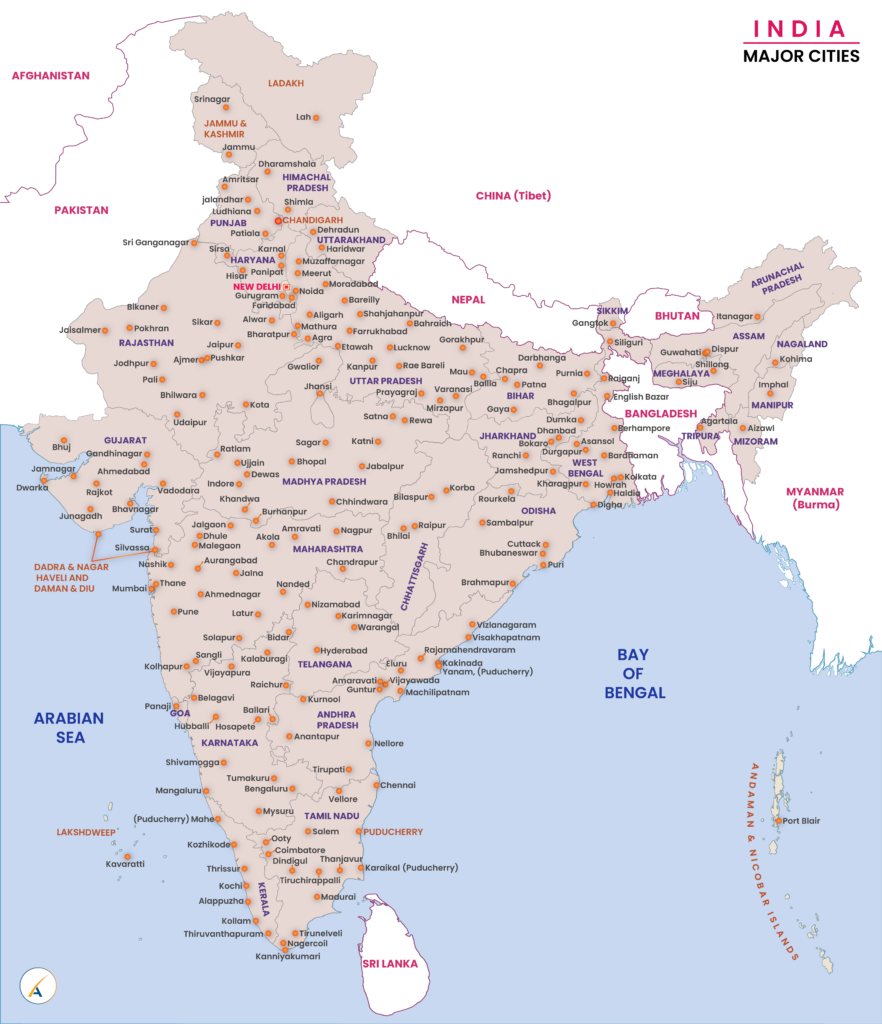
- On this map, “Lah” is Leh, Ahmednagar is Ahilyanagar and Aurangabad is Chhatrapati Sambhajinagar. Port Blair is now Sri Vijaya Puram.
Towns by Function
| Function | Towns in this list |
|---|---|
| Fertiliser | Ranipet, Sindri, Aonla, Kalol, Jagdishpur, Nangal, Gorakhpur, Bathinda, Bareilly |
| Cement | Dalmiapuram, Katni, Churk, Dalmianagar, Japla, Shahabad, Chaibasa, Jamul, Siju, Satna |
| Sugar | Ahilyanagar, Sakarwadi, Rawalgaon, Chandaonagar, Mandya, Sakkarnagar, Modinagar, Anakapalli |
| Jute | Titagarh, Budge Budge, Rishra, Serampore, Kakinara, Naihati, Cuttack |
| Textiles and hosiery | Ludhiana, Dhariwal, Coimbatore, Solapur, Kolhapur, Malegaon, Surendranagar |
| Crafts | Firozabad (glass), Moradabad (brass), Bhadohi and Mirzapur (carpets), Khurja (ceramics), Sivakashi (fireworks), Meerut and Jalandhar (sports goods) |
| Oil refineries | Jamnagar, Koyali, Bina, Mathura, Bathinda, Tinsukia |
| Railway zone headquarters | Gorakhpur, Jabalpur, Hubballi, Secunderabad, Bilaspur |
| Capitals in this list | Ranchi, Dehradun, Gandhinagar, Raipur, Bhubaneswar, Panaji, Dispur, Itanagar, Kohima, Aizawl, Agartala, Gangtok, Sri Vijaya Puram, Kavaratti, Srinagar and Jammu |
North and the Himalaya
Jammu and Kashmir
- Srinagar: the largest city and summer capital of the Union Territory, on the bank of the Jhelum.
- Famous for lakes, houseboats, handicrafts, gardens and dry fruits.
- Jammu: the largest city of the Jammu region and the winter capital, known as the City of Temples.
- Vaishno Devi lies in its vicinity.
- Anantnag: near the meeting of the Lidder (Liddar) River and the Jhelum, and the second-largest city of the Kashmir Valley.
- Industries: silk, carpets and gabbas. Its sulphur springs are known for medical value.
- The route to Amarnath passes through it.
- Baramulla (Baramula): a city of the Kashmir Valley on the bank of the Jhelum, near the Line of Control (LoC).
- The third-largest city of the valley after Srinagar and Anantnag.
- Industries: woollens, silk, gabba and namda.
- Udhampur: just north of Jammu city, and headquarters of the Indian Army’s Northern Command.
- Pampore (Pulwama district): on the eastern side of the Jhelum, on the Jammu–Srinagar National Highway.
- Known for saffron, almonds, walnuts and apricots.
- Amarnath Caves: on the Greater Himalaya in Anantnag district.
- The limestone cave holds an ice stalagmite, worshipped as a natural Shivling.
- Pilgrims reach it by the Pahalgam and Baltal (Sonamarg) routes.
- Rajouri (Rajauri): a border city near the LoC, with a silk industry.
- Poonch: a border city along the LoC.
- The Pir Panjal separates the Poonch Valley from the Kashmir Valley, and the Mughal Road connects the two.
- Akhnoor (Jammu district): a border city at the foothills of the Himalaya, on the bank of the Chenab.
- Manda, near it, is the northernmost site of the Harappan civilisation.
- Kupwara: a border city along the LoC.
- Tourist places: Lolab Valley and Sogam.
- Uri (Baramulla district): a border city along the LoC, on the bank of the Jhelum.
- It suffered in the earthquake of 2005.
Ladakh
- Leh: the largest city of the Ladakh region, on the bank of the Indus.
- A centre of Ladakh’s Buddhist culture, with many monasteries, and a tourist hub.
- Kargil: near the LoC, and the only Muslim-majority district of the Ladakh region. Known for the Kargil War of 1999.
- Dras: a border town in Kargil district on the Srinagar–Leh highway, just east of the Zoji La, often called the gateway to Ladakh.
- Long called the coldest inhabited place in India.
- It has the Dras War Memorial.
Punjab and Haryana
- Amritsar: a million-plus city of Punjab near the Pakistan border, founded in 1577 by Ram Das, the fourth Guru of the Sikhs.
- Golden Temple, and the Jallianwala Bagh massacre of 1919.
- Ludhiana: an industrial city of central Punjab, and a million-plus city.
- Cotton, woollen and silk textiles and hosiery. Long the largest centre of hosiery manufacture in India.
- Jalandhar: long ranked the third-largest city of Punjab after Amritsar and Ludhiana, midway between the two, on old NH-1, now NH-44.
- It has a big cantonment and a military air base.
- Known for sports goods, and musical and surgical equipment.
- Bathinda (Bhatinda): an industrial city of south-western Punjab, in the Malwa region, named after the Bhati Rajput kings.
- A large oil refinery, a fertiliser plant and thermal power (the Guru Nanak Dev plant closed early in 2018), and the Qila Mubarak fort.
- Nangal: a small city on the bank of the Satluj, downstream of the Bhakra Dam.
- The Nangal Dam and a hydroelectric plant lie here, and it has a nitrogenous fertiliser plant.
- Rupnagar (Ropar): in eastern Punjab on the bank of the Satluj, and an ancient city of the Harappan civilisation.
- Dhariwal (Gurdaspur district): an industrial city near Amritsar, and the largest centre of woollen textiles in the State.
- Pinjore (Panchkula district, Haryana): a unit of Hindustan Machine Tools (HMT), with tractor production. The town owes its growth to it.
- It is a breeding centre of vultures, and it has the Yadavindra Gardens.
Himachal Pradesh
- Solan: a city of southern Himachal Pradesh between Kalka and Shimla, on the Kalka–Shimla Railway.
- It has diversified industries and is known as the mushroom city of India.
- Known for the Mohan Meakin Brewery, described as India’s oldest.
- Kasauli (Solan district): a small cantonment town, set up as a hill station by the British in 1842.
- It has the Central Research Institute, a medical research centre founded in 1905.
- Kangra: on the Dhauladhar Range, north of the Pong Reservoir, with many temples.
Uttarakhand
- Dehradun: capital of Uttarakhand, in the south-western part of the State, and an academic and learning centre.
- Institutions: Forest Research Institute, ONGC, Indian Institute of Petroleum, Wadia Institute of Himalayan Geology, Indian Military Academy and the Doon School.
- Uttarkashi: in north-western Uttarakhand on the bank of the Bhagirathi.
- Routes to Gangotri and Yamunotri pass through it. It suffered a major earthquake in 1991.
- Ranikhet: a hill station and cantonment town west of Almora, home of the Kumaon Regiment and Naga Regiment.
- The British founded the cantonment in 1869.
Northern Plains and Central India
Uttar Pradesh
- Kanpur: on the bank of the Ganga, a million-plus city, long the largest city of Uttar Pradesh, known as the Manchester of North India.
- Industries: cotton and woollen textiles, leather and sugar.
- Meerut: a million-plus city of western Uttar Pradesh, to the north-east of Delhi, on the Delhi–Saharanpur rail line.
- History: the start of the 1857 uprising and the Meerut Conspiracy Case.
- Known for sports goods.
- Aonla: near Bareilly in the Rohilkhand Division, known for chemical fertilisers from gas.
- It draws gas from the Hazira–Bijaipur–Jagdishpur (HBJ) pipeline.
- Jagdishpur: in Amethi district, formerly Sultanpur.
- Industries: gas-based fertilisers, Bharat Heavy Electricals Limited (BHEL) and paper.
- The HBJ pipeline provides its gas, and the Jagdishpur–Haldia–Bokaro–Dhamra pipeline carries gas east from it.
- Churk (Sonbhadra district, south-eastern Uttar Pradesh): a cement factory was set up here in 1956, owing to its limestone hills.
- Firozabad: an industrial city known for glass factories and bangle making.
- Mirzapur: an industrial city in south-eastern Uttar Pradesh, just south of Varanasi, on the right bank of the Ganga.
- Known for carpets, blankets, brassware and pottery. It lies on the Delhi–Kolkata rail line.
- Moradabad: in the Rohilkhand Division, west of Rampur, founded in 1625 by Rustam Khan, a Mughal general.
- Known for inlaid brass work, and so called Peetalnagri (Brass City).
- Bhadohi (Sant Ravidas Nagar district): a small industrial town west of Varanasi, headquarters of a newer district.
- Known for carpet-making, with sari-making and agro-based industries.
- Khurja: an industrial town of western Uttar Pradesh, south of Bulandshahr, known as the Ceramic City for its pottery.
- Its coal-based chimneys cause much air pollution.
- Modinagar (Ghaziabad district): an industrial city of western Uttar Pradesh close to Delhi, best known as the home of Modi Mills.
- Industries: sugar, textiles and petrochemicals.
- Gorakhpur: on the bank of the Rapti, a major city of north-eastern Uttar Pradesh.
- Headquarters of the North Eastern Railway Zone.
- Industries: fertilisers, sugar and printing. Its fertiliser plant, shut for nearly 30 years, restarted in December 2021.
- Mathura: a historical, religious and industrial city of western Uttar Pradesh, on the bank of the Yamuna.
- Held to be the birthplace of Lord Krishna, with Vrindavan just north of it.
- It has an oil refinery.
- Aligarh: an industrial, historical and educational city in the Ganga–Yamuna Doab.
- Known for Aligarh Muslim University, and traditionally for lock-making and printing.
- Saharanpur: an industrial and religious city of north-western Uttar Pradesh, founded in 1340 and named after the Sufi saint Shah Haroon Chishti.
- Industries: paper and sugar.
- Bareilly (Baraily): between Delhi and Lucknow in Rohilkhand, founded in 1537 by the Mughal governor Makrand Rai, and later the capital of the Rohillas.
- It took part in the 1857 uprising.
- Industries: sugar and gas-based fertiliser.
- Rae Bareli: an industrial and historical city in the Ganga–Gomati Doab, on the bank of the Sai River.
- The nearby town of Lalganj has a railway coach factory.
- Naini: a satellite town of Prayagraj (Allahabad), on the bank of the Yamuna.
- Naini Jail, where Jawaharlal Nehru was jailed.
Rajasthan
- Alwar: in north-eastern Rajasthan between Delhi and Jaipur, within the National Capital Region.
- Known for Sariska National Park and Tiger Reserve. The Kho-Dariba copper mines lie nearby.
- Udaipur: the main city of southern Rajasthan, on old NH-8, now NH-48, and on the Delhi–Mumbai rail line.
- The old capital of a princely state, known for palaces, lakes and luxury hotels.
- Industries: zinc smelting, fertilisers, cement and marble.
- Pokhran: in the Thar Desert between Jodhpur and Jaisalmer.
- India’s nuclear testing site of 1974 and 1998. The name is taken to mean the place of five mirages.
- Sri Ganganagar (Ganganagar): the northernmost city of Rajasthan, near the borders of Pakistan and Punjab, on NH-11.
- Known as the Granary of Rajasthan, with cotton textiles and sugar.
- It has benefited from the Indira Gandhi Canal.
- Bikaner: an industrial and historical city of the northern Thar.
- Named after its founder, Rao Bika, a Rajput chief.
- It has an agricultural university, and it is a wool-collecting and camel-breeding centre.
- Jodhpur: long ranked the second-largest city of Rajasthan, a historical city in the Thar and a million-plus city on the 2011 Census.
- The Central Arid Zone Research Institute (CAZRI) is here.
- Seat of a princely state of the same name and capital of Marwar, with tourism in forts, palaces and temples.
- Known as the Sun City and the Blue City.
- Jaisalmer: a historical city of western Rajasthan, nicknamed the Golden City.
- Desert National Park lies in the vicinity, and tourism is the main industry.
- Pushkar: 14 km north-west of Ajmer, on the shore of Pushkar Lake.
- A Hindu pilgrimage centre often called the Tirth Raj, with many temples, and known for the Pushkar Fair.
- Munabao (Barmer district): a village on the Pakistan border, through which the Thar Express ran to Khokhrapar in Pakistan.
- The link reopened in February 2006, and the train has been suspended since August 2019.
Madhya Pradesh
- Indore: long the largest city of the State, on the Malwa Plateau, known as Mini Bombay and a million-plus city.
- The old capital of the Holkar Maratha family.
- Industries: cotton textiles, soya and pharmaceuticals.
- It lies on the Khan and Saraswati streams of the Shipra (Sipra) basin.
- Dewas: an industrial city between Indore and Ujjain, known for the Bank Note Press.
- Cotton textiles and soya processing.
- The seat of two princely states in British times.
- Narmadapuram (Hoshangabad): an industrial town on the southern bank of the Narmada, south of Bhopal, renamed in February 2022.
- Known for the Security Paper Mill, with paper, pulp and textiles.
- Famous for Sethani Ghat on the river.
- Jabalpur: an industrial city of eastern Madhya Pradesh on the bank of the Narmada, and a million-plus city.
- Seat of the High Court of Madhya Pradesh, and headquarters of the West Central Railway.
- Mainly known for defence-related industries.
- Katni (Kanti): an industrial city of eastern Madhya Pradesh on the Katni River, famous for its lime and bauxite.
- A cement factory and an ordnance factory.
- One of the largest railway junctions in India, with a very large rail yard and diesel locomotive shed.
- Satna: an industrial city of eastern Madhya Pradesh, on the Uttar Pradesh border, known for cement.
- Mandsaur: in western Madhya Pradesh near the Rajasthan border, south-west of the Gandhi Sagar.
- Long the centre of the largest opium production in India.
- Tourist places: Pashupatinath Temple, Gandhi Sagar Sanctuary and Mandsaur Fort.
- Itarsi: south of Narmadapuram, and one of the star railway junctions of India, described as near the geographical centre of the country.
- Tawa Dam and Bori Wildlife Sanctuary lie in the vicinity.
- Economy: ordnance factory, soya oil mills and plywood.
- Bina: an industrial town near Sagar, on the right side of the Betwa, and an important railway junction of central India.
- Its oil refinery was commissioned in 2011 and has since been expanded to 7.8 million tonnes a year.
- Ratlam: an industrial town and railway junction on the Delhi–Mumbai line, with a railway workshop.
- It lies a few kilometres south of the Tropic of Cancer.
- Gwalior: the main city of northern Madhya Pradesh, and a million-plus city, the old capital of the Scindias (Sindhiyas).
- It has Gwalior Fort, the Tomb of Tansen and the Saas-Bahu Temple.
Chhattisgarh
- Raipur: capital and largest city of Chhattisgarh, on the bank of the Kharun, a tributary of the Seonath in the Mahanadi basin.
- Founded in the 14th century by Rai Brahma Deo of the Ratanpur dynasty.
- On old NH-6, now NH-53, and on the Mumbai–Kolkata main rail line.
- Bilaspur: the second city of the State, on the Mumbai–Kolkata railway line.
- Headquarters of the South East Central Railway Zone, and seat of the High Court of Chhattisgarh.
- Jamul (Durg district): an industrial town near Bhilai, with the State’s most important cement plant, set up in 1965 and run by ACC.
Bihar and Jharkhand
- Dalmianagar (Rohtas district, Bihar): one of the oldest and biggest industrial towns of India, on the bank of the Son in south-western Bihar.
- Founded by Ramkrishna Dalmia, founder of the Dalmia group.
- Madhubani (Bihar): in northern Bihar near the Nepal border, west of the Kosi.
- Known for Madhubani Paintings, and the cultural centre of Mithilanchal, the birthplace of many literary figures.
- Sindri (Dhanbad district, Jharkhand): known for a large chemical fertiliser plant set up by the Fertilizer Corporation of India (FCI) in 1951.
- It also has a cement plant.
- It was the first fertiliser plant in India to produce ammonium sulphate, urea and ammonium nitrate sulphate.
- A new urea plant of Hindustan Urvarak and Rasayan was dedicated in March 2024.
- Japla (Palamu district): an industrial town near the Bihar border, known for cement, with the factory at Deori.
- Chaibasa (West Singhbhum district): near the Odisha (Orissa) border, known for cement.
- India’s first entirely indigenous cement plant was set up here in 1947, operated by ACC.
- Ranchi: capital and industrial city of Jharkhand, on the bank of the Subarnarekha, and a million-plus city on the 2011 Census.
- Heavy engineering, with the Heavy Engineering Corporation (HEC).
- Known for its hospital for mental illness at Kanke.
- The City of Waterfalls: Dassam, Hundru, Jonha, Hirni and Panchghagh lie near it.
- Dhanbad: an industrial city between the Barakar and the Damodar, and a million-plus city.
- Industries: iron and steel, fertilisers, cement and heavy engineering goods.
- A coal-mining centre and zinc smelter, with the Jharia coal mines very close.
- Site of the Indian School of Mines, now an Indian Institute of Technology, and of the Central Institute of Mining and Fuel Research, which absorbed the Central Fuel Research Institute.
West Bengal
- Titagarh: an industrial city on the bank of the Hooghly (Hoogly), known for jute and paper.
- Budge Budge: an industrial city on the bank of the Hooghly, south-west of Kolkata, towards Haldia, with jute mills, paper and pulp.
- Rishra (Risra): an industrial town in the Hooghly Valley, near Titagarh.
- The modern jute industry began here in 1855. It also has a petrochemical industry.
- Serampore, Kakinara and Naihati: industrial towns on the Hooghly near Titagarh, known for jute. Kakinara and Naihati also make paper.
- Murshidabad: an industrial and historical city, near the border with Bangladesh.
- Once the capital of Bengal under its Nawab, with the Nawab’s Hazarduari Palace.
- Industries: cotton, woollen and silk textiles.
- Diamond Harbour (South 24 Parganas district): on the bank of the Hooghly, once a stronghold of Portuguese pirates.
- A minor port and a popular tourist destination.
- Asansol: the State’s second million-plus city, along the Damodar, an industrial, educational and Bengali cultural centre.
- Raniganj, Kulti, Burnpur, Durgapur, Chittaranjan and Jaykaynagar (Jayaknagar) all lie in its vicinity.
- Kharagpur: near Medinipur, known for its Indian Institute of Technology (IIT).
- It long had the longest railway platform in India, until Gorakhpur’s (1,366 m, 2013) and then Hubballi’s passed it.
- The Chennai–Kolkata and Kolkata–Mumbai main rail lines pass through it.
- Belur: on the right bank of the Hooghly (Hugli), about 20 km north of Howrah (Haora), and an important suburb of Kolkata.
- Well known for the Belur Math, headquarters of the Ramakrishna Math and Mission.
- Jaykaynagar (Jayak Nagar): an industrial town of West Bengal in the Asansol belt.
- Aluminium Corporation of India Ltd was formed here in 1937, which sped the growth of the aluminium industry in India.
West and Western India
Gujarat
- Kalol: two places carry the name. The gas-based fertiliser plant and oilfields belong to Kalol in Gandhinagar district, while Kalol in Panchmahal district, with Halol, forms part of a special economic zone (SEZ).
- Vadodara (Baroda): between the Mahi and the Narmada, and a million-plus city.
- The old capital of the Maratha Gaekwad family.
- Koyali: near Vadodara, the Gujarat Refinery of Indian Oil Corporation.
- Its capacity is 13.7 million tonnes a year.
- Surat: a million-plus, industrial and historical city on the bank of the Tapi.
- It has an old tradition of trade through its port, and it is known for diamond-cutting and jewellery.
- Rajkot: the main city of Saurashtra, in the centre of the Kathiawar Peninsula, on the banks of the Aji and Niari, and a million-plus city.
- Industries: sugar, textiles and pharmaceuticals.
- It was the capital of the former Saurashtra State.
- Anjar: a town of the Kachchh region, near Kandla.
- The earthquake of 2001 shattered the old fortified town.
- Bhuj: the main city of the Kachchh region, established by Rao Hamirji in 1510, and capital of an old princely state.
- Earthquakes: that of 1819 formed the Allah Bund. That of 2001 left about 20,000 dead.
- Anand: an industrial city between Vadodara and Ahmedabad, on old NH-8, now NH-48.
- The birthplace of the White Revolution, known for the Anand Milk Union Ltd (AMUL).
- Jamnagar: an industrial city near the Gulf of Kachchh.
- Industries: oil refining, petrochemicals and textiles.
- The Jamnagar complex of Reliance Industries is the largest refinery in India, at 68.2 million tonnes a year.
- Lothal (Ahmedabad district, near Dholka): an ancient Indus Valley city near the Gulf of Khambhat, between the Sabarmati and its tributary the Bhogavo.
- It was a port and trading centre, with a brick dockyard held to be the oldest known in the world.
- Surendranagar: an industrial city between Ahmedabad and Rajkot, west of the Nal Sarovar Bird Sanctuary, called the Gateway to Saurashtra.
- Industries: cotton textiles and groundnut processing.
- Junagadh (Junagarh): an industrial and historical city of southern Saurashtra, at the foot of the Girnar Hills.
- Gir National Park lies in the vicinity. It was a princely state, and it is a tourist centre.
- Gandhinagar: capital of Gujarat, on the bank of the Sabarmati, north of Ahmedabad.
- Home to a thermal power plant and the Akshardham Temple.
- Planned by H. K. Mewada and Prakash Apte.
Dadra and Nagar Haveli and Daman and Diu
- Silvassa: long the capital of Dadra and Nagar Haveli. The merged Union Territory has its capital at Daman (2020).
- It has many factories and industries, and it is home of the Warli culture.
- Diu: on the eastern edge of Diu Island, and the site of the Battle of Diu in 1509.
- Known for fortresses and a Portuguese cathedral, and a tourist destination.
Maharashtra
- Pune: a million-plus city on the eastern side of the Sahyadris.
- Shivaji’s home, and the Maratha capital by 1750.
- Industries: cotton textiles and automobiles.
- A hub of research and education, with the Indian Institute of Tropical Meteorology.
- Nashik (Nasik): a million-plus city of north-western Maharashtra, a site of the Maha Kumbh Mela.
- It has the Indian Army’s School of Artillery and a printing and security press.
- Nagpur: the main city of the Vidarbha region, and a million-plus city.
- It lies on the Nag River, in the Wainganga system, where old NH-6 and NH-7 cross, now NH-53 and NH-44.
- It hosts the winter session of the Maharashtra Legislature.
- Site of the National Environmental Engineering Research Institute (NEERI), and known for Nagpur oranges and bananas.
- Ahilyanagar (Ahmadnagar, Ahmednagar): an industrial city on the bank of the Sina, which flows to the Bhima and the Krishna, renamed in 2024.
- Industries: sugar, cotton and textiles.
- Long called the largest sugar-producing centre of Maharashtra.
- Sakarwadi (Ahilyanagar district): an industrial town north of Ahilyanagar with a sugar plant.
- Rawalgaon: an industrial town near Nashik, known for sugar.
- Chandaonagar: an industrial city to the north of Ahilyanagar, known for sugar.
- Solapur: an industrial and historical city of southern Maharashtra, once a seat of the Chalukya and Yadava dynasties, known for bedsheets.
- Kolhapur: an industrial city of southern Maharashtra, on the bank of the Panchganga.
- It was a centre of Buddhism, and it was a princely state.
- Industries: cotton textiles, leather goods and chemicals.
- Location of the Temple of Mahalakshmi.
- Satara: an industrial and historical city of southern Maharashtra.
- Industries: cotton textiles, sugar and scooters.
- Mahabaleshwar and Panchgani lie near it, and Shivaji Sagar and Koyna Dam a few kilometres west.
- Lavasa: a private planned hill town near Pune, built around a dammed lake for tourism and leisure, with only pollution-free industries allowed.
- Malegaon (Nashik district): at the confluence of the Girna and Mausam, and a major textile-producing centre.
- Latur: a city on the Balaghat Range, on the bank of the Manjira.
- It suffered the earthquake of 1993.
- Industries: sugar and cotton textiles.
Goa
- Panaji: capital of Goa, on the bank of the Mandovi on Tiswadi Island.
- The National Institute of Oceanography lies here.
- The name is taken to mean the land that never floods.
South India
Karnataka
- Vijayapura (Bijapur): in north-western Karnataka, a historical and industrial city, renamed in 2014.
- Gol Gumbaz, the mausoleum of Mohammad Adil Shah, is described as the world’s second-largest dome unsupported by pillars.
- Industries: sugar, textiles and cement.
- Shahabad (Kalaburagi district): known for Shahabad stones and cement.
- Mandya: an industrial city of southern Karnataka, between Mysuru and Bengaluru.
- Industries: sugar, silk, matches and fertilisers. The Mysore Sugar Factory is in the city.
- Tumakuru (Tumkur): an industrial town north-west of Bengaluru, with silk, cotton and woollen textiles, renamed in 2014.
- Belagavi (Belgaum): an industrial and historical city of north-western Karnataka, near Maharashtra, renamed in 2014.
- Industries: cotton and woollen textiles.
- Kodagu (Coorg): a hill district of the Western Ghats in south-western Karnataka, with its headquarters at Madikeri, known for coffee and cardamom, and long India’s largest coffee-producing region.
- A former princely state. Pilgrims bathe at Talakaveri, on the Brahmagiri hills, the source of the Kaveri.
- Ballari (Bellary): a historical and industrial city, near Andhra Pradesh and Telangana.
- The region has good reserves of iron ore, and the city has a 16th-century fort.
- Industries: sugar and textiles.
- Hassan: a city with the Master Control Facility (MCF) of the Indian Space Research Organisation.
- Belur, Halebidu and Shravanabelagola lie in the vicinity.
- Hubballi (Hubli): an industrial city between Dharwad and Gadag.
- Headquarters of the South Western Railway, and the site of the world’s longest railway platform (1,507 m, 2023).
- Industries: cotton and woollen textiles.
- With its twin, Dharwad, it forms the State’s second-largest urban agglomeration.
- Raichur: an industrial and historical city, between the Krishna and the Tungabhadra.
- Famous for the wars of the Vijayanagar Empire in the Raichur Doab.
- Mysuru (Mysore): the main city of southern Karnataka, and long the State’s second-largest.
- It was the capital of the princely state of Mysore.
- Industries: silk and sandalwood crafts.
- Attractions: the royal palaces, the Giant Nandi, Krishnaraja Sagar Dam and Brindavan Gardens. Famous for the Dussehra Festival.
- Kalaburagi (Gulbarga): formerly part of Hyderabad state, founded by the Bahmani Sultans in the 14th century as their capital, renamed in 2014.
- The Sharana Basaveshwara Temple draws both Hindu and Muslim devotees.
Tamil Nadu
- Ranipet (Ranipet district, once Vellore): the modest beginning of the chemical fertiliser industry in India was made here in 1906, with a superphosphate factory.
- It has suffered serious groundwater pollution.
- Dalmiapuram (Tiruchirappalli district): 40 km from Tiruchirappalli (Trichy), and hometown of Dalmia Cements, in a region rich in limestone.
- Sivakashi (Virudhunagar district): the capital of India’s fireworks industry, also known for printing and match making.
- It has been notorious for employing children.
- Coimbatore: an industrial city near the Palghat Gap, on the bank of the Noyyal, known as the Manchester of South India.
- A million-plus city, with the Salim Ali Centre for Ornithology and Natural History.
- Avadi (Thiruvallur district): about 23 km north-west of Chennai. The name is an acronym for Armoured Vehicles and Ammunition Depot of India.
- It has units of the Indian Air Force, Army, Central Reserve Police Force and Navy, and T-72 tanks are produced here.
- Thanjavur: a city in the Kaveri Delta, dating back to the Sangam Age, which rose under the Later Cholas.
- Brihadeeswara Temple, part of the Great Living Chola Temples World Heritage Site.
- Known for craft industries.
- Yercaud: a hill station near Salem, on the Shevaroy Hills, with coffee estates and sandalwood, teak and silver oak.
- Tiruchirappalli (Trichy): a city at the start of the Kaveri Delta.
- A Chola fortified town of the second century, known to the Greek geographer Ptolemy.
Andhra Pradesh and Telangana
- Anakapalli (Andhra Pradesh): an industrial city near Visakhapatnam, on the Sarada River, known for sugar.
- The largest source of jaggery in southern India, and the second largest in India.
- Rajamahendravaram (Rajahmundry): the main city of the East Godavari district.
- The Central Tobacco Research Institute, since renamed the National Institute for Research on Commercial Agriculture, is here, and it is a collection centre for rice and salt.
- Guntur: an industrial city at the head of the Krishna Delta, just south of Vijayawada, on NH-16 and the Chennai–Kolkata main rail line.
- Known for sugar, cement and leather goods.
- It has the largest chilli market (mandi) in Asia.
- Vijayawada: on the banks of the Krishna, among the Eastern Ghats hills known as Indrakeeladri.
- A million-plus city, and the second-largest of Andhra Pradesh after Visakhapatnam, often called its Business Capital.
- Industries: automobile body building and garments.
- Secunderabad (Telangana): the twin city of Hyderabad, just north of it, set up by the British as a cantonment.
- Headquarters of the South Central Railway Zone.
- Sakkarnagar (Telangana): an industrial city of the Telangana Plateau, near Nizamabad, named for its sugar industry.
- The Nizam Sugar Factory was once one of the largest sugar factories in Asia.
- Nizamabad (Telangana): an industrial and historical city, formerly in northern Andhra Pradesh, with Nizam Sagar in the vicinity.
- Industries: sugar, paper and cotton textiles.
East, North-East and the Islands
Odisha
- Cuttack: an industrial city at the apex of the Mahanadi Delta, the former capital and the commercial capital of Odisha.
- Industries: jute textiles, sugar and handicrafts.
- It has the Central Rice Research Institute (CRRI), set up in 1946 and known as the National Rice Research Institute from 2015, and the famous Katak Chandi Temple.
- Bhubaneswar: the capital and a religious city of Odisha, on the Mahanadi Delta, famous for its temple architecture.
- It dates back to the third century BC, when the area was the capital of the Kalinga kingdom.
- It has the University of Agriculture and Technology, Utkal University and a Tribal Research Institute.
Sikkim and the North-East
- Gangtok: capital and largest city of Sikkim, on a ridge of the Lesser Himalaya.
- A centre of Buddhist culture and of Sikkim’s tourism, with the Enchey Monastery, built in 1840.
- Dispur: capital of Assam, within Guwahati city, which has Gauhati University.
- Industries: paper, tea and coal marketing.
- Silchar: a city of southern Assam in the Surma (Barak) Valley, headquarters of Cachar district.
- Its farmland and tea plantations make it a centre for trading and processing tea, rice and other farm products.
- Jorhat: a city of the Upper Assam Valley, south of Majuli Island, and the last capital of the Ahom Kingdom.
- Known as the Cultural Capital of Assam, with the Tocklai Tea Research Institute; the area is a principal place of pilgrimage of Vaishnavites.
- Tinsukia: a city of the Upper Assam Valley, north-west of Digboi.
- The region is rich in oil and coal, and there is an oil refinery in the area.
- Itanagar: capital of Arunachal Pradesh, with a 14th-century fort, a Buddhist temple and a university, formerly Arunachal University.
- Kohima: capital and historical city of Nagaland, inhabited mainly by the Angami tribes.
- NH-2 connects it with Dimapur and Imphal.
- The Kohima War Cemetery holds soldiers who fell in the Second World War battle fought here.
- Dimapur: the main commercial hub of Nagaland, a gateway to Nagaland and Manipur, and an important military centre.
- Long the only city of Nagaland connected by both rail and air.
- Aizawl: capital and primate city of Mizoram, in the Mizo Hills, known for Lushai culture.
- Dampa Wildlife Sanctuary lies in the vicinity.
- Agartala: capital of Tripura, near the Bangladesh border, on the Haroa River, a tributary of the Meghna.
- Industries: rice processing and tea.
- Siju (Meghalaya): famous for the Siju Caves, and it also has a cement plant.
- Mawsynram (Meghalaya): in the Khasi Hills, about 15 km west of Cherrapunji.
- It receives the highest average rainfall in the world, about 1,187 cm a year, because of its funnel-shaped topography.
- Inhabited by the Khasi tribes. The region has been ecologically degraded by shifting cultivation.
- Cherrapunji (Sohra, Meghalaya): in the southern part of the Khasi Hills.
- It receives one of the highest rainfalls in the world, and shares Mawsynram’s Khasi people and degraded ecology.
Andaman and Nicobar Islands and Lakshadweep
- Sri Vijaya Puram (Port Blair): capital and largest city of the Andaman and Nicobar Islands, renamed on 13 September 2024, in the south-east of South Andaman Island.
- A base of the Indian Navy and the Indian Coast Guard, with the famous Cellular Jail.
- Kavaratti: capital of Lakshadweep, on Kavaratti Island, and a tourist centre.
- India’s first low-temperature thermal desalination (LTTD) plant opened here in May 2005.
- It is associated with India’s ocean thermal energy conversion (OTEC) work.
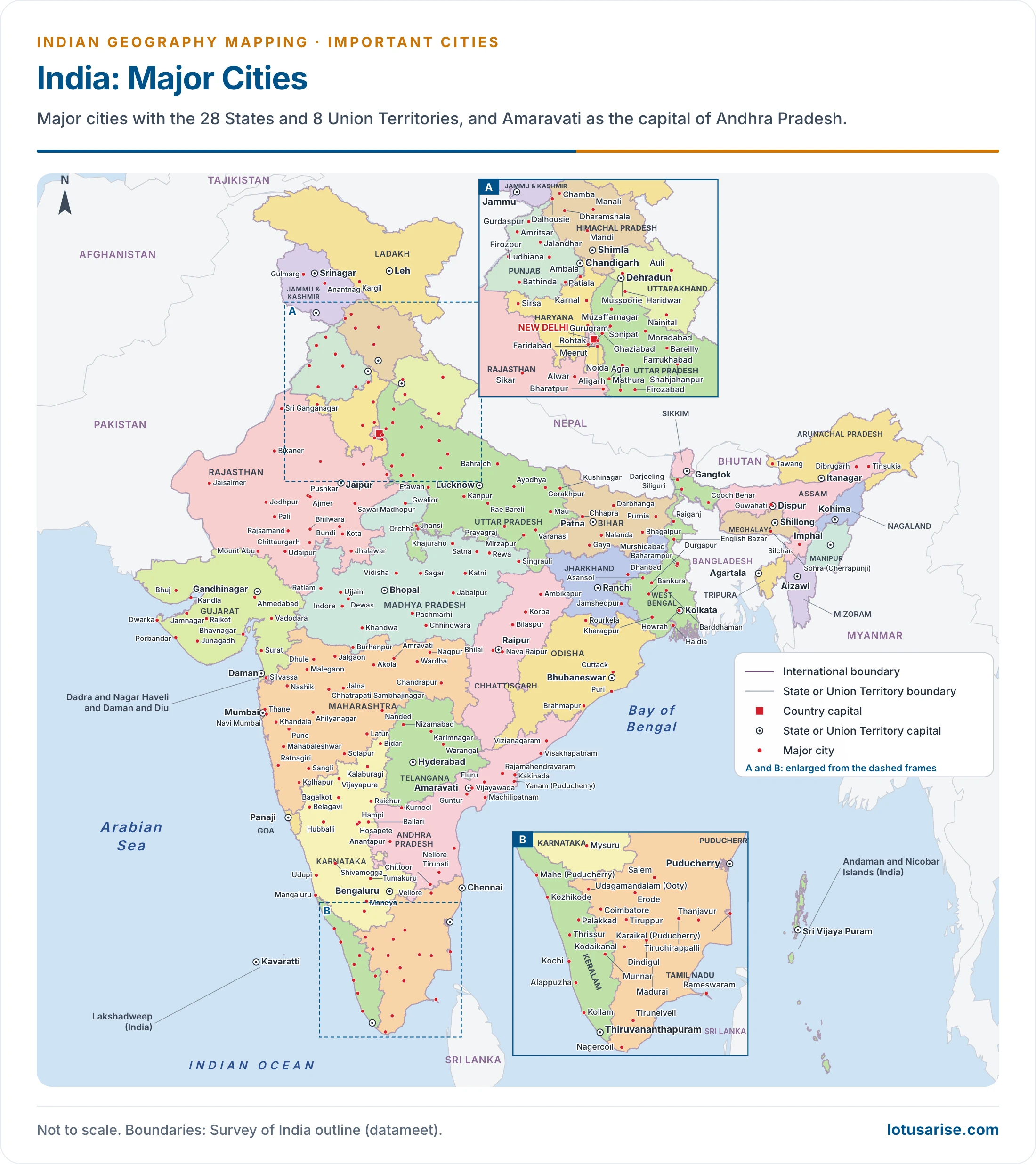
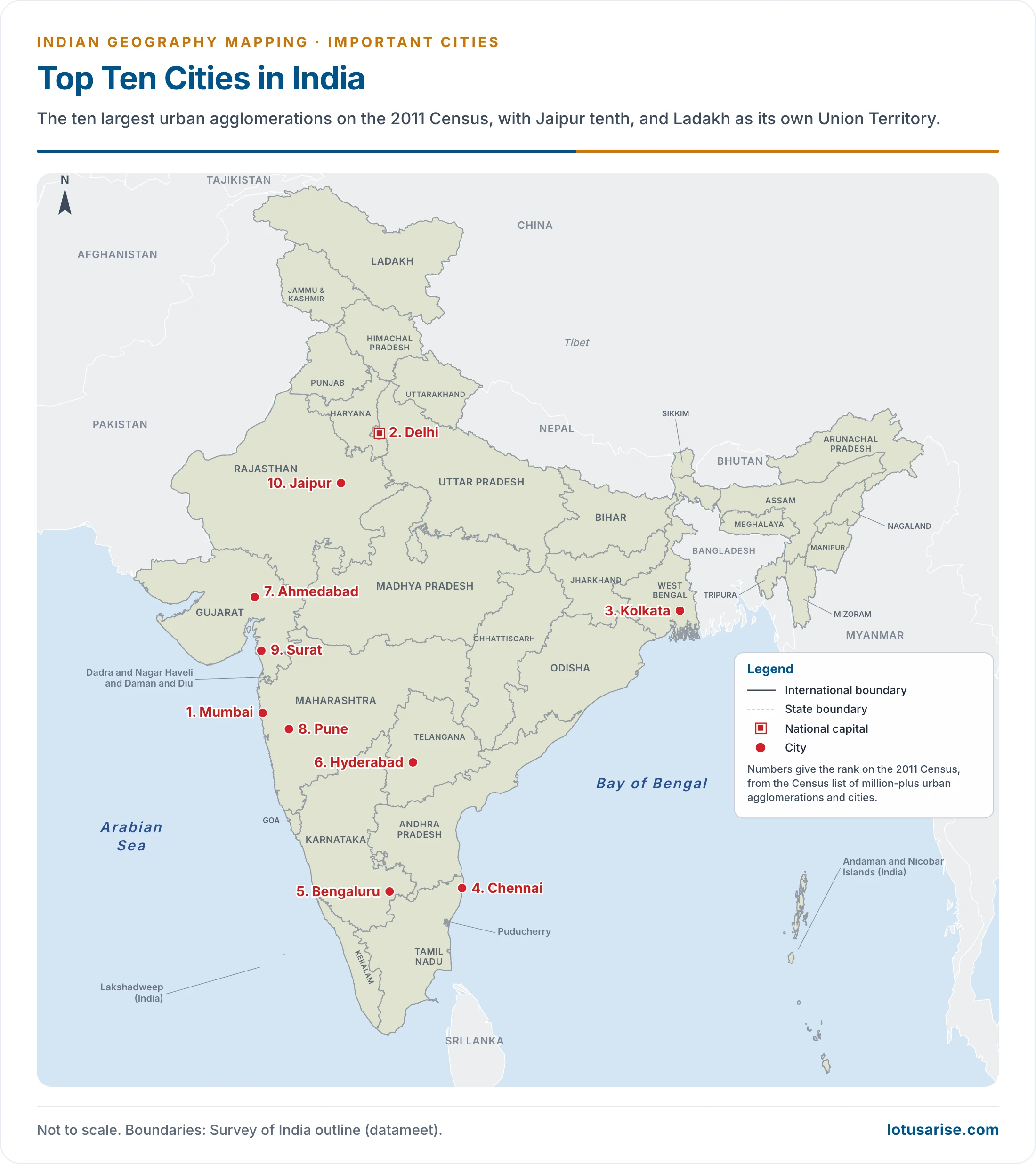
- Ladakh has been a separate Union Territory since 31 October 2019.
Previous Year Questions
2026Map item: Dras2020Map item: Coorg2019Map item: Lothal2016Map item: Headquarters of North-Eastern Railways2013Map item: Amarnath2013Map item: Sindri2013Map item: Churk


sir thank u so much, ur notes r very helpful pls upload the remaining part as early as possible