

Religion and Morality: Religion and Morality.
Official Syllabus: Paper II, Section B, Unit 8
Most people assume that being religious means being good — that a religion without a moral code would hardly deserve the name. Yet the history of religion shows many forms of religious life in which morality is not invoked at all, or in which the believer is said to rise above morality. Early religion was full of magic and taboo; some sects openly taught that no action brings merit or sin; great theologians taught that we are saved by grace alone, not by good works; Advaita and the bhakti saints spoke of the liberated soul as beyond good and evil; and Kierkegaard praised Abraham for being ready to suspend ethics at God’s command. This article asks two questions that UPSC treats separately: is there religion without morality (a question of fact), and should there be — what is the propriety of religion without morality (a question of value)?
In simple words
Think of a temple bell. Some people ring it believing the sound itself will bring them luck, whatever they do afterwards — this is religion below morality, a kind of magic. A saint rings the same bell with no thought of luck or reward; his goodness has become so natural that he no longer needs rules to remind him — this is religion above morality. Both stand “outside” ordinary morality, but in opposite directions. Keeping these two directions apart is the key to this whole topic.
Context & Problem
Two Questions in One
- The factual question — Can there be religion without morality? Here we look at history and the variety of religions: have there been religious beliefs and practices with no moral content, or even against morality?
- The normative question — Is religion without morality proper? Even if such religion exists, is it genuine religion, or a degenerate form of it? Ought religion to include morality?
- The two must be kept apart. That a thing exists does not show that it is right; and that something is improper does not show that it never happens.
Why the Question Arises
- The interdependence thesis (Article 1) says religion and morality are inseparable. If even one living form of religion lacks morality, “inseparable” is false as a factual claim.
- Religion has its own centre. Worship, prayer, ritual, contemplation, grace and mystical union are not in themselves moral acts. Rudolf Otto found the heart of religion in the numinous — the “holy” with its moral and rational element subtracted. So religion seems to have a core that is more than morality.
- The danger. If religion can float free of morality, it can also be used to justify cruelty — from child sacrifice to persecution in God’s name. Whether religion may stand apart from morality is therefore also a practical question.
Core Doctrine
1. Religion below Morality: Magic, Taboo and the Totem
- Magic before morality. In primitive religion there was more of magic than of morality. Magic tries to compel unseen powers by formulas and rites; it does not ask whether the person using it is good. A charm works — or is believed to work — for saint and sinner alike.
- Taboo before moral code. Early religion was governed by taboos — prohibitions whose force is sacred, not moral. Touching a forbidden object or eating a forbidden food pollutes a person even if done unknowingly; the pollution has nothing to do with intention or harm to others.
- Totem and sacrifice. In some totem cults, cannibalism was practised without moral scruple; children were sacrificed to please the gods. A trace of this is visible in the story of Abraham, ready to sacrifice his only son Isaac to please Yahweh.
- Religion’s own history. Ambedkar describes religion as passing through stages: first it was identified with magic; then with beliefs, rituals, ceremonies, prayers and sacrifices to propitiate a power; only later was this power called God and linked to the soul and its moral accountability. On this account morality entered religion late.
In simple words
A child who is told “don’t step on the cracks in the pavement or something bad will happen” is following a taboo: there is no one harmed by stepping on a crack, and nothing wrong with the act — only a feared consequence. A child who is told “don’t push your little brother, you will hurt him” is following a moral rule: the reason is the harm to another. Early religion had many rules of the first kind.
2. Ritualism: When the Rite Becomes Everything
- The rite as a mechanism. In ritualism the correct performance of a rite is thought to produce its result automatically. The character of the performer and the morality of the goal fall into the background.
- The Vedic example. The ritual portion of the Veda (karmakāṇḍa) prescribes sacrifices for heaven, cattle, sons or rain. The Mīmāṃsakas themselves discussed the Śyena sacrifice — a rite for harming an enemy — as a case where a Vedic rite and dharma come apart: the rite is effective, yet the harm it aims at is not dharma.
- The prophetic protest. Every major tradition produced a protest against empty ritual:
- The Upaniṣads call sacrifices “frail boats” that cannot carry one across to the highest good.
- The Buddha rejected animal sacrifice and rites as useless for liberation; śīla (moral discipline) comes first.
- The Hebrew prophets proclaimed that God desires justice and mercy, not burnt offerings.
- Kabir mocked pilgrimages, rosaries and ritual bathing that leave the heart unchanged.
- Kant’s verdict. Kant called everything that a person does to please God over and above good conduct a “religious illusion” and a counterfeit service of God. For him, religion that substitutes rites for a good life is not religion at all but superstition.
3. Religion against Morality: Antinomian Sects
- Antinomianism (Greek anti, against; nomos, law) is the teaching that the religious person is not bound by moral law.
- In India, early Buddhist texts describe several heretical teachers of the Buddha’s time:
- Pūraṇa Kassapa — an akriyāvādin (“non-action theorist”) who held that no action affects the soul: killing, stealing or lying bring no demerit, and giving or self-control no merit.
- Makkhali Gosāla, leader of the Ājīvikas — taught niyati (fate): everything is fixed, and no human effort can change one’s destiny; purification comes automatically after a fixed number of births.
- Such views, catalogued in Buddhist texts such as the Sāmaññaphala Sutta and the Brahmajāla Sutta (with its list of sixty-two wrong views), were attacked by both Buddhists and Jainas precisely because they destroyed moral responsibility.
- In Christianity, the word “antinomian” was coined by Luther against those who argued that, since believers are saved by grace, they are free from the moral law. Mainstream Christianity rejected this: Paul himself asks, “Shall we continue in sin, that grace may abound? By no means.“
Common confusion
Were the Ājīvikas and Pūraṇa Kassapa just “atheists without morals”? No. Their denial of morality did not come from denying God but from a theory of action — that actions do not touch the soul (Pūraṇa) or that fate decides everything (Gosāla). They were ascetic sects with strict practices. Their teaching is “religion without morality” in a precise sense: a religious path whose metaphysics leaves no room for moral merit and demerit — which is exactly why Buddhists and Jainas, who also had no creator God, opposed them.
4. Salvation by Grace Alone
- The teaching. In both Christianity and Indian thought there is the teaching that one is saved by the grace of God alone, not by one’s own effort or virtue.
- Indian source. The Kaṭha and Muṇḍaka Upaniṣads say: “This Self is not to be attained by instruction, nor by intellect, nor by much learning. He is to be attained only by the one whom He chooses; to such a one the Self reveals His own form.“
- Christian sources.
- Paul: we are justified by faith, not by works of the law.
- Luther: salvation is by faith alone (sola fide) and grace alone (sola gratia).
- Calvin: men are saved by God’s grace according to His eternal election (predestination).
- Karl Barth: God’s word can be understood only through divine grace; human religion and morality cannot climb up to God.
- The consequence. In these teachings moral excellence is discounted, for “no man can be counted righteous before God”. Salvation does not depend on how good one has been.
In simple words
A child receives a birthday gift from her mother. She did not earn it by good marks; it is given out of love. But a child who truly feels loved does not then say, “Since the gift was free, I may now be rude to my mother.” She behaves well because she is grateful. This is how the doctrine of grace is meant to work: goodness is not the price of salvation but the response to it.
Indian Connect — The cat and the monkey
- Later Śrīvaiṣṇavism split over grace. The Teṅkalai (southern) school held the cat principle (mārjāra-nyāya): God saves the soul as a cat carries its kitten by the neck — the kitten does nothing. The Vaḍakalai (northern) school held the monkey principle (markaṭa-nyāya): the baby monkey must cling to its mother — the soul must make some effort.
- The cat principle is the Indian counterpart of sola gratia. Yet even its defenders insisted that the surrendered soul (prapanna) lives righteously out of gratitude — grace changes the motive of morality, it does not abolish morality.
5. “Beyond Good and Evil”: The Liberated Soul
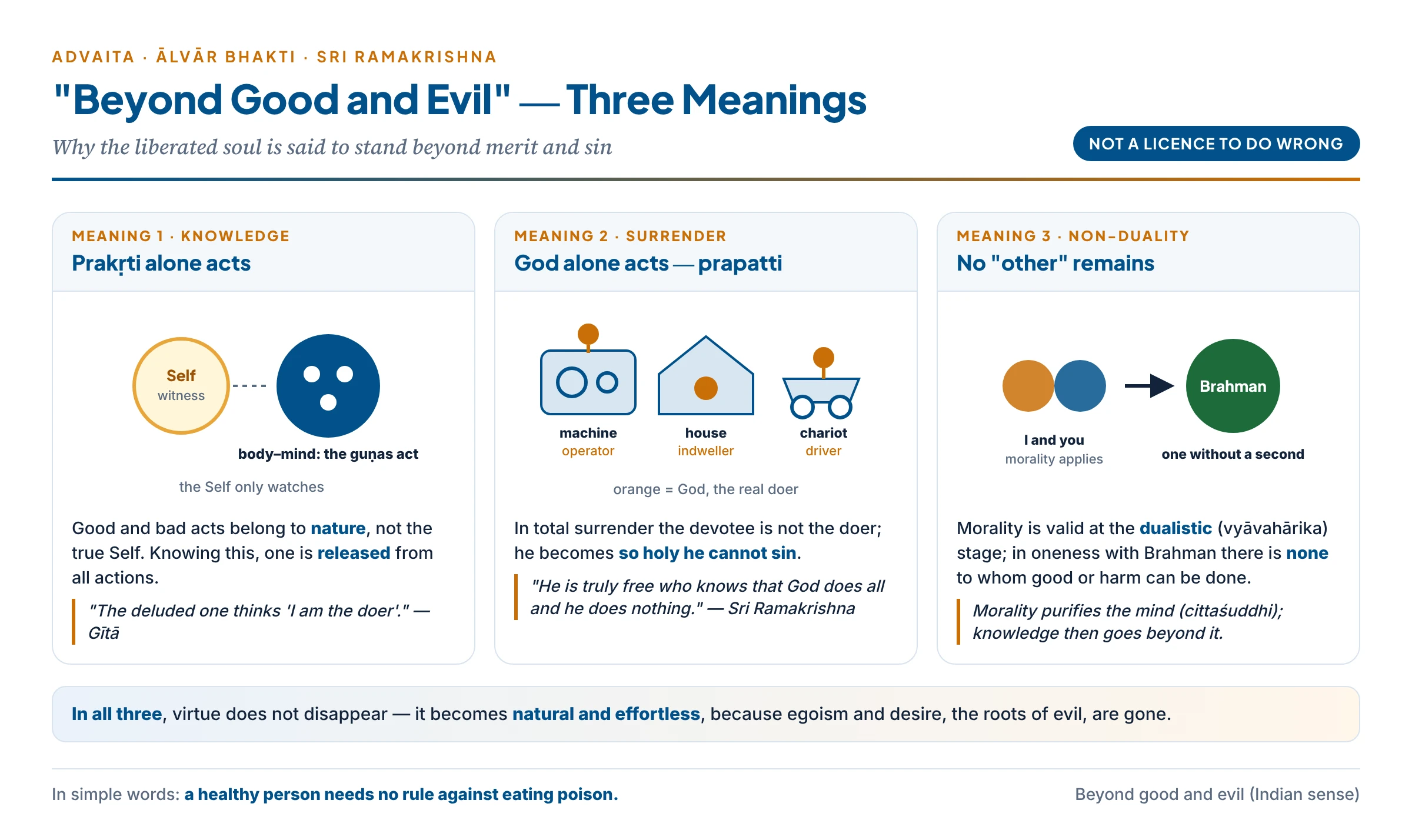
In both Advaita and the bhakti of the Ālvārs, it is taught that after the final spiritual ascent the seeker goes beyond good and evil. The phrase has three nuances of meaning.
(a) Prakṛti alone is the doer
- Actions, good or bad, belong to Prakṛti (nature, the body–mind complex), not to the true Self.
- Once the illumination dawns that Prakṛti alone acts, this knowledge releases a person from all actions, good or bad. “The fool deluded by egoism thinks ‘I am the doer’,” says the Gītā; the wise know that only the guṇas act.
(b) God alone is the doer — prapatti
- On reaching prapatti (total self-surrender), the devotee realises that it is not he but God who works. He is therefore not the doer of any act, good or bad.
- Sri Ramakrishna expressed it thus: the released soul feels, “I am the machine and Thou, O Lord, art the Operator; I am the house and Thou art the Indweller; I am the chariot and Thou art the Driver.” And again: “He is truly free, even in this life, who knows that God does all and he does nothing.“
- This also means the devotee becomes so holy that he can commit no sin — only holy acts flow from him.
(c) Morality belongs to the stage of duality
- Morality remains valid at the dualistic stage, where there is an “I” and “others”. When one becomes one with Brahman, action ceases, for there is no other to whom one could do good or harm.
- In Advaita terms: morality operates at the empirical level (vyāvahārika), where it purifies the mind (cittaśuddhi); at the level of ultimate truth (pāramārthika) the distinctions of doer, deed and receiver vanish. The liberated person (jīvanmukta) is beyond the three guṇas (nistraiguṇya).
Common confusion
Does “beyond good and evil” mean the liberated person may do evil? No. “Beyond” means that rules are no longer needed as rules — not that evil becomes permitted. Advaita teachers held that in the knower the virtues — non-hatred, friendliness, compassion — continue naturally, without effort, because the egoism and desire from which evil comes have been burnt away. The jīvanmukta does not need the commandment “do not steal” for the same reason a healthy person does not need a rule against eating poison. This is quite different from Nietzsche’s “beyond good and evil” (Article 7), which rejects the morality of humility and pity altogether.
6. Faith above Ethics: Kierkegaard and Abraham
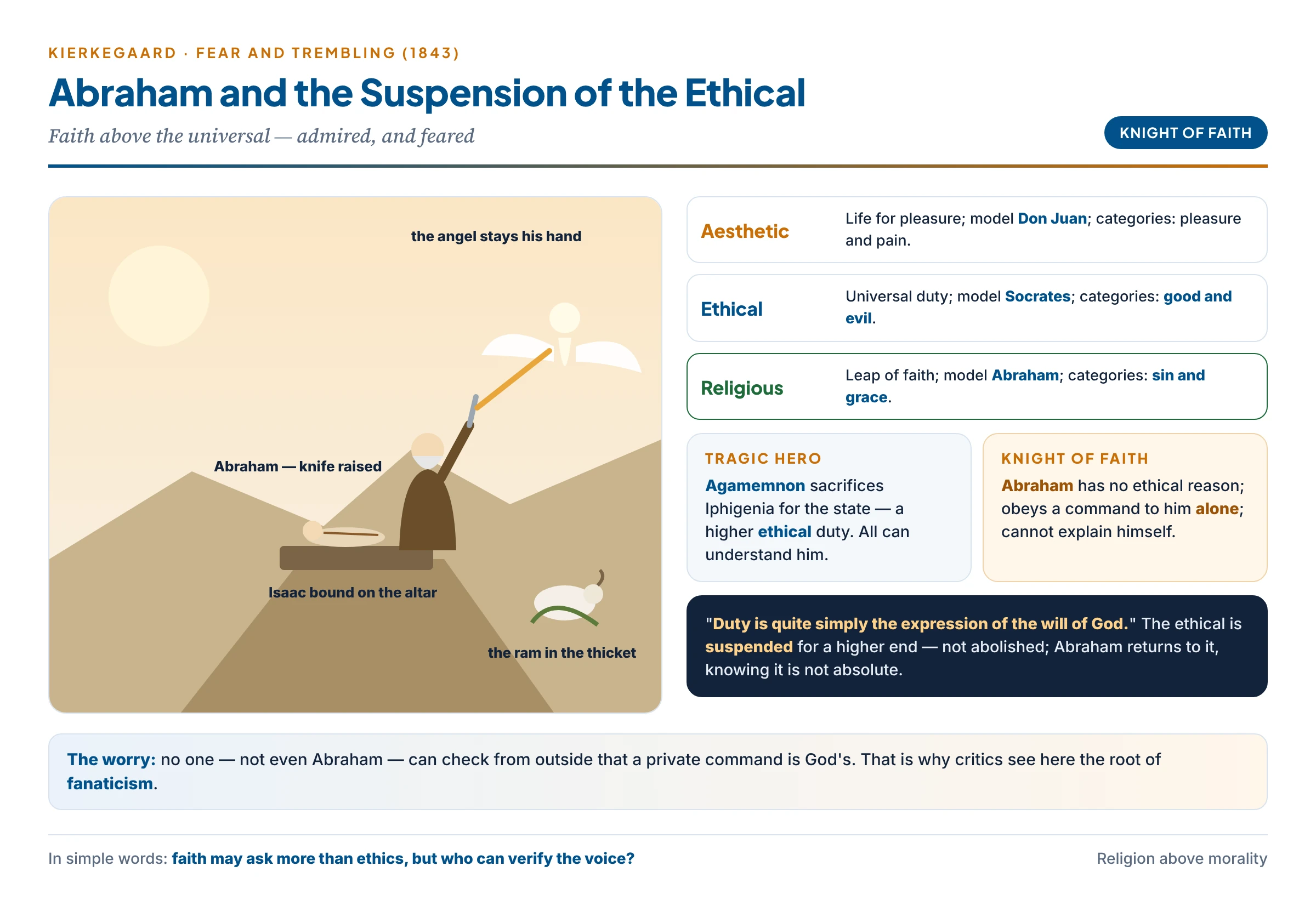
- The story. In Genesis, God commands Abraham to sacrifice his son Isaac. Abraham takes the boy to Mount Moriah, binds him and raises the knife; an angel stays his hand, and a ram is sacrificed instead. Abraham is praised as the father of faith.
- Kierkegaard’s question. In Fear and Trembling (1843), Søren Kierkegaard asks how Abraham can be admired. Ethically, a man who prepares to kill his son is a murderer. Yet faith calls him great.
- The three stages of life (spheres of existence):
- Aesthetic — life for pleasure and variety; the model is Don Juan; its categories are pleasure and pain.
- Ethical — life under universal duties; the model is Socrates, who obeyed the laws of Athens even when they condemned him unjustly; its categories are good and evil.
- Religious — life in a personal relation to God, entered by a leap of faith; the model is Abraham; its categories are sin and grace.
- Tragic hero and knight of faith.
- The tragic hero — e.g. Agamemnon, who sacrifices his daughter Iphigenia for the sake of the Greek army — gives up one ethical duty for a higher ethical duty (the good of the state). He remains within the ethical; everyone can understand and weep with him.
- The knight of faith — Abraham — has no ethical reason at all. He obeys a command addressed to him alone and by name. He cannot explain himself to his wife or anyone else; he stands alone before God.
- The teleological suspension of the ethical. For Abraham the ethical is suspended for a higher goal (telos) — fidelity to God’s command. “Duty is quite simply the expression of the will of God,” Kierkegaard writes; here “it is ethics itself which tries to prevent him from doing God’s will”.
- Not abandonment. Kierkegaard does not reject the ethical. It is suspended, not destroyed. Abraham returns to the ethical when he comes down the mountain — but now he knows the ethical is not absolute: the individual, in his relation to God, stands above the universal.
- D.Z. Phillips, a later philosopher of religion, carries this further: the religious concept of duty cannot be understood as a moral concept; to the believer, duty simply is the will of God, and there is “no difficulty in envisaging the ethical as the obstacle to duty”.
In simple words
A soldier who, in war, kills an enemy to save his country is like Kierkegaard’s tragic hero — painful, but understandable to all: one duty yields to a greater public duty. A man who says “God told me, privately, to do something everyone else would call wrong” is in Abraham’s position. Kierkegaard admires Abraham — but he also shows how terrifying such a claim is, since no one, not even Abraham, can be sure from outside that the voice was God’s.
7. Other Ways Religion Exceeds Morality
- The numinous. For Otto, the holy is first of all the numinous — the “wholly other”, awe-inspiring and fascinating — which is only later “schematised” by moral ideas such as justice and love. The religious core is non-moral, though not immoral.
- Worship and contemplation. Prayer, praise, meditation and mystical union are ends in themselves for the religious person, not means to good conduct.
- Grace and forgiveness. Religion speaks of forgiving the sinner and of love beyond desert — attitudes that go beyond the strict moral logic of reward and punishment.
- Religion without God (Unit 07) shows the reverse case: there can be religions without God that are intensely moral (Buddhism, Jainism). The two cases together show that God and morality are separable elements of religion.
Critical Evaluation
Is There Religion without Morality? — The Factual Answer
- Yes, in some forms. Magic, taboo, ritualism, antinomian sects and some cults show that religious belief and practice can exist with little or no moral content.
- But not in the higher religions. Every developed world religion contains a moral code (Ten Commandments, pañca mahāvrata, pañcaśīla, Sharia, Rehat Maryada). The cases of grace, prapatti and jīvanmukti are not lacks of morality but claims to have gone beyond the need for rules.
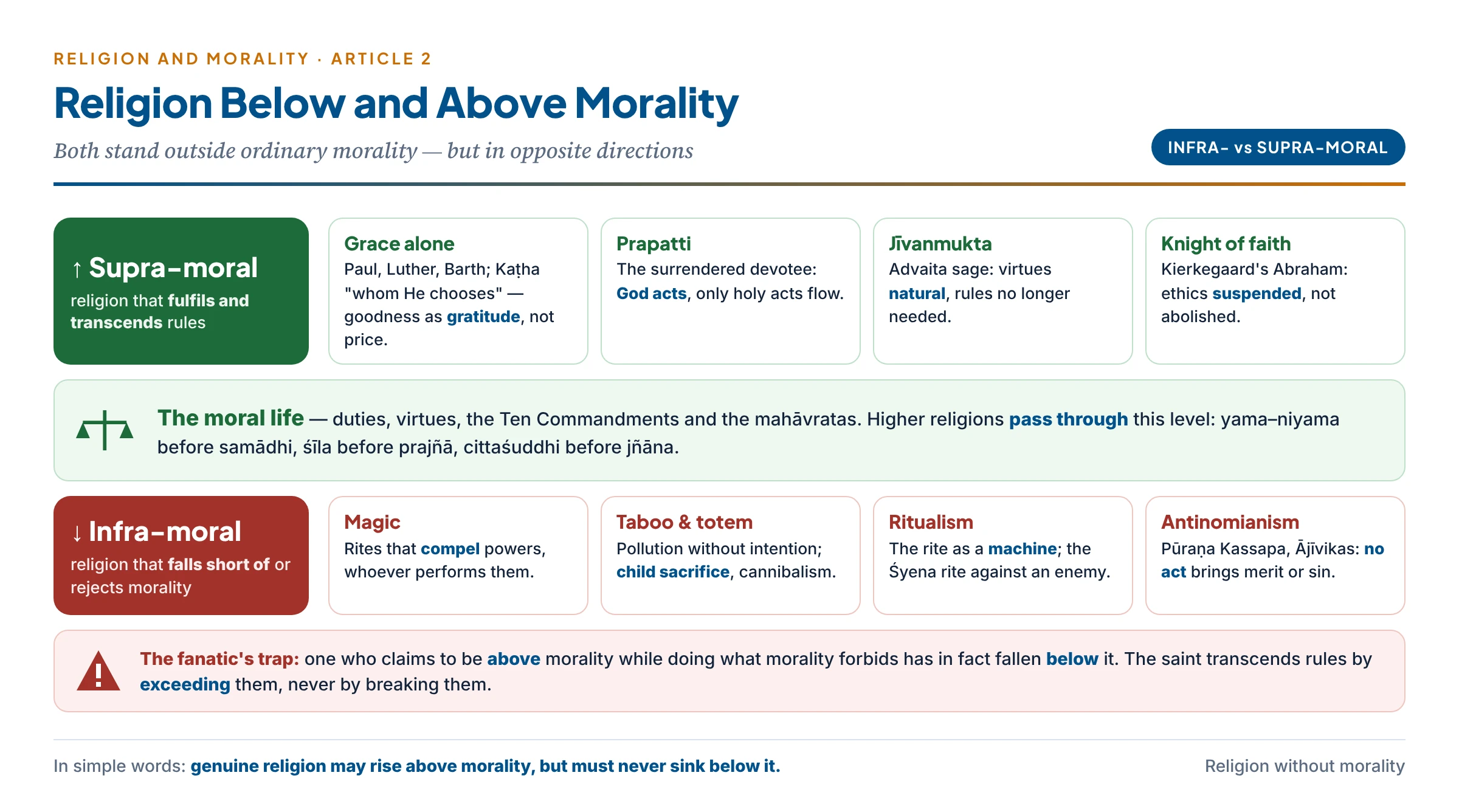
- Key distinction: religion may be infra-moral (below morality — magic, taboo, antinomianism) or supra-moral (above morality — grace, the saint, the liberated sage). Only the first is truly religion without morality; the second is religion that fulfils and transcends morality.
Is Religion without Morality Proper? — The Normative Answer
Arguments that it is improper:
- Degeneration. Religion without morality decays into superstition and magic — attempts to bribe or compel the divine.
- Danger. It can sanctify cruelty: human sacrifice, holy war, persecution, untouchability. If the commands of religion are not checked by conscience, anything can be done in God’s name.
- The nature of God. If God is holy and good, a religion that ignores goodness does not worship God at all. Otto himself admitted the numinous is properly schematised by moral ideas in the higher religions.
- Kant: whatever is done to please God beyond a good life is “religious illusion“.
- Indian reformers: Gandhi (“true religion and true morality are inseparably bound up”), Ambedkar (“morality is the essence of Dhamma”), Vivekananda (service of man as worship of God) all reject a religion that leaves conduct untouched.
Arguments that religion has a proper dimension beyond morality:
- Religion’s core is the relation to the sacred — worship, communion, liberation — which cannot be reduced to good conduct (Otto, Tillich, Schleiermacher).
- Grace and forgiveness go beyond moral desert; a religion that were only morality would have no room for mercy.
- The liberated sage shows that rule-bound morality is a stage, not the summit, of spiritual life.
Critics and Defenders
Criticism — Against religion without morality
- Kant: rites in place of a good life are counterfeit service of God.
- Hebrew prophets, the Buddha, Kabir: God desires justice and mercy, not sacrifice.
- Gandhi, Ambedkar: a religion that permits untouchability or cruelty is no true religion.
- Secular critics: Abraham’s readiness to kill shows the danger of putting faith above ethics.
- Common sense: if anyone may claim a private divine command, fanaticism cannot be checked.
Defence — For religion’s independence from mere morality
- Kierkegaard: faith is a relation to God that the universal ethical cannot contain.
- Otto, Schleiermacher: religion’s core is feeling of the holy, not moral rules.
- Barth, Luther: salvation is God’s gift, not a moral achievement.
- Advaita, Ramakrishna: the knower is beyond rules because virtue has become nature.
- Supra-moral, not immoral: these views raise morality to a higher level rather than deny it.
Cross-Tradition Comparison
| Form | Western example | Indian example | Below or above morality? |
|---|---|---|---|
| Magic and taboo | Primitive cults, totemism | Early magical rites; pollution taboos | Below |
| Ritualism | Temple sacrifice criticised by the prophets | Vedic karmakāṇḍa; the Śyena rite | Below (when cut off from conduct) |
| Antinomianism | Antinomians opposed by Luther | Pūraṇa Kassapa, Ājīvikas | Against |
| Grace alone | Paul, Luther, Calvin, Barth | Kaṭha–Muṇḍaka “whom He chooses”; Teṅkalai cat principle | Above (changes motive) |
| Beyond good and evil | Mystics’ union with God | Advaita jīvanmukta; Ālvār prapatti; Ramakrishna | Above |
| Faith above ethics | Kierkegaard’s Abraham | Arjuna told to fight by Kṛṣṇa (debated) | Above — and dangerous |
Indian Connect — Takeaways
- Indian thought, like Western, knows both directions: below morality (magic, ritualism, antinomian sects) and above it (grace, prapatti, jīvanmukti).
- But Indian traditions almost always make morality the gateway: yama–niyama before samādhi, śīla before prajñā, cittaśuddhi before jñāna. One can go beyond morality only by first going through it.
Synthesis (Siddhānta)
- Factually, there have been religions and religious attitudes without morality, mainly in early, magical and ritualistic forms, and in antinomian sects; so the strong claim that religion and morality are always inseparable is false.
- Normatively, religion without morality is improper: it degenerates into superstition and can sanctify cruelty. The higher religions themselves have condemned it through their prophets, saints and reformers.
- Yet religion is more than morality. Worship, grace, forgiveness and mystical union give religion a dimension beyond rules. The right formula is that genuine religion is supra-moral, never infra-moral — it may transcend morality but must never contradict it.
- Contemporary relevance. Claims of private divine command and of exemption from ordinary morality underlie much religious extremism. The distinction between rising above rules (the saint) and falling below them (the fanatic) is therefore not only philosophical but civic — it is the test any religion must pass in a plural, constitutional society.
“Shall we continue in sin, that grace may abound? By no means.” — St. Paul
Previous Year Questions
- 2024Can there be a religion without morality? Discuss.
- 2022“One can have morality without religion but not religion without morality.” Discuss.
- 2012“I can be moral without being religious, but I cannot be religious without being moral.” Do you agree? Give reasons for your answer.
- 2008Propriety of religion without morality. Critical notes.
- 2002“Religion without morality is empty and morality without religion is blind.” Do you agree with this contention? Give reasons in support of your view.