

Religion and Morality: Religion and Morality.
Official Syllabus: Paper II, Section B, Unit 8
Religion and morality have lived together for most of human history. The same scriptures that tell people what to believe about God, the soul and the world also tell them how to live — do not kill, do not steal, speak the truth, care for the poor. Yet the two are not the same thing. A person can be honest and kind without belonging to any religion, and history also records people who were intensely religious and cruel. The philosophical problem of this unit is therefore simple to state and hard to settle: how exactly are religion and morality related? Does morality depend on religion, does religion depend on morality, are they independent, or do they need each other? This article sets out what the two terms mean, maps every possible relation between them, explains the three ideas of autonomy, heteronomy and theonomy, examines the claim that the two are interdependent, and shows how each major religion actually grounds its ethics.
In simple words
Think of a river and its banks. Morality is like the water — the actual flow of good conduct in daily life. Religion is like the banks — it gives the water a direction, a channel and a destination. Some say the water cannot exist without the banks (morality depends on religion). Some say the banks are only there because of the water (religion grows out of morality). Some say water flows perfectly well across open land (morality is independent). And some say the river needs both — water without banks floods and spreads thin, banks without water are a dry ditch. The whole debate of this unit is a debate about this river.
Context & Problem
What Is Morality?
- Morality is our knowledge and practice of right and wrong — the principles by which we judge actions, motives and characters as good or bad, and the conduct that follows from them.
- It has three layers:
- Moral rules — “do not lie”, “keep promises”, “do not harm the innocent”.
- Moral motives — why we follow them: duty, love, fear, sympathy, hope of reward.
- Moral ideals — the goal of a good life: happiness, perfection, liberation, the good of all.
- Morality is mainly a matter of the will — it concerns what we choose to do. Philosophers call this the conative side of the mind (conation = willing and striving).
What Is Religion?
- Religion is a person’s whole response to what he takes as his ultimate concern — the reality he regards as supreme, sacred or holy (God, Brahman, Nirvāṇa, the Tao).
- Because it is a whole response, religion involves all three sides of the mind:
- Cognition (knowing) — beliefs about God, soul and world;
- Conation (willing) — a way of life, duties and vows;
- Affection (feeling) — awe, love, devotion, peace.
- Science expresses cognition most clearly, morality expresses conation, and art expresses feeling. Religion contains a little of all three — which is why it has always been found together with morality, art and science.
- The word “religion” is often traced to the Latin religare, “to bind” — religion binds its followers together into a community, and also binds the loose ends of the lower impulses within each person. Both kinds of binding are moral tasks.
From Unity to Separation
- In early civilisation, religion, art, science and morality were inseparable. The priest was also the healer, the law-giver, the astronomer and the poet; temple carvings were art, the calendar was science, the sacred law was morality.
- With the growth of thought, these activities became relatively independent of one another. Today each claims to be an autonomous discipline, with slogans such as “art for art’s sake” and “morality for morality’s sake”.
- So the modern question arises: once morality has become independent, does it still need religion at all? And can religion survive if it is cut off from morality?
In simple words
In a joint family, the grandfather once decided everything — what the family believed, how it earned, whom the children married. As the family grows, each son sets up his own household. They remain relatives, but each now manages his own affairs. Morality and religion are like two such brothers. The question is whether they are now strangers, partners, or whether one still depends on the other for its living.
Core Doctrine
1. The Map of Possible Relations
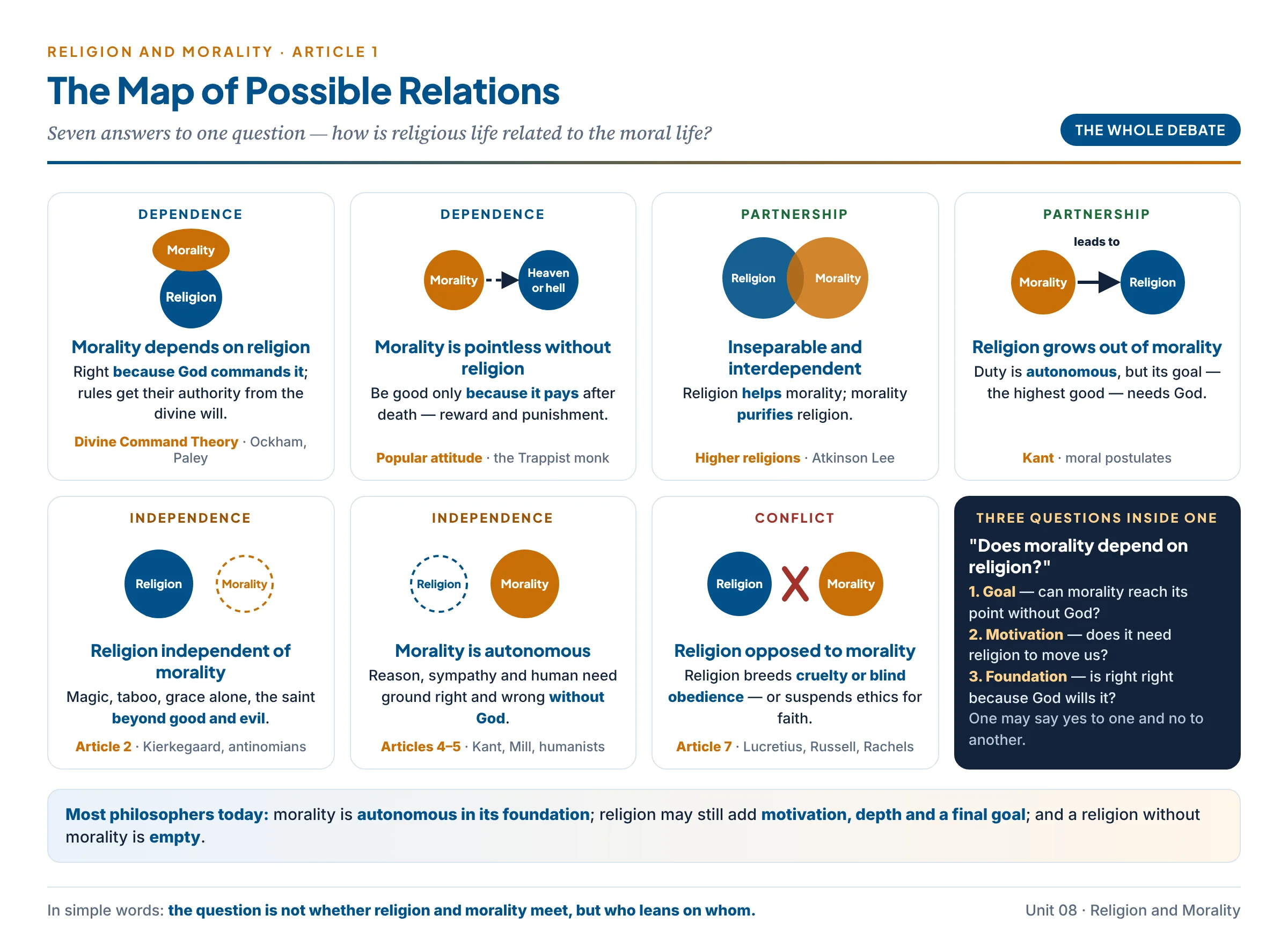
Different thinkers have answered the question in different ways. The answers can be arranged on a single map.
The four classical positions:
- Morality depends on religion (theological heteronomy). Moral rules get their existence, meaning and authority from God’s will or from religious teaching. An act is right because God commands it. This is the Divine Command Theory, held by many theists in Judaism, Christianity, Islam and some Hindu schools.
- Religion is independent of morality. Religion has its own aims — worship, ritual, salvation, union with God — which need not be moral. Primitive magic and taboo, salvation by grace alone, and the saint who goes “beyond good and evil” are examples. (Treated in Article 2.)
- Religion and morality are inseparable and interdependent. Each helps the other: religion strengthens morality, and morality purifies religion. This is the view of most higher religions and of many philosophers of religion.
- Morality is independent of religion (ethical autonomy). Moral principles are self-validating — rational and objective whether God exists or not. Since Kant this has been the accepted view of most philosophers. (Treated in Articles 4 and 5.)
A fifth position — Kant’s reversal: Religion depends on morality. Morality is autonomous, but when it is followed through to its end it leads to religion — it requires us to postulate God. Religion is not the foundation of ethics but its culmination.
Two further theses add to the map:
- Morality is pointless without religion. Moral rules are worth obeying only if God will reward the good and punish the wicked. This is not a philosopher’s theory so much as a popular attitude — like the monk who said he would leave his monastery if he stopped believing in heaven.
- Morality is opposed to religion. Religion either corrupts morality (by making people cruel or obedient) or suspends it (by demanding faith above ethics). Thinkers as different as Lucretius, Bertrand Russell and, from the religious side, Kierkegaard have argued in this direction.
2. Three Ways Morality Might Depend on Religion
“Does morality depend on religion?” is really three separate questions, and a person may answer them differently:
- Dependence of goal — Does morality need religion to reach its point? Kant thought the highest good (virtue rewarded with happiness) can be reached only if God exists. Without God, the moral life may seem to aim at something impossible.
- Dependence of motivation — Does morality need religion to move people to act? Even if we know what is right, we may lack the courage, conviction or hope to do it; religion may supply these.
- Dependence of foundation — Does morality need religion for its truth and authority? Is “murder is wrong” true because God forbids murder, or would it be true in a godless world?
- These three are independent of each other. A person may hold that morality has a secular foundation but a religious motivation, or that it can be known without religion but cannot reach its goal without God.
- Two pressures in the modern world push against dependence:
- The naturalistic temper of the age — many people do not believe in God, yet almost all believe morality matters. Belief in religion is clearly not required for belief in morality.
- The fact of religious plurality — if morality depends on religion, on which religion does it depend? A society of many faiths needs a common morality that all can share. One can opt out of a religion, but one cannot opt out of morality.
In simple words
Ask three questions about a cricket team. Why does it play? (to win the cup — the goal). What makes the players try hard? (the coach’s encouragement — the motivation). Who makes the rules? (the cricket board — the foundation). A team might need the coach for motivation without needing him to write the rules. In the same way, religion might be needed to motivate morality without being its foundation.
3. Autonomy, Heteronomy and Theonomy
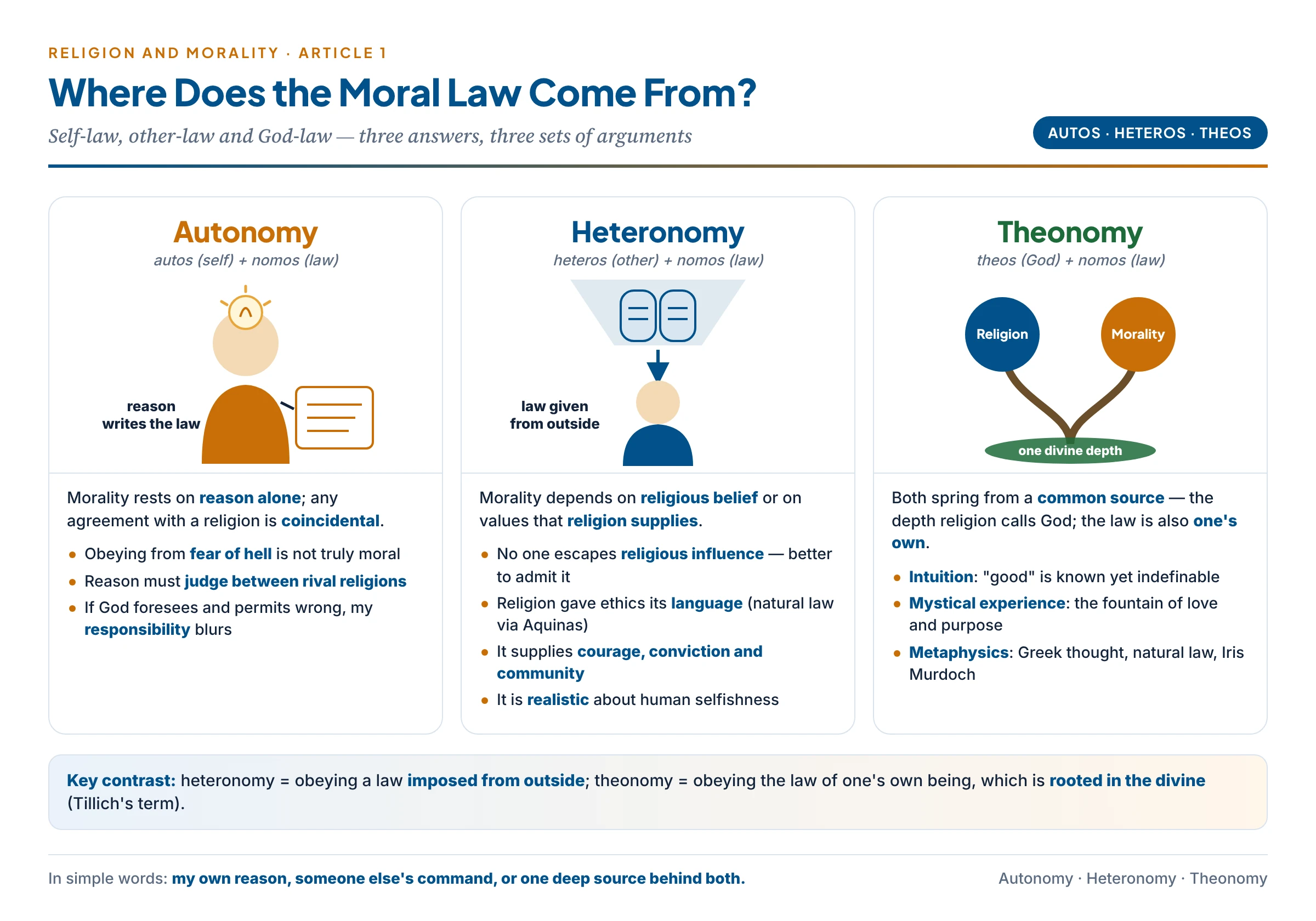
A clear way to compare the positions is to ask where moral rules come from. Three answers have Greek-derived names: autos (self), heteros (other), theos (God), and nomos (law).
Autonomy — morality from reason alone
- Morality is autonomous if it is based on reason alone, without reference to religious ideas. If its values agree with a particular religion, that agreement is coincidental.
- Arguments for autonomy:
- Freedom and rational choice. Responsible moral choice requires freedom and the ability to choose rationally. But religions promise rewards and punishments after death — heaven or hell, a higher or lower rebirth. Is someone behaving morally if he obeys only from fear of punishment?
- Reason decides between religions. Different religions, and even different sects of one religion, give different answers to moral questions. To choose between them a person must use his reason as the final judge — and that is already autonomy.
- Responsibility and divine power. If God already knows what I will do and is all-powerful, He could prevent my wrongdoing. If He does not, He seems to share responsibility — “aiding and abetting through divine negligence” — and my own moral responsibility seems to shrink.
Heteronomy — morality from religion
- Morality is heteronomous (rules coming from outside the moral agent) if it depends directly on religious belief or on values given by religion.
- Arguments for heteronomy:
- No escape from religious influence. Religious values shape everyone’s attitudes, even those who reject religion. It is better to acknowledge this influence than to deny it.
- Religion supplied the language of ethics. The moment we define “goodness” or “justice”, we use words shaped by religion. Natural law, for instance, began with Aristotle but is understood today mainly through Aquinas and the Catholic Church.
- Courage and community. Knowing what is right is one thing; having the courage to do it is another. Religion supplies conviction and a community in which values are shared and reinforced.
- A realistic view of human nature. Philosophers often assume people are reasonable. Religions know well that human beings are selfish and unreasonable, and so may guide moral choice more realistically.
Theonomy — morality and religion from a common source
- Morality is theonomous (from God, or from the divine depth of reality) if both morality and religion spring from a common source of inspiration and knowledge — a source religion calls “God”. Here morality is neither imposed from outside nor invented by the self; it expresses the deepest law of one’s own being.
- Arguments for theonomy:
- Intuition. Intuitionism was right that some things are known but cannot be defined — we have an intuitive sense of what “good” means. This intuition lies behind both religion and morality.
- Mystical experience. Moments of intuitive awareness of meaning, wholeness and acceptance give the impetus both to religious devotion and to purposeful moral action. Mystics claim that mystical consciousness is the “secret fountain of love”, and love is the only source of true moral activity — the realisation that “no man is an island“.
- Metaphysics. The rational exploration of meaning and purpose can ground morality — as in Greek thought, the natural law tradition, and in modern times Iris Murdoch‘s Metaphysics as a Guide to Morals — and is equally fundamental to religion.
Common confusion
Is “theonomy” just another word for heteronomy? No. In heteronomy the moral law comes from an outside authority — a commanding God, a book, a priest — and the agent simply obeys. In theonomy the law comes from the depth of the agent’s own being, which is grounded in the divine; obeying it is therefore also self-fulfilment. Paul Tillich used “theonomy” exactly to escape the choice between a cold self-made autonomy and an alien heteronomy.
4. Religion and Morality as Interdependent
The higher religions of the world have always remained inseparably related to morality. “Interdependent” means two things: religion helps morality, and morality, in turn, keeps refining religious demands.
(a) The same moral core across religions
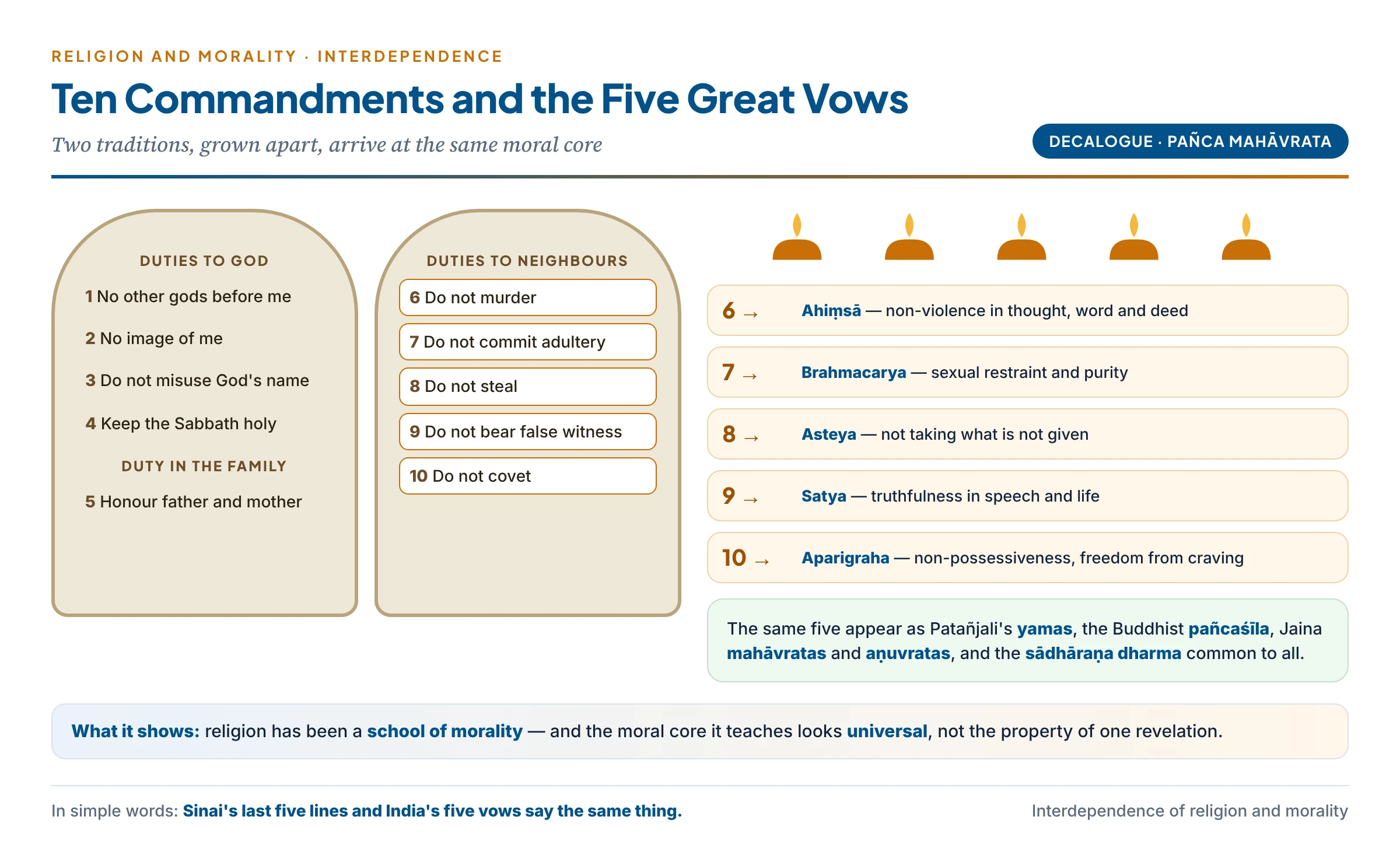
- Judaism and Christianity accept the Ten Commandments given by Yahweh:
- I am the Lord your God; you shall have no other gods before me.
- You shall not make an image of me.
- You shall not misuse the name of the Lord your God.
- Observe the Sabbath day as holy.
- Honour your father and mother.
- You shall not murder.
- You shall not commit adultery.
- You shall not steal.
- You shall not give false witness.
- You shall not covet.
- The first four concern duties to God; the last six concern duties to neighbours. Of these, the last five are virtually the same as the five great vows (pañca mahāvrata) of Jainism, which in some form are accepted by all Indian religions:
| Commandment | Indian vow | Meaning |
|---|---|---|
| You shall not murder | Ahiṃsā | non-violence |
| You shall not commit adultery | Brahmacarya | sexual restraint |
| You shall not steal | Asteya | non-stealing |
| You shall not give false witness | Satya | truthfulness |
| You shall not covet | Aparigraha | non-possessiveness |
- The very religious necessity of the Ten Commandments and the pañca mahāvrata shows that religion has helped the growth of morality.
Indian Connect — One moral core, two traditions
- The overlap between the Decalogue and the mahāvratas is striking because the two traditions grew independently. It suggests that the moral core of religion answers to something universal in human life, not to the accident of one revelation.
- In India the five vows appear as the yamas of Patañjali’s Yoga, the pañcaśīla of Buddhism, the Jaina mahāvratas for monks and aṇuvratas for householders, and the sādhāraṇa dharma (duties common to all) of the Dharmaśāstras.
(b) How religion helps morality
- Taming the aggressive impulses. Even Freud, no friend of religion, admitted that man has been able to give up many cruel and aggressive impulses “in the name of God”. The usual example given is of the head-hunting tribes of the Garo and Khasi hills, who, after embracing Christianity, gave up head-hunting and came to respect their neighbours.
- A psychological booster. Even when morality is held to be wholly autonomous, religion is not thrown away. Kant and R.B. Braithwaite both bring in God as a psychological booster of morality. Doing one’s duty is hard; so Kant recommends that duties be regarded as divine commands — not because God’s command makes them right, but because seeing them so gives the will strength.
- Interiorising morality. Religion turns external rules into inner discipline. The more morality is interiorised, the purer it becomes.
- In Christianity it is not enough to refrain from adultery: “whoever looks at a woman to lust after her has already committed adultery with her in his heart.”
- In Indian thought people are taught to overcome the inner enemies — lust, anger, infatuation and greed (kāma, krodha, moha, lobha).
- Both point to self-conquest and the culture of the soul. Hence the general rule: the higher the religion, the stricter its demand for higher morality.
- God as the guardian of values. God is said to be the conserver of all values, especially moral values — the embodiment of morality and its chief guardian. Religion places morality within a cosmic setting, gives it ultimate significance, and adds love and hope to duty.
(c) How morality refines religion
- Morality is the great purifier of religion — a phrase used by Atkinson Lee in The Groundwork of the Philosophy of Religion. Religious development has been greatly helped by the deepening of moral insight:
- Later Judaism moved away from the cruel rite of animal sacrifice; the prophets taught that the Lord is better pleased with justice, mercy and a contrite heart.
- In India, the Ṛgvedic Aryans were gradually persuaded to give up animal sacrifice and to accept the Upaniṣadic doctrine of Brahman, which taught the conquest of one’s own animal desires in place of the sacrifice of animals.
- Practices once defended in the name of religion — human sacrifice, sati, untouchability, slavery — have been abandoned largely because moral conscience condemned them.
- So the summary formula: morality is the purifier of religion, and religion is the perfection of morality.
In simple words
A garden needs both a gardener and pruning shears. Religion is like the gardener who plants, waters and gives the garden its purpose; morality is like the shears that cut away the dead and diseased branches. Without the gardener there is no garden; without the shears the garden grows wild and sick. Interdependence means the gardener uses the shears.
5. “Religion without Morality Is Empty, Morality without Religion Is Blind”
This formula (modelled on Kant’s “concepts without intuitions are empty, intuitions without concepts are blind”) states the interdependence thesis in its strongest form.
- Religion without morality is empty. A religion of ritual, belief and emotion that makes no difference to conduct is hollow. Rituals that leave the worshipper cruel, dishonest or proud have no religious worth. Gandhi went further: a religion that permits untouchability is no true religion at all.
- Morality without religion is blind. Morality cut off from any vision of the meaning and goal of life may know its rules but not why they finally matter, and may lack hope when goodness goes unrewarded. Kant’s argument that morality must postulate God and immortality is one form of this claim.
- Assessment:
- The first half is widely accepted — even by most religious thinkers. Every great religion condemns hollow ritual (the Hebrew prophets, the Upaniṣads’ critique of sacrifice, the Buddha’s rejection of rites, Kabir’s mockery of empty worship).
- The second half is disputed. Secular moralists reply that morality sees perfectly well by the light of reason, sympathy and human need (Article 5). Whether it can also see its final point without religion is the real question.
- The two related PYQ sayings — “one can have morality without religion but not religion without morality” and “I can be moral without being religious, but I cannot be religious without being moral” — accept the first half and deny the second. They express the modern consensus: morality is necessary to religion, but religion is not necessary to morality.
Common confusion
If one can be moral without being religious, does it follow that religion adds nothing to morality? No. Saying morality is possible without religion is a claim about its foundation. It leaves open whether religion adds motivation (courage, hope, community), depth (interior purity, love beyond duty) or a final goal (the highest good). Most thoughtful versions of the saying admit that religion can enrich a morality that does not depend on it.
6. How Religions Ground Their Ethics
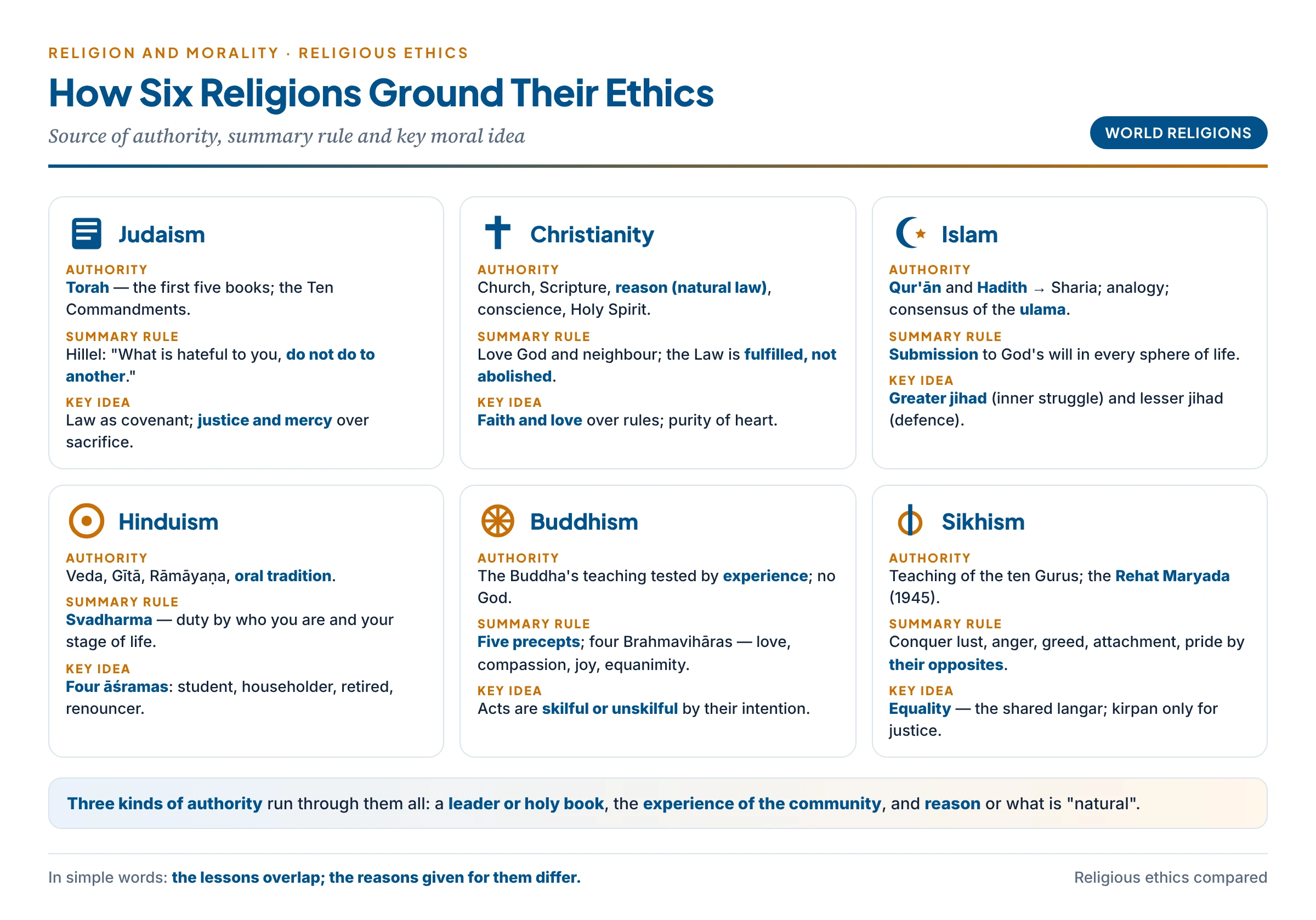
The moral choices people make, and the values they express, depend — consciously or unconsciously — on their understanding of the nature of the world and the place of humanity within it. These are exactly the things with which religions are concerned. Each religion:
- presents a particular view of the world;
- promotes a set of values by which its followers should live;
- gives specific advice on how to live — either rules to be followed or attitudes to be cultivated.
Religious rules or values may rest on three kinds of authority:
- the authority of a religious leader or holy book;
- the cumulative experience of the religious community;
- rational thought, or an understanding of what is “natural“.
Religious values influence society as a whole, not just believers. Everyone who lives within Western culture is shaped by Christian ideas, because they pervade habitual thinking; the same is true of a person living in a predominantly Hindu, Muslim, Jewish, Sikh or Buddhist society. People’s assumptions about life usually reflect their religious background — or a deliberate reaction against it.
(a) Judaism
- Jewish morality is based on the Torah (“teaching” or “law”), the first five books of the Hebrew Bible, which contains many rules for ethical and social life.
- The most famous are the Ten Commandments.
- Rabbi Hillel (first century BCE) summed up the whole Torah in a form of the Golden Rule: “What is hateful to you, do not do to another.” The rest, he said, is commentary.
(b) Christianity
- Christianity grew out of Judaism and accepts the Ten Commandments and the Torah as scripture, but interprets them through the life and teaching of Jesus.
- Jesus set aside detailed requirements of the Law while insisting that he came not to abolish the Law but to fulfil it — which gives Christian morality interpretative flexibility.
- Christianity emphasises faith in God and in Christ, and love, rather than obedience to rules as the basis of life; it is therefore less rule-based than Judaism even where it shares the same values.
- Sources of authority vary between denominations:
- the authority of the Church (believed to be guided by the Holy Spirit), including the Pope;
- the authority of the Scriptures;
- human reason, used in applying a natural law basis for morality;
- conscience;
- the direct inspiration of the Holy Spirit.
- The plurality of sources matters: at the Reformation, the authority of the Church was challenged by the authority of Scripture; today reason and conscience are used to re-examine old teaching in changing circumstances.
(c) Islam
- “Islam” means submission. Muslims hold that everything in the world submits naturally to God, the source of life; human beings alone can choose to submit or refuse. Hence the belief that every child is born a Muslim (in natural submission), and only later may adopt another faith or none.
- God revealed His will through many prophets, finally through Muhammad. Two written sources:
- the Qur’ān — the revelation of God’s will, received by Muhammad in visionary experiences and recited (tradition holds that he was unlettered);
- the Hadith — the recorded sayings and deeds of the Prophet.
- Together these form the basis of the Sharia (“path”) — a law created by God that governs everything, from the movement of planets to the details of human conduct. It expresses the unity of God (tawḥīd) and forms not only an ethical system and legal framework but a whole way of life.
- Applying Sharia to new situations, Muslims use analogy (qiyās) — linking a present issue to a decision in the Qur’ān or Hadith. Where doubt remains, an assembly of scholars (ulama) reaches a decision; since the community is believed never to agree on what is wrong, such consensus is authoritative.
- Jihad (striving) has two forms:
- the greater jihad — the inner struggle every Muslim must wage to overcome his or her own faults;
- the lesser jihad — the duty to defend the faith and the community against external threat.
(d) Hinduism
- “Hinduism” names a variety of traditions of the Indian subcontinent. Scriptures such as the Rāmāyaṇa and the Bhagavad Gītā are widely used, but there is no single way of interpreting them; many Hindus rely on oral tradition.
- Dharma — “right conduct” or “duty” — determines what is morally right. One’s particular dharma (svadharma) depends on who one is and the stage of life one has reached.
- The four āśramas (stages of life), each with its duties:
- Student (brahmacārin) — hard work, respect for parents and teachers, self-discipline; abstaining from sex, alcohol, tobacco and drugs.
- Householder (gṛhastha) — marriage, family and career; the social rules are most lenient at this stage.
- Retired (vānaprastha) — traditionally from the arrival of a grandchild, husband and wife step back from family and business concerns and hand over control to the next generation.
- Ascetic (saṃnyāsin) — a few, in their last years, give up all possessions to devote themselves to religion; most remain in the retired stage with their families.
- Hinduism recognises that different people have different abilities and responsibilities — morality is graded to station and stage. (Its classical foundations — Ṛta, Dharma and Karma — are taken up in Article 8.)
(e) Buddhism
- Unlike most religions, Buddhism is not based on belief in God; it offers a practical path of spiritual development.
- The aim is to overcome the suffering caused by greed, hatred and delusion (the “three poisons”) and to grow towards peace, joy and insight.
- Karma: all ethically significant actions have consequences. What you do today shapes the person you become tomorrow — not because of an externally imposed law, but because actions have their natural consequences.
- The five precepts (pañcaśīla), undertaken by all committed Buddhists:
- Not to destroy life — avoiding killing, and for many Buddhists a vegetarian diet; also avoiding negative, denigrating attitudes and cultivating mettā (loving-kindness).
- Not to take what is not given — avoiding dishonesty and the craving for material goods; cultivating generosity.
- Not to indulge in harmful sexual activity — sexuality should not harm people; Buddhism is generally liberal and positive about sex, and the precept is sometimes widened to mean not over-indulging any sense.
- Not to speak falsely — no lying, and nothing that deliberately gives a false impression.
- Not to take what clouds the mind — avoiding alcohol and drugs so as to stay alert and sensitive; but, unlike Islam, there is no absolute prohibition.
- The four Brahmavihāras (“divine abodes”), mental states to be cultivated:
- Love (mettā) towards all creatures, oneself included;
- Compassion (karuṇā) for all who suffer;
- Sympathetic joy (muditā) — unselfish sharing in others’ happiness;
- Equanimity (upekkhā) — freedom from anxiety about success and failure; even-mindedness towards others.
- “Skilful”, not “good”: Buddhists judge actions as skilful (kusala) or unskilful (akusala) rather than right or wrong. An action is skilful if it comes from insight and loving-kindness, unskilful if it comes from ignorance, greed or hatred — so it is judged by the intention behind it, not by an external absolute, and its unskilfulness shows both in the act and its results.
- Adaptability: Buddhism has adapted freely as it moved from culture to culture — Theravāda in Sri Lanka and Thailand differs greatly from Tibetan or Japanese Buddhism — using “skilful means” to apply the teaching to each society. It values the lineage of teachers, but is essentially a process of self-examination, offering general principles and virtues rather than narrowly defined rules. The exception is the monastic discipline, voluntarily accepted, which is itself only a means to practise the dharma.
(f) Sikhism
- Sikhs believe that, without the inspiration of devotion to God, people live in illusion and are ruled by five evil impulses — lust, anger, greed, attachment and pride. They must cultivate the opposites — self-control, forgiveness, contentment, love of God and humility.
- Practical guidance is set out in the Rehat Maryada (A Guide to the Sikh Way of Life, 1945), prepared by Sikh scholars as an authoritative summary of the teaching of the ten Gurus.
- The community emphasises equality: every gurdwara has a kitchen (langar) where all sit and eat together.
- Members of the Khalsa carry a sword (kirpan), to be used only in self-defence or to re-establish justice when all peaceful means have failed.
In simple words
Six schools teaching the same subject (good conduct) with different textbooks. In one, the textbook is a law book (Torah, Sharia); in another, it is the life of a teacher to be imitated (Christ, the Buddha, the Gurus); in a third, it is a duty chart that depends on your class and age (dharma and āśrama). The lessons overlap a great deal — do not kill, do not steal, speak the truth, share with others — but why a student should learn them is explained differently in each.
7. Religion and Moral Behaviour Today
- Belief and morality in public opinion. A 2019 survey across 34 countries found a median of 45% saying it is necessary to believe in God to be moral and have good values; in India the figure was 79%. A 2025 survey of 25 countries found that the share had fallen in many countries (for example to 21% in Germany) but risen in India to 85% — among the highest anywhere.
- What this shows. In most of Europe, morality is widely felt to be independent of religion; in India, Indonesia, Kenya and similar societies, religion and morality are felt to be inseparable. The philosophical debate is therefore not academic: it shapes how people in different societies justify their values.
- Influence is real but two-sided. Religion can promote honesty, charity, self-control and service (sewa, zakat, dāna); it can also be used to justify exclusion and violence. Whether religious beliefs are compatible with moral behaviour is examined in Article 6.
Critical Evaluation
Assessing the Interdependence Thesis
Strengths:
- It fits history: no major religion lacks a moral code, and moral reform has repeatedly come from within religions (the prophets, the Buddha, Kabir, Guru Nanak, Gandhi).
- It explains why religious believers experience moral duties as sacred and not merely useful.
- It allows for criticism in both directions — religion can correct a shallow morality, and morality can correct a cruel religion.
Weaknesses:
- Unequal partners. If morality is the judge that purifies religion, morality seems to be the senior partner — which is really the autonomy thesis.
- Counter-examples. There are religions (or religious moments) without morality and moral lives without religion; “inseparable” is therefore too strong as a factual claim.
- Vagueness. “Religion” and “morality” mean different things to different people; sweeping claims that they are necessarily united — or necessarily opposed — should be regarded with suspicion.
Critics and Defenders
Criticism — Critics of the dependence and interdependence theses
- Kant: morality is binding by reason alone; acting from fear of hell or hope of heaven has no moral worth.
- Freud: morality must be separated from religion, or it will fall when religion’s myths fall.
- Secular moralists (Mill, Rawls, humanists): sympathy, utility and fairness ground morality without God.
- Russell, Lucretius: religion has produced as much cruelty as virtue.
- Rachels: total obedience to God is incompatible with being an autonomous moral agent.
Defence — Defenders of interdependence
- A widely shared view in Indian philosophy of religion: religion and morality must go together, refining, criticising and sublimating one another.
- Kant himself advised treating duties as divine commands for strength of will.
- Heteronomy argument: religion supplied the language, community and courage of ethics.
- Theonomy (Tillich): both spring from one depth, so neither is alien to the other.
- History: Ten Commandments and mahāvratas show religion as a school of morality.
Cross-Tradition Comparison
| Question | Western tradition | Indian tradition |
|---|---|---|
| Source of moral law | God’s command (Torah, Sharia) or reason (Kant) | Dharma rooted in cosmic order (Ṛta), known through the Veda; or reason and experience (Buddhism, Jainism) |
| Role of God | Lawgiver and judge | Often guardian or dispenser of fruits (Nyāya), sometimes none (Mīmāṃsā, Buddhism, Jainism) |
| Core rules | Ten Commandments | Pañca mahāvrata, yama, pañcaśīla, sādhāraṇa dharma |
| Inner discipline | Purity of heart, love | Conquest of kāma, krodha, lobha, moha; cittaśuddhi |
| Graded duties | Mostly universal | Svadharma by varṇa and āśrama |
| Goal | Salvation, beatific vision | Mokṣa, Nirvāṇa, Kaivalya |
Indian Connect — Takeaways
- Indian thought rarely makes morality depend on a divine command: dharma is an order that even the gods uphold, and in several schools morality works without any God at all. This makes the Indian tradition a natural ally of the autonomy thesis and of the interdependence thesis at the same time.
- At the same time, Indian religions treat moral discipline as the first step of spiritual life (yama and niyama in Yoga, śīla in Buddhism, the vows in Jainism) — morality is the gateway to religion, not its rival.
Synthesis (Siddhānta)
- The best-supported view is a qualified interdependence: morality has its own foundation in reason, sympathy and human need, so it is possible without religion; but religion can give morality depth (interior purity, love beyond duty), strength (courage, community, hope) and a final horizon (the meaning of the moral life as a whole).
- Religion, on the other hand, cannot do without morality. A religion that ignores or violates morality is empty, and history shows that morality has repeatedly purified religion of cruel practices.
- Different senses of dependence must be kept apart. Morality may be independent of religion in its foundation while still benefiting from it in motivation and goal — this resolves most of the apparent conflict between the autonomy and interdependence theses.
- Contemporary relevance. In plural societies such as India, a common constitutional morality must be shared by believers of all faiths and by non-believers, while each religion remains free to ground and deepen that morality in its own way. The task is not to choose between religion and morality, but to let them keep refining, criticising and sublimating each other.
“What is hateful to you, do not do to another. That is the whole Torah; the rest is commentary.” — Rabbi Hillel
Previous Year Questions
- 2026How does the issue of moral autonomy conflict with conception of religion as a source of morality? Critically discuss.
- 2023Does religion influence the moral behaviour? Explain the interactive relation between religion and morality.
- 2022“One can have morality without religion but not religion without morality.” Discuss.
- 2021Do you consider that religion and morality are inseparable? Give reasons for your answer.
- 2012“I can be moral without being religious, but I cannot be religious without being moral.” Do you agree? Give reasons for your answer.
- 2002“Religion without morality is empty and morality without religion is blind.” Do you agree with this contention? Give reasons in support of your view.
- 2001There are two incompatible views regarding the relationship between religion and morality. According to one view, morality requires some divine transcendental source in order that it is binding and objective. The second view argues in favour of purely secular morality, based entirely on human reason. Which one of these two views is correct in your opinion and why? Discuss.
- 2000Religion and Morality. Short note.