

Religion without God.
Official Syllabus: Paper II, Section B, Unit 7
The Western religions of humanity (Article 7) replaced God with society or Humanity. A second family of modern thinkers went further: they tried to keep the religious attitude itself — awe, reverence, ultimate commitment, the sense of the sacred — while giving up belief in a supernatural God. Spinoza identified God with Nature; Einstein spoke of a “cosmic religious feeling“; Julian Huxley wrote Religion without Revelation and preached an evolutionary humanism; John Dewey distinguished “a religion” from the “religious” quality of experience; Paul Tillich made religion a matter of ultimate concern; non-realists such as Braithwaite and Don Cupitt read religious language as guidance for living rather than description of a world beyond. The most recent and most systematic statement is Ronald Dworkin‘s Religion without God (2013), which argues that “religion is deeper than God” and that an atheist can be genuinely religious. This article studies these thinkers, the authority of absolute values without God, the critiques, and closes with a synthesis of the whole unit.
In simple words
Two people stand at the rim of the Grand Canyon at sunset. One whispers, “How great is God, who made this!” The other, an atheist, is silent — but she too is overwhelmed, feels small, feels that this beauty matters and must not be destroyed, and goes home resolved to live better. Dworkin asks: are these two really so different? Both feel awe, both sense value that is not just their own opinion, both feel responsible. The first adds a belief about who made the canyon. The religious attitude — he says — is what they share.
Context & Problem
Keeping the Religious Attitude without the Supernatural
- The modern dilemma. Science made the supernatural — miracles, a God who intervenes, life after death — hard for many to believe. Yet many such people did not feel irreligious. They felt awe before nature, reverence for life, an unconditional demand to live well.
- Five routes.
- Naturalist — the sacred is Nature itself (Spinoza, Einstein, Huxley).
- Pragmatist — “religious” is a quality of experience, not a set of beliefs (Dewey).
- Theological redefinition — religion is ultimate concern; God is “beyond” the God of theism (Tillich); the numinous comes before any idea of a personal God (Otto).
- Linguistic non-realism — religious statements express commitments and ways of life, not facts about a world beyond (Randall, Braithwaite, Santayana, Phillips, Cupitt).
- Value realism — the religious attitude is belief in the objective reality of value, which theists and atheists can share (Dworkin).
- The question. Are these genuine religions without God — or philosophies that borrow religion’s vocabulary?
Core Doctrine
1. Spinoza: God or Nature
- One substance. Spinoza (1632–1677) held that there is only one infinite substance, which he called “God or Nature” (Deus sive Natura). Everything that exists is a mode of this one substance; “whatever is, is in God” (Paper I, Rationalism unit).
- No personal God. Spinoza’s God has no will, no purposes, no emotions; it does not create by choice, perform miracles, reward or punish. Everything follows from its nature with necessity, as the properties of a triangle follow from its definition.
- A religion of understanding. The highest human good is the “intellectual love of God” (amor Dei intellectualis) — the joy of understanding everything as part of the one, necessary whole. This love brings freedom from fear and passion and a kind of eternity of the mind.
- Atheist or “God-intoxicated”? His contemporaries condemned him as an atheist; the poet Novalis called him “a God-intoxicated man“. Both are partly right: Spinoza rejected the personal God of theism while making reverence for Nature the centre of a contemplative religious life — a model for later religious naturalism.
In simple words
Every wave on the ocean thinks of itself as separate — rising, falling, afraid of breaking on the shore. Spinoza says each of us is such a wave, and the ocean is God-or-Nature. Understanding that we are the ocean’s waves does not save us from breaking — but it frees us from fear, and that understanding, loved, is Spinoza’s whole religion.
2. Einstein: The Cosmic Religious Feeling
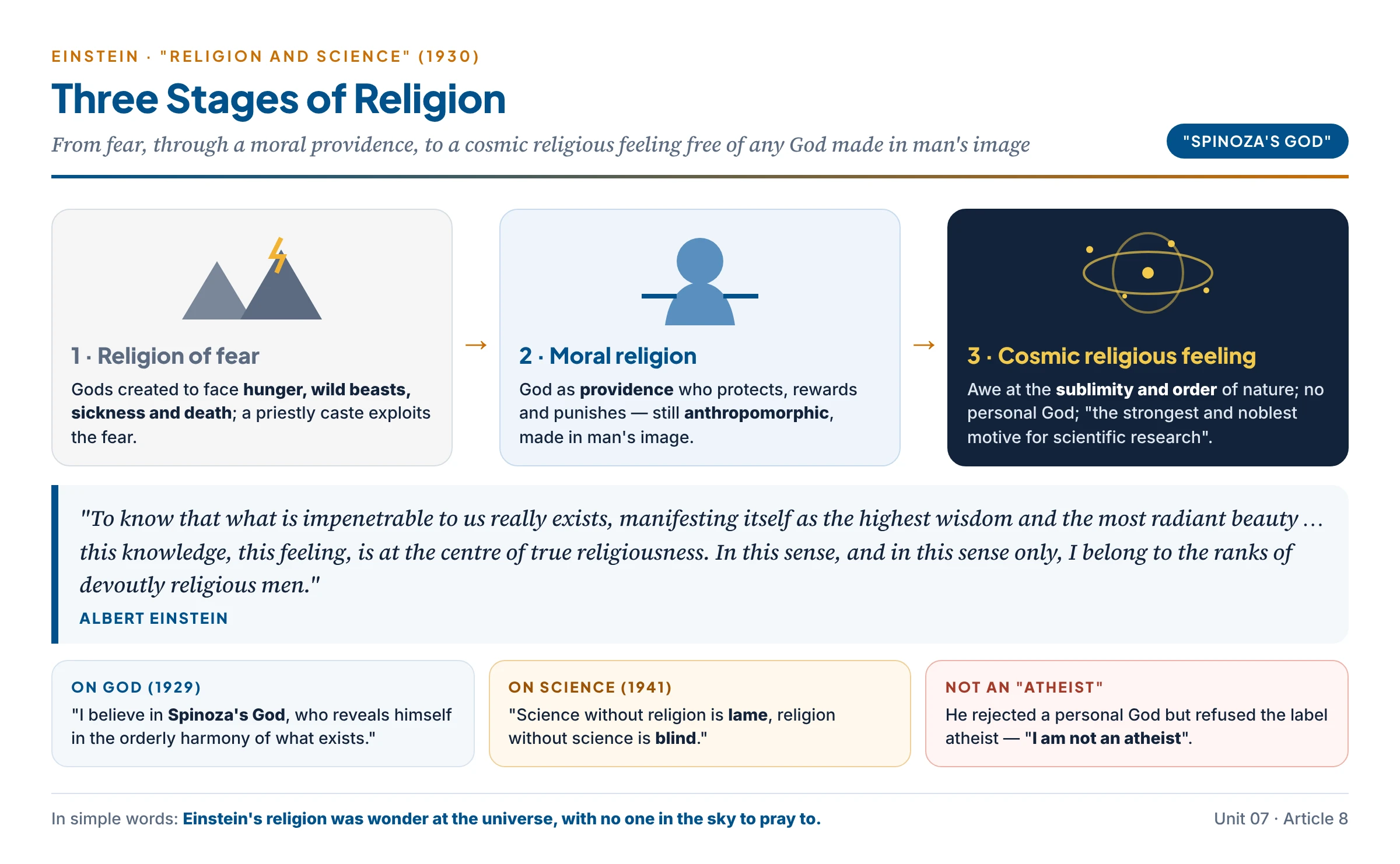
- Three stages of religion. In “Religion and Science” (1930), Albert Einstein described:
- The religion of fear — primitive people create gods to cope with hunger, wild beasts, sickness and death; a priestly class exploits this fear.
- The social or moral religion — God as providence, who protects, rewards and punishes; admirably illustrated in the Jewish scriptures and the New Testament, but marked by an anthropomorphic (human-like) idea of God.
- The cosmic religious feeling — free of any God made in man’s image; the individual feels the futility of human desires and the sublimity and marvellous order revealed in nature and in thought, and wishes to experience the universe as a single significant whole. Democritus, St Francis and Spinoza, he said, had it; it is “the strongest and noblest motive for scientific research“.
- His creed. “To know that what is impenetrable to us really exists, manifesting itself as the highest wisdom and the most radiant beauty which our dull faculties can comprehend only in their most primitive forms — this knowledge, this feeling, is at the centre of true religiousness. In this sense, and in this sense only, I belong to the ranks of devoutly religious men.“
- Spinoza’s God. Asked whether he believed in God, Einstein replied (1929): “I believe in Spinoza’s God who reveals himself in the orderly harmony of what exists, not in a God who concerns himself with the fates and actions of human beings.”
- Science and religion. “Science without religion is lame, religion without science is blind” (1941) — science tells us what is; religion, for Einstein, concerns what should be and the reverence that drives inquiry.
Common confusion
Was Einstein an atheist? Dworkin and many others call Einstein a “religious atheist“, since he rejected a personal God who answers prayers, rewards and punishes. But Einstein himself refused the label “atheist”: “I am not an atheist,” he told an interviewer, adding that the problem of God was “too vast for our limited minds”; he preferred to call himself an agnostic or a “religious non-believer”. So the precise statement is: Einstein denied a personal God, believed in “Spinoza’s God” — the order of nature — and had a deep cosmic religious feeling.
3. Julian Huxley: Religion without Revelation
- The man. Julian Huxley (1887–1975), evolutionary biologist, grandson of T.H. Huxley (Article 2), first Director-General of UNESCO (1946), wrote Religion without Revelation (1927; revised 1957).
- The essence of religion — a sense of sacredness. Huxley wrote: “Somewhere at the root of every religion there lies a sense of sacredness; certain things, events, ideals, beings are felt as mysterious and sacred. Somewhere, too, in every religion is a sense of dependence … And, finally, into every religion there enters a desire for explanation and comprehension.” The sense of sacredness, he held, is irreducible — like hunger or love — and needs no revelation to justify it.
- Religion as a human function. Religion is not imposed from outside by a revealing God; it is a human activity — a kind of organ that humanity has evolved for dealing with the ultimate problems of its destiny, and it should be improved by the methods of science like any other human institution.
- Against an external God. “This question of God or no God, external Power or no external Power … is fundamental. … Once we have rid ourselves of this doctrine of a Divine Power external to ourselves, we can get busy with the real task of dealing with our inner forces.“
- Evolutionary humanism.
- Evolution has produced, in human beings, a creature through whom evolution becomes conscious of itself.
- Humanity’s religious task is to guide the further evolution of life and mind — to realise human possibilities in knowledge, beauty, love and cooperation.
- He coined “transhumanism” (1957) for humanity’s effort to transcend itself by realising its potential.
- A naturalistic Trinity. Huxley reinterpreted Christian language: God the Father is the forces of non-human nature; God the Holy Spirit is the ideals for which human beings strive at their best; God the Son is human nature itself, using the forces of nature in pursuit of those ideals — and the “unity” of the three is the unity of nature.
- The theistic reply. Critics said this leaves religion “little more than a sentiment of sacredness“: a human spirit able to unify only a tiny part of the world demands a Mind for which the vast whole exists — and Huxley’s religion, confined to each individual and dying with him, offers no relation with anything beyond the self.
4. John Dewey: “A Religion” and “the Religious”
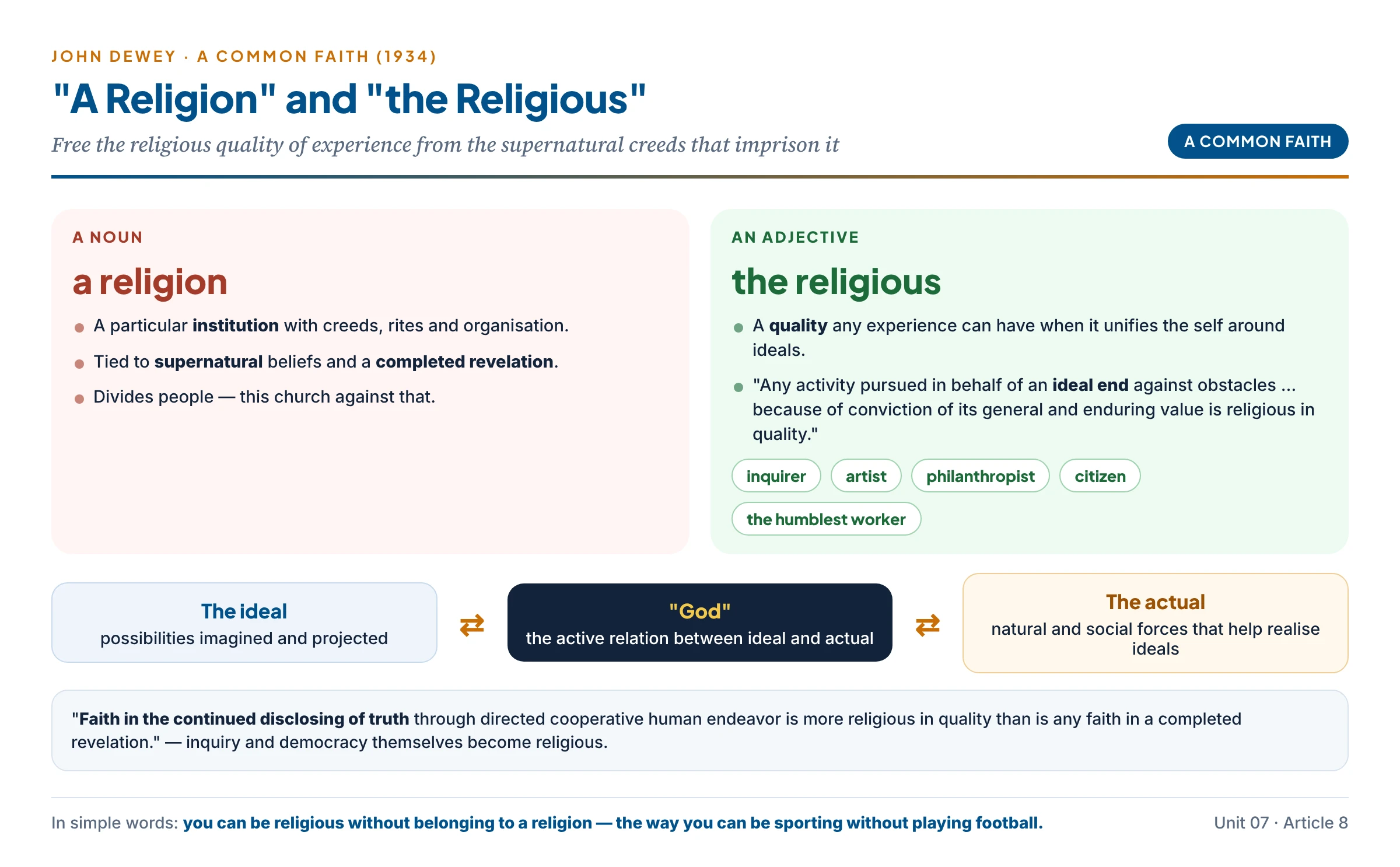
- The distinction. In A Common Faith (1934), John Dewey (1859–1952) separated:
- A religion (a noun) — a particular institution with creeds, supernatural beliefs and an organisation;
- The religious (an adjective) — a quality that any experience can have when it unifies the self around ideals.
- What makes an experience religious. “Any activity pursued in behalf of an ideal end against obstacles and in spite of threats of personal loss because of conviction of its general and enduring value is religious in quality. Many a person, inquirer, artist, philanthropist, citizen, men and women in the humblest walks of life, have achieved, without presumption and without display, such unification of themselves.”
- God redefined. The word “God” can name “the active relation between ideal and actual” — the union of our ideal possibilities with the natural and social forces that help realise them. God is not a being outside nature but the ideal working in nature and society.
- Faith redefined. “Faith in the continued disclosing of truth through directed cooperative human endeavor is more religious in quality than is any faith in a completed revelation.” Dewey thus makes scientific inquiry and democratic cooperation themselves religious.
- Freeing the religious from religion. The religious quality has been imprisoned by supernatural creeds; freed from them, it can be shared by all — a “common faith“.
- A related view. The American theologian Henry Nelson Wieman defined God naturalistically as “that interaction between individuals, groups and ages which generates and promotes the greatest possible mutuality of good“. Asked whether men can pray to an interaction, he replied that this is what they always pray to, under any concept of God — though critics noted that the personal God is completely lost.
In simple words
“Football” is a thing — teams, leagues, stadiums. “Sporting” is a quality — fairness, effort, grace under pressure — which you can show in football, in a classroom or in a hospital. Dewey says “a religion” is like football — a particular institution; “religious” is like “sporting” — a quality that a scientist, an artist or a nurse can have without belonging to any church or believing in any God.
5. Tillich and Otto: The Sacred before and beyond the God of Theism
- Tillich’s ultimate concern. “Religion is the state of being grasped by an ultimate concern, a concern which qualifies all other concerns as preliminary and which itself contains the answer to the question of the meaning of our life.” Whatever demands unconditional commitment and promises ultimate meaning — whether nirvāṇa, human liberation or cosmic truth — is religious.
- “Whatever concerns a man ultimately becomes god for him.” God is not first a being and then an object of concern; “God” is the name for what concerns us ultimately. Making a preliminary concern (nation, success, wealth) ultimate is idolatry.
- The God above God. Tillich, himself a Christian theologian, spoke of “the God above the God of theism” — the ground of being that appears when the God of ordinary theism has vanished in doubt. This opens a way to religion after the personal God.
- Hick’s criticism. “Ultimate concern” is ambiguous — it may mean an attitude of concern or the object of that attitude. If it means only the attitude, faith can operate “whether God be a reality or not” — religion becomes an autonomous function of the mind, close to naturalism.
- Otto’s numinous. The essence of religion is the experience of the numinous — the holy as mysterium tremendum et fascinans, a non-rational, primordial category. The experience of the Holy comes before the intellectual concept of a personal creator; the personal God is one way of interpreting it (Unit 06).
- The Sacred and the Holy as the object of religion. “Sacred” and “Holy” have become generic names for the object of religion because they cover all its forms — God, Brahman, nirvāṇa, the Tao, the totem, the moral law.
- Can God be the object of religion? Yes — God is the theistic form of the Holy, the one in which the sacred is experienced as a personal Thou.
- Must God be the object? No — the Holy is wider than God; in Buddhism and Advaita it is impersonal, and for Durkheim it is a social power.
- So God is one object of religion among others — the most common, not the only one.
6. Non-realist Religion: Religious Language as Guidance for Life
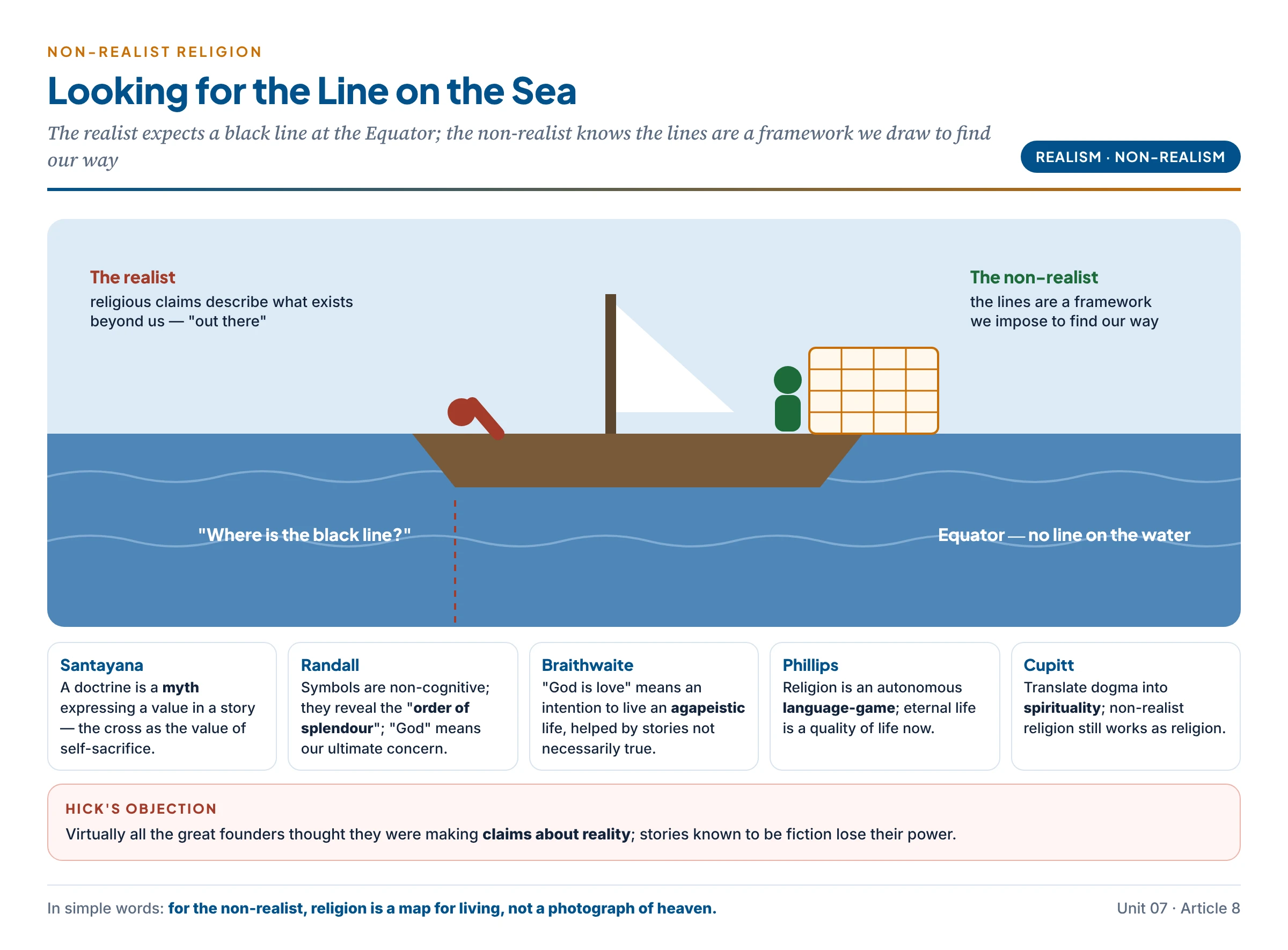
- Realism and non-realism.
- Religious realists — the large majority of believers — hold that their beliefs are about what really exists independently of human beings: a claim about Allah, Brahman, salvation or rebirth is true if there is an actual referent for it.
- Religious non-realists — a minority — hold that religious claims are not about realities beyond human language and culture; they are human creations that guide how we live.
- Don Cupitt’s image. A leading non-realist, the English theologian Don Cupitt (Taking Leave of God, 1980; founder of the “Sea of Faith” network), wrote: “Today, a realist is the sort of person who, when his ship crosses the Equator, looks overboard, expecting to see a big black line across the ocean. Realism tries to turn cultural fictions into objective facts. A non-realist sees the whole system of lines of latitude and longitude as a framework, imposed upon the Earth by us, that helps us to define locations and to find our way around.”
- What non-realist religion does.
- It recognises that all religious and ethical ideas are human, with a human history.
- It gives up the old metaphysical way of understanding belief and translates dogma into spirituality — a religious lifestyle.
- It understands doctrines in practical terms, as guiding myths to live by, in the way that Kant, Kierkegaard and Bultmann began to map out.
- It gives up a supernatural world-beyond — yet insists that non-realist religion can work very well as religion, and can deliver “eternal happiness“.
- Varieties.
- George Santayana (Reason in Religion, 1905): a religious doctrine is a myth that expresses an evaluation in the form of a picture or story — the story of Christ’s self-sacrificing death expresses the value of self-sacrifice more powerfully than a moral rule.
- J.H. Randall: religious symbols are non-cognitive; they arouse emotion and action, bind a community, communicate qualities of experience, and reveal “the order of splendour” — the religious dimension of the world. “God” is “our ideals, our controlling values, our ultimate concern”.
- R.B. Braithwaite (1955): a religious assertion is a declaration of intention to follow a policy of life — “God is love” means “I intend to live an agapeistic (loving) life”. Religions with the same policy (say, Christianity and Buddhism) differ in their stories, which need not be true or even believed to be true; they help us carry out the policy (Unit 10).
- D.Z. Phillips (Religion without Explanation, 1976), following the later Wittgenstein: religion is an autonomous language-game within a form of life; “eternal life” is not life after death but a quality of life lived now; religious statements are immune to scientific refutation because they are not hypotheses.
- “Religion without religion” — Jacques Derrida and his interpreters speak of a messianic hope for justice and a better world kept alive outside any institutional religion and any definite God.
- Unfavourable non-realists — Freud (religion as illusion), Dawkins and Dennett (religion as cultural replicators, “memes”) — agree that religion has no transcendent referent but do not wish to keep it.
- Hick’s criticism. If religion makes no claims about reality, it abandons what virtually all the great founders and teachers believed they were doing; and Braithwaite’s stories, admitted to be fiction, would lose their power once known to be fiction. It seems religious beliefs must be regarded as assertions of fact, not merely as imaginative fictions.
7. Ronald Dworkin: Religion without God
(a) The book and the thesis
- Ronald Dworkin (1931–2013), the American legal and moral philosopher, gave the Einstein Lectures at the University of Bern in December 2011; they were published shortly after his death as Religion without God (2013).
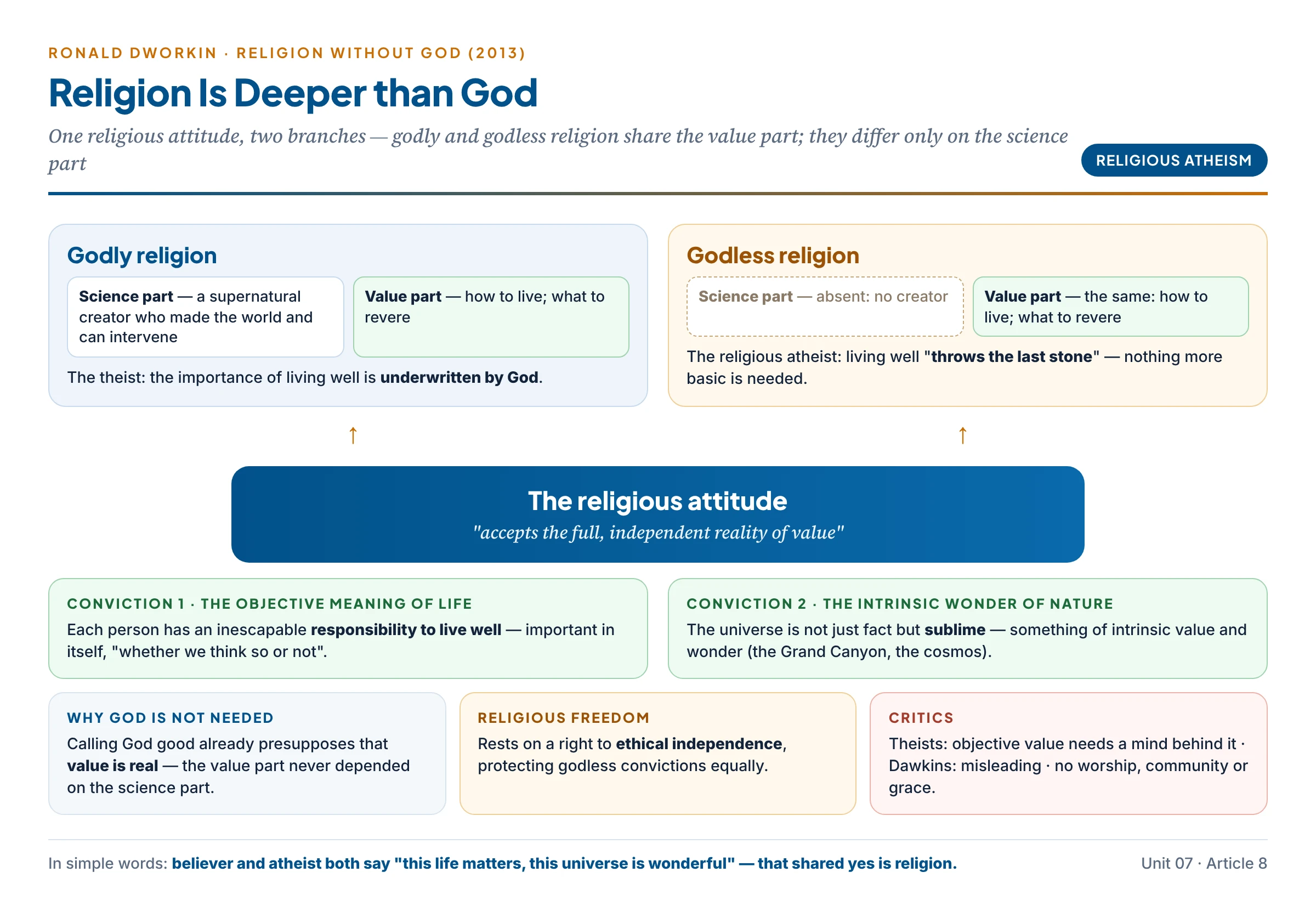
- The thesis. “Religion is deeper than God.” The religious attitude is a genus; belief in God is one species of it. “The familiar stark divide between people of religion and without religion is too crude.”
- Religious atheists. “Many millions of people who count themselves atheists have convictions and experiences very like and just as profound as those that believers count as religious.” They feel an inescapable responsibility to live well; they find the Grand Canyon “not just arresting but breathtakingly and eerily wonderful”; they are enthralled by the vast universe. They express a conviction that “the force and wonder they sense are real, just as real as planets or pain”.
- Not an oxymoron. “Religious atheism” is not a contradiction; “religion is not restricted to theism just as a matter of what words mean”. Religion is an interpretive concept: people who use it take a stand about what it should mean.
(b) The metaphysical core: two convictions
- “The religious attitude accepts the full, independent reality of value.” It accepts the objective truth of two central judgments:
- The objective meaning of human life. “Human life has objective meaning or importance. Each person has an innate and inescapable responsibility to try to make his life a successful one: that means living well, accepting ethical responsibilities to oneself as well as moral responsibilities to others, not just if we happen to think this important but because it is in itself important whether we think so or not.”
- The intrinsic wonder of nature. “What we call ‘nature’ — the universe as a whole and in all its parts — is not just a matter of fact but is itself sublime: something of intrinsic value and wonder.”
- Two dimensions of life. Together these judgments declare inherent value in both dimensions of human life — the biological (we are part of nature) and the biographical (we make a life by our choices).
(c) Why God is not needed for value
- The science part and the value part. Theistic religions, Dworkin argues, have two parts:
- a science part — claims about a supernatural creator who made the world and can intervene;
- a value part — convictions about how people should live and what they should revere.
- The value part does not depend on the science part. The conviction that God underwrites value already presupposes a commitment to the independent reality of that value — and that commitment is available to non-believers too. To call God good one must already know what goodness is; so goodness does not depend on God. (This is the old Euthyphro point, Unit 08.)
- So theists and religious atheists share “a commitment … more fundamental than what divides them”. Their real disagreement is over the science part — whether a creator exists — not over the sacred.
- William James’s “last stone”. James said one essential of religion is a sense that there are “things in the universe that throw the last stone“. The theist gives God that role; the religious atheist can hold that the importance of living well throws the last stone — “there is nothing more basic on which that responsibility rests or needs to rest”.
- Against naturalism. Dworkin rejects the metaphysics of naturalism — the view that nothing is real except what the natural sciences study. Value is objective and mind-independent, though not a physical fact.
- Cosmic necessity. Theists hold that God’s existence needs no explanation because God exists necessarily; religious atheists like Einstein, Dworkin suggests, have a parallel faith — that a final theory of the universe will prove not only simple but, like mathematics, inevitable.
(d) How the atheist experiences the sacred
- Sacred means intrinsically valuable. For Dworkin (developing an idea from his earlier Life’s Dominion), something is sacred when it has intrinsic value — value that does not depend on anyone’s wanting it. As a great work of art — the Mona Lisa, say — must not be destroyed even if no one at the moment wants it, so human life and the natural world are sacred.
- Experiences of the sacred without God: ethical seriousness about one’s own life, moral indignation at injustice, reverence before nature’s beauty and order, the scientist’s awe at the universe.
(e) Religious freedom without God
- The legal consequence. If religion does not require God, freedom of religion cannot be justified merely as respect for belief in God. Dworkin argues it should flow from a general right to ethical independence — the right of each person to decide for themselves the foundational questions of how to live — and must protect godless religious convictions equally.
- Applications. He used this to discuss state-supported religion, harmful religious rituals, and bans on crucifixes, headscarves, burqas or minarets in public places — insisting that government may not favour any answer to ethical questions, theistic or atheistic.
- A parallel. The US Supreme Court had already held that conscientious objection may rest on “a sincere and meaningful belief which occupies in the life of its possessor a place parallel to that filled by the God of those admittedly qualifying” (United States v. Seeger, 1965), and listed Secular Humanism among religions without God (Torcaso v. Watkins, 1961). India’s Supreme Court (Shirur Mutt, 1954) held religion “not necessarily theistic” (Article 1).
In simple words
Two friends both treasure their grandmother’s old letters. One believes the letters are precious because grandmother is watching from heaven and would be hurt if they were burnt. The other believes they are precious in themselves — they carry a life, a love, a history. Ask both, “Would it be wrong to burn them?” — both say yes, with equal conviction. Dworkin says this shared “yes” is the religious attitude; the belief about heaven is an extra that only one of them adds.
8. The Authority of Absolute Values in a Non-theological System
- The problem (asked in 2017). If there is no God, what gives absolute ethical values — “do not torture the innocent”, “respect human dignity” — their authority, and why would people accept them?
- Non-theological sources of authority.
- Reason — Kant: the moral law is given by pure practical reason itself; it binds every rational being categorically, and morality based on God’s command would be heteronomy (Unit 08).
- Objective value — Dworkin: values are real and mind-independent; their authority is their truth, not anyone’s command.
- Cosmic moral order — ṛta, dharma, karma, the Buddhist Dhamma that “stands whether Tathāgatas arise or not” (Articles 4, 6).
- Human nature and flourishing — virtue ethics: what makes human life go well.
- Social agreement — contract theories; Rawls‘s “overlapping consensus“, in which citizens of different religions and none agree on basic principles of justice for different reasons.
- How they gain acceptance.
- Education and the cultivation of moral sensitivity.
- Constitutions and human-rights law — the Universal Declaration of Human Rights (1948) grounds rights in “the inherent dignity” of every human being, with no reference to God; the Indian Constitution rests on justice, liberty, equality and fraternity.
- Example — moral exemplars, like the perfected persons of the non-theistic religions.
- The difficulty. Critics argue that without God, absolutes lose their ultimate ground and their motivation (“why be moral all the time?”); in pluralist societies, values tend to become relative or negotiable. Defenders reply that a value’s authority lies in its truth or reasonableness, and that God’s command itself presupposes that what he commands is good (Dworkin, Euthyphro).
- Balanced view. Non-theological systems can give absolute values authority (through reason and objective value) and acceptance (through education, law and consensus); what they lack is the added motivation and consolation that belief in a personal God provides to many people.
Critical Evaluation
Critiques of Religious Naturalism and Dworkin
- From theism.
- Value without a ground. Why should there be objective value in a universe of particles with no mind behind it? Objective moral truth fits better with a personal God than with blind nature — the theist turns Dworkin’s argument round.
- Awe without an object. Awe and gratitude seem to be directed to someone; awe at an impersonal universe may be aesthetic, not religious.
- No worship, no community, no grace. Dworkin’s “religion” is an attitude of individuals; it has no rites, no saṅgha or church, no prayer, no forgiveness — a religion only in a thin sense.
- From naturalism and the new atheism.
- Misleading language. Richard Dawkins called Einstein’s religious language “destructively misleading“: calling awe at physical law “religion” invites confusion with the supernatural.
- Value realism is “spooky”. If nothing exists but what science studies, Dworkin’s mind-independent values are as mysterious as God.
- From the philosophy of religion.
- Dilution. If every person who finds life important and nature wonderful is “religious”, the word loses its edge (Article 3).
- Misreading the believers. Non-realism and naturalism reinterpret what religious people mean — few believers think “God is love” is only a policy (Hick).
- Einstein’s own self-description was not “atheist” — he preferred “agnostic” or “religious non-believer”.
Strengths
- They identify a real phenomenon. Many non-believers do experience awe, reverence and unconditional ethical demand; a theory of religion should account for them.
- They locate common ground. Dworkin shows theists and atheists share a deeper commitment to the reality of value — a basis for mutual respect and for secular law that does not privilege theism.
- They keep religion honest with science. Religious naturalism avoids conflict with science by giving up the supernatural, while keeping meaning and reverence.
- They anticipate Indian insights. The impersonal sacred of Spinoza and Einstein resembles Brahman and the Dhamma; Dewey’s religious quality resembles niṣkāma karma; Dworkin’s objective value resembles ṛta and dharma.
Critics and Defenders
Criticism — Critics of religious naturalism and Dworkin
- Theists: objective value needs a personal ground; awe needs an object; no worship, community or grace.
- Dawkins: calling awe at nature “religion” is destructively misleading.
- Naturalists: mind-independent values are as mysterious as God.
- Hick: non-realism abandons what the founders of religions believed they were saying.
- Dilution critics: if every sense of value is religion, the word means nothing.
Defence — Defenders and strengths
- Dworkin: religion is deeper than God; the value part never depended on the science part.
- Einstein: the cosmic religious feeling is the noblest motive of science.
- Dewey: the religious is a quality of experience, freed from supernatural creeds.
- Tillich: whatever concerns us ultimately is our god; the God above God remains when theism fades.
- Cupitt and Braithwaite: religious language guides life; non-realist religion works as religion.
Cross-Tradition Comparison
Modern Western “Religions without God”
| Thinker | The sacred | Attitude | God becomes |
|---|---|---|---|
| Spinoza | Nature as one necessary whole | Intellectual love | Nature (Deus sive Natura) |
| Einstein | The order and beauty of the universe | Cosmic religious feeling | “Spinoza’s God” |
| Julian Huxley | Life and its evolution | Sense of sacredness; evolutionary humanism | A naturalistic Trinity |
| Dewey | Ideal ends pursued in experience | The religious quality | Active relation of ideal and actual |
| Tillich | Whatever is of ultimate concern | Being grasped by ultimacy | God above the God of theism |
| Braithwaite, Cupitt | A chosen way of life | Commitment to a policy | A guiding symbol or story |
| Dworkin | Objective value of life; sublimity of nature | Religious atheism | Optional — one species of the religious attitude |
Western Naturalism and Indian Non-theism
| Point | Western religious naturalism | Indian non-theism |
|---|---|---|
| The sacred | Nature, value, ideals, ultimate concern | Nirvāṇa, the perfected soul, kaivalya, dharma |
| Supernatural realities | Rejected | Kept — soul, karma, rebirth |
| Practice | Mostly individual attitude; little ritual | Full religious life — monasteries, rites, pilgrimage |
| Goal | A meaningful, responsible life; awe | Liberation from suffering and rebirth |
| Impersonal absolute | Spinoza’s Substance, Einstein’s order | Brahman, the Dhamma, ṛta |
Indian Connect — Takeaways
- Western “religion without God” is mostly a philosophy of the religious attitude; Indian religion without God is a living religious life with monks, rites and pilgrimage.
- The Indian idea of an impersonal moral order — ṛta, dharma, the Dhamma — is the nearest classical parallel to Dworkin’s objective reality of value.
- Gandhi’s “Truth is God” (Article 3) anticipates Dworkin: the honest seeker of truth, believer or atheist, shares the religious attitude.
Synthesis (Siddhānta) — Religion without God: The Unit as a Whole
- Whether religion is possible without God depends on how religion is defined (Article 1). On narrow theistic definitions, no; on functional and family-resemblance definitions — which fit the actual history of religion far better — yes.
- The positions on God are many (Article 2): theism, atheism, agnosticism and, above all, the Indian non-theism that rejects a creator while keeping the sacred.
- The theist’s case (Article 3) shows what religion without God lacks — personal grace, prayer to a hearer, a conscious guarantor of justice — but not that it is impossible; God is important to religion, not essential.
- Buddhism, Jainism, Sāṃkhya and Mīmāṃsā (Articles 4–6) prove religion without God historically real: transcendent goals, sacred communities, scriptures, rituals and paths of liberation, with no creator.
- Feuerbach, Comte, Durkheim and Marx (Article 7) explained religion as human and tried to replace God with Humanity or Society; their insights about the sacred and the community last, their reductionism and artificial cults do not.
- Religious naturalism and Dworkin (Article 8) show that the religious attitude — awe, reverence, ultimate concern, belief in objective value — can be held without God, though in a thinner, more individual form.
- The final verdict. The central concept of religion without God is the sacred goal of self-transcendence — liberation or ultimate value — sustained by an impersonal order (dharma, karma, the Dhamma, objective value) and modelled by perfected persons or ideals. Religion can exist without God; it then becomes a religion of self-reliance, law and example rather than of grace, relationship and providence. The two kinds of religion are not rivals so much as two members of one family — and the recognition of this is the beginning of genuine dialogue between believers and non-believers.
“The religious attitude accepts the full, independent reality of value.” — Ronald Dworkin
Previous Year Questions
- 2026Critically discuss the views of R. B. Braithwaite on the nature of religious language.
- 2018The terms ‘Sacred’ and ‘Holy’ have come to serve as generic names for the object of religion. Do you agree that one can have God as the object of religion? Discuss.
- 2017What will be the authority and acceptance of the absolute ethical values in the non-theological system of social practices? Discuss.
- 2005Can atheism be a religion? Discuss.