

Notions of God: Attributes; Relation to Man and the World (Indian and Western).
Official Syllabus: Paper II, Section B, Unit 1
When believers say God is infinite, eternal, unchanging, all-present, good and holy, they are naming God’s attributes — the characteristics that make God God and not merely a very powerful being. Philosophy asks three questions about them: how can finite human words describe an infinite God at all?, what exactly does each attribute mean?, and do the attributes fit together without contradiction? This article covers the “being” attributes — infinity, necessity and aseity, simplicity, eternity, immutability and impassibility, omnipresence, incorporeality, goodness, love and holiness — together with the main theories of religious language about God (negation and analogy) and the Indian accounts of God’s nature (sat-cit-ānanda, the auspicious qualities of Viṣṇu, the Īśvara of Nyāya and Yoga). The “power and knowledge” attributes — omnipotence and omniscience — and their paradoxes are treated in the next article.
In simple words
When you describe the ocean to someone who has never seen it, you say “it is like a lake, but without a far shore; like water in a glass, but endless; it is not sweet; it is not still.” You use ordinary words, stretch them, and correct them with “not”. Speaking of God works the same way: we take our best words — good, wise, living — stretch them to infinity, and remove every limitation.
Context & Problem
Why Talk of Attributes at All?
- Worship needs a description. One cannot love, trust or obey a complete blank. The believer needs to know whether God is good, powerful, near and reliable.
- Three routes to the attributes.
- Revelation — scripture names God the Holy One, the Almighty, the Merciful, the Eternal.
- Perfect-being theology — Anselm: God is “that than which nothing greater can be conceived“. Whatever it is better to be than not to be, God must be: so God is powerful, wise, good, eternal and exists necessarily.
- Cosmic explanation — if God is the First Cause of a contingent world, God must be uncaused, unlimited and intelligent.
- The philosopher’s three problems.
- Meaning — can words drawn from finite things apply to the infinite?
- Content — what does “eternal” or “unchanging” actually mean?
- Coherence — do the attributes contradict each other (unchanging and loving? timeless and acting? perfectly good and free?)
The Classical List in One Place
The traditional concept of God in Western philosophical theology contains five core attributes, to which others are added.
| Attribute | Meaning in brief | Main tension |
|---|---|---|
| Necessity (aseity) | Exists by itself, cannot not exist | Can existence be logically necessary? (Kant: no) |
| Omnipotence (sarva-śaktimattā) | Perfect in power | Paradox of the stone; can God sin? |
| Omniscience (sarvajñatā) | Perfect in knowledge | Foreknowledge vs human freedom |
| Eternity | No beginning or end | Timeless or everlasting? |
| Immutability | Changeless in nature | Can an unchanging God love and respond? |
| Omnibenevolence (sarva-kalyāṇakāritā) | Perfect goodness | Problem of evil; Euthyphro dilemma |
| Simplicity, omnipresence, incorporeality, impassibility, holiness | No parts; present everywhere; no body; cannot suffer; wholly other | Personal love and suffering with creatures |
Core Doctrine
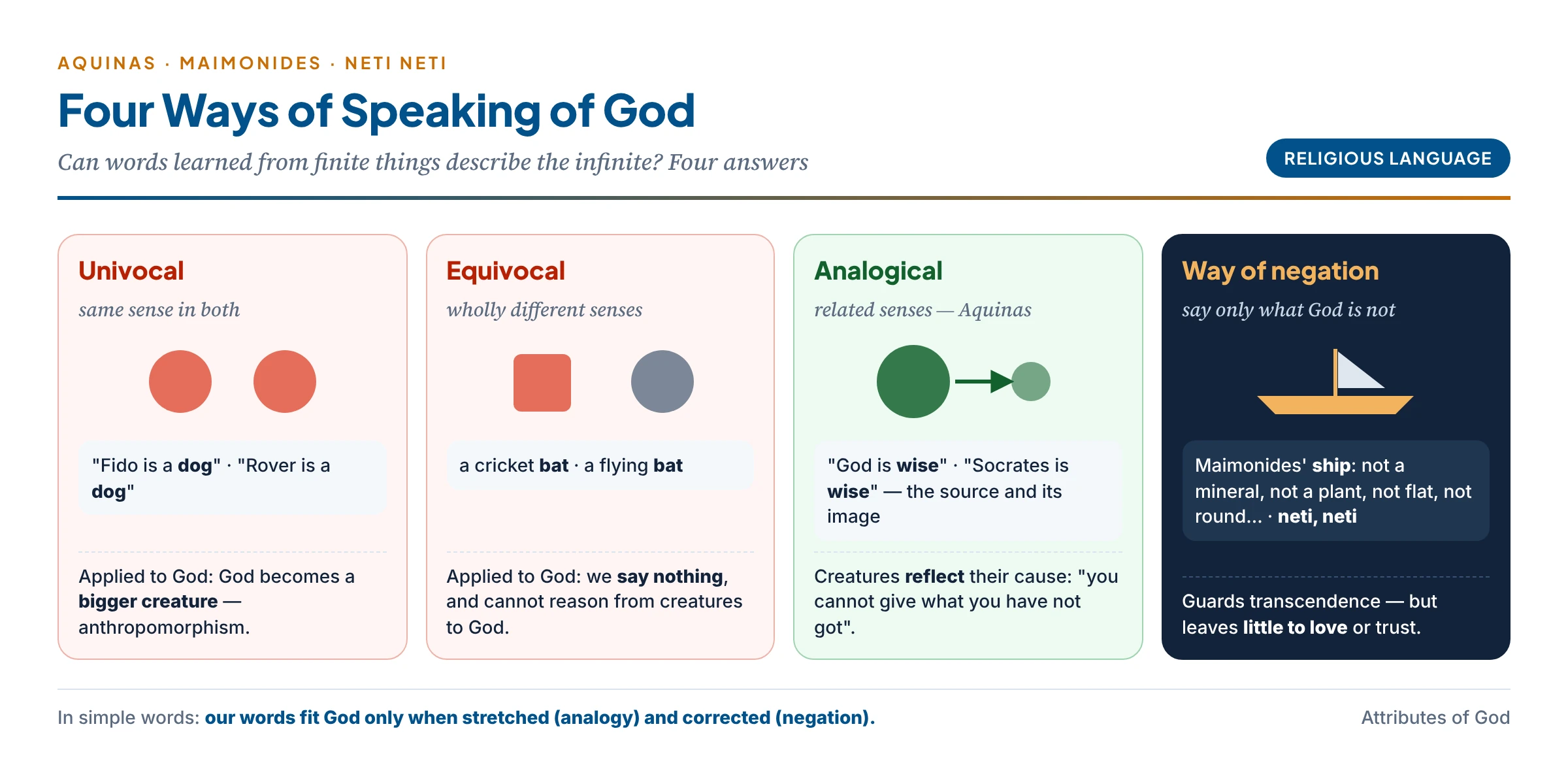
How Can We Speak of God? Negation and Analogy
- The problem. Our words — “wise”, “good”, “father”, “living” — are learned from finite things. If they mean the same of God and of creatures, God becomes a big creature (anthropomorphism); if they mean something completely different, we say nothing at all.
- The way of negation (via negativa). We speak truly of God only by saying what God is not: not finite, not changing, not in time, not a body.
- Maimonides’ ship. A person knows a “ship” exists but not what it is. One learns it is not an accident, not a mineral, not a plant, not a body joined by nature, not flat like boards, not a sphere, not pointed, not round, not solid. “This tenth person has almost arrived at the correct notion of a ‘ship’” through negatives alone. So with God: we come nearer by negative attributes, and whoever affirms positive attributes, Maimonides warns, “unconsciously loses his belief in God“.
- Indian parallel. The Upaniṣadic “neti, neti” (“not this, not this”) reaches Brahman by denying every finite description.
- Limitation. Pure negation leaves the worshipper with nothing to love or trust — a God described only by “nots” is hard to tell apart from nothing.
- The way of analogy. Aquinas asked whether words are used of God and creatures univocally or equivocally.
- Univocal use means exactly the same in both cases — “Fido is a dog” and “Rover is a dog”.
- Equivocal use means completely different things — “bat” for a cricket bat and for a winged mammal.
- Not univocal, says Aquinas: God is infinite, so “wise” in God “goes beyond” our meaning.
- Not purely equivocal either, or “we could never argue from creatures to God“.
- So analogical — between the two. Words apply to God and creatures because of a real relation between them, a causal one: creatures come from God, and “you cannot give what you have not got“. Goodness in a good person reflects a goodness that exists in God in a higher way. This is the analogy of being (analogia entis).
- Kinds of analogy.
- Analogy of attribution — a quality belongs first and fully to one thing and derivatively to another that it causes. Aquinas’ example: we call a bull’s urine “healthy” because it signs the health that really belongs to the bull. So God has wisdom and goodness first and perfectly; creatures have them secondarily, as effects that imitate their source.
- Analogy of proper proportion — each thing has a quality in proportion to its own nature. Hick’s example: a man is faithful and a dog is faithful — very differently, yet recognisably alike; true faithfulness we know in ourselves, and a dim likeness of it in the dog. So man is wise as befits a man, God as befits God: we have the qualities in lesser proportion because we are made in God’s image but are inferior to him.
- Analogy of improper proportion — metaphor, as when God is called a “rock” or a “shepherd”.
- Ian Ramsey — models and qualifiers. A model is an ordinary word we understand (“good”); a qualifier stretches it towards God (“infinitely good”). The qualified model points beyond itself and evokes insight, awe and wonder — a “disclosure” of God.
- Weaknesses of analogy.
- It rests on religious assumptions (that God exists and causes the world).
- It makes assertions about God while admitting words are limited — we still cannot say how far the likeness reaches.
- Analogical statements cannot be empirically verified (A. J. Ayer’s challenge).
- The analogy of attribution meets the problem of evil: if creatures reflect God, does the world’s evil reflect him too?
- Swinburne argues we may not need analogy at all: “good” can be used univocally of God and humans, applied to different subjects.
- Defenders reply that analogy is valuable within the believer’s language game — an aid to faith about what lies beyond full understanding.
- A critical note. Aquinas devised analogy partly to solve the problem of proving an infinite God from finite data. Many critics feel it shows the difficulty more than it solves it: we never know how far the analogy holds.
- Two further routes (treated under Religious Language): symbol — Tillich held that all talk of God is symbolic, a symbol “participating” in what it points to; and Hick’s remark that God is “at least personal“, not “a person” magnified.
In simple words
A photograph of your mother is not your mother — it is flat, silent and small. Yet it is really like her, because light from her face made it. Aquinas thinks creatures are like that photograph: goodness and wisdom in us are real but faint images of goodness and wisdom in God, because God is their source. That is “analogy”.
Infinity
- God is unlimited being. A recurring idea in Judaism and Christianity is that God is infinite — not limited by anything outside God, nor by any inner lack.
- Tillich’s radical form. Paul Tillich held that we should not even say “God exists”, since “exists” is said of finite things: “God is being-itself, not a being.” “It is as atheistic to affirm the existence of God as it is to deny it.” He did not mean God is unreal, but that God is not one thing among others, not even the highest — God is the source and ground of all being. The medieval thinkers made the same point: creator and creature do not “exist” in exactly the same sense.
- All attributes flow from it. The divine “attributes” are so many ways in which the infinite reality is.
Necessity and Aseity
- Aseity (from the Latin “a se esse”, being from oneself) means self-existence. It contains two elements:
- Absolute independence. God depends on nothing for existence or for character. God was not created by any higher being; nothing can constitute or destroy God. God is “the ultimate, unconditioned, all-conditioning reality”.
- Eternity follows. If God had a beginning, something prior would have brought God into being; if God could end, something could destroy God. Both are excluded by independence.
- Necessary vs contingent being.
- A contingent being might not have existed, and depends on something else. Everything we find in the world is contingent — the very small (quarks and gluons), the very large (planets, stars, galaxies) and things in between (plants, pandas, people).
- A necessary being cannot fail to exist and depends on nothing.
In simple words
The moon shines, but only with borrowed light — switch off the sun and the moon goes dark. The sun shines with its own light. Every thing in the world is like the moon: it exists by “borrowed existence” from parents, causes and conditions. Aseity means God is like the sun — existing by its own existence, borrowing from nothing.
- Two senses of “necessary”.
- Factual necessity. Since God does exist, God could not have come into existence and can never cease to exist — God’s existence is uncaused and indestructible.
- Logical necessity. “God exists” is true in every possible situation, as “five plus five equals ten” is; it would be as impossible for God not to exist as for five and five to make twelve.
- The debate. Kant argued that no proposition about existence is logically necessary — existence is never part of a concept’s definition. Positivists added that existential statements are always contingent. But in recent decades philosophers (Malcolm, Plantinga) have defended the logical necessity of God’s existence again, so the idea has become “respectable once again“. (The ontological argument built on this is treated under Proofs for the Existence of God.)
Indian Connect — Aseity in Indian thought
- Brahman is “svayambhū” (self-existent) and the ground (āśraya) of all; the Taittirīya Upaniṣad describes it as that “from which beings are born, by which they live, into which they return“.
- Nyāya’s Īśvara is an eternal self, uncaused, whose knowledge, desire and effort are eternal.
- Madhva calls God the only svatantra (independent) reality; souls and matter are paratantra (dependent) — a clear Indian statement of aseity.
- Buddhism rejects any self-existent being: everything arises dependently (pratītyasamutpāda); a self-existent God is exactly what dependent origination denies.
Simplicity
- Meaning. God has no parts — no physical parts, no distinction between substance and qualities, not even between what God is (essence) and that God is (existence). For Aquinas, God’s essence is God’s existence; God’s wisdom is God’s goodness is God’s power.
- Why theists hold it. Anything composed of parts depends on its parts and on whatever put them together — so a composite God would not be independent (a se).
- Objections. If all God’s attributes are identical, then “God is powerful” and “God is merciful” mean the same — which seems false. If God is goodness, then God would seem to be a property, not a person who knows and loves.
- Indian parallel. Advaita’s Brahman is uncompounded (niravayava) and attributeless (nirguṇa); “sat, cit, ānanda” are not three qualities but one reality viewed three ways. Rāmānuja rejects this: Brahman is saviśeṣa — truly possessed of distinct, real qualities.
Eternity: Timeless or Everlasting?
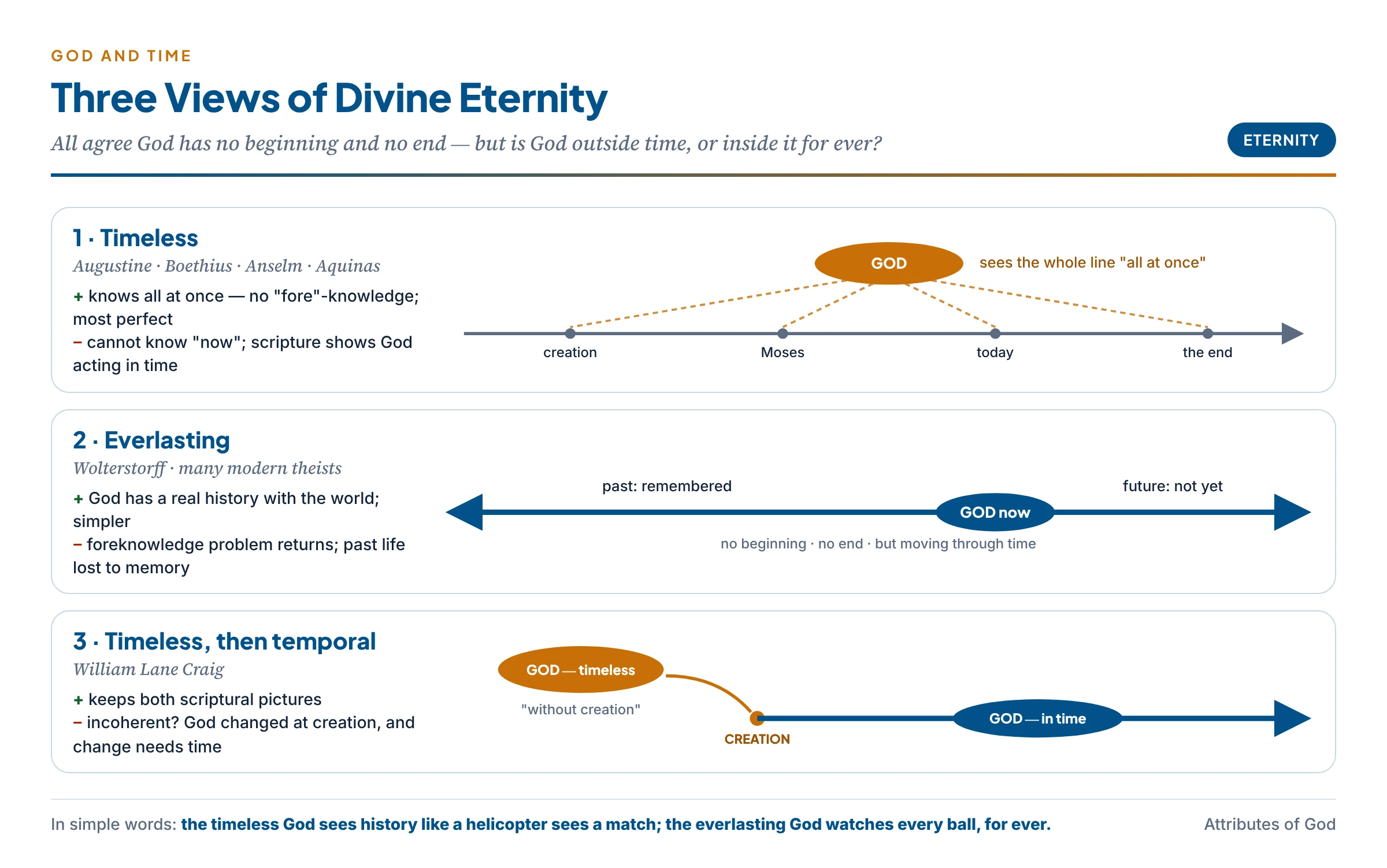
Theists agree that God has neither beginning nor end; the agreement ends when “eternal” must be defined.
- View 1 — Timeless eternity. God exists outside time: no temporal extension, no before or after. Held by Augustine, Boethius, Anselm and Aquinas.
- Boethius’ definition. Eternity is “the complete possession, all at once, of illimitable life“. We possess our life piece by piece — yesterday is gone, tomorrow not yet; God possesses the whole at once.
- Anselm. “You exist neither yesterday nor today nor tomorrow but are absolutely outside all time … nothing contains You, but You contain all things.”
- Reasons for it.
- It solves the problem of foreknowledge. A timeless God does not fore-know; God knows all events — including free acts — in one eternal present.
- It is the most perfect mode of existence. A temporal God would lose past episodes of his own life, keeping them only in memory — “even a very great memory is much less than a present reality”.
- Relativity theory. Space and time are bound together; if God is non-spatial, God should be non-temporal too.
- Objections to it.
- No knowledge of “now”. If it is 7 p.m. and I have just now finished dinner, a timeless God cannot know that it is “just now” — for such a God there is no “now”; God could never know what time it is.
- It contradicts scripture. The Bible and the Qur’an show God acting in history — creating, sustaining, speaking, judging, responding to prayer. Acting in time seems to require being in time.
- View 2 — Everlasting (sempiternal). God has no beginning or end but exists in time, forever. Defended by Nicholas Wolterstorff and others.
- Reasons. God is actively involved in the world and has a history with it — a succession of acts and conversations — which requires temporal relations. The view is also simpler and avoids the puzzles of timelessness.
- Objections. It loses the advantages of timelessness: the foreknowledge problem returns, and a temporal life seems a less perfect mode of being.
- View 3 — Timeless without creation, temporal with it. William Lane Craig: scripture is indecisive; God is timeless “before” creation but enters time with the creation of the universe.
- Objection. It seems incoherent: God changed (at least in relations) at the moment of creation, and change requires time — so God could not have been fully timeless.
In simple words
Imagine watching a cricket match from a helicopter high above the ground: you see the whole field — every player, every movement — at once. A spectator in the stands sees it ball by ball. The timeless God is like the helicopter view of all of history; the everlasting God is like a spectator who never leaves the stadium and watches every ball, forever.
Immutability and Impassibility
- Immutability. God is intrinsically changeless; it is logically impossible for God’s nature to change.
- The argument from perfection. To change is to become better or worse. An absolutely perfect being cannot become better (it is already perfect) and must not become worse (it would cease to be perfect). So God cannot change.
- Extrinsic change is allowed. After creating the world, God stands in a relation to it that God lacked before — a “Cambridge change”, like a man becoming “shorter than his son” without himself shrinking. The real question is only about intrinsic change in God’s nature.
- Impassibility. God cannot suffer or be affected by anything outside God — not moved to grief, anger or pain by creatures.
- The objections.
- The God of devotion responds. Scripture and bhakti portray a God who grieves, rejoices, forgives, is moved by prayer. An unchanging, unaffected God seems incompatible with personal love, compassion and responsiveness.
- Process philosophy. For Charles Hartshorne and the process thinkers, God is not a static substance but divine becoming; immutability comes from ancient Greek philosophy rather than scripture. Hartshorne challenged the assumption “that it makes sense to think of a value so great that it could in no sense whatever be excelled” — “in my view it does not, and is either a contradiction or mere nonsense“. God’s abstract qualities (goodness, wisdom) are stable, but God grows — in new joys, new knowledge of real events, and in the values created over time by free creatures.
- Replies of classical theism. God’s love is active, not reactive — an unchanging will to the good of creatures, like the sun that shines on all without being changed by them; God’s “anger” and “grief” are analogical expressions of an unchanging justice and love.
Indian Connect — Immutability in Indian thought
- Advaita: Brahman is kūṭastha — immovable like an anvil on which things are shaped — and nirvikāra (without modification); all change belongs to māyā.
- Rāmānuja: God is unchanged in essence even though his body (souls and matter) changes — as the soul is untouched by the body’s childhood, youth and old age; yet Viṣṇu is ever responsive to the devotee through grace (prasāda).
- Bhakti keeps the responsive side vivid: Kṛṣṇa runs to save Draupadī; Rāma weeps for Sītā — devotional poetry deliberately speaks of a God who is moved.
Omnipresence and Incorporeality
- Omnipresence. God is present everywhere, but not by being spread out like a gas, a part here and a part there — that would make God bodily and divisible. Aquinas: God is in all things by power (all things are subject to God), by presence (all things are open to God’s knowing) and by essence (God is the cause of their very being).
- Omnipresence and immanence. Omnipresence says God is present to everything; immanence says God indwells everything as its inner principle. A “Big Brother” who watches everyone everywhere would be omnipresent in a sense without being immanent. (Immanence, transcendence, infinitude and omnipresence are treated together in a separate article.)
- Incorporeality. God has no body: a body is limited in space, composed of parts and subject to change — all incompatible with infinity, simplicity and immutability. (Whether a God without a body can cause a physical world, and whether God needs some physical manifestation, is examined in the article on creation.)
Goodness
- Perfect and essential. God is not just good but unsurpassably good, and good by nature — God cannot cease to be good. Compare: a bachelor is necessarily unmarried, but the man who is a bachelor can marry and stop being one; the being who is God cannot stop being God, and so cannot stop being good.
- Three kinds of goodness in God.
- Moral goodness — perfect justice, faithfulness, mercy.
- Non-moral goodness — supreme happiness or bliss. (“He led a good life” is moral; “he had a good life” is non-moral.)
- Metaphysical goodness — from the Neoplatonists, Augustine and Pseudo-Dionysius: whatever has being is good, so evil is only a privation (absence) of good; and creation is better for containing a great variety of kinds of being.
- Puzzles of perfect goodness.
- Can we praise a God who cannot do otherwise? If God’s nature necessitates doing the best, God acts of necessity, and praise and thanks seem out of place. One reply: God’s nature requires duty but God freely does more than duty (supererogatory grace) — though Samuel Clarke insisted “though God is a most perfectly free agent, he cannot but do always what is best and wisest on the whole“.
- Must God create the best world? Leibniz: a perfect God must create the best of all possible worlds, so this is it. If there is no best world (every world can be bettered), God freely chooses a good one. Robert Adams argued God may create a world less than the best out of grace — “a disposition to love which is not dependent on the merit of the person loved”.
In simple words
A truly honest person does not tell the truth because a rule forces him; truth-telling is simply who he is. Asked “could you lie?”, he might say “I could not” — not from weakness but from character. Theists say God’s goodness is like this: God “cannot” do evil the way a loving mother “cannot” abandon her baby.
Goodness and Divine Commands: The Euthyphro Dilemma
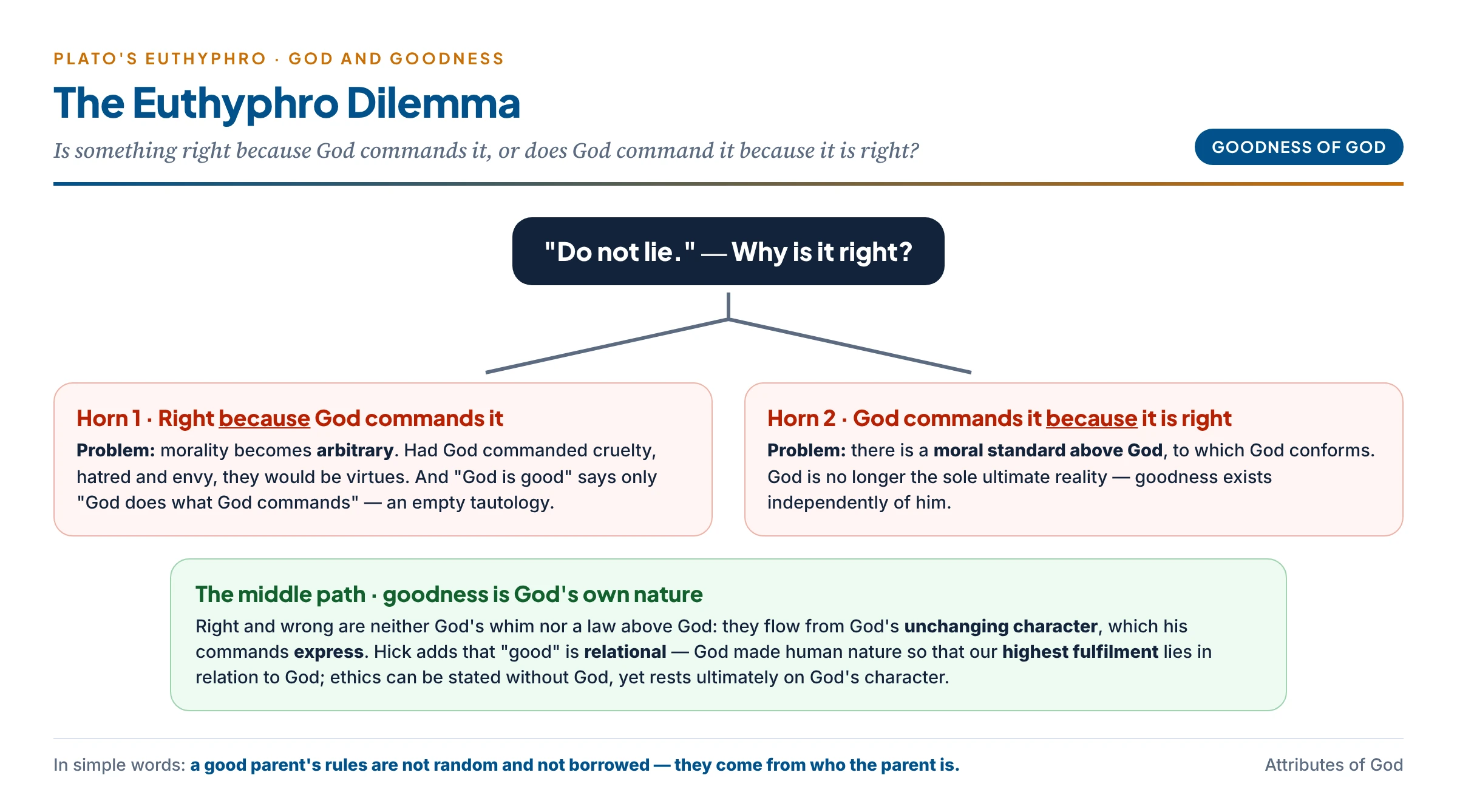
- The dilemma. Is an act right because God commands it, or does God command it because it is right?
- If right because commanded, then morality is arbitrary: had God commanded hatred, cruelty and envy, these would be virtues; and “God is good” becomes an empty tautology.
- If commanded because right, then there is a moral standard independent of God, and God is no longer the sole ultimate reality.
- Responses.
- The dominant religious view: God commands what is right independently of the command; God’s commands help our knowledge and practice of morality and assure us that leading a good life and having a good life are not accidentally connected. Mathematics offers a parallel: God believes “seven plus five is twelve” because it is true, not the other way round.
- John Hick’s “frankly circular” solution: “good” is a relational concept — the fulfilment of a being’s nature. To call God good is to say that God’s existence and activity are the condition of humanity’s highest good, because God has made human nature so that our fulfilment lies in relation to God. Ethics can be stated without mentioning God, yet ultimately rests on God’s character.
- Grounding goodness in God’s nature: goodness is neither above God nor a matter of God’s whim; it is God’s own unchanging character, and God’s commands express it.
Love, Wrath and Holiness
- Love as agape. In the New Testament God’s goodness, love and grace are virtually one, and the key word is love. Hick contrasts:
- Eros — “desiring love”, evoked by the lovable qualities of the beloved (he is handsome, she is charming; parents love their own children).
- Agape — unconditional and universal, given to a person simply because he or she is there as a person, actively seeking that person’s deepest good. “God is love” and “God so loved the world” use agape.
- Two sides of religious life follow: God as the final refuge (“a very present help in trouble”), and God as Lord and King whose love makes an absolute moral demand — “nothing is so inexorably demanding as a love that seeks our highest good”.
- Wrath. Talk of the “wrath of God” need not be anthropomorphic. Saint Paul, as C.H. Dodd pointed out, never calls God wrathful; he speaks impersonally of “the Wrath” — the inevitable reaction of the moral order on wrongdoing, “the increasing horror of sin working out its hideous law of cause and effect”.
- Holiness. Each attribute taken alone is an abstract idea; the believer experiences them together as holiness — God as infinitely other and greater: “To whom then will you liken God? … It is He who sits above the circle of the earth, and its inhabitants are like grasshoppers.” The awareness of God as holy is awareness of One “terrifyingly mysterious“, before whom “all our righteousnesses are as filthy rags”.
- Hick’s summary. God is “the infinite, eternal, uncreated, personal reality, who has created all that exists and who is revealed to human creatures as holy and loving“.
The Attributes of God in Indian Thought
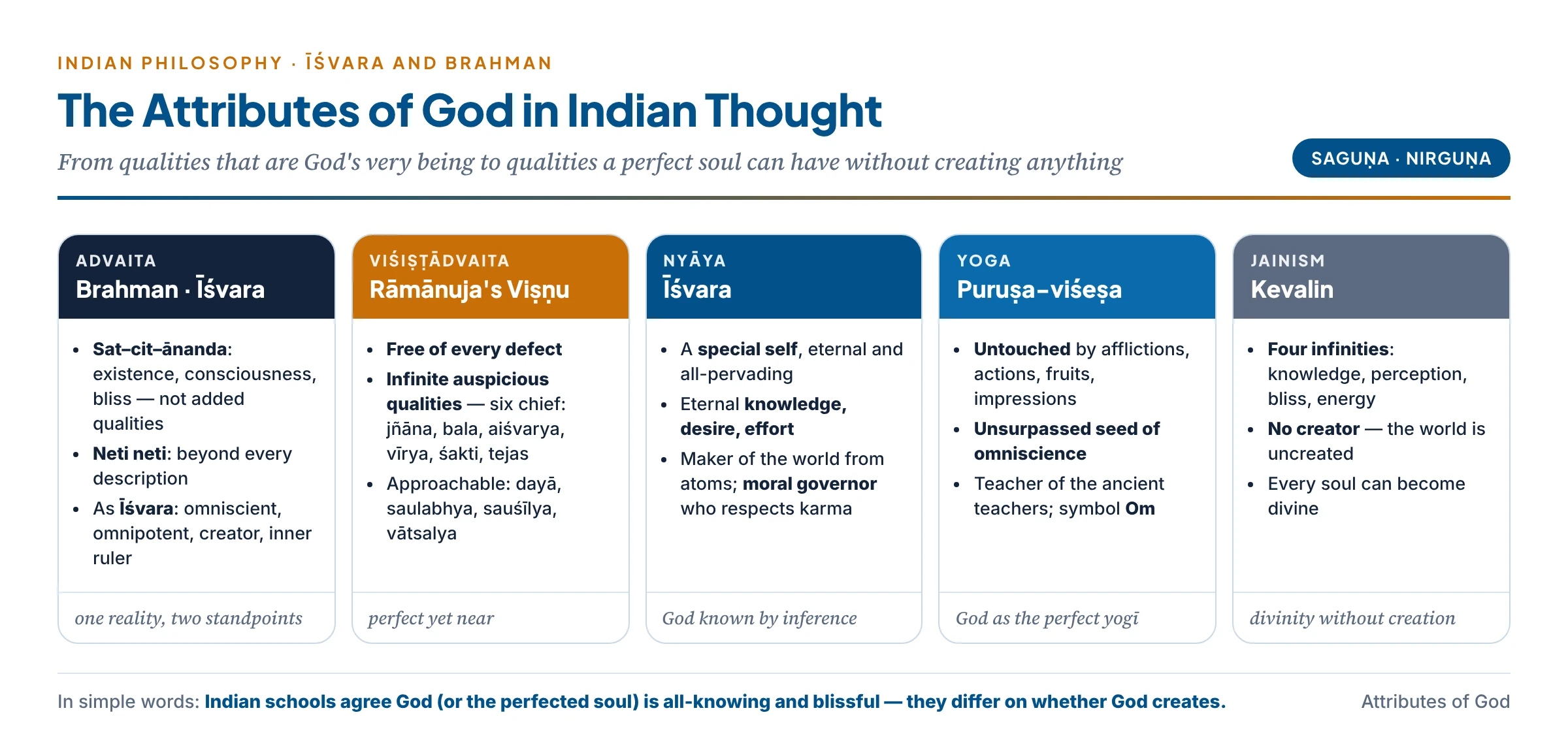
- Brahman (Advaita). Its essential definition (svarūpa-lakṣaṇa) is sat–cit–ānanda — existence, consciousness, bliss; also satyaṃ jñānam anantaṃ brahma (“Brahman is truth, knowledge, infinite”). These are not qualities added to Brahman but Brahman itself. As Īśvara (Brahman seen through māyā), God is omniscient, omnipotent, creator, sustainer and destroyer, inner ruler (antaryāmin) and dispenser of karmic fruits.
- Viṣṇu–Nārāyaṇa (Rāmānuja). God is “ubhaya-liṅga” — marked by two features:
- Free from every defect (akhila-heya-pratyanīka) — no ignorance, sin, change of essence or suffering.
- Possessed of infinite auspicious qualities (ananta-kalyāṇa-guṇa) — above all the six: knowledge (jñāna), strength (bala), lordship (aiśvarya), unwearied energy (vīrya), creative power (śakti) and splendour (tejas); and qualities that make God approachable — compassion (dayā), accessibility (saulabhya), condescending love (sauśīlya) and motherly love that overlooks faults (vātsalya).
- Īśvara in Nyāya. A special self, eternal and all-pervading, possessing eternal knowledge, desire and effort (jñāna, icchā, prayatna); omniscient and omnipotent in the sense that he can create and direct the world; the moral governor who does not override karma but dispenses its fruits; the efficient cause of the world from eternal atoms.
- Īśvara in Yoga. A special puruṣa (puruṣa-viśeṣa) untouched by afflictions, actions, their fruits and latent impressions (kleśa, karma, vipāka, āśaya); in him the seed of omniscience is unsurpassed (niratiśaya sarvajña-bīja) — since knowledge comes in degrees, there must be a highest degree; he is the teacher even of the ancient teachers, not limited by time; his sacred word is Om (praṇava).
- Viṣṇu in Madhva. God is full of infinite auspicious qualities (sarva-guṇa-paripūrṇa), the only independent reality, the efficient cause of the world.
- Jaina kevalin. A liberated soul has infinite knowledge, perception, bliss and energy (ananta-catuṣṭaya) — divine attributes without creatorship; Jainas deny a creator but honour perfected souls.
Critical Evaluation
Objections (Pūrva-pakṣa)
- Incoherence among the attributes.
- Simplicity vs many attributes — if all are one, why name them differently?
- Immutability vs love — a changeless God cannot respond to prayer or suffer with creatures.
- Timelessness vs action — a timeless God cannot create “then”, speak “now”, or know what time it is.
- Perfect goodness vs freedom — if God must do the best, God is not free and praise is misplaced.
- Kant’s limit. The attributes are ideas of reason: they regulate our thinking but give no knowledge of a reality beyond experience.
- Projection. Feuerbach: the attributes are human perfections — love, wisdom, power — raised to infinity and worshipped outside ourselves.
- Meaninglessness. Logical positivists: “God is infinitely good” cannot be verified or falsified, so it says nothing.
- Greek, not biblical. Process thinkers: immutability, impassibility and timelessness come from Greek metaphysics, not from the living God of scripture.
Replies (Siddhānta)
- Analogy and negation show that the attributes do not describe God in the same sense as creatures; apparent clashes often come from using words univocally.
- Distinctions dissolve many contradictions: intrinsic vs extrinsic change; active vs reactive love; knowing all things in an eternal present vs foreknowing.
- Perfect-being theology gives a principled way to derive and adjust the attributes: each is the maximum compatible with all the others.
- Indian thought offers a model of two levels: Brahman without qualities (nirguṇa) and Īśvara with qualities (saguṇa) — the “God of philosophy” and the “God of devotion” held together.
Common confusion
Does “eternal” simply mean “lasting for ever”? Not necessarily. “Lasting for ever” is everlastingness — endless time, with a past and future. Classical theists (Augustine, Boethius, Aquinas) meant timelessness — existing outside time altogether, possessing all life “all at once“. Many notes use “eternal” only in the first sense; in philosophy of religion the two must be kept apart, because they give different answers to the foreknowledge problem.
Common confusion
Does immutability mean God has no relations with the world? No. Immutability denies intrinsic change in God’s nature, not relations. When God creates, God comes to stand in a new relation to creatures — as a man becomes “shorter than his son” when the son grows, without himself shrinking. Classical theists hold that God’s knowledge and will are eternally directed to creatures; only the creatures change.
Critics and Defenders
Criticism — Critics
- Hartshorne and process thinkers — immutability and impassibility are Greek, not biblical; God grows.
- Feuerbach — the attributes are projected human perfections.
- Kant — the attributes give no knowledge of God.
- Logical positivists — attribute-talk is unverifiable.
- Critics of simplicity — identical attributes make God a property.
- Buddhists — no self-existent, unchanging being is possible.
Defence — Defenders and strengths
- Anselm — perfect-being theology derives the attributes systematically.
- Aquinas — analogy avoids both anthropomorphism and agnosticism.
- Boethius — timeless eternity reconciles knowledge and freedom.
- Maimonides, neti neti — negation guards God’s transcendence.
- Hick — God “at least personal”; agape as the core of goodness.
- Rāmānuja — real qualities without defects; a God both perfect and approachable.
Cross-Tradition Comparison
| Attribute | Western formulation | Indian counterpart |
|---|---|---|
| Self-existence | Aseity; necessary being (Anselm, Aquinas) | Brahman as svayambhū; Madhva’s svatantra God |
| Infinity | Unlimited being; Tillich’s “being-itself” | Ananta (Brahman as infinite); bhūmā (“the plenitude”) |
| Simplicity | No parts; essence = existence (Aquinas) | Advaita’s uncompounded, nirguṇa Brahman (Rāmānuja rejects it) |
| Eternity | Timeless (Boethius) vs everlasting (Wolterstorff) | Brahman beyond time (kālātīta); Yoga’s Īśvara “not limited by time” |
| Immutability | Changeless nature; extrinsic change only | Kūṭastha, nirvikāra Brahman; Rāmānuja: unchanged essence, changing body |
| Knowledge | Omniscience | Sarvajña; Yoga’s “unsurpassed seed of omniscience”; Jaina kevala-jñāna |
| Goodness and love | Perfect goodness; agape | Ananta-kalyāṇa-guṇa; dayā, vātsalya; Brahman as ānanda |
| Language | Via negativa; analogy; symbol | Neti neti; lakṣaṇā (indirect meaning); svarūpa- vs taṭastha-lakṣaṇa |
Indian Connect — Key takeaways
- Indian thought builds the two levels into the system: Advaita’s nirguṇa Brahman and saguṇa Īśvara correspond to the negative and positive ways of speaking about God.
- Rāmānuja’s “free from all defects, full of all auspicious qualities” is a precise Indian version of perfect-being theology.
- The Jaina kevalin shows that “divine” attributes (omniscience, bliss) can be separated from creatorship.
Synthesis (Siddhānta)
- The attributes are not a random list. They follow from two ideas: God as the greatest possible being and God as the independent ground of everything. From these come infinity, aseity, eternity, immutability, simplicity, goodness, power and knowledge.
- Language is stretched, not broken. Negation removes every limitation; analogy keeps a real likeness between creatures and their source. Without negation God becomes a big creature; without analogy God becomes an empty blank.
- The tensions are real but not fatal. Timelessness vs action, immutability vs love, simplicity vs many attributes — each is eased by careful distinctions (intrinsic and extrinsic change; active and reactive love; one reality, many aspects), though philosophers still disagree.
- Two levels serve two needs. The “God of the philosophers” (infinite, simple, timeless) satisfies reason; the “God of devotion” (loving, responsive, gracious) satisfies the heart. Śaṅkara’s Brahman–Īśvara and Rāmānuja’s “defectless yet full of qualities” are Indian solutions to the same problem that Western theists face.
- Contemporary relevance. Process theology, open theism and inter-religious dialogue have reopened these questions: a God who suffers with the world speaks to an age of great suffering, while the classical God who is beyond all change offers an unshakeable ground. A balanced view keeps both the transcendent perfection and the personal nearness of God.
“To whom then will you liken God, or what likeness compare with him?” — Isaiah
Previous Year Questions
- 2021Discuss the nature of God as propounded in Nyāya philosophy.
- 2016Show how the attributes of immanence and transcendence of God go with omnipresence and infinitude.
- 2015Write a critical note on the attributes of God.