

Notions of God: Attributes; Relation to Man and the World (Indian and Western).
Official Syllabus: Paper II, Section B, Unit 1
Before we can ask what God is like, how God is related to the world, or whether God exists at all, we must be clear about what the word “God” means and how a philosopher should study it. Religions speak of Allah, Yahweh, the Holy Trinity, Brahman, Īśvara, Viṣṇu, Śiva and the Dao; some speak of no God at all and still call themselves religions. This article lays the foundation for the whole unit: it separates religion, theology and philosophy of religion, explains realist and non-realist ways of taking talk about God, maps the main types of belief (from atheism to monism), distinguishes the God of religion, of philosophy and of mysticism, examines whether the Sacred and the Holy or God is the real object of religion, and answers two classic questions — what a non-theological concept of God is, and whether Hinduism is polytheistic.
In simple words
Think of the word “mother”. A child calls out to her mother when afraid; a novelist writes about mothers in a story; a psychologist studies what “motherhood” means across cultures without taking anyone’s side. All three use the same word in different ways. “God” is like this: the believer talks to God, the theologian talks of God with reverence, and the philosopher talks about God with detachment — asking what the word means and whether what it claims is true.
Context & Problem
What Philosophy of Religion Studies
- Philosophy of religion is philosophical reflection on religious ideas. Its scope is narrow (religious ideas only) but its tools are those of the whole of philosophy — metaphysics (what is real) and epistemology (how we know).
- “Philosophical reflection” means the careful analysis of words, reasons and evidence for religious claims, hypotheses and arguments.
- “Religious ideas” are the central concepts debated within religious traditions for centuries: the existence and nature of God or Ultimate Reality, conflicting truth-claims of religions, science and religion, creation, nirvāṇa, salvation and so on.
- These are not ivory-tower questions. They are living issues in traditions that give deep existential meaning to most of humanity.
- Who does it? Analytic and continental philosophers, Eastern and Western thinkers, believers and agnostics, sceptics and atheists — and it draws on theology, history, sociology, psychology and the natural sciences.
- A setback and a revival. In the early-to-mid twentieth century the logical positivists held that a meaningful factual claim must be empirically verifiable; since claims about God are not, religious talk was dismissed as meaningless. From the 1970s, thinkers such as John Hick and Alvin Plantinga defended the philosophical respectability of religious belief, and the field has flourished since.
The Variety of Religious Beliefs
- Monotheists hold that a personal God exists and that God is good.
- Buddhists hold that the Four Noble Truths show the path to enlightenment — without a creator God.
- Many Hindus affirm that Brahman is the one reality.
- Daoists affirm that the Dao is the fundamental process of reality.
- So the first philosophical question is not “Does God exist?” but “What kind of claim is a religious claim?” — is it true or false in the way a scientific claim is?
Religion, Theology and Philosophy of Religion
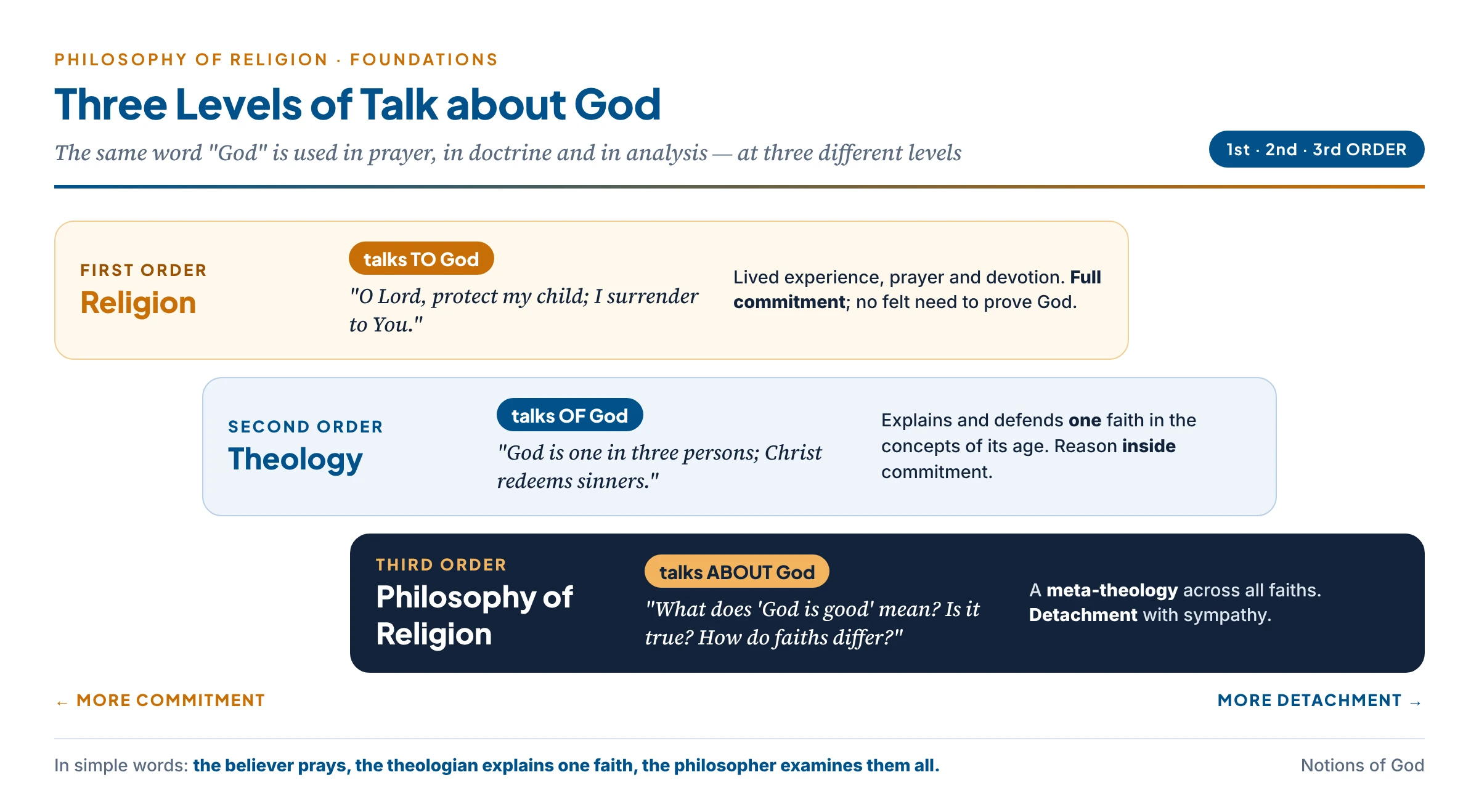
- Religion is a system of lived experience. It uses first-order language in which the believer expresses feelings, thoughts and acts towards the object of devotion. A theist prays to God, talks to God, turns to God in distress, joy and gratitude, and feels no need to prove God’s existence.
- Why theology arises. No believer lives in prayer all day. He earns a living, keeps a social life, takes part in politics, culture and learning. Very few can keep a watertight wall between religious and non-religious life. The demand for an integrated life forces the believer to unify these experiences using the intellectual categories of his age — and that is philosophising.
- Theology is this use of one’s age’s concepts to clarify, explain and systematise the beliefs and practices of a religion.
- “Theology” literally means “discourse about God” — in theology we do not talk to God but about God.
- Theology is the philosophy of one religion. There are as many theologies as religions, and several within one religion (Buddhism, Christianity and Islam each have many).
- It defends as well as explains — against sceptics, agnostics and rival religions.
- It is not disinterested. It shares the commitment of its religion — and so risks staying tied to an old conceptual framework.
- Yet theologies change with the intellectual climate: early Christian thinkers used the Greek logos philosophy, Aquinas absorbed Aristotle, a generation of theologians were Hegelians, and many contemporary ones are existentialists.
- Theology and current philosophy. Analytic philosophy takes science as the model of knowledge — detached and impersonal — while religion demands self-involvement, passion and commitment. So analytic philosophy suits theology poorly; existentialism, which studies persons in moments of crisis and decision, suits it better — which is why the theology of Karl Barth, Rudolf Bultmann and Paul Tillich is hard to state in analytic terms. Still, a theologian must use the philosophy of his age, or he will be “religious on Sundays and secular on all other days” — a split personality that is neither possible nor healthy.
- Why a philosophy of religion is needed. Each theology tends to present itself as a “world theology”, and so religions meet and clash. A philosophical theology (a meta-theology) clarifies the concepts of all theologies so that dialogue and an ecumenical understanding become possible. For example, “God” is used by many theistic religions, but not in the same sense: the God of the Gītā is more monistic than theistic, and the God of Spinoza is more pantheistic than deistic or theistic.
- Even “religion” is ambiguous. Must a religion believe in some being higher than man, or can it be an all-out orientation towards an object of devotion? Western theists take the first view; many Indian thinkers do not require a being higher than man to worship, though they assume some metaphysical commitment; only the modern secular humanist makes no metaphysical commitment at all.
- Philosophy of religion therefore applies the methods of current philosophy to analyse and clarify religious and theological concepts and beliefs. It is a branch of philosophy, differing only in its subject matter; it is neither religion nor theology.
| Religion | Theology | Philosophy of religion | |
|---|---|---|---|
| What it is | Lived experience, self-involvement, full commitment to the object of devotion | Interpretation of religious experience in current concepts, in the interest of one’s own commitment | Analysis of religious concepts within a general framework, with detachment |
| How many | No single “religion in general” — only religions | One theology per religion (and more within it) | One discipline — a meta-theology examining all theologies |
| Level of statements | First-order (prayer, confession, praise) | Second-order — statements about religious statements | Third-order — statements about theological statements |
| Attitude to God | The theist talks to God | The theologian talks of God with reverence and piety | The philosopher talks about God with disinterestedness |
Detachment and Involvement
- The believer uses religious concepts in their customary sense, without critical analysis; he cares about the end result — the culture of the soul.
- The philosopher of religion need not be religious, need not be a theist or even a humanist, but should not lack sympathy for religion. He must be committed to truth and to rigorous analysis.
- Both must alternate. The philosopher must enter the spirit of religion — “put on the spectacles of the believer” — or he will not understand it; the theologian must step back from the ground he holds holy and judge its holiness if he wants to show its universal validity. So commitment and detachment are needed by both, and they must stay in dialogue.
Core Doctrine
Realism and Non-realism: Is “God” About Something Out There?
- Realism. Most believers are religious realists: their beliefs are about what really exists independently of human minds. For a Muslim, “Allah is the one true God” is true if there actually is a being, independent of human thoughts and practices, identifiable as Allah. The same holds for Brahman, mokṣa or rebirth.
- Non-realism. A minority hold that religious claims are not about realities beyond human language, concepts and social forms — not about something “out there”.
- The Equator analogy. One leading non-realist put it vividly: a realist is like a passenger who, when his ship crosses the Equator, looks overboard expecting a black line on the ocean. The non-realist sees latitude and longitude as a framework we impose to find our way. For the realist, truth is “ready-made out there”; for the non-realist, we are the makers of truth.
- Religion as human improvisation. All religious and moral ideas are human, with a human history; doctrines become guiding myths to live by (a path mapped by Kant, Kierkegaard and Bultmann); there is no supernatural world beyond. Yet such non-realist religion, it is claimed, still works as religion.
- Non-realists hostile to religion.
- Sigmund Freud: religious ideas are illusions — fulfilments of “the oldest, strongest and most urgent wishes of mankind”; belief in God is the projection of a father-image.
- Richard Dawkins and Daniel Dennett: religion spreads through memes — units of cultural imitation that leap “from brain to brain” as genes leap from body to body. Dawkins lists religious memes such as “you will survive your own death”, “belief in God is a supreme virtue”, “faith is a virtue” and “there are weird things (the Trinity, transubstantiation, incarnation) we are not meant to understand”. The “god meme” spreads like a virus; religion is “an accidental by-product — a misfiring of something useful“.
- Non-realists friendly to religion.
- Ludwig Wittgenstein took religion seriously (he even considered the priesthood) but opposed natural theology — proving God from nature. In his later philosophy, language is a set of activities, “language-games” woven into forms of life: in his builder’s example, the builder calls “block!”, “slab!”, and the assistant brings the stone — the meaning of a word is its use. So “God”, “Brahman”, “nirvāṇa” or “Dao” get their meaning from their use in religious practice, not from picturing a reality beyond it.
- No proof has succeeded, such non-realists add; so it is better to read religion through non-realist lenses.
- Context shapes meaning. Since religious claims are always made inside a human context, and the mind structures all perception within it, positing transcendent realities beyond language “simply goes too far”.
- Realist replies.
- Some admit there are no conclusive proofs but hold that faith does not require evidence.
- Others claim there are good reasons and evidences for faith.
- Much of religious language is indeed human, but it does not follow that all its meaning reduces to human language — that would be reductionism.
In simple words
A traffic signal’s red light means “stop” only because people agree on it — that is a “non-realist” meaning, made by us. But when you say “there is a tree in the courtyard”, the tree is there whether or not anyone agrees — that is a “realist” claim. The debate is whether “God exists” is more like the red light (a meaning that lives inside a way of life) or more like the tree (a fact that holds whatever we think).
The Vocabulary of Belief: From Atheism to Monism
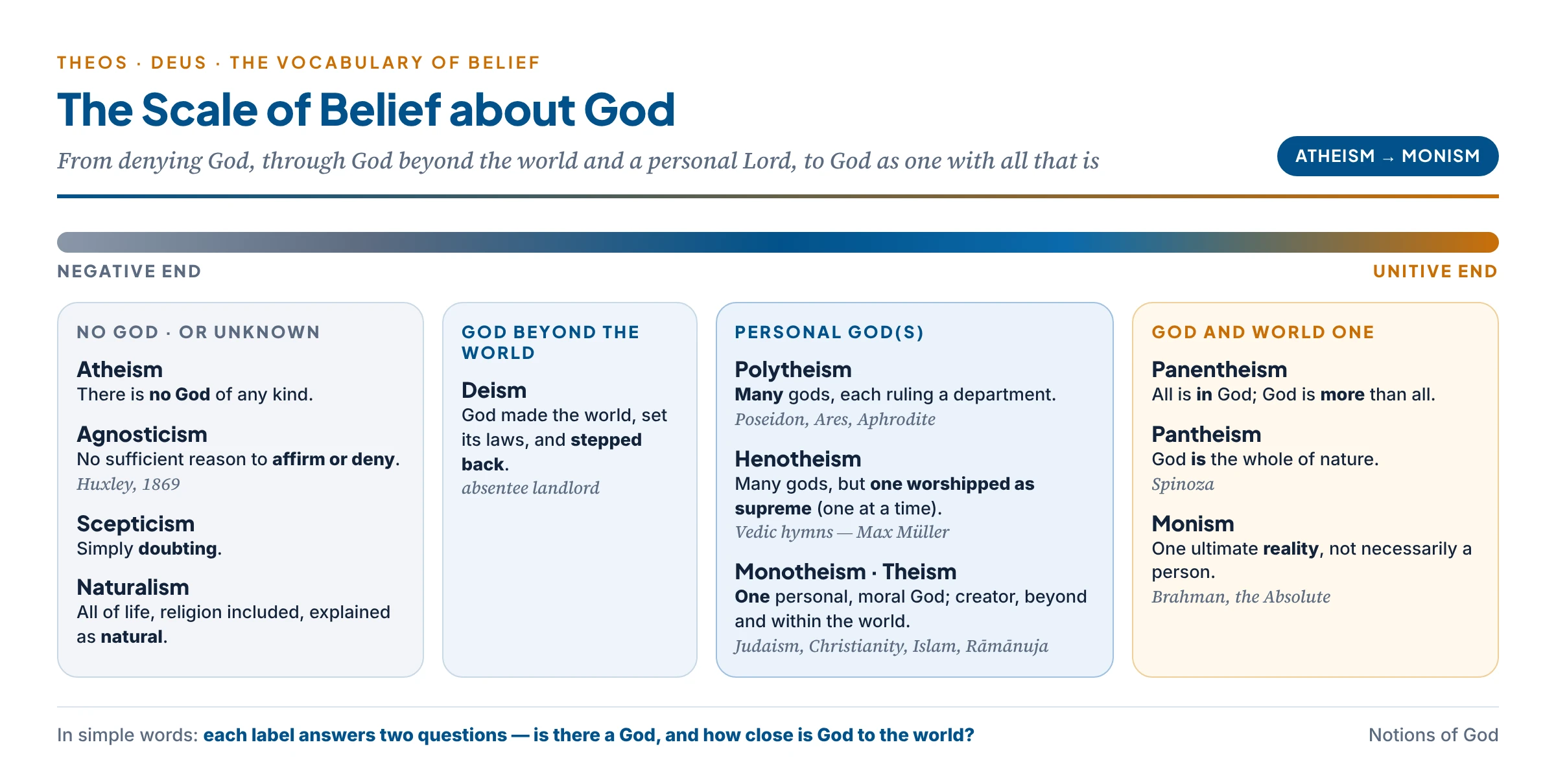
The names for the main ways of thinking about God are built on the Greek theos or the Latin deus. Arranged from the negative end of the scale to the positive end:
- Atheism (“not-God-ism”) — the belief that there is no God of any kind.
- Agnosticism (“not-know-ism”) — the belief that we have no sufficient reason either to affirm or to deny God’s existence. The word was coined by T.H. Huxley (1869); the attitude is old (Protagoras: about the gods “I cannot know whether they exist or not”).
- How agnostics see religion and God. For the agnostic, the question of God is unanswerable by reason, so religion cannot rest on a known God. Some agnostics keep religion as morality, ritual or community without metaphysical claims; others treat religious experience as a live but unproven possibility; others suspend both belief and practice. Agnosticism thus separates religion from certainty about God — which is why Buddhism’s silence on metaphysical questions is sometimes called agnostic.
- Agnosticism is not atheism. The atheist denies; the agnostic suspends judgement.
- Scepticism — simply doubting.
- Naturalism — the theory that every aspect of human life, including moral and religious life, can be fully explained in terms of our existence as intelligent social animals in a natural environment.
- Deism — either an “absentee” God who long ago set the universe in motion and has left it alone, or, historically, the view of the eighteenth-century English deists that natural theology alone (knowledge of God by reason) is religiously sufficient.
- Theism — belief in a personal deity (often used as a synonym for monotheism).
- Polytheism (“many-gods-ism”) — belief in many personal gods, each ruling a department of life, as in ancient Greece and Rome (Poseidon of the sea, Ares of war, Aphrodite of love).
- Henotheism — belief in many gods but allegiance to one of them, usually the god of one’s tribe or people. Max Müller, studying the Ṛg Veda, used henotheism and kathenotheism (“one god at a time”) for the Vedic habit of praising each god in turn as if supreme.
- Pantheism (“God-is-all-ism”) — God is identical with nature or with the world as a whole.
- Panentheism (“everything-in-God-ism”) — all things exist in God, but God is more than the world.
- Monotheism (“one-God-ism”) — there is one supreme Being, personal and moral, who seeks a total and unqualified response from human beings: “Hear, O Israel: The Lord our God is one Lord; and you shall love the Lord your God with all your heart, and with all your soul, and with all your might.”
- Monism — there is one ultimate reality (not necessarily a person): Advaita’s Brahman, Spinoza’s Substance, Hegel’s Absolute.
How Monotheism Arose
- From tribal god to universal God. The Hebrew scriptures record a long struggle of monotheism with polytheism and henotheism. Yahweh was first worshipped as the god of Israel, over against Dagon of the Philistines and Chemosh of the Moabites.
- The prophets’ insight. Amos, Hosea, Isaiah and Jeremiah taught that Yahweh is not only the God of the Hebrews but the Maker of heaven and earth and Judge of all peoples. “A God who is righteous first and last must be as universal as righteousness itself.”
- An earlier experiment. In the fourteenth century BCE the Egyptian pharaoh Ikhnaton established the sole worship of the sun-god Aton, but it collapsed after his death.
- Consequences. If one God rules all life, there is no separate religious sphere set apart from the secular, and service of God includes responsibility to all human beings. This monotheism continues in Christianity and Islam.
Three Faces of God: The God of Religion, of Philosophy and of Mysticism
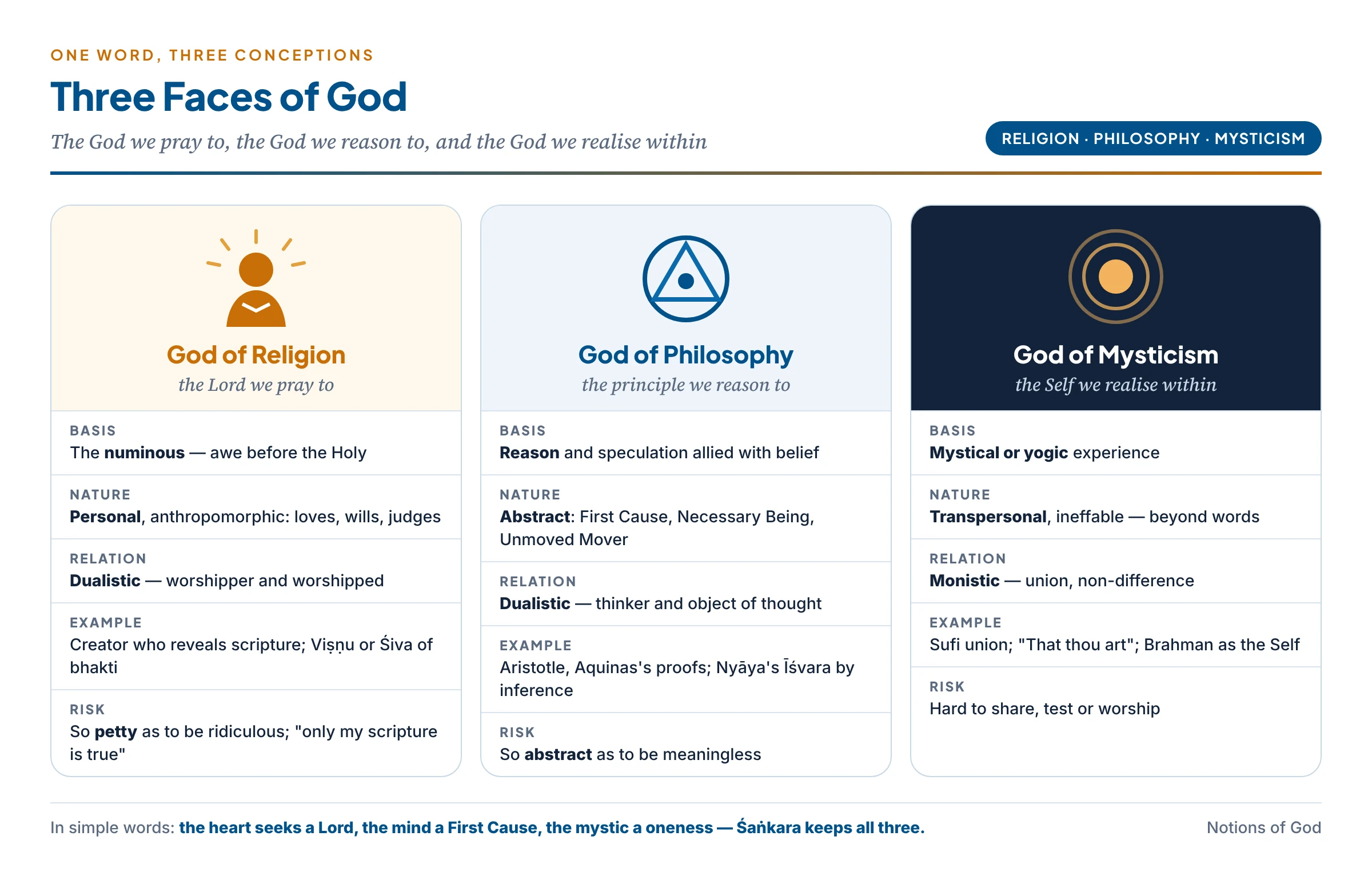
“God” is the name religions give to the supreme deity of the monotheistic worldview. But we should distinguish three ways of conceiving God.
| God of religion | God of philosophy | God of mysticism | |
|---|---|---|---|
| Basis | The numinous — awe before the holy | Intellectual speculation allied with belief | Mystical or yogic experience |
| Nature | Personal and anthropomorphic | Abstract principle | Transpersonal and ineffable |
| God–self relation | Dualistic | Dualistic | Monistic |
| Example | The Lord who creates, reveals scripture, rewards and punishes | Aristotle’s Unmoved Mover, the First Cause, the Necessary Being | The Sufi’s union with God; Advaita’s Brahman realised as one’s own Self |
- The God of religion. Most religions explain the meaning of life and the origin of the universe through a supernatural being who creates everything out of nothing, then reveals Himself through a scripture; whoever follows it is rewarded with heaven, whoever does not is punished. The weakness: since each religion has its own scripture, each believer tends to say only his religion is true — the root of holy wars, crusades, inquisitions and forced conversions. And when science threatens the believer’s picture, some build a pseudo-science of their own (so-called “creation science”).
- The God of philosophy. A far more abstract principle — the First Cause, the original Spirit, “that than which nothing greater can be conceived” — developed by medieval theologians seeking to support faith with reason. The criticism: the God of the philosophers can be so abstract as to be meaningless, just as the God of popular religion can be so petty as to be ridiculous.
- The God of mysticism. Theistic mysticism (Sufism, Christian mysticism) keeps a conception of God but sees God as ultimately non-different from the self; the goal is union with God. Alongside the personal God there is an impersonal Ultimate Reality — not an unknowable principle but one’s own innermost Self (or “not-self”, in Buddhism). This view is most clearly worked out in Indian traditions, but is also found in the West and the Middle East.
Indian Connect — Three faces in Indian thought
- God of religion: the Viṣṇu, Śiva or Devī of temple worship, purāṇic story and bhakti — personal, loving, accessible.
- God of philosophy: Nyāya’s Īśvara, proved by inference as the intelligent maker of the world; Yoga’s Puruṣa-viśeṣa reached through the idea of unsurpassed knowledge.
- God of mysticism: Advaita’s Brahman realised as “I am Brahman” (ahaṃ brahmāsmi); the Upaniṣadic “That thou art (tat tvam asi)“.
- Śaṅkara’s two standpoints hold all three together: the personal Īśvara for worship and the world, the impersonal Brahman for final realisation.
God as the Object of Religion: The Sacred and the Holy
- Why “sacred” and “holy” became general names. Because many religions have no God in the monotheistic sense, scholars sought a neutral name for “whatever religion is about“. “Sacred” and “Holy” came to serve.
- Durkheim: the sacred as “set apart”. For the sociologist Émile Durkheim, religion divides the world into the sacred (things set apart and forbidden) and the profane (ordinary things). A stone, a tree, a flag or a totem becomes sacred by being set apart by the community.
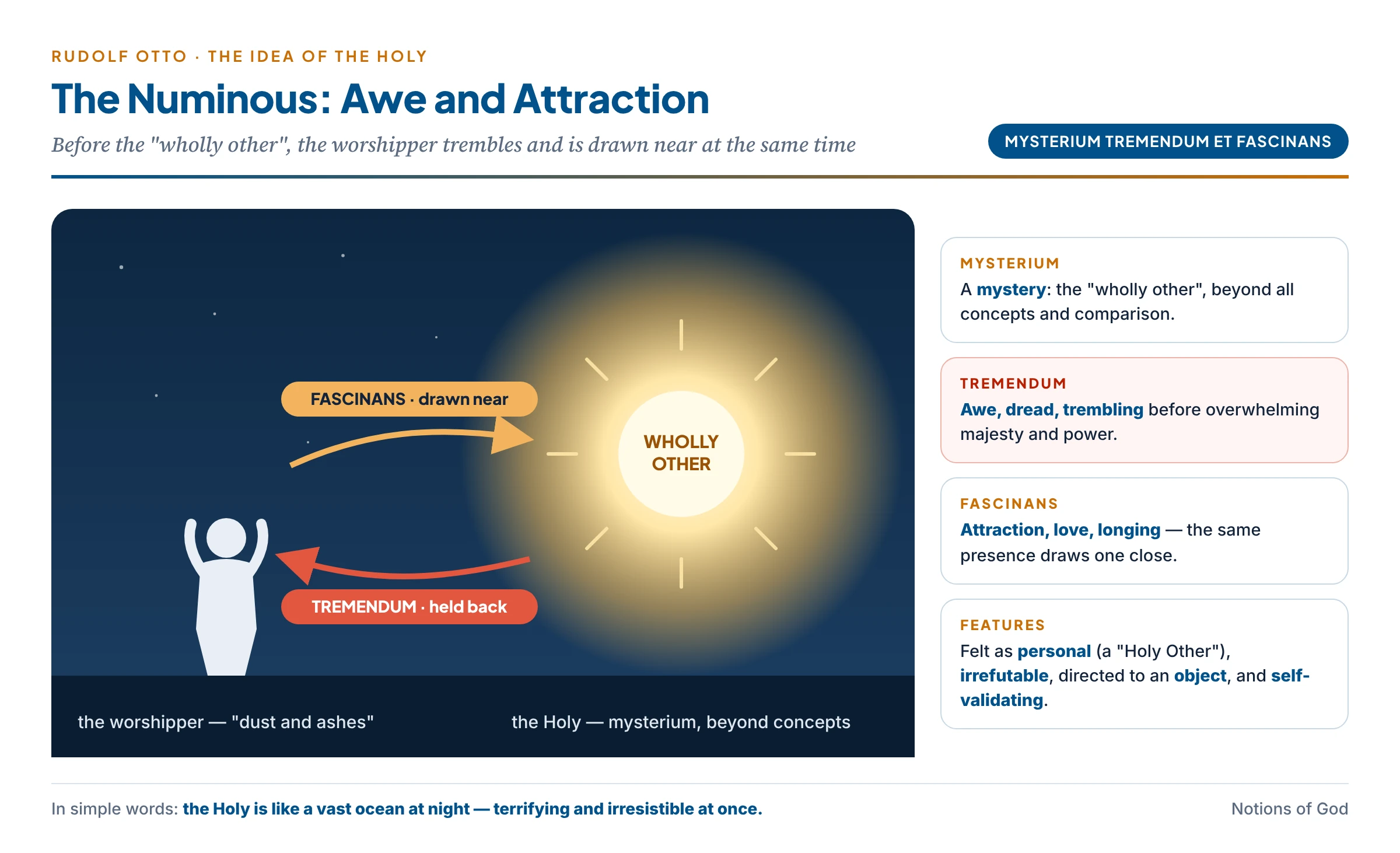
- Rudolf Otto: the Holy and the numinous. In The Idea of the Holy, Otto called the core of religious experience the numinous — the experience of a “wholly other” reality, mysterium tremendum et fascinans:
- Mysterium — it is a mystery, beyond concepts.
- Tremendum — it overwhelms, evoking fear, awe and trembling; one feels like “dust and ashes“.
- Fascinans — at the same time it attracts, fascinates and compels, drawing the worshipper near.
- Features of the numinous experience. It has a personal quality — communion with a “Holy Other”; it is felt as irrefutable; it is directed to an object (just as perception reveals a table or a rose, the numinous experience reveals the presence of God); and it is claimed to be self-validating. Otto held that the numinous is the one common factor in all religious experience, whatever the culture. It may focus on a person (Jesus, Kṛṣṇa), an object (an icon, a stone), or on nothing identifiable.
- Mircea Eliade: hierophany. The sacred shows itself (a “hierophany”) in ordinary things — a mountain, a river, a temple — which thereby become different from the profane world around them.
- Primitive religion. The sacred is felt in stones, amulets, bones of the dead, unusual animals, sacred trees, groves and shrines, and in earth, water, sky and stars; shamans are believed to commune with the holy.
- The holy in monotheism. For the Hebrew prophets God is “the Holy One“, “the high and lofty One who inhabits eternity”, whose “thoughts are not your thoughts” — the awareness of God as holy is awareness of One who is terrifyingly mysterious, before whom human beings can only bow in silent awe.
In simple words
A national flag is only cloth, yet soldiers salute it and people weep before it — it has been set apart (Durkheim’s “sacred”). Standing at the edge of the sea at night, you feel small and afraid, yet you cannot stop looking — that mix of dread and fascination is what Otto calls the numinous. The flag shows how a community makes things sacred; the sea shows how the Holy feels from inside.
Can God Be the Object of Religion?
- The case for “Yes”.
- In the Abrahamic religions and in theistic Hinduism, the object of worship is explicitly God — an eternal, omniscient, omnipotent, free and perfectly good Spirit who reveals himself (to Moses, Muhammad and Saint Paul unbidden; to mystics through discipline).
- Otto’s numinous has a personal quality — it is a meeting with a Holy Other, a self or will, which is what “God” names.
- Even where God is not named, the sacred is usually personalised in practice: Buddhists bow before the Buddha, Jainas before the Tīrthaṅkaras.
- The case for “Not necessarily”.
- Yandell’s five kinds of religious experience show that the object varies: monotheistic (God), nirvāṇic (Buddhist enlightenment), kevalic (Jaina omniscience), mokṣa (Hindu release from karma) and nature experiences.
- In Indian traditions the object of religious experience is often some basic fact or feature of reality — emptiness, the pure self, Brahman — rather than an entity separate from the universe.
- Buddhism, Jainism, Sāṃkhya and Pūrva Mīmāṃsā are religions without a creator God; their object is nirvāṇa, kaivalya, the moral law (karma) or the eternal Veda.
- Balanced view. “Sacred” and “Holy” are wider than “God”: every God is holy, but not everything holy is God. God can be the object of religion — and in theistic religions is its supreme object — but God is one form that the Sacred takes, not the only one. The “Sacred” is the genus, “God” one of its species.
Theological and Non-theological Concepts of God
- Theological (theistic) concept. God as conceived within a religion, chiefly through revelation and faith: a personal being whose names include creator, redeemer, sanctifier, lover, knower, the holy one, the powerful one, the eternal one. It is the God of Judaism, Christianity, Islam, and of Indian theists such as Rāmānuja (who held such a view with no knowledge of Abrahamic thought). This God is worshipped, prayed to, and acts in history.
- Non-theological (non-theistic) concepts. Conceptions of the ultimate or divine that depart from this personal, revealed God:
- Philosophical Absolutes reached by reason: Aristotle’s Unmoved Mover (pure thought thinking itself, unaware of the world), Spinoza’s God-or-Nature, Hegel’s Absolute Spirit, Bradley’s Absolute, Tillich’s “being-itself”, Whitehead’s God in process philosophy.
- Humanistic “gods”: Feuerbach (God is the projected essence of man), Comte’s Religion of Humanity, John Dewey (God as the active union of the ideal and the actual), Gandhi’s “Truth is God”, Einstein’s reverence for the order of nature.
- Indian non-theistic divines: the Mīmāṃsakas took the Veda — eternal, authorless sound — as the maximally significant reality, the sustaining feature of a well-ordered universe; Advaita takes the nondual Brahman, without qualities, as the real; Buddhists treated the Buddha as of maximal and final significance — single, omniscient, beyond time — while arguing against any eternal creator (Buddhism has been called “transpolytheistic” rather than simply atheistic, since it accepts gods like Indra and Brahmā but places them below the Buddha); Jainas honour the Tīrthaṅkaras and the liberated kevalin, perfect in knowledge, without making them creators.
| Theological concept | Non-theological concept | |
|---|---|---|
| Source | Revelation, scripture, faith | Reason, metaphysics, ethics, mystical insight |
| Nature of God | A person — knows, wills, loves | An Absolute, principle, ideal or process |
| Relation to the world | Creator, ruler, judge; acts in history | Ground, totality, law or ideal of the world; often does not “act” |
| Religious attitude | Worship, prayer, obedience, grace | Contemplation, knowledge, moral striving, intellectual love |
| Examples | Yahweh, the Trinity, Allah, Rāmānuja’s Nārāyaṇa | Aristotle’s Unmoved Mover, Spinoza, Hegel, Bradley, Tillich, Brahman, the Buddha, Dewey |
In simple words
The theological God is like a father you talk to; the non-theological God is like the law of gravity or the idea of justice — it explains and guides everything, but you do not pray to it for help. Both can be called “ultimate”, but only one can answer.
- Why the difference matters. The theological God answers the heart’s need for a Thou; the non-theological God answers the intellect’s need for an ultimate explanation free of human limitations. Most great systems try to hold both — Śaṅkara (Īśvara and Brahman), Hegel (religion as picture-thinking of what philosophy knows as the Absolute), Bradley (God as the highest appearance of the Absolute).
Is God Indispensable for Religion?
- Those who say “Yes.” Many Western thinkers hold that religion and God are inseparable: without a personal God there is no one to worship, pray to or receive grace from. Some even argue that Jainism and Buddhism, by worshipping images of Mahāvīra and the Buddha, have made gods of them.
- Those who say “No.” Non-theism simply rejects a personal God (omnipotent, omniscient, creator, sustainer and destroyer); it does not reject every supernatural or spiritual reality. Jainism, Buddhism and Sāṃkhya reject God but accept nirvāṇa, kaivalya, the law of karma, prakṛti and puruṣa. What religion needs is a supernatural or ultimate object of commitment, not necessarily a personal God; the Buddha and the Tīrthaṅkaras are objects of worship without being creators, so these are non-theistic religions. (This question is treated fully under Religion without God.)
- The concept of God as a “prerequisite”. For theistic religions God is the foundation (the object of faith, the source of revelation and moral law). Philosophically, however, the essence of religion is better described as an ultimate concern (Tillich) or an orientation to the Sacred; God is the most common but not the only form this takes.
Is Hinduism Polytheistic?
- Why it looks polytheistic. Hindus worship Viṣṇu, Śiva, Devī, Gaṇeśa, Sūrya, Hanumān and countless village deities; the Vedic hymns praise Agni, Indra, Varuṇa, Soma; temples, festivals and myths are full of gods.
- Why the label misleads.
- Henotheism. In the Vedic hymns, each god, while being praised, is treated as supreme and all-embracing — Max Müller’s henotheism or kathenotheism. A true polytheist ranks gods as limited departmental rulers; the Vedic poet does not.
- One Being, many names. The Ṛg Veda itself says “Ekaṃ sad viprā bahudhā vadanti” — “Truth is one; the wise call it by many names” (they call it Indra, Mitra, Varuṇa, Agni).
- One Brahman. The Nāsadīya hymn speaks of “That One (tad ekam)” before all gods; the Upaniṣads teach that Brahman is the one reality and that the gods are its forms or powers.
- Trimūrti and avatāra. Brahmā, Viṣṇu and Śiva are three functions (creation, preservation, dissolution) of one Supreme; the avatāras are descents of one God.
- Chosen deity (iṣṭa-devatā). A devotee worships the form he loves as the Supreme: “Whatever form a devotee seeks to worship with faith, I make that faith of his steady” (Gītā); “As people approach me, so do I accept them.”
- Philosophical schools. Nyāya, Yoga, Viśiṣṭādvaita, Dvaita and the bhakti schools are monotheistic (one Īśvara); Advaita is monistic (one Brahman); Sāṃkhya and Mīmāṃsā are non-theistic.
In simple words
One person may be “Papa” to his children, “Sir” to his students and “Ravi” to his friends — three names, one man. The Ṛg Vedic seer says the same of the Divine: Indra, Agni and Varuṇa are names, not separate beings.
- Conclusion. Hinduism is polytheistic in its forms of worship but monotheistic or monistic in its understanding of the Ultimate. It is better described as unity in diversity — one Reality worshipped in many forms. Thinkers like Vivekananda and Radhakrishnan put it so: the many gods are “many names and forms of the one God”. A purely polytheistic label also ignores the non-theistic and monistic strands within the same tradition.
Common confusion
Is henotheism just another word for polytheism? No. Polytheism believes in many gods, each limited to a department (sea, war, love). Henotheism also accepts many gods, but worships one as supreme — either one at a time (Max Müller’s kathenotheism) or one chosen god (a tribe’s god, an iṣṭa-devatā). Monotheism denies that other gods exist at all. Vedic religion is henotheistic and Upaniṣadic thought monistic; neither is simple polytheism.
Is God Dead? Nietzsche and the Living God of Faith
- Nietzsche’s announcement. In The Gay Science, a madman runs into the marketplace with a lantern in broad daylight crying “God is dead! … And we have killed him.” The crowd of unbelievers laughs; he says he has come too early.
- What it means. Not that a being has died, but that belief in God has lost its power in modern European culture — through science, historical criticism and secular life. The danger Nietzsche sees is nihilism: if the foundation of values is gone, values must be revalued, and humanity must create meaning (the Übermensch, “overman”).
- The believer’s reply. For the faithful, God is living: known in prayer, worship and experience, not as a hypothesis that science could kill. Kierkegaard (truth is subjectivity), Buber (God as the eternal Thou, met in relation, not as an object), Tillich (God as ultimate concern) and the bhakti saints insist that what Nietzsche buried was a cultural idol, not the living God.
- Balanced view. Nietzsche correctly diagnosed the decline of God as a public, cultural foundation; but he did not refute the possibility of a living relation to God. Both sides agree that a God reduced to a social convention is indeed “dead”.
Critical Evaluation
Objections to the Idea of God (Pūrva-pakṣa)
- Projection. Feuerbach: God is human qualities (love, wisdom, power) projected and worshipped; Freud: God is an exalted father; Marx: religion is “the opium of the people“.
- Anthropomorphism. Xenophanes mocked the Greeks: Ethiopians picture their gods dark, Thracians red-haired — and if horses had hands they would draw gods like horses. A personal God looks like man writ large.
- Meaninglessness. Logical positivists: “God exists” is neither tautology nor verifiable, so it is literally meaningless.
- Cultural evolution. Dawkins and Dennett: belief in God spreads as a meme, not because it is true.
- Indian critiques. Cārvāka rejects God as unperceived; Buddhists (e.g. Aśvaghoṣa) and Jainas argue that an eternal creator is incoherent; Sāṃkhya explains the world by prakṛti alone; Mīmāṃsā finds the Veda and karma sufficient.
Replies (Siddhānta)
- Origin is not validity. That belief has psychological or social causes does not show it is false (the “genetic fallacy”); our belief in the external world also has causes.
- Analogical language. Talk of God need not be crude anthropomorphism: God is “at least personal“, not “a person” magnified; words are used analogically.
- Verification is too narrow. The verification principle is itself unverifiable; religious statements may be meaningful in other ways — as eschatologically verifiable (Hick), or as a form of life (Wittgenstein).
- Properly basic belief. Plantinga argues that belief in God can be rational without proof, like belief in other minds.
- Experience. The near-universal witness of numinous and mystical experience is evidence that should not be dismissed.
Common confusion
Do “credo ut intelligam” and “fides quaerens intellectum” mark the difference between theology and philosophical scrutiny? No — some notes present them that way, but both are Anselm’s formulas for the same attitude: “I believe in order to understand” (credo ut intelligam) and “faith seeking understanding” (fides quaerens intellectum). Both describe theology — reason working within faith. Philosophy of religion, by contrast, examines religious claims without presupposing faith.
Critics and Defenders
Criticism — Critics of the idea of God
- Feuerbach, Marx, Freud — God as projection, opium, father-image.
- Xenophanes — gods made in human image.
- Logical positivists — “God” talk is meaningless.
- Nietzsche — “God is dead”; values must be revalued.
- Dawkins, Dennett — the “god meme” spreads like a virus.
- Cārvāka, Buddhist, Jaina, Mīmāṃsā — no creator God is needed or coherent.
Defence — Defenders and strengths
- Origin ≠ truth — psychological causes do not refute a belief.
- Hick, Plantinga — revived the rationality of belief; properly basic belief.
- Otto — the numinous as a universal, irreducible experience.
- Analogy (Aquinas) — avoids both crude anthropomorphism and empty abstraction.
- Wittgenstein — religious language has its own grammar and use.
- Indian theists (Nyāya, Rāmānuja) — rigorous rational defence of Īśvara.
Cross-Tradition Comparison
| Question | Western tradition | Indian tradition |
|---|---|---|
| Main conception | Monotheism — one personal Creator (Judaism, Christianity, Islam) | Many models — monistic (Advaita), theistic (Nyāya, Rāmānuja, Madhva), non-theistic (Sāṃkhya, Mīmāṃsā, Buddhism, Jainism) |
| Is God needed for religion? | Mostly yes | Not necessarily — karma, dharma, mokṣa and nirvāṇa can be ultimate |
| God of philosophy | Unmoved Mover, First Cause, Necessary Being | Nyāya’s Īśvara proved by inference; Yoga’s Puruṣa-viśeṣa |
| God of mysticism | Christian and Sufi union with God | Brahman realised as the Self; Upaniṣadic identity |
| Many gods | Rejected (polytheism = idolatry) | Accepted as forms of the One (henotheism, iṣṭa-devatā) |
| Object of religion | God, the Holy One | Brahman, Īśvara, nirvāṇa, kaivalya, dharma — the Sacred in many forms |
Indian Connect — Key takeaways
- Indian thought separates religion from belief in a creator more easily than the West — hence non-theistic religions are natural there.
- The Ṛg Vedic “One Truth, many names” anticipates the modern philosophical idea that the Sacred is wider than any one name for God.
- Śaṅkara’s two standpoints give a ready framework for holding the God of religion and the God of mysticism together.
Synthesis (Siddhānta)
- “God” is a family of ideas, not one idea. It ranges from the personal Lord of devotion to the abstract First Cause to the Self realised in mystical union. Much confusion — and much conflict between religions — comes from not noticing which God is being discussed.
- Philosophy of religion has a distinctive task. It is not prayer (religion) or defence of one faith (theology) but third-order analysis of all of them, combining sympathy with detachment.
- The Sacred is wider than God. God is the supreme object of theistic religion, but Buddhism, Jainism, Sāṃkhya and Mīmāṃsā show that religion can centre on nirvāṇa, kaivalya, dharma or the Veda. The Sacred is the genus; God is its richest species.
- Hinduism shows “one and many” together. Its many gods are forms of one Reality, making it a living example of unity in diversity rather than a simple polytheism.
- Contemporary relevance. In a plural world, clarifying these concepts is the first step to inter-religious dialogue — the ecumenical role of philosophy of religion. It also helps a secular, scientific culture see that the question of God is not only a scientific hypothesis but a question of meaning, value and ultimate concern.
“Truth is one; the wise call it by many names.” — Ṛg Veda
Previous Year Questions
- 2023What is Agnosticism? How do agnostics conceptualize the relation between religion and God? Discuss.
- 2020Critically examine the concept of God as prerequisite for a religion.
- 2018The terms ‘Sacred’ and ‘Holy’ have come to serve as generic names for the object of religion. Do you agree that one can have God as the object of religion? Discuss.
- 2018Is Hinduism poly-theistic? Give reasons for your answer.
- 2017What is a non-theological concept of God? How is it different from theological concept of God? Discuss with arguments.
- 2013Is God indispensable for religion?