

Caste Discrimination: Gandhi and Ambedkar.
Official Syllabus: Paper II, Section A, Unit 10
Seventy-five years after the Constitution abolished untouchability, caste has not disappeared; it has changed form. It has moved from wells and temples to ballot boxes, matrimonial sites, campuses, rental housing and hiring networks. Democracy has both weakened caste hierarchy and strengthened caste identity. This article examines caste and democracy, the role of caste in the body politic in an age of individualism and universal franchise (Srinivas, Kothari), the constitutional and legal scheme, the reservation debates and landmark judgments (from Champakam Dorairajan to Indra Sawhney, Janhit Abhiyan and Davinder Singh), the question which principle of justice can dissolve caste — with its continuity and hierarchy — (Rawls, Sen, Fraser, Young, Walzer, Ambedkar), whether rights can be sustained in a caste society, and the impact of caste discrimination and affirmative action on social harmony — ending with today’s debates: the 2027 caste census, campus equity rules, sub-classification and caste in the diaspora.
In simple words
A village once had one well that only upper castes could use. Today, by law, the well is open to all, a Dalit woman may be the village head, and her son may be a doctor in the city. Yet when that doctor wants to marry, rent a flat or join a family business network, he may find invisible walls. Caste in India today is like that well: the lock has been broken, but the path to it is still watched.
Context & Problem
The Paradox of Caste in Democracy
- Universal franchise and individualism: the Constitution treats each person as an individual citizen with one vote and equal rights — the opposite of caste’s birth-based groups.
- Yet caste persists — and even thrives in democratic politics, because elections reward numbers, and caste is a ready-made basis for mobilising numbers.
- Ambedkar’s prophecy: he warned that political equality would sit beside social and economic inequality — “a life of contradictions” — and that unless social democracy was built, political democracy would be in danger (Article 7).
- The philosophical questions:
- Has democracy dissolved caste or transformed it?
- Can rights survive where society denies equal status?
- Which principle of justice can dissolve a hierarchy that is continuous (inherited across generations) and graded?
- Do the remedies (reservation, caste data) heal or harden caste?
Core Doctrine
Is There an Impact of Caste Discrimination on Democracy?
Negative impact
- Fraternity undermined: democracy needs fellow-feeling among citizens; caste divides them into closed groups (Ambedkar’s social endosmosis, Article 6).
- Vote banks and caste parties: candidates are chosen and votes sought on caste lines; policy debate gives way to identity bargaining.
- Unequal participation: in many villages Dalits face intimidation at polling time; women sarpanches from SC communities may be proxies or face obstruction.
- Atrocities and impunity: caste violence and low conviction rates erode faith in the rule of law.
- Majoritarian danger: where majorities are caste or communal blocs, minorities’ rights depend on goodwill (Ambedkar’s fear of communal majorities).
- Merit and efficiency debates poison public institutions with suspicion.
Positive impact (democracy acting on caste)
- Representation: reserved seats in Parliament, assemblies and panchayats (Articles 330, 332, 243D) have brought Dalits and Adivasis into power; a Dalit has been President of India and Chief Justice.
- Political assertion: lower castes have used numbers to win power (the Bahujan and backward-caste movements) — a democratic upsurge of the once-excluded.
- Weakening of ritual hierarchy: caste as purity–pollution has weakened; caste as interest group has grown — a shift from hierarchy to difference.
- Legal equality: courts and commissions give the oppressed remedies unavailable before.
Caste in the Body Politic — in an Age of Individualism and Universal Franchise
1. M.N. Srinivas — dominant caste, sanskritisation, vote banks
- Dominant caste: a caste is dominant in a region when it has numerical strength, economic power (especially land), political power, a fairly high ritual status, and Western education and modern jobs (for example, Jats, Marathas, Reddys, Vokkaligas, Patidars in their regions). Dominant castes, not necessarily the Brahmins, control village power.
- Sanskritisation: lower castes try to rise by adopting the customs, rituals and beliefs of higher castes (vegetarianism, sacred thread) — mobility within the caste frame, not its abolition.
- Vote bank: Srinivas coined the term for a bloc of voters, often of one caste, delivered by a local leader.
2. Rajni Kothari — the politicisation of caste (Caste in Indian Politics, 1970)
- The question is not whether caste is destroying democracy but what democracy is doing to caste.
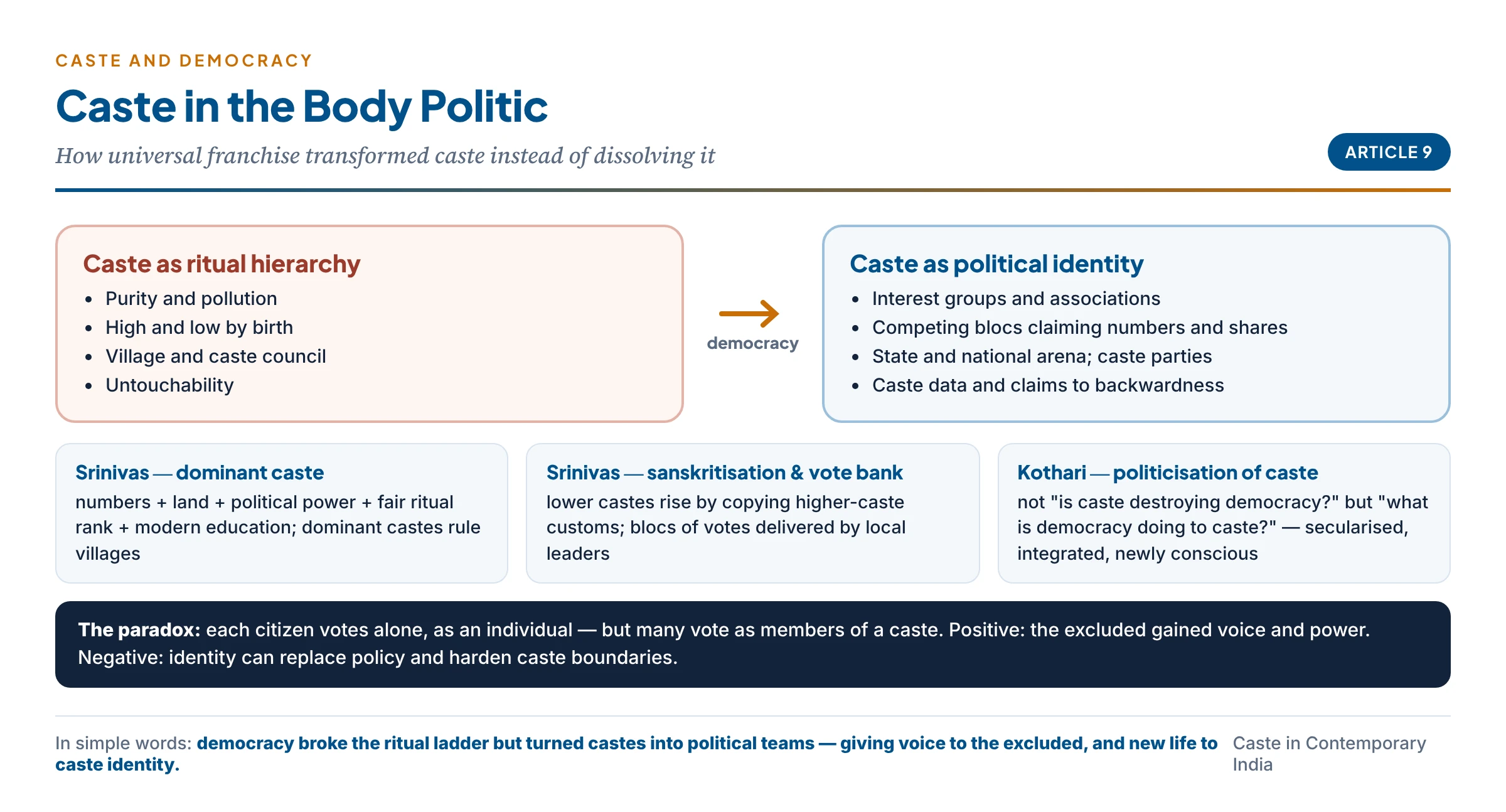
- Democratic politics politicises caste: castes form associations, federations and parties; caste becomes an interest group competing for power and resources.
- Caste is thereby secularised — its ritual meaning weakens; it is integrated into the national political system; and lower castes acquire new consciousness and organisation.
- Conclusion: caste survives, but as a modern political identity rather than a sacred hierarchy.
3. The answer to the paradox
- Individualism and franchise have not abolished caste; they have changed its role:
- From hierarchy (high and low) to competing identity groups (each claiming numbers and share).
- From ritual to political and economic interest.
- From the village to the state and nation (caste federations, caste parties, caste census).
- Two evaluations:
- Positive: caste mobilisation gave a voice to the excluded and deepened democracy — a “silent revolution” of the backward and Dalit castes.
- Negative: it can turn citizens into blocs, reward identity over policy, and harden the very boundaries Ambedkar wanted to dissolve.
In simple words
Think of caste in politics like a family WhatsApp group before an election. No one forces you to vote with the group; you vote alone, in secret, as an individual. But the group decides whom to “support”, shares who has “helped our people”, and your standing in the family may depend on what you do. Universal franchise gave each person a vote; caste gave many voters a group to answer to.
The Constitutional and Legal Scheme against Caste Discrimination
1. Equality and non-discrimination
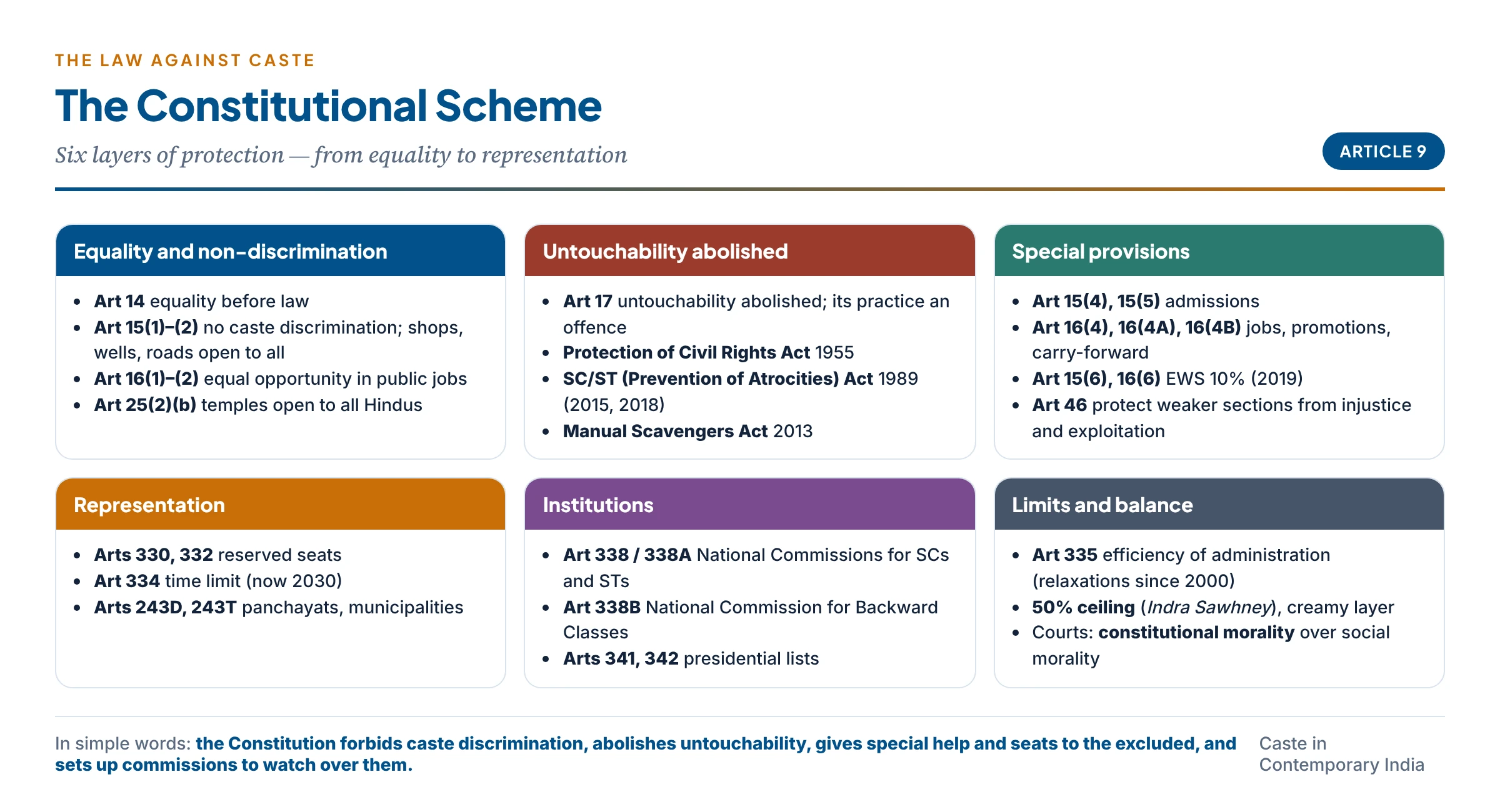
- Article 14 — equality before law and equal protection of the laws.
- Article 15(1)–(2) — no discrimination on grounds of religion, race, caste, sex or place of birth; access to shops, wells, tanks, roads and public places for all.
- Article 16(1)–(2) — equality of opportunity in public employment.
- Article 17 — “Untouchability is abolished and its practice in any form is forbidden”; its enforcement is an offence.
- Article 25(2)(b) — throwing open Hindu religious institutions to all classes and sections of Hindus.
2. Special provisions (affirmative action)
- Article 15(4) — special provisions for socially and educationally backward classes, SCs and STs (added by the First Amendment, 1951, after State of Madras v. Champakam Dorairajan); Article 15(5) — reservation in admissions, including private unaided institutions (2005).
- Article 16(4) — reservation in appointments for backward classes inadequately represented; 16(4A) — reservation in promotions for SCs/STs (1995), with consequential seniority (2001); 16(4B) — carry-forward of unfilled vacancies (2000).
- Articles 15(6) and 16(6) — 10% reservation for the economically weaker sections (EWS) not covered by other reservations (103rd Amendment, 2019).
- Article 46 — the state shall promote the educational and economic interests of the weaker sections, especially SCs and STs, and protect them from social injustice and exploitation.
- Articles 330 and 332 — reserved seats in the Lok Sabha and state assemblies; Article 334 — time limit, repeatedly extended (now to 2030); Articles 243D and 243T — reservation in panchayats and municipalities.
- Article 335 — claims of SCs/STs in services to be considered consistently with efficiency of administration (with relaxations allowed since 2000).
- Article 338 / 338A — National Commissions for Scheduled Castes and Scheduled Tribes; 338B — National Commission for Backward Classes (2018).
- Articles 341 and 342 — presidential lists of SCs and STs.
3. Laws
- Protection of Civil Rights Act, 1955 (originally the Untouchability (Offences) Act) — punishes the practice of untouchability.
- SC/ST (Prevention of Atrocities) Act, 1989 — special offences, special courts, no anticipatory bail; strengthened in 2015; after the Supreme Court diluted it in Subhash Kashinath Mahajan (2018), Parliament restored its rigour the same year, and the Court upheld the amendment in Prithvi Raj Chauhan (2020).
- Prohibition of Employment as Manual Scavengers and their Rehabilitation Act, 2013; the Supreme Court has ordered compensation for sewer deaths (enhanced to ₹30 lakh in Dr. Balram Singh, 2023).
The Reservation Debates and Landmark Judgments
| Year | Case / event | What it decided |
|---|---|---|
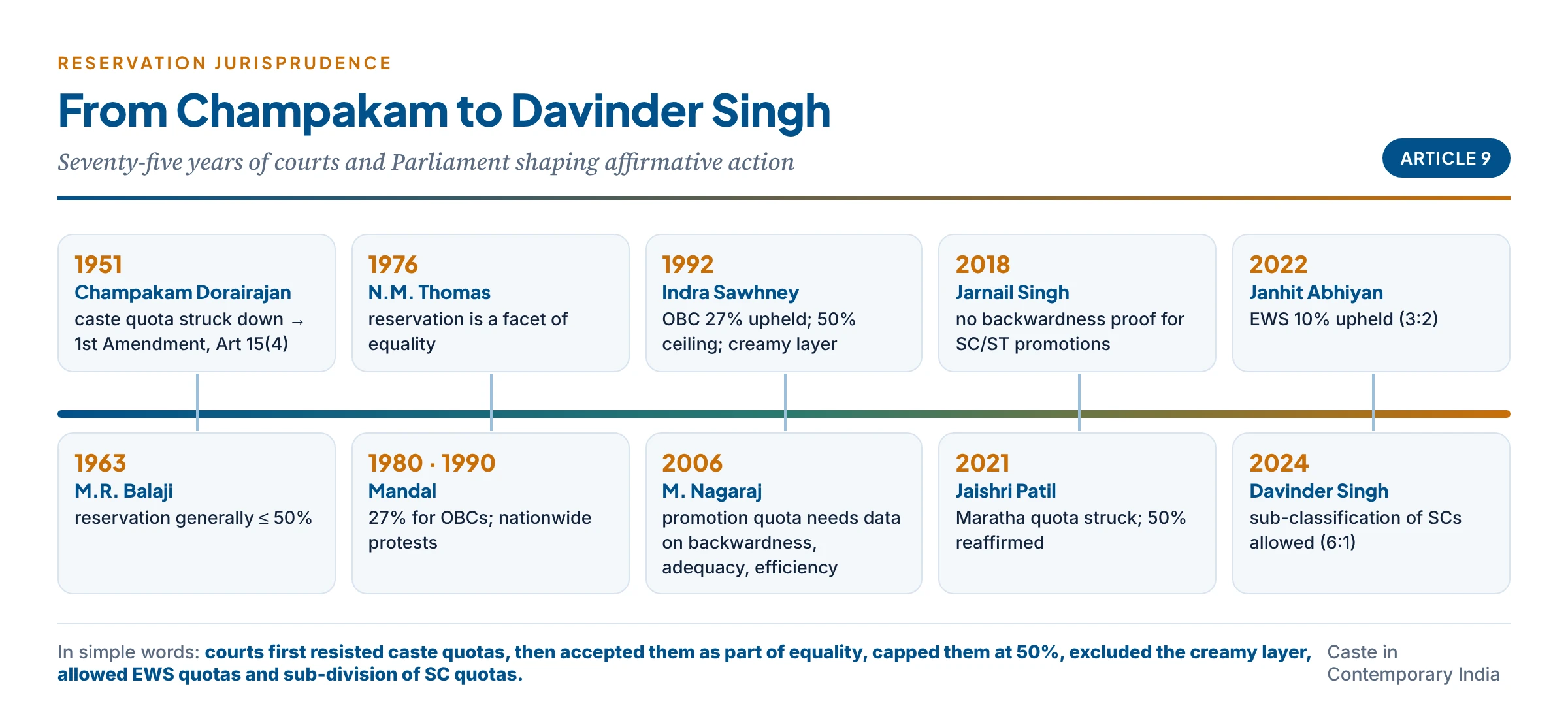
| 1951 | Champakam Dorairajan | Caste-based admissions quota struck down → First Amendment added Article 15(4) |
| 1963 | M.R. Balaji | Reservation should generally not exceed 50% |
| 1976 | N.M. Thomas | Reservation is a facet of equality (substantive equality), not an exception to it |
| 1980 · 1990 | Mandal Commission report; implementation | 27% reservation for OBCs in central jobs; nationwide protests |
| 1992 | Indra Sawhney | OBC reservation upheld; 50% ceiling (save extraordinary cases); creamy layer excluded for OBCs; no reservation in promotions (later restored by amendment) |
| 2006 | M. Nagaraj | Promotion reservation valid if the state shows backwardness, inadequate representation and efficiency |
| 2018 | Jarnail Singh | No need to prove backwardness of SCs/STs for promotions; creamy layer principle can apply to promotions |
| 2021 | Jaishri Patil (Maratha case) | Maratha reservation struck down; 50% ceiling reaffirmed |
| 2022 | Janhit Abhiyan | EWS 10% upheld (3:2) — economic criterion valid; exclusion of SC/ST/OBC from EWS upheld |
| 2024 | State of Punjab v. Davinder Singh | Sub-classification of SCs permitted (6:1) — most backward SC groups can get a separate share; several judges suggested a creamy layer for SCs/STs |
The arguments for affirmative action
- Compensatory (corrective) justice: centuries of untouchability, denial of education and property are a historical wrong requiring restitution — Nozick’s own principle of rectification points this way.
- Distributive justice (fair equality of opportunity): formal equality is hollow when one group starts the race with inherited deficits; reservation levels the field (Rawls).
- Democratic legitimacy and social cohesion: institutions monopolised by a few castes lack legitimacy; diversity in administration, judiciary and universities builds fraternity and trust.
- Substantive equality: equality means treating unequals unequally to make them equal (N.M. Thomas).
The arguments against — and replies
- Merit and efficiency: reservation lowers standards.
- Reply: “merit” is shaped by inherited cultural capital — private tuition, English, family networks; what tests measure is partly privilege. Studies of railways and public services have not found a loss of efficiency from reservation.
- Reverse discrimination: it punishes today’s individuals for ancestors’ wrongs.
- Reply: it does not punish anyone; it dismantles structural advantages that today’s privileged still enjoy.
- Creamy layer capture: benefits go to the better-off within reserved groups.
- Reply: hence the creamy layer for OBCs and the 2024 permission for sub-classification of SCs.
- It keeps caste alive: using caste as a category perpetuates caste consciousness.
- Reply: caste is kept alive by discrimination; remedies end when parity is reached — Ambedkar saw them as temporary means to social endosmosis.
- Competitive backwardness: dominant castes (Jats, Patidars, Marathas) agitate to be called “backward”.
- Reply: a real problem — answered by data, ceilings and sub-classification rather than by abolishing reservation.
In simple words
Two runners line up for a 100-metre race. One has had a personal trainer since childhood; the other’s legs were chained until last year. Removing the chain and saying “now the race is fair” is formal equality. Giving the second runner a few metres’ start, training and good food until both can truly compete is substantive equality. Reservation is that start; the goal is a race in which no start is needed.
Common confusion
Did Ambedkar want reservation to be permanent? Not for political seats. Ambedkar accepted a time limit (ten years, in the original Article 334) for reserved seats in legislatures, expecting social conditions to change; Parliament has since extended it repeatedly (now to 2030). Reservation in education and public employment (Articles 15(4), 16(4)) carries no time limit in the Constitution. Ambedkar’s aim was not permanent quotas but a society of social endosmosis in which they would no longer be needed.
Which Principle of Justice Can Dissolve Caste?
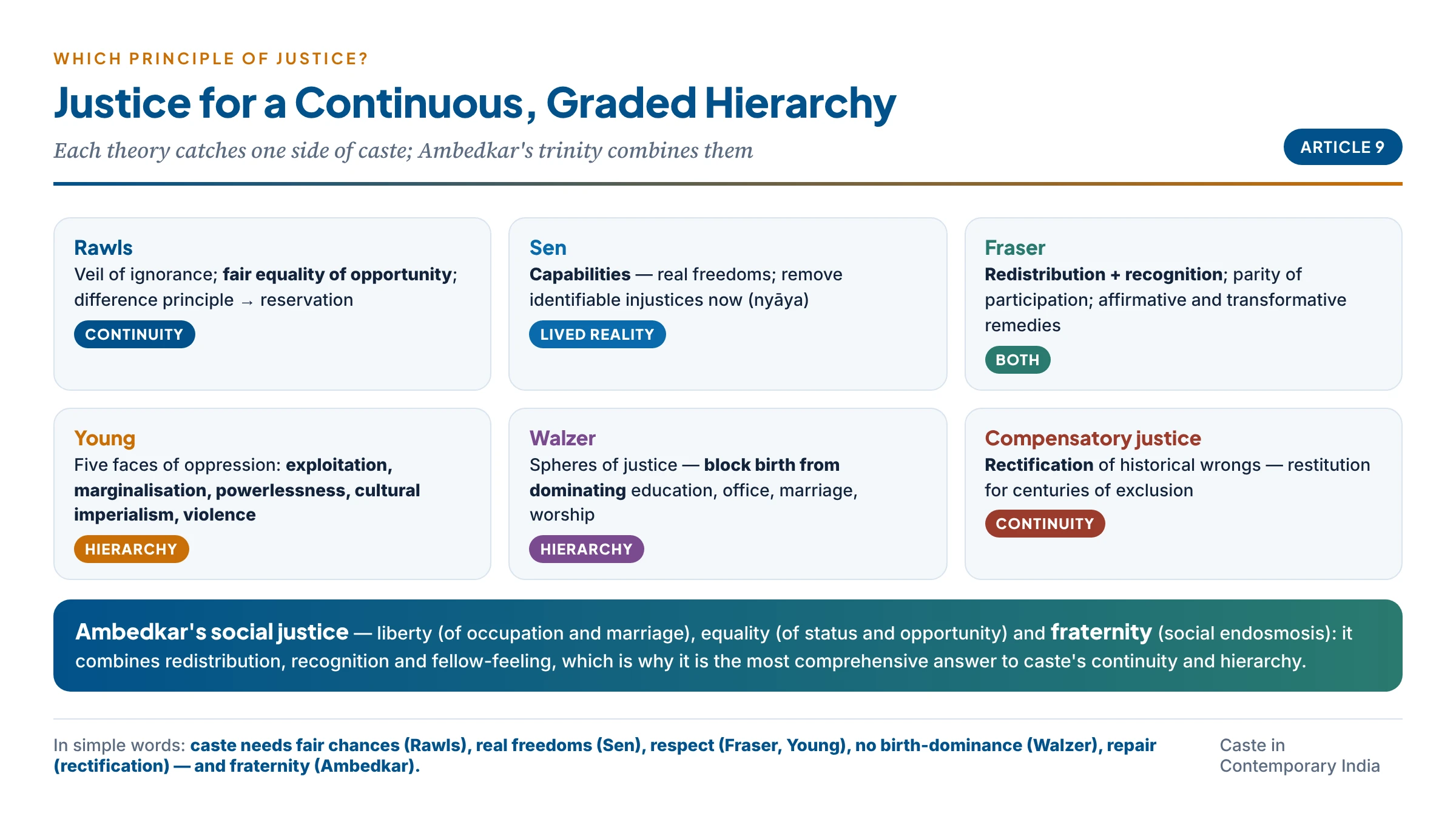
Caste discrimination has two marks: continuity (inherited disadvantage across generations) and hierarchy (graded ranking of groups). A principle of justice adequate to it must tackle both.
1. Rawls — justice as fairness
- Behind a veil of ignorance, not knowing whether one would be born a Brahmin or a Dalit, no rational person would choose a caste order.
- Fair equality of opportunity — people with similar talents should have similar chances, whatever their birth — directly condemns caste; the difference principle — inequalities are just only if they benefit the least advantaged — justifies reservation and targeted spending.
- Strength: breaks continuity through redistribution of opportunities. Limit: Rawls focuses on distribution of goods; caste is also about respect and status.
2. Amartya Sen — capabilities and comparative justice
- Justice is measured by people’s real freedoms (capabilities) — to be educated, healthy, mobile, respected. Caste reduces Dalits’ capabilities even where formal rights exist.
- Sen’s comparative approach (nyāya, not only nīti): remove identifiable injustices — untouchability, manual scavenging, segregation — without waiting for a perfect theory.
3. Nancy Fraser — redistribution and recognition
- Injustice has two dimensions: maldistribution (economic) and misrecognition (status). Caste is a clear case of both.
- Her test is parity of participation — can all participate in social life as peers?
- Affirmative vs transformative remedies: affirmative remedies correct outcomes without changing the structure (reservation, scholarships); transformative remedies change the structure that produces them (abolishing hereditary occupation, deconstructing caste identities, inter-caste marriage). Caste needs both — reservation now, transformation for the end.
4. Iris Marion Young — the five faces of oppression
- Oppression is not only unequal shares but a structure with five faces: exploitation, marginalisation, powerlessness, cultural imperialism and violence. Caste displays all five — hereditary labour (exploitation), exclusion (marginalisation), no voice (powerlessness), stigmatised culture (cultural imperialism), atrocities (violence). Justice must address each.
5. Michael Walzer — spheres of justice
- In a just society, success in one sphere (birth, money) must not dominate others (education, office, marriage, worship). Caste is the extreme case of birth dominating every sphere; justice means blocking that dominance.
6. Ambedkar — social justice through liberty, equality, fraternity
- Equality of status and opportunity; liberty of occupation and marriage; and — what most Western theories underplay — fraternity (social endosmosis). Without fraternity, Rawlsian redistribution and Fraserian recognition remain fragile; with it, caste dissolves.
Which is most helpful?
- No single principle is enough. Caste’s continuity calls for distributive and compensatory justice (Rawls, rectification); its hierarchy calls for recognition and anti-oppression justice (Fraser, Young, Walzer); its lived reality calls for capability and comparative justice (Sen); and its final dissolution calls for Ambedkar’s fraternity. The most helpful single principle is therefore Ambedkar’s social justice — because it combines redistribution, recognition and fraternity.
In simple words
Imagine a family that, for ten generations, was barred from school and land. Giving the eleventh generation one scholarship helps (redistribution), but if teachers still call the child “dirty”, it is not enough (recognition). If the child also cannot marry, rent or eat with others, something deeper is missing (fraternity). Caste needs all three remedies at once — which is why no single Western theory is sufficient and Ambedkar’s trinity is so often preferred.
Can the Conception of “Rights” Be Sustained in a Society Characterised by Caste Discrimination?
The problem
- Rights presuppose equal moral status — each person is a bearer of claims others must respect. Caste denies this equal status at its root: it ranks persons by birth.
- Rights on paper, denial in practice: a Dalit has the legal right to enter a temple or draw water, but social boycott, violence or economic pressure may make the right unusable.
- Ambedkar’s warning: rights are protected not by law alone but by the social and moral conscience of society; if society refuses to recognise the rights that law enacts, they remain insecure.
How rights can be sustained
- Legal enforcement with teeth — special laws, special courts, accountable police (the PoA Act).
- Group-sensitive rights — reservation and representation make equal rights effective for unequal groups (SP Unit 03).
- Economic security — land, education and work give people the power to use their rights.
- Social reform — education, inter-caste marriage, campaigns — to build the conscience that protects rights.
- Constitutional morality — courts upholding dignity against social majorities (Article 7).
- Conclusion: rights can be sustained, but only if law, power and conscience work together; rights alone, in a caste society, are necessary but not sufficient.
The Impact of Caste Discrimination — Affirmative or Otherwise — on Social Harmony
Caste discrimination itself
- Produces resentment, fear, humiliation and violence; divides society into suspicious blocs; wastes human talent; damages national unity and fraternity.
Affirmative action
- Positive effects on harmony:
- Creates a Dalit and backward-class middle class — teachers, officers, doctors — whose presence changes perceptions.
- Gives the excluded a stake in the system — reducing alienation and the appeal of violent movements.
- Diverse institutions command more trust.
- Negative effects (or perceived):
- Backlash — anti-reservation agitations (1990 Mandal protests, earlier ones in Gujarat in the 1980s).
- Competitive backwardness and new demands (Jats, Patidars, Marathas).
- Hardening of caste identity in politics and on campuses.
- Resentment among the excluded poor of non-reserved groups — partly addressed by EWS reservation.
- Balance: affirmative action produces short-term friction but long-term integration; harmony bought by ignoring injustice would be the “peace” of the graveyard Ambedkar warned against. True harmony requires justice first, then fraternity.
Contemporary Developments
- Caste census: the Union Cabinet decided (30 April 2025) to include caste enumeration in the 2027 Census — the first since Independence (the last full caste count was in 1931). The second phase (population enumeration) begins in February 2027; caste will be recorded through an open column for those outside the SC/ST lists. States such as Bihar (2023) and Telangana (2024) conducted their own caste surveys. Supporters see data for justice; critics fear the hardening of caste identity.
- Sub-classification: after Davinder Singh (2024), states may give the most marginalised SC groups a separate share — a debate within the oppressed about equity among the unequal.
- Campus discrimination: after the deaths of Rohith Vemula (2016) and Payal Tadvi (2019), the UGC notified equity regulations in January 2026; the Supreme Court kept them in abeyance (29 January 2026) over concerns about vagueness and a definition of caste-based discrimination limited to SC, ST and OBC students, and revived the 2012 rules meanwhile; in August 2026 the Centre told the Court the rules were under reconsideration.
- Persistence of atrocities: 57,789 cases of crimes against SCs were registered in 2023 (NCRB).
- Manual scavenging and sewer deaths continue despite the 2013 law.
- Diaspora caste: in 1916 Ambedkar predicted that if Hindus migrated to other regions, Indian caste would become a world problem; in 2023 Seattle banned caste discrimination, and the issue is debated in US universities and companies.
- Private sector: as public jobs shrink, the debate on diversity and affirmative action in private employment grows.
Indian Connect — Indian Connect — Ambedkar’s two warnings come true
- “A life of contradictions”: political equality (one person, one vote) beside social and economic inequality (one person, unequal value) — exactly the paradox of caste in the body politic.
- “Indian caste would become a world problem”: the 1916 prediction of Castes in India is now visible in the debates in Seattle, California and global companies.
- Both point to his answer: social democracy — fraternity, social endosmosis — as the precondition of a democracy that lasts.
Critical Evaluation
Critics and Defenders
Criticism — Critics of current caste policy
- Merit-based critics: reservation compromises efficiency and individual merit.
- Liberal individualists: policy should be caste-blind and need-based; caste categories entrench caste.
- Some Dalit and Ambedkarite critics: reservation has become an affirmative palliative that leaves the structure — land, endogamy, private capital — untouched; it co-opts a creamy layer.
- Critics of identity politics: caste mobilisation hardens boundaries and turns citizens into blocs.
Defence — Defenders of current caste policy
- Compensatory and distributive justice: rectifying historical wrongs, levelling opportunity (Rawls, rectification).
- Substantive equality: treating unequals unequally (N.M. Thomas); merit is partly inherited privilege.
- Democratic legitimacy: diverse institutions build trust and fraternity.
- Evidence: representation has produced a Dalit middle class and political voice without loss of efficiency.
- Course-correction is built in: creamy layer, sub-classification, EWS, data from the caste census.
Cross-Tradition Comparison
| Theme | Indian context | Western parallel |
|---|---|---|
| Affirmative action | Reservation (Articles 15(4), 16(4), 330, 332) | US affirmative action; the US Supreme Court ended race-conscious admissions in SFFA v. Harvard (2023) |
| Substantive equality | N.M. Thomas, Ambedkar | Rawls‘s fair equality of opportunity; Dworkin on affirmative action |
| Recognition | Dalit dignity, end of untouchability | Fraser, Honneth, Taylor |
| Oppression as structure | Graded inequality | Young‘s five faces of oppression |
| Blocking dominance | Birth dominating all spheres | Walzer‘s complex equality |
| Group-based politics | Caste parties, vote banks | Ethnic and racial politics; “identity politics” debates |
Synthesis (Siddhānta)
- Caste discrimination weakens democracy (fraternity, participation, rule of law), yet democracy has transformed caste — from ritual hierarchy to political identity (Srinivas’s dominant castes and vote banks; Kothari’s politicisation of caste). In an age of individualism and universal franchise, caste survives as a group to answer to.
- The constitutional scheme — Articles 14–17, 25(2)(b), 46, 330–342 — and laws (PCR Act, PoA Act, Manual Scavengers Act) form one of the world’s most extensive anti-discrimination regimes; reservation jurisprudence has evolved from Champakam Dorairajan to Indra Sawhney, Janhit Abhiyan and Davinder Singh.
- Justice for caste must address continuity (Rawlsian and compensatory redistribution) and hierarchy (recognition, anti-oppression, blocking dominance), measured in capabilities, and completed by fraternity — which makes Ambedkar’s social justice the most comprehensive principle.
- Rights can be sustained in a caste society only when law, economic power and social conscience work together.
- Affirmative action causes short-term friction but long-term integration; real harmony needs justice first.
- Contemporary relevance: the 2027 caste census, sub-classification, campus equity rules, persistent atrocities, manual scavenging and diaspora caste show that Ambedkar’s “life of contradictions” is still being lived — and that his remedy, social democracy, is still the task.
“If Hindus migrate to other regions on earth, Indian caste would become a world problem.” — B.R. Ambedkar, Castes in India (1916)
Previous Year Questions
- 2022In the age of individualism and universal franchise, what role does caste play in body-politic? Discuss.
- 2014If caste discrimination has any continuity and hierarchy, which principle of justice can dissolve this problem?
- 2013Is there any impact of caste discrimination on democracy in Indian context?
- 2011Which principle of justice can, in your view, be most helpful in addressing the issues related to caste discrimination and why?
- 2011Can the conception of ‘rights’ of citizens be sustained in a society characterized by caste discrimination? Discuss.
- 2008Discuss the impact of caste-discrimination — affirmative or otherwise — on the harmony of the society as a whole.