

Sovereignty: Austin, Bodin, Laski, Kautilya.
Official Syllabus: Paper II, Section A, Unit 2
Harold J. Laski (1893–1950) is the best-known voice of political pluralism — the view that sovereignty is not one, absolute and indivisible, but shared among the many associations in which people live their lives. A person belongs to a family, a religious community, a trade union, a university, a profession and a state; each claims loyalty, and the state’s claim is not automatically the strongest. For Laski the monistic doctrine of sovereignty was a legal fiction that hid how power really works and gave the state a dangerous moral blank cheque. “Because society is federal,” he wrote, “authority must also be federal.” This article covers Laski’s life and the origins of pluralism, his pluralist view of state and society, the grounds on which he rejected absolute sovereignty and attacked Austin, what role he left for the state, how his thought changed towards Marxism, the other pluralists (MacIver, Duguit, Figgis, Barker, Cole), and the question whether his position is satisfactory.
In simple words
Think of a college student. She obeys her parents at home, the coach on the cricket ground, her religious community at the temple or mosque, the principal in college and the state on the road. Each has authority in its own sphere, and none of them — not even the state — can claim to decide everything in her life. If the state told her what to believe about God, what to study or whom to marry, she would rightly say: “That is not your business.” This everyday experience is the core of Laski’s pluralism.
Context & Problem
Life and Works
- Born in Manchester in 1893; studied at Oxford; taught at McGill University and Harvard (1916–1920), where he wrote his first books on sovereignty.
- London School of Economics from 1920 (professor of political science from 1926) — one of the most influential teachers of his generation; many students from India and other colonies studied under him, among them V. K. Krishna Menon.
- Public life. A leading member of the Fabian Society and the British Labour Party (chairman, 1945–46).
- Main works on sovereignty:
- Studies in the Problem of Sovereignty (1917)
- Authority in the Modern State (1919)
- The Foundations of Sovereignty and Other Essays (1921)
- A Grammar of Politics (1925) — his most systematic work
- Liberty in the Modern State (1930); The State in Theory and Practice (1935), marking his turn towards Marxism
- International politics. He wrote extensively on world affairs between the wars. Early on he was hopeful about the League of Nations; by the late 1920s he became more pessimistic and radical, arguing that the sovereign-state system could not be transcended without moving beyond capitalism. His work is often overlooked today, but the questions he asked about state power, markets and global order remain live.
Why Pluralism Arose
- Against the “absolute state”. In the nineteenth century, idealist philosophers following Hegel (in Britain, Bernard Bosanquet) described the state as the highest expression of reason and morality, the fountain of all social and moral values. Combined with Austin’s legal monism, this produced the picture of an all-powerful, all-wise state.
- Capitalism and state power. The rise of industrial capitalism, joined to a theory of the absolute state, seemed to threaten the freedom of ordinary people.
- The First World War. States demanded that citizens sacrifice everything — life, conscience, property — for the nation. The suffering this caused led many thinkers to see the state as only a partial expression of human social life, with a limited sphere.
- Intellectual sources:
- Otto von Gierke and F. W. Maitland — groups such as guilds, churches and towns have a real personality of their own; they are not created by the state.
- J. N. Figgis (Churches in the Modern State, 1913) — churches have their own life and law, which the state must respect.
- Léon Duguit — law springs from social solidarity, not from the state’s will; the state itself is bound by law.
- William James — the universe is pluralistic, not a single block; Laski carried the idea into politics.
Common confusion
Did Austin’s theory glorify the state as the fountain of all moral values? Not quite — some notes say so. Austin’s theory is legal: it says who makes law, and deliberately keeps morality out. It was the idealist tradition of Hegel and Bosanquet that glorified the state as the embodiment of reason and morality. The pluralists attacked both — Austin’s legal monism (one unlimited law-maker) and the idealists’ moral monism (the state as the highest good). Laski’s critique joins them because together they gave the state both unlimited power and unlimited moral authority.
Core Doctrine
The Pluralist Picture of State and Society
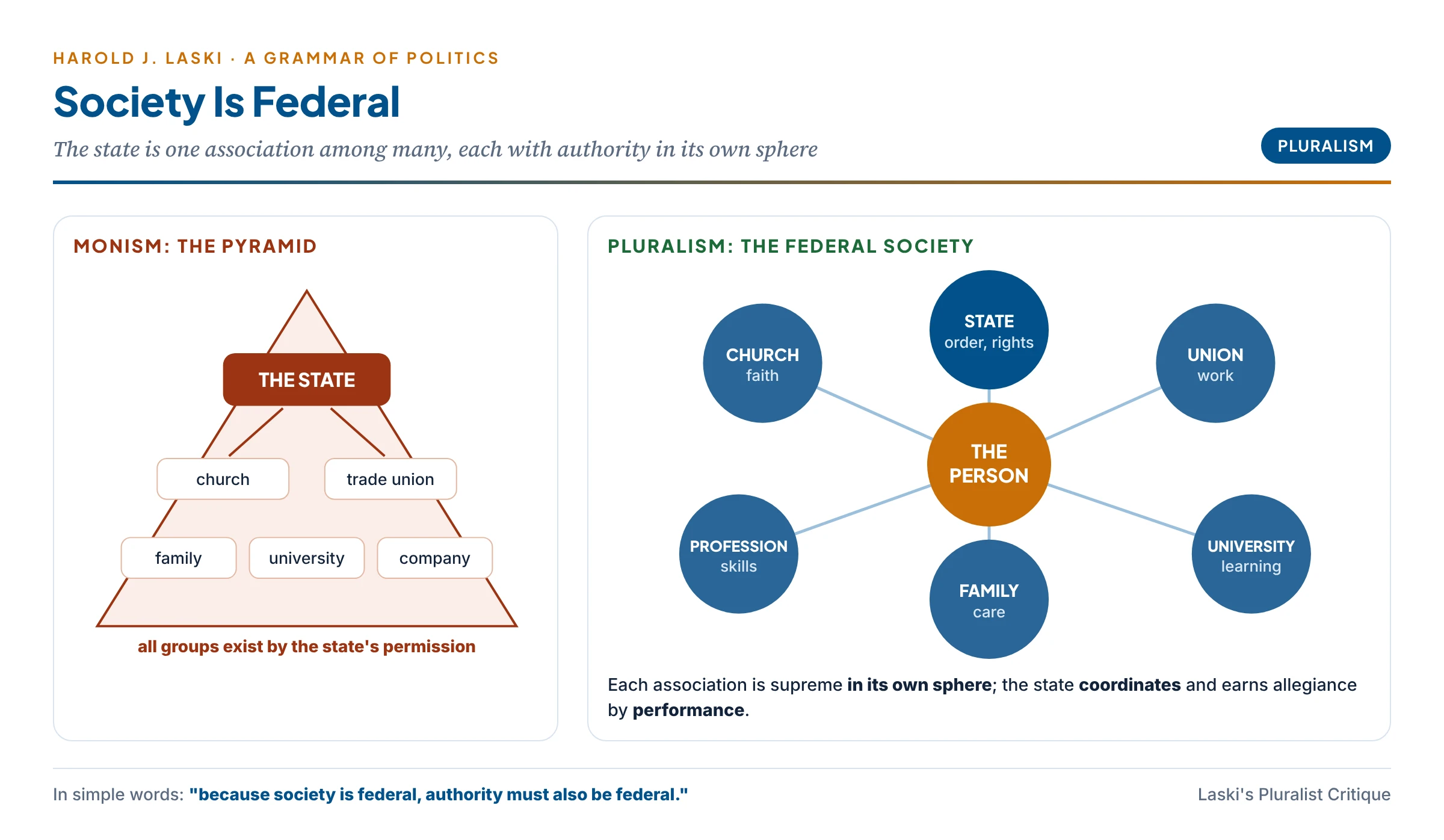
- Society is wider than the state. Society is the whole network of human relationships; the state is one organisation within it, with a particular function — maintaining order and securing the conditions of a good life.
- Society is federal in structure. It is made up of many associations — families, churches, trade unions, professional bodies, universities, clubs, cooperatives — each serving a different human need.
- The state is one association among many. It competes with other associations for people’s loyalty and obedience. It has no automatic claim to be supreme over them in every matter.
- Associations are real. Groups are not mere creations or agents of the state; they arise from human needs and have their own life, rules and authority.
- Sovereignty is divisible. Each association is “sovereign” in its own sphere — a church in matters of faith, a union in matters of work, a university in matters of learning. Sovereignty is vested in society and exercised by its various organisations, including the state.
- Allegiance is earned. The state can justify its existence only as a “public service corporation” — its claim on citizens rests on how well it performs its functions.
- Power should be decentralised to reflect the diversity of interests and values in society.
“Because society is federal, authority must also be federal.” — Harold J. Laski
Sovereignty as a “Legal Fiction”
- What the fiction says. The legal theory claims that the state has complete and exclusive authority within its territory and can make and enforce any law without interference.
- Why it is a fiction. In reality no state can do whatever it likes; its commands are obeyed only when people accept them. The state’s “sovereignty” is really its ability to secure obedience, and that ability always depends on consent and on what other groups will allow.
- Why it is dangerous. Treated as true, the fiction encourages conflict and violence between states (each claiming to be answerable to no one) and threatens the rights and freedoms of individuals within states.
In simple words
A company’s rulebook may say “the Managing Director’s decision is final in all matters”. But if the workers’ union calls a strike, the bank refuses a loan or customers stop buying, the “final” decision changes quickly. The rulebook states a legal claim; real power depends on whether others go along. Laski says the state’s absolute sovereignty is that rulebook sentence — true on paper, false in life.
“It would be of lasting benefit to political science if the whole concept of sovereignty were surrendered.” — Harold J. Laski
Why Laski Rejected Absolute Sovereignty
Laski attacked absolute sovereignty on several grounds. Together they explain the 2023 question in full.
- Historical ground. The doctrine of absolute sovereignty was born in the sixteenth and seventeenth centuries to meet particular needs — the struggle of kings against the Pope and the feudal lords, and the search for order after the religious wars. It answered those needs; it does not fit a modern, complex, democratic society. In fact no state in history has ever been absolute.
- Legal ground. Law is not simply the command of a sovereign. Much law grows from custom and social need; courts interpret and develop it; and the state itself is bound by law. The “sovereign” of legal theory is a fiction of the lawyers.
- The state is the government. In practice, “the state” always acts through a government — a group of ordinary, fallible people. The claim to pre-eminence of the state becomes a claim to unquestioning obedience to particular ministers and officials, who can err, be corrupt or serve narrow interests.
- Moral (ethical) ground. The individual’s first duty is to his own conscience. Obedience to the state is justified only when its commands are ethically right — when they serve the well-being of citizens. The citizen is entitled to judge the state by what it actually achieves. A theory that demands unconditional obedience destroys moral personality.
- Political ground. Power in practice is dispersed. Churches, trade unions and other associations command loyalties the state cannot override; when the state has tried (against churches in matters of faith, or against unions in matters of labour), it has often had to retreat. Legal omnipotence in theory meets real limits in practice.
- Rights ground. Individuals have rights that are the conditions of their personality and good life. The state does not create them; it exists to secure them. “Every state is known by the rights that it maintains.” A state that violates basic rights loses its claim to allegiance.
- Federal and administrative ground. Effective, responsible government needs decentralisation — territorial federalism and functional devolution to industries, professions and local bodies. Concentrating all authority in one centre makes government remote and inefficient.
- International ground. Absolute external sovereignty — each state as final judge of its own interest — is incompatible with the interdependence of the modern world and with peace. It leads to war. Laski supported the League of Nations and argued for international institutions and norms that would limit state sovereignty; his later writings call for the abolition of sovereignty in a new world order.
- Economic ground. Behind the formal sovereignty of the state stands the power of property and capital. Absolute sovereignty in a capitalist society often means the domination of the economically powerful. (This ground grew stronger as Laski moved towards Marxism.)
In simple words
A school principal who says “My word is final on everything” sounds powerful. But the teachers’ union decides when teachers will work late, the parents’ association decides whether a fee rise is acceptable, and the students simply stop attending a pointless class. The principal’s “absolute” authority exists on the notice board, not in the corridors. Laski says the state’s absolute sovereignty is the same — a notice-board claim.
Laski’s Grounds against Austin
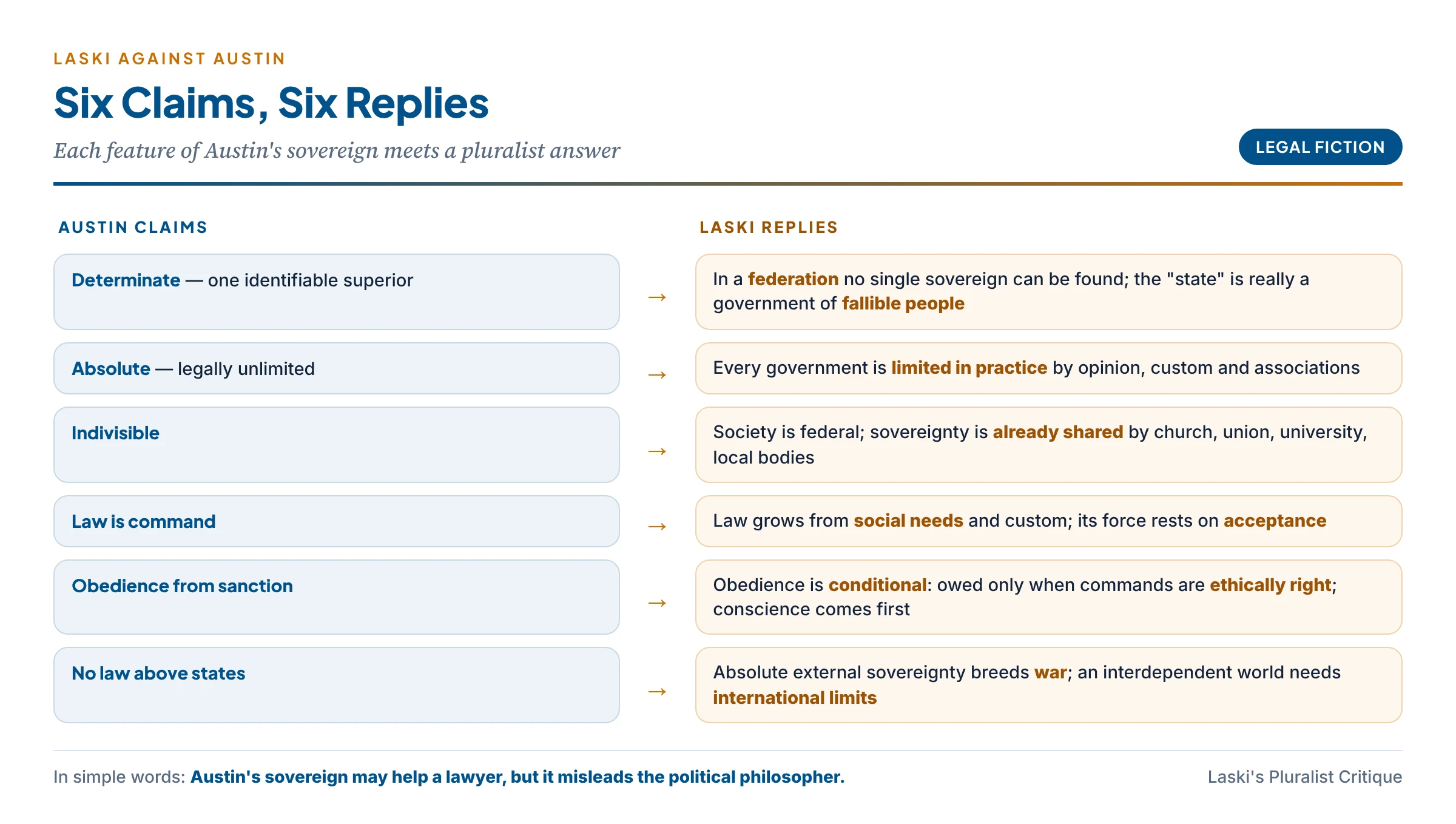
Laski took each feature of Austin’s sovereign and answered it.
| Austin claims | Laski replies |
|---|---|
| Determinate superior — an identifiable person or body | In a modern state, especially a federation like the USA, one cannot locate such a sovereign; power is spread among many bodies, and the electorate is no determinate body |
| Absolute and legally unlimited | Legal omnipotence is a fiction; in practice every government is limited by opinion, associations, custom and the fear of resistance |
| Indivisible | Society is federal; sovereignty is already divided among associations and among levels of government |
| Law is the command of the sovereign | Law springs from social needs and custom; its authority rests on acceptance, not on the sovereign’s will |
| Obedience rests on sanctions | People obey for many reasons — habit, agreement, moral conviction, self-interest; obedience is conditional on the rightness of commands |
| International law is only positive morality | In an interdependent world, external sovereignty must be limited by international law and institutions |
| Morality is outside the theory | A theory of the state that ignores rights and moral purpose is both false and dangerous |
- Laski’s summary verdict: Austin’s theory may be useful to a lawyer who needs to know which body’s commands the courts will enforce; it is useless to political philosophy, which asks why and when the state deserves obedience.
What Role Does Laski Leave for the State?
Laski was a pluralist, not an anarchist. He limited the state; he did not abolish it.
- The state as coordinator. Associations will clash; someone must set the framework within which they act and settle conflicts between them. This is the state’s special role — a coordinating authority among the different interest groups in society.
- Some commanding power. Especially in his later work, Laski accepted that the state needs real commanding power to carry out social and economic reforms — to regulate industry, provide welfare and reduce inequality.
- Legitimacy through service. The state’s claims are legitimate when it maintains order, protects rights and promotes welfare; it should be accountable to the people it serves.
- Democracy and sovereignty. Democratic theory and the state can coexist when the state’s decision-making reflects democratic principles — participation, accountability and respect for associations.
In simple words
A large residential colony has many groups — a temple committee, a sports club, a women’s self-help group, a traders’ association. Each runs its own affairs. But someone has to decide where the new road goes, settle a quarrel when the club’s loudspeaker disturbs the temple, and collect money for street lights. That coordinating committee is Laski’s state: not the master of every group, but the body that keeps them working together — and it keeps its position only as long as it serves them well.
Laski’s sovereignty in different spheres:
| Sphere | Laski’s position |
|---|---|
| Legal | Legal sovereignty must be subject to checks and balances, the rule of law, constitutionalism and the protection of individual rights |
| Political | Participatory, democratic government; distribution rather than concentration of political power; active citizen participation |
| Economic | Influenced by social democracy: equitable distribution of wealth, economic justice, workers’ rights and democratic scrutiny of economic decisions |
| Cultural and linguistic | Not developed in detail, but his pluralism implies respect for cultural and linguistic diversity — and the autonomy of cultural and emotional groups |
| Individual | Protection of individual freedoms; individuals should have a say in decisions affecting their lives |
| International | Recognition of interdependence; international cooperation; limiting state sovereignty in global matters |
The Development of Laski’s Thought
- Pluralist phase (about 1915–1925). Attack on monistic sovereignty; the state as one association among many; emphasis on groups and conscience.
- Positive-liberal and Fabian phase. In A Grammar of Politics, the state gains a stronger role as provider of the conditions of a good life — education, welfare, fair wages — while remaining limited by rights.
- Marxist phase (1930s onwards). Laski came to see the state as largely an instrument of the economically dominant class. In a capitalist society, he argued, real pluralism and democracy are impossible, because economic power shapes political power. The pluralist ideal now required socialism.
- Balancing liberalism and Marxism, he ended as a spokesman of democratic socialism — an exponent of positive liberalism who wanted to curb the concentration of economic power through democratic means. His influence on Indian leaders who favoured democratic socialism was considerable.
Other Pluralists
| Thinker | Key idea |
|---|---|
| J. N. Figgis | Churches and other groups have their own original life and authority; the state must recognise, not create, them |
| R. M. MacIver | The state is an association within the wider community; it creates order, but society creates the state; state laws are bounded by the community’s mores and values (The Modern State) |
| Léon Duguit | Law arises from social solidarity; the state is bound by law; rulers are only managers of public services |
| Ernest Barker | A moderate pluralist; groups have real personality, but the state remains the necessary adjuster of their relations |
| G. D. H. Cole | Guild socialism — industry run by self-governing guilds of workers; the state one functional body among others |
| Hugo Krabbe | The sovereignty of law, not of the state |
Critical Evaluation
Is Laski’s View a Satisfactory Position in Political Theory?
Criticisms:
- Lack of clarity. His idea of sovereignty is broad and loose, covering many social elements; it is hard to say where authority finally lies or to analyse it precisely.
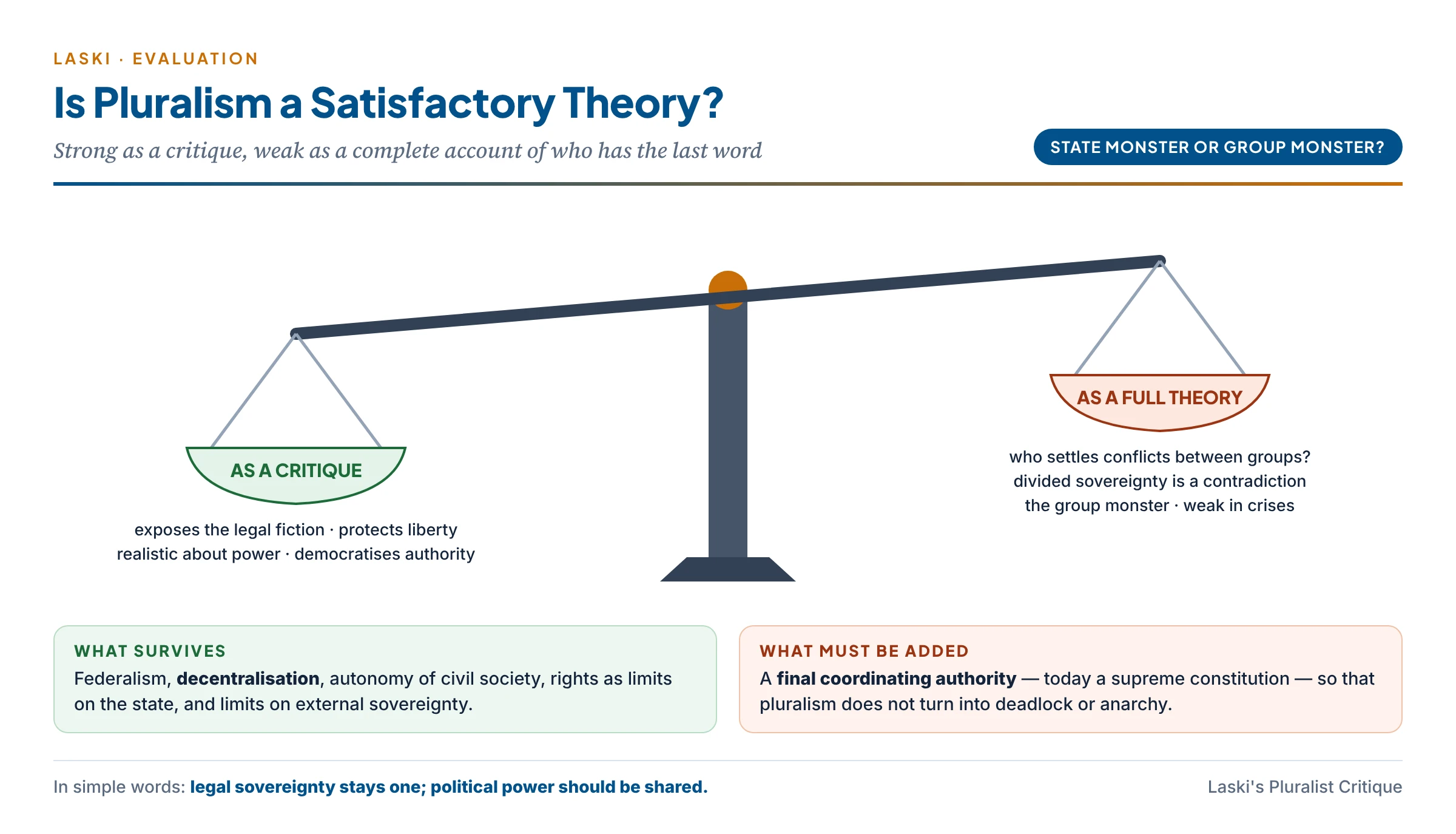
- The coordination problem. If associations conflict — a union strikes in essential services, a religious group defies a court — who decides? If the state decides, it is sovereign after all. If no one decides, there is deadlock. Pluralism, pushed to its end, returns to monism.
- Divided sovereignty is a contradiction. Two final authorities in the same territory cannot both be final. What can be divided is power and function, not ultimate authority.
- The “group monster”. Pluralism replaces the “state monster” with a “group monster“. Some associations — giant corporations, powerful unions, organised religions — can become more oppressive to their own members and to outsiders than the state.
- Danger of anarchy. Many centres of sovereignty could fragment society and weaken order; critics fear a kind of neo-feudalism of competing groups.
- Weak state in crises. In war, pandemic or economic collapse, an effective state needs undivided authority to act quickly; Laski’s view may weaken it.
- Neglect of legal foundations. Traditionalists argue that a well-defined legal framework, with a clear final authority, is essential for order and legitimacy.
- Confusing legal and political sovereignty. The pluralists rightly show that political power is dispersed, but this does not refute the claim that legal sovereignty is one.
- Laski’s own retreat. His move to a strong reforming state and then to Marxism suggests he himself found pure pluralism unworkable.
Defences:
- Reflects social reality. Modern societies are in fact made up of many groups with real influence; pluralism describes them better than monism.
- Adaptable. It accommodates changing social and economic conditions and the dynamic nature of power.
- Protects liberty. By making individual freedom and rights central, it anticipates modern human-rights thinking and guards against totalitarianism.
- Sees economic power. By including economic power in the analysis, it gives a fuller picture of how decisions are really made.
- Democratisation of power. “Make authority federal” leads logically to decentralisation, functional representation and participatory democracy.
- Curbs economic concentration and defends the autonomy of cultural and religious groups.
A balanced verdict: Laski’s pluralism is satisfactory as a critique and unsatisfactory as a complete theory. It successfully shows that absolute, indivisible sovereignty is a dangerous fiction in political terms, and it has shaped federalism, decentralisation and rights-based government. But it cannot do without a coordinating authority with the last legal word — which is sovereignty in a limited, constitutional form. The best modern answer combines both: legal monism under a constitution, political pluralism in society.
Indian Connect — Pluralism in the Indian Constitution
India blends Laski’s pluralism with a strong, united state:
- Decentralisation. The 73rd and 74th Amendments (1992) gave constitutional status to panchayats and municipalities — Laski’s “authority must be federal” in practice; Gandhi’s village self-rule pointed the same way.
- Autonomy of associations. Religious denominations may manage their own affairs (Article 26); minorities may establish and administer educational institutions (Article 30); the right to form associations and unions, including cooperative societies, is a fundamental right (Article 19(1)(c)).
- Federalism. Powers are divided between the Union and the states through three lists.
- But one final authority. Emergency provisions, the Union’s overriding powers and the Supreme Court’s role ensure that conflicts are settled within one constitutional order — sovereignty is limited and shared in exercise, but not divided in principle.
Critics and Defenders
Criticism — Critics
- Monists: someone must have the last word; pluralism smuggles sovereignty back in as “coordination”.
- Logical critics: divided sovereignty is a contradiction in terms.
- Realists: groups can be more tyrannical than the state — the group monster.
- Marxists: pluralism ignores class; in a capitalist society the “many associations” are dominated by capital (a point Laski himself later accepted).
- Statists: a pluralist state is too weak for war, crisis and large-scale reform.
Defence — Defenders and strengths
- Realism: power really is dispersed in modern societies.
- Liberty: the individual is protected from an all-claiming state.
- Democracy: decentralisation and participation bring government closer to people.
- Rights: the state is judged by the rights it maintains.
- Legacy: federalism, local self-government, autonomy of civil society and human-rights limits on states all carry Laski’s insight forward.
Cross-Tradition Comparison
Laski and the Monists
| Point | Bodin / Austin (monism) | Laski (pluralism) |
|---|---|---|
| Sovereignty | One, absolute, indivisible | Shared, limited, divisible |
| State | Supreme over all associations | One association among many; a coordinator |
| Law | Command of the sovereign | Expression of social needs; valid when accepted |
| Obedience | Unconditional (legally) | Conditional on the rightness of commands |
| Individual | Subject | Citizen with rights and many loyalties |
| Strength | Order, clarity | Liberty, realism |
| Weakness | Absolutism | Fragmentation |
Indian Connect — Laski, Gandhi and Kautilya
- Gandhi goes further than Laski: the state should be minimal, and real authority should rest in self-governing village republics arranged as “ever-widening, never-ascending” oceanic circles. Laski decentralises the state; Gandhi wants to dissolve most of it into self-rule (Article 7).
- Kautilya stands at the opposite pole: a strong, centralised king heading all seven elements of the state, with guilds (śreṇī) and corporations allowed to function but kept under royal supervision. Kautilya’s state is monistic; Laski’s is pluralist.
- Indian tradition did know a kind of pluralism in practice: guilds, caste councils and village assemblies managed much of social life under the king’s overall protection — closer to Laski’s “federal society” than to Austin’s single commander.
Synthesis (Siddhānta)
- The core insight. Laski showed that sovereignty as unlimited, indivisible power is a legal fiction and a political danger. Society is federal; the state is one association among many; obedience is conditional; rights are prior.
- The limit of the insight. A plural society still needs a final coordinating authority. The real question is not “sovereign or not?” but “sovereign how, and limited by what?“
- The modern resolution. Constitutional democracies keep a single legal sovereign — the constitution — while dispersing political power through federalism, local government, independent institutions, a free civil society and enforceable rights. This is Laski’s pluralism made workable.
- Contemporary relevance.
- Civil society and pressure groups play the role Laski gave to associations.
- Decentralisation (India’s panchayati raj, EU subsidiarity) applies “authority must be federal”.
- Global governance — the WTO, climate treaties and human-rights regimes continue his call to limit external sovereignty.
- Corporate power — today’s tech and financial giants are the “group monster” his critics warned of, and the concentration of economic power he wanted democratically controlled.
“Every state is known by the rights that it maintains.” — Harold J. Laski
Previous Year Questions
- 2026Explain the contrast between the monistic and pluralistic approaches to sovereignty.
- 2023Elucidate why the absolute nature of sovereignty was rejected by Laski.
- 2018Critically evaluate Laski’s view on sovereignty as a satisfactory position in political theory.
- 2016On what grounds does Laski criticize Austin’s concept of sovereignty?
- 2015Explain Harold Laski’s critique of sovereignty.
- 2012Who amongst Austin, Bodin and Laski is the most consistent in his analysis of the concept of sovereignty?