

Schools of Vedānta: Brahman; Īśvara; Ātman; Jīva; Jagat; Māyā; Avidyā; Adhyāsa; Mokṣa; Apṛthaksiddhi; Pañcavidhabheda.
Official Syllabus: Paper I, Section B, Unit 19
Vedānta is the philosophy of the Upaniṣads — the last and most reflective part of the Veda — and it asks one question in many forms: what is the relation between the Supreme Reality (Brahman), the individual self (jīva) and the world (jagat)? Every school of Vedānta accepts the same three source-texts, yet each gives a different answer. This article sets out the common foundations of all the schools and then explains the first and most radical answer — Śaṅkara’s Advaita, for which Brahman alone is real: one, attributeless, pure existence–consciousness–bliss, which is both the material and the efficient cause of the world, and which can be pointed to only by “not this, not this” (neti neti).
In simple words
Think of the ocean and its waves. The waves rise, fall, crash and differ in size, but all of them are only water. Someone who watches only the waves thinks there are millions of separate things; someone who looks deeper sees one ocean. For Śaṅkara, Brahman is the ocean, and the world of separate things and persons is the play of waves. The waves are not nothing — they can soak you — but they have no being of their own apart from the water.
Context & Problem
What “Vedānta” Means
- Literal meaning. Veda + anta = “the end of the Veda”. The word has two senses:
- The last part of the Veda. Each of the four Vedas has layers that come one after another — the hymns (Saṃhitā), the ritual manuals (Brāhmaṇa), the forest-texts (Āraṇyaka) and finally the Upaniṣads. The Upaniṣads come at the end, so they are “the end of the Veda”.
- The culmination of the Veda. The Upaniṣads give the inner or secret meaning of the Veda — knowledge of the self and of reality. They form the knowledge-section (jñāna-kāṇḍa), as against the action-section (karma-kāṇḍa) of rituals.
- Uttara-Mīmāṃsā. Vedānta is also called the “later inquiry” (Uttara-Mīmāṃsā), as against the “earlier inquiry” (Pūrva-Mīmāṃsā) of Jaimini, which interprets the ritual portion. Mīmāṃsā asks “what must I do?”; Vedānta asks “what is real, and who am I?”
- An orthodox, theistic darśana. Vedānta is one of the six āstika schools (it accepts the Veda’s authority), and in all its forms it is spiritual and, in the broad sense, theistic. Later it became the dominant current of Hindu thought, and it is often called the fountainhead of Indian philosophy.
The Three Source-Texts (Prasthāna-traya)
Every Vedāntin had to write commentaries on the same three “starting-points” (prasthāna), and a new school was born whenever a new commentator read them in a new way.
| Source-text | Name as a source | What it gives |
|---|---|---|
| The Upaniṣads | Śruti-prasthāna (revealed source) | The original insights — “That thou art”, “All this is Brahman”, “This self is Brahman” |
| The Bhagavad Gītā | Smṛti-prasthāna (remembered/traditional source) | The practical and ethical working-out — action, devotion and knowledge |
| Bādarāyaṇa’s Brahmasūtra | Nyāya-prasthāna (logical source) | A system: the scattered Upaniṣadic teachings arranged and defended |
- Bādarāyaṇa (also called Vyāsa) is the founder-systematiser of Vedānta. Before him, Vedāntic ideas lay scattered in the Upaniṣads in poetic and dialogue form. His Brahmasūtra (about 555 short aphorisms, sūtras) turned them into a formal school of philosophy (darśana).
- Why so many schools? The sūtras are extremely brief — often a few words — and so are open to more than one reading. Each great teacher (ācārya) wrote a commentary (bhāṣya) on them, and each commentator became the founder of a school.
- What the Brahmasūtra already settles.
- Brahman is the cause of the world — both its material cause (the stuff) and its efficient cause (the maker).
- Upaniṣadic statements of unity (“That thou art”) and statements of difference (the soul as worshipper, God as Lord) must be harmonised. How they are harmonised decides whether a school is non-dualist, qualified non-dualist or dualist.
- It refutes Sāṃkhya, the atomists, the Buddhists and the Jainas.
The Bhagavad Gītā: the Second Pillar
- On being. The Gītā teaches the immortal self that “is never born and never dies”, and separates the real (that which never ceases to be) from the unreal (that which never comes to be).
- Yoga as union and synthesis. Yoga means union; the Gītā is a synthesis of the paths of knowledge (jñāna), devotion (bhakti) and action (karma) — of intellect, emotion and will. Its goal is liberation from the cycle of birth and death (saṃsāra) through self-realisation.
- On action. Total inaction is a psychological impossibility — even to keep alive one must act. So the Gītā asks for action without attachment to its fruits (niṣkāma karma); the guṇas of nature act, and the wise do not claim doership.
- On devotion. It speaks of four kinds of devotees — the distressed, the seeker of knowledge, the seeker of wealth, and the wise, who is dearest — and of service to God.
- Gītā and Sāṃkhya. The Gītā uses the same words as Sāṃkhya — puruṣa, prakṛti, the three guṇas — but makes the system theistic: Prakṛti works under God.
- Gītā and the Upaniṣads. The Gītā is often called the milk of the Upaniṣads; it turns their insights into a way of life. Modern readers such as Annie Besant and Gandhi made it the handbook of action; it forms part of the Bhīṣma-parva of the Mahābhārata.
The Central Question and the Six Answers
All Vedāntins agree that Brahman exists and is the ground of everything. They disagree about how Brahman, the souls and the world are related.
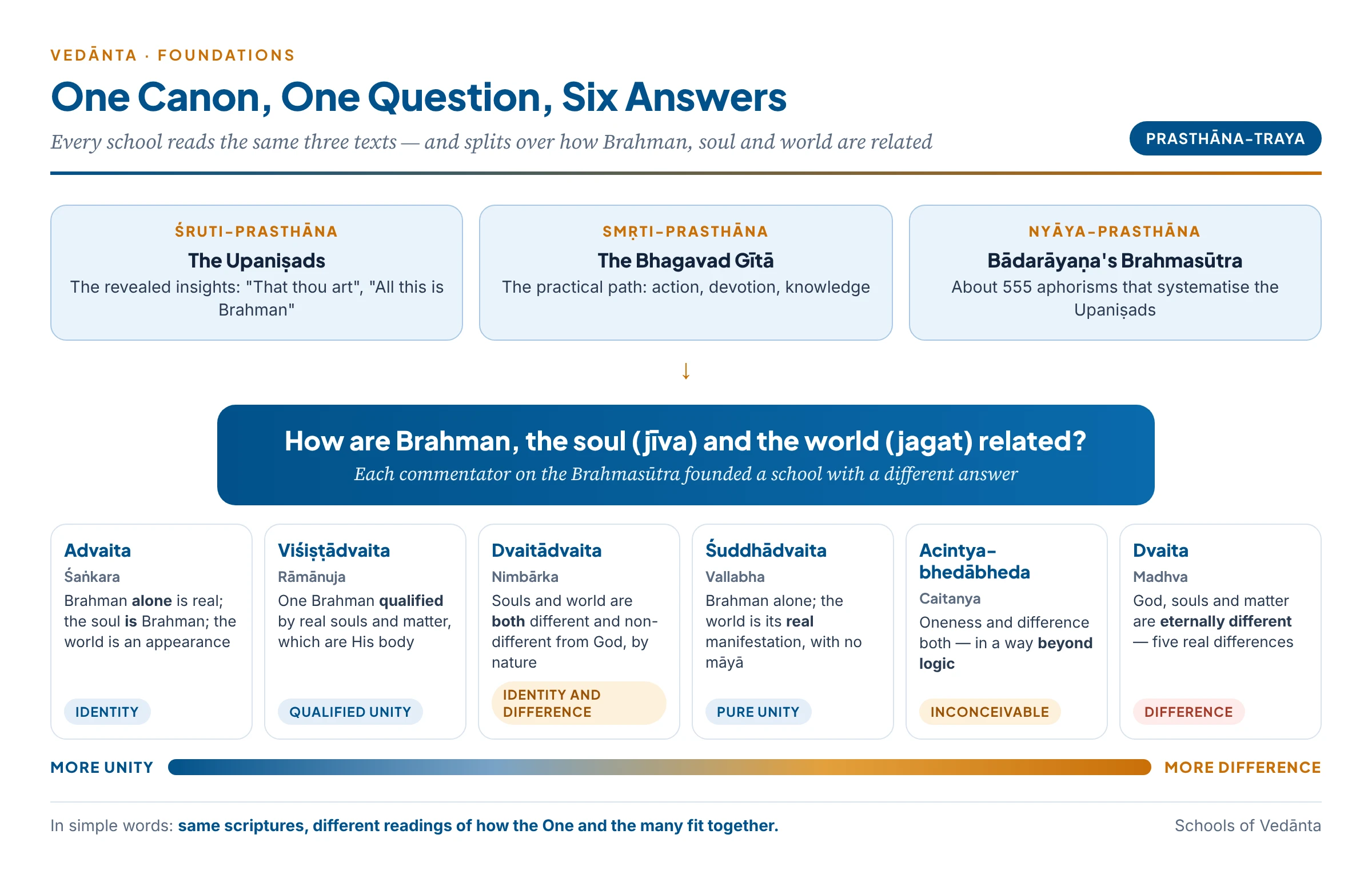
| School | Founder | Answer in one line | One-word summary |
|---|---|---|---|
| Advaita (non-dualism) | Śaṅkara | Brahman alone is real; soul = Brahman; world an appearance | Identity |
| Viśiṣṭādvaita (qualified non-dualism) | Rāmānuja | One Brahman qualified by real souls and matter as its body | Qualified unity |
| Dvaita (dualism) | Madhva | God, souls and matter eternally different; five real differences | Difference |
| Dvaitādvaita (difference-and-non-difference) | Nimbārka | Souls and world both different and non-different from God, naturally | Identity and difference |
| Śuddhādvaita (pure non-dualism) | Vallabha | Brahman alone, but the world is its real, untainted manifestation — no māyā | Pure unity |
| Acintya-bhedābheda (inconceivable difference-and-non-difference) | Caitanya | Oneness and difference both, in a way beyond logic | Inconceivable unity |
Indian Connect — Why Vedānta matters
- Vedānta is the meeting-point of philosophy and religion in India: Śaṅkara’s monasteries (maṭhas), Rāmānuja’s temple culture, Madhva’s Uḍupi tradition, and the Bhakti movements of Vallabha and Caitanya all grew out of it.
- In modern times Vivekananda, Radhakrishnan, Gandhi and Sri Aurobindo presented Vedānta’s message of the oneness of humanity and divinity to the world.
Core Doctrine
Śaṅkara: Life and Mission
- Life. Ādi Śaṅkarācārya (traditionally 788–820 CE) was born at Kālaḍi in present-day Kerala. He renounced the world as a young saṃnyāsin, travelled across India debating Buddhists, Mīmāṃsakas, Naiyāyikas and other Vedāntins, and died young. He founded monasteries (maṭhas) and teaching lineages that keep his tradition alive.
- Works. Commentaries on all three source-texts — the principal Upaniṣads, the Gītā and the Brahmasūtra — and independent works such as the Upadeśa-sāhasrī.
- Character of his thought. It is often summed up as eternalism (the real is eternal), essentialism (each thing’s being lies in Brahman), mysticism (Brahman is realised in direct experience) and theism at the practical level.
- Method. Scripture (śruti) is the highest authority on Brahman, supported by reasoning (yukti) and experience (anubhava). Liberation comes from knowledge (jñāna), not from ritual or mere devotion.
Advaita in Half a Verse
The whole of Advaita is often summed up in a half-verse:
“Brahma satyaṃ jagan mithyā, jīvo brahmaiva nāparaḥ” — “Brahman is real, the world is false (mithyā), the individual self is nothing but Brahman, not another.” — traditional summary of Śaṅkara’s teaching
- Brahma satyam — Brahman is real (sat) in the highest sense: it exists at all times and can never be contradicted.
- Jagan mithyā — the world is mithyā: neither absolutely real (it can be sublated by knowledge of Brahman) nor absolutely unreal like a hare’s horn (it is experienced). It is real until Brahman is known.
- Jīvo brahmaiva nāparaḥ — the individual self, which seems many and limited, is essentially Brahman; the difference holds only from the empirical standpoint.
The word Advaita means “not-two” — non-dualism. It also carries the sense of absolute, peerless, unique. Śaṅkara chose “not-two” rather than “one” because Brahman is not a number among numbers; the word only denies duality.
Brahman: The Only Reality
- Brahman alone is real. It is the Supreme Self, the universal consciousness, the divine ground from which all beings come, in which they live and into which they return.
- Nirguṇa and nirviśeṣa. Brahman is without qualities (nirguṇa) and without distinguishing marks (nirviśeṣa). It is absolutely indeterminate and non-dual. Hence Advaita is unqualified monism.
- Free from all three kinds of difference (bheda). Philosophers distinguish three kinds of difference, using the example of a tree:
| Kind of difference | Meaning | Tree example | In Brahman? |
|---|---|---|---|
| Sajātīya (homogeneous) | Between things of the same kind | One tree and another tree | No — there is no second Brahman |
| Vijātīya (heterogeneous) | Between things of different kinds | A tree and a stone | No — nothing exists outside Brahman |
| Svagata (internal) | Between parts within one thing | Trunk, branches and leaves of one tree | No — Brahman has no parts |
- Sat–cit–ānanda. If anything positive is said, Brahman is existence (sat), consciousness (cit) and bliss (ānanda) — saccidānanda. These are not three qualities possessed by Brahman; they are its very nature, and they are one. Śaṅkara even says that the description “saccidānanda” is imperfect — it only turns the mind away from their opposites: Brahman is not non-existent, not unconscious, not sorrowful.
- Self-existent and self-luminous. Brahman needs nothing else to exist (self-existent) and nothing else to be revealed (self-luminous) — like light, which shows itself while showing other things.
- Infinite and impersonal. Brahman is infinite, all-pervading, bodiless, impersonal and transcendent — the ground of all beings. All else, including the universe, material objects and individuals, is mithyā.
In simple words
A tree has three kinds of “difference”: it differs from other trees, from stones, and its own branches differ from its trunk. Brahman has none of these — no second Brahman, nothing outside it, and no parts inside it. That is what “one without a second” (ekam eva advitīyam) means.
Why Brahman Cannot Be Described: Neti Neti
- Beyond speech and mind. The Upaniṣad says Brahman is that “from which words turn back, along with the mind, without reaching it“. Every description uses categories — substance and quality, this and that — and Brahman is beyond them all.
- Why any description limits it. To say “Brahman is red” is to say it is not blue; to give Brahman any one quality is to deny it the opposite, and so to make it limited. It would be self-contradictory for the unlimited reality to have limits. Hence no positive description can be complete.
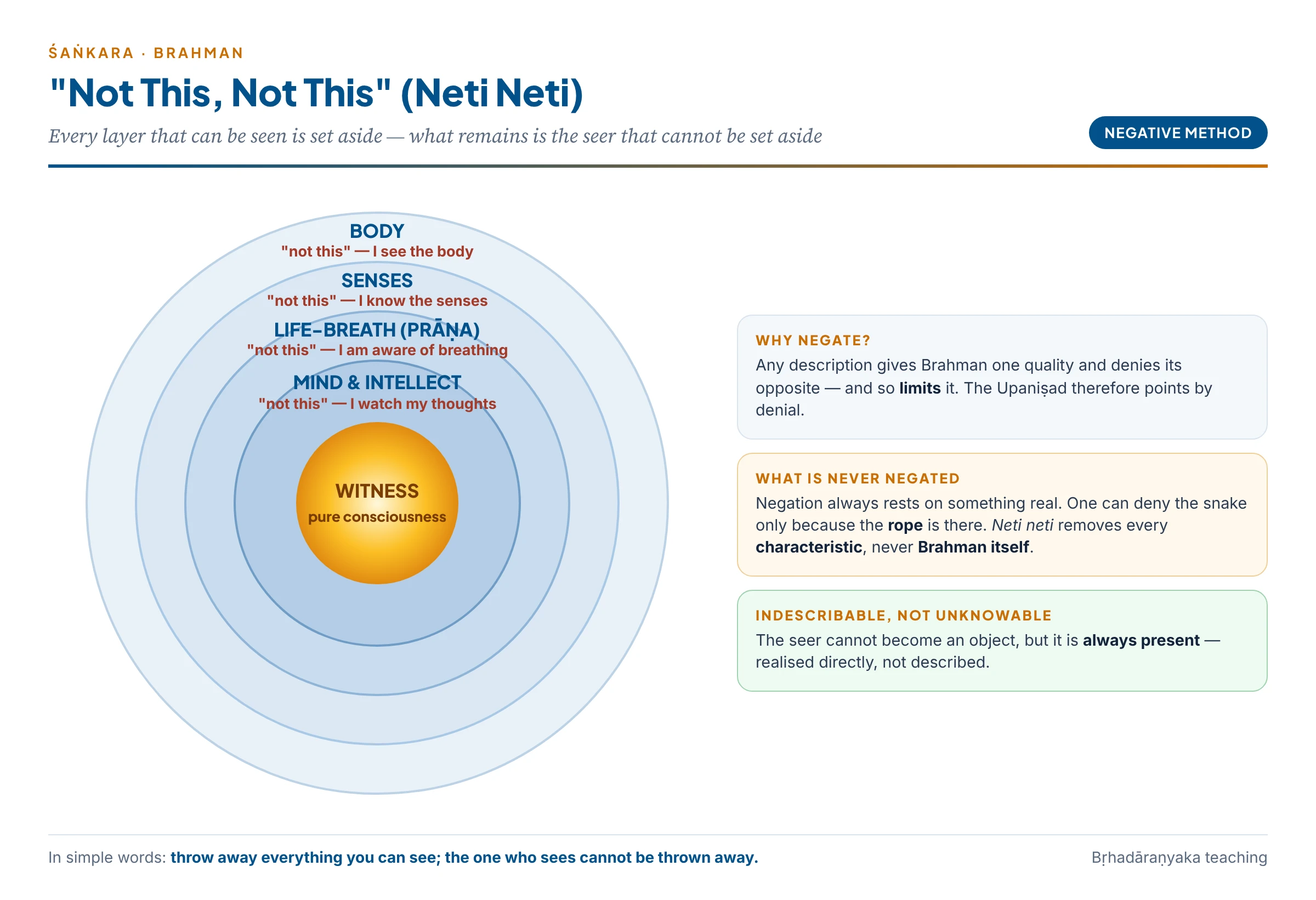
- The negative method — “neti neti” (“not this, not this”). The safest way to point to Brahman is to deny every finite feature: it is not gross, not subtle, not short, not long, not body, not senses, not mind.
- The two “no”s cover the whole field of objects: whatever can be presented as an object is not the Absolute.
- Negation always presupposes something positive. One can deny the snake only because the rope is there. “Neti neti” negates every characteristic of Brahman, never Brahman itself, which is the ground of all denials.
- Śaṅkara’s illustration: if a man does not understand that he is a man when told “you are not a non-man“, he will not understand it when told “you are a man” either. The negations point; the realisation must be one’s own.
In simple words
Imagine trying to find “the seer” by looking at things one by one: “Am I this body? No — I see the body. Am I these thoughts? No — I watch the thoughts.” Each “no” removes something that was only seen. What can never be removed is the one doing the seeing and the removing. Neti neti works like this: it throws away every object and leaves the subject that cannot be thrown away.
- Indescribable is not unknowable. Brahman cannot be known as an object by the intellect — the knower can never become the known. But Brahman is the Self and is always present, so it can be directly realised in spiritual experience (samyag-jñāna, anubhava). To try to grasp it by categories, Śaṅkara says, is like trying to roll up the sky like a skin, or to see the footprints of birds in the sky.
Two Definitions: Svarūpa-lakṣaṇa and Taṭastha-lakṣaṇa
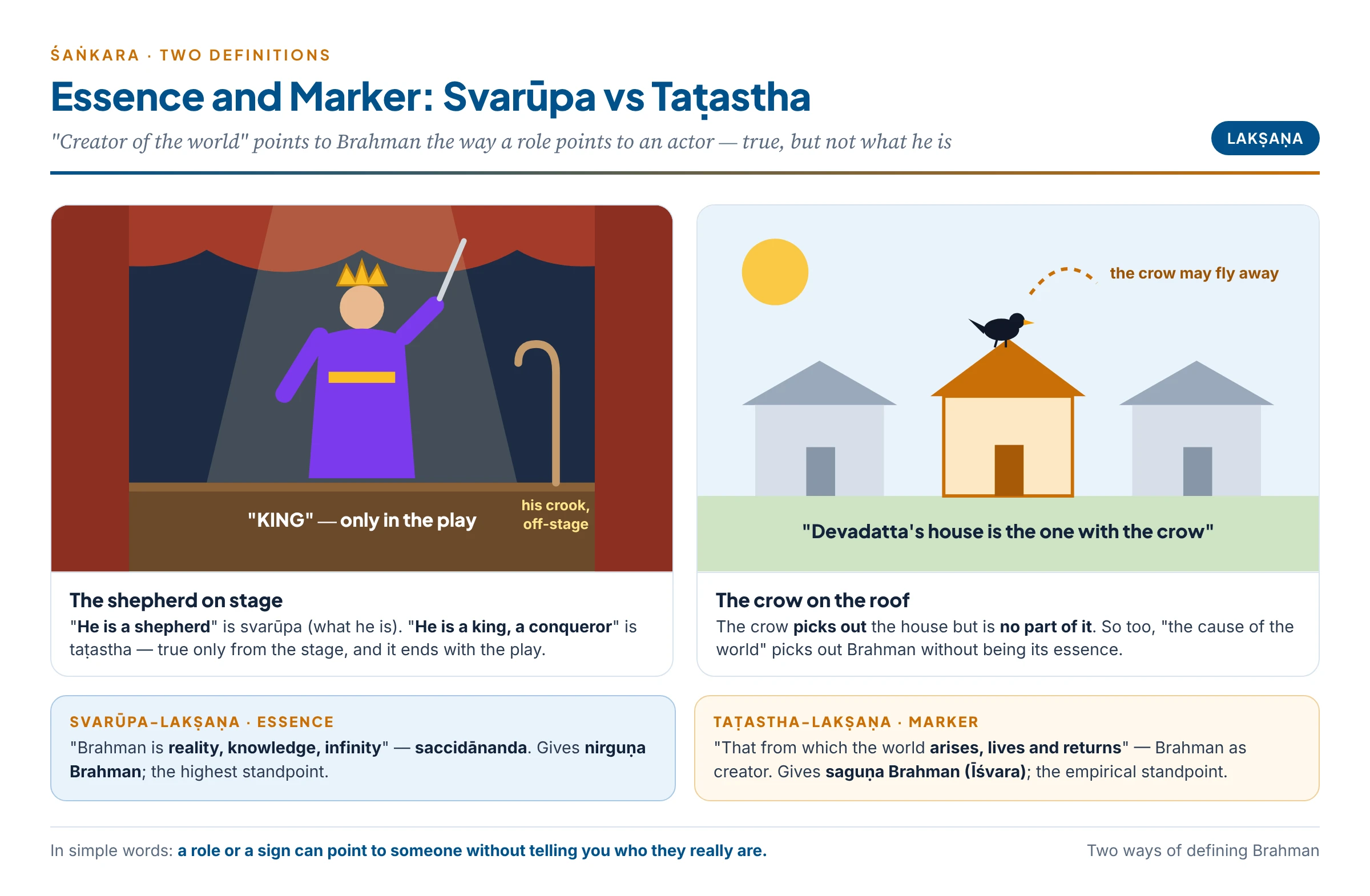
Indian philosophers define a thing in two ways: by its essence or by a marker that picks it out without being part of it. Śaṅkara uses this distinction to explain how Brahman can be called both “pure consciousness” and “creator of the world”.
| Svarūpa-lakṣaṇa (essential definition) | Taṭastha-lakṣaṇa (accidental / indicative definition) | |
|---|---|---|
| Meaning | Describes what the thing is in itself | Points to the thing by something outside its essence, which may be temporary |
| Everyday example | The actor is a shepherd | The shepherd is a king — in the play |
| Classic example | — | “Devadatta’s house is the one with the crow on its roof” — the crow picks out the house but is no part of it and may fly away |
| For Brahman | “Brahman is reality, knowledge, infinite” (satyaṃ jñānam anantaṃ brahma); saccidānanda | “That from which this world arises, in which it lives, into which it returns” — Brahman as creator, sustainer, destroyer |
| Standpoint | Pāramārthika (highest) | Vyāvahārika (empirical) |
| Gives | Nirguṇa Brahman | Saguṇa Brahman / Īśvara |
- The shepherd on stage. A shepherd plays the role of a king on stage: he wages war, conquers a country, rules it. The description “a shepherd” tells us what he really is (svarūpa). The description “king, ruler, conqueror” is true only from the standpoint of the stage (taṭastha); it does not touch his real being, and it lapses when the play ends.
- Brahman as creator is like the shepherd as king. “Creator of the world” is a true description of Brahman only from the world’s point of view. When the world is seen through, the description lapses, and Brahman remains what it always was — pure being, consciousness, bliss.
- Why this matters. The distinction lets Śaṅkara accept every Upaniṣadic and Brahmasūtra statement about Brahman as cause of the world without making creation part of Brahman’s essence.
Nirguṇa and Saguṇa Brahman
- Nirguṇa Brahman (Para Brahman, the higher Brahman). Brahman as it is in itself: pure, unconditioned, attributeless consciousness, beyond all distinctions — known by its essential definition. It is reached by the negative method.
- Saguṇa Brahman (Apara Brahman, the lower Brahman, Īśvara). The same Brahman seen through māyā — endowed with auspicious qualities (kalyāṇa-guṇa): omniscient, omnipotent, moral governor, creator–preserver–destroyer, the object of worship (upāsanā) and devotion (bhakti).
- Not two Brahmans. There is only one Brahman seen from two standpoints. From the empirical standpoint (vyāvahārika) Īśvara is fully real; from the highest standpoint (pāramārthika) the qualities are seen as superimposed, and only nirguṇa Brahman remains. (Īśvara is studied in detail in the next article.)
| Feature | Nirguṇa Brahman | Saguṇa Brahman (Īśvara) |
|---|---|---|
| Qualities | None; saccidānanda is its nature, not a quality | Infinite auspicious qualities |
| Relation to world | None — the world is an appearance on it | Creator, sustainer, destroyer, inner ruler |
| Known by | Direct intuition; negative method | Scripture, worship, devotion |
| Definition | Essential (svarūpa) | Indicative (taṭastha) |
| Standpoint | Highest (pāramārthika) | Empirical (vyāvahārika) |
| Personal? | Impersonal (“It”) | Personal (“He”) |
| Fate in liberation | Remains — it is the liberated self | Sublated as “God over me” |
Brahman as Both Efficient and Material Cause (Nimitta and Upādāna Kāraṇa)
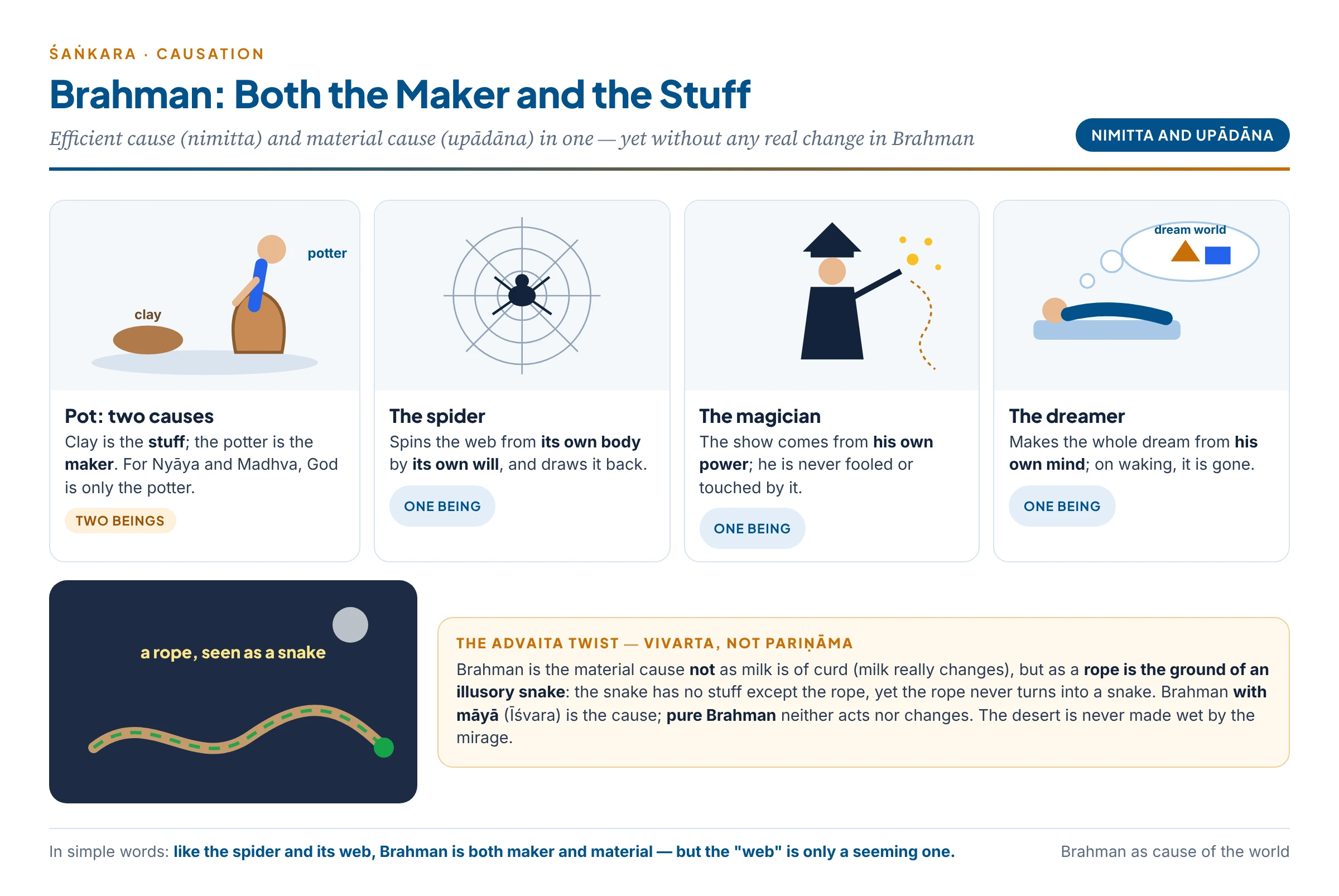
Every effect needs at least two causes: the material cause (upādāna kāraṇa) — the stuff it is made of — and the efficient cause (nimitta kāraṇa) — the agent who makes it. For a pot, clay is the material cause and the potter is the efficient cause. For most Indian theists (Nyāya, Madhva) God is only the efficient cause: he shapes eternal atoms or primal matter. Advaita, following the Brahmasūtra, says Brahman is both.
- Why Brahman must be the material cause.
- Knowing one, all is known. The Upaniṣad promises that by knowing Brahman everything is known — “as by knowing one lump of clay, all things made of clay are known; the modification is only a name, the clay alone is real”. This is possible only if Brahman is the stuff of everything.
- “All this is Brahman.” If the world were made of a second stuff, Brahman would not be “one without a second”.
- The world comes from, lives in and returns to Brahman — exactly what is said of a material cause, as pots come from clay, exist as clay and return to clay.
- Why Brahman must be the efficient cause.
- “It thought: may I be many.” The Upaniṣadic cause thinks and wills — so it is conscious, not inert matter like Sāṃkhya’s Pradhāna.
- Order and design in the world require an intelligent cause; bricks and mortar do not build a house without a builder.
- Brahman is omniscient and omnipotent — the only being fit to be the first cause.
- How can one cause be both? Śaṅkara’s examples:
- The spider spins its web out of its own body (material cause) by its own will (efficient cause), and draws it back again.
- The magician produces a magic show out of his own power — he is both the stuff and the maker of the show, and remains untouched by it.
- A dreamer produces the whole dream world from his own mind, and is both its material and its maker.
- The Advaita twist — material cause by vivarta, not by real change. Brahman is the material cause of the world not as milk is the material cause of curd (milk really changes), but as a rope is the ground of an illusory snake: the rope does not become a snake, yet the snake has no other stuff than the rope. This is vivartavāda — apparent transformation — explained fully in the article on Jagat. Hence:
- Brahman as associated with māyā (Īśvara) is the cause of the world; pure Brahman does nothing and changes nothing.
- The effect has no being apart from its cause, but the cause is not affected by the effect — the desert is not made wet by the mirage.
- Creation is not ultimately real; it is real only as long as ignorance lasts.
In simple words
A spider is the best picture. The thread of its web comes out of its own body, so the spider is the “stuff” of the web. It also decides where to spin, so it is the “maker” too. Śaṅkara adds one twist: Brahman is like a spider whose web is only a seeming one — like the snake that a rope seems to be in the dark. The rope gives the snake all the “stuff” it has, yet the rope never turns into a snake.
How Do We Know Brahman? Scripture, Reason and Experience
- Brahman is beyond perception and inference. It has no form, so it cannot be perceived; it has no characteristic mark (liṅga), so it cannot be inferred. Śaṅkara therefore denies that the ordinary means of knowledge (pramāṇas) can prove Brahman.
- Scripture (śruti) is the direct source. The great sayings (mahāvākyas) of the Upaniṣads reveal it:
- “This self is Brahman” (ayam ātmā brahma).
- “All this is indeed Brahman” (sarvaṃ khalv idaṃ brahma).
- “That thou art” (tat tvam asi).
- “Consciousness is Brahman” (prajñānaṃ brahma).
- “I am Brahman” (ahaṃ brahmāsmi).
- Supporting arguments (reasoning in the service of scripture). As a philosopher Śaṅkara also gives grounds that point to Brahman:
- Agreement and difference (anvaya–vyatireka). Wherever there is intelligent order there is an intelligent cause; when the world is negated — in deep sleep or liberation — consciousness alone remains.
- Effect to cause (kārya–kāraṇa). The world is an effect; its ultimate cause cannot be inert matter; it must be intelligent Brahman.
- Inner experience of the self. Everyone experiences “I am” (ahaṃ-pratyaya); this points to a self-luminous consciousness that never ceases — the witness (sākṣin) of waking, dream and deep sleep.
- Unity of experience. The world appears diverse, yet our awareness unifies it; this unifying principle cannot come from inert matter.
- Impossibility of infinite regress. If everything depends on something else, there must be a self-existent reality on which all depends.
- Bliss of deep sleep. In deep sleep, without any objects, one experiences peace, and on waking says “I slept happily” — a hint of Brahman as bliss.
- The argument from pure existence. Śaṅkara builds a rational path from everyday experience:
- When gold becomes a chain or a ring, only the form changes; the gold remains. Forms come and go; the substance persists.
- But gold itself changes too. What remains common to every form of everything — even to dreams and illusions — is existence (“is”) itself.
- Persistence is the mark of the real; exclusion is the mark of the unreal. A pot and a cloth exclude each other, but “existence” runs through both. Hence pure existence is the ground and material cause of the world.
- In every experience of existence there is awareness; existence and consciousness are inseparable. So the ground is existence that is consciousness — Brahman.
- Reason’s proper place. Śaṅkara attacks only empty logic-chopping (kutarka), not sound reasoning (sutarka). Reason is supreme in the empirical world: “even if a hundred scriptures said that fire is cold, we could not accept it“. Scripture should be read in harmony with reason; reason, in turn, cannot reach Brahman unaided.
Common confusion
Does Advaita say that Brahman is “unknowable”? No. Brahman is indescribable and cannot be an object of the intellect, but it is not unknowable: it is the very Self of the knower and is directly realised. “Indescribable” means that no description can be complete, not that nothing true can be said. To say “Brahman exists but is not known” would be like saying “coloured objects exist but there is no eye to see them”.
The Problems Brahman Creates — and Why Māyā Is Needed
If Brahman alone is real, one, changeless and attributeless, three problems arise:
- Plurality and change. We perceive a plural, determinate, changing world. How is it related to the one, changeless Brahman?
- Devotion. Religion needs a personal God — omniscient, omnipotent, merciful — but the only reality is attributeless.
- Bondage and liberation need many selves, but there is only one Self.
Advaita’s answer to all three is māyā (and avidyā): through māyā Brahman appears as the plural, changing world, is conceived as a personal God (Īśvara) by the worshipper, and seems to be many selves (jīvas). Māyā, adhyāsa and avidyā are treated in a separate article.
Critical Evaluation
Objections from Rival Schools (Pūrva-pakṣa)
- Rāmānuja (Viśiṣṭādvaita).
- Metaphysical. If Brahman is non-dual and attributeless, the diversity of the world remains unexplained.
- Epistemological. All knowledge involves distinction; pure identity or pure difference cannot be known. An attributeless Brahman can be the object of no pramāṇa — perception is always determinate, language works through nouns and adjectives, inference needs a mark.
- Religious. An indeterminate Brahman cannot be worshipped; the Upaniṣadic word “nirguṇa” means only that Brahman has no bad qualities.
- Madhva (Dvaita).
- Knowledge presupposes difference in the object; pure identity cannot be known.
- An indescribable Brahman is no different from the Buddhist “void” (śūnya) — Madhva calls Advaitins “crypto-Buddhists“.
- “Nirguṇa” means Brahman is beyond the three guṇas of matter (sattva, rajas, tamas); “neti neti” means nothing finite resembles Him.
- Logical objection. “To say Brahman is indescribable is already to describe it.“
- Venkaṭanātha (Rāmānuja’s follower). If Brahman is wholly attributeless, the very word “Brahman” can denote it neither directly nor by implication, and inquiry into Brahman becomes impossible.
- Theistic objection (Paper II). Does Śaṅkara’s Brahman leave room for theism? If God is only the “lower” Brahman, prayer and grace seem provisional.
Advaitin Replies (Siddhānta)
- “Indescribable” has a precise sense. It does not mean nothing at all can be said; it means no finite category fits — Brahman is neither “this” nor “that”. The statement “Brahman is indescribable” belongs to the empirical level and points beyond itself, like a finger pointing at the moon.
- Knowledge of Brahman is not object-knowledge. It is immediate realisation of one’s own being; the objection that “knowledge needs difference” holds for objects, not for the subject that knows them. Words point to Brahman by implication; they do not have to denote it.
- Not the void. Brahman is positive — pure existence, consciousness and bliss, the ground of every denial. Śūnya (as Śaṅkara understood it) negates everything; neti neti negates everything except the negator.
- Theism is kept, not destroyed. Īśvara is fully real from the empirical standpoint — the only standpoint from which anyone worships. Advaita places theism on a ladder: worship purifies the mind and leads to the highest knowledge. (See the next article.)
- Plurality is explained, not ignored — by māyā and the two standpoints.
Śaṅkara’s Brahman and Nāgārjuna’s Śūnya
The charge that Advaita is “Buddhism in disguise” needs a careful comparison.
| Aspect | Śaṅkara’s Brahman | Nāgārjuna’s Śūnyatā |
|---|---|---|
| Ultimate reality | One, eternal, changeless, non-dual Brahman | Emptiness: all things lack inherent existence |
| Nature | Nirguṇa, beyond name and form; saguṇa only at empirical level (Īśvara) | Not a substance but the absence of self-nature (svabhāva); things arise dependently |
| Ontology | Monism — Brahman alone real, world mithyā | Relational view — reality is interdependent (pratītyasamutpāda) |
| World | Appearance due to māyā, superimposed on Brahman | Conventionally real, ultimately empty |
| Self | Ātman = Brahman: the true self is ultimate reality | No-self (anātman); the self too is empty |
| Liberation | Realising identity with Brahman — “I am Brahman“ | Nirvāṇa: realising emptiness, beyond eternalism and nihilism |
| Method | Knowledge through hearing, reflection, meditation | Dialectic (prasaṅga) refuting all views |
| Language | Brahman beyond speech; Upaniṣads use neti neti | All concepts conventional; ultimate truth ineffable |
| Criticism of the other | Śūnyavāda is nihilism, denying the ground | Brahman is a reified permanent essence |
| Position | Absolute monism | Middle Way between eternalism and nihilism |
- Similarities — two levels of truth, the world as appearance, ineffable ultimate, dialectical method — explain why Madhva and Rāmānuja accused Śaṅkara of being a “crypto-Buddhist“.
- Decisive difference — Śaṅkara’s ultimate is a positive, self-luminous Self; Nāgārjuna’s is emptiness of self-nature, and he denies any permanent self.
Critics and Defenders
Criticism — Critics
- Rāmānuja: an attributeless Brahman explains no diversity, can be known by no pramāṇa and cannot be worshipped.
- Madhva: knowledge needs difference; indescribable Brahman is the Buddhist void.
- Venkaṭanātha: no word can denote, and no inquiry can reach, a wholly attributeless Brahman.
- Logicians: calling Brahman “indescribable” is self-refuting.
- Theists: God becomes a “lower”, provisional reality.
Defence — Defenders and strengths
- Śaṅkara: Brahman is not an object but the Self; it is realised, not described.
- Advaitins: neti neti negates every characteristic, never the ground; Brahman is positive saccidānanda.
- Two standpoints: Īśvara and the world are fully real for all practical and religious purposes.
- Strength: one consistent principle explains the unity behind all diversity, and the self-evidence of consciousness.
- Strength: Brahman as both causes avoids a second eternal stuff beside God.
Cross-Tradition Comparison
Brahman and the Western Absolute
| Thinker | Ultimate | Similarity with Śaṅkara | Difference |
|---|---|---|---|
| Kant | Thing-in-itself (noumenon) | Beyond the categories; unknowable by the intellect | Kant’s noumenon is unknowable absolutely; Brahman is realised in intuition and is the Self |
| Spinoza | One Substance (God or Nature) | One reality; finite things are its modes; “all determination is negation” | Spinoza’s modes are real expressions; Śaṅkara’s world is mithyā |
| Hegel | Absolute Spirit | One Absolute behind all | Hegel’s Absolute is a concrete unity-in-difference unfolding in history — closer to Rāmānuja |
| Bradley | The Absolute | Appearance and reality; contradictions show finite things are appearances | Bradley’s Absolute is a whole of experience including appearances; Brahman excludes all distinctions |
| Plotinus | The One | Beyond being and thought; reached by negation | The One “emanates” the world; Brahman does not really produce anything |
Indian Connect — Key takeaways
- Śaṅkara and Kant both hold that the ultimate is beyond the categories and that God cannot be proved by reason; but Kant falls back on faith, Śaṅkara on scripture and realisation.
- Śaṅkara and Spinoza both make one reality the ground of all; but for Spinoza the world is God’s real expression, for Śaṅkara an appearance.
- Against Nāgārjuna, Śaṅkara keeps the Upaniṣadic Self as the positive ground.
Brahman in the Three Main Schools (preview)
| Śaṅkara | Rāmānuja | Madhva | |
|---|---|---|---|
| Nature | Nirguṇa, nirviśeṣa | Saviśeṣa — infinite good qualities | Saguṇa — infinite good qualities |
| Internal difference | None | Real (souls and matter as body) | None in God; souls and matter outside God |
| Cause of world | Material + efficient (by vivarta) | Material + efficient (by real transformation of His body) | Only efficient; matter (prakṛti) is the material |
| “Nirguṇa” texts mean | No qualities at all | No bad qualities | Beyond the guṇas of matter |
| God and Brahman | Two standpoints of one reality | Identical | Identical |
Synthesis (Siddhānta)
- Vedānta is the philosophy of the Upaniṣads, systematised in Bādarāyaṇa’s Brahmasūtra and lived in the Gītā — the three source-texts. Its question is the relation of Brahman, soul and world; the six schools give six answers, from identity to difference.
- For Śaṅkara, Brahman alone is real — one without a second, free of all three kinds of difference, saccidānanda as its very nature, beyond speech and mind, pointed to by neti neti, indescribable but not unknowable.
- Brahman has two definitions: the essential (reality–knowledge–infinity) gives nirguṇa Brahman; the indicative (creator of the world) gives saguṇa Brahman, Īśvara — like the shepherd who is a king only on stage.
- Brahman is both the efficient and the material cause — like the spider and its web, the magician and his show — but by apparent, not real, transformation (vivarta).
- Brahman is known through scripture, supported by reason and fulfilled in direct experience; the argument from pure existence shows its rational side.
- The charges of unknowability, nihilism and lost theism are answered by the distinction of standpoints and by Brahman’s positive nature — though Rāmānuja’s and Madhva’s objections remain the main debate of later Vedānta.
- Contemporary relevance.
- Philosophy of mind. The view that consciousness is fundamental, not produced by matter, has modern defenders (forms of idealism and panpsychism); Śaṅkara’s argument from the self-evidence of consciousness is a classic of this kind.
- Interfaith understanding. The idea of one reality “called by many names” underlies Vivekananda’s and Radhakrishnan’s universalism.
- Ecology and ethics. “All this is Brahman” grounds a sense of the unity of life — a basis for non-violence and care for nature.
“Brahman is reality, knowledge, infinity.” — Taittirīya Upaniṣad
Previous Year Questions
- 2025How is Brahman conceptualised in Advaita philosophy as both Nimitta and Upādāna Kāraṇa of the world? Discuss with suitable examples.
- 2022Critically examine the idea of Brahman in Advaita philosophy of Śaṅkara. Does Śaṅkara’s conception of Brahman leave room for theism? Discuss.
- 2018What is the difference between the indescribability (Anirvacanīyatā) of Brahman and the indescribability (Anirvacanīyatā) of Māyā in the Advaita Vedānta system? Discuss.
- 2015Compare and contrast the notion of Brahman in Śaṅkara and Rāmānuja.
- 2014How does the nature of Brahman differ in the philosophy of Śaṅkara, Rāmānuja and Madhva? Discuss critically.
- 2013Distinguish between svarūpa lakṣaṇa and taṭastha lakṣaṇa of Brahman after Śaṅkara.
- 2007State and explain the difference between Saguṇa and Nirguṇa Brahman.