

Mīmāṃsā: Theory of Knowledge.
Official Syllabus: Paper I, Section B, Unit 18
Verbal testimony (śabda) is the pramāṇa that Mīmāṃsā values above all others — and the reason is simple. Its whole purpose is to know dharma, the duty that leads to unseen results like heaven, and dharma cannot be known by perception or inference. Only the Veda can reveal it. So Mīmāṃsā builds an elaborate theory to show that the Veda is authorless (apauruṣeya), eternal and self-valid; that words, their meanings and the relation between them are eternal; that words primarily mean universals; and — in a famous internal debate — how the meaning of a sentence arises from the meanings of its words. These theories also set Mīmāṃsā against Nyāya, which holds that the Veda is the work of God and that language rests on convention — the contest the 2026 paper asked about.
In simple words
A family recipe has been handed down for twenty generations. No one knows who first wrote it; every cook has passed it on word for word; and it has never failed. Mīmāṃsā treats the Veda like that recipe — with one difference: it claims the Veda was never written by anyone at all. Because no author made it, no author’s mistake, ignorance or deceit can have crept in.
Context & Problem
- The central need. Mīmāṃsā’s goal is to establish dharma. Dharma is adṛṣṭa — unseen: no one can see that a particular sacrifice yields heaven, and there is no observable sign from which to infer it. Comparison and postulation also depend on perceived facts. So only verbal testimony — and specifically the Veda — can give knowledge of dharma. “The doctrine of śabda is the backbone of the entire school.”
- Jaimini’s position. For Jaimini the Word (the Vedic word) is the only means of knowing dharma.
- The opponents.
- Buddhists, Jainas, Cārvākas: the Veda is a human composition with no special authority; the Cārvāka even calls its authors “buffoons, knaves and demons“.
- Nyāya–Vaiśeṣika: the Veda is authoritative, but because it was composed by an omniscient God; words are non-eternal sounds and their meanings are fixed by convention.
- Grammarians: meaning is carried by an indivisible sphoṭa, not by letters.
- The two-part Mīmāṃsā answer.
- Validity. All knowledge, including verbal knowledge, is intrinsically valid (Article 7). The Veda needs no external certificate.
- Freedom from defect. Errors in testimony come from speakers — their ignorance, carelessness or deceit. The Veda has no speaker, so it can have no such defect.
Core Doctrine
1. What Is Śabda?
- Definition. An intelligible sentence yields knowledge unless it is known to be the statement of an unreliable person (anāpta-vākya). This is testimony or authority.
- Śālikanātha’s definition. The Prābhākaras call this pramāṇa śāstra: the knowledge, arising from the knowledge of words, of things that are beyond the reach of perception (asannikṛṣṭa) — that is, not known by any other source.
- Two kinds.
- Personal (pauruṣeya) — the spoken or written testimony of some person. Useful for everyday knowledge, but fallible, because people can err.
- Impersonal (apauruṣeya) — the Veda. Supreme in authority and infallible, because no human or divine person composed it.
- Two kinds of sentences.
- Siddhārtha-vākya — a declarative sentence that informs us of something already existing: “Fire is bright” (agniḥ śociṣmān).
- Vidhāyaka-vākya — an injunctive sentence that commands an action: “One who desires heaven should perform a sacrifice” (svargakāmo yajeta). Here the Veda is not describing heaven or sacrifice; it is ordering a person to act.
2. Personal Testimony: The Two Schools Differ
- Bhāṭṭa. The testimony of a reliable person (āpta) is a valid source of knowledge in its own right. Vedic testimony has a special value only because the knowledge of dharma it gives can be had from no other source, and does not depend on any previous knowledge.
- Prābhākara. Like the Vaiśeṣikas, the Prābhākaras hold that the statement of a non-Vedic person gives knowledge only through inference — from the speaker’s reliability. Only the Veda is testimony proper (śāstra).
- The Mīmāṃsā reply to reductionists. Against those who reduce all testimony to inference (on the ground that we must first infer the speaker’s reliability), Mīmāṃsā says that the validity of every cognition — testimony included — is assured by the very conditions that produce it. On hearing a meaningful sentence we at once believe what it says unless there is reason for doubt. So testimony stands on its own legs (Article 7).
Common confusion
Is human testimony intrinsically valid for Kumārila, or is its validity inferred? Notes seem to disagree, and both are partly right. Kumārila’s general principle is that every cognition, including one born of a reliable person’s words, is valid by itself unless defeated. But because human speakers can have defects, a hearer who has reason to doubt must check the speaker’s trustworthiness — and here human testimony is vulnerable in a way the Veda is not. The Prābhākaras go further and treat ordinary testimony as straightforward inference from the speaker’s reliability. Keep the two schools apart.
3. Why Vedic Testimony Is Supreme
- Dharma is adṛṣṭa. The duty of a particular sacrifice, and its unseen fruit, can be known by neither senses nor logic. Only Vedic injunctions reveal it.
- Apauruṣeyatva. Since the Vedas are not human creations, they are free from error, bias and falsehood.
- Svataḥ prāmāṇya. Knowledge is valid by itself unless contradicted; Vedic testimony therefore needs no external proof.
- Never contradicted. The objects of Vedic injunctions — dharma and its fruits — lie beyond perception and inference, so no later perception or inference can contradict them. And there are no internal contradictions in the Veda once it is correctly interpreted.
- Independent of prior knowledge. Personal testimony often reports what could be known otherwise and rests on the speaker’s own earlier knowledge; the Veda’s knowledge is neither obtainable otherwise nor dependent on any previous knowledge.
4. Arguments That the Veda Is Authorless (Apauruṣeya)
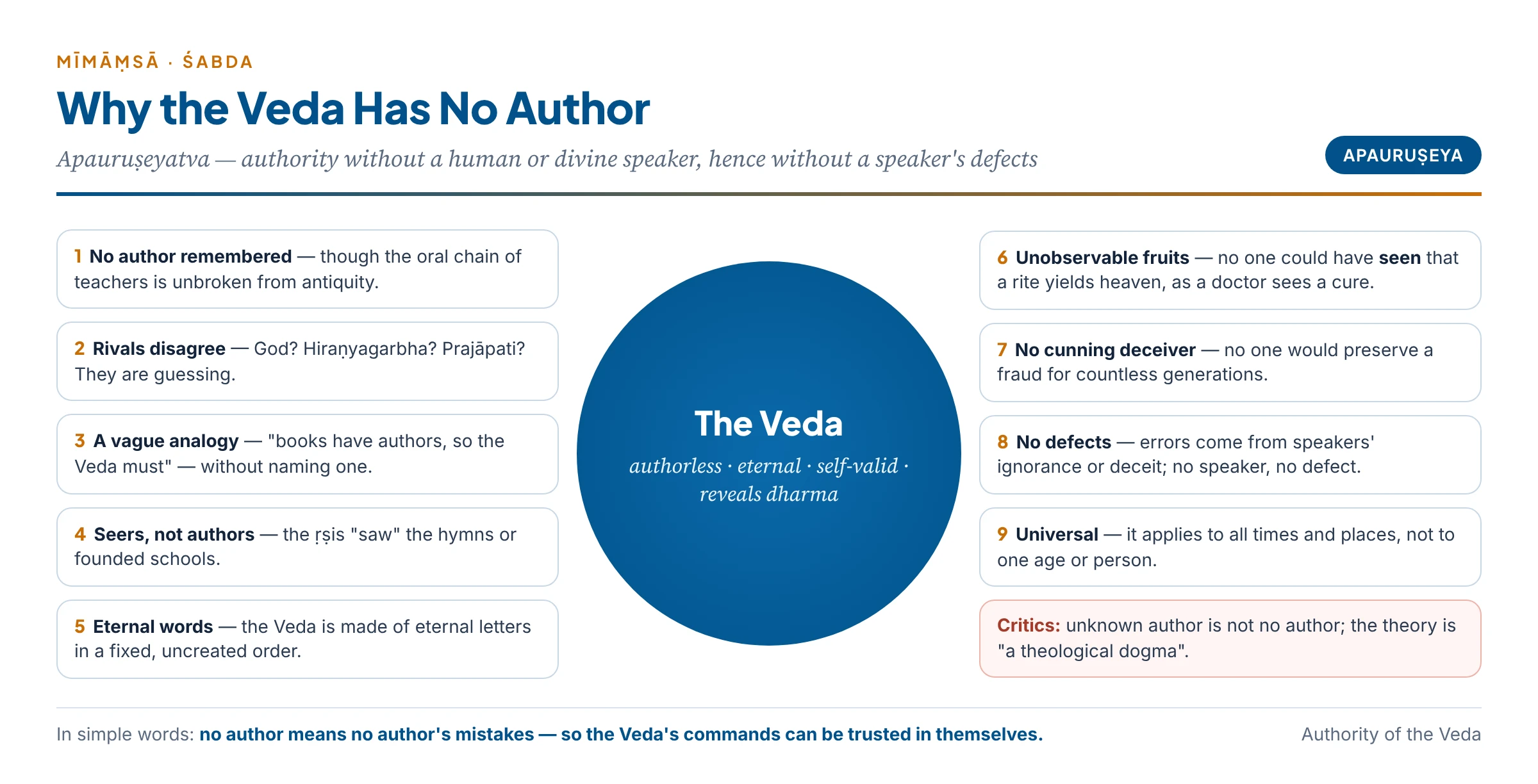
Most pro-Vedic schools say the Veda’s authority comes from its being the word of God. Mīmāṃsā, which accepts no creator, says the Vedas — like the world — are eternal. They are the work of no person, human or divine. The arguments:
- (1) No author is remembered. If the Vedas had an author, his name would be known and remembered, because the Vedic lore has been passed down by an unbroken chain of teachers and learners from unknown antiquity — as the names of Kālidāsa or Pāṇini are remembered. No such name is remembered.
- (2) The rival views disagree. Even those who say the Vedas were produced do not agree on their origin: some say God, some Hiraṇyagarbha, some Prajāpati. Such disagreement shows they are guessing.
- (3) A vague analogy. They think, vaguely, on the analogy of ordinary books written by people, that the Veda too must have an author — without knowing who.
- (4) Names in the Veda are seers, not authors. Certain persons’ names appear with Vedic hymns, but they are the seers (ṛṣis) to whom the hymns were revealed, or the expositors and founders of different Vedic schools (śākhās). A seer sees; he does not compose.
- (5) Words are eternal. The Veda is made of words, and words are really letters which are eternal (section 5). So the Veda’s material is uncreated.
- (6) The fruits could not have been observed. The Veda declares that rituals bring fruits like heaven. The connection between such actions and their fruits is not something any person could have observed — unlike the connection between taking a medicine and the cure of a disease, which a physician can observe. So no person could have authored these statements from his own knowledge.
- (7) Not the work of a cunning deceiver. The Cārvāka suggests the Veda is the work of cunning priests. But if it were a deception, no one would have cared to study and hand down such works for countless generations.
- (8) Free from defects. The works of imperfect beings carry their defects. The Veda has no author and so carries none — this is the root of its infallibility.
- (9) Universal applicability. The Veda applies to all times and places; this shows it is not the product of a particular time, place or individual.
In simple words
Ask: “Who invented the rule that 2 + 2 = 4?” No one did — people discovered it, and different people in different lands found the same truth. Mīmāṃsā thinks of the Veda in a similar way: the ṛṣis did not invent it; they saw (heard) what was always there, the way an astronomer sees a star that existed before him.
5. The Eternity of Words (Śabda-nityatva)
- The objection. “The Vedas are made of words, and words are produced by speakers and perish the moment they are uttered. How can a text made of perishing sounds be eternal?”
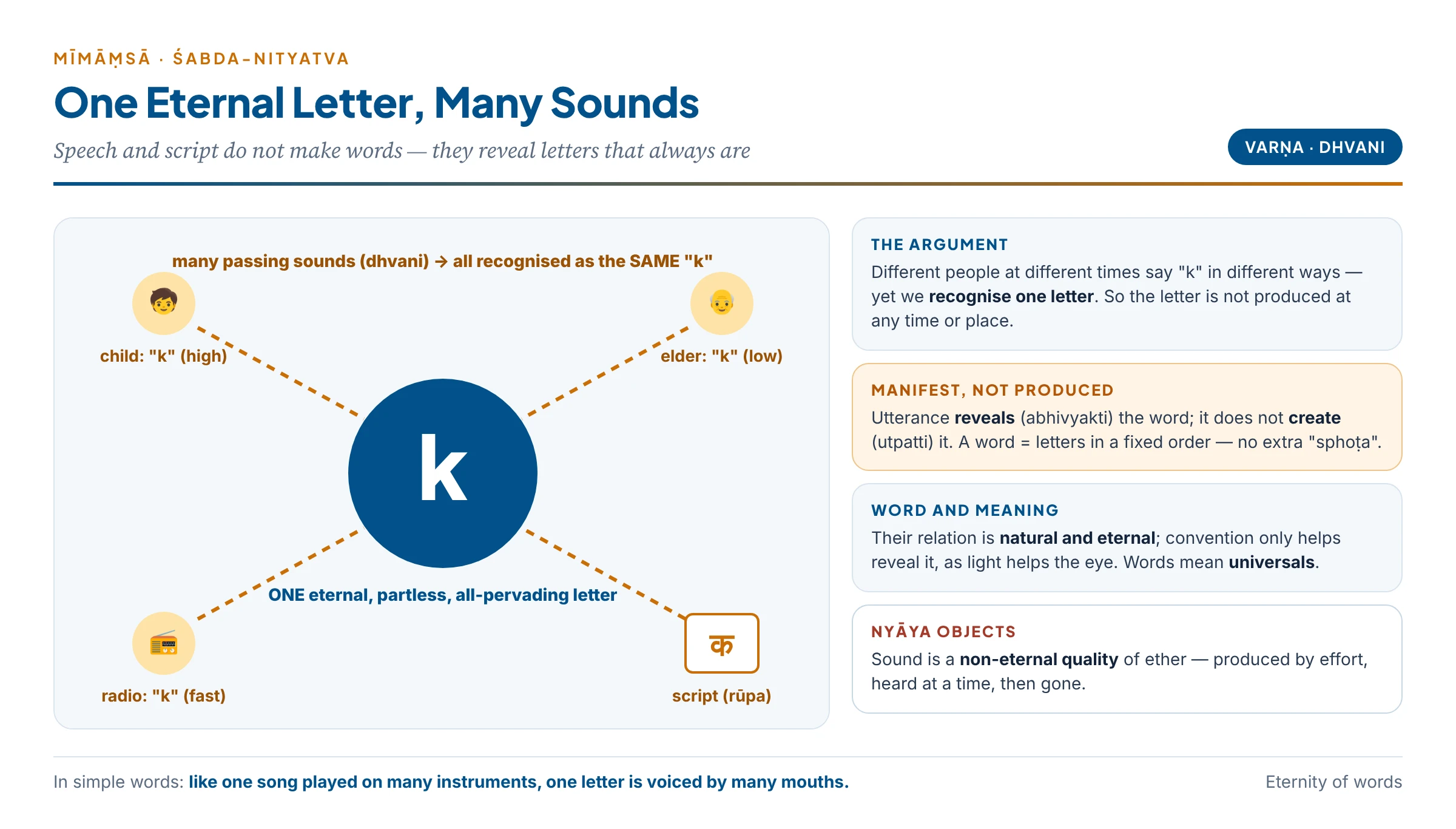
- Letters are eternal. Mīmāṃsā answers that words are not really the perceived sounds (dhvani). A word is made of two or more letters (varṇa), and each letter is:
- eternal (nitya),
- omnipresent (sarvagata), and
- partless (niravayava).
- Sound and script only reveal. The audible sound (dhvani) when spoken, and the written shape (rūpa) when written, are only the accidental vehicles that manifest the eternal letter. Speaking does not produce a word; it reveals it (abhivyakti, not utpatti).
- The argument from recognition. The letter “k” is pronounced by different people, at different places and times, in different ways — high, low, fast, slow. Yet we recognise that the same letter is pronounced by all of them. If “k” pronounced ten ways were ten different letters, there would be no “k” at all. This identity shows that the letter is not produced at any time and place but transcends them.
- A word is an ordered aggregate. A word is a collection of letters in a fixed order, not a separate whole (avayavī). Mīmāṃsā rejects the Grammarians’ sphoṭa — an indivisible meaning-bearer “burst forth” by the letters — as an unnecessary extra entity.
- The Nyāya counter-view. For Nyāya, sound is a non-eternal quality of ether (ākāśa): it is produced by effort, perceived at a particular time, and perishes; we speak of “making a noise”. Mīmāṃsā replies that what is produced and perishes is the sound that manifests the word, not the word.
In simple words
A song is played on a phone, a radio, a guitar and hummed by a child. Four very different sounds — yet you say, “That’s the same song.” The song is not any one of those sounds; each performance makes it audible. For Mīmāṃsā a letter like “k”, and hence every word, is like that song: one eternal thing, many temporary performances.
6. Word, Meaning and Their Relation Are Eternal
- The relation is natural (autpattika). The relation between a word and its meaning is innate — “the relation of word with meaning is original” (autpattikas tu śabdasyārthena sambandhaḥ, Jaimini). It is natural, necessary, inseparable and eternal.
- Not fixed by God or by convention. Old Nyāya held that word–meaning relations are fixed by God’s will; later Nyāya, by human convention (saṅketa). Mīmāṃsā rejects both: language is not a creation of the human or even the divine mind.
- Convention plays a helping role. The conventional element in language is secondary — an auxiliary (sahakārin) that helps manifest the eternal words and their meanings, as light helps the eye to see what is already there.
- The fixed order of the Veda. But if all words are eternal, what makes the Veda special? Any poem is also made of eternal words. Mīmāṃsā’s answer: in ordinary works the order of words is fixed by an author, and so is open to his defects. In the Veda the order (ānupūrvī) is self-determined and eternal. It is this fixed, authorless text, not merely its words, that is eternal.
7. What Do Words Mean — Universals or Particulars?
The 2023 paper asked whether words refer to universals, particulars or both, according to Nyāya and Mīmāṃsā.
- The Mīmāṃsā view: words mean universals. A word does not signify the particular things that come into existence and pass away, but the eternal universal (jāti, also called ākṛti, “form”) underlying them. “Cow” means cowness.
- Arguments.
- Eternity. The word–meaning relation is eternal, so its meaning must be eternal; particular cows are born and die, cowness does not.
- Infinity. There are countless individual cows, past, present and future. If “cow” meant individuals, it would need countless separate relations — one per cow — which no one could learn (the fault of endlessness, ānantya).
- Wandering. If “cow” meant one particular cow, it could not apply to any other (the fault of deviation, vyabhicāra).
- Usage. When someone says “bring a cow“, any cow will do. The word picks out the kind, not a particular cow.
- How do we then reach the individual? Universals cannot be milked, tied or brought. Mīmāṃsā says the individual is grasped secondarily — by implication (ākṣepa) or by secondary signification (lakṣaṇā): since a universal cannot exist without individuals, the mention of cowness brings with it an individual cow.
- Example. “The cow is to be sacrificed” (gaur anubandhyaḥ). Cowness is eternal and cannot be sacrificed; so here “cow” must convey an individual cow by secondary signification.
- The Nyāya view: individual, form and universal together. The Nyāya-sūtra says the meaning of a word is the individual, the form and the universal together (vyakty-ākṛti-jātayas tu padārthaḥ).
- In any given use, one of the three is prominent and the others are subordinate: in “the cow is standing” the individual is prominent; in “the cow is not to be kicked“, the universal (all cows); in “make a cow of clay“, the form.
- Later Nyāya: a word means an individual qualified by a universal (jāti-viśiṣṭa-vyakti) — “cow” means “a thing having cowness”.
- Against Mīmāṃsā: if words meant only universals, sentences like “bring the cow” or “the cow is to be sacrificed” would be absurd or need constant secondary meaning; it is simpler to say the word directly denotes the individual-as-qualified.
- The Buddhist view (apoha). Buddhists deny real universals: “cow” means only “not non-cow” — the exclusion of everything else. Kumārila argued at length against this theory, defending real universals as the meanings of words.
| Point | Mīmāṃsā | Nyāya | Buddhist (Dignāga) |
|---|---|---|---|
| Primary meaning of “cow” | The universal cowness (jāti/ākṛti) | Individual + form + universal; later: individual qualified by cowness | Exclusion of non-cows (apoha) |
| Universals real? | Yes, eternal | Yes, eternal | No — mental constructions |
| How the individual is reached | By implication or secondary meaning | Directly, as qualified by the universal | Never truly; only exclusion |
| Example used | “Bring a cow” — any cow will do | “The cow is standing” — this cow | “Cow” = “not a horse, not a man…” |
Indian Connect — Reading the 2023 question
- Mīmāṃsā: words mean universals; individuals come by implication.
- Nyāya: words mean individuals as qualified by universals (with form), the emphasis shifting with use.
- Both agree that universals are real — against the Buddhist apoha.
8. How Does a Sentence Mean? Abhihitānvayavāda vs Anvitābhidhānavāda
This is the great internal debate, asked in 2024: how do word-meaning and sentence-meaning differ for the Bhāṭṭa and the Prābhākara?
- The shared conditions. Both schools (and Nyāya) accept that words must stand in proper relation to form a sentence:
- Expectancy (ākāṅkṣā) — words must need one another (“bring” needs an object);
- Compatibility (yogyatā) — their meanings must fit (“wet him with fire” lacks it);
- Proximity (sannidhi, āsatti) — they must be uttered close together in time.
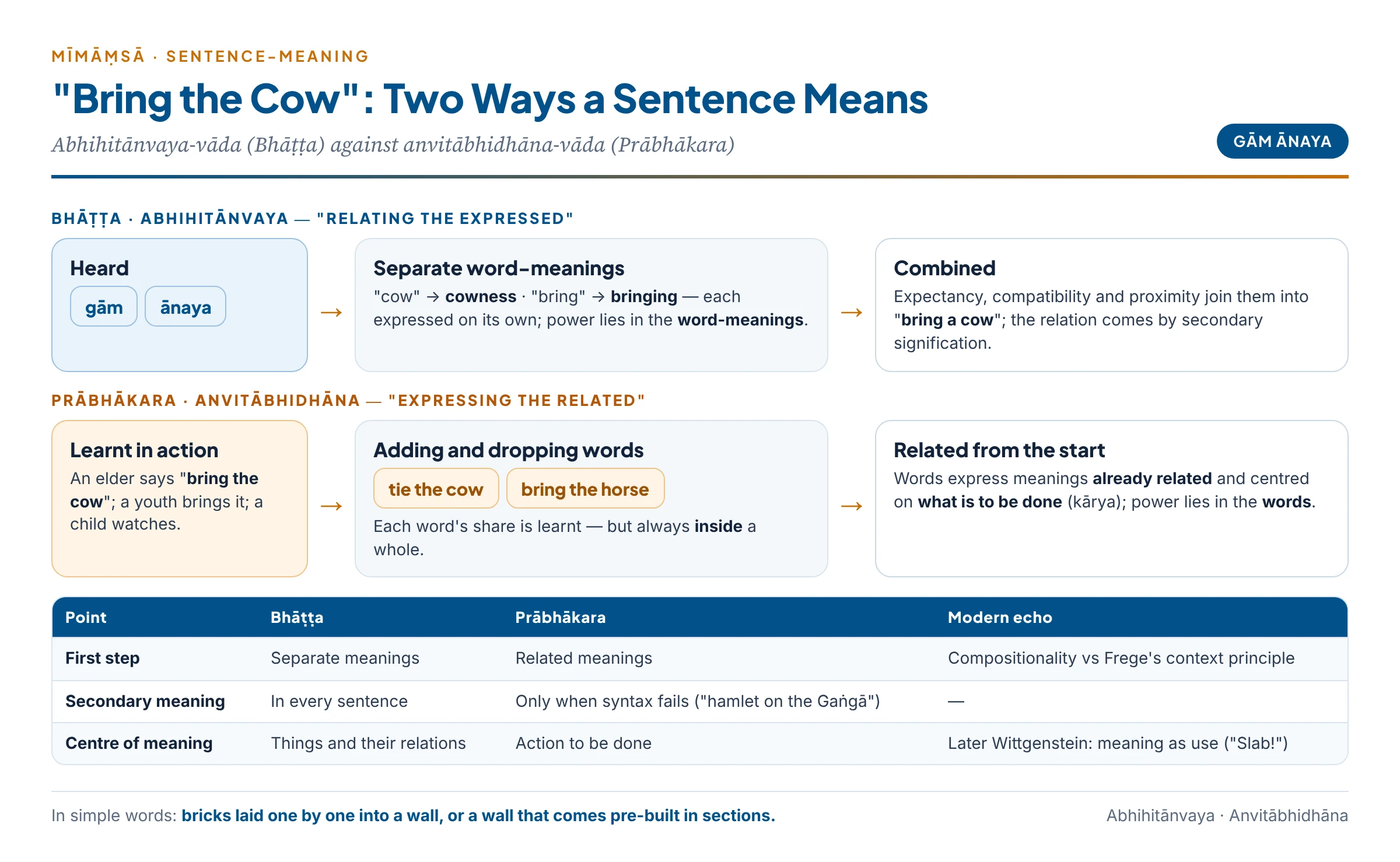
- (a) Bhāṭṭa: abhihitānvaya-vāda — “relation of the expressed”.
- Each word first expresses its own separate meaning (padārtha) — “bring” expresses bringing, “cow” expresses cowness.
- These separately expressed meanings then combine into the sentence-meaning (vākyārtha), on the basis of expectancy, compatibility and proximity.
- The relation among the meanings is not expressed by any single word; Kumārila says it is conveyed by the word-meanings themselves through secondary signification (lakṣaṇā) — so in a sense every sentence involves lakṣaṇā.
- Power (śakti) to produce the sentence-meaning belongs to the word-meanings (padārtha), not to the words directly.
- Kumārila allows both existential and injunctive sentences; but he limits the final import of the Veda to injunctions.
- (b) Prābhākara: anvitābhidhāna-vāda — “expression of the related”.
- Words never express isolated meanings. Each word expresses its meaning already related (anvita) to the meanings of the other words in the sentence. There is no separate stage of isolated word-meanings.
- How we learn language. A child learns words not from a dictionary but from elders’ usage (vṛddha-vyavahāra). An elder says to a younger person, “Bring the cow” (gām ānaya), and the younger person brings a cow. The child watching understands the sentence as a whole, as an instruction for action. Then he hears “Tie the cow“, “Bring the horse“, and by adding and dropping words (āvāpa–udvāpa) learns what each word contributes — but always as a part of a related whole.
- Action at the centre (kāryānvitābhidhāna). Since words are learnt in the context of something to be done, their meanings are always related to kārya — “what is to be done”. Every sentence ultimately points to activity; the Veda’s purpose is to command.
- Power (śakti) belongs to the words (pada) themselves, which directly convey the related meaning.
- Secondary meaning (lakṣaṇā) is needed only when there is a syntactic difficulty (anvaya-anupapatti): “the hamlet is on the Gaṅgā” (gaṅgāyāṃ ghoṣaḥ) — a hamlet cannot be in a river, so “Gaṅgā” means its bank; “let the sticks in” (yaṣṭīḥ praveśaya) — “sticks” means “the people carrying sticks“.
- Figurative meaning. Mīmāṃsakas also accept a separate figurative function (gauṇī vṛtti) different from lakṣaṇā: “the young scholar is a lion” or “is fire” conveys his bravery or brilliance — qualities shared with lion and fire.
| Point | Bhāṭṭa — abhihitānvaya | Prābhākara — anvitābhidhāna |
|---|---|---|
| First step | Words express separate meanings | Words express meanings already related |
| Source of sentence-meaning | Combination of word-meanings | The words themselves, as related |
| Where power lies | In the word-meanings (padārtha) | In the words (pada) |
| Role of lakṣaṇā | Involved in every sentence (the relation) | Only when syntax fails |
| Centre of meaning | Things and their relations | Action to be done (kārya) |
| How words are learnt | Words and meanings first, then combination | From elders’ commands in action, by adding and dropping words |
| Analogy | Bricks laid one by one into a wall | A wall that comes pre-built in sections |
| Close to | Nyāya | Later Wittgenstein’s “meaning is use” |
In simple words
“Pass the salt.” The Bhāṭṭa says you first understand “pass” and “salt” separately and then put them together. The Prābhākara says you never understood “salt” in isolation — you learnt it at the dinner table, where “salt” always came inside requests like “pass the salt”, “add salt”, “too much salt”. Its meaning came to you already tied to doing something.
9. The Structure of the Veda and the Primacy of Injunction
- Five kinds of Vedic content. Mīmāṃsā divides the Veda into:
- Vidhi — injunctions (“one should sacrifice”);
- Mantra — formulas recited during the rite, which remind of what is to be done;
- Nāmadheya — names of sacrifices;
- Niṣedha — prohibitions (“one should not eat…”) — which are really injunctions in disguise: injunctions to refrain;
- Arthavāda — explanatory passages that praise what is enjoined or condemn what is forbidden, or tell stories in support.
- Action is the final import of the Veda. The Vedas are a Book of Commandments; therein lies their value. Any part that does not direct action but merely tells us about the existence of something — the soul, immortality — is useless unless it can be connected with some injunction, by persuading people to perform a rite or dissuading them from a forbidden act.
- Ritualistic pragmatism. This attitude reminds us of modern Pragmatism, which values knowledge only in so far as it leads to action. Mīmāṃsā is therefore called ritualistic pragmatism: the value of Vedic knowledge lies in ritual activity.
- The two schools.
- Kumārila accepts the distinction between existential and injunctive sentences, but limits the Veda’s purpose to injunctions; existential passages (arthavāda) explain and support them.
- Prabhākara takes a strictly pragmatic view of all knowledge: every sentence, Vedic or secular, ultimately points to activity; even “assertive” Vedic passages are authoritative only as they help people do their duty.
- Tools of interpretation. To harmonise apparently conflicting texts, Mīmāṃsā ranks six means of deciding how a text applies — direct statement (śruti), indicatory mark (liṅga), syntactical connection (vākya), context (prakaraṇa), position (sthāna) and name (samākhyā) — the earlier being stronger than the later. These rules later shaped Indian legal interpretation.
10. Prābhākara’s Case for Śruti as a Pramāṇa
The 2013 paper asked us to evaluate Prabhākara’s arguments for accepting śruti (the Veda) as a pramāṇa.
- (1) Only śāstra reveals kārya. The proper object of verbal knowledge is kārya — what ought to be done. No other pramāṇa can reveal a duty: perception shows what is, not what ought to be. So verbal knowledge of duty is an independent pramāṇa.
- (2) Dharma is supersensible. The duty and its fruit lie beyond perception and inference; only injunction (codanā) reveals them.
- (3) No author, no defect. Testimony is spoiled only by the defects of speakers. The Veda has no speaker, hence no defect.
- (4) Intrinsic validity. Every apprehension is valid; the knowledge arising from Vedic sentences is valid by itself and needs no confirmation.
- (5) Only the Veda is testimony proper. Human statements are known to be true only by inferring the speaker’s reliability; the Veda alone gives knowledge directly from words. So the Veda is not merely one testimony among others but the only true śāstra.
- (6) Eternal word–meaning relation. Because words, meanings and their relation are eternal, the Veda’s meaning does not depend on any person’s intention.
- Evaluation.
- Strength: it explains why moral ought cannot be derived from perceived is — a point close to Hume’s “is–ought” gap.
- Weakness: the authorlessness of a text is not provable; the argument rests on the absence of a remembered author, which proves only our ignorance.
- Weakness: reducing all human testimony to inference makes most of our knowledge (history, science learned from teachers) inferential, which seems artificial.
11. The Śābdabodha Debate: Naiyāyikas vs Prābhākaras
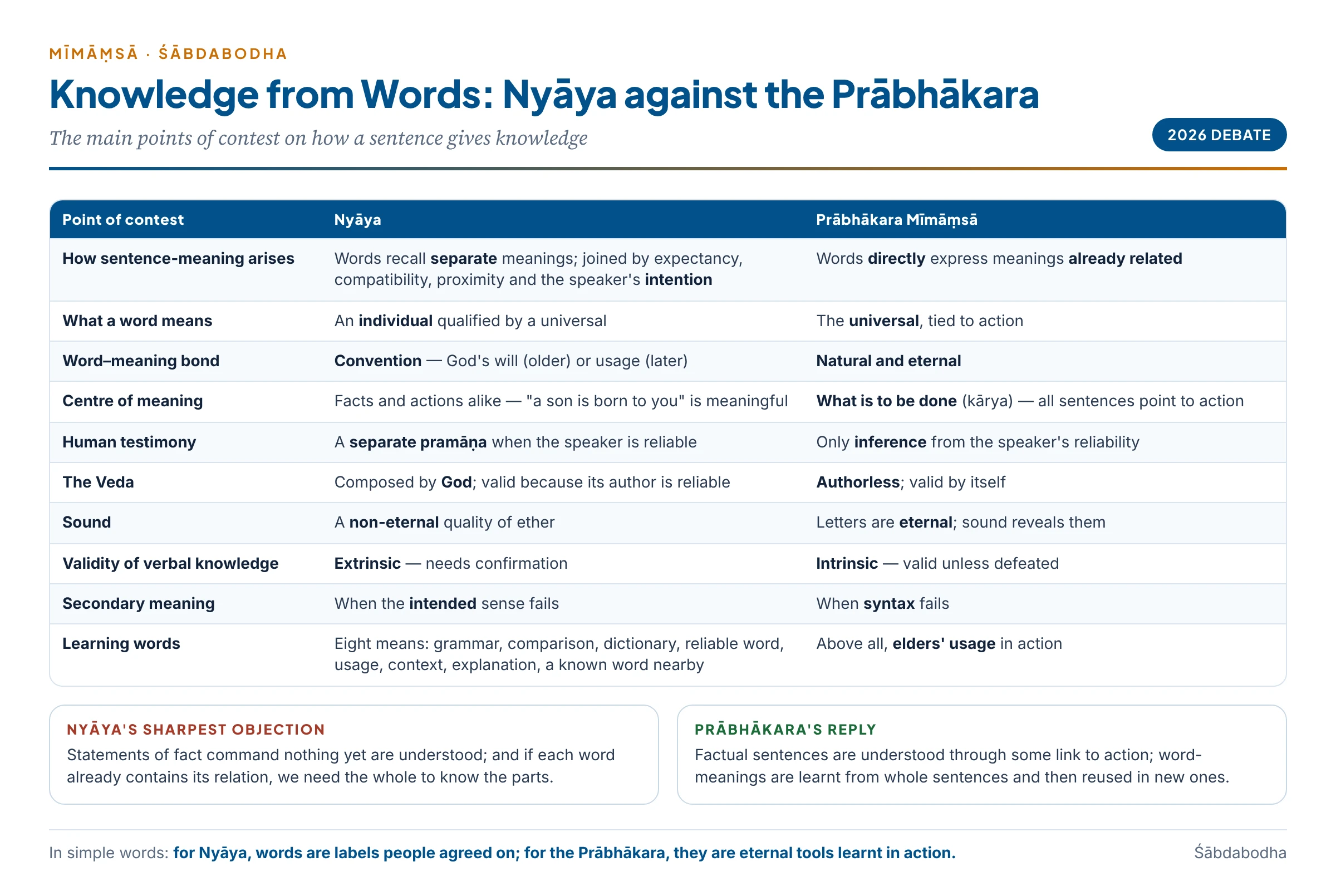
The 2026 paper asked for the main points of contestation between the Naiyāyikas and the Prābhākara Mīmāṃsakas on knowledge through words (śābdabodha).
| Point of contest | Nyāya | Prābhākara Mīmāṃsā |
|---|---|---|
| How sentence-meaning arises | Words recall their separate meanings; these are then related through expectancy, compatibility, proximity and the speaker’s intention (tātparya) | Words directly express meanings already related (anvitābhidhāna) |
| What a word primarily means | An individual qualified by a universal | The universal, related to action |
| Nature of word–meaning relation | Conventional (saṅketa) — set by God’s will (older Nyāya) or human usage (later) | Natural and eternal (autpattika) |
| Centre of sentence-meaning | Facts and actions alike; declaratives are fully meaningful | Kārya — what is to be done; all sentences point to action |
| Human testimony | A separate pramāṇa, valid when the speaker is reliable (āpta) | Not a separate pramāṇa — a case of inference |
| Authority of the Veda | Composed by God; valid because its author is reliable | Authorless; valid by itself |
| Nature of sound | A non-eternal quality of ether, produced and destroyed | Letters are eternal; sound only manifests them |
| Validity of verbal knowledge | Extrinsic — must be confirmed | Intrinsic — valid unless defeated |
| When secondary meaning applies | When the intended sense fails (tātparya-anupapatti) | When syntax fails (anvaya-anupapatti) |
| How meanings are learnt | Eight means — grammar, comparison, dictionary, a reliable person’s word, usage, context, explanation, proximity of a known word | Above all, elders’ usage in action |
- Nyāya’s chief objections.
- Sentences of fact are meaningful. “A son is born to you” or “There is a pot on the floor” command nothing, yet everyone understands them. Meaning cannot be tied to action.
- Learning is not only from commands. Children also learn words from pointing and naming (“this is a dog”).
- Circularity. If each word’s meaning already contains its relation to the others, we must know the whole sentence to know any word — and know the words to know the sentence.
- Words are produced. We hear sounds begin and end; “eternal letters” are an unnecessary hypothesis.
- Prābhākara replies.
- Declarative sentences are understood because they are connected, directly or indirectly, with some action.
- Even pointing teaches a word within activity (“look at the dog”, “don’t touch the dog”).
- No circle: we learn word-meanings from whole sentences, by adding and dropping words, and then apply them to new sentences.
Critical Evaluation
Objections to the Mīmāṃsā Theory of Śabda
- “A theological dogma.” The claim that the Veda — a literary work made of sounds and symbols — is eternal and authorless cannot be supported by any rational argument; it remains more or less a theological dogma.
- Absence of an author’s name proves nothing. Many folk songs and proverbs have no known author, yet are obviously human. Unknown authorship is not no authorship.
- Scholarship. Modern historical study shows the Vedic hymns were composed over many centuries, in a developing language, reflecting particular societies.
- Eternal sounds. Physics treats sound as vibration that begins and ends; the “eternal letter” seems to confuse a type (the letter k as a pattern) with a thing that exists eternally.
- Circularity. The Veda’s authority is defended by svataḥ prāmāṇya, and svataḥ prāmāṇya is defended partly to protect the Veda.
- Ritualistic narrowness. Calling the existential parts of the Veda “useless” unless they serve ritual devalues the Upaniṣads and their teaching about the self — the objection of Vedānta.
- Nyāya: a text needs an author as a pot needs a potter; the Veda’s excellence is best explained by an omniscient author.
- Cārvāka, Buddhist, Jaina: the Veda contains contradictions, repetitions and meaningless formulas; its authority is a priestly interest.
Mīmāṃsā’s Replies
- Tradition. For texts handed down by an unbroken oral tradition of extraordinary precision, the silence about an author is significant, unlike for folk songs.
- Types are real. Recognising the same letter in many utterances shows that the letter is a real, repeatable unity; to call it eternal is to say it is not made by any speaker.
- God would be worse. Grounding the Veda in God’s authorship makes its authority depend on proving God — far harder than accepting the text’s own self-validity.
- Contradictions vanish on correct interpretation; that is exactly what Mīmāṃsā’s rules of interpretation are for.
Critics and Defenders
Criticism — Critics
- Rational critics: authorlessness and eternal letters are a theological dogma.
- Nyāya: every text has an author; the Veda’s is God; words are produced; meaning rests on convention.
- Vedānta: the Veda’s knowledge-portion (Upaniṣads) is not “useless”; Brahman, not ritual, is its final import.
- Cārvāka, Buddhists, Jainas: the Veda is a human, interested composition.
- Against Prabhākara: factual sentences have meaning without any command.
Defence — Defenders and strengths
- Dharma is genuinely beyond perception; only a normative source can reveal an “ought”.
- Recognition of one letter in many sounds is a real phenomenon needing explanation.
- Universals as word-meanings explain how a word applies to endless new cases.
- Anvitābhidhāna anticipates “meaning is use” and context-based theories of language.
- The rules of interpretation became the foundation of Indian legal and textual hermeneutics.
Cross-Tradition Comparison
Śabda and Western Philosophy
| Point | Mīmāṃsā | Western parallel |
|---|---|---|
| Testimony as a basic source | Bhāṭṭa: reliable testimony is valid by itself | Thomas Reid: we trust testimony by a natural “principle of credulity”; today’s anti-reductionists about testimony |
| Testimony reduced to inference | Prābhākara, Vaiśeṣika | Hume: we trust testimony only from experience of its reliability |
| Meaning learnt from use | “Bring the cow” — elders’ usage | Later Wittgenstein: “the meaning of a word is its use”; the builders’ “Slab!” |
| Sentence first | Anvitābhidhāna | Frege: a word has meaning only in the context of a sentence |
| Words combine | Abhihitānvaya | Compositionality: the sentence-meaning is built from word-meanings |
| Words mean universals | Cowness | Plato’s forms; realism about universals; vs nominalism (Buddhist apoha ≈ Ockham) |
| Is–ought gap | Perception shows what is; only injunction shows duty | Hume: no “ought” from “is” |
| Commands as the core of scripture | Veda as a Book of Commandments | Divine command traditions — but Mīmāṃsā’s commands have no commander |
Revelation and Śruti (Paper II link)
| Point | Śruti in Mīmāṃsā | Revelation in theistic religions |
|---|---|---|
| Source | No author — eternal, “heard” by seers | God reveals truths to prophets |
| Content | Mainly injunctions (duties) | Truths about God and salvation, and commands |
| Validity | Self-valid; needs no confirmation | Often said to need faith; sometimes confirmed by miracles or reason |
| Role of reason | Removes doubts; interprets | Debated — reason as servant or judge of revelation |
| Nyāya’s version | — | Closer to theistic revelation: Veda authored by an omniscient God |
Indian Connect — Key takeaways
- Mīmāṃsā makes the Veda supreme without God — a unique position: authority from authorlessness.
- Vedānta inherits the authorless Veda, but turns its final import from ritual action to knowledge of Brahman.
- The Bhāṭṭa–Prābhākara quarrel on sentence-meaning is one of the most sophisticated debates on language anywhere before the twentieth century.
Synthesis (Siddhānta)
- Śabda is the highest pramāṇa for Mīmāṃsā because dharma is supersensible and only the Veda can reveal it.
- Testimony is personal or impersonal; the Bhāṭṭa accepts reliable human testimony as a pramāṇa, the Prābhākara reduces it to inference and keeps only the Veda as śāstra.
- The Veda is authorless (no remembered author, seers not authors, unobservable fruits, no defects), eternal (its letters and fixed order are eternal) and self-valid.
- Words are eternal letters; their relation to meaning is natural, not conventional; and words primarily mean universals, reaching individuals by implication — against Nyāya (individual qualified by universal) and the Buddhists (exclusion).
- On sentence-meaning, the Bhāṭṭa says separate word-meanings combine (abhihitānvaya); the Prābhākara says words express already-related, action-oriented meanings (anvitābhidhāna).
- Against Nyāya, the Prābhākara differs on sentence formation, the nature of the word–meaning bond, the centrality of action, human testimony, the Veda’s author, the eternity of sound and the validity of verbal knowledge.
- Contemporary relevance.
- Epistemology of testimony — whether we may trust what we are told without checking — is a live debate today, with Reid-style and Hume-style camps mirroring Bhāṭṭa and Prābhākara.
- Linguistics — how children learn words from use in context — echoes the Prābhākara account.
- Law — Mīmāṃsā maxims of interpretation are still cited in Indian statutory interpretation.
“The relation of the word with its meaning is original (natural, not made).” — Jaimini, Mīmāṃsā-sūtra
Previous Year Questions
- 2026Bring out the main points of contestation between Naiyāyikas and Prabhākara Mīmāṃsakas with reference to knowledge through words (Śābdabodha).
- 2024How does Bhāṭṭa’s view of nature of word-meaning and sentential-meaning differ from Prābhākara’s view? Critically discuss.
- 2023Do words refer to universals or particulars or both? Present an exposition of Nyāya and Mīmāṃsā position with regard to above question along with suitable examples.
- 2019How does Mīmāṃsā establish the authority of Vedic knowledge?
- 2013Evaluate Prabhākara Mīmāṃsaka’s arguments for accepting śruti as pramāṇa.
- 2012Why does Mīmāṃsā give utmost importance to Śabda pramāṇa, the verbal testimony? Is it anything to do with Vedas? Give your comments.
- 2006Explain the notion of revelation. Does revelation stand in need of confirmation? Discuss and also explain the difference or similarity between revelation and Śruti.