

Sāṃkhya: Prakṛti; Puruṣa; Causation; Liberation.
Official Syllabus: Paper I, Section B, Unit 16
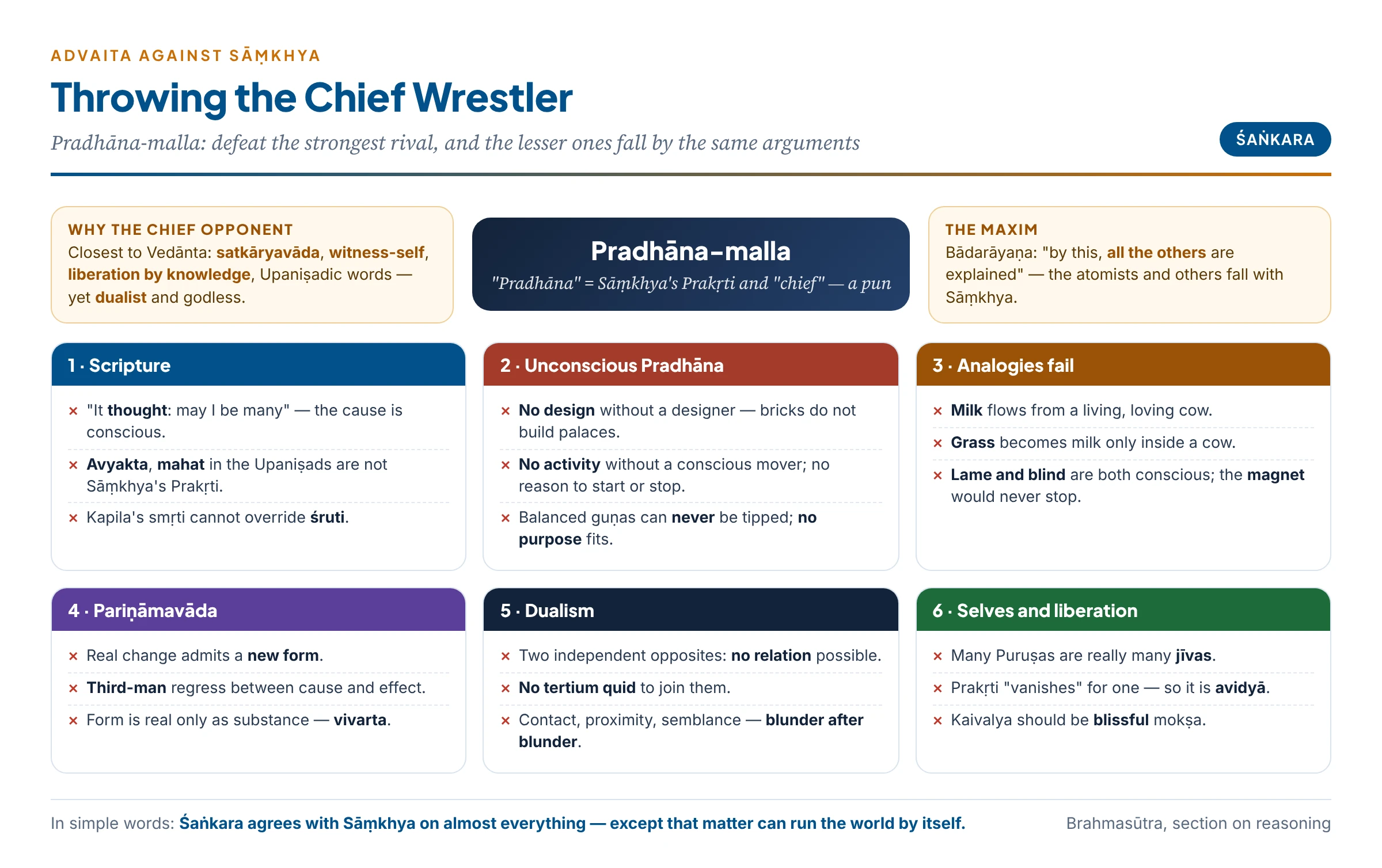
Śaṅkara calls Sāṃkhya his pradhāna-malla — the “chief wrestler” among the opponents of Vedānta. The name is a pun: Sāṃkhya’s first cause is Pradhāna (Prakṛti), and Sāṃkhya is also the foremost rival, so close to Vedānta in many ways that it had to be defeated first. Once the strongest wrestler is thrown, the rest fall easily. This article brings together the whole case against Sāṃkhya — Śaṅkara’s scriptural and rational arguments against an unconscious Pradhāna as the cause of the world, his rejection of real transformation (pariṇāmavāda), the famous problem of how two completely independent realities can be related at all, and the critiques of many Puruṣas and of a bliss-less liberation — together with Sāṃkhya’s replies, the verdict that “Vedānta is implicit in Sāṃkhya“, and comparisons with Descartes, Spinoza and Advaita.
In simple words
Imagine two neighbours who agree on almost everything — that the house was built from materials already present, that the owner is not the furniture, that freedom comes from knowledge. They quarrel bitterly over one thing: whether the house builds itself or needs a mind behind it. Neighbours who agree on ninety things fight hardest over the ninety-first. Śaṅkara and Sāṃkhya are such neighbours, and that is why Sāṃkhya is his chief opponent.
Context & Problem
Why Sāṃkhya Is the “Chief Opponent” (Pradhāna-malla)
- Closest to Vedānta. Sāṃkhya shares much with Advaita:
- Satkāryavāda — the effect pre-exists in its cause.
- The self as pure consciousness, distinct from body, mind and intellect, beyond bondage and liberation.
- Liberation by knowledge, not by action.
- The guṇas and the account of the evolution of the world, which Vedānta largely keeps.
- A vocabulary taken from the Upaniṣads — avyakta, mahat, puruṣa.
- Claims scriptural support. Some Sāṃkhyas claimed that their system was the teaching of the Upaniṣads; Upaniṣadic and smṛti passages seem to use Sāṃkhya terms. Bādarāyaṇa’s Brahmasūtra returns again and again to the question whether Sāṃkhya can be the meaning of the Upaniṣads, and rejects it; it also refutes Sāṃkhya on rational grounds in its section on reasoning.
- Respected by the wise. Śaṅkara grants that Sāṃkhya and Yoga are widely accepted by the wise as conducive to the highest good — yet they teach dualism and so cannot be supported by the śruti.
- The strongest rival. Sāṃkhya’s Pradhāna is the most powerful alternative to Brahman as the cause of the world. Śaṅkara applies the “maxim of the chief wrestler“: defeat the chief, and the lesser opponents — the atomists and others — are defeated by the same arguments. The Brahmasūtra itself says that “by this, all the others are explained“.
- The pun. Pradhāna is both Sāṃkhya’s name for Prakṛti and the word for “chief”.
What Is at Stake
- The first cause of the world. Is it an unconscious, self-evolving Pradhāna, or a conscious, omniscient Brahman?
- The nature of causation. Is the world a real transformation (pariṇāma) of its cause, or an appearance (vivarta) of an unchanging reality?
- Dualism or non-dualism. Can two absolute, independent realities — consciousness and matter — account for the world, or must there be one reality?
- The self. Are there many selves or one? Is liberation the isolation of a self or the realisation of identity with Brahman?
Core Doctrine
1. The Scriptural Case: Pradhāna Is Not the Cause Taught by the Upaniṣads
- “It thought.” The Upaniṣad says of the first cause: “It thought: may I be many; may I grow forth.” Thinking (īkṣaṇa) belongs only to a conscious being. An unconscious Pradhāna cannot “think”; so the cause the Upaniṣads speak of is Brahman, not Pradhāna. Pradhāna is “not based on scripture“.
- The “unmanifest” of the Upaniṣads is not Sāṃkhya’s Prakṛti. When the Kaṭha speaks of the mahat and the avyakta, it means stages of the subtle body and of the self’s path, not Sāṃkhya’s independent Prakṛti. Words such as mahat and avyakta are used in the Veda in the sense of names and forms dependent on Brahman.
- The “unborn red-white-dark” verse describes a power of the Lord (later, māyā), not an independent matter.
- Smṛti cannot override śruti. Kapila’s smṛti, where it conflicts with the Veda, has no authority; other smṛtis (such as Manu) agree with the Upaniṣads that Brahman is the cause.
2. The Rational Case against an Unconscious Pradhāna
Even apart from scripture, Śaṅkara argues that reason itself rejects Pradhāna as the first cause.
- (a) No design without a designer (racanā-anupapatti). The world is full of order, design and purpose — bodies suited to experience, a cosmos suited to moral life. An unconscious cause cannot produce such an arrangement, any more than stones, bricks and mortar can build a palace without an architect, or clay can shape itself into a pot. Wherever we see design, we see an intelligent maker.
- (b) No activity without a conscious mover (pravṛtti-anupapatti). Even the tendency to act cannot belong to an unconscious thing by itself. A chariot moves only when driven; clay moves only when the potter handles it. If Pradhāna is inert, what moves it from equilibrium to creation? Puruṣa is inactive and cannot move it.
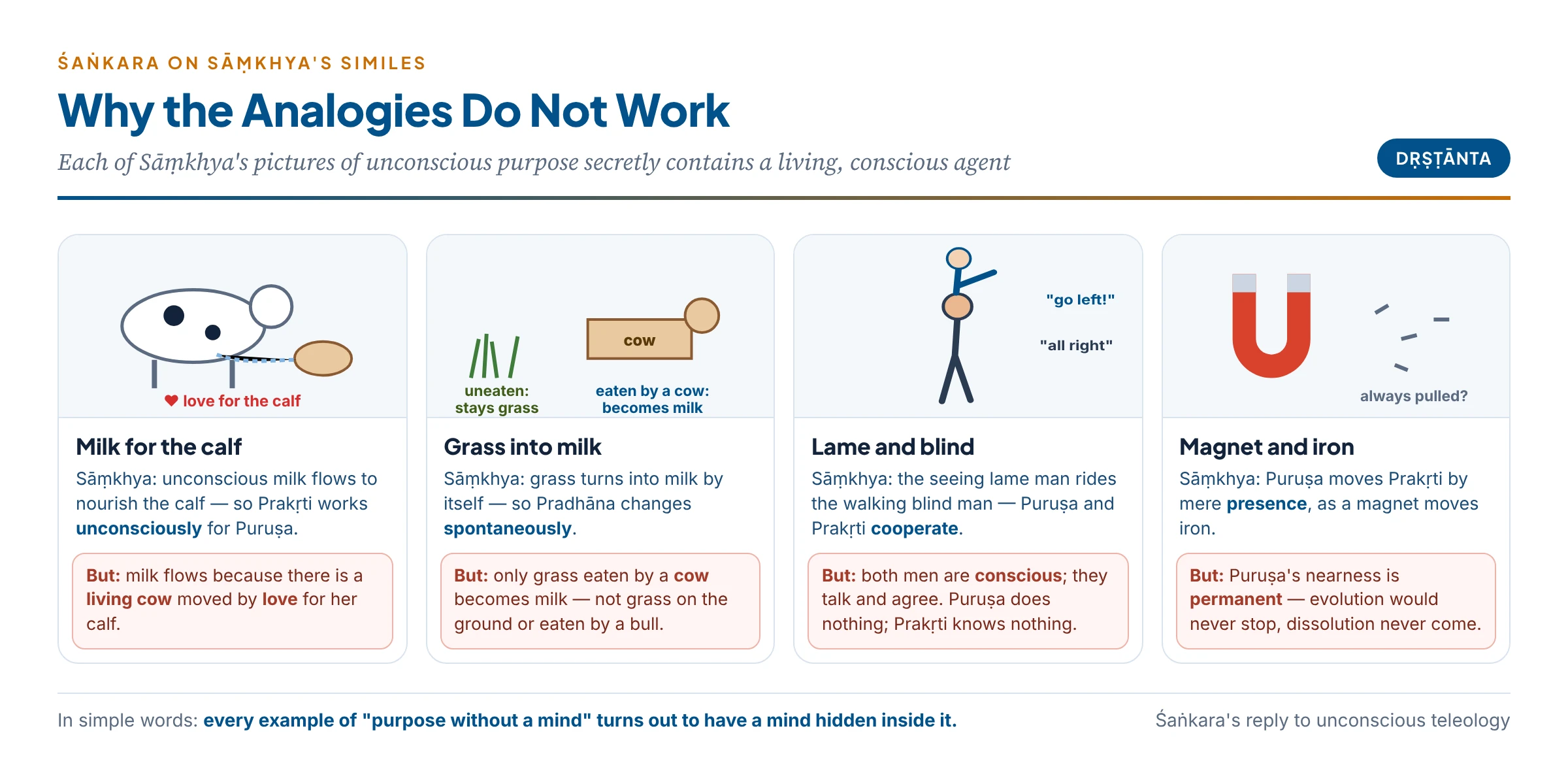
- (c) The milk and water analogies fail. Sāṃkhya says Pradhāna acts unconsciously for Puruṣa as milk flows from the cow for the calf and water flows downhill for people’s use.
- Milk flows because there is a living cow, moved by love for her calf.
- Water too moves under conditions set by the order of nature, which Vedānta traces to a conscious ruler.
- So these are not cases of unconscious activity at all.
- (d) No reason to start or stop. Since nothing exists outside Pradhāna to prompt it, why should it sometimes evolve and sometimes rest in dissolution? Its activity becomes either permanent or impossible.
- (e) Grass does not turn into milk by itself. Sāṃkhya says Pradhāna changes spontaneously, as grass changes into milk. But grass becomes milk only when eaten by a cow — not when it lies uneaten, or is eaten by a bull. The change depends on a living agent.
- (f) No purpose can be assigned. Pradhāna is said to act for Puruṣa’s experience (bhoga) or liberation (apavarga).
- Not for experience — Puruṣa is changeless and can gain nothing; and if experience were the end, creation would never cease.
- Not for liberation — Puruṣa is already isolated and free; and if liberation were the end, no evolution would be needed at all.
- Not for both — then creation would go on for ever without end, and liberation would never be final.
- (g) Neither the lame-and-blind nor the magnet helps.
- The lame man and the blind man are both conscious and active; they can speak, plan and agree. Puruṣa is inactive and Pradhāna unconscious; they can make no plan.
- The magnet moves iron only when brought near, and must be brought by someone; Puruṣa’s presence is permanent and unchanging, so it would either always or never move Pradhāna.
- (h) The guṇas in balance cannot be disturbed. In equilibrium the three guṇas are equal; none is principal and none subordinate. With nothing outside to tip the balance, no guṇa can become dominant, and evolution can never begin.
- (i) Even inferred otherwise, Pradhāna lacks intelligence. Even if the guṇas were imagined as restless by nature, they would still lack the intelligence needed to produce an ordered world.
- (j) Sāṃkhya contradicts itself. Its texts differ on the number of organs (sometimes seven, sometimes eleven), on how the elements arise, and on whether Puruṣa is the experiencer; it makes Prakṛti act and Puruṣa reap the fruit (vicarious liability); and it calls Prakṛti unconscious while describing her as knowing exactly what Puruṣa needs.
In simple words
A shop full of bricks, cement, steel and sand will stay a shop full of materials for ever. A house appears only when an engineer plans and workers build. Śaṅkara’s main argument is just this: the world is like a well-built house, so its cause must include a mind. Sāṃkhya’s Pradhāna is like the pile of materials — rich in possibilities but with no one to plan.
3. Śaṅkara against Real Transformation (Pariṇāmavāda)
- Real change admits a new form. If the effect is a real modification, at least its new form did not exist before — which gives away satkāryavāda to the Nyāya critic.
- The third-man regress. If both cause and effect are independently real, a third thing is needed to relate them, and so on endlessly.
- Form has no reality of its own. Whatever reality a form has, it has through its substance: the pot is real only as clay, the ornament only as gold. “All modification is a matter of words, a mere name; the clay alone is real.” So causation involves no change of substance — only a change of name and form, an appearance.
- Immutability of the cause. If the ultimate cause really changed, it would lose its original nature and become imperfect and perishable.
- Sāṃkhya’s own concession. By admitting only a semblance of contact between Puruṣa and Prakṛti, Sāṃkhya already accepts appearance in place of real change.
- Conclusion. Satkāryavāda, made consistent, becomes vivartavāda: the world is an appearance of Brahman, as a snake is of a rope.
4. “If Puruṣa and Prakṛti Are Two Completely Independent Realities, No Relation between Them Is Possible”
- The thesis. Sāṃkhya makes Puruṣa and Prakṛti absolutely separate and independent, with opposite natures. Then no relation between them is possible, because:
- No third principle (no tertium quid). Prakṛti is unintelligent, Puruṣa indifferent, and there is no third reality to connect them.
- Relation needs some commonality. Consciousness and unconscious matter share nothing through which they could touch.
- Any relation compromises independence. If Prakṛti depends on Puruṣa’s presence to evolve, and Puruṣa depends on Prakṛti for experience, neither is truly independent.
- Sāṃkhya’s three attempts all fail (Article 3):
- Real contact — then Puruṣa is really bound and can never be liberated.
- Mere proximity — Puruṣa is always near, so evolution never stops, and there is no equilibrium, no Prakṛti and no dissolution.
- Semblance of contact — reflection in buddhi presupposes buddhi before evolution; reflection in Prakṛti is permanent, so no liberation; and a semblance of contact yields only a semblance of evolution — vivarta.
- “Blunder after blunder.” To defend its first mistake — treating subject and object as two absolutes — Sāṃkhya commits one mistake after another.
- Śaṅkara’s alternative. The relation between the self and the not-self is superimposition (adhyāsa): through ignorance, the qualities of the not-self are superimposed on the self and vice versa. The “relation” is apparent, not real — exactly what Sāṃkhya’s own semblance-of-contact theory half-admits.
- The deeper point. Subject and object are not two separate absolutes but two aspects of one reality which holds them together and transcends them — “two sides of the same coin”. To dig a chasm between them is to undermine both.
In simple words
Oil and water will not mix, however long you leave them side by side. To bring them together you need a third thing — soap — that has something in common with both. Śaṅkara’s point is that Puruṣa and Prakṛti are like oil and water, only more so: they share nothing at all, and Sāṃkhya has no soap — no third principle — to join them.
Common confusion
Does Śaṅkara reject satkāryavāda? No — a common slip. Śaṅkara accepts satkāryavāda: the effect is not something new beside its cause. What he rejects is pariṇāmavāda, the claim that the cause really changes into the effect. His own view, vivartavāda, is a form of satkāryavāda in which the effect is an appearance of the unchanging cause. So the Advaita–Sāṃkhya quarrel is not about whether the effect pre-exists, but about whether the change is real.
5. Against Many Puruṣas and a Bliss-less Liberation
- One self, not many. The Upaniṣads teach “one only, without a second” and “That thou art“; differences of birth, death, experience and guṇas belong to bodies and minds (the adjuncts), not to the self — as one sun appears in many water-pots. Sāṃkhya’s arguments prove many jīvas, which no one denies, not many Puruṣas (Article 4).
- No principle to distinguish them. If all Puruṣas are pure, contentless consciousness, nothing distinguishes one from another; numerical plurality is idle.
- Inconsistent logic. Sāṃkhya reduces all objects to one Prakṛti; by the same logic it should reduce all selves to one Puruṣa.
- Liberation is bliss. Sāṃkhya’s kaivalya is merely the absence of pain; Advaita’s liberation is the realisation of Brahman as existence–consciousness–bliss (sat-cit-ānanda). Sāṃkhya mistakes empirical pleasure (a product of sattva) for transcendental bliss (Article 5).
6. Prakṛti Turns Out to Be Relative
- The guṇas point beyond themselves. The original state of Prakṛti is not a harmony but a tension of three guṇas; harmony must come from something beyond them — the nistraiguṇya Puruṣa.
- Prakṛti serves Puruṣa. If Prakṛti exists to serve Puruṣa’s ends — through the guṇas, the evolutes, the subtle body — it is subservient, not absolute.
- Prakṛti is described in personal terms. Though called impersonal, she is a dancing girl, feminine, virtuous, generous, the benefactress of Puruṣa, shy and delicate, many-coloured, wanting to attract the spectator. How can such a being be impersonal and absolute?
- Prakṛti vanishes for one, remains for others. She “vanishes” for the Puruṣa who has seen her but continues to exist for others. What vanishes on being seen is not an absolute reality but something like ignorance (avidyā). Either admit a separate Prakṛti for each Puruṣa, or frankly equate Prakṛti with avidyā.
In simple words
Two children are frightened by a “ghost” in a dark room. One switches on the torch and sees a coat on a hook — for him the ghost is gone for good; the other, still in the dark, remains terrified. Something that disappears when properly seen, yet stays for those who have not seen, is not a solid, independent thing but a misreading. That, says the Advaitin, is what Sāṃkhya’s Prakṛti looks like once we notice that she “vanishes” for the liberated alone.
7. “Vedānta Is Implicit in Sāṃkhya”
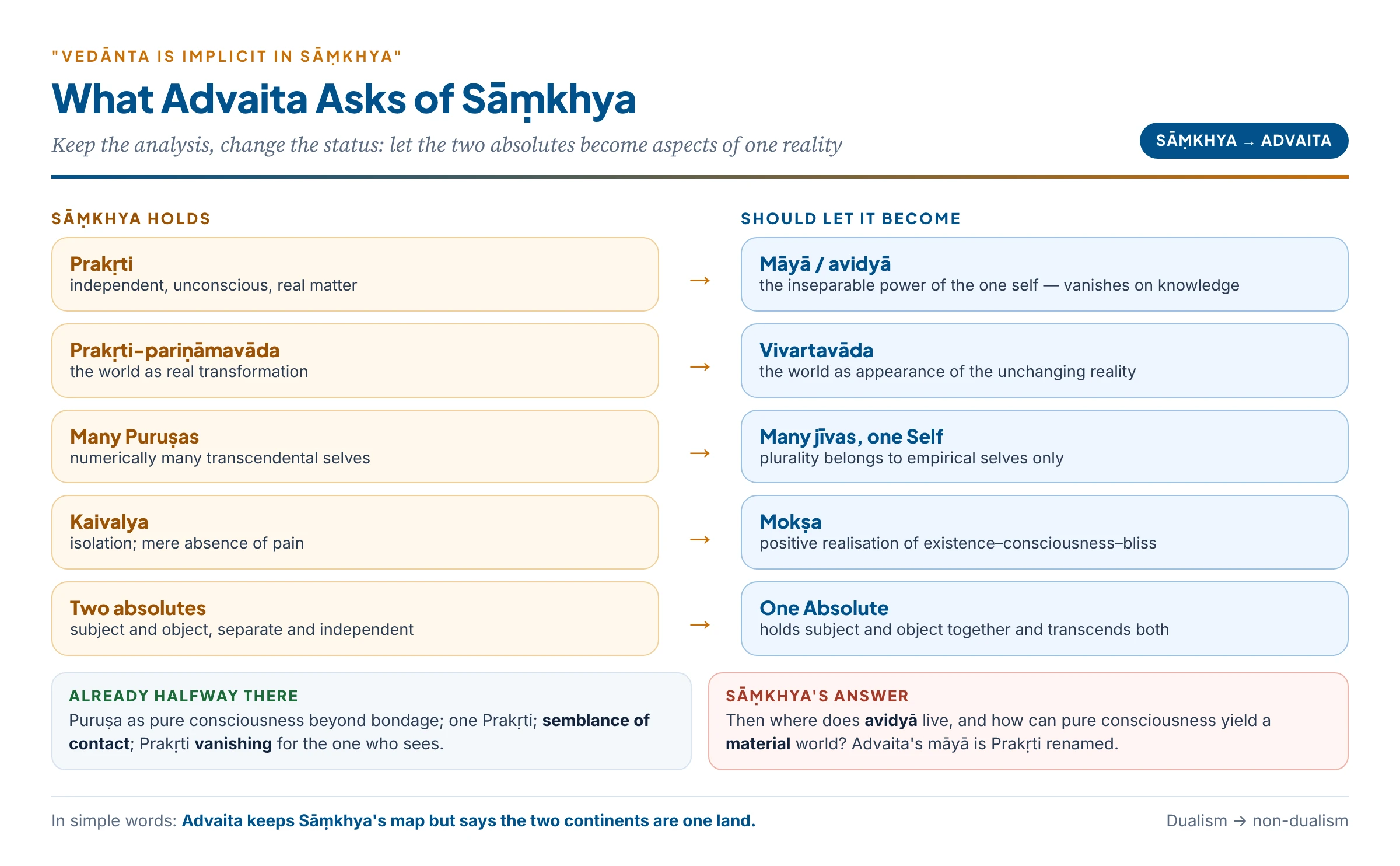
- Radhakrishnan’s verdict. Dr S. Radhakrishnan held that Vedānta is implicit in Sāṃkhya, and that Sāṃkhya rises above the pluralism of the Jainas and Vaiśeṣikas by reducing all material things to one Prakṛti — a step that, carried through, leads to one reality.
- The logic of Sāṃkhya, like that of Jainism, points to absolutism. It is driven towards idealistic monism, but clings to spiritualistic pluralism and dualistic realism.
- Points where Sāṃkhya already leans towards Advaita.
- It describes Puruṣa as pure consciousness, beyond bondage, liberation and transmigration — the Advaitic self.
- It reduces all material causes to one Prakṛti — which corresponds to Advaita’s māyā.
- Its semblance of contact is close to vivarta.
- Its many Puruṣas behave like the many jīvas of Advaita.
- Prakṛti vanishes for the one who has seen her — like avidyā ending in knowledge.
- The recommendation. Sāṃkhya should let:
| Sāṃkhya’s doctrine | Should become (Advaita’s view) |
|---|---|
| Prakṛti, an independent unconscious reality | Avidyā / māyā — the inseparable power of the one transcendental self |
| Prakṛti-pariṇāmavāda — real transformation | Brahma- or Puruṣa-vivartavāda — apparent transformation |
| Many Puruṣas | Many jīvas — empirical selves; one transcendental self |
| Negative kaivalya — isolation, no bliss | Blissful mokṣa — realisation of sat-cit-ānanda |
| Two absolutes, subject and object | One Absolute that holds subject and object together and transcends them |
- The point of the recommendation. Every jīva is potentially the Puruṣa; liberation is the realisation of that potential — the philosophy to which Sāṃkhya’s own logic points.
Indian Connect — Sāṃkhya inside Advaita
- Advaita keeps much of Sāṃkhya: the guṇas, the order of evolution, the distinction of the witness-self from body and mind, and liberation by knowledge.
- Later Advaitins even say that the world is a pariṇāma of māyā but a vivarta of Brahman — Sāṃkhya’s real transformation survives, but now as the transformation of ignorance, not of an independent matter.
- So Advaita does not simply destroy Sāṃkhya; it absorbs it, putting Prakṛti under Brahman.
Critical Evaluation
Sāṃkhya’s Defence
- On satkāryavāda and pariṇāma. The five proofs show that effects pre-exist; experience shows the change is real — curd nourishes, mangoes are eaten, oil lights lamps. To call such change an appearance empties experience of meaning.
- On new form. The form too pre-exists potentially; only its manifestation is new. Manifestation is a new state of the same substance, not a new thing — so satkāryavāda stands.
- On form having no reality. If the form has no reality of its own, the world has none; then the distinction between truth and error in daily life — between the pot that holds water and the pot that does not — collapses.
- On design. Nature everywhere shows purposive processes without conscious design — seeds grow into trees, bodies heal, organs serve the whole. Unconscious teleology is a fact before it is a theory.
- On Brahman as cause. A conscious, perfect, unchanging Brahman makes a worse cause than Pradhāna:
- If Brahman really becomes the world, it changes and is no longer perfect.
- If it only appears to become the world, then the world — with its order, suffering and moral law — is an illusion, and Advaita must explain where ignorance resides and how it arose.
- A material world cannot come from pure consciousness, since the effect shares the nature of its cause.
- On dualism. The difference between consciousness and matter is a datum of experience, not an invention. Monism must either reduce one to the other or call one an appearance — both deny experience.
- On many selves. Experiences, karma and liberation are individual; only many selves fit the facts.
- On kaivalya. Promising bliss smuggles in a guṇa-product; the end of all suffering is the honest goal.
- Advaita’s own debt. Advaita needs a māyā that is unconscious, made of the guṇas, the material cause of the world and beginningless — Sāṃkhya’s Prakṛti under another name.
A Fair Assessment
- Where the critique succeeds.
- Sāṃkhya never explains how an inactive Puruṣa and an unconscious Prakṛti come together; its three attempts fail.
- Its arguments for many Puruṣas really prove many jīvas.
- Its unconscious teleology remains puzzling: purpose without mind is hard to understand.
- Where the critique is less decisive.
- Śaṅkara’s alternative also has a hard question: how does avidyā arise and where does it reside, if Brahman alone is real?
- Calling the world appearance saves non-duality but at the cost of the full reality of the experienced world — a cost Rāmānuja and others refused to pay.
- Śaṅkara’s main weapon is the śruti; his rational arguments mostly show that some intelligence is needed, which a theist (Nyāya, Rāmānuja) could supply without Advaita.
- The lasting value of Sāṃkhya. A brilliant analysis of cosmology, psychology and liberation; a clear dualism that allows clean distinctions (consciousness vs its contents); an evolution model that shaped Yoga, the Gītā, Āyurveda and later Indian thought. Its weakness is the interaction between consciousness and matter — the same weakness that troubles every dualism.
Critics and Defenders
Criticism — Critics
- Śaṅkara: Pradhāna is not taught by the Upaniṣads (“It thought”); unconscious matter cannot design, move, start or stop; the milk, grass, blind–lame and magnet analogies fail; no purpose can be assigned.
- Śaṅkara on causation: pariṇāma admits a new form and a third-man regress; form has no reality apart from substance — vivarta.
- On dualism: two independent opposites cannot be related; no tertium quid; blunder after blunder.
- On selves and liberation: many Puruṣas are really jīvas; kaivalya without bliss is uninspiring.
- On Prakṛti: subservient, personal and vanishing for the liberated — so relative, like avidyā.
Defence — Defenders and strengths
- The five proofs of satkāryavāda and the reality of experienced change.
- Purpose without consciousness is visible in nature.
- A perfect, unchanging Brahman cannot really become a material world; calling the world appearance raises the problem of avidyā.
- The difference between consciousness and matter is a fact any theory must respect.
- Advaita’s māyā is Sāṃkhya’s Prakṛti renamed — Sāṃkhya’s analysis survives inside its critic.
Cross-Tradition Comparison
Sāṃkhya, Descartes, Spinoza and Advaita
| Point | Sāṃkhya | Descartes | Spinoza | Advaita Vedānta |
|---|---|---|---|---|
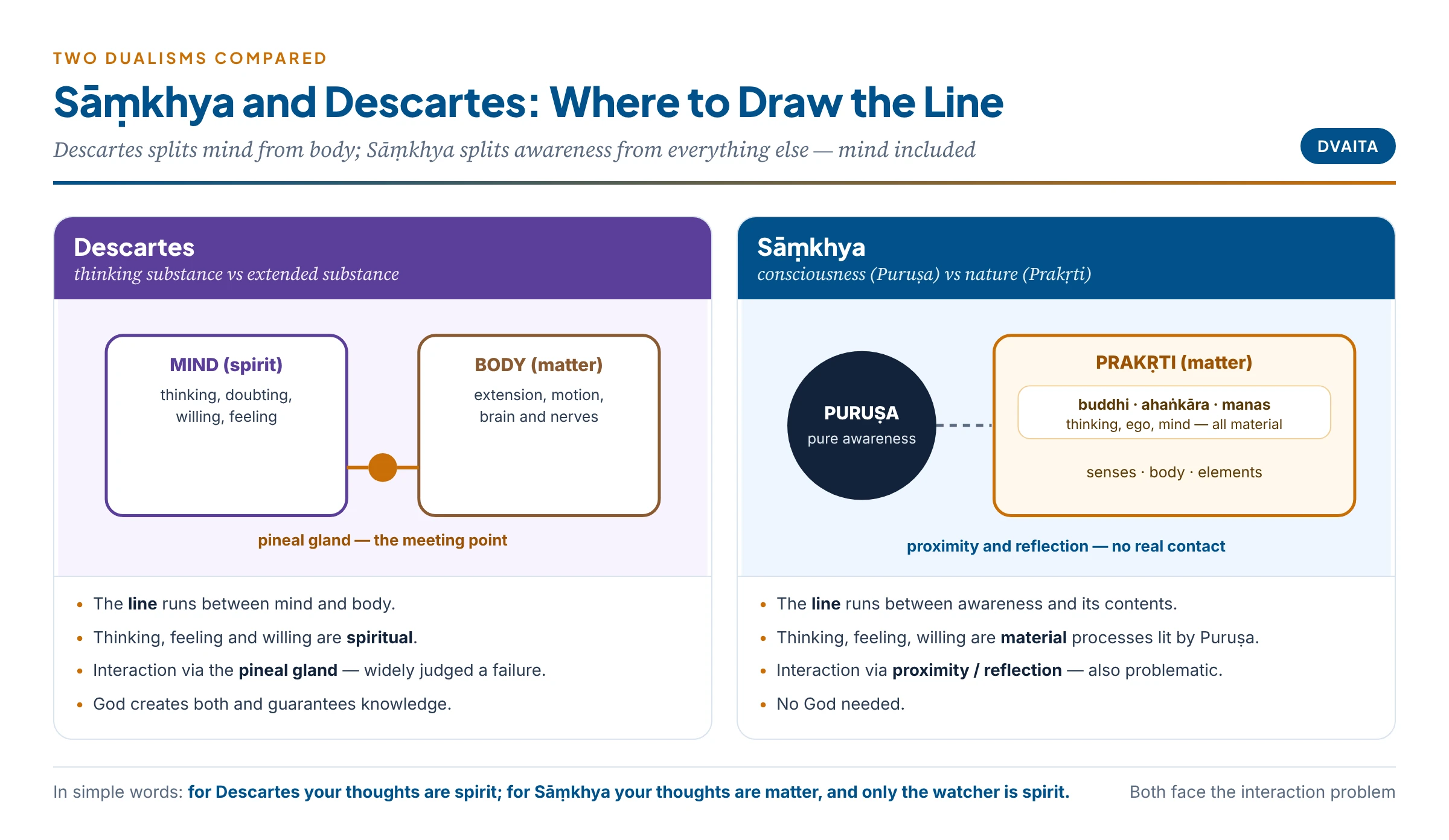
| Ultimate realities | Two kinds: Puruṣa (consciousness) and Prakṛti (matter) | Two substances: thinking and extended (plus God) | One substance (God or Nature) with infinite attributes, including thought and extension | One reality, Brahman; the world an appearance |
| Status of the mind | Material — buddhi, ahaṅkāra, manas are products of Prakṛti; only the witness is conscious | Spiritual — mind is the thinking substance | Mind is a mode of the attribute of thought | The mind (antaḥkaraṇa) is material, lit by the witness-self |
| Interaction problem | How do Puruṣa and Prakṛti relate? Contact, proximity, reflection — all problematic | How do mind and body interact? The pineal gland | Solved by parallelism: mind and body are one thing seen under two attributes | No real interaction; relation is superimposition (adhyāsa) |
| Causation | Real transformation of matter | Mechanical efficient causes; God sustains | Everything follows necessarily from the one substance | Apparent transformation of Brahman |
| God | Not needed | Creator, guarantor of truth | Identical with Nature | Īśvara is Brahman with māyā; empirical level only |
| Selves | Many | Many minds | Minds are modes of one substance | One self; many jīvas only apparent |
| Goal | Isolation (kaivalya) | Clear knowledge; freedom of will | Intellectual love of God; freedom through knowledge | Realisation of identity with Brahman |
- The lesson of the comparison. Every strict dualism — Sāṃkhya’s and Descartes’ — runs into the interaction problem. Spinoza solves it by making thought and extension two attributes of one substance; Advaita solves it by making the world an appearance of one consciousness. Both are versions of the critic’s demand that Sāṃkhya should let its two absolutes become aspects of one reality.
- A key difference from Descartes. For Descartes the mind is spiritual; for Sāṃkhya the mind is matter and only pure awareness is spiritual. Sāṃkhya’s line between consciousness and its contents is in some ways closer to modern philosophy of mind than Descartes’ line between mind and body.
Indian Connect — Key takeaways
- Śaṅkara’s critique made Sāṃkhya the touchstone for every later school: Rāmānuja, Madhva and the Nyāya theists all argue that matter needs a conscious controller.
- Advaita absorbed Sāṃkhya’s guṇas, evolution and witness-self while turning Prakṛti into māyā — the most important case of one Indian system transforming another.
- The Gītā and Yoga keep Sāṃkhya’s analysis but place Prakṛti under God — a middle way between Sāṃkhya’s dualism and Advaita’s non-dualism.
Synthesis (Siddhānta)
- Śaṅkara calls Sāṃkhya the pradhāna-malla because it is the closest and strongest rival — sharing satkāryavāda, the witness-self and liberation by knowledge, claiming Upaniṣadic support, yet teaching dualism and an unconscious first cause.
- His scriptural argument: the Upaniṣadic cause “thought“, so it is conscious Brahman, not Pradhāna.
- His rational arguments: unconscious matter cannot design, move, start or stop itself; the analogies of milk, grass, the lame and blind and the magnet fail; no purpose fits; balanced guṇas cannot be disturbed; Sāṃkhya contradicts itself.
- Against pariṇāmavāda: a real change admits a new form and an endless regress; form has no reality apart from substance — so the world is vivarta.
- Against dualism: two completely independent opposites cannot be related; there is no third principle; contact, proximity and semblance of contact all fail.
- Against plurality and kaivalya: many Puruṣas are really many jīvas; liberation is bliss, not mere painlessness.
- Hence “Vedānta is implicit in Sāṃkhya“: Prakṛti should become māyā, pariṇāma vivarta, Puruṣas jīvas, kaivalya blissful mokṣa.
- Sāṃkhya’s defence — the reality of experienced change, purpose without consciousness, the difficulty of deriving a material world from pure consciousness, and Advaita’s dependence on a Prakṛti-like māyā — shows that the debate is not one-sided.
- Contemporary relevance.
- Mind–body problem. The Sāṃkhya–Advaita debate is an Indian version of today’s choice between dualism, dual-aspect monism and idealism about consciousness.
- Design and self-organisation. Whether order needs a designer or can arise from unconscious processes is still debated — in biology (natural selection) and physics (self-organising systems) — and echoes Śaṅkara’s “bricks and mortar” argument against Sāṃkhya’s unconscious teleology.
- Philosophy of science. Sāṃkhya’s real transformation of one material stuff anticipates scientific realism; Advaita’s appearance theory anticipates views on which physical reality is a construct of consciousness.
“All modification is only a name arising from speech; the clay alone is real.” — Chāndogya Upaniṣad (the text behind Śaṅkara’s vivartavāda)
Previous Year Questions
- 2025Why does Śaṅkara consider Sāṃkhya Philosophy as his chief opponent (pradhāna malla)? Examine his arguments against Sāṃkhya Philosophy.
- 2023“If Puruṣa and Prakṛti are two completely independent realities, then no relation between the two is possible.” In the light of this statement make a brief presentation of Śaṅkara’s criticism of Sāṃkhya dualism.
- 2018How do the Advaita Vedāntins react to the Prakṛti-pariṇāmavāda of the Sāṃkhya philosophy? How do the Sāṃkhyas defend their own position in this regard? Discuss.
- 2013Evaluate the relation, if any, between Prakṛti and Puruṣa.